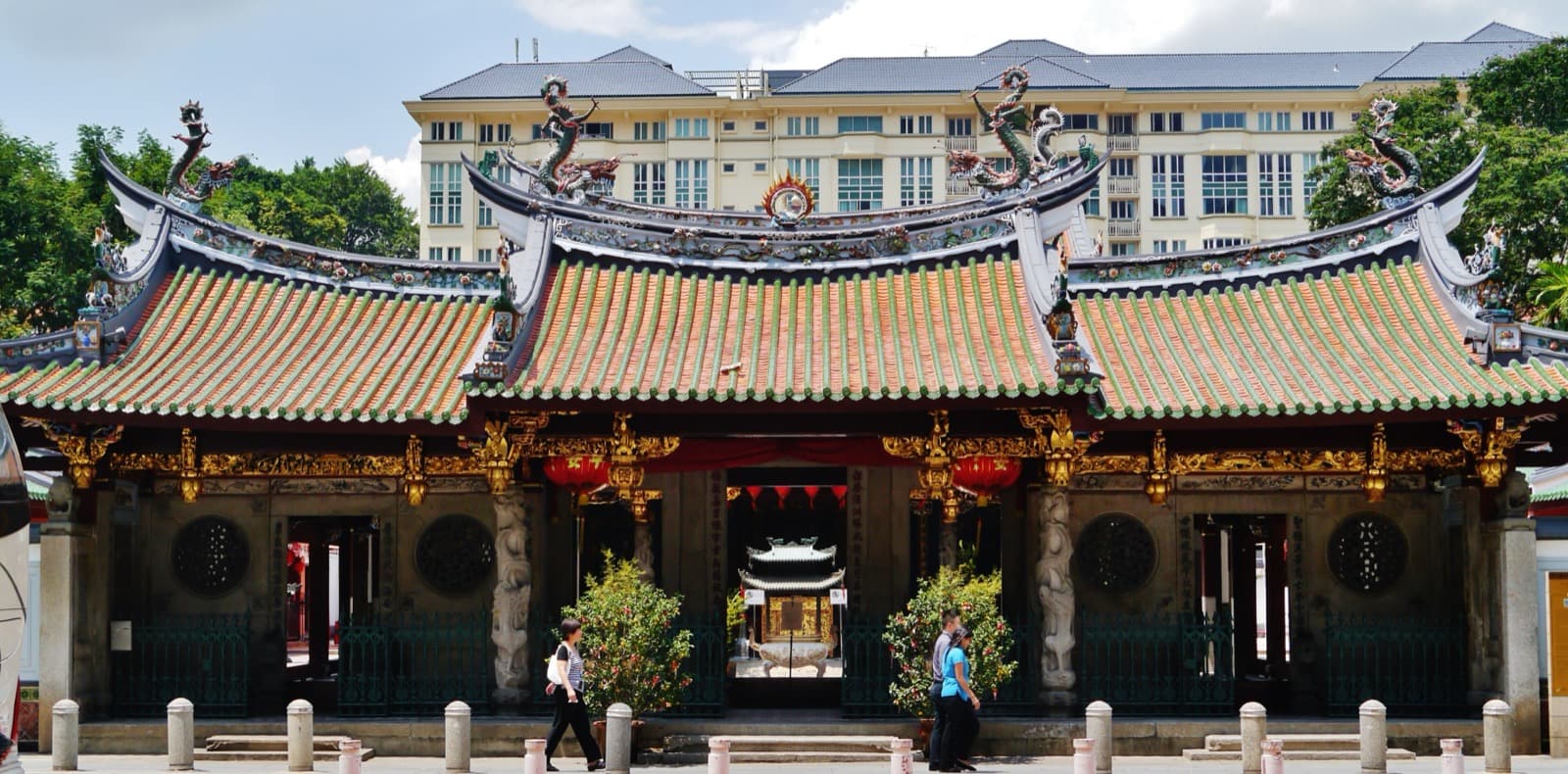
Thian Hock Keng is a temple built in thanks for a survived sea crossing, and that single fact opens the whole story of Chinatown. Immigrants who had crossed a dangerous ocean came ashore near this spot, raised a shrine to the goddess of the sea, and began organizing themselves into the plural city Singapore became. If you want to understand how newcomers landed, worshipped, and built a society here, this temple on Telok Ayer Street is where to start reading it.
A temple that faces the water that is gone
Stand on Telok Ayer Street today and you are standing on a seam of history. The name is Malay for water bay, and it is honest: this street once ran directly along Singapore's southern shoreline, and the sea came right up to it. Boats docked here. It was the main landing point for early immigrants who had crossed the water to reach the island. Everything inland of this line, all the way to the modern waterfront, is reclaimed land filled in from the late nineteenth century onward, which is why a street named for the bay now sits well away from any water. Reclamation works pushed Telok Ayer Street several streets back from the seafront, and Cecil Street, Robinson Road, and Shenton Way were later built on the new ground.
Because this shore was the immigrants' first landfall, it became the natural place for the first temples and mosques of thanksgiving, clustered within a few steps of one another. Picture newcomers stepping off crowded junks, exhausted and often frightened, onto what was then a beach. Some of the first things they built were shrines, in gratitude for surviving the crossing, facing the water that had carried them. Thian Hock Keng is the grandest of those shrines, and it still faces the direction of a sea that has since been buried under the city.
The Temple of Heavenly Happiness
Hear a stop from this walk
Buddha Tooth Relic Temple: A Tang-Style Temple of This Century
The temple sits at 158 Telok Ayer Street. Its name means the Temple of Heavenly Happiness, and it is Singapore's oldest and most important Hokkien temple. It began around 1821 as a simple joss house facing the sea, and it is dedicated to Mazu, the Chinese goddess of the sea. That dedication is the heart of the story. Immigrants who had survived a dangerous ocean crossing came here to give thanks to the deity they believed had carried them safely across. The Mazu statue was brought from China and enshrined as chief deity in a grand procession in 1840.
The building you can see was constructed between 1839 and 1842, three years of work in the southern Chinese, Fujian temple style. Here is the detail that turns a pretty building into a piece of testimony: all of the building materials were imported from China, and the carvings and decorations were crafted by artisans from Fujian province. This is quite literally a piece of the homeland reassembled on the immigrant coast. The total cost was about thirty thousand Spanish dollars, and the largest single contributor was Tan Tock Seng, the Malacca-born pioneer and philanthropist, who gave three thousand Spanish dollars. It is often said that the temple was assembled without a single nail. That claim is widely repeated, so hold it as tradition rather than as documented fact. The temple was gazetted a national monument in 1973. It is a working temple that welcomes respectful visitors, so if you step inside, keep your voice low and your dress modest, and let the incense and the carved beams speak.
Why one temple explains a whole quarter
Once you see Thian Hock Keng as a survivor's thank-offering, the rest of the walk reads itself. This was never a Chinese-only coast. A few doors along the same street stand two houses of worship built by Indian Muslims, the community once known here as the Chulias: Al-Abrar Mosque, first a thatched hut in 1827 and rebuilt in brick by 1855, and Nagore Dargah, built between 1828 and 1830 to honor a South Indian holy man. A Chinese sea-temple, a Tamil Muslim mosque, and a Muslim saint's shrine stand within a few doors of one another. That is the argument of the whole quarter, compressed into one short street.
The walk then climbs a little onto Ann Siang Hill and Club Street, where you can read how immigrant life was actually organized. These lanes were the home of Chinese clan associations, the surname and village networks that bound people from the same family or hometown. For a newcomer arriving alone, speaking a particular dialect, a clan association could mean lodging, work, a loan, a burial, and a link back to the home village. It was often the difference between sinking and surviving. Notice the five-foot way as you pass, the covered walkway required across the colonial town so pedestrians could always move under shelter.
From there the route reaches Sri Mariamman Temple on South Bridge Road, the oldest Hindu temple in Singapore, founded by Naraina Pillai, a clerk who arrived with Raffles in 1819. Its painted gopuram, the six-tiered tower crowded with deities, dates to 1925, and once a year the temple hosts Theemithi, a firewalking festival. Nearby the Buddha Tooth Relic Temple, opened in 2007 in a Tang-dynasty style, shows that belief on this old ground did not end in the nineteenth century.
The walk finishes where it must, on the honest ground floor of the immigrant city. Pagoda Street was home to opium dens and coolie lodging houses, a coolie station from the 1850s to the 1880s. The Chinatown Heritage Centre at 48 Pagoda Street recreates the cramped cubicles where whole families once shared a single partitioned space, and it does not prettify the squalor.
Walk it, do not just read it
Thian Hock Keng gives you the thesis. The route gives you the evidence, one temple, mosque, and shophouse lane at a time, over about two and a half kilometers and roughly seventy minutes, flat and unhurried. Start early, before the equatorial heat and the afternoon thunderstorms, and dress modestly so you can step inside the working places of faith along the way.
The full seven-stop audio walk carries this argument in your ear as you move, from the vanished shoreline to the coolie quarters. You can walk it with the Chinatown: The Making of Immigrant Singapore tour, and find more on the city page for Singapore.
Sources
- Thian Hock Keng Temple, Wikipedia. Construction dates, Mazu dedication, Fujian materials, and national monument status.
- Thian Hock Keng, Roots.gov.sg (National Heritage Board). Official record of Singapore's oldest Hokkien temple, the 1840 procession, the thirty thousand Spanish dollar cost, and Tan Tock Seng's three thousand dollar contribution.
- Telok Ayer, Roots.gov.sg. Account of the vanished shoreline, the reclamation that pushed the street inland, and Telok Ayer's role as the first immigrant landfall.
- Sri Mariamman Temple, Wikipedia. Founding by Naraina Pillai, the six-tiered 1925 gopuram, and its standing as the oldest Hindu temple in Singapore.
- Chinatown Heritage Centre, chinatown.sg. The restored Pagoda Street shophouses at 48 Pagoda Street recreating coolie-era living quarters.
Ready to experience it?
Chinatown: The Making of Immigrant Singapore
70 min · 2.4 km · easy
More from Singapore
Explore more at your own pace.
One Day in Singapore: A Walkable Morning-to-Evening Itinerary
Reading Singapore Neighbourhood by Neighbourhood: From the Founding River to the Supertrees
Istana Kampong Glam: The Sultan's Palace That Predates Colonial Singapore
Marina Bay Sands and the Skyline Singapore Built on Reclaimed Sea
Sri Veeramakaliamman Temple: The Mother Little India's Labourers Raised