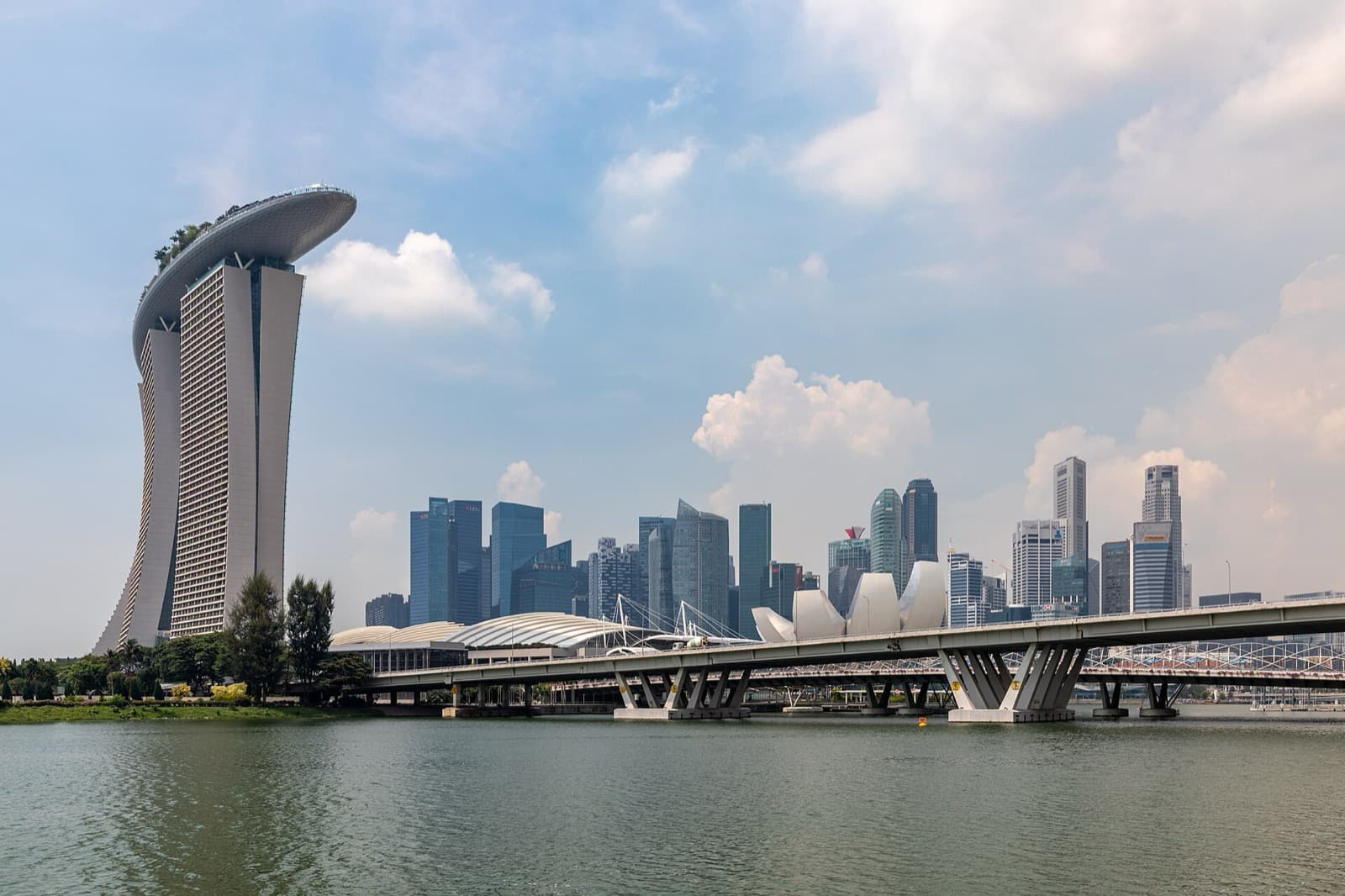
Marina Bay Sands stands on about sixteen hectares of ground reclaimed from the strait, at the edge of a bay Singapore dammed into being in 2008, and the fastest way to read the whole waterfront honestly is to read that building as engineering rather than as spectacle. Three hotel towers rise together and are joined across their tops by a ship-like skyway. Most visitors photograph the ship and move on. If you instead ask how, why, and on what ground it stands, the entire composed skyline around the bay becomes legible: a young, wealthy city-state assembling icons, all at once, on land it lifted out of the sea.
The ship in the sky, and the ground beneath it
The building is the work of the Israeli-Canadian architect Moshe Safdie. It had a soft opening in April 2010 and a grand opening in February 2011. The three towers are crowned by the Sands SkyPark, a skyway roughly three hundred and forty metres long sitting about two hundred metres above the ground, carrying an observation deck and a long infinity pool. Below sit a casino, a convention centre, a shopping mall, and, next door, a museum shaped like a flower.
Two facts anchor the building honestly, and both matter more than the photograph. The first is cost. Marina Bay Sands was built for about eight billion Singapore dollars, and with the land it ranks among the most expensive standalone buildings of its kind ever raised. Sources place the all-in figure near six billion US dollars, not the eight billion US dollars sometimes claimed. Be precise about the currency and the resort stays remarkable without the exaggeration. (On the tower height, sources also split between fifty-five and fifty-seven storeys, so it is fair to say only that the towers pass fifty storeys and the SkyPark caps them.)
The second fact is the ground. Those sixteen hectares were open sea within living memory. Beginning in the 1970s the state pushed Singapore's shoreline out into the strait, and in 2008 it dammed the river mouth so a salt estuary became a freshwater reservoir. So when you frame the ship in the sky, remember the scaffolding beneath the spectacle. The building is a deliberate statement raised on invented ground, at the centre of a bay that did not exist as fresh water until a generation ago.
Every stop is a climate decision
Hear a stop from this walk
Marina Bay Sands: A Ship on Reclaimed Ground
Once you read the Sands this way, the rest of the route stops being a list of landmarks and becomes a sequence of engineering answers to the same tropical problem. Singapore sits almost on the equator. Heat, humidity, and sudden downpours are the design constraints, and the best buildings on this bay wear their solutions on the outside.
The Esplanade Theatres, the spiny domes the city nicknamed the durians, are wrapped in more than seven thousand triangular aluminium sunshades. That skin is not ornament. Glass domes in this heat would behave like greenhouses, so the shades, angled and layered over the shells, are a climate device. Every spike is a decision. The centre opened on the twelfth of October 2002, designed by DP Architects of Singapore with Michael Wilford and Partners of London, and it took a while for the city to warm to it. One early critic likened the design to two copulating aardvarks before the durian nickname stuck.
The same logic runs through the ArtScience Museum beside the Sands, also a Safdie building. Shaped as a white lotus with ten petals, and read equally as the welcoming hand of Singapore, its form does real work. Each petal-tip carries a skylight that draws daylight into the galleries. Its concave roof is a rainwater harvester: the afternoon downpours are gathered and channelled about thirty-five metres down through a central opening into an interior pond, then recycled for use inside. It opened in February 2011, calling itself the world's first ArtScience museum, and it is Singapore's largest private museum. A flower that drinks the rain is exactly the kind of object this bay keeps producing.
The bridges make the argument visible
Two pedestrian crossings turn the composed skyline into something you can stand inside. The Jubilee Bridge, a low curving walkway two hundred and twenty metres long, is the single best vantage on the whole route. From its curve the reclaimed bay reads as one planned picture: the towers and rooftop of Marina Bay Sands, the white lotus of the museum, the steel spiral of the Helix Bridge, and, beyond, the Supertree Grove. The bridge itself carries a quiet story. Prime Minister Lee Kuan Yew proposed it in 2004 after noticing pedestrians had too far to walk to cross at the neighbouring Esplanade Bridge. It opened on the twenty-ninth of March 2015 for the Golden Jubilee, the fiftieth anniversary of independence, but it opened early, not for celebration: Lee had died that same month, and the walkway he proposed first served as a path for the crowds attending his state funeral.
The Helix Bridge is the turn in the walk. Two hundred and eighty metres of duplex stainless steel, about six hundred and fifty tonnes of it, wound into a DNA double helix, with lit letters c, g, a, and t glowing along it at night. Designed by Australia's Cox Architecture with engineers Arup and Singapore's Architects sixty-one, chosen by the Urban Redevelopment Authority in 2006 from thirty-six competing bids, it opened on the twenty-fourth of April 2010 and won a world architecture award as the best transport building that year. Crossing it, you pass from the older Marina Centre shore to the reclaimed eastern ground in front of the Sands. Everything beyond stands on land taken from the strait.
Where the walk begins and ends
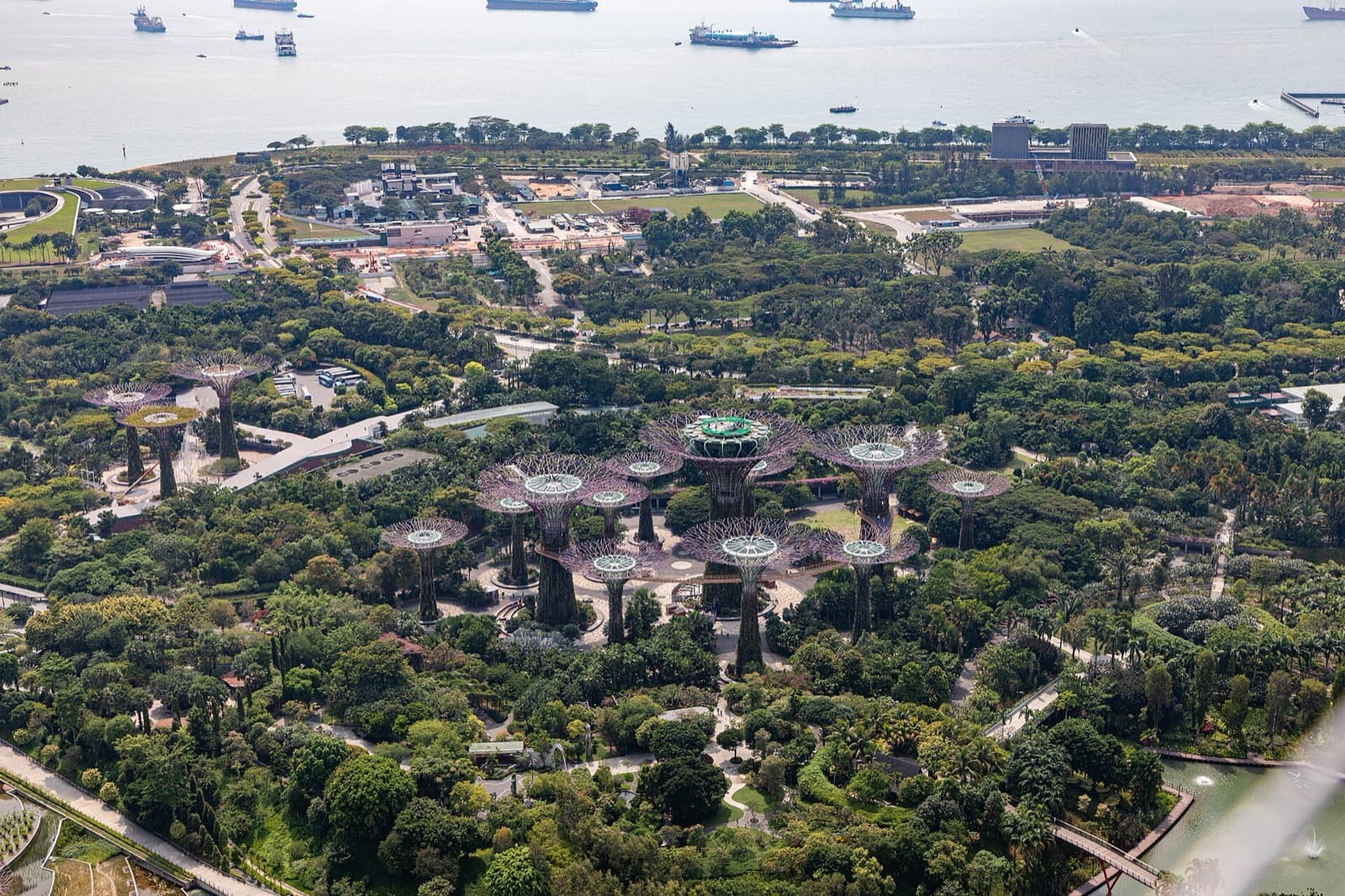
The route runs seven stops over about four and a half kilometres, close to two hours entirely on foot along the promenade. It opens at the Merlion, the invented emblem designed in 1964 by the British zoologist Alec Fraser-Brunner for the tourist board and unveiled in 1972: a made symbol fusing the lion-city legend of Singapura with the memory of the old fishing port of Temasek. It closes among the eighteen man-made Supertrees of Gardens by the Bay, which opened its Bay South garden on the twenty-ninth of June 2012 across about a hundred hectares of reclaimed land, some trees clad in solar cells, glowing each night under the Garden Rhapsody show. From the invented lion at the river mouth to the artificial forest on made land, the bay is a single argument that engineering and imagination belong together.
To plan the full loop and the neighbouring quarters, browse Singapore walking tours, or start from the city page for Singapore. Walk it at dawn for empty promenades, or in late afternoon to finish under the lit towers.
Sources
- Marina Bay Sands, Wikipedia. Architect, opening dates, SkyPark dimensions, cost and reclamation details.
- Safdie Architects, Marina Bay Sands Hotel and SkyPark project page. Design intent and skyway description.
- Helix Bridge, Wikipedia; Cox Architecture project page. Length, materials, competition, and award.
- Jubilee Bridge, Singapore, Wikipedia; Roots (National Heritage Board). Length, Golden Jubilee context, and Lee Kuan Yew connection.
- Gardens by the Bay, Wikipedia; official Supertree Grove article. Supertree count, height range, and opening date.
Ready to experience it?
Marina Bay: The Skyline Built on Reclaimed Sea
110 min · 4.4 km · easy
More from Singapore
Explore more at your own pace.
One Day in Singapore: A Walkable Morning-to-Evening Itinerary
Reading Singapore Neighbourhood by Neighbourhood: From the Founding River to the Supertrees
Istana Kampong Glam: The Sultan's Palace That Predates Colonial Singapore
Sri Veeramakaliamman Temple: The Mother Little India's Labourers Raised
The National Gallery Singapore: Where an Empire Surrendered and a Nation Was Born