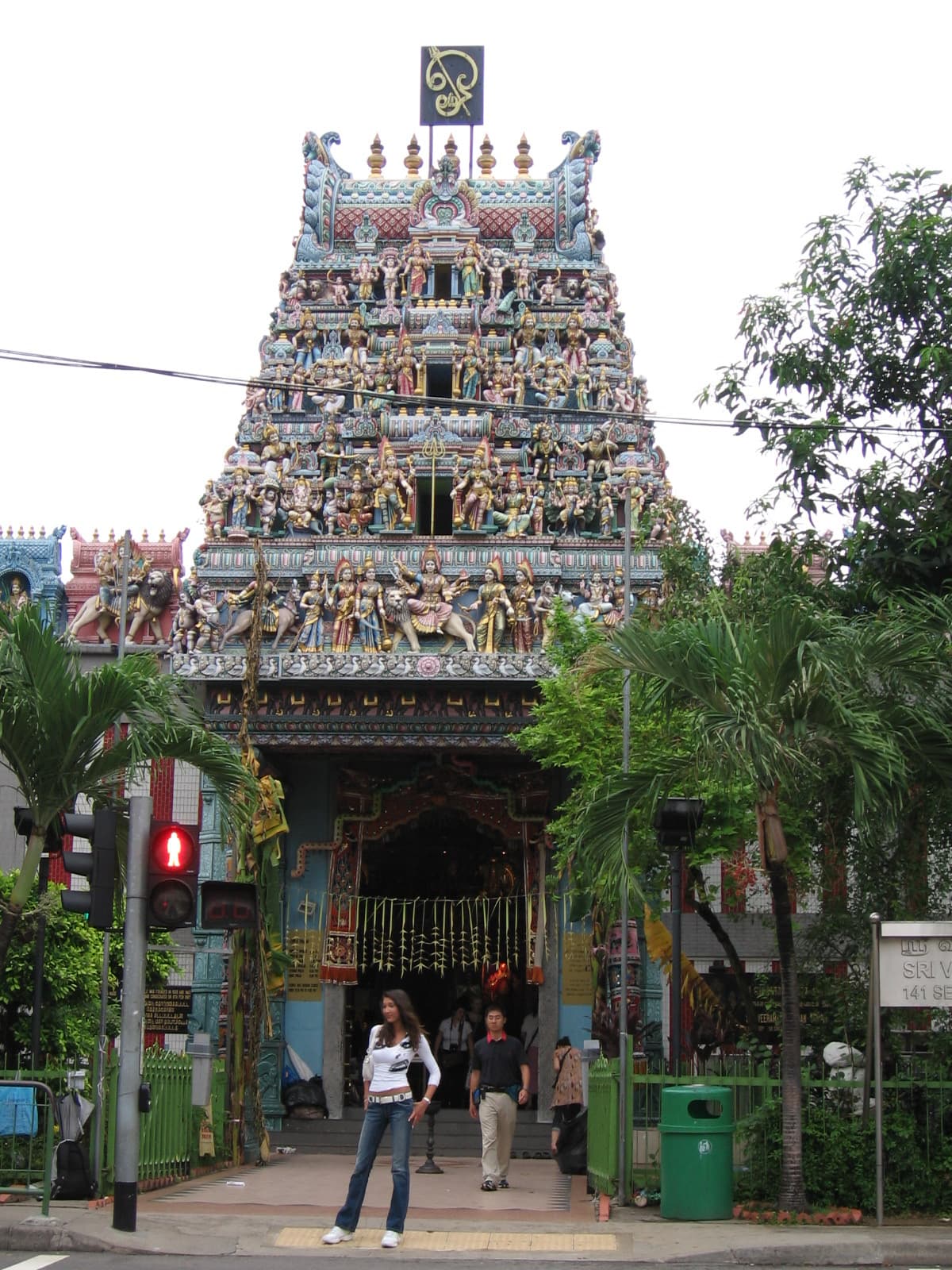
Sri Veeramakaliamman Temple was raised by labourers, not by rich patrons, and that single fact is the key to reading the whole of Little India. Stand before its front tower on Serangoon Road and you are looking at a shrine to Kali, the fierce mother goddess, built by the Tamil and Bengali workers who dug the government lime pits and laid the bricks of the quarter around it. The temple holds two truths at once, the wall of colour above you and the hard immigrant labour beneath it, and those two truths are exactly what the seven-stop walk up Serangoon Road is built to show you.
A shrine of the lime village
A shrine stood on this site from about 1855, raised by Tamil workers from the nearby government lime pits. They called it the temple of the lime village, a name that tells you plainly who they were and what they did. The temple proper was built by Bengali labourers in 1881, in the South Indian Tamil, or Dravidian, style, even though its builders came from Bengal. Hold that detail for a moment. Men from one corner of the subcontinent built, in a tropical port thousands of miles from home, a temple in the architectural grammar of another corner of it, for a goddess they carried in common. A major restoration in 1908 brought a Kali statue from South India.
Look up at the rajagopuram, the front tower over the gateway. It rises about eighteen metres and carries roughly six hundred hand-painted stucco deities, a crowded, saturated wall of figures against the sky. It is the most alive shrine on the road, worshipped in daily, and one of the most revealing, because everything the walk wants to tell you is compressed into it. This is a conserved building within the Little India Conservation Area. Unlike the mosque and the great Vishnu temple further north, it is not a gazetted national monument, which makes it, if anything, more honest: a working temple that earned its place through use, not designation.
There is one more layer worth carrying with you. During the Japanese Occupation, from 1942 to 1945, the temple sheltered and fed people with nowhere else to go. A shrine the labourers built became, in the worst years, a refuge for the desperate. That is the temperament of this place, and of the quarter it anchors.
Why the anchor opens the whole quarter
Hear a stop from this walk
Serangoon Road: The Spine of the Quarter
Little India is the most living of Singapore's old ethnic quarters, a piece of the subcontinent transplanted whole onto a tropical island. Indians came from the very first colonial year, after Stamford Raffles arrived on the twenty-ninth of January, 1819, and the East India Company concluded its treaty with the Temenggong Abdul Rahman and Sultan Hussein Shah days later, on the sixth of February. Some came as merchants and clerks. Many more came as indentured labourers and transported convicts, the people who cleared the land, built Serangoon Road, and worked the lime pits, brick kilns and cattle yards that once stood here. The abundance you smell now, jasmine, marigold, incense and cooking spice, grew directly out of that hard, often deadly beginning.
The temple is where you feel both halves at once, and from there the walk fans out to trace them across the quarter. It begins south at the Tekka Centre, the covered wet market and hawker floor that is the belly of Little India, where the sacks of turmeric and chilli and the crush of shoppers feed the whole neighbourhood. It moves through the Little India Arcade, a cluster of 1913 shophouses that packs garlands, bangles, sarees, spices and sweets into a single block, complete with the five-foot way, the covered walkway that shades you from sun and rain.
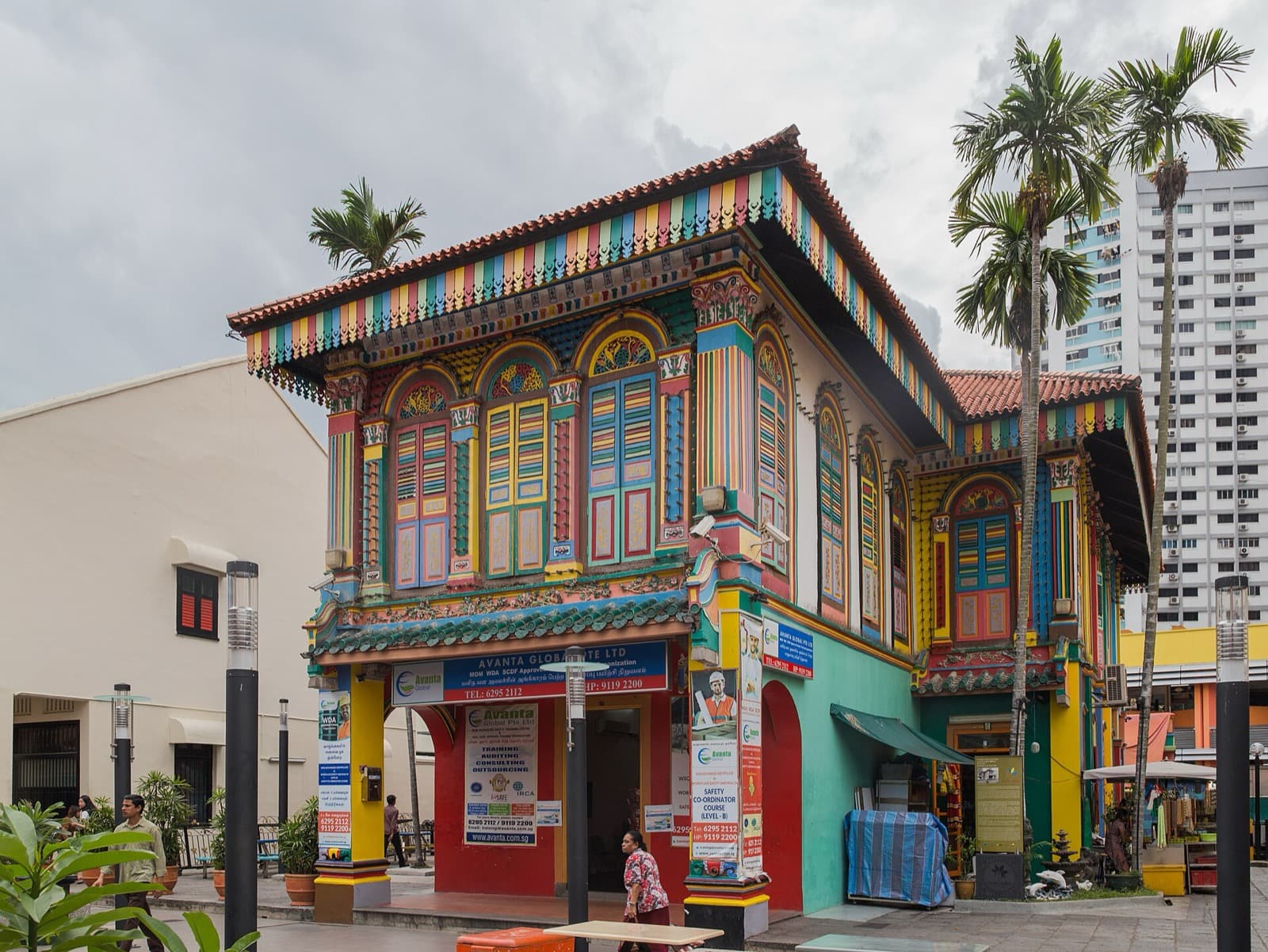
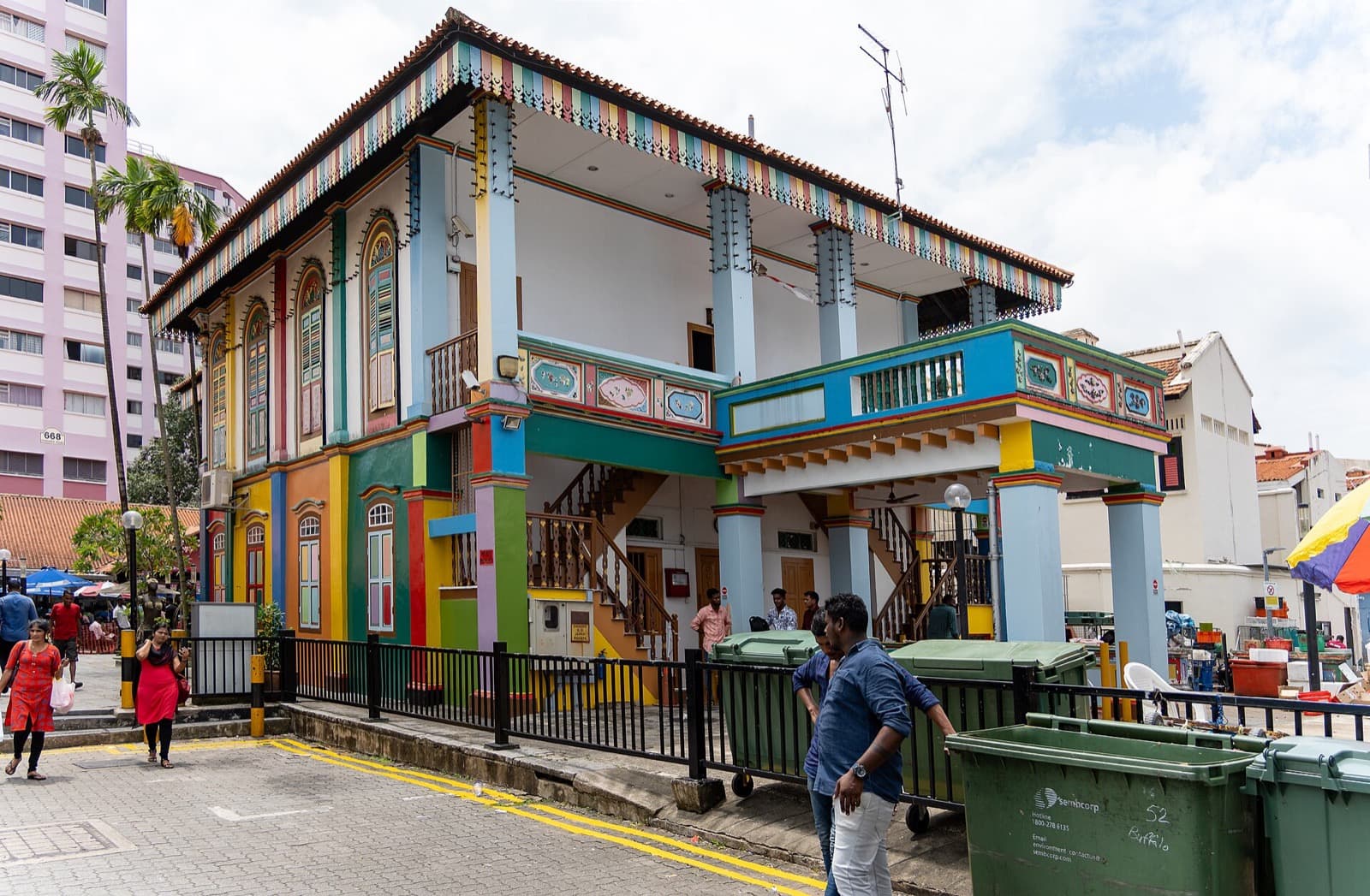
Then the story deliberately complicates itself. Just off Serangoon Road stands the House of Tan Teng Niah, a Chinese villa built in 1900 for a towkay who ran sweet-making factories along the road, now painted in brilliant rainbow colours and one of the most photographed spots in the quarter. It is proof the neighbourhoods here always overlapped. So is the Abdul Gafoor Mosque on Dunlop Street, completed in 1910 and gazetted a national monument on the fifth of July, 1979, founded by a Tamil Muslim chief clerk. Its entrance carries a sunburst that works like a sundial, its twenty-five rays inscribed in Arabic with the names of the twenty-five prophets of the Qur'an, from Adam to Muhammad. Little India was never purely Indian, and never purely Hindu.
From the mother goddess to the god of the road's end
The walk climbs to its climax at Sri Srinivasa Perumal Temple, at the northern end of Serangoon Road, dedicated to Vishnu and among the oldest Hindu temples in Singapore, dating to 1855 on land acquired from the East India Company in 1851. Its five-tiered gopuram rises about twenty metres and was added in 1966, donated by the philanthropist P. Govindasamy Pillai, who once ran a small spice and saree shop back near the arcade. That gate is the starting point of the annual Thaipusam procession, when devotees carry the kavadi, a physical burden borne on foot in fulfilment of a solemn vow, across the city to the Chettiar Temple on Tank Road, honouring Lord Murugan. It is an act of living faith and endurance, not a spectacle.
Notice the arc. You begin at a fierce mother goddess whose shrine the labourers built for themselves, and you end at a god whose gate a merchant funded and from which the quarter's greatest act of public devotion sets out each year. The Kali temple is the private, ground-level heart of the story. The Vishnu temple is its public climax. Walk between them and you read the whole of Little India in order.
The walk ends back on Serangoon Road itself, the spine that holds everything together, best at dusk when the gold shops light up and garland-makers work their doorways. Come early to beat the equatorial heat, dress modestly with covered legs and shoulders so you can step into the temples and the mosque with bare feet, and treat every one of them as the working place of worship it is. If you want the wider map of the city first, browse Singapore walking tours or the Singapore city page, then let the temple of the lime village lead you up the road.
Sources
- Sri Veeramakaliamman Temple, Roots.gov.sg (Singapore National Heritage Board): the shrine's 1855 origin, 1881 construction by Bengali labourers, and Dravidian style.
- Sri Veeramakaliamman Temple, Wikipedia: rajagopuram height and stucco figures, 1908 restoration, and Japanese Occupation shelter.
- Little India: A Cultural and Historical Precinct, Roots.gov.sg: the quarter's origin in lime pits, brick kilns and immigrant labour along Serangoon Road.
- Sri Srinivasa Perumal Temple, Roots.gov.sg: national-monument status, the 1966 gopuram donated by P. Govindasamy Pillai, and the Thaipusam procession start point.
- Serangoon Road, Singapore Infopedia (National Library Board): the road's history, the lime-village names and the cattle trade that shaped the area.
Ready to experience it?
Little India: The Scent of the Subcontinent
85 min · 3.6 km · easy
More from Singapore
Explore more at your own pace.
One Day in Singapore: A Walkable Morning-to-Evening Itinerary
Reading Singapore Neighbourhood by Neighbourhood: From the Founding River to the Supertrees
Istana Kampong Glam: The Sultan's Palace That Predates Colonial Singapore
Marina Bay Sands and the Skyline Singapore Built on Reclaimed Sea
The National Gallery Singapore: Where an Empire Surrendered and a Nation Was Born