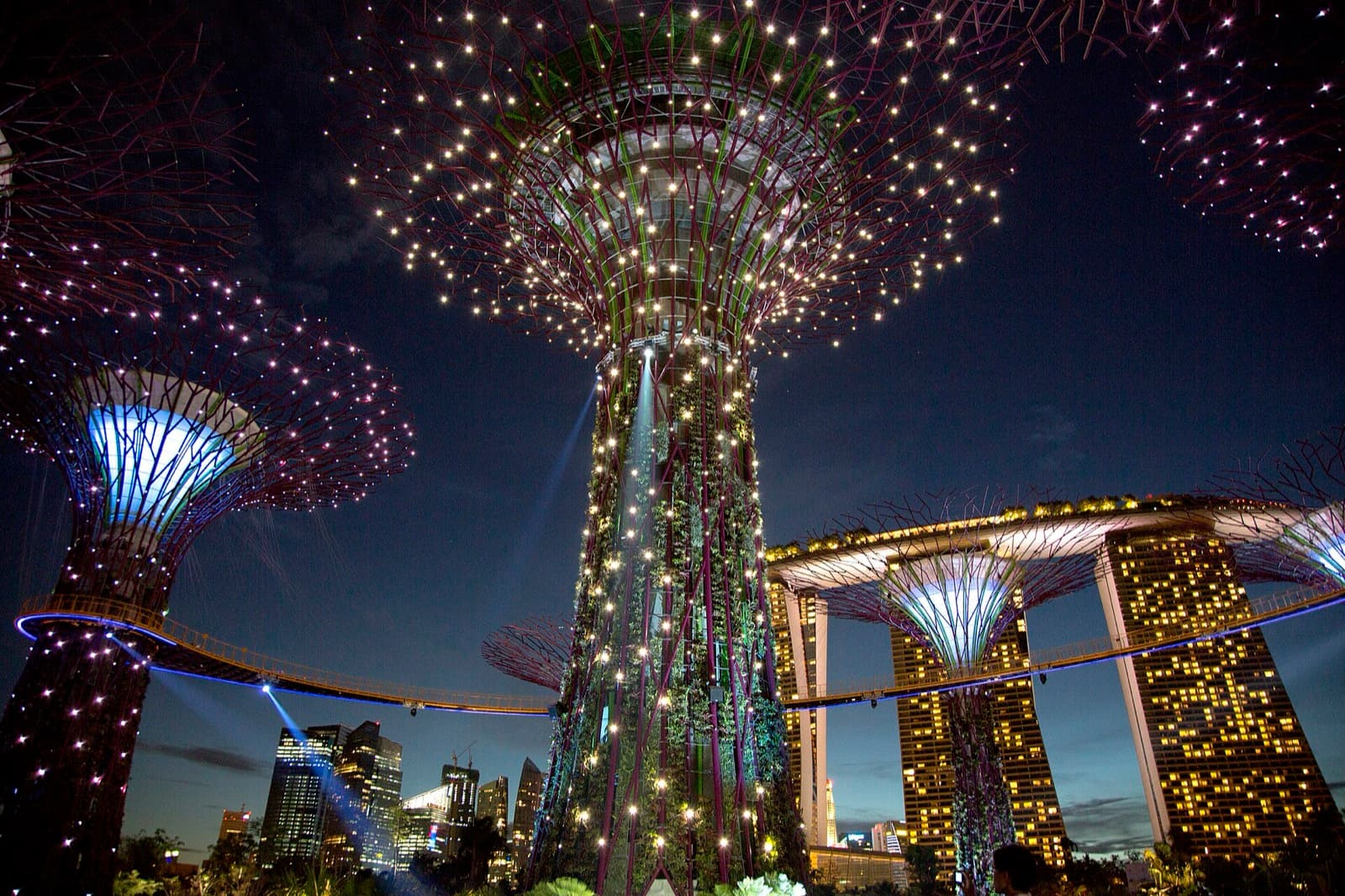
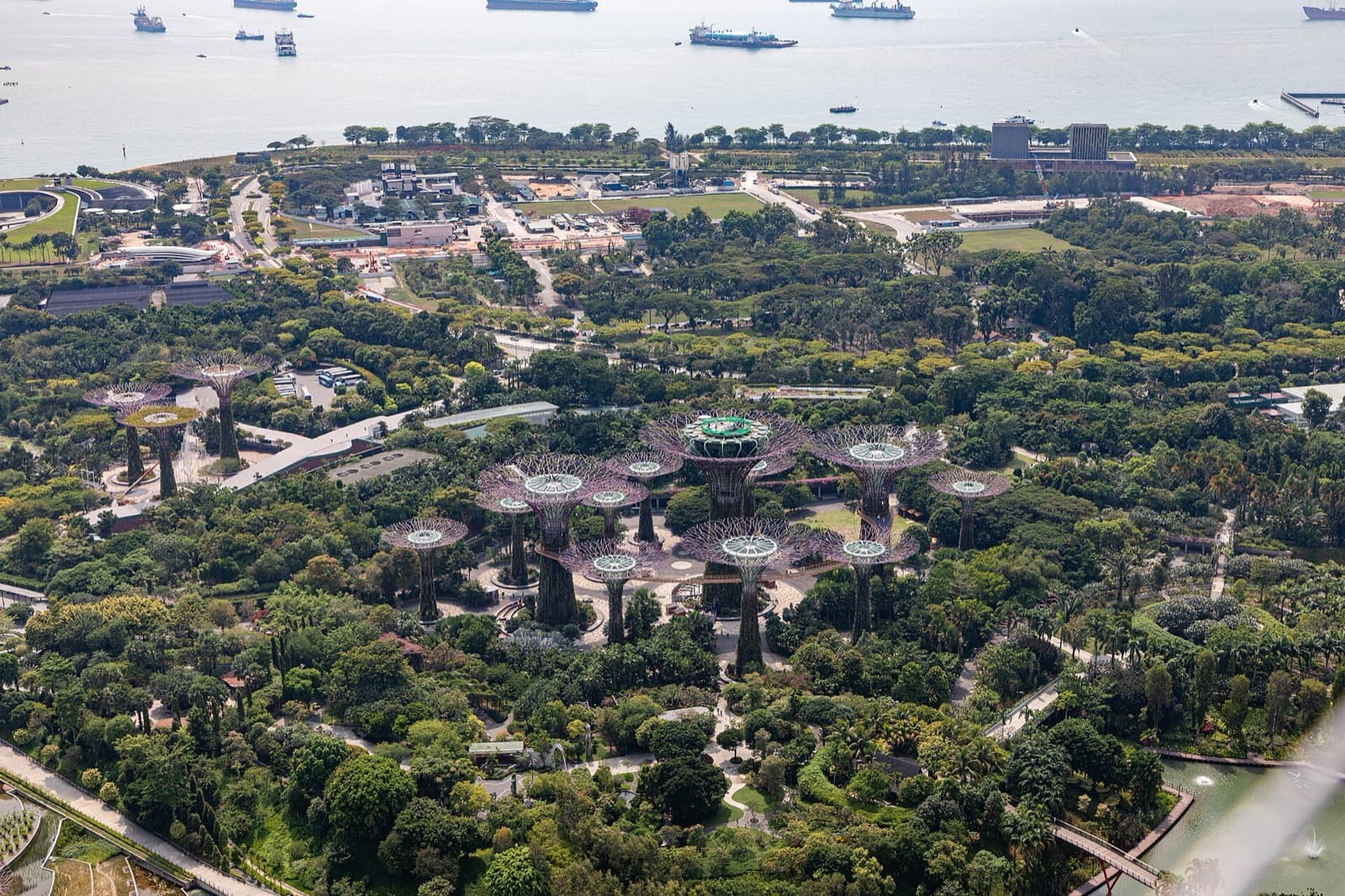
Singapore built the Supertree Grove as working infrastructure disguised as a garden: eighteen steel-and-plant structures between twenty-five and fifty metres tall, some fitted with solar cells, standing on ground the city reclaimed from the strait. Stand beneath them and the first thing to understand is that these are not sculptures pretending to be trees. They are engineered systems doing real jobs, planted in a hundred hectares of made land along the eastern shore of a bay that was open sea within living memory. The grove is the closing statement of a waterfront Singapore composed for itself, and reading it as engineering, not decoration, is the key to seeing it clearly.
What a Supertree Actually Is
A Supertree is a vertical garden wrapped around a structural spine. Each one is a tall trunk of reinforced concrete and steel, ringed by a planting canopy that supports living ferns, orchids, bromeliads, and climbers across its surface. The eighteen structures in the grove rise between twenty-five and fifty metres, roughly the height of a nine-to-sixteen-storey building, which is why they read as a canopy from below and as a skyline in their own right from a distance.
The word "tree" is doing careful work here. A real tree pulls water up from roots, spreads leaves to catch light, and releases moisture into the air. The Supertrees borrow that logic and rebuild it in steel. The trunk carries the structural load and threads services up through its core. The canopy spreads outward to hold the planting and to shade the ground. And the whole form gives Gardens by the Bay a vertical dimension that ground-level planting alone could never produce. In a garden built on flat reclaimed land, height had to be engineered in.
The Systems Inside the Spectacle
Hear a stop from this walk
Marina Bay Sands: A Ship on Reclaimed Ground
The detail worth pausing on is that some of the Supertrees are fitted with photovoltaic cells that gather solar energy from the equatorial sun. That is the honest heart of the design. Singapore sits almost on the equator, where sunlight is abundant and predictable, and the grove was conceived to put that resource to work rather than simply stand under it. The trees collect energy up in the air where nothing shades them.
Two of the larger structures are linked, high above the ground, by an elevated walkway called the OCBC Skyway. Crossing it turns the grove from something you look up at into something you move through, letting you walk among the canopies at a height ordinary gardens never reach. This is the same instinct that runs through the whole of Marina Bay: take a flat, reclaimed surface and build usable space upward.
The grove does not stand alone. Beyond it sit two cooled conservatories, the Flower Dome and the Cloud Forest. The Cloud Forest holds an indoor mountain wrapped in a thirty-five-metre waterfall, an entire simulated highland climate raised inside glass in a country that has no highlands. These glasshouses and the Supertrees belong to one argument: that a tropical city can manufacture the environments it lacks, cooling air here, harvesting sun there, and stacking gardens into the sky where land runs short.
Every evening the grove performs. A light-and-sound show called the Garden Rhapsody plays over the structures, and the man-made trees glow against the dark. It is easy to file this under entertainment and move on. But the show only works because the trees were built as armatures capable of carrying lighting, sound, and plants all at once. The spectacle is a use of the infrastructure, not the reason it exists.
The Ground Beneath the Grove
Here is the fact that reframes everything. Gardens by the Bay opened its Bay South garden to the public on the twenty-ninth of June two thousand and twelve, spread across about a hundred hectares of reclaimed land along the eastern shore of the bay. This is not a garden that was preserved. It is a garden that was placed, deliberately, on ground the state lifted out of the sea.
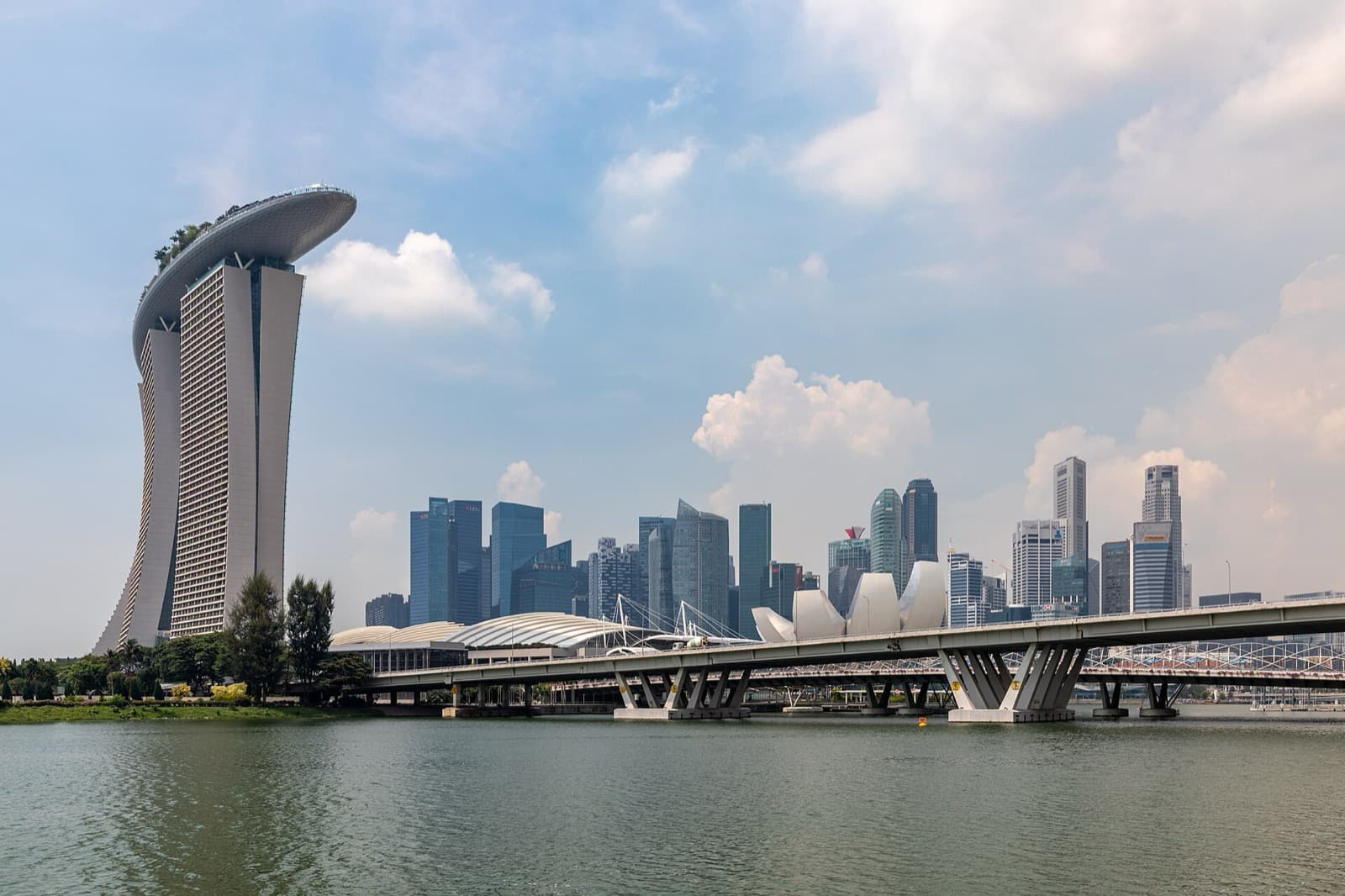
That reclaimed ground is the same story told all the way around Marina Bay. Beginning in the nineteen seventies, Singapore pushed its shoreline out into the strait. In two thousand and eight it dammed the river mouth, turning a salt estuary into a freshwater reservoir and closing the bay into being. Marina Bay Sands, the ArtScience Museum, the promenade, and the Supertree Grove all stand on land and around water that a single generation engineered. The grove is the greenest expression of that project, but it rests on exactly the same made foundation as the towers.
So the Supertrees carry a double meaning. Read as a garden, they are the city's vision of a green future, a canopy of glowing artificial trees rising over living plants. Read as engineering, they are a demonstration that when a country has to invent its own land, it can also invent its own forest, complete with solar collection and elevated walkways, and make the invention beautiful. Both readings are true at once, and standing in the grove you feel the seam between them.
The One Thing to Understand Standing Here
If you take a single idea away, let it be this: the Supertree Grove is not nature dressed up as architecture, and it is not architecture pretending to be nature. It is a working landscape that admits it was designed. The solar cells, the OCBC Skyway, the hundred hectares of reclaimed ground, the conservatories cooling manufactured climates nearby, all of it says the same thing plainly. Singapore does not hide the fact that it composed this place. It shows you the machinery and asks you to find it impressive anyway.
That candour is the reward of walking the whole waterfront rather than photographing the grove alone. The Supertrees make far more sense as the last stop on a route that begins at the invented Merlion, reads the composed skyline from the low curve of the Jubilee Bridge, and crosses the DNA strand of the Helix Bridge to the reclaimed eastern shore. Each stop is a piece of the same argument, and the grove is where the argument turns green.
You can walk the full loop, the Merlion to the Supertree Grove, on our self-guided Marina Bay audio tour, roughly four and a half kilometres along the promenade that rings the bay. Start from the city page for Singapore to find it alongside the neighbouring quarters. Arrive at the grove in the late afternoon, and you will finish among the lit Supertrees as the Garden Rhapsody begins.
Sources
- Gardens by the Bay, official Supertree Grove and Supertree Observatory resource. Primary description of the grove, its structures, and the OCBC Skyway.
- Gardens by the Bay entry, Wikipedia. Opening date of the Bay South garden, hectarage, conservatories including the Flower Dome and Cloud Forest.
- Roamer tour transcript, "Marina Bay: The Skyline Built on Reclaimed Sea." Fact-audited narration for the Supertree Grove and the surrounding reclaimed-land skyline.
- Urban Redevelopment Authority of Singapore, Marina Bay land reclamation and Marina Barrage background. Context for the 1970s reclamation and the 2008 damming of the bay.
Ready to experience it?
Marina Bay: The Skyline Built on Reclaimed Sea
110 min · 4.4 km · easy
More from Singapore
Explore more at your own pace.
One Day in Singapore: A Walkable Morning-to-Evening Itinerary
Reading Singapore Neighbourhood by Neighbourhood: From the Founding River to the Supertrees
Istana Kampong Glam: The Sultan's Palace That Predates Colonial Singapore
Marina Bay Sands and the Skyline Singapore Built on Reclaimed Sea
Sri Veeramakaliamman Temple: The Mother Little India's Labourers Raised