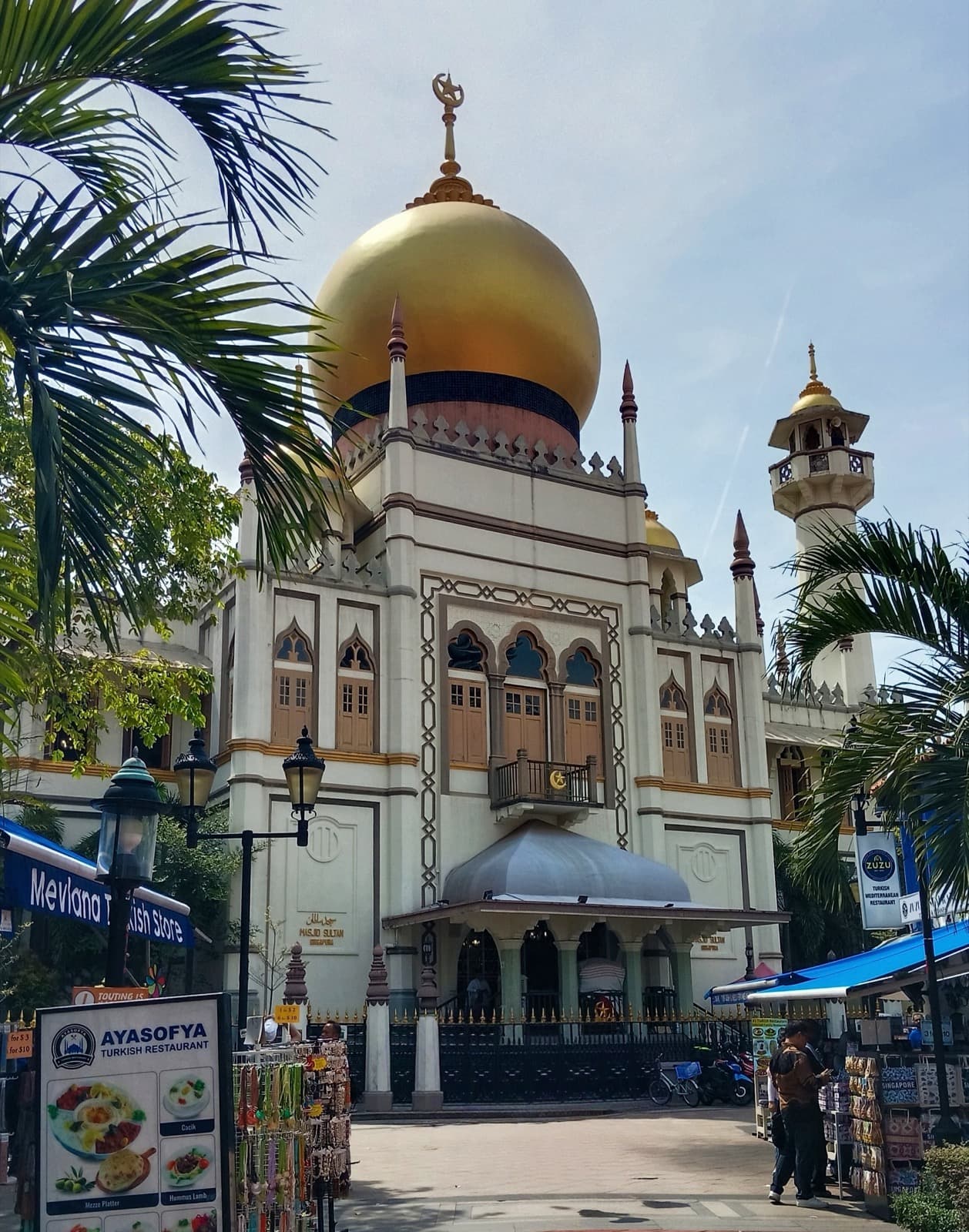
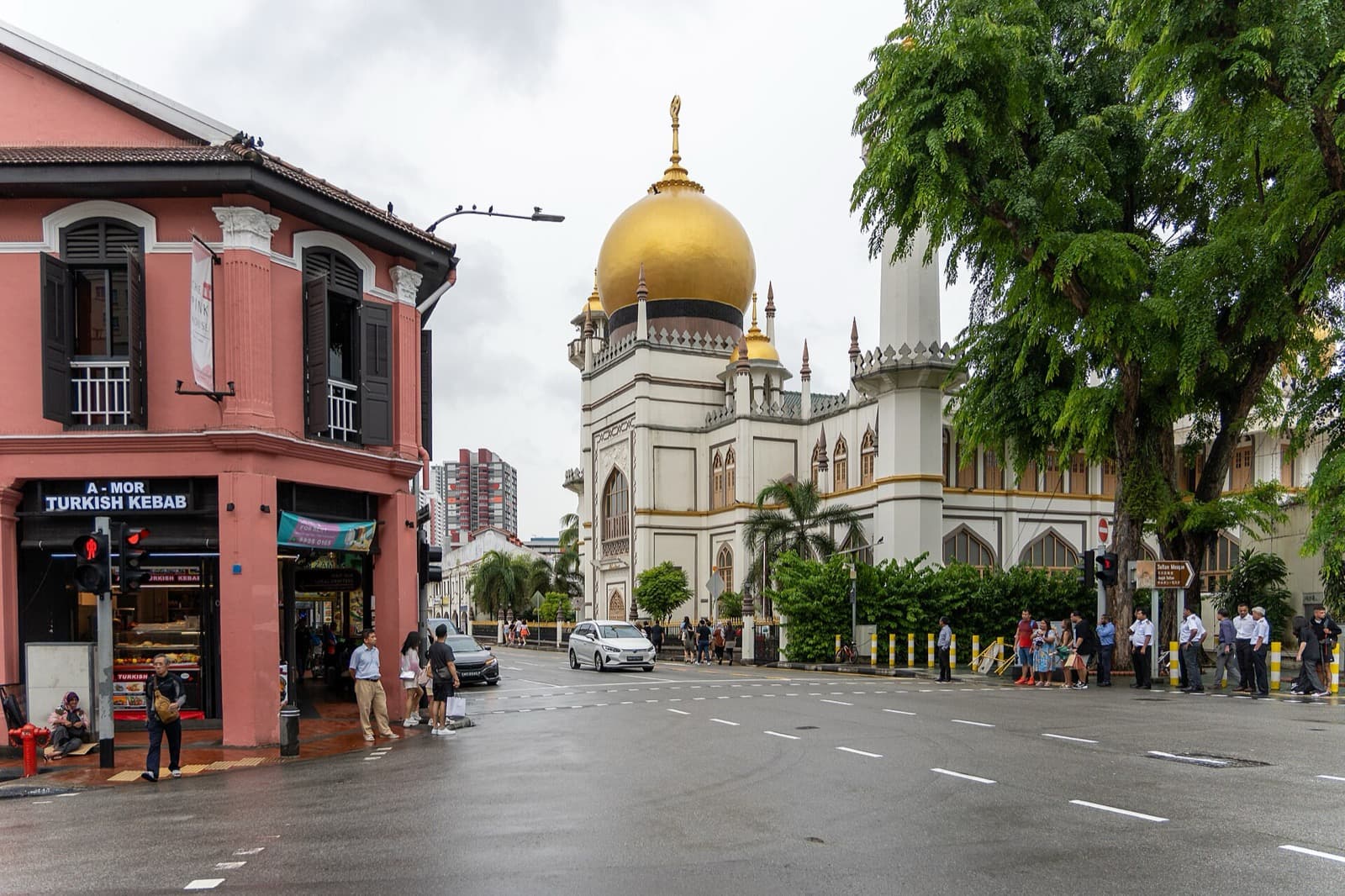
Stand in front of the Sultan Mosque in Kampong Glam and the first thing you notice is the golden dome. The second thing, if someone points it out, is stranger and more human: a dark belt runs around the base of each dome, and that belt is made from the ends of glass bottles. They were collected and donated by the poor, so that people with nothing to give could still share in building the mosque. That detail, documented and not legend, tells you almost everything about why this building matters. The Sultan Mosque was the royal mosque of a Malay sultanate that already had rulers here before the colonial port existed, and it was built by the whole community, the wealthy and the destitute alike.
A mosque older than the colonial city
The story starts with a name most visitors to Singapore know from streets and hotels: Raffles. But before that name was written across the island, there were rulers here. In eighteen nineteen the treaty Sir Stamford Raffles signed with Sultan Hussein Shah of Johor recognized him as sultan and opened the island to the British East India Company, and in the years that followed the ground of Kampong Glam was set aside for the sultan and his household. Around his palace grew a village of the Malay world, a royal and religious capital in miniature. The Sultan Mosque was its beating heart.
The first mosque rose on this spot around eighteen twenty-four to eighteen twenty-six, as the royal mosque of Sultan Hussein Shah. Sir Stamford Raffles, acting for the East India Company, pledged three thousand Spanish dollars toward its building fund. It is worth being clear-eyed about what that was: a colonial gesture inside an imperial system, not charity from nowhere. What it did was seat the mosque firmly beside the sultan's palace, binding faith and royalty into one small quarter. When you understand that, the neighborhood stops reading as a pretty cafe district and starts reading as what it actually is, the seat of Malay Muslim Singapore.
The building you actually see
Hear a stop from this walk
Hajjah Fatimah Mosque: The Mosque a Woman Built
Here is a distinction that trips up a lot of visitors. The golden-domed building in front of you is not the mosque Raffles helped fund. That first structure was replaced. The present mosque is younger, and its timeline is precise. Fundraising began in nineteen twenty-four, construction started in nineteen twenty-eight, and the mosque was completed on the twenty-sixth of February, nineteen thirty-two. The design came from the Irish architect Denis Santry, of the firm Swan and Maclaren, one of the most important architectural practices in colonial Singapore.
So the dome you photograph is a nineteen-thirties building, not an eighteen-twenties one. That matters because it changes what the glass-bottle belt is telling you. This was not an act of a single wealthy patron. Raising a new mosque in the nineteen twenties and early thirties meant asking an entire community to contribute over years, and the community responded at every level. Those who could give money gave money. Those who had only empty bottles gave the ends of their bottles, and the builders set them into the base of every dome as a permanent, visible record of that contribution. Walk close and look at the dark ring beneath the gold. Each of those glass ends is somebody's share.
If there is one thing to understand while standing here, it is that. The gold catches the eye, but the meaning is in the humble belt underneath it, a mosque deliberately built so that everyone had a stake in it.
Reading the doorway
From the mosque's doorway you can look straight down a street that once ran toward the sea. That street is Bussorah Street, and the stretch nearest the mosque was once called Kampong Kaji, the Pilgrim Village. Until the mid-nineteen-seventies, Singapore was the pilgrim hub of Southeast Asia, and this quarter was where pilgrims lodged while they waited for the ship that would carry them across the Indian Ocean to Mecca. The mosque was not an isolated monument. It was the anchor of a working religious economy of lodging houses, money changers, and travel agents, and the pilgrims' road began at its front step.
That is the reward of standing here and reading the building in place rather than glancing at it and moving on. The Sultan Mosque explains the entire quarter. The palace of the sultans is a short walk away. The Arab merchant houses that endowed mosques and schools traded a couple of streets over. The whole grammar of Kampong Glam radiates outward from this dome.
Visiting with respect
This is a working mosque, and it welcomes respectful visitors outside prayer times. If you go in, dress modestly with shoulders and knees covered. Robes are provided at the entrance if you need them. Keep your voice low, and remember that people come here to pray, not to be photographed. The mosque was gazetted a national monument on the eighth of March, nineteen seventy-five, which formally recognized what the quarter had always known: this is the de facto national mosque of Singapore, and the reason Kampong Glam exists in the shape it does.
Singapore sits almost on the equator, so the practical advice is simple. Come early, when the light is soft and the dome glows gold against a cooler sky, and the streets are quiet. The midday heat is punishing and the afternoon rain arrives fast. Time your visit for outside prayer times if you want to step inside.
Walk the quarter it anchors
The Sultan Mosque is the first stop on a slow, roughly one-and-a-half-kilometer walk through the old Malay royal and religious town, and it makes far more sense as the opening chapter of that walk than as a standalone photo. From the golden dome the route follows the pilgrims' road down Bussorah Street, reaches the sultan's surviving palace and the yellow royal mansion beside it, threads the textile and perfume trade of Arab Street, turns into the mural-covered reinvention of Haji Lane, and ends at a mosque a remarkable businesswoman built where her own house had burned. Each place answers a question the last one raised, and the mosque is where the questions begin.
If you want the full context before you go, browse our guide to Singapore walking tours and the wider city page for Singapore. Then let the Roamer self-guided audio tour of Kampong Glam narrate the quarter for you, stop by stop, starting at the golden dome and the belt of glass bottles beneath it.
Sources
- Sultan Mosque, ROOTS (National Heritage Board). Official heritage listing with the 1924 fundraising and 1928 construction dates, the 26 February 1932 completion, architect Denis Santry of Swan and Maclaren, and the Raffles building-fund pledge.
- Sultan Mosque, Wikipedia. Overview of the founding under Sultan Hussein Shah, the original 1820s mosque, the Raffles contribution, the glass-bottle belt at the dome base, and the 8 March 1975 national monument gazette.
- Kampong Glam Heritage Trail, ROOTS (National Heritage Board). Context on the quarter as the Malay royal and religious town and the pilgrim economy along Bussorah Street.
- Kampong Gelam neighbourhood, Visit Singapore (Singapore Tourism Board). Visitor context for the mosque and surrounding streets.
Ready to experience it?
Kampong Glam: The Sultan's Quarter
60 min · 1.4 km · easy
More from Singapore
Explore more at your own pace.
One Day in Singapore: A Walkable Morning-to-Evening Itinerary
Reading Singapore Neighbourhood by Neighbourhood: From the Founding River to the Supertrees
Istana Kampong Glam: The Sultan's Palace That Predates Colonial Singapore
Marina Bay Sands and the Skyline Singapore Built on Reclaimed Sea
Sri Veeramakaliamman Temple: The Mother Little India's Labourers Raised