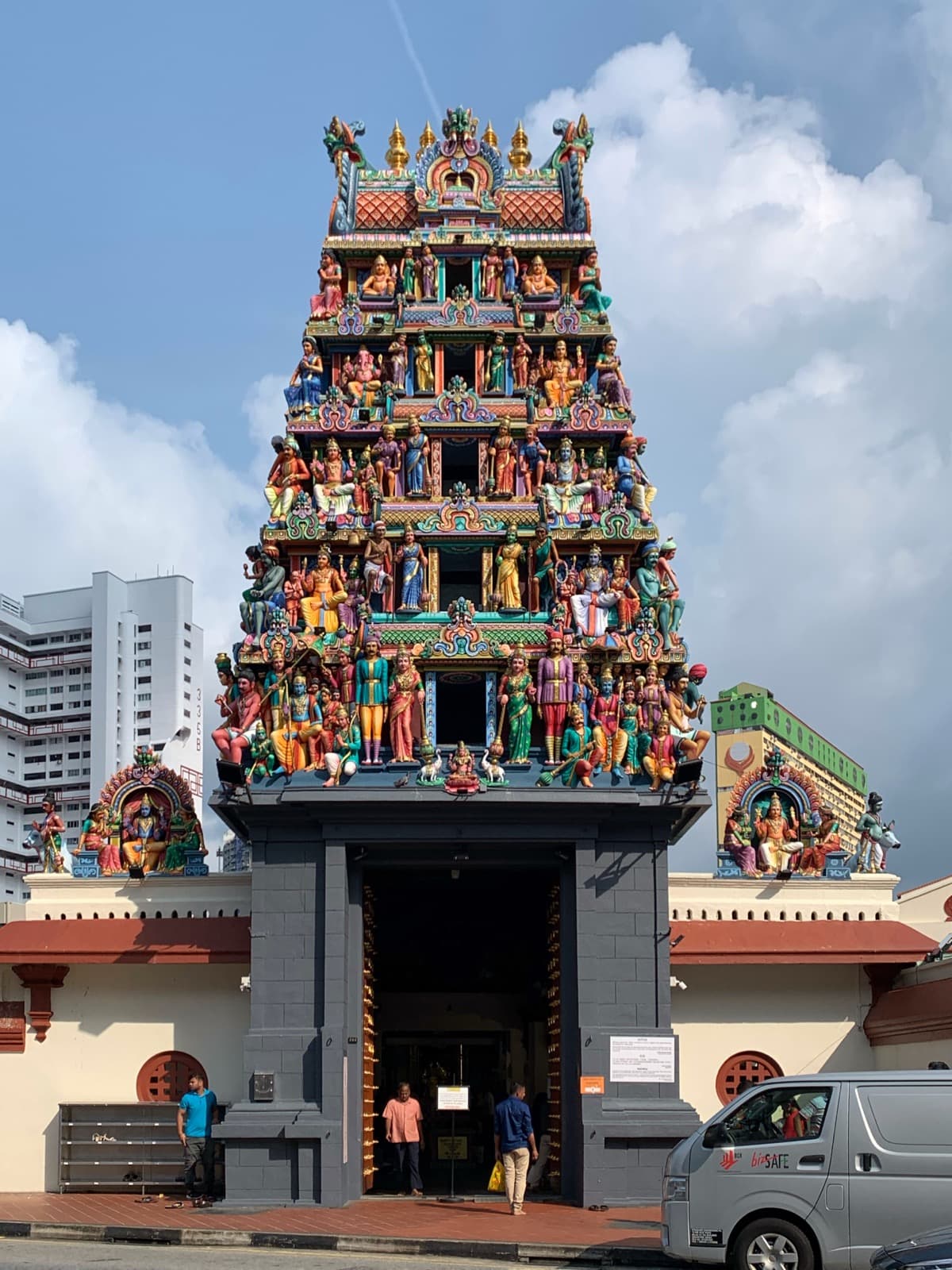
Sri Mariamman Temple is the oldest Hindu temple in Singapore, and it stands in the middle of Chinatown, at 244 South Bridge Road, a South Indian temple holding its ground among Chinese shophouses for close to two centuries. If you take only one idea away from standing in front of it, take this one: the quarter that everyone calls Chinatown was never only Chinese. The temple is not a curiosity that wandered into the wrong district. It is evidence, still living and still busy, that immigrant Singapore was plural from its first day ashore.
The one thing to understand standing in front of it
Look up before you look at anything else. Above the entrance rises the gopuram, the tall tower crowded with brightly painted Hindu deities stacked in tier upon tier. The six-tiered tower you are seeing dates to 1925, when it replaced an earlier three-tiered one. It is the loudest object on South Bridge Road, and it is meant to be. A gopuram is a South Indian temple gateway, and its job is to announce the sacred ground behind it from a distance. That it announces itself here, surrounded by the trades and lanes of a historically Chinese quarter, is the whole point of the place.
The temple is dedicated to the goddess Mariamman, associated with rain and with protection from epidemic disease, especially cholera. That dedication is not decorative. It tells you exactly what the people who built and used this temple were afraid of. The community that lived in these blocks was crowded and poorly drained, and disease was a real and constant fear, not a historical abstraction. When worshippers came to Mariamman, they were asking for protection from the thing most likely to kill them. Understanding that turns the temple from a pretty building into a record of ordinary human worry.
How it got here
Hear a stop from this walk
Buddha Tooth Relic Temple: A Tang-Style Temple of This Century
The temple was founded by Naraina Pillai, a government clerk who arrived with Sir Stamford Raffles' party in 1819, the same year the British established their trading post. Pillai requested land in 1823. The plot on South Bridge Road was granted, and a modest wooden structure with an attap roof, a thatch made from palm fronds, was standing by 1827. What you walk into today is not that first building. The oldest sections of the present brick temple were built around 1843, and the tower on top of the entrance came later still, in 1925. So the structure in front of you is a layered thing, a wooden shrine that became brick, then grew its crown generations after the first prayers were said on the site.
Hold the dates next to the neighborhood and a pattern appears. This was a temple raised by a South Indian in the 1820s, in a quarter that Raffles had designated for Chinese settlement in 1822. The two facts sit side by side because the reality of the coast sat side by side. A few streets away, on Telok Ayer Street, Chinese immigrants raised Thian Hock Keng in thanks to the sea-goddess Mazu, and Tamil Muslim traders known as the Chulias built Al-Abrar Mosque and Nagore Dargah within a few doors of it. Sri Mariamman is the Hindu voice in that same chorus, and it is the oldest one of its faith on the island.
A living temple, not a museum
It matters that this is not a preserved shell. Sri Mariamman is a national monument, and it is a working temple where people pray every day. Once a year it hosts Theemithi, the firewalking festival held in October or November, honouring Draupadi, in which devotees walk across a bed of burning charcoal after a long procession. If you happen to be in Singapore for it, you are watching a rite that has continued on this ground for generations, not a reenactment staged for visitors.
That living status changes how you should behave in front of it and inside it. Sri Mariamman welcomes respectful visitors, and entering is worth doing. If you go in, remove your shoes, dress modestly, keep quiet, and ask before photographing worshippers. There is usually a small camera fee. None of this is red tape. It is the difference between visiting someone's home and barging through it. The people around you are not part of the attraction. They are the reason the attraction is still here.
Why this stop is the point of the walk
On the Singapore Chinatown route, this temple is the climax, and that placement is deliberate. The walk begins on Telok Ayer Street, which was once the actual shoreline where immigrants stepped off boats onto the beach, and it moves through Chinese, Tamil Muslim and Hokkien houses of worship raised in gratitude for surviving the crossing. By the time you reach Sri Mariamman, you have already learned that this coast held many faiths within a few steps of each other. The temple then makes that lesson unmissable: a South Indian Hindu temple, oldest of its kind on the island, planted firmly in the middle of Chinatown and refusing to be anywhere else.
Standing here, the useful thought is not how surprising it is. It is how ordinary it was. Newcomers arrived from South China, from South India, from the Malay world that was already here long before the British, and they built their gods into the same few blocks because they lived in the same few blocks. The gopuram over your head is simply the tallest and most colorful piece of that ordinary, plural truth.
You can read the temple well enough from a photograph. You can only feel why it sits where it sits by walking the streets that surround it, in order, the way the arrivals themselves crossed them. The self-guided Chinatown audio tour takes about seventy minutes across seven stops and roughly two and a half flat kilometres, going at your own pace with no group to keep up with. To see how this temple fits with the sea-temple, the mosques, the clan-association hill and the coolie lanes, browse the full set of Singapore walking tours and start where the immigrants started, at the old waterline.
Sources
- Sri Mariamman Temple, Singapore, Wikipedia: founding by Naraina Pillai, the 1843 brick sections, the 1925 six-tiered gopuram, and national monument status.
- Sri Mariamman Temple, NLB Infopedia (National Library Board Singapore): official record of the temple's dedication to Mariamman and its history on South Bridge Road.
- Roamer self-guided tour, "Chinatown: The Making of Immigrant Singapore": fact-audited transcript for the anchor stop and the surrounding houses of worship.
- Roots.gov.sg (National Heritage Board): context on the Telok Ayer immigrant coast and the plural cluster of monuments around the temple.
Ready to experience it?
Chinatown: The Making of Immigrant Singapore
70 min · 2.4 km · easy
More from Singapore
Explore more at your own pace.
One Day in Singapore: A Walkable Morning-to-Evening Itinerary
Reading Singapore Neighbourhood by Neighbourhood: From the Founding River to the Supertrees
Istana Kampong Glam: The Sultan's Palace That Predates Colonial Singapore
Marina Bay Sands and the Skyline Singapore Built on Reclaimed Sea
Sri Veeramakaliamman Temple: The Mother Little India's Labourers Raised