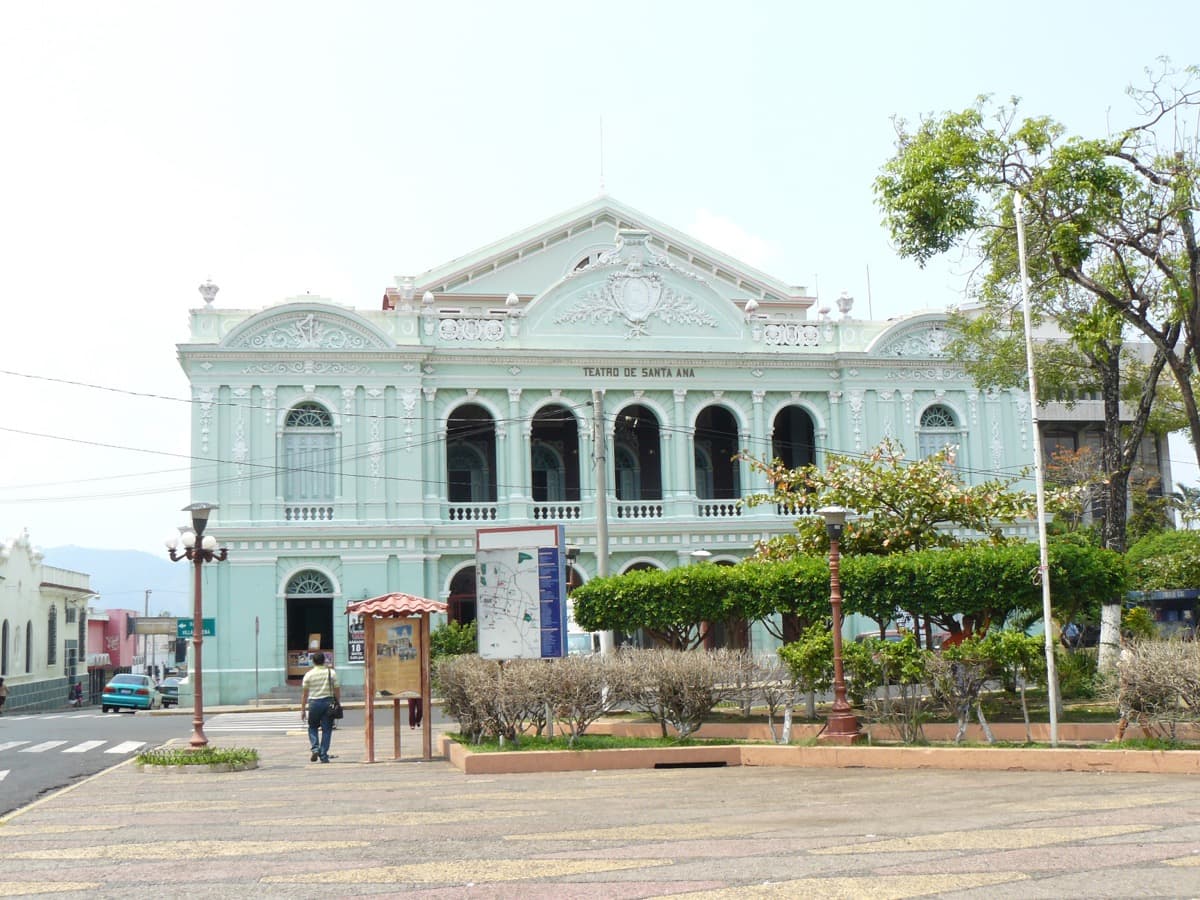
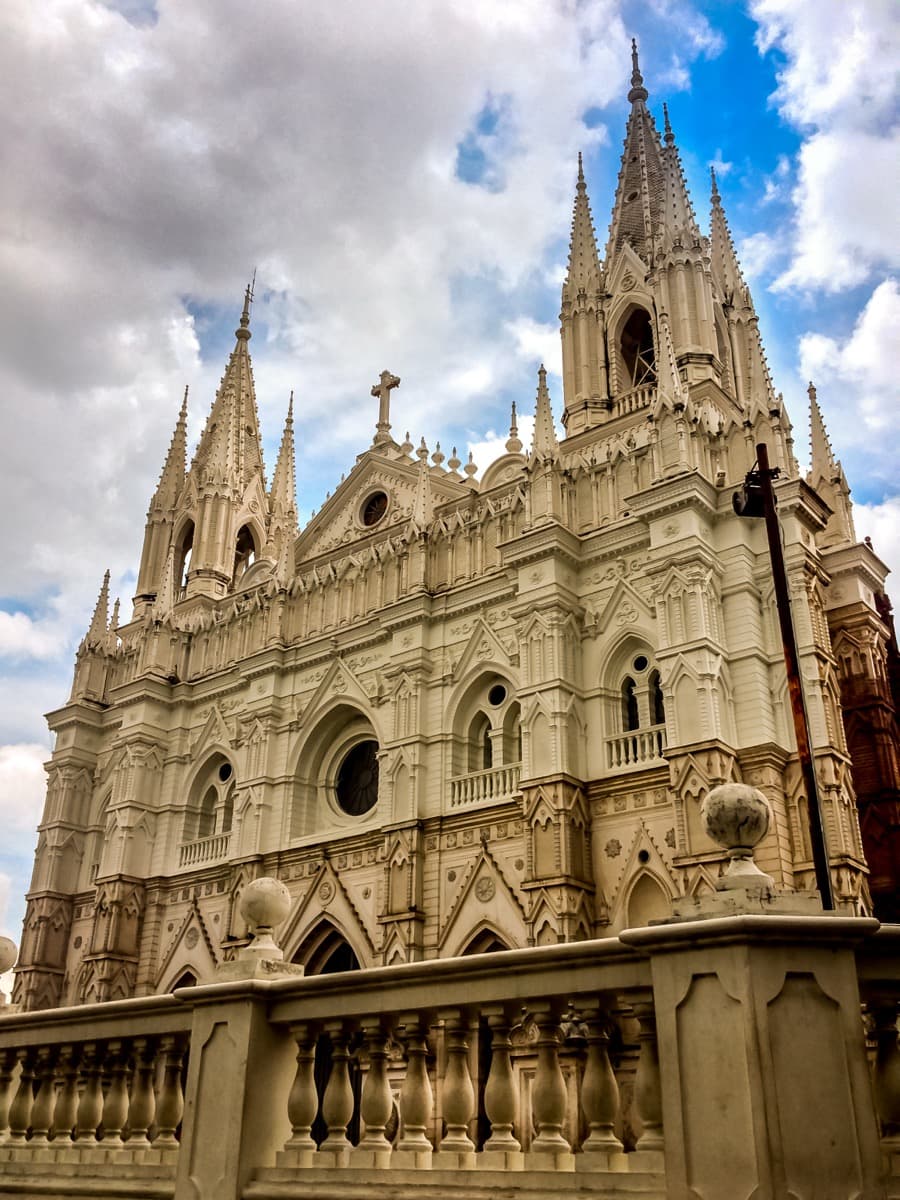
Stand on the north side of Parque Libertad in Santa Ana and look at the Teatro Nacional. The façade is symmetrical, calm, and dressed in the Renaissance Revival style that European theatre architecture had settled into by about 1900. Three arched ground-floor openings, a row of arched upper windows, restrained ornament, a cornice line that holds the composition together. The building is the same scale as the neo-Gothic cathedral diagonally across the plaza, but its idiom is completely different. The cathedral reads Northern European. The theatre reads Italian. Both are statements, made within a few years of each other, by the same coffee families.
The theatre is the more revealing of the two statements, because it does not have a religious cover story. A cathedral can be argued for on doctrinal grounds. An opera house has to be argued for on civic and aesthetic grounds, and the argument the Teatro Nacional makes is that Santa Ana, a provincial town of perhaps thirty thousand people in 1910, deserved a venue capable of hosting touring European opera companies and orchestras. The argument was not modest. The building is not modest. Whether the building made the argument well is a question worth holding in mind while walking through it.
Why a theatre, and why here
By the early 1900s, San Salvador had its own national theatre under construction. The Salvadoran capital was funding what would eventually become the Teatro Nacional de El Salvador, completed in the late 1910s. For the Catorce Familias of Santa Ana, the coffee oligarchy that had concentrated most of the country's export wealth into a few dozen households, the existence of a national theatre in the capital and the absence of one in Santa Ana was a problem.
The problem was not really aesthetic. It was political. The coffee families understood that civic infrastructure carries political weight. Schools, hospitals, cathedrals, theatres, opera houses, and railways are the visible markers of where a country's power and wealth concentrate. The decision to build a comparable national theatre in Santa Ana was a decision to ratify, in architecture, the fact that Santa Ana was the country's actual economic capital, regardless of where its administrative capital sat.
The funding mechanism was direct. A portion of the coffee export tax was redirected to the construction of the theatre. This is a notable detail. The building you walk past was financed by a tax on the same coffee whose production depended on indigenous and peasant labour in the surrounding plantations. The labour question is not abstract. It would erupt, fewer than thirty years after the theatre's inauguration, in the 1932 massacre that killed somewhere between ten thousand and forty thousand of those same workers.
Construction began in the first decade of the twentieth century. The principal architect was the French-trained Daniel Beylard, a French architect working in El Salvador in the same period. Materials were imported from across Europe, in keeping with the building's intent. Italian marble for the staircases. Belgian iron for some of the structural elements. French mirrors. Decorative pieces from workshops in Paris, Barcelona, and northern Italy. The theatre was inaugurated around 1910 to 1912, the exact date of the formal opening varying between sources.
What you see inside
Hear a stop from this walk
Iglesia El Carmen
The exterior, in the Renaissance Revival idiom of late nineteenth-century European theatre architecture, is the calm public face of a much more elaborate interior. The interior is what the building was actually for.
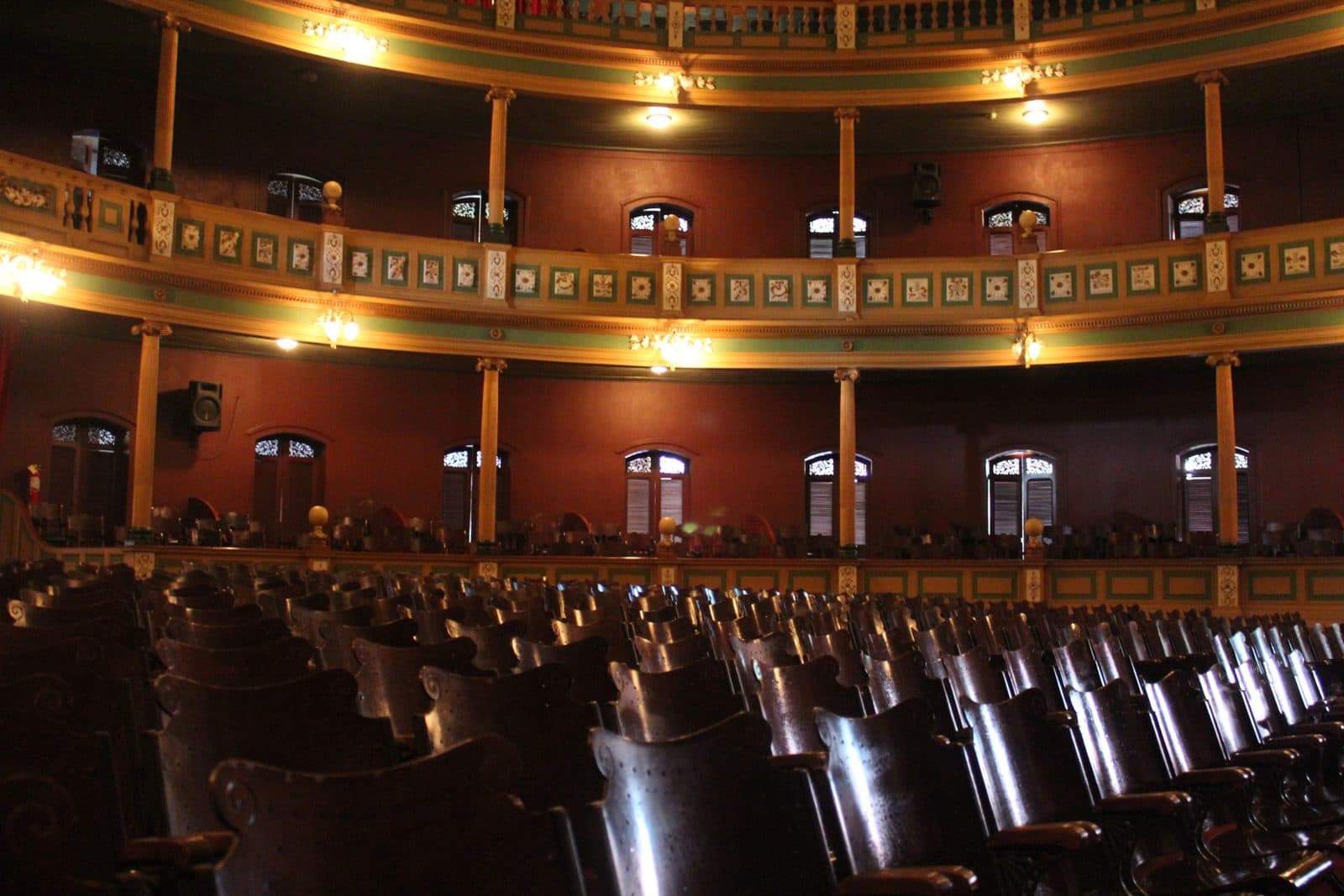
The auditorium is horseshoe-shaped, with three or four levels of boxes wrapping around a main floor that descends toward a proscenium stage. This is the standard plan of Italian and French opera house design, derived ultimately from La Scala in Milan and the Paris Opéra. The horseshoe shape exists because it puts the maximum number of seats within sight and earshot of the stage, and because it allows the audience to see itself. In a provincial elite culture, where the wealthy families saw each other every weekend and where the social hierarchy was constantly being performed, seeing the audience was as important as seeing the performance. The boxes were owned by specific families and were the social geography of Santa Ana on opera nights.
The ceiling above the auditorium is painted, in the late-baroque-meets-Beaux-Arts style of contemporary European opera houses, with allegorical figures, muses, garlands, clouds, and gilded ornament. A crystal chandelier hangs from the centre. The proscenium is gilded. The seats are upholstered. Every surface is decorated.
The decoration is the building's argument made literal. The Catorce Familias did not want a functional auditorium. They wanted a room that would convince a visiting European tenor, an American diplomat, a touring orchestra conductor, and a Salvadoran general that Santa Ana was a city of consequence. The interior makes that case insistently.
The acoustics, designed in consultation with European theatre engineers of the period, are precise enough that a whisper from the stage can be heard from the back of the upper gallery. This is the technical detail that the guided tours, when they run, like to demonstrate.
The decline and the return
The Teatro Nacional functioned as a serious venue for European touring companies for about three decades. The 1932 massacre and the subsequent forty-year period of military-dominated Salvadoran politics, combined with the eventual decline of coffee as the dominant export commodity, slowly removed the conditions that had made the building economically necessary. By the 1950s and 1960s, the theatre was operating intermittently. By the 1980s, with the civil war underway, it was largely closed. The building suffered structural damage, water damage, and the kind of slow neglect that comes from a building serving a function the country no longer needs.
The restoration that returned the building to working use was a multi-decade project. Conservation work began in the 1990s, accelerated in the 2000s, and the formal reopening of the fully restored interior came in 2010, a century after the inauguration. The painted ceiling was restored. The crystal chandelier was rehung. The proscenium was regilded. The structural problems were addressed. The horseshoe auditorium was reupholstered.
Today the theatre operates as a working venue. It hosts concerts, plays, dance performances, occasional opera, and visiting orchestras. The guided tours, which run during the day for a small fee, take visitors through the entrance, the staircases, the auditorium, and the upper galleries. The painted dome is the photograph everyone takes home.
What the building means
A building can be honest about its origins or it can pretend to be something else. The Teatro Nacional de Santa Ana is honest. It is exactly what it looks like, a provincial opera house built by a regional elite as an argument that the regional elite mattered. The argument was made in marble, in gilded plaster, in painted ceiling figures, and in a horseshoe auditorium designed for the audience to see itself.
The argument was not wrong on its own terms. Santa Ana in 1910 was, in any honest reckoning of where the country's wealth concentrated, more important than San Salvador. The theatre is the most legible piece of evidence for that claim. Whether the claim should have been made, in a country with the labour conditions that El Salvador had in 1910, is a separate question. Both questions belong on the tour. The building, considered as architecture, is a serious piece of work. The cost of the wealth that produced it is the silent companion question of every visit.
Stand in the lobby, look up at the painted ceiling, and the answer is not a simple one. The grandeur is real. The cost is real. The building holds both.
Ready to experience it?
Santa Ana: The Coffee-Built Capital
75 min · 1.8 km · easy
More from Santa Ana
Explore more at your own pace.
How to See Santa Ana: A City the Coffee Money Built and the Coffee Money Left
How to See Santa Ana: Coffee, the Fourteen Families, and the Town Built on a Massacre
One Day in Santa Ana, El Salvador: A Walkable Center Itinerary (2026)
Santa Ana Travel Guide: How Many Days, Getting Around, Is It Safe (2026)

What to Eat in Santa Ana, El Salvador: A Food Guide (2026)