Montmartre was a working hill of gypsum quarries, windmills and vines before it was a painters' village, and that changes how you read the climb. Most of what visitors come up here to see is, in one way or another, a stand-in: a metro entrance brought from the city center, a studio front rebuilt after a fire, a windmill with nothing inside, a copied sign, a vineyard planted on waste ground. The real thing is the hill under all of it, dug for plaster, and the white basilica that had to be sunk deep into that hill to stand on it.
A village with its own town hall
Montmartre rises about a hundred and thirty metres above sea level on the northern edge of Paris, and until 1860 it was not part of Paris at all. It was a village with its own town hall, which stood on what is now Place du Tertre. Long before the painters, the hill was put to work. It was quarried for gypsum, the soft rock that is baked to make plaster. Windmills turned along its ridge. Vines grew on its slopes for about a thousand years.
Then came cheap rents, studios, cabarets and dance gardens, and finally the basilica on the summit. The walk climbs through those layers in order, from Place des Abbesses to the Sacré-Cœur, then drops down the long staircase to the foot of the hill.
Five stand-ins
Hear a stop from this walk
Foot of the Hill: The Whole Basilica
The first thing you meet is a migrant. Hector Guimard's green cast-iron metro entrance with its glass roof was designed in 1900 for the Hôtel de Ville station in the center of Paris. In the early 1970s it was taken down there and rebuilt in Place des Abbesses, on a line whose original company never used Guimard's designs.
Up the steps, the Bateau-Lavoir on Place Émile-Goudeau is where Pablo Picasso lived from 1904 to 1909 among wooden artists' studios. The wooden building burned in May 1970. What stands there now dates from 1978, and its front on the square is a restoration of the old one, with working studios behind it.
At the corner of Rue Lepic, a windmill body with lattice sails sits on the roof of a restaurant. It is a real mill, the Radet, but its machinery is long gone; it is a sign now. Between it and the other mill on this spot lay the open-air dance garden that Pierre-Auguste Renoir painted in 1876, the Bal du Moulin de la Galette, now in the Musée d'Orsay. The painting with a mill in its title shows a dance.
Further up, the cabaret of the Lapin Agile carries a rabbit leaping out of a cooking pot, a copy of a sign painted around 1880 by the caricaturist André Gill. Lapin à Gill, said quickly, became Lapin Agile. Across the corner, the Clos Montmartre looks like the last of the ancient vines. It is not. The City of Paris says the plot was waste ground until the illustrator Francisque Poulbot named it the Square of Liberty in 1929; the vineyard was planted in 1933 and now has about two thousand vines, tended by the city's gardeners and celebrated each October with a harvest festival. A copied sign and a replanted vineyard: two stand-ins, both of them fought for.
What paint and walls do
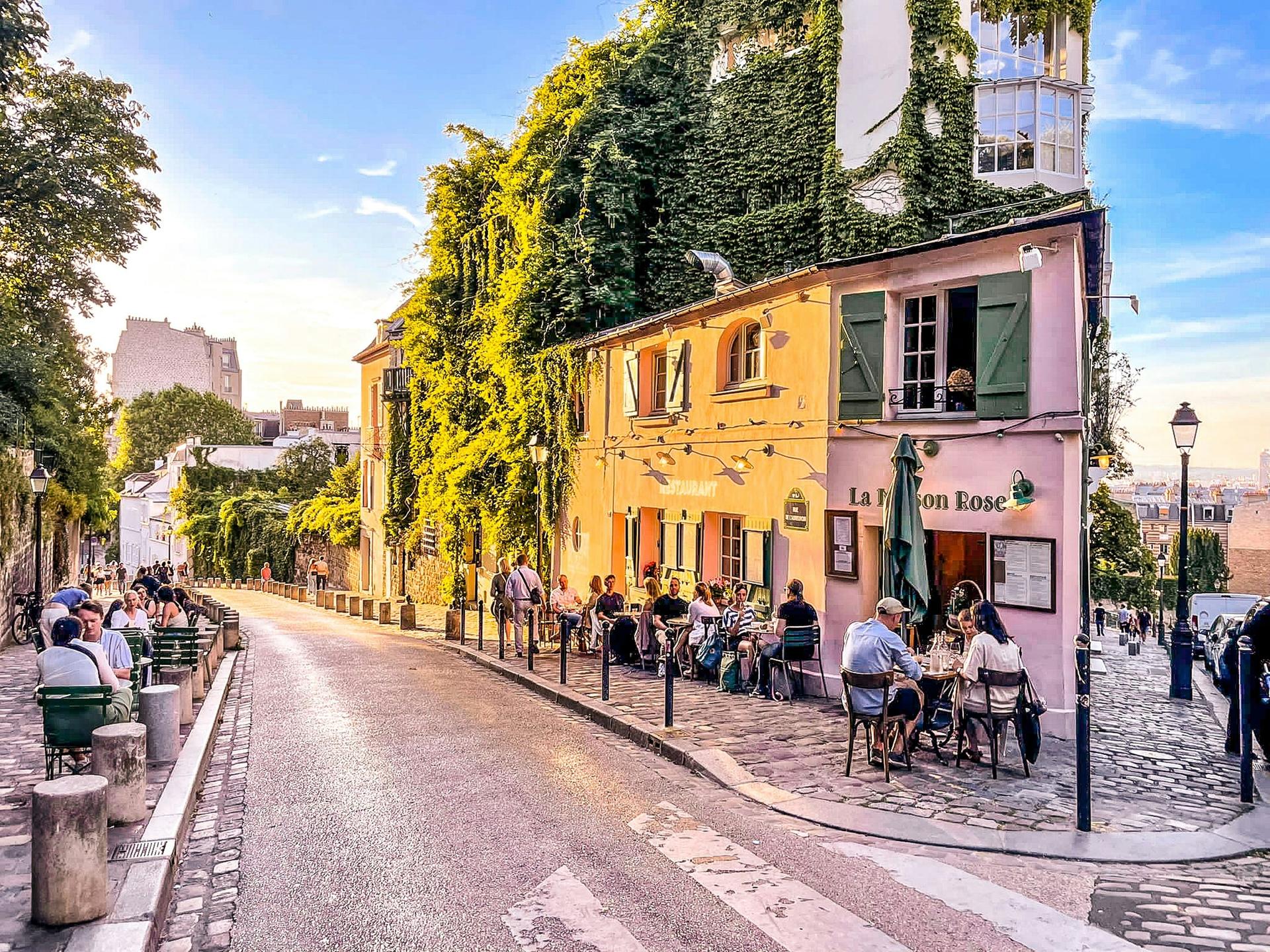
The walk keeps showing how small Montmartre's famous things are. La Maison Rose is a two-storey corner house with plain rendered walls. Around 1908 the wife of its owner painted it pink and opened a restaurant, and that single colour on a hill of pale walls is what draws the queue. Rue Cortot is a walled lane where you see a house front and shutters, while the Musée de Montmartre, in one of the oldest buildings on the hill and Renoir's address in 1876, keeps its gardens out of sight behind. Place Marcel-Aymé makes the same joke in bronze: a man stepping out of a wall, from a story about a clerk who could walk through them. The life of the hill goes on behind its walls.
The real stone on the real hill
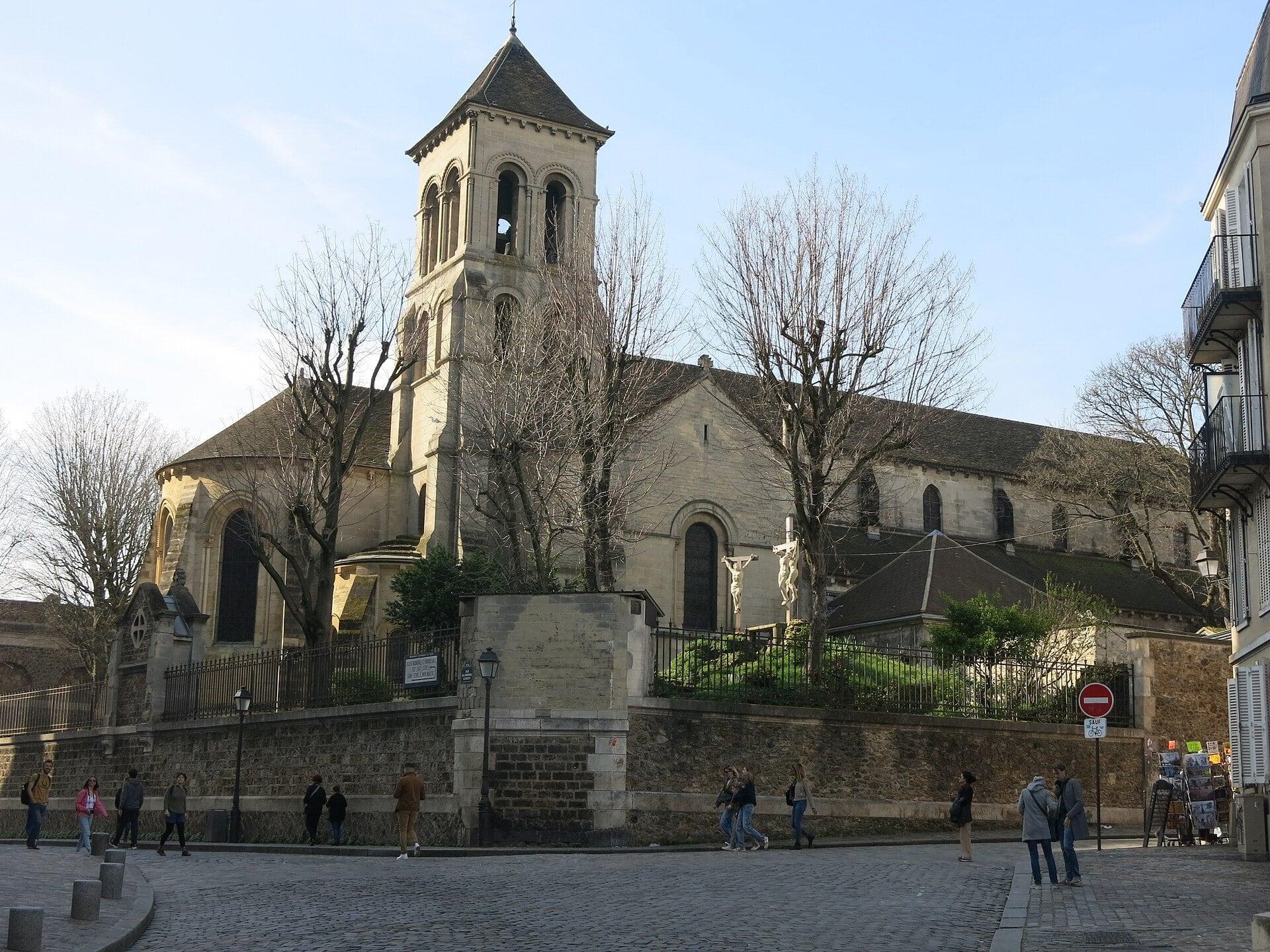
Place du Tertre is the old village center, now full of licensed painters' pitches, and beside it stands Saint-Pierre de Montmartre, consecrated in 1147, the church of the royal abbey whose abbesses gave the first square its name. It reuses columns far older than itself.
Then the Sacré-Cœur. Look at its stone. It is a limestone from the Château-Landon beds that whitens in the rain; the darker patches on the front are where the water does not run. The City of Paris records that about ten million donors paid for it, that the first stone was laid in 1875, and that it was consecrated only in 1919. The vow to build it was first written in December 1870, after France's defeat in the war with Prussia and before the Commune of 1871, although the city also notes that critics long read it as a monument against the Communards.
Under your feet is the walk's real subject. The hill is riddled with old plaster quarries, so the basilica stands on eighty-three shafts sunk thirty-three metres into the ground. At the start of the walk, the church of Saint-Jean de Montmartre went up in the same years in thin reinforced brick and cement. The basilica went the other way: massive stone on deep foundations.
Walking it
The route is eleven stops over about one and a half kilometres and takes about seventy-five minutes. It climbs steeply with many steps, then descends more than two hundred steps on Rue Foyatier; the funicular beside them, on a metro ticket, is the step-free way down. Walking on your own lets you take the climb slowly, wait out a crowd at Place du Tertre, and stay on the terrace as long as the view holds you.
The basilica is stop 10 of Montmartre and Sacré-Cœur: Windmills, Vines and White Stone. For more walks, see the Paris city page.
Sources
- Ville de Paris, Clos Montmartre (https://www.paris.fr/lieux/clos-montmartre-2697): the former waste ground named the square de la liberté by Francisque Poulbot in 1929, about two thousand vines, up to 1,300 kilos of grapes, the harvest festival.
- Ville de Paris, Le Sacré-Cœur de Montmartre qui fête ses 150 ans (https://www.paris.fr/pages/le-sacre-coeur-de-montmartre-qui-fete-ses-150-ans-n-a-pas-pris-une-ride-30567): the limestone that whitens in the rain, eighty-three wells thirty-three metres deep, about ten million donors, first stone 1875, consecration 1919, the vow of December 1870 and its anti-Communard reading.
- Roamer tour dossier for "Montmartre and Sacré-Cœur: Windmills, Vines and White Stone" (paris-montmartre), fact-checked October 2026, which draws on the Musée de Montmartre, the French heritage register and the Lapin Agile.
Ready to experience it?
Montmartre and Sacré-Cœur: Windmills, Vines and White Stone
75 min · 1.5 km · moderate
More from Paris
Explore more at your own pace.
Musée d'Orsay: What to See, Floor by Floor
The Code of Hammurabi at the Louvre: Which Room, and the Story of the Stone
The Louvre: What to See, by Wing and Room Number, and a Two-Hour Route

The Mona Lisa: Which Room It Is In and What to Know

The Raft of the Medusa at the Louvre: Where It Hangs and the True Story