The Eiffel Tower was granted twenty years for a world's fair on an old drill ground, and it never left. The walk that crosses the Seine to it reads the tower among the other things the fairs left behind: a palace on top of an older palace, a garden older than that palace, a bridge widened for a crowd. It also walks on ground that was not always ground. Beside the tower, where a museum stands now, there was an island and a river channel until 1812. The postcard view is the end of a long argument about what this stretch of riverbank was for.
A view made by three fairs
The walk opens on the Trocadéro terrace, between the two curved wings of the Palais de Chaillot. France's heritage register says the palace was designed for the international exhibition of 1937 and built from 1934 on the old structures of the Trocadéro palace, put up for the world's fair of 1878. The old palace had a large building in the middle. The new one did without it, and the gap became the terrace you stand on, opening the view across the river.
So three fairs built the classic view: 1878 for the gardens below, 1889 for the tower, 1937 for the palace. Look at the tower's colour from here. It is a warm yellow-brown, the shade Gustave Eiffel chose in 1907, brought back for the Paris Olympic and Paralympic Games of 2024.
Walk down through the Trocadéro gardens and notice what you are doing: dropping from the hilltop to the low ground beside the Seine. Ahead, the tower stands on the old drill ground and the museum stands on the old island, once called the Isle of Swans.
Napoleon's bridge, widened for a crowd
Hear a stop from this walk
École Militaire: The End of the Line
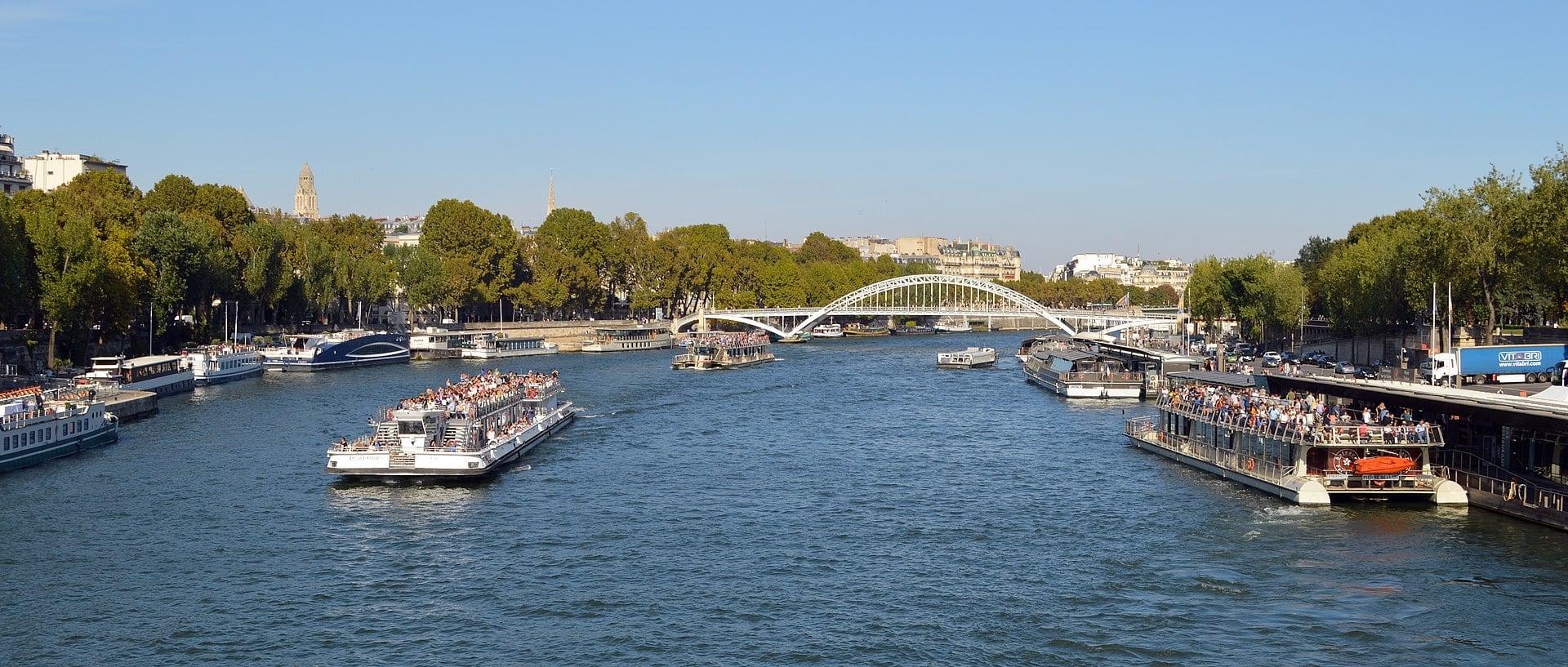
The Pont d'Iéna was ordered by Napoleon in a decree signed in Warsaw in 1807, named for his victory at Jena the year before, and built between 1808 and 1814. It points at the École Militaire, the military school at the far end of the lawns, where Napoleon studied as a teenager. Five stone arches carry it about a hundred and fifty-five metres from bank to bank, with stone horsemen added at each end in 1853.
Then the fairs went to work on it. For 1937 the bridge was widened from about fourteen metres to about thirty-five, which is why it looks so broad for a bridge of Napoleon's time. It is one more piece of the riverbank reshaped for visitors.
The tower and the island
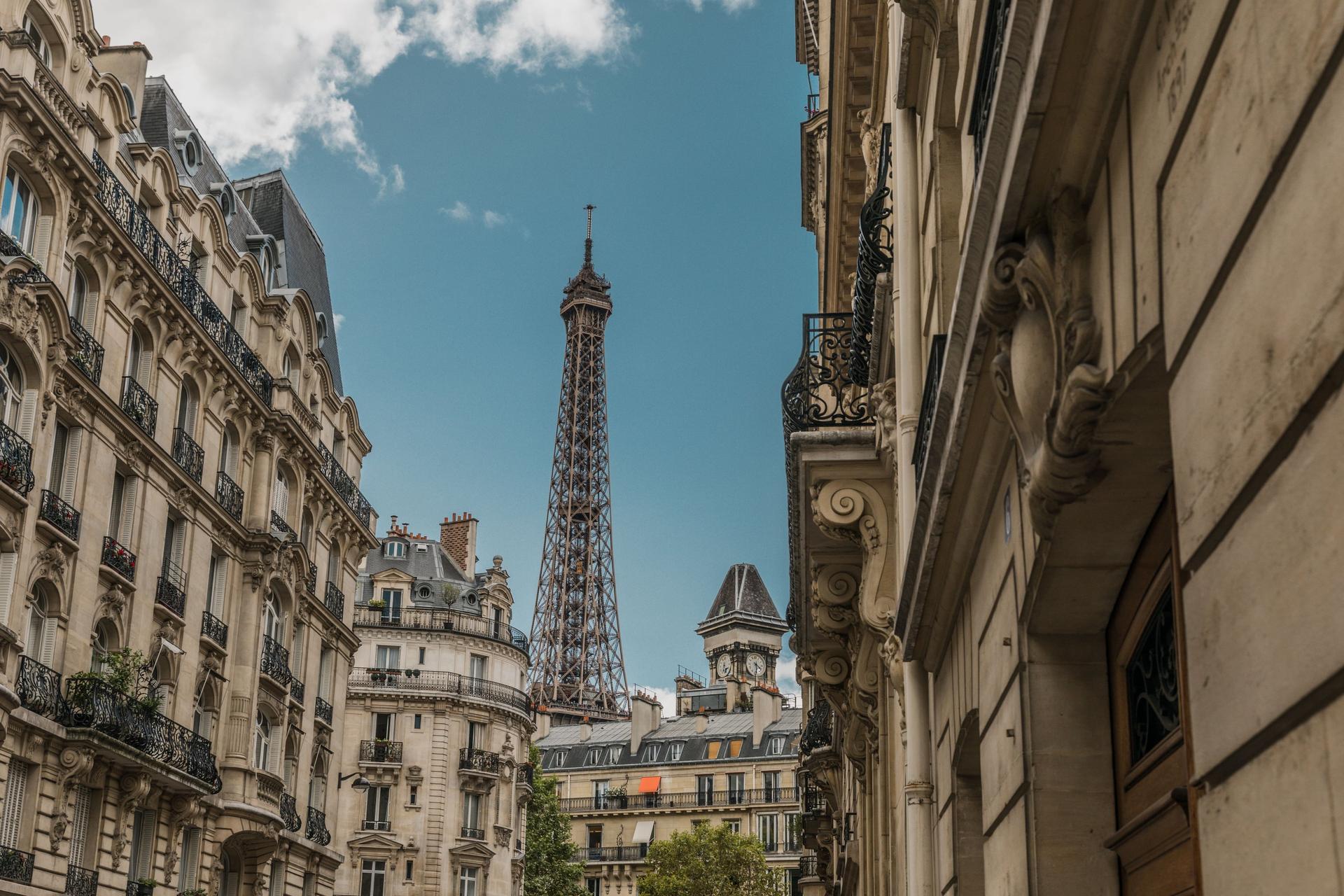
On the far bank, the tower that was meant to come down still fills the sky. The brief for 1889 asked for an iron tower on this ground, three hundred metres tall. The winning design came from Gustave Eiffel's company. It opened at three hundred and twelve metres; with its antennas it is now three hundred and thirty. Look at the curve of the legs, which Eiffel said came from his calculations against the wind, and think of the two and a half million rivets, most of them set in the workshop.
Next door, the Musée du quai Branly is the walk's newest building, by Jean Nouvel, opened in 2006. Its planted wall, about fifteen thousand plants over eight hundred square metres in the heritage register's count, faces the river road, and its main building is raised on stilts that recall houses on piles and the wet ground of the island beneath it. The museum is built on a filled-in river channel, and it says so in its structure.
The quarter the fairs did not make
Behind the showpieces, the walk turns into streets that kept a life of their own. On the Avenue Rapp, number 29 is an apartment building of 1900 whose front is covered in Art Nouveau ceramic. Its owner was a maker of ceramics, and the heritage register calls the facade a real shop window for his products. In 1901 it won the City of Paris prize for new facades. People live here, so look from the street.
A few corners on, the Fontaine de Mars is more than eighty years older than the tower. Begun in 1806, it pairs Mars, the god of war, with Hygieia, the goddess of health, because it stood at the gate of the Gros-Caillou military hospital. At its foot, a small plaque marks the height of the Seine in the flood of 1910, more than half a kilometre from the river. In the quarter beside the old island, the water once came this far.
The drill ground itself
The walk ends on the Champ de Mars. The City of Paris records it as a drill ground for the École Militaire before it became the stage of the world's fairs of 1867, 1878, 1889, 1900 and 1937. Its garden of lawns and straight avenues is younger than the tower: it was laid out in 1908. A drill ground, then a fairground, then a garden, with one iron tower that outlived its twenty years.
From the gravel in front of the École Militaire, founded under Louis the Fifteenth in 1751, turn round and look down the whole length of the lawns. The tower stands at the end of the line, smaller now, with the palace of another fair beyond the river on the hill where you began.
Walking it
The route is nine stops over about 2.4 kilometres and takes about eighty minutes. It starts with long flights of steps down through the Trocadéro gardens and is flat after that. Going up the tower is a separate ticket; the walk works from the streets and the free lawns, at your own pace, and you can break off for the lift and pick it up again afterwards.
The tower is stop 4 of Eiffel Tower: The Tower Meant to Stand Twenty Years. For more walks, see the Paris city page.
Sources
- Ministère de la Culture, POP Mérimée record PA00086706, Palais de Chaillot (https://pop.culture.gouv.fr/notice/merimee/PA00086706): designed for the 1937 exhibition and built from 1934 on the structures of the 1878 Trocadéro palace.
- Ville de Paris, Parc du Champ de Mars (https://www.paris.fr/lieux/parc-du-champ-de-mars-1807): drill ground of the École Militaire, the world's fairs of 1867, 1878, 1889, 1900 and 1937, and the French-style garden laid out in 1908.
- Roamer tour dossier for "Eiffel Tower: The Tower Meant to Stand Twenty Years" (paris-eiffel-tower), fact-checked October 2026, which draws on the Mérimée records for the Pont d'Iéna, the Musée du quai Branly, 29 avenue Rapp and the Fontaine du Gros-Caillou.
Ready to experience it?
Eiffel Tower: The Tower Meant to Stand Twenty Years
80 min · 2.4 km · easy
More from Paris
Explore more at your own pace.
Musée d'Orsay: What to See, Floor by Floor
The Code of Hammurabi at the Louvre: Which Room, and the Story of the Stone
The Louvre: What to See, by Wing and Room Number, and a Two-Hour Route
The Mona Lisa: Which Room It Is In and What to Know
The Raft of the Medusa at the Louvre: Where It Hangs and the True Story