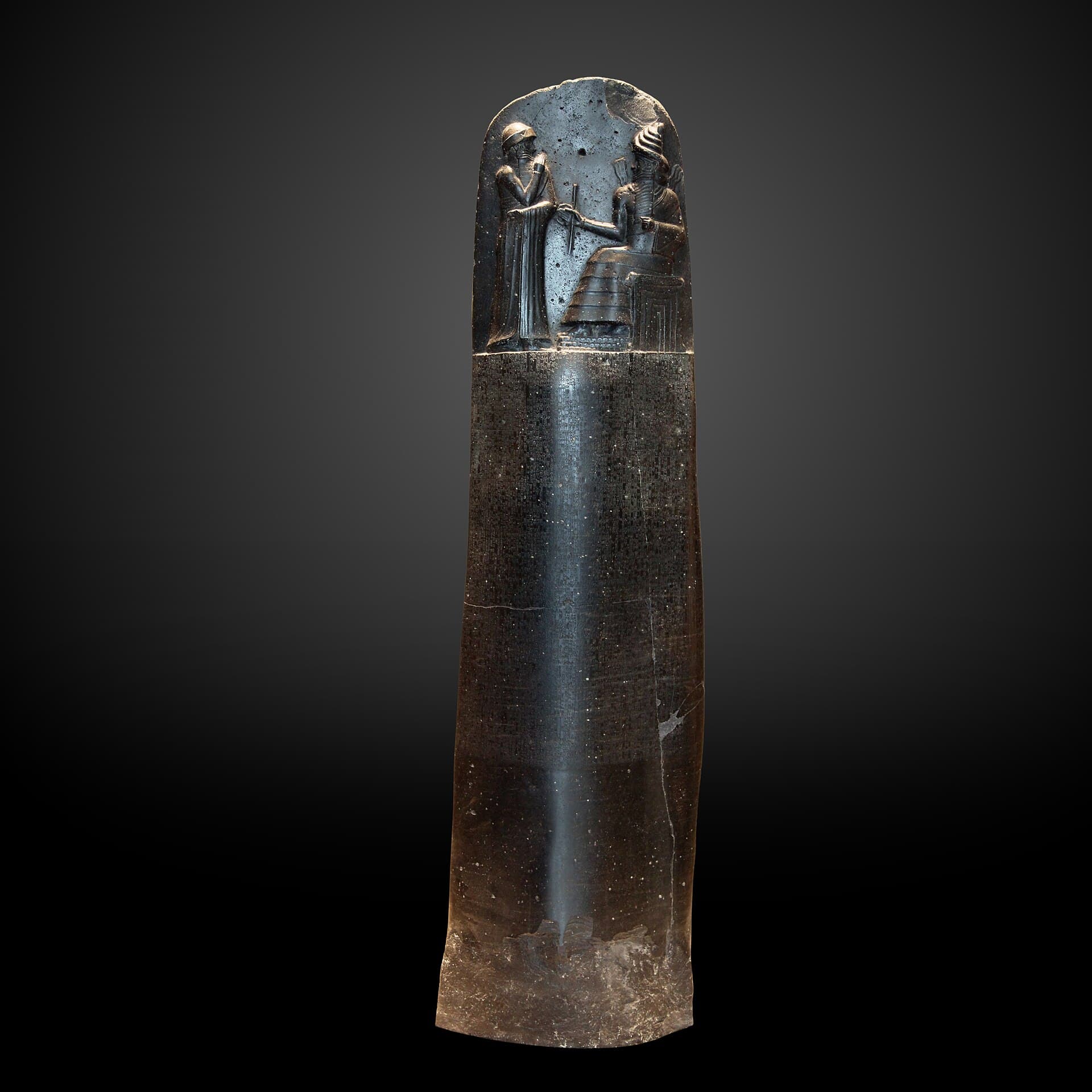
The Code of Hammurabi is in room 227, the Salle du code d'Hammurabi, in the Richelieu wing on level 0 (the ground floor) of the Louvre, as of October 2026. The basalt stele stands 2.25 metres high and dates to the reign of Hammurabi, 1792 to 1750 BC.
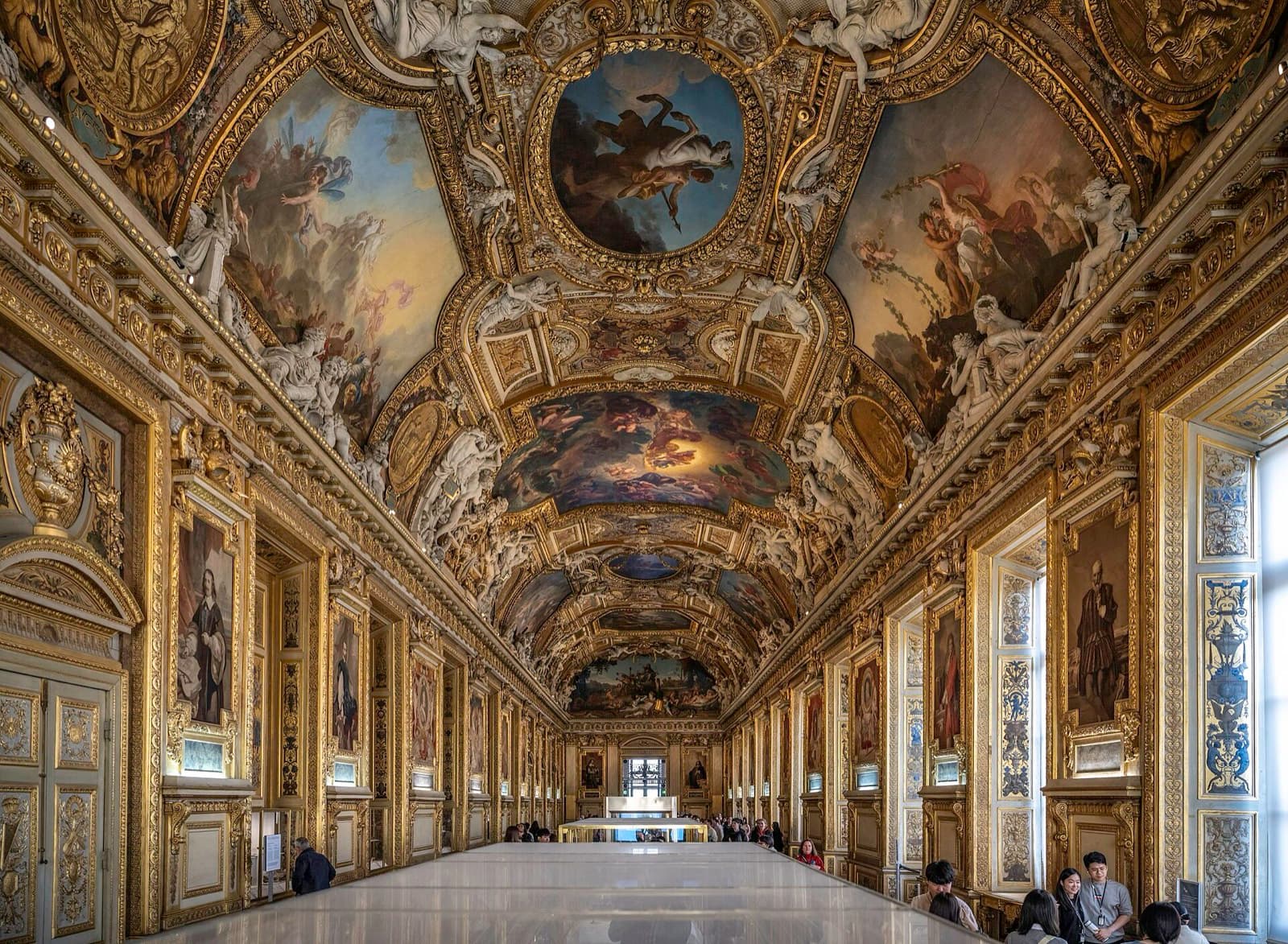
The Code of Hammurabi is in room 227, in the Louvre's Richelieu wing on level 0, the ground floor. The room is named for it: the Salle du code d'Hammurabi. That was its place on the museum's plan in October 2026.
What to look for
Start at the top. A bearded king stands before a seated god. Flames rise from the god's shoulders: the museum names him Shamash, the sun god, who was also the god of justice. The king is Hammurabi, who ruled Babylon from about 1792 to 1750 BC. The stele is basalt and stands 2.25 metres high.
Below the picture the whole stone is covered with tiny wedge-shaped signs, called cuneiform, in neat columns. There are about four thousand lines, and most are laws written as rules: if a man does this, then this happens to him. Near the bottom, look for the smoothed zone where seven columns were polished away in antiquity. Other surviving copies of the text fill in most of what is missing.
Found in Iran
Hear a stop from this walk
Quai d'Anjou and the Hôtel de Lauzun: A Plain Front, a Rich House
This stone did not stand in Paris, or even in Babylon. A French team led by Jacques de Morgan found it at Susa, in what is now Iran, between December 1901 and January 1902. The usual explanation is that an Elamite king carried it off as loot, some six hundred years after it was carved. The Louvre's record gives the way it came to the museum as a share of the finds after the excavation.
The room around it
About 1800 BC, Mesopotamia was a map of rival kingdoms. Look for the big painted wall from the palace of Mari, where a goddess hands a king the ring and rod of rule. Babylon defeated that king around 1761 BC. Look for the small gold-plated worshipper who prays for Hammurabi's life by name, and for a much later clay tablet that is a map, with mountains drawn as little squares.
How this fits the Roamer guide
The Code of Hammurabi is on the end of both "The Louvre in 90 Minutes" and "The Louvre in Two Hours" in Roamer's independent audio guide to the Louvre. Open room 227 and play its story, or start a route: the Louvre guide. For the rest of the museum, by wing and room number, read what to see at the Louvre. It is not affiliated with the museum, and admission is separate.
Cover photo: Rama, the stele of the Code of Hammurabi, via Wikimedia Commons (CC BY-SA 3.0 fr).

Ready to experience it?

Notre-Dame and Île de la Cité: An Island Rebuilt Three Times
90 min · 2.1 km · easy
More from Paris
Explore more at your own pace.
Musée d'Orsay: What to See, Floor by Floor
The Louvre: What to See, by Wing and Room Number, and a Two-Hour Route
The Mona Lisa: Which Room It Is In and What to Know
The Raft of the Medusa at the Louvre: Where It Hangs and the True Story
The Venus de Milo: Where Are Her Arms, and Where to Find Her