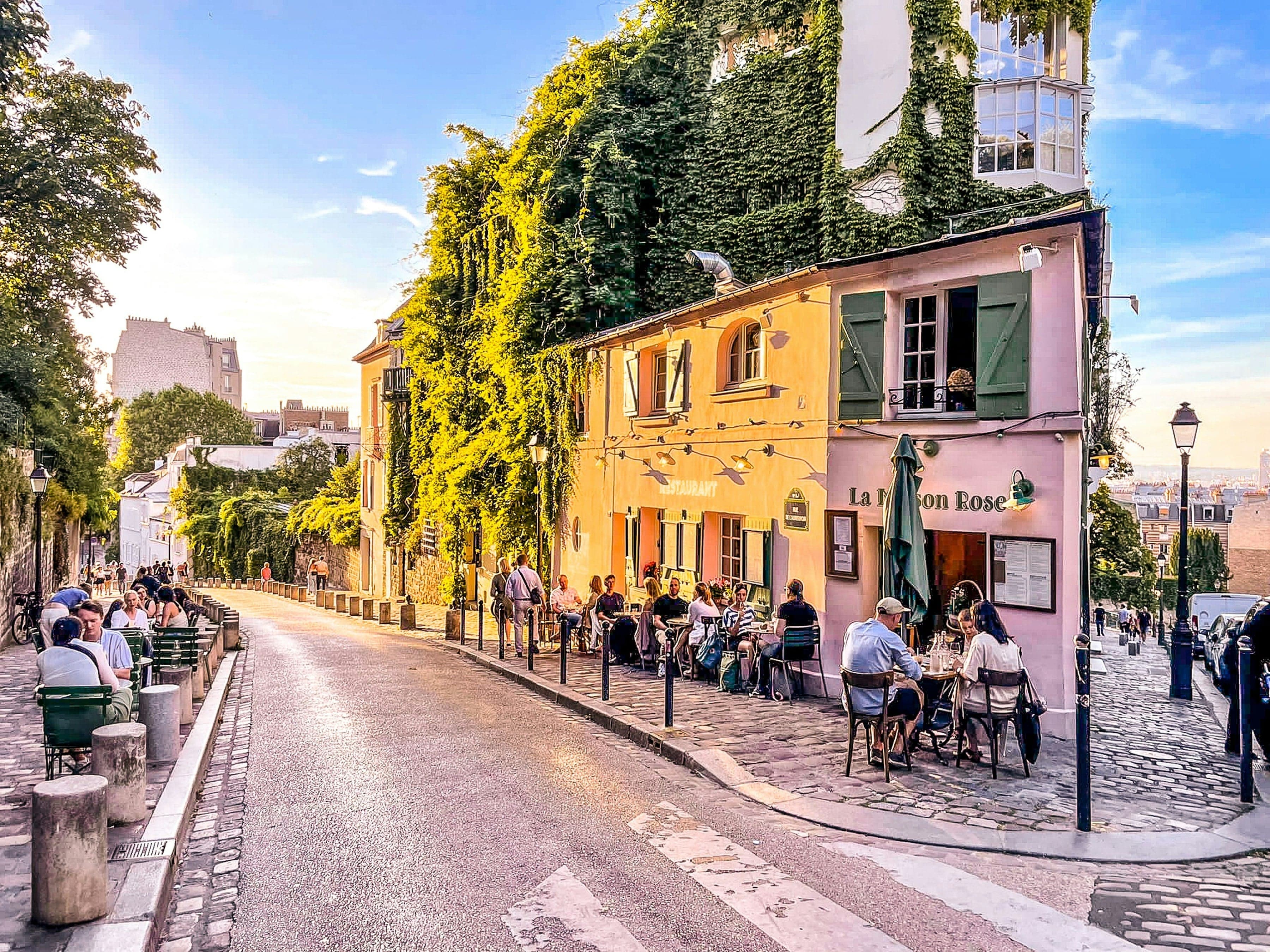
Climb Montmartre from the Guimard metro entrance at Abbesses past the Bateau-Lavoir, the Moulin de la Galette, the Lapin Agile and the vineyard to Place du Tertre and the Sacré-Cœur, then down the long stairs.
Start · Place des Abbesses: The Entrance That Moved
DirectionsStops
- 1
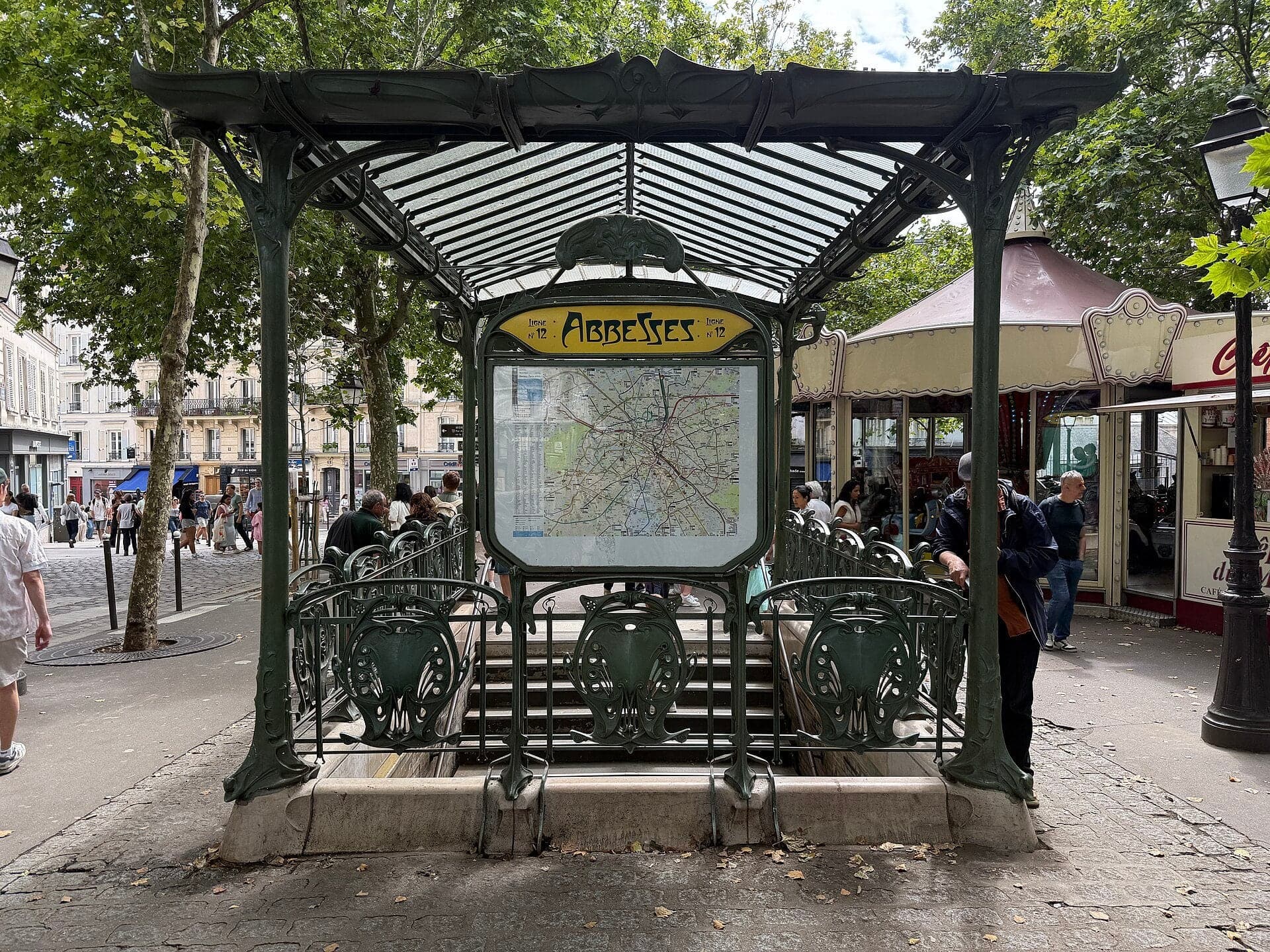
Place des Abbesses: The Entrance That Moved
A Guimard entrance moved here. Designed in 1900 for the Hôtel de Ville station and rebuilt here in the 1970s, beside Saint-Jean, a church of reinforced brick and cement.
- 2
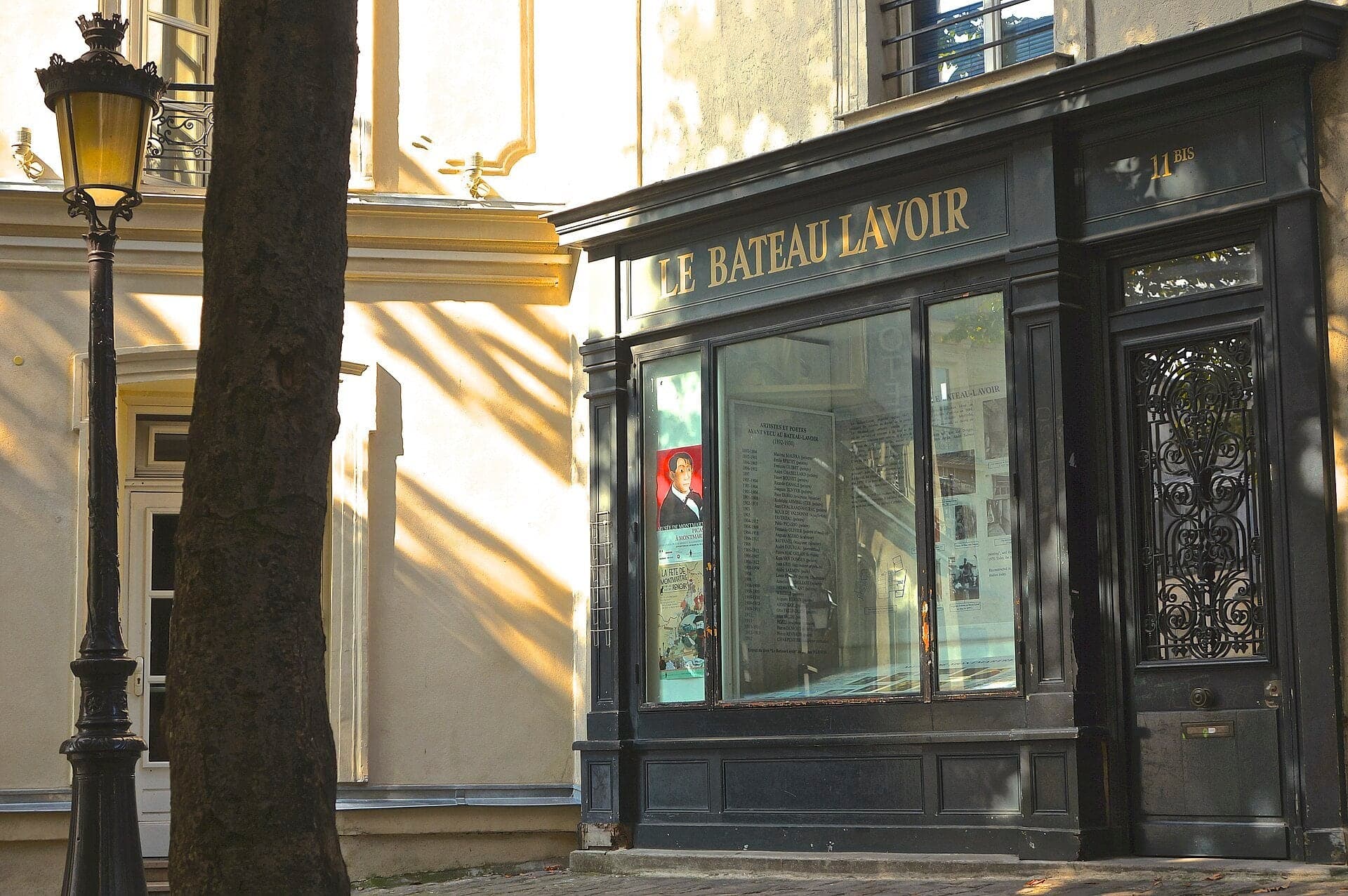
Bateau-Lavoir: Picasso's Studio, Rebuilt
A rebuilt front from 1978. The wooden Bateau-Lavoir burned in 1970; what stands on Place Émile-Goudeau is a 1978 building with its old front restored.
- 3
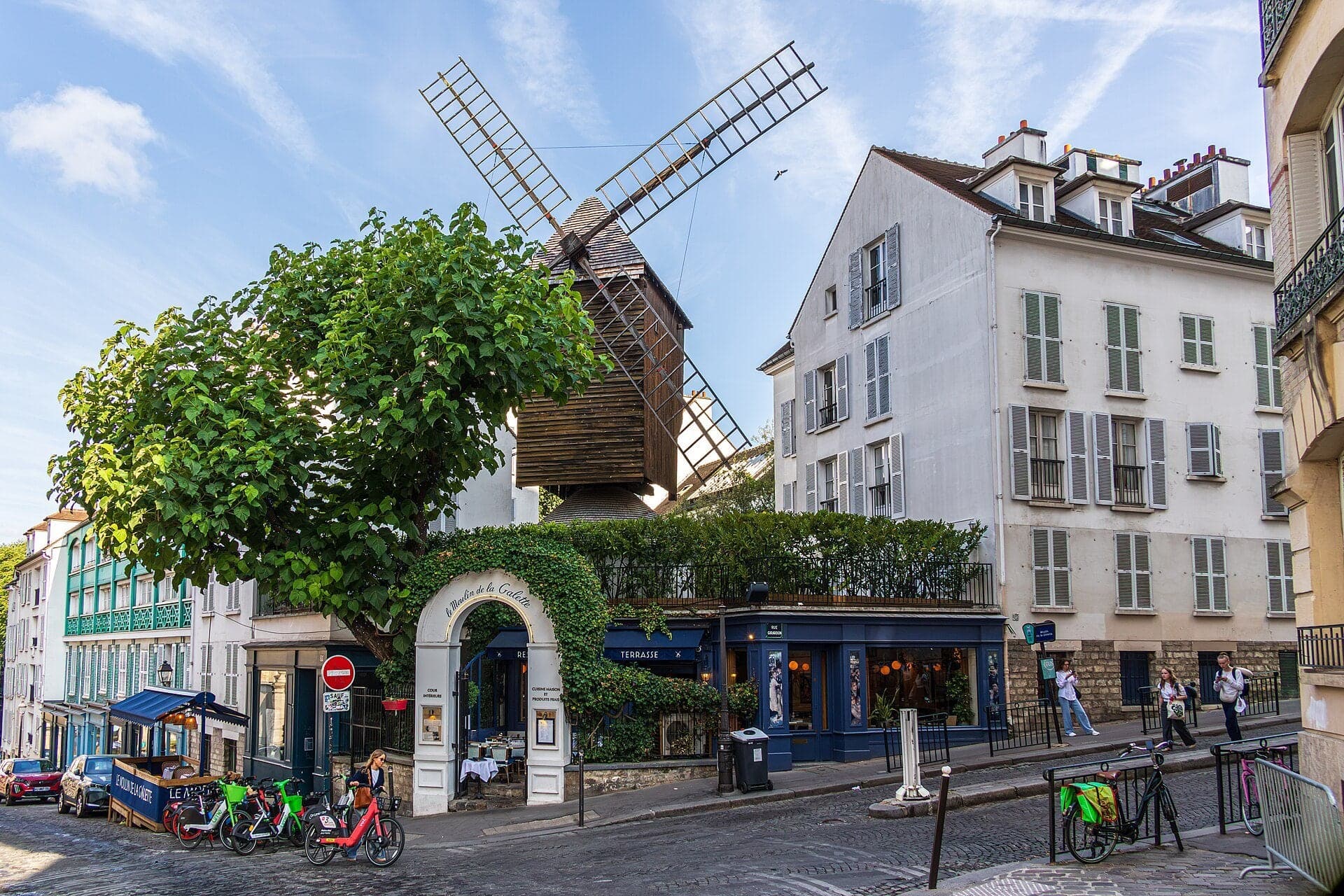
Moulin de la Galette: A Dance Between Two Mills
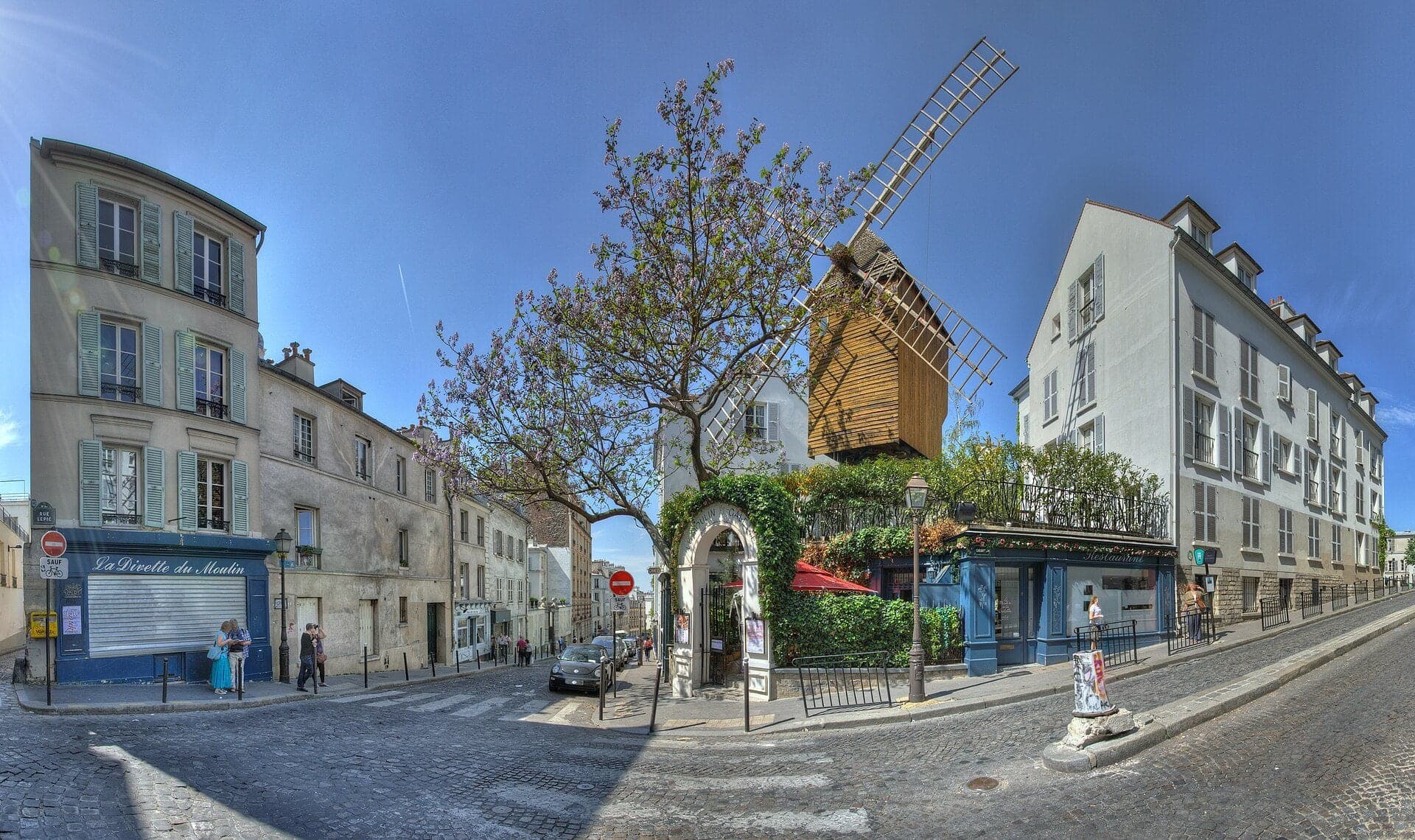
A hollow windmill above Rue Lepic. The sails above the corner belong to the Radet, an empty shell; the other mill, the Blute-fin, stands in private grounds, and Renoir painted the dance between them.
- 4
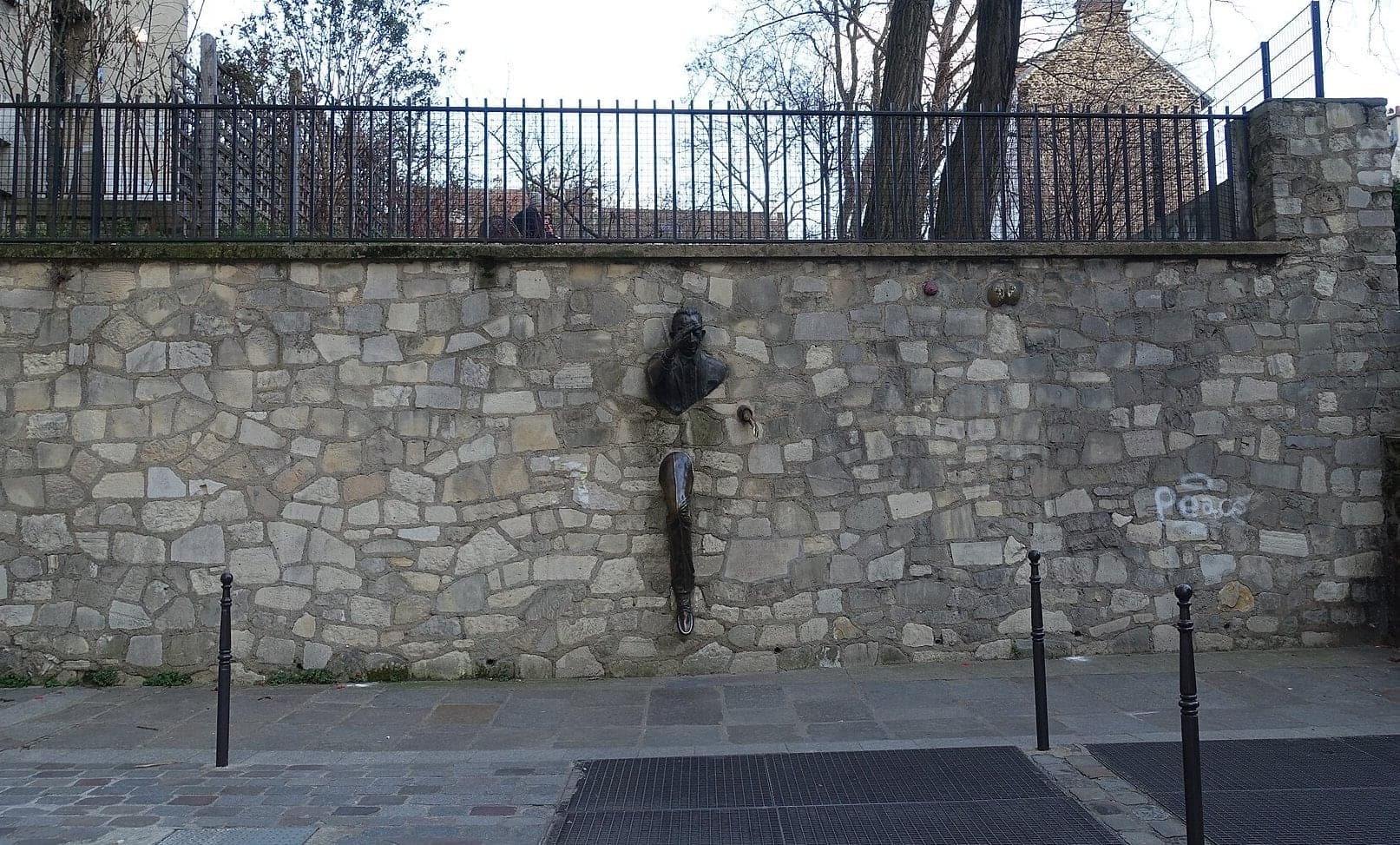
Place Marcel-Aymé: The Man in the Wall
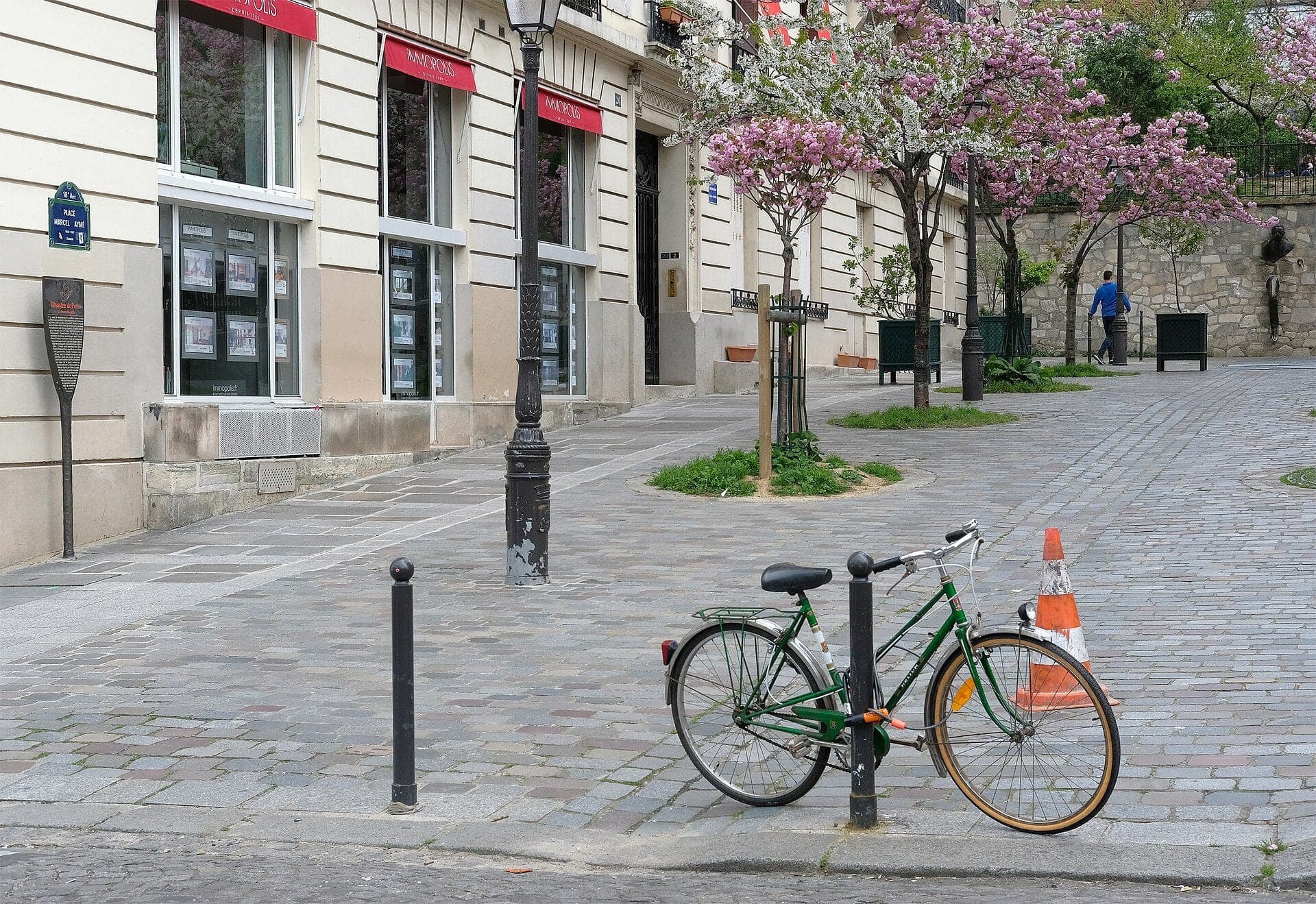
A bronze man in a wall. Across the little square, a figure from Marcel Aymé's story of a Montmartre clerk who could walk through walls.
- 5
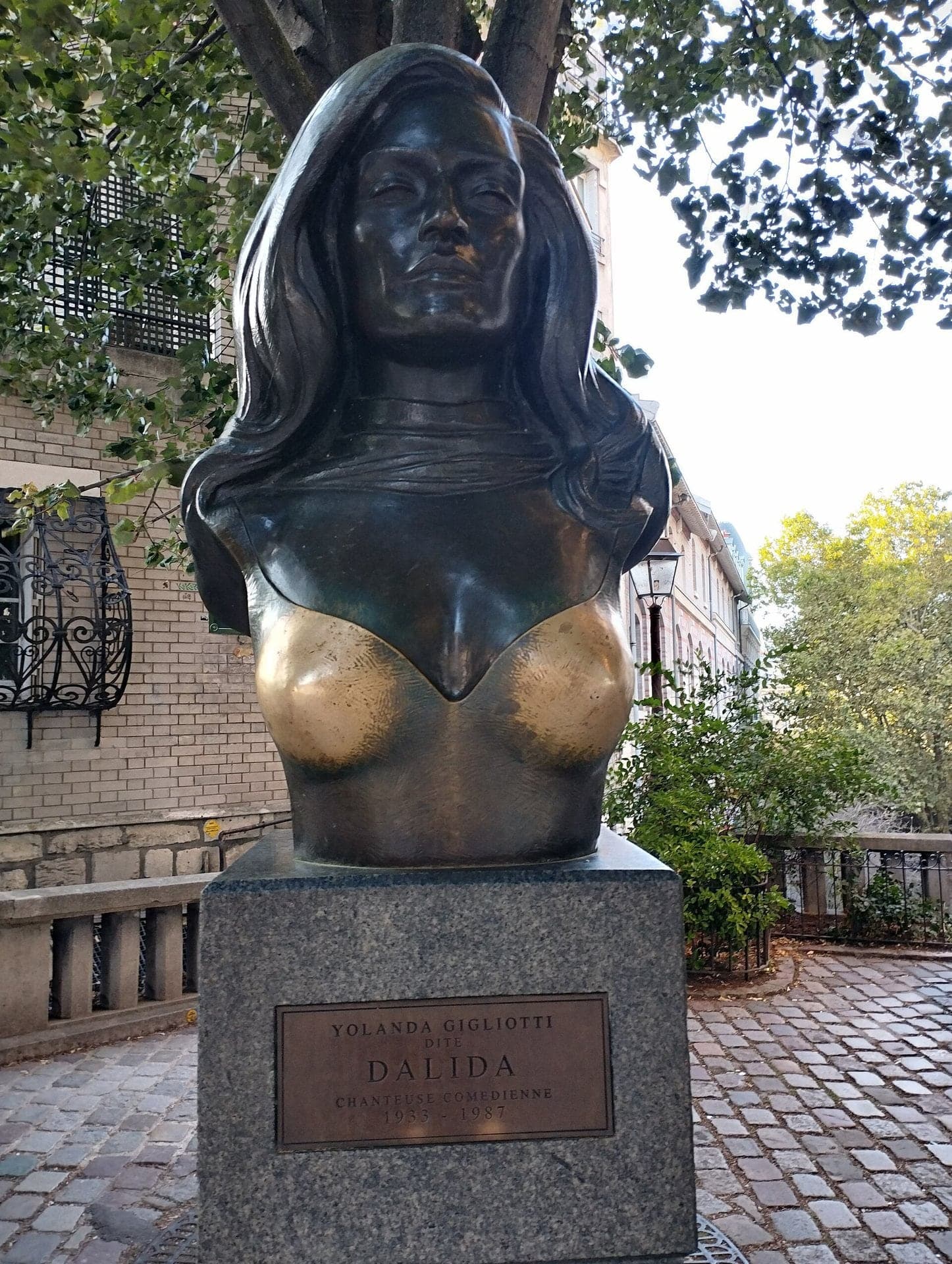
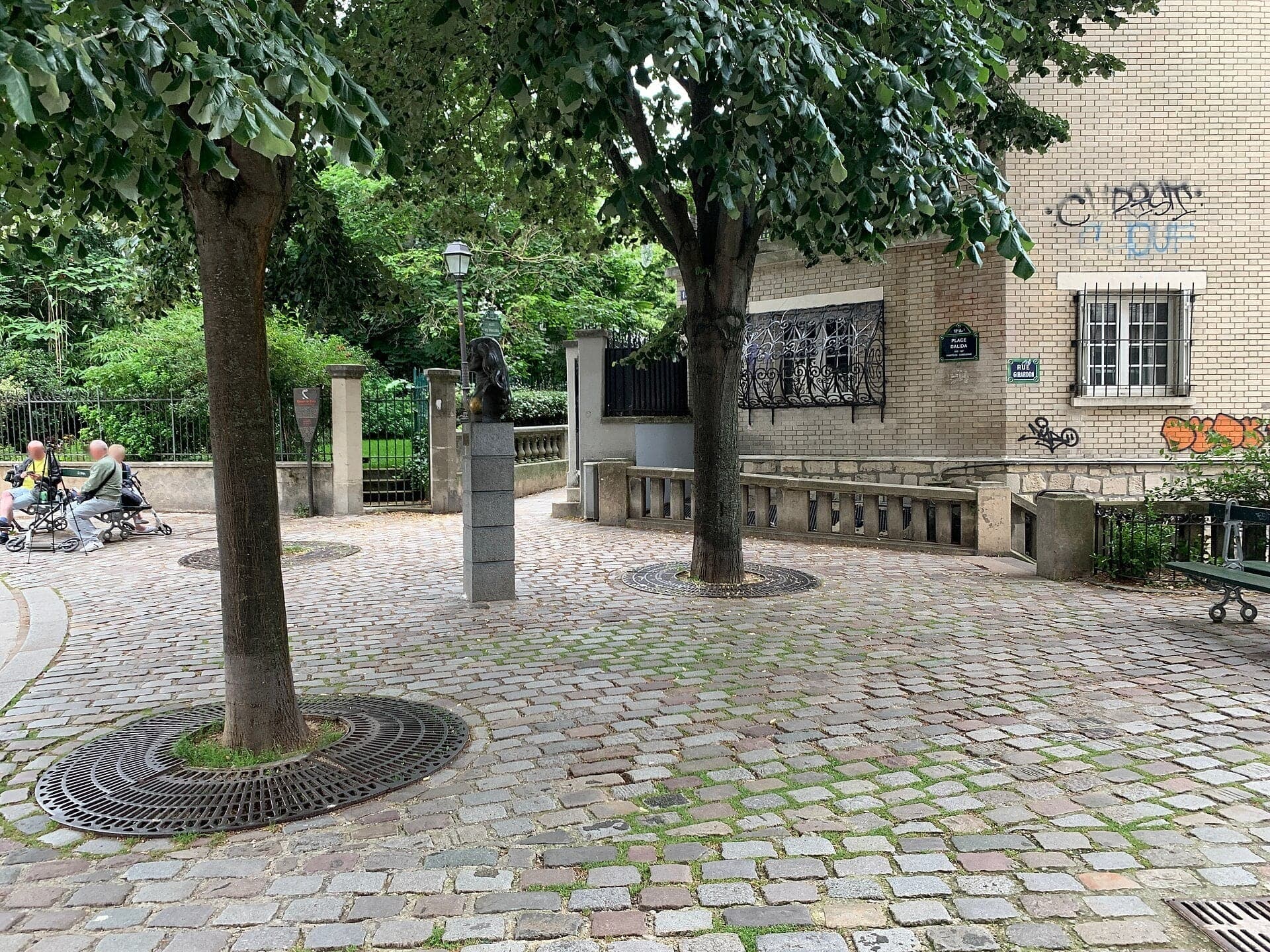
Place Dalida: First Sight of the Dome
Where the dome first shows. She lived a short walk away, and along the lane beside the square the white dome of the basilica first shows.
- 6
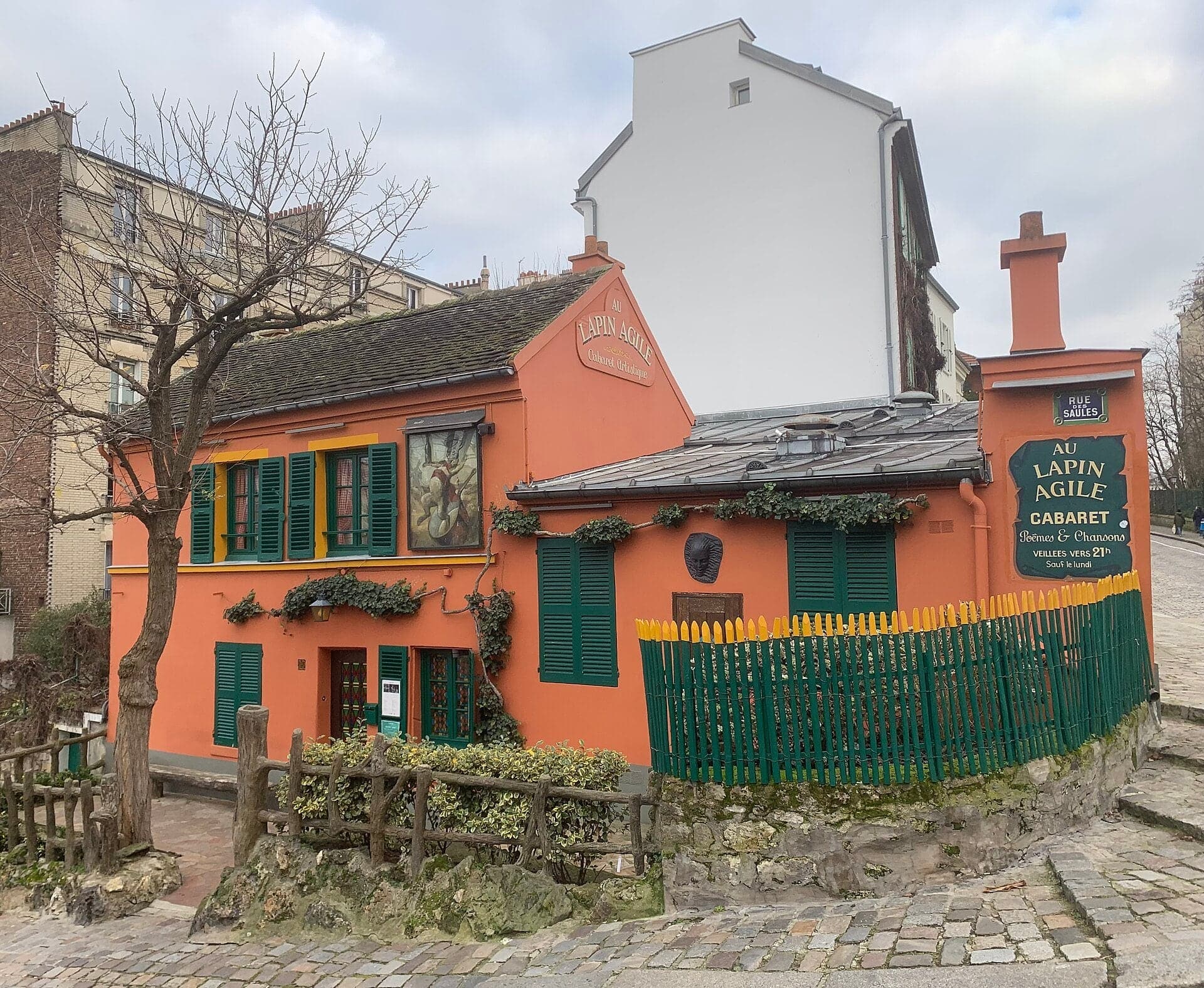
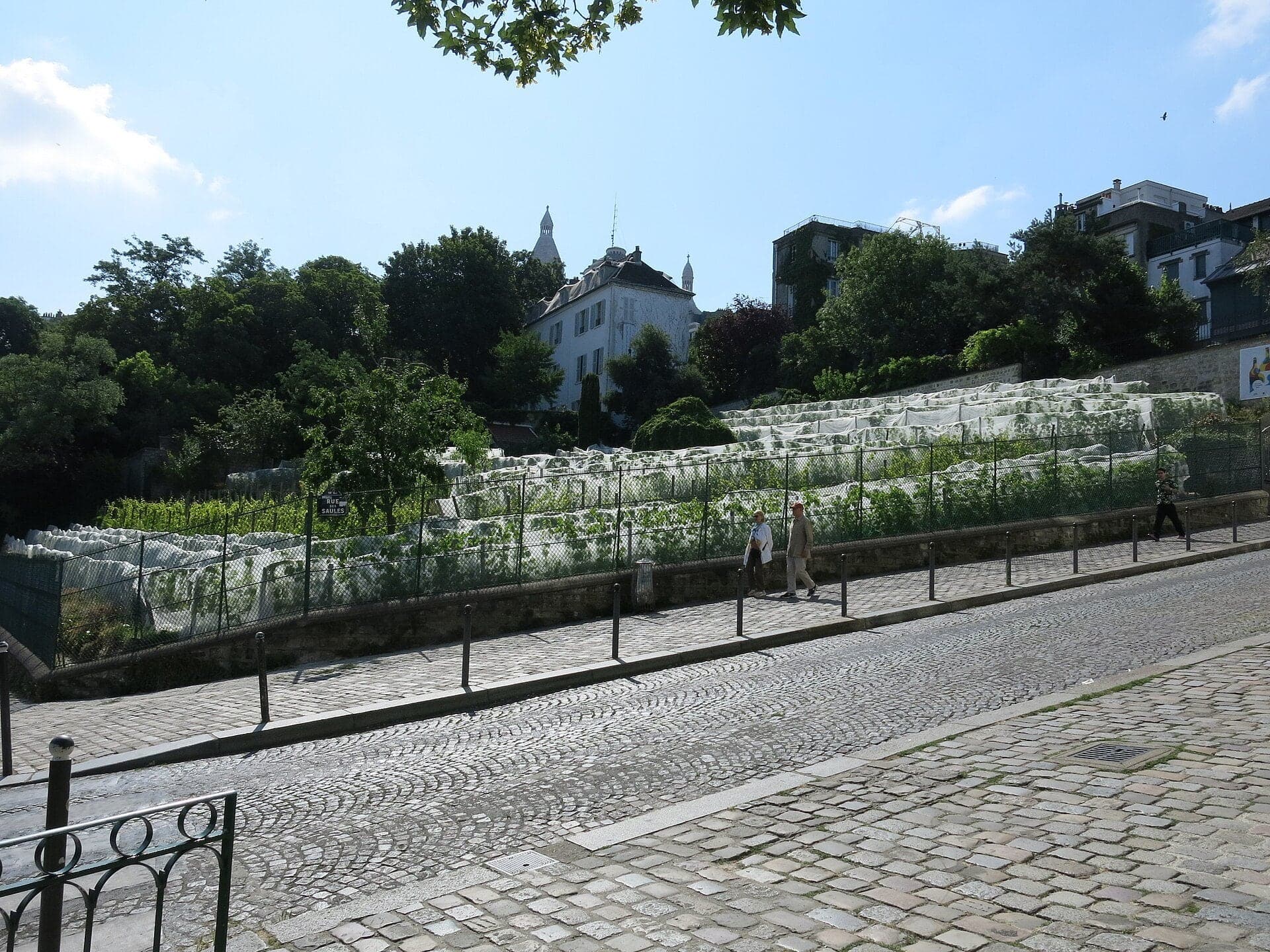
Lapin Agile and the Vineyard: Two Survivors
A cabaret and a 1933 vineyard. The rabbit on the Lapin Agile's wall is a copy of André Gill's sign; the Clos Montmartre vines replaced a waste ground.
- 7
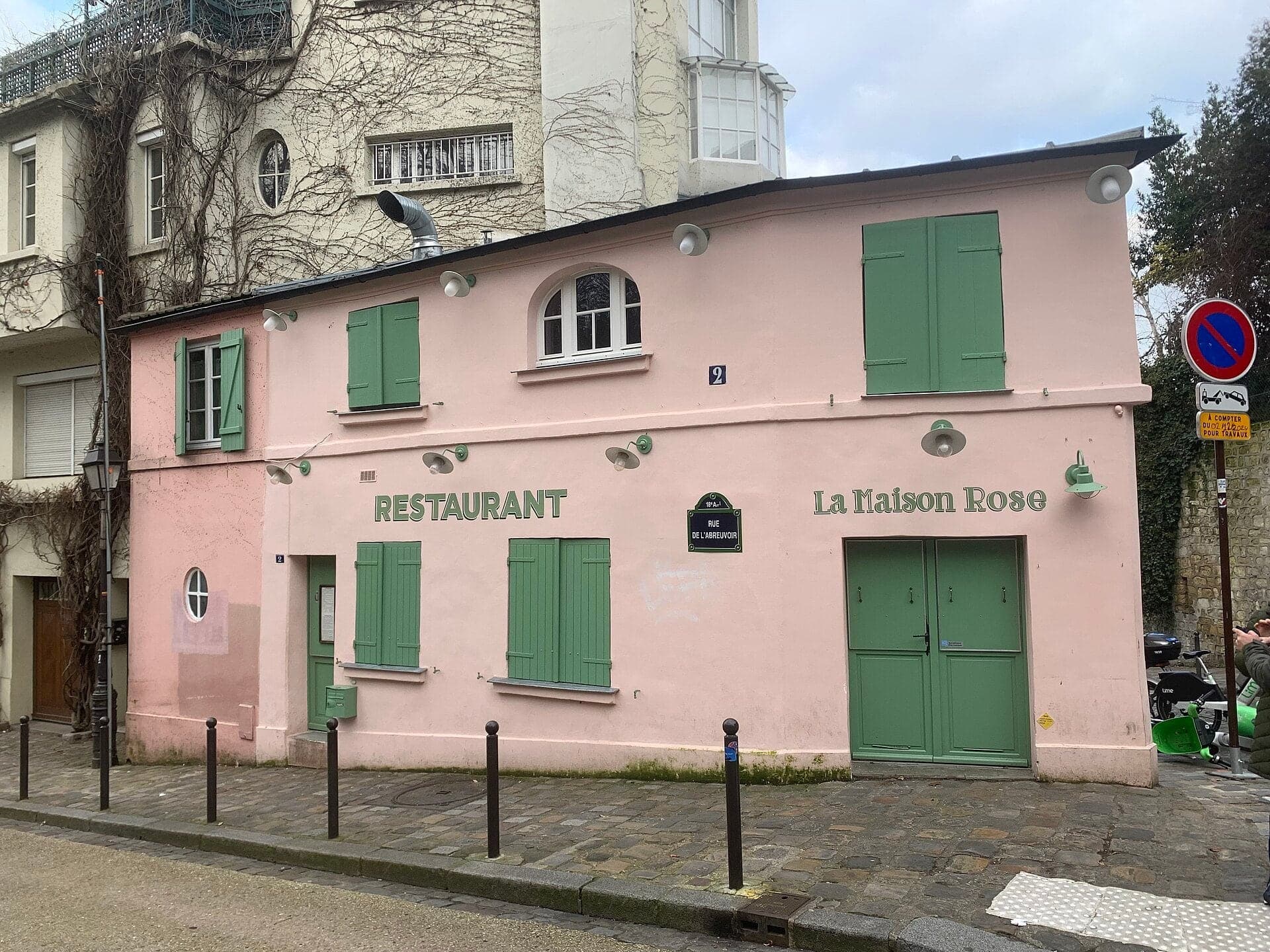
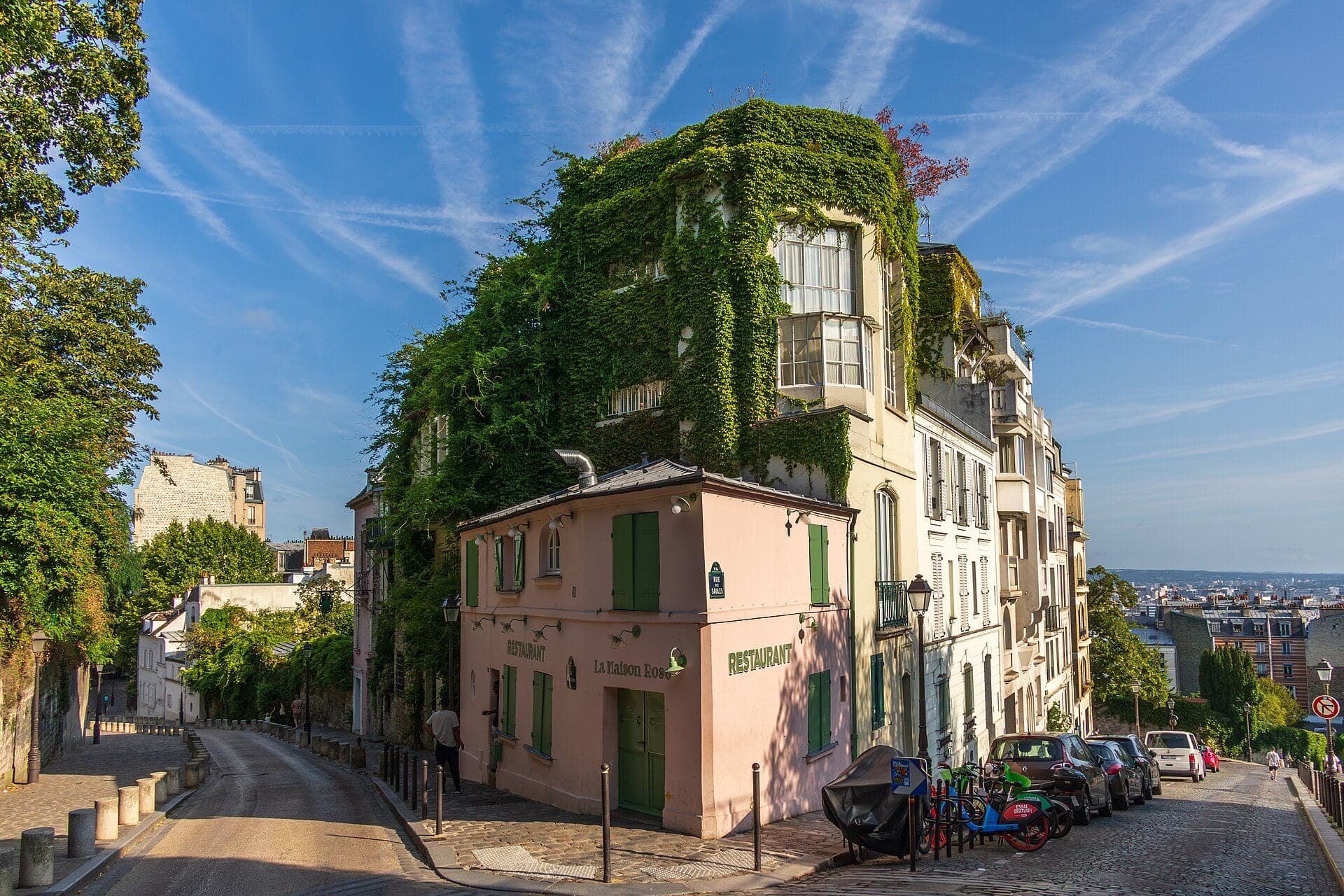
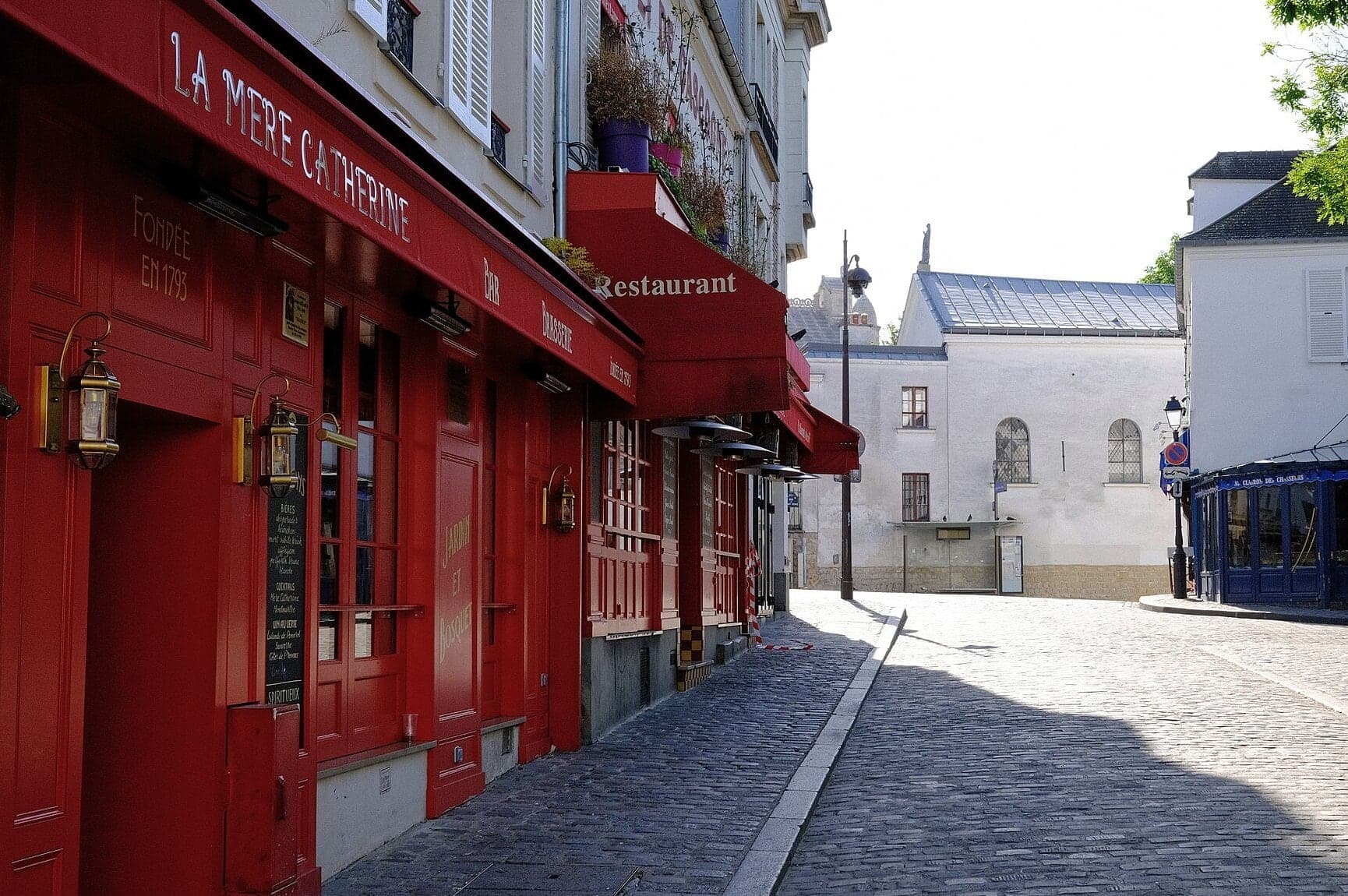
La Maison Rose: A Coat of Paint
A corner house painted pink. Its owners say it was painted pink in 1908, when it opened as a restaurant for the painters of the hill.
- 8
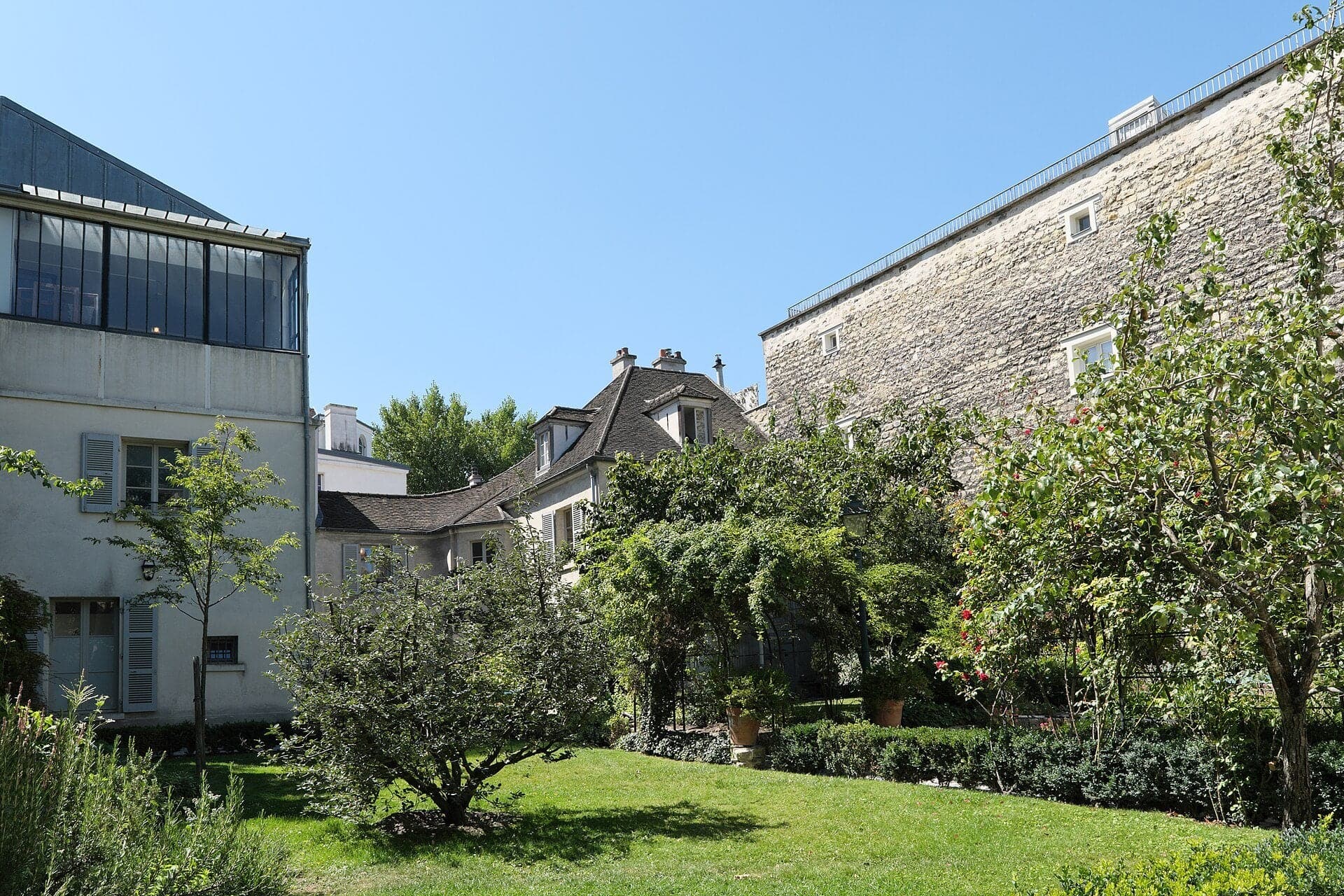
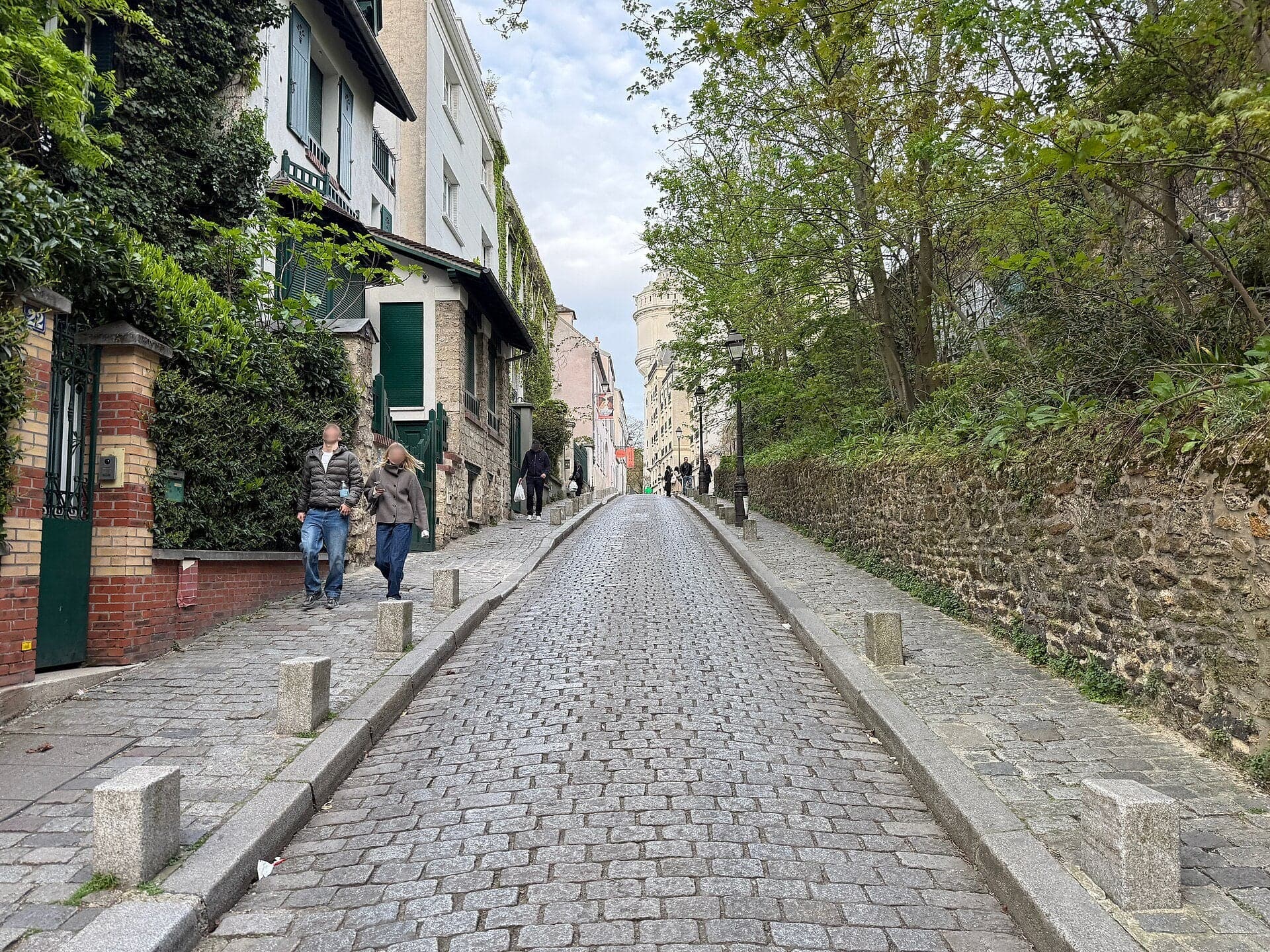
Rue Cortot: Renoir's House
The house where Renoir lived. Now the Musée de Montmartre, with gardens looking over the vineyard, on a narrow cobbled lane.
- 9
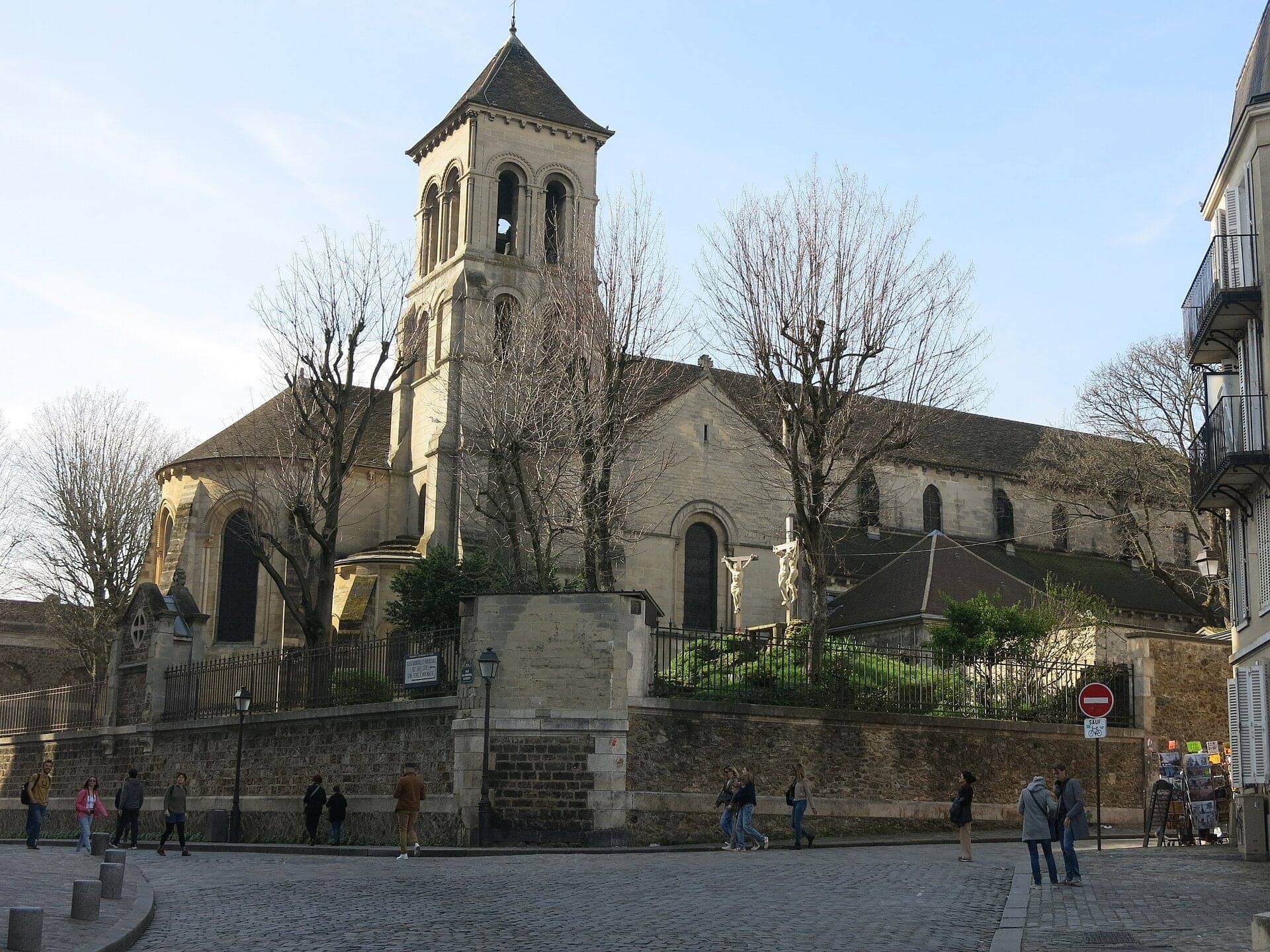
Place du Tertre: The Village and Its Abbey Church
The old village square and church. Licensed painters fill Place du Tertre, and Saint-Pierre de Montmartre, consecrated in 1147, was the church of the royal abbey.
- 10
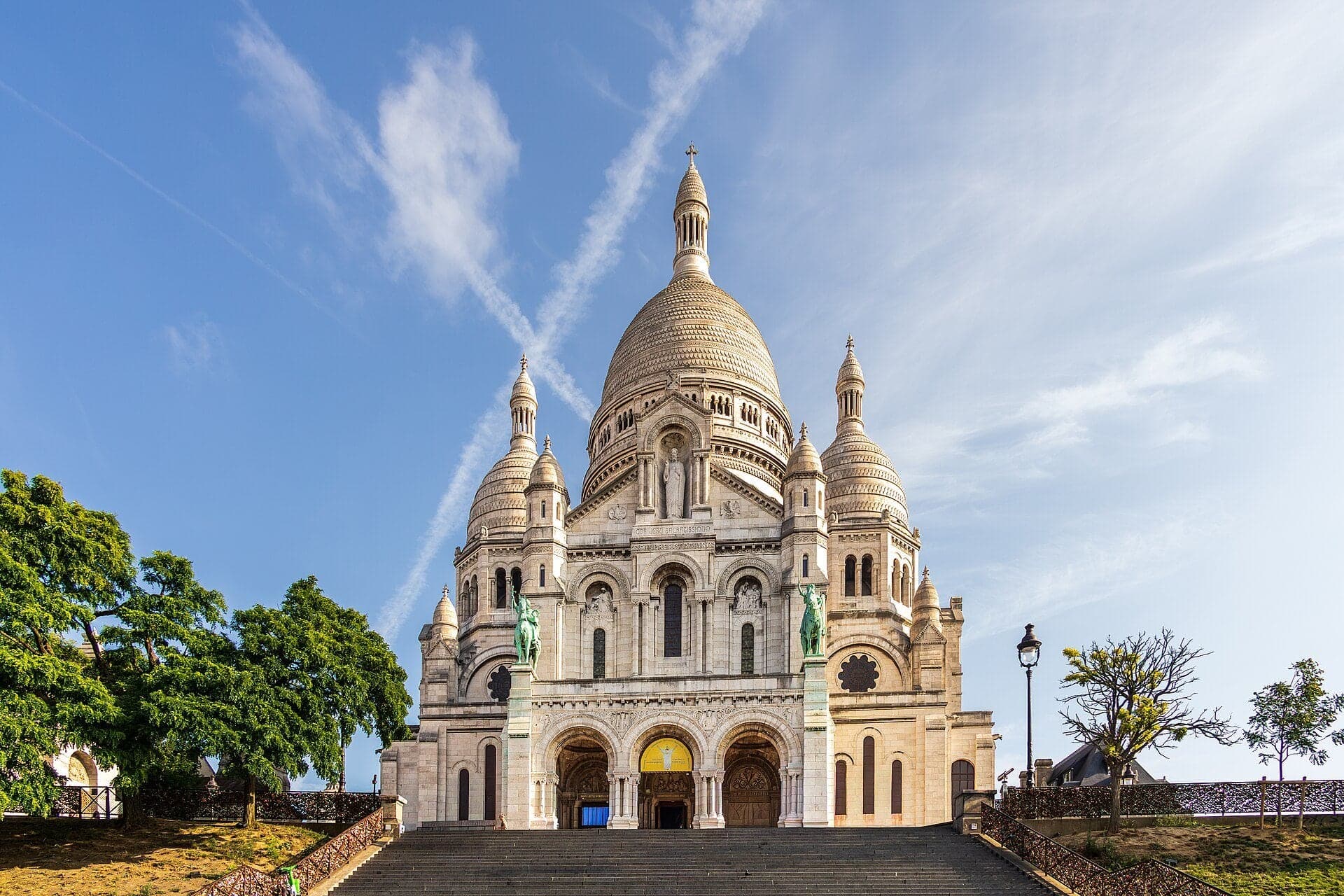
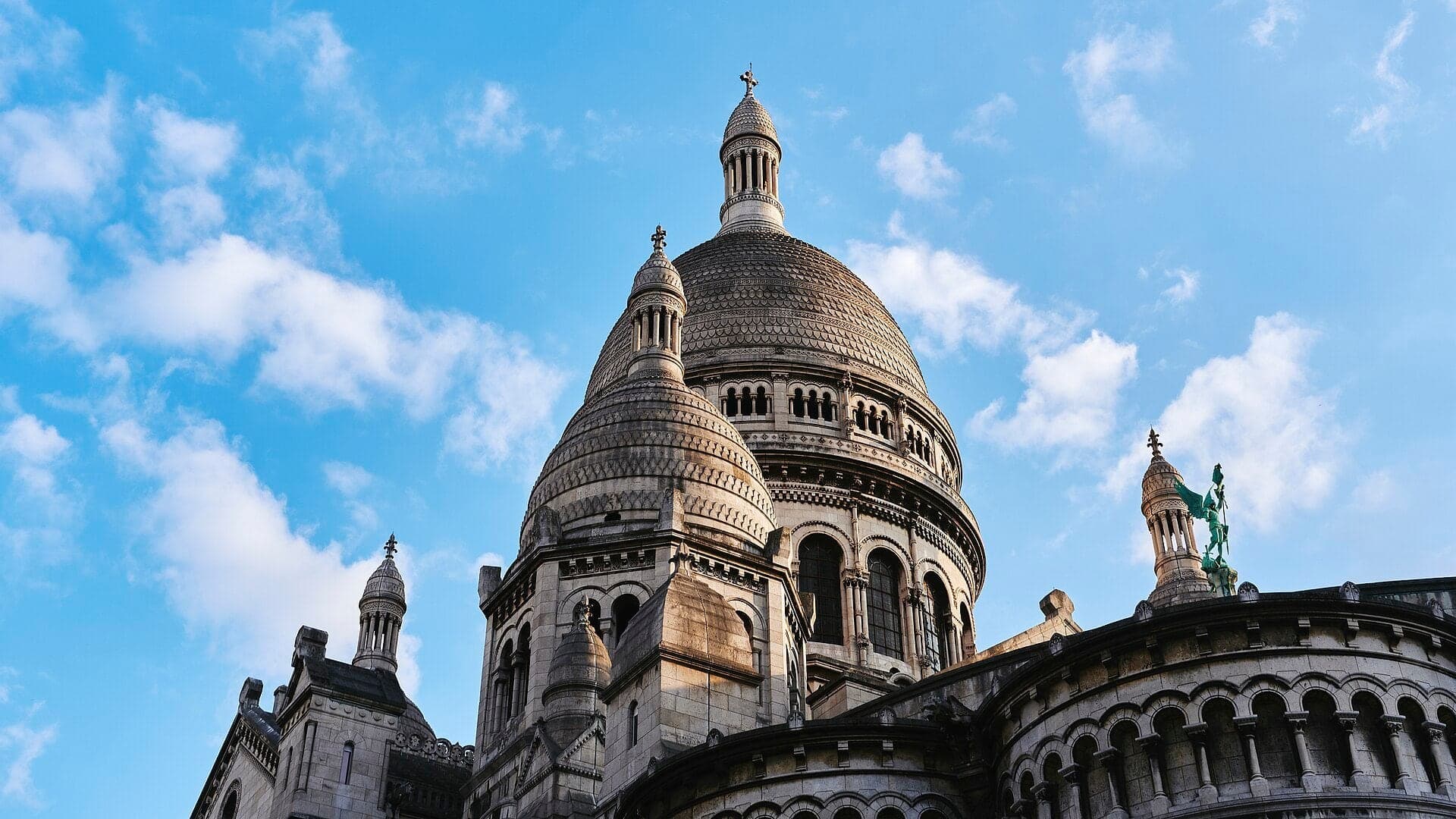
Sacré-Cœur: The Stone That Rain Makes White
Limestone that whitens in rain. Built from 1875 and consecrated in 1919, its limestone grows whiter in the rain, and it is free to enter.
- 11
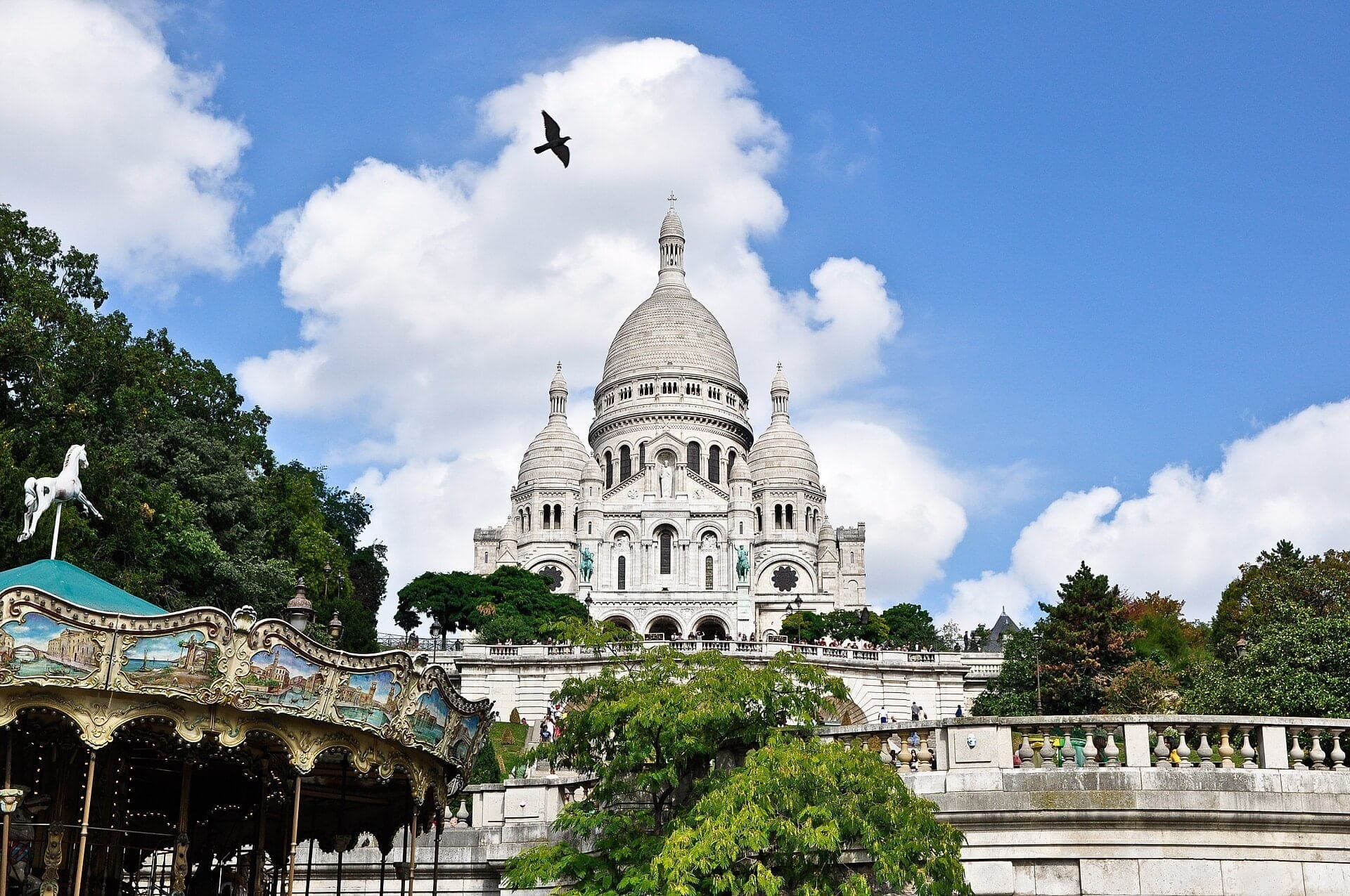
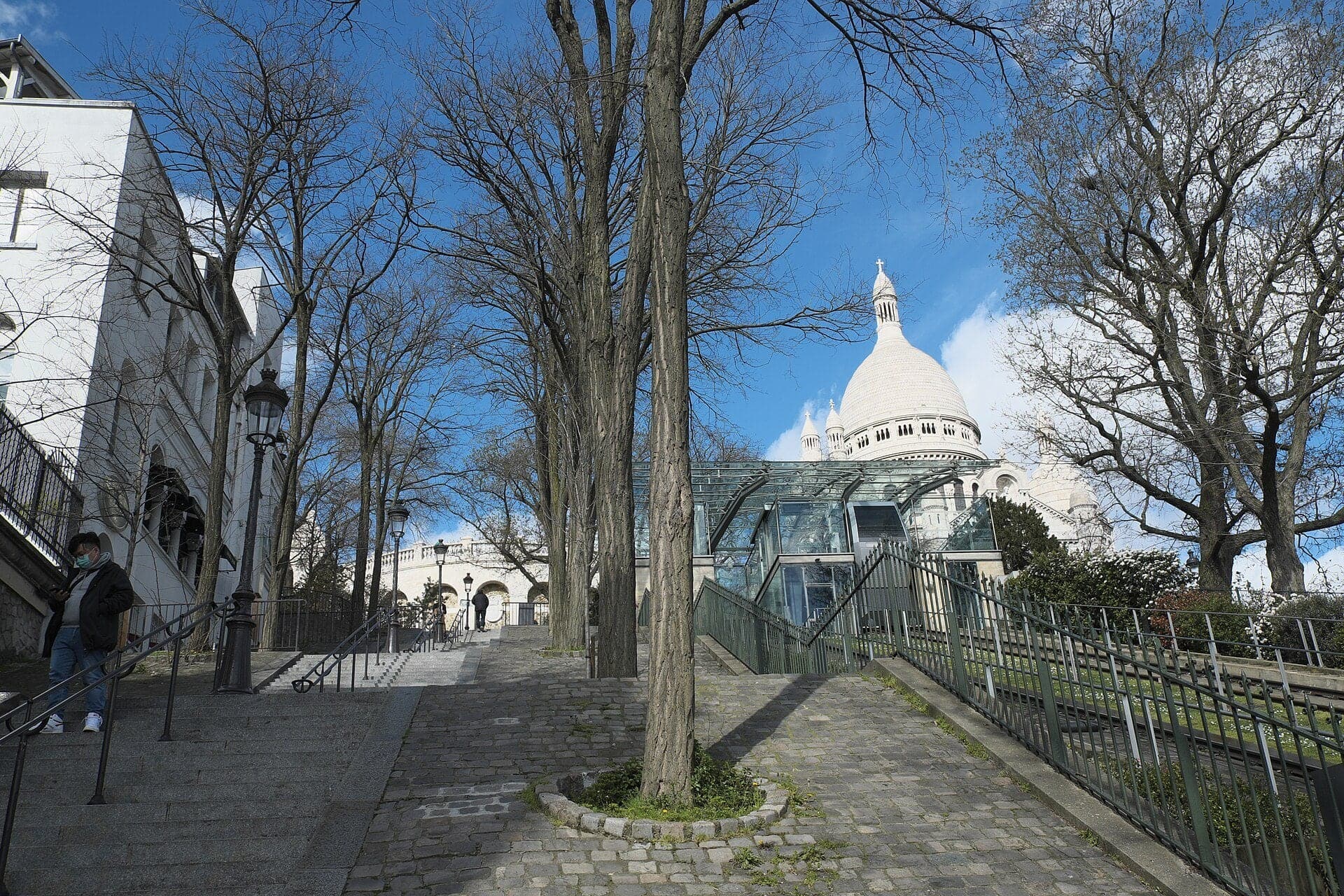
Foot of the Hill: The Whole Basilica
The whole basilica from below. Below the Rue Foyatier steps and the funicular, the square looks back up at the white domes over the trees.
Details
Best Time to Visit
A weekday morning, starting at about 9am to 10am, before the Place du Tertre and the basilica terrace fill up; the Musée de Montmartre opens at 10am and the Sacré-Cœur dome at 10.15am. Weekend afternoons are the most crowded. The Fête des Vendanges (7 to 11 October 2026) fills the lanes around the vineyard; outside those dates the upper streets are quieter. Trees screen some views while in leaf; from late autumn the basilica shows best from the foot of the hill.
Pro Tips
- •Getting to the start: Metro line 12 to Abbesses; the station's exit comes up beside stop 1. The platforms are very deep, so take the lift. Pigalle (lines 2 and 12) and Blanche (line 2) are about ten minutes' walk uphill. The walk ends near Anvers (line 2). Checked 7 October 2026.
- •The funicular beside the Rue Foyatier stairs is part of the metro network: a metro ticket rides it (a ticket already validated on the metro cannot be reused), and it is the step-free way up or down the hill. It runs from about 6am to about 12.45am but is sometimes stopped for maintenance. Checked 7 October 2026.
- •Bus 40, the Montmartrobus, crosses the top of the hill (stops Saules-Cortot and Mont-Cenis-Cortot) and is the step-free way to the upper village. Checked 7 October 2026.
- •Sacré-Cœur (stop 10): the basilica is free, open every day 6.30am to 10.30pm. The dome is 8 euros for adults and 5 euros for children, tickets on site only, open 10.15am to 5.30pm (last entry 5pm), nearly 300 steps and no lift. Modest dress and silence are asked; no photos in the nave. The great organ is under restoration until the end of May 2027. Checked 7 October 2026 at sacre-coeur-montmartre.com.
- •Musée de Montmartre (stop 8): open every day 10am to 6pm; museum and gardens 16 euros during an exhibition, gardens only 6 euros, free under 10. The Demarne Garden and the Café Renoir are closed on Saturday 10 October 2026. Checked 7 October 2026 at museedemontmartre.fr.
- •Saint-Pierre de Montmartre (stop 9): free; self-guided visits outside services; a guided visit in English every Friday at 3.30pm from September to June. Shoulders and knees covered, caps off. Checked 7 October 2026.
- •The Lapin Agile (stop 6) holds its shows on Tuesday, Thursday, Friday and Saturday from 9pm to 1am, in French. La Maison Rose (stop 7) is open Wednesday to Sunday for lunch, afternoon drinks and dinner, with reservations only through its website. Checked 7 October 2026.
Safety & Precautions
- •The Fête des Vendanges de Montmartre runs from 7 to 11 October 2026. On Saturday 10 October the harvest ceremony is held at the vineyard from 9.45am and a parade leaves at 11.45am: expect barriers, stalls and closures on Rue Saint-Vincent and Rue des Saules (stops 6 and 7), and follow any signed diversions. From Friday 9 October 9.30am to Sunday 11 October 10pm the basilica can be entered only by its east pavilion. Checked 7 October 2026.
- •This is a steep walk with steps and no step-free route on the climb: about ten steps into Place Émile-Goudeau (before stop 2), a flight of more than fifty steps after Place Dalida (stop 5), and more than two hundred steps on Rue Foyatier after the basilica. Use the handrails. The funicular is the step-free way down from the basilica.
- •There are no traffic lights on this walk. Rue des Abbesses, Rue Ravignan, the Rue Lepic corner, Rue Norvins, Rue de l'Abreuvoir and Rue Cortot carry cars and delivery vans, often with no real pavement: keep to the side and look both ways at every crossing.
- •Cobbles and steps are slippery when wet.
- •Place du Tertre, Place Dalida, the Maison Rose corner, the basilica terrace and the steps below it are crowded: watch your bags, decline portrait sellers politely, and walk on past anyone offering bracelets.
- •The Wall of I Love Yous in the Square Jehan-Rictus (stop 1) is closed for safety; the garden itself is open 8am to 6.30pm on weekdays and 9am to 6.30pm at weekends in October. Checked 7 October 2026.
- •The Clos Montmartre vineyard (stop 6) is not open to the public except on guided visits; the Bateau-Lavoir (stop 2) is working artists' studios. See both from the street.
- •Part of the Square Louise-Michel, the garden on the slope beside the Rue Foyatier stairs, is closed to the public for safety; stay on the stairs. Checked 7 October 2026.
- •Do not sightsee inside Saint-Jean, Saint-Pierre or the Sacré-Cœur during a service.
Travel advisory: Exercise Increased Caution (Level 2).
Gallery
Related Reading
Go deeper on what you'll see, hear, and walk through.

Overview
Best Self-Guided Walking Tours in Paris (2026)
4 min
Overview
One Day in Paris: A Walkable Right-Bank-to-Latin-Quarter Itinerary (2026)
5 min
Overview
Paris Travel Guide: How Many Days, Getting Around, When to Go (2026)
5 min
Thematic
Paris in Layers: How Five Centuries of Power Left the City We Walk
7 min
Read the walk
The full story of Montmartre and Sacré-Cœur: Windmills, Vines and White Stone, in words. Prefer to listen? Play it narrated, from home or on location.
Introduction
Paris, the capital of France, has a hill on its northern edge: Montmartre. It stands about a hundred and thirty metres above sea level, and until eighteen sixty it was not part of Paris at all, but a village with its own town hall.
Long before the painters came, the hill was put to work. It was quarried for gypsum, the soft rock that is baked to make plaster. Windmills turned along its ridge. Vines grew on its slopes for about a thousand years. Then came cheap studios, cabarets and dance gardens, and on the summit, a white basilica seen from all over Paris.
Much of what visitors come to see here is a stand-in: a metro entrance brought from the city center, a rebuilt studio front, a windmill with nothing inside, a copied sign, a replanted vineyard. The hill underneath is the real thing.
Three people appear along the way. Hector Guimard, who designed iron and glass entrances for the Paris metro in nineteen hundred. Pablo Picasso, who lived in a wooden studio building on the hill for five years. And Pierre-Auguste Renoir, who painted its open-air Sunday dances.
The walk is eleven stops over about one and a half kilometres, about a mile, and takes about seventy-five minutes. It climbs steeply, with many steps, from Place des Abbesses through the old village to the Sacré-Cœur, then goes down a long staircase to the foot of the hill.
1. Place des Abbesses: The Entrance That Moved
Welcome to Place des Abbesses, at the foot of the climb. Find the metro entrance in the square: green-painted cast iron, with a glass roof that rises in a shallow V over the stairs.
Hector Guimard designed it in nineteen hundred, for line one of the Paris metro, at the Hôtel de Ville station by the city hall, down in the center of Paris. In the early nineteen seventies an underground car park was dug there, the entrance was taken down, and it was put back up here. The line under this square was built by a rival company, which never used Guimard's designs at all. So the first thing you meet here came from somewhere else. It is one of the very few Guimard entrances that still has its glass roof.
The square takes its name from the abbesses of the old royal abbey on the hill. What is left of their abbey is a church near the top, and you will reach it later.
The famous Wall of I Love Yous is in the little garden behind the railings, but the city has closed it for safety for now.
Now look for the church. As you set off along Rue des Abbesses, its front comes into view ahead of you: brick, trimmed with glazed ceramic. This is Saint-Jean de Montmartre, built between eighteen ninety-four and nineteen oh four. The brick is not just a skin: brick and cement, reinforced together, carry the building, and the diocese of Paris calls it one of the first churches built in reinforced brick and cement. It is usually open in the daytime.
Keep those thin walls in mind. At the top of the hill, in the same years, another church was going up the old way, in massive white stone.
Follow the route along Rue des Abbesses, past the church front, and up the first steep street.
2. Bateau-Lavoir: Picasso's Studio, Rebuilt
Walk on up the last few steps into Place Émile-Goudeau and stop on the cobbles. Under the trees of this small sloping square, find the low building at number thirteen. This is the Bateau-Lavoir. Its nickname means a laundry boat.
Nobody is quite sure what it was built as. The French heritage register calls its origin uncertain, and records a locksmith and mechanic owning it in eighteen sixty-seven. In eighteen eighty-nine a new owner had it turned into artists' studios, built in wood.
Rents on the hill were low, and artists came. The Musée de Montmartre says the first painter settled here in eighteen ninety-two. Pablo Picasso lived here from nineteen oh four to nineteen oh nine, and painters and sculptors whose work now hangs in the world's great museums worked in the same rooms. The museum adds that from nineteen oh nine rents on the hill began to rise, as Montmartre filled with cabarets and visitors.
Now look again at the front. In May nineteen seventy the wooden building burned. What stands here was built in nineteen seventy-eight, and the heritage register says the front on the square is a restoration of the old one. Behind it, the City of Paris built twenty-five artists' studios. They are still working studios, so this is not a museum, and you cannot go in.
So the rooms where Picasso lived are gone. What you see is their face, put back. Remember him here: a painter in a cheap wooden studio. He will turn up again at a cabaret further up the hill.
Like the metro entrance, it is a stand-in.
Follow the route on up the hill, toward the windmills.
3. Moulin de la Galette: A Dance Between Two Mills
Walk on up to the corner where Rue Lepic meets Rue Girardon, and stop. Look up above the restaurant's arched front door: on the roof stands the body of a windmill, with its lattice sails.
Windmills once worked all along this ridge. There were two mills on this spot. The sails above this corner belong to the one called the Radet, and it is an empty shell. Its machinery was taken out long ago, and it now stands on top of a restaurant as a sign. The other mill, the Blute-fin, still stands in private grounds a little further up the street, out of sight from here.
Between the two mills there was an open-air dance garden. In eighteen seventy-six Pierre-Auguste Renoir moved to Montmartre and painted it: a crowded Sunday dance in a garden, the painting now called the Bal du Moulin de la Galette. It hangs today in the Musée d'Orsay. So Renoir's painting with this mill's name in its title shows not a mill but a dance. Remember Renoir, the painter of the dance: you will pass the house where he lived.
The hill hid another industry under the ground. It is riddled with old quarries, dug for gypsum, the soft rock that is baked to make plaster. Keep that in mind. It matters at the top.
The mill on the roof is the third stand-in on the walk: a real windmill body, with no mill left inside it.
Watch for delivery vans on this corner; there are no traffic lights on this walk, so look both ways at every little street.
Follow the route along Rue Girardon to a small square.
4. Place Marcel-Aymé: The Man in the Wall
Walk on to the edge of the small square, Place Marcel-Aymé, and stop. Across the square, set into the wall of the corner house at about head height, a bronze man is stepping out of the stone.
He comes from a story by the writer Marcel Aymé, who gives the square its name. It is about a quiet clerk living in Montmartre who discovers that he can walk through walls. In the story, the gift fails him at last, and he is left inside a wall.
It is a good joke for this hill, because Montmartre is a hill of walls. Look along the lanes around you: houses step up the slope on stone walls, garden walls run beside the pavements, and behind many of them are gardens you will never see. A street map shows the lanes; it does not show how much of the hill is hidden behind them.
The figure is easy to miss among parked scooters and passing groups, and it is a short walk across the square if you want a closer look. Come back to this spot before you go on.
Follow the route a little further along the ridge, to a small square with a bronze bust.
5. Place Dalida: First Sight of the Dome
Walk on to Place Dalida and stop by the bronze bust on its plinth. You arrive behind it. Its face looks the other way, so step round to the front if you want to see it, and mind the crowd that often gathers here. The square is named for Dalida, a singer who lived in a house a…
Full narration for this stop unlocks with the tour.
6. Lapin Agile and the Vineyard: Two Survivors
Walk on to the corner of Rue Saint-Vincent and Rue des Saules, and stop. Two things face you here. Ahead and to the left, a low house with a painted rabbit on its wall. Ahead and to the right, a slope of vines behind a green mesh fence on a low stone wall. The low house is the…
Full narration for this stop unlocks with the tour.
7. La Maison Rose: A Coat of Paint
Walk on up Rue des Saules to the corner of Rue de l'Abreuvoir, and stop on the pavement. The pink house on the corner, with green shutters, is La Maison Rose, the Pink House. Its owners tell the story this way. Around nineteen oh five a Catalan painter bought the house. In…
Full narration for this stop unlocks with the tour.
8. Rue Cortot: Renoir's House
Walk on along Rue Cortot, a narrow cobbled lane, and stop by the house at number twelve, behind its wall on your left, with grey-blue shutters. This is the Musée de Montmartre. It is ticketed, and well worth it: the house, its gardens, and a view over the vineyard you just…
Full narration for this stop unlocks with the tour.
9. Place du Tertre: The Village and Its Abbey Church
Walk on down to the corner of Place du Tertre, and stop by the church front. Two things share this spot. One is the square, full of easels, umbrellas and restaurant tables. The other is a cream stone church front with a triangular top and bronze doors, seen between the…
Full narration for this stop unlocks with the tour.
10. Sacré-Cœur: The Stone That Rain Makes White
Walk on to the corner of the open terrace in front of the basilica, and stop. The white front rises ahead and to the left: a porch of three arches, and above it, two riders on horseback. The Sacré-Cœur basilica is free to enter, every day, from early morning until late evening.…
Full narration for this stop unlocks with the tour.
11. Foot of the Hill: The Whole Basilica
Walk on down to the open square at the foot of the steps, and stop. Now turn round and look back up the hill. From here the whole basilica stands over the slope: the white domes above the trees, the porch you stood beside, the stone that the rain keeps washing. If the leaves…
Full narration for this stop unlocks with the tour.
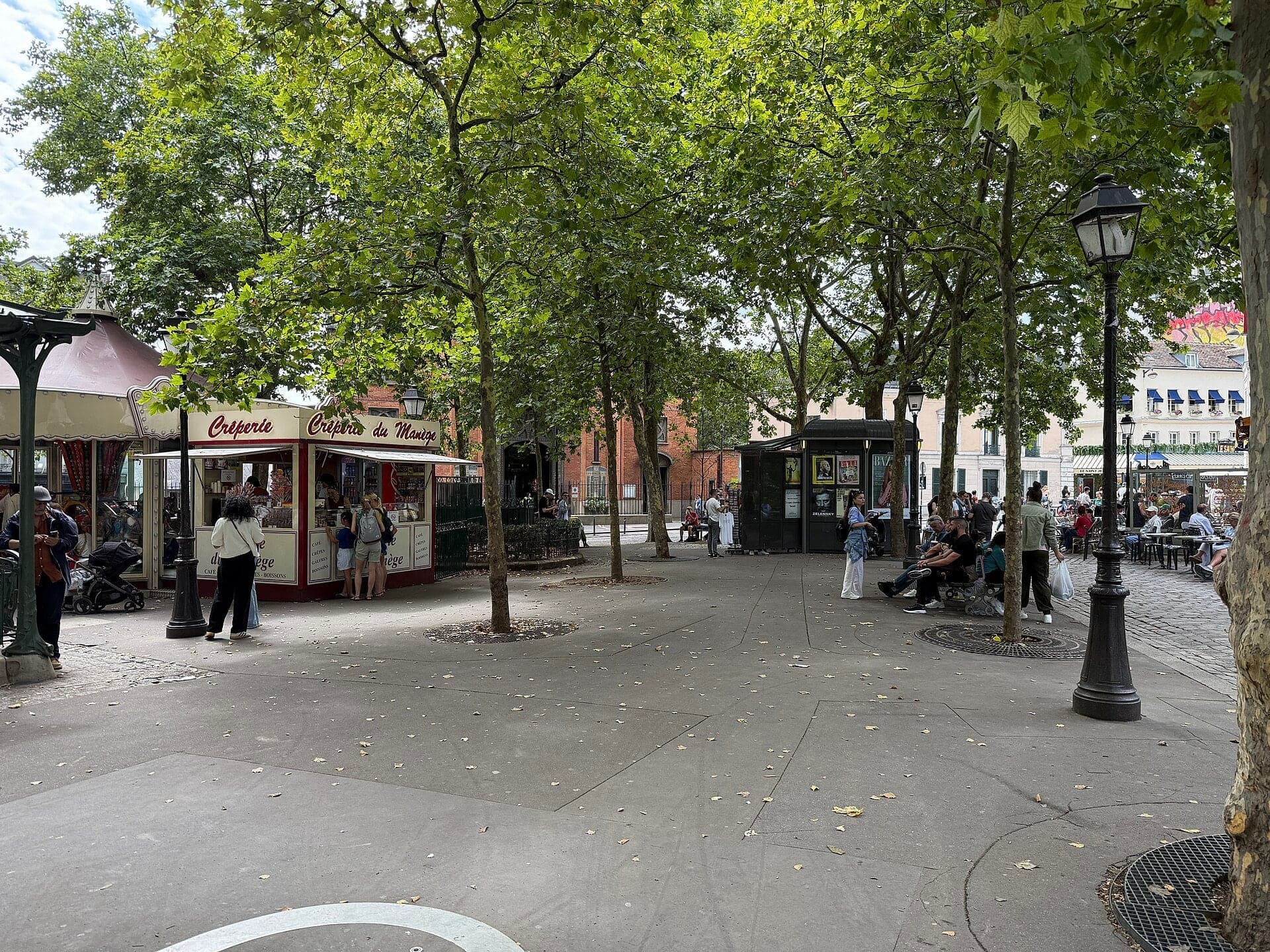
- Accès à la station Abbesses du métro de Paris, place des Abbesses, Paris. (stop: Place des Abbesses: The Entrance That Moved) — Chabe01, CC BY-SA 4.0 · source
- Place des Abbesses, Paris. (stop: Place des Abbesses: The Entrance That Moved) — Chabe01, CC BY-SA 4.0 · source
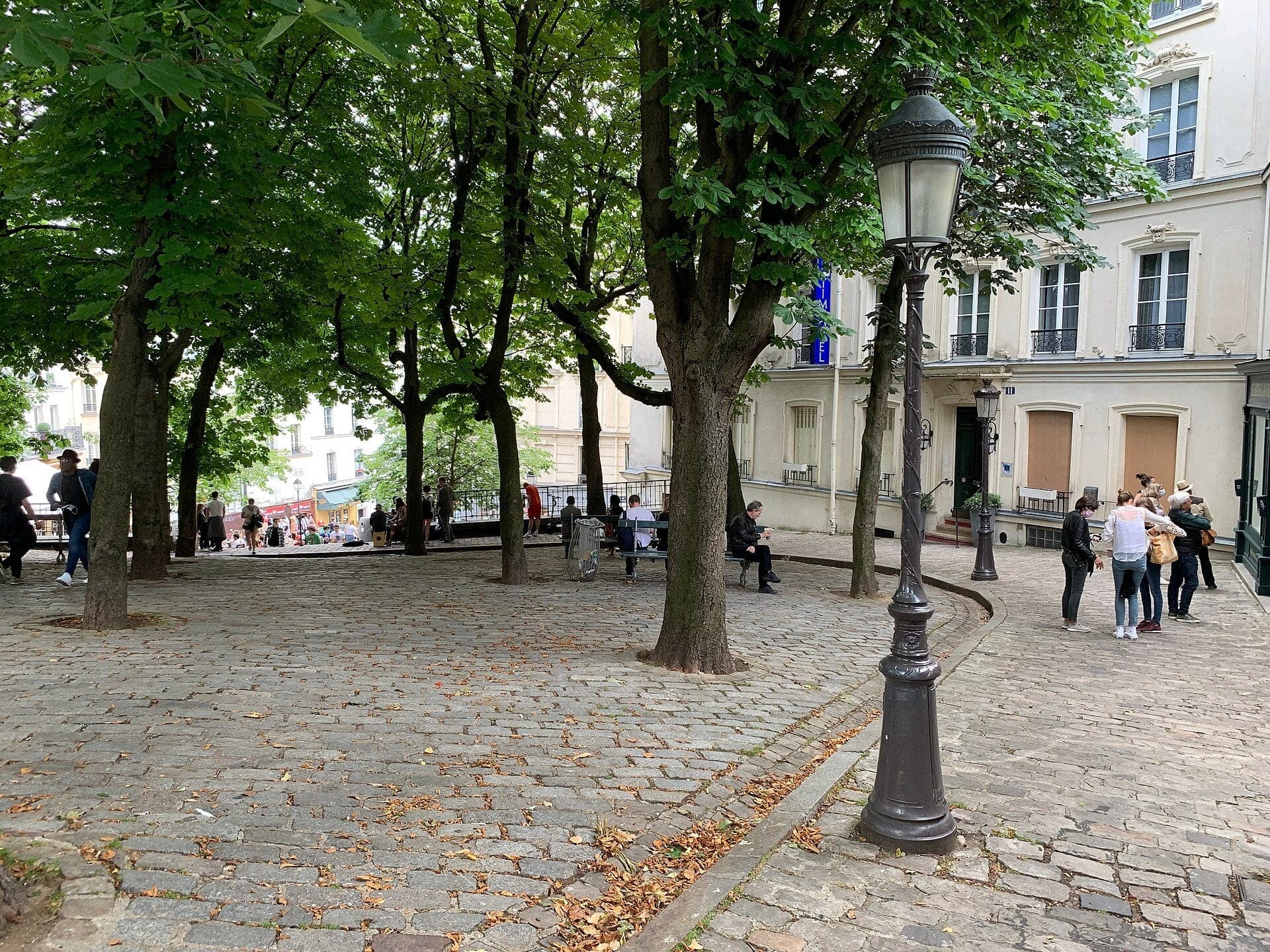
- Place Émile Goudeau, Paris. (stop: Bateau-Lavoir: Picasso's Studio, Rebuilt) — Chabe01, CC BY-SA 4.0 · source
- This picture was uploaded via app "Wiki Loves Monuments France". (stop: Moulin de la Galette: A Dance Between Two Mills) — Matthias_Süßen, CC BY-SA 4.0 · source
- Le Moulin de la Galette - Paris, France (stop: Moulin de la Galette: A Dance Between Two Mills) — Giorgio Galeotti, CC BY 4.0 · source
- Le Passe-Muraille @ Montmartre @ Paris 18 (stop: Place Marcel-Aymé: The Man in the Wall) — Guilhem Vellut from Paris, France, CC BY 2.0 · source
- Place Marcel-Aymé avec, à gauche, un panneau historique de la ville de Paris et, à droite, une sculpture de Jean Marais représentant le "Pas — Mbzt, CC BY-SA 4.0 · source
- Place Dalida, Paris. (stop: Place Dalida: First Sight of the Dome) — Chabe01, CC BY-SA 4.0 · source
- La Maison Rose Montmartre (stop: La Maison Rose: A Coat of Paint) — Matthias Süßen, CC BY-SA 4.0 · source
- Musée de Montmartre im 18. Arrondissement in Paris (Région Île-de-France/Frankreich), Jardins Renoirinks Atelier-Appartement von Suzanne Val — GFreihalter, CC BY-SA 4.0 · source
- Rue Cortot, Paris. (stop: Rue Cortot: Renoir's House) — Chabe01, CC BY-SA 4.0 · source
- Fujifilm x100v (stop: Place du Tertre: The Village and Its Abbey Church) — madras91, CC BY 2.0 · source
- This picture was uploaded via app "Wiki Loves Monuments France". (stop: Sacré-Cœur: The Stone That Rain Makes White) — Matthias_Süßen, CC BY-SA 4.0 · source
- Basilique du Sacré-Cœur de Montmartre, Paris. (stop: Sacré-Cœur: The Stone That Rain Makes White) — Øyvind Holmstad, CC BY-SA 4.0 · source
- Basilique du Sacré-Cœur de Montmartre, Paris (stop: Foot of the Hill: The Whole Basilica) — CEllen, CC BY-SA 4.0 · source
- Treppe im 18. Arrondissement in Paris (Île-de-France/Frankreich) (stop: Foot of the Hill: The Whole Basilica) — GFreihalter, CC BY-SA 3.0 · source
- Bateau-Lavoir (stop: Bateau-Lavoir: Picasso's Studio, Rebuilt) — By Lapady, CC BY-SA 3.0 · source
Images may be cropped or resized. Other photos via Unsplash and Pexels.