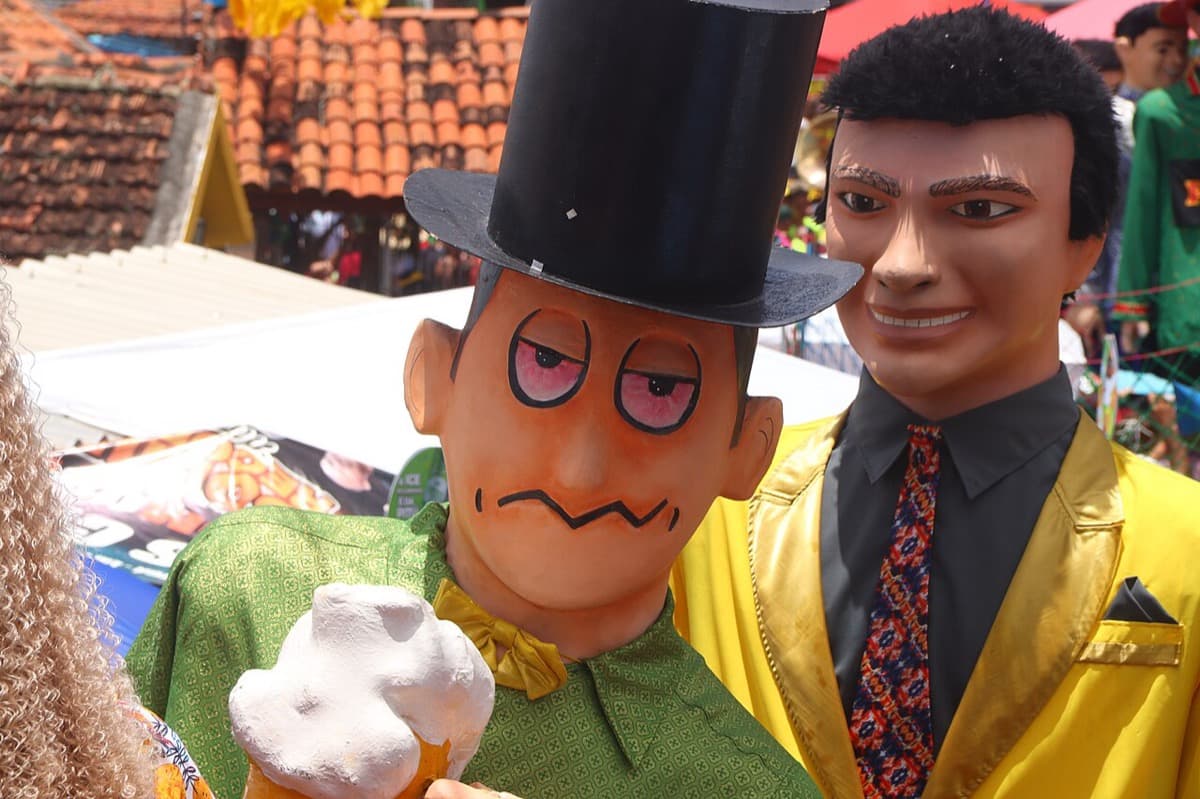
In Olinda, the oldest Carnival giant opens the festival at exactly midnight, and the Homem da Meia-Noite is rooted in Afro-Brazilian faith through the brotherhood church it steps out beside. He is about four meters tall, dressed in green and white, with a watch on his lapel and the key to the city in his hand. On Carnival Saturday, when the clock turns over, this towering papier-mache figure moves out of a quiet corner of the historic hill and starts the party. Everything else in Olinda's famous street Carnival follows him.
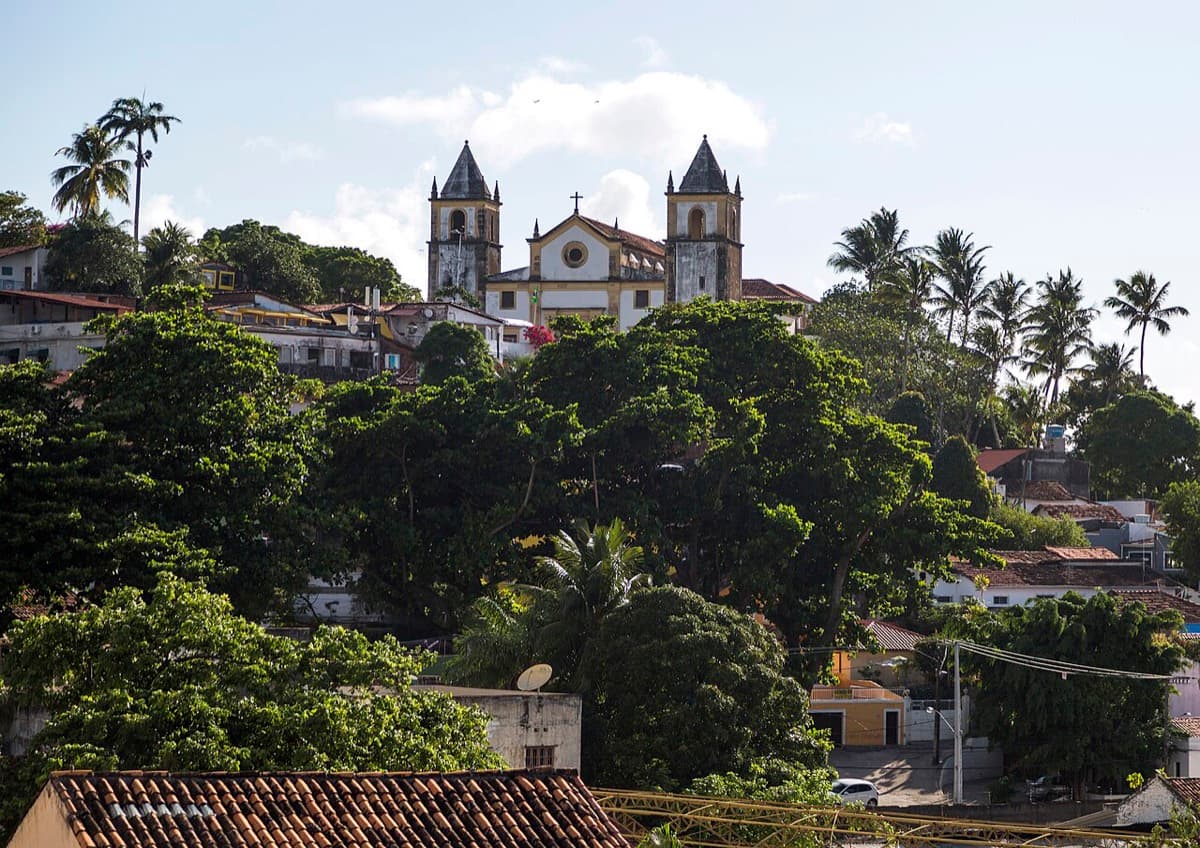
To understand why he matters, you have to look at where he lives rather than only at how tall he is. The Homem da Meia-Noite, the Midnight Man, has his headquarters on the Largo do Bonsucesso, facing the church of Nossa Senhora do Rosario dos Homens Pretos. That church is described as the first in Brazil to belong to a Black brotherhood, an irmandade of Black men. The brotherhood is referenced from the middle of the fifteen hundreds, and the church itself is well documented from sixteen twenty-seven. So the town's most beloved Carnival giant does not step out from a generic square. He steps out beside a building raised and kept by people who were enslaved and their descendants, a place of worship and mutual aid built when few other doors in colonial Brazil were open to them.
A Giant Built to Be Carried
The scale of these figures is easy to underestimate until one is coming down the street toward you. Olinda's modern giant puppets, the bonecos, stand between three and four meters tall, higher than any doorway on the streets where they parade. And yet a hollow figure that size can weigh as little as around twenty kilograms, with heavier ones running up to about fifty. That balance is the whole point. A single person climbs inside, lifts the frame onto their shoulders, and carries it through the crowd for hours, dancing it up and down the slopes.
They reach that lightness through layered construction. The giants are built up from fabric, paper and papier-mache, styrofoam, wood, fiberglass and aluminum, shaped and painted by hand. Traditional paste and armature meet modern lightweight materials so that a figure taller than a house can be worn like a costume. If you walk the Rua do Amparo a few streets over, you can see where this work happens: colonial houses turned into open artists' workshops, where masks and Carnival giants take shape year-round behind the walls. The Homem da Meia-Noite is not a one-off spectacle. He belongs to a living craft tradition that Pernambuco has kept alive by hand.
Why Midnight, and Why He Goes First
Hear a stop from this walk
The Rosario dos Homens Pretos: Home of the Midnight Man
The Midnight Man is the oldest giant puppet of Olinda, and there is a story in his timing. English Wikipedia records the block as founded on February second, nineteen thirty-one, in the early nineteen thirties, and its calunga, the great puppet, first paraded in nineteen thirty-two. From the start, its founders wanted him at the front of Carnival. They had broken away from an older, rival block, the Cariri Olindense, after an internal dispute, and they chose the midnight hour so their new giant would open the festival before anyone else. By stepping out at exactly midnight on Carnival Saturday, the Homem da Meia-Noite claimed the very first moment of the party for himself.
What makes the story more than a rivalry is how it resolves each year. After his own parade winds through the old town, the Homem da Meia-Noite passes by the Cariri headquarters and hands over the key to the city so that the rival block can open its own procession. That is why he carries the key in his hand: it marks both who opens Carnival and the partnership the two blocks keep despite their old split. Every February the giant reenacts the gesture, opening the party and then passing the key along.
Rooted in Afro-Brazilian Faith
The colors and the dates carry meaning too, and here the giant's link to the Rosario dos Homens Pretos becomes literal. His wooden calunga first paraded on February second, a day that honors Iemanja in Afro-Brazilian tradition. His companion figure, the Woman of the Day, wears yellow and blue in reference to Iemanja and Oxum. These are not decorative choices. They tie the giant to the same religious world that built the brotherhood church he stands across from, a world where the sea goddess and the goddess of rivers and love are named and honored.
In two thousand six, the state of Pernambuco recognized the Homem da Meia-Noite as Patrimonio Vivo, living heritage. That designation treats the giant not as a museum object but as an ongoing cultural practice worth protecting, the same way a master craftsman or a musical tradition can be named living heritage. It affirms what the walk around him makes plain: this is a tradition that is still being carried, literally, on someone's shoulders every February.
Standing Where He Steps Out
Visit off-season and the Largo do Bonsucesso is quiet. The church door is shut or barely open, the square is empty, and there is no crowd to press against. That emptiness is worth using. Stand where four meters of green and white step out into the dark, and hold the geography in your mind: the Black brotherhood church at your back, the workshops of the Amparo a few slopes away, the crossroads where the frevo boils up through the hills. The Homem da Meia-Noite gathers all of it into a single figure and a single moment. When the clock turns over, he goes first, and Olinda's Carnival begins.
The tour that ends here, on the hill in Olinda, walks you up from the gateway square, past the summit view and the giant-makers' street, to this last quiet door. Come during Carnival and you fight the crowd. Come any other day and you get the whole story to yourself.
Sources
- O Homem da Meia-Noite, English Wikipedia. Founding on February 2, 1931 after an internal split from Cariri Olindense, the doll in place by 1931 to 1932, the key handover to Cariri, the Woman of the Day's yellow and blue for Iemanja and Oxum, and the two thousand six intangible-heritage recognition of Pernambuco.
- Homem da Meia-Noite, Patrimonio Vivo de Pernambuco (Governo de Pernambuco / press coverage). About four meters tall, the oldest giant puppet of Olinda, green and white with a watch on the lapel and the city key in hand, midnight exit on Carnival Saturday from the Largo do Bonsucesso, and the wooden calunga's first parade on February 2, 1932.
- Igreja de Nossa Senhora do Rosario dos Homens Pretos (Olinda), Portuguese Wikipedia. The first church in the country belonging to a brotherhood of Black people, the brotherhood referenced from the middle of the sixteenth century, and the church well documented from sixteen twenty-seven.
- Boneco de Olinda, Portuguese Wikipedia. Construction of the bonecos gigantes: three to four meters tall, twenty to fifty kilograms, built from fabric, styrofoam, paper, wood, fiberglass and aluminum, hollow so one person can carry them.
- Frevo, performing arts of the Carnival of Recife, UNESCO Intangible Cultural Heritage (inscribed 2012). Context for the Recife-born rhythm that fills Olinda's street Carnival.
Brazil eSIM· 10% off with ROAMER10
Ready to experience it?
Carnival Town: Giants, Frevo, and the Steep Streets
90 min · 2.75 km · moderate
More from Olinda
Explore more at your own pace.
Olinda Travel Guide: How Many Days, Getting Around, When to Go (2026)
One Day in Olinda: A Walkable Hilltop Itinerary (2026)
Olinda vs Recife: Which to Stay In, and How to See Both
Olinda: The Hill the Dutch Burned and the Portuguese Rebuilt
What to Eat in Olinda: A Pernambuco Food Guide (2026)