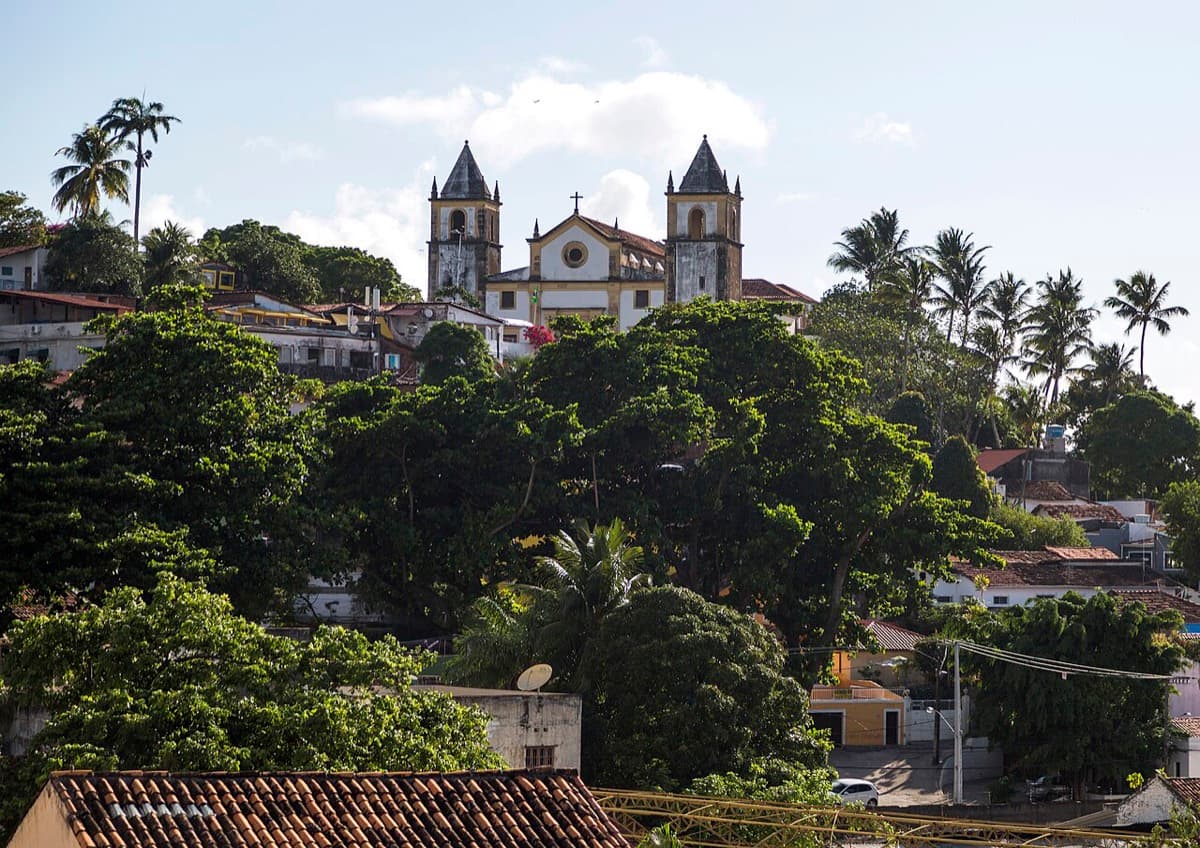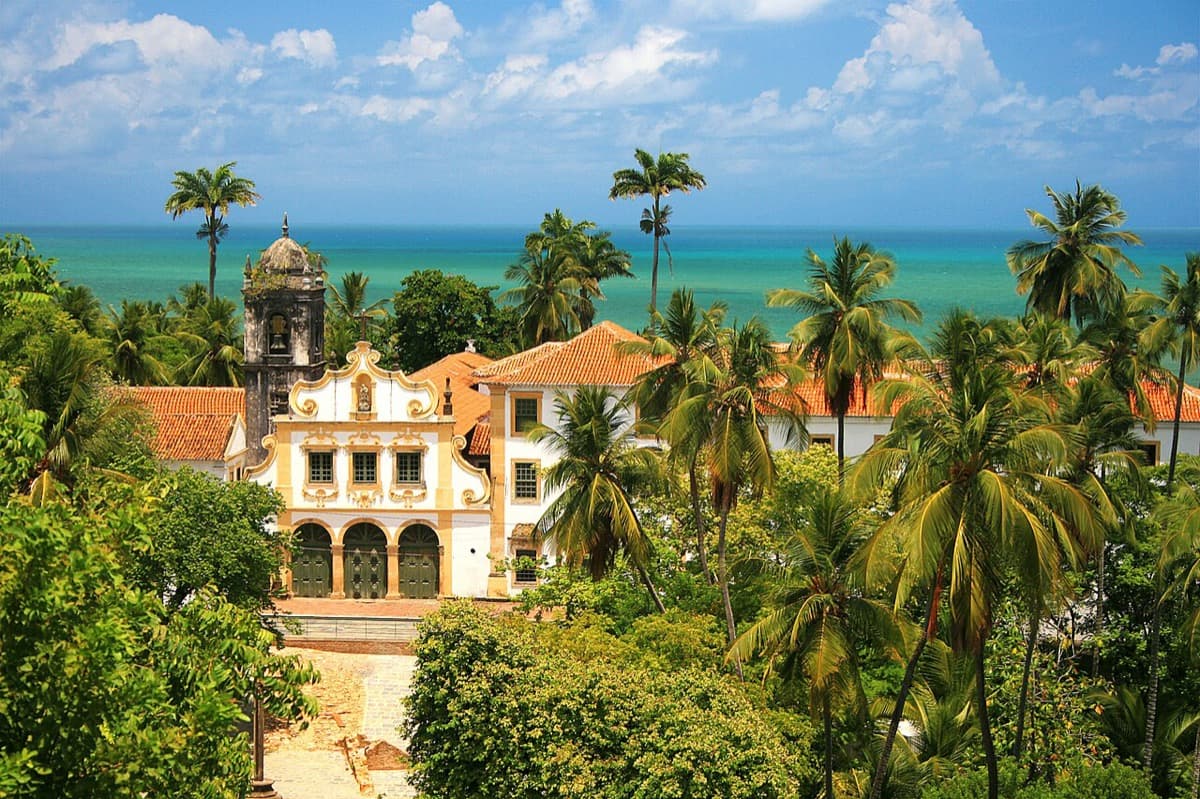
The Convento de São Francisco in Olinda is the oldest Franciscan convent in Brazil, and once you learn to read its blue-and-white azulejo cycles, its gilded carving, and its burned-then-rebuilt walls, you can read the entire convent hill around it. Construction began in 1585, to a design by the friar Francisco dos Santos, which makes this the first Franciscan foundation planted in Brazilian soil. It sits on a slope facing the sea in Olinda, in the northeastern state of Pernambuco, and it is not a single church but a small assembled world: the church of Nossa Senhora das Neves, the chapel of São Roque, a cloister, and a sacristy. Understanding how those pieces were built, destroyed, and put back together is the shortest route into the whole ridge.
A convent, not a church
The first thing to correct is the word church. A convent is a machine for a way of life, and its plan reflects that. The church of Nossa Senhora das Neves handles public worship. The cloister, a square walkway around an open court, organized the friars' daily circulation and gave them a sheltered, shaded loop in a hot climate. The sacristy staged the vestments and vessels for the altar. The chapel of São Roque handled a smaller, separate devotion. Read the complex this way and it stops being a pile of pretty rooms and becomes a diagram of Franciscan routine: worship, circulation, preparation, private prayer, each with its own room.
That functional logic matters because it explains why the decoration lands where it does. The most concentrated ornament is in the cloister, the nave, and the sacristy, exactly the spaces the friars used most and the ones visitors were meant to move through. The building spends its richness where it teaches.
Reading the azulejos
Hear a stop from this walk
Catedral da Se: The Cathedral Crowning the Sea View
The convent is celebrated above all for its azulejos, the Portuguese blue-and-white tin-glazed tiles that run in panels through the cloister, the nave, and the sacristy. Heritage records describe this as one of the major tile cycles in the state, and a series in the cloister narrates the life of Saint Francis. That last point is the key to reading them. These panels are not wallpaper. They are a sequence, meant to be walked past in order, each frame advancing a story the way a comic strip does. A friar circling the cloister was reading a biography with his feet.
The engineering behind the color is worth pausing on. Azulejo blue comes from cobalt oxide painted onto a raw tin-glazed surface, then fired so the pigment fuses into the glaze rather than sitting on top of it. That is why these panels survive centuries of tropical humidity and still read crisply: the image is glass, not paint. Portuguese workshops mass-produced these tiles and shipped them across the Atlantic as flat-packed panels, numbered for reassembly on site. The cloister you walk is, in a real sense, a Lisbon product installed in Brazil.
Burned, then rebuilt
Now the detail that ties this convent to every other building on the hill. In 1631, during the Dutch invasion of Olinda, the convent was partly destroyed. The fire that swept the town gutted much of the church fabric, and what stands today is largely a seventeenth-century reconstruction laid back over the loss. This is the paradox that governs the whole ridge: the serene baroque you see is a second act, gold and tile rebuilt over ashes.
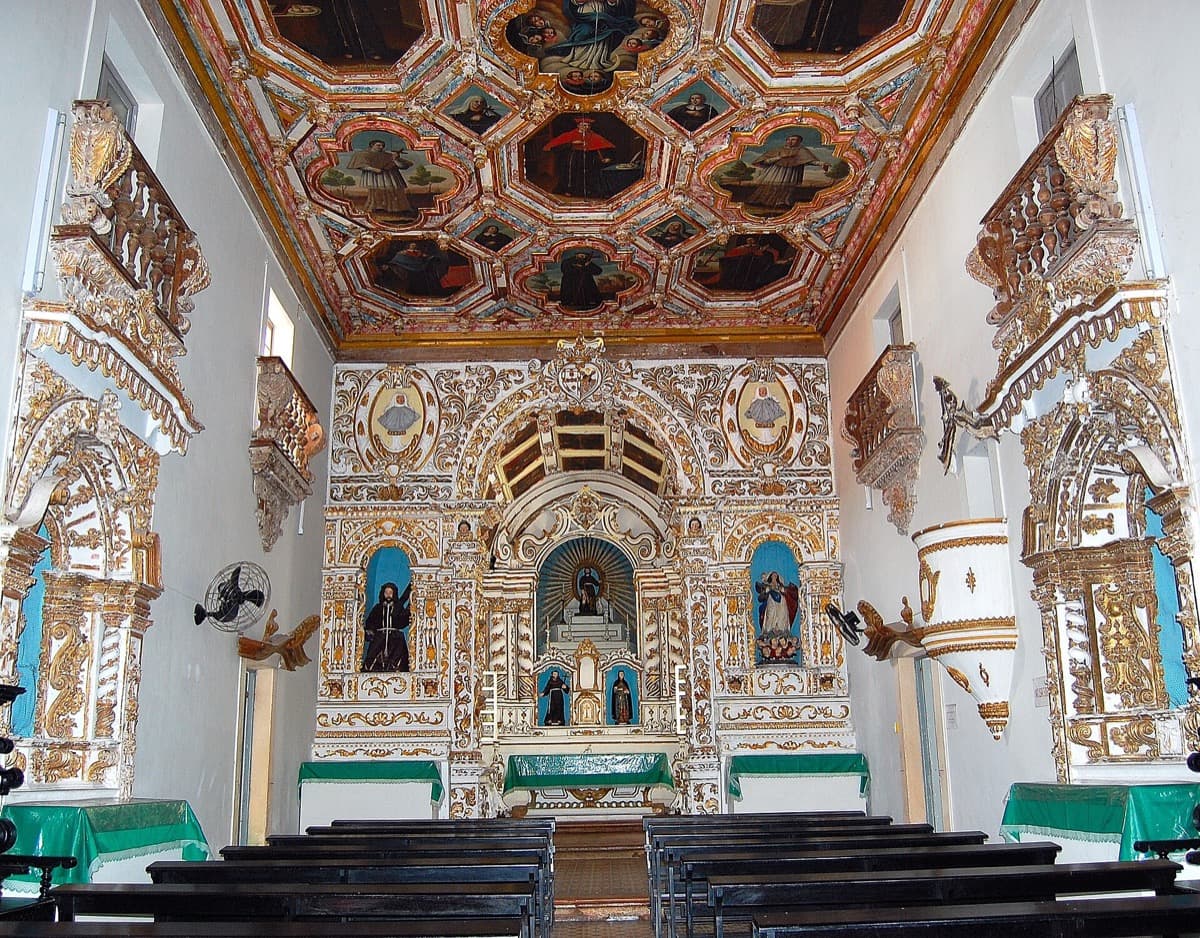
For a building, that history is not just sad, it is structural. A reconstruction is never a copy. It follows the taste and technique of the moment it was rebuilt, which is why the gilded carving and the painted coffered ceilings here read as mature seventeenth and eighteenth-century baroque rather than sixteenth-century austerity. The talha dourada, gilded wood carving, and the coffered ceilings with their painted panels belong to the rebuild, not the founding. When you look up at the ceiling, you are looking at the recovery, not the original.
The library that pointed forward
One quieter fact reframes everything. This convent once housed Pernambuco's first public library. Hold onto that, because it complicates the simple story of a hill built only to convert and obey. From early on, this was also a place where knowledge was gathered, copied, and kept. A convent is a reading institution as much as a praying one, and Olinda's convent hill would eventually carry that logic to its limit: at the summit, the Enlightenment seminary of Nossa Senhora da Graça, installed in 1800, is historically tied to the Pernambucan Revolution of 1817, remembered as the revolution of the priests. The library in this Franciscan cloister is the small first sign of the hill's second nature. Faith at the base, reason near the top, and a thread of books running between them.
How to see it well
Give the cloister more time than feels natural. Follow the tile panels as a slow narrative, left to right, and let the Saint Francis cycle unfold as a sequence rather than a wall. Look up in the church and sacristy for the coffered ceilings and their painted coffers, then down at the gilded carving that frames the altar. There is usually a modest entry fee or donation for the church, cloister, and sacristy, so carry small change. Because the convent sits partway up the ridge, it is the natural pivot of a low-to-high climb: below it, the sugar wealth carved into São Bento's altar; above it, the cathedral terrace and the seminary where the hill turns from obedience to revolt.
If you want to walk the full ascent in order, from the gilded altar at the bottom to the rebel seminary at the top, the self-guided route through Olinda reads the whole hill as one layered monument, exactly the way UNESCO's 1982 inscription of the historic centre does.
Sources
- Convento de São Francisco (Olinda), Wikipédia (pt): foundation date of 1585, the design attribution to friar Francisco dos Santos, the 1631 Dutch destruction, the complex's components, and Pernambuco's first public library.
- Olinda: Convento e Igreja de São Francisco, ipatrimônio: confirms the oldest Franciscan example in the country, the 1585 project, the 1631 fire, and the three azulejo sets in nave, sacristy, and cloister.
- Convento de São Francisco Olinda, IPHAN roteiro do patrimônio: heritage-agency account of the convent's tilework, including the cloister cycle on the life of Saint Francis, and its baroque interior.
- Historic Centre of the Town of Olinda, UNESCO World Heritage List: the 1982 inscription that treats the convent hill as a single layered ensemble.
Brazil eSIM· 10% off with ROAMER10
Ready to experience it?
Historic Center: Convents of the Coast
90 min · 2.25 km · moderate
More from Olinda
Explore more at your own pace.
Olinda Travel Guide: How Many Days, Getting Around, When to Go (2026)
One Day in Olinda: A Walkable Hilltop Itinerary (2026)
Olinda vs Recife: Which to Stay In, and How to See Both
Olinda: The Hill the Dutch Burned and the Portuguese Rebuilt

What to Eat in Olinda: A Pernambuco Food Guide (2026)