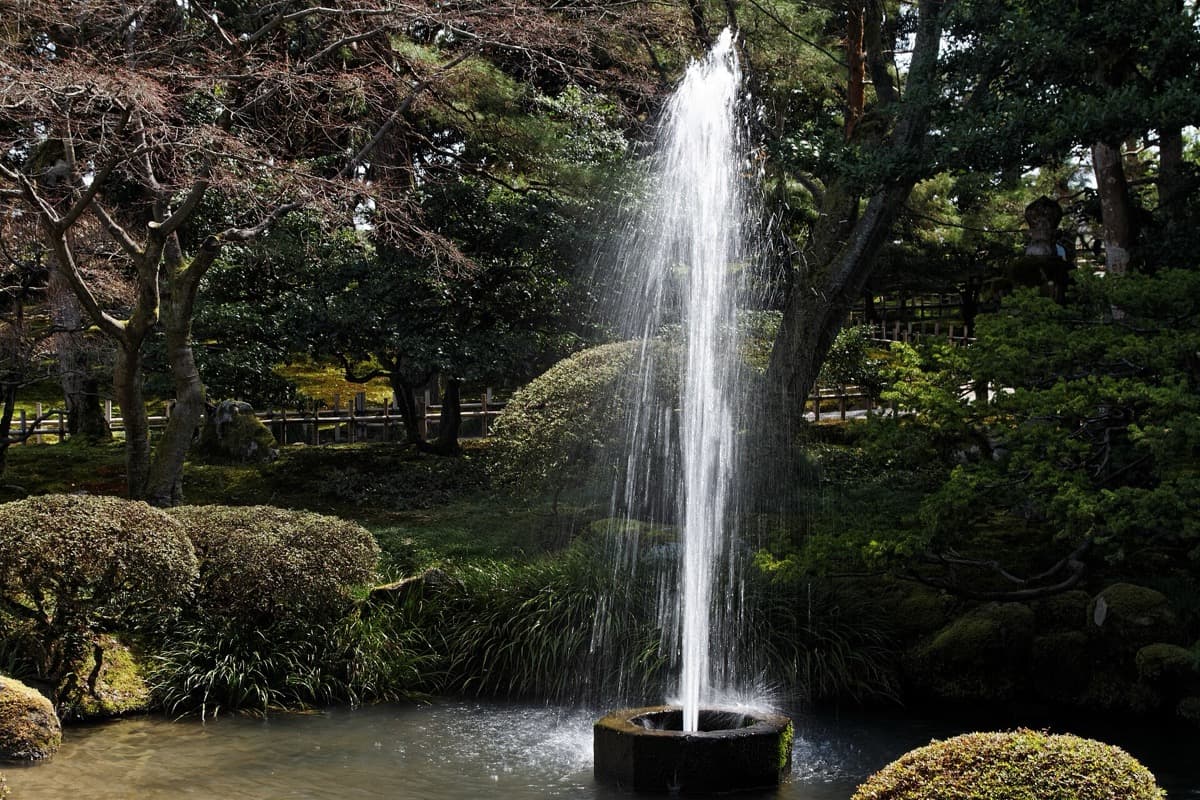
Most visitors walk straight past it. The oldest fountain in Japan sits low in Kenrokuen Garden, a thin jet of water rising about three and a half meters into the air, and it does so with no pump, no motor, no machinery of any kind. It runs entirely on natural water pressure. It was built around 1861, late in the Edo period, and it was never meant as decoration. It was a working experiment, a test built to prove the water-supply technology that would later be pulled uphill to Kanazawa Castle across the moat. To understand this fountain is to understand the whole garden around it.
A river carried uphill
Kenrokuen sits roughly fifty meters above the Sea of Japan and above the Sai River that runs below the city. That elevation is the problem the fountain quietly solves. A garden this high, filled with large ponds and streams, needs an enormous volume of water, and gravity does not deliver water upward on its own. The Maeda lords who developed the garden did not have pumps in the modern sense. What they had was a long canal drawn from the river below and a firm grasp of how pressure behaves inside an enclosed pipe.
The fountain works on the same principle a plumber would recognize today. The large central pond, Kasumigaike, the Misty Lake, sits higher than the spot where the fountain stands. Water runs down from that higher pond through a closed pipe, and because the water is enclosed and the source is elevated, the difference in height forces it back up into the air when it reaches the outlet. This is an inverted siphon. The jet is not powered by anything mechanical. It is powered by the pond above it. Stand and watch for a while and you may notice the height of the jet shift slightly, rising and falling as the level of Kasumigaike changes. The fountain is, in effect, a live gauge of the pond it draws from.
Why a garden needed a prototype
Hear a stop from this walk
Kenrokuen Garden: A Fortune Made Visible
The reason this small jet matters more than its size suggests is what it was built to prove. Filling the elevated ponds of Kenrokuen was one challenge. Supplying Kanazawa Castle, on its own high ground across the old moat, was a larger one. Before committing to the full water system for the castle, the engineers of the domain needed to demonstrate that they could move water uphill reliably using elevation and pressure alone. The fountain was that demonstration, a visible test running in the garden where the technique could be observed and trusted.
That is a striking way to run an experiment. A warrior clan that could have poured its money into thicker walls and taller towers instead hired the cleverest minds of the age to pull a river uphill, first for a garden and then for a fortress. The fountain is the engineering thesis of the entire place made visible. It says, in a single quiet gesture, that this was a domain solving problems with cleverness rather than force.
The Maeda paradox, in one jet of water
The family behind all of this were the Maeda lords of the Kaga Domain, which covered present-day Ishikawa and Toyama. For close to two hundred and eighty years they ruled from Kanazawa Castle as among the wealthiest daimyo in all of Japan, rich enough to raise an army. Generation after generation, from the 1620s into the 1840s, they spent that fortune not on soldiers but on the garden. Every hill moved and every pond shaped was a message to the distant government in Edo: we are spending on beauty, not on war. We are no threat to you.
The fountain fits that message perfectly. It is proof of enormous technical capability turned toward something graceful and unthreatening. The same skill that could pull water uphill to a fortress was put on display as a delicate jet in a public-facing garden. Power and refinement folded into one small object. Kenrokuen itself is counted among the three great gardens of Japan, beside Kairakuen in Mito and Korakuen in Okayama, and its name means the garden that combines six attributes: spaciousness, seclusion, artifice, antiquity, waterways, and broad views. The fountain belongs to that last quality, the waterways, but it also embodies the artifice, the sense that nothing here shaped itself.
What to look for when you stand there
The fountain is easy to reach. It sits a short walk downhill from the Kotoji-toro, the famous two-legged stone lantern on the north shore of Kasumigaike that has become the emblem of the whole city. Follow the path from the lantern toward the garden's edge and you will find the jet near the exit that leads to the castle.
When you arrive, resist the urge to keep walking. Look first at how modest it is, then remember there is no machinery underneath it. Trace the logic in your mind: the pond you just passed sits higher than where you stand, and that height alone is doing all the work. Watch the top of the jet for a minute to catch it breathing with the pond. Then look up and out toward the castle grounds across the moat, and picture the same trick performed at a larger scale to supply a stronghold. The fountain is a preview of the whole story the walk is about to tell.
From here the garden opens onto Kanazawa Castle, a place that kept burning and kept being rebuilt, roofed in fireproof lead. The fountain and the castle are two halves of one idea: a family that survived an uneasy peace by being too refined to fear and too capable to remove. If you want to walk the full loop from the garden to the castle and the private garden hidden inside its walls, start in Kanazawa at the Kenrokuen ticket gate.
Sources
- Kenroku-en, Wikipedia. Overview of the garden, the six attributes, the Maeda development from the 1620s to the 1840s, the Kotoji lantern as emblem, and its status among the three great gardens of Japan.
- Kenrokuen Garden, Kanazawa Station guide. Confirms the fountain as Japan's oldest powered by natural water pressure and its 3.5-meter height.
- Kenrokuen Garden, Japan National Tourism Organization. Official tourism entry on the garden and its features.
- Kanazawa Castle, Japan Guide. Background on the castle, the Maeda domain, and the reconstructed grounds across the moat.
Ready to experience it?
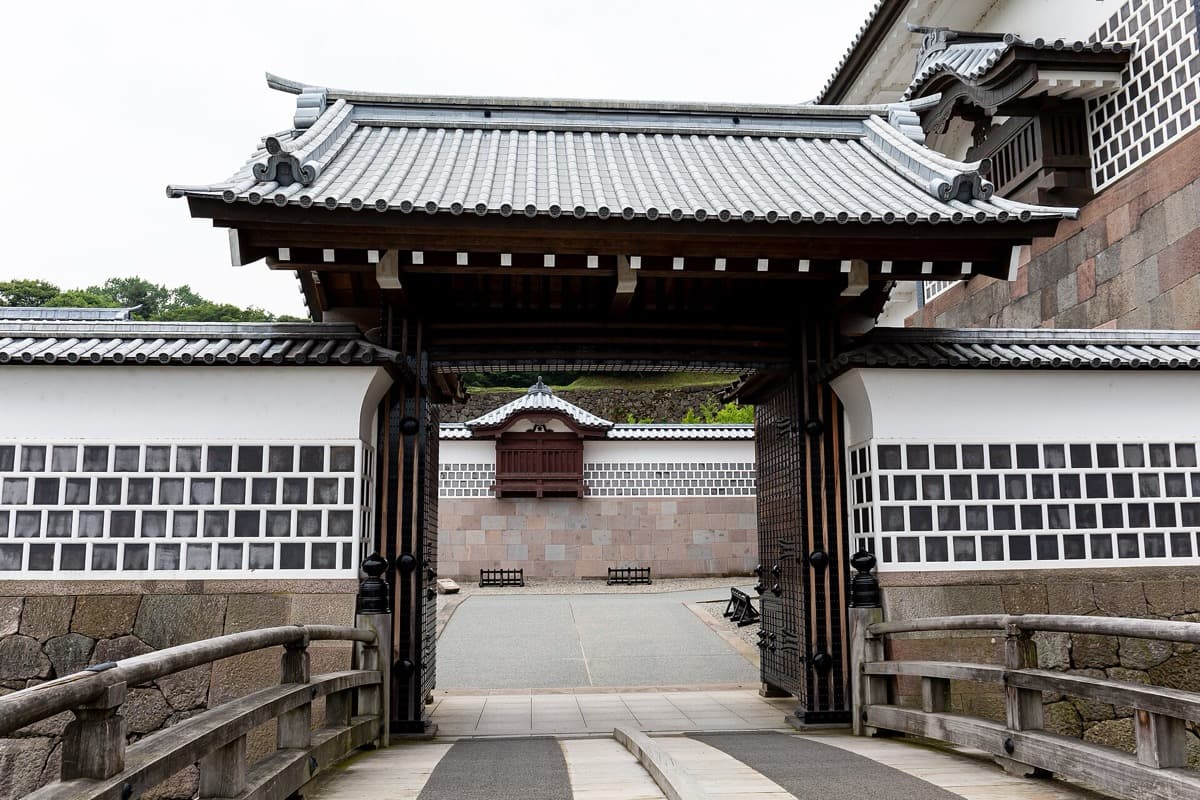
Kenrokuen and the Castle: A Garden of Power
90 min · 2 km · easy
More from Kanazawa
Explore more at your own pace.
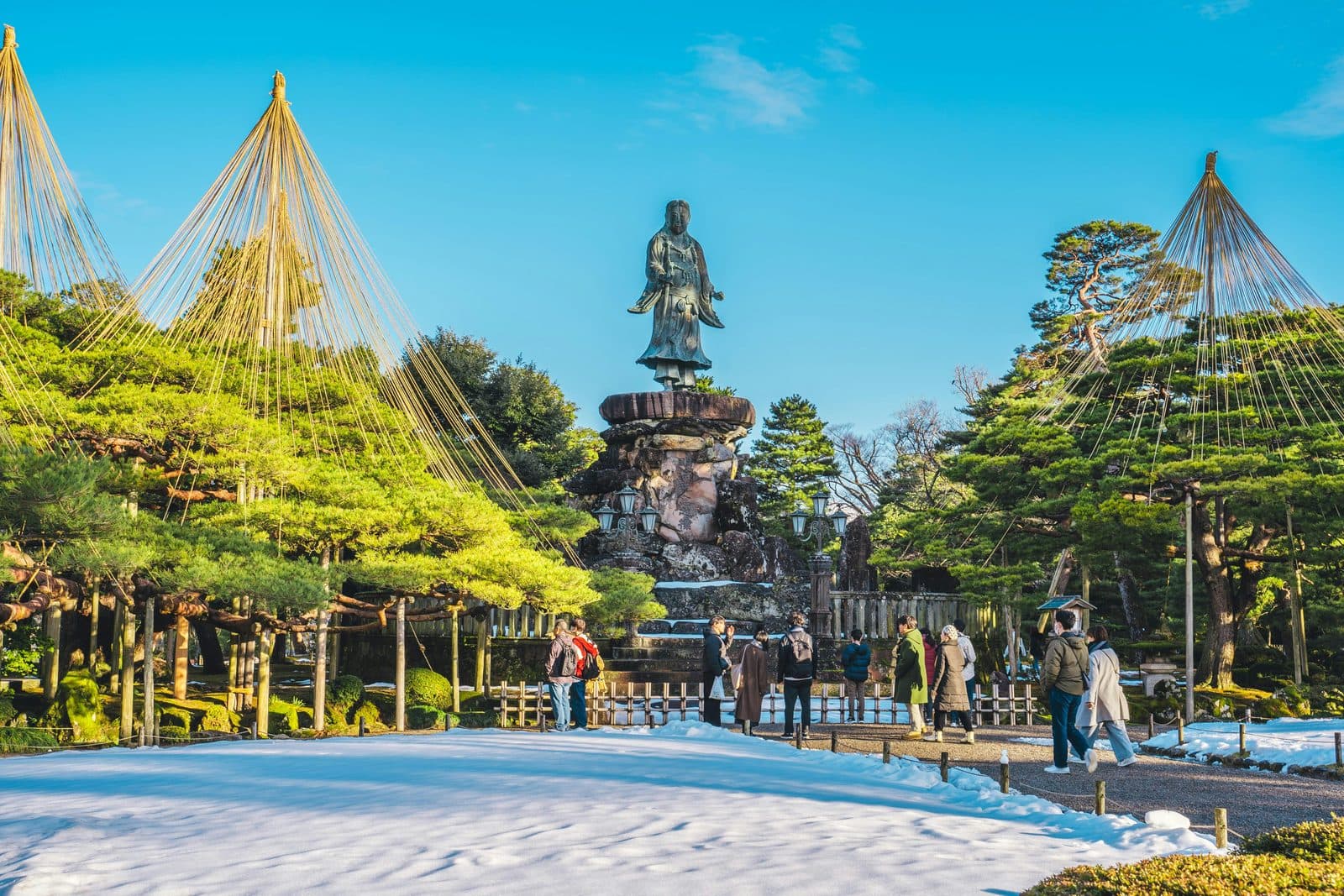
Kanazawa Travel Guide: How Many Days, Getting There, When to Go (2026)
One Day in Kanazawa: A Walkable Castle-Town Itinerary (2026)

What to Eat in Kanazawa: A Food Guide (2026)
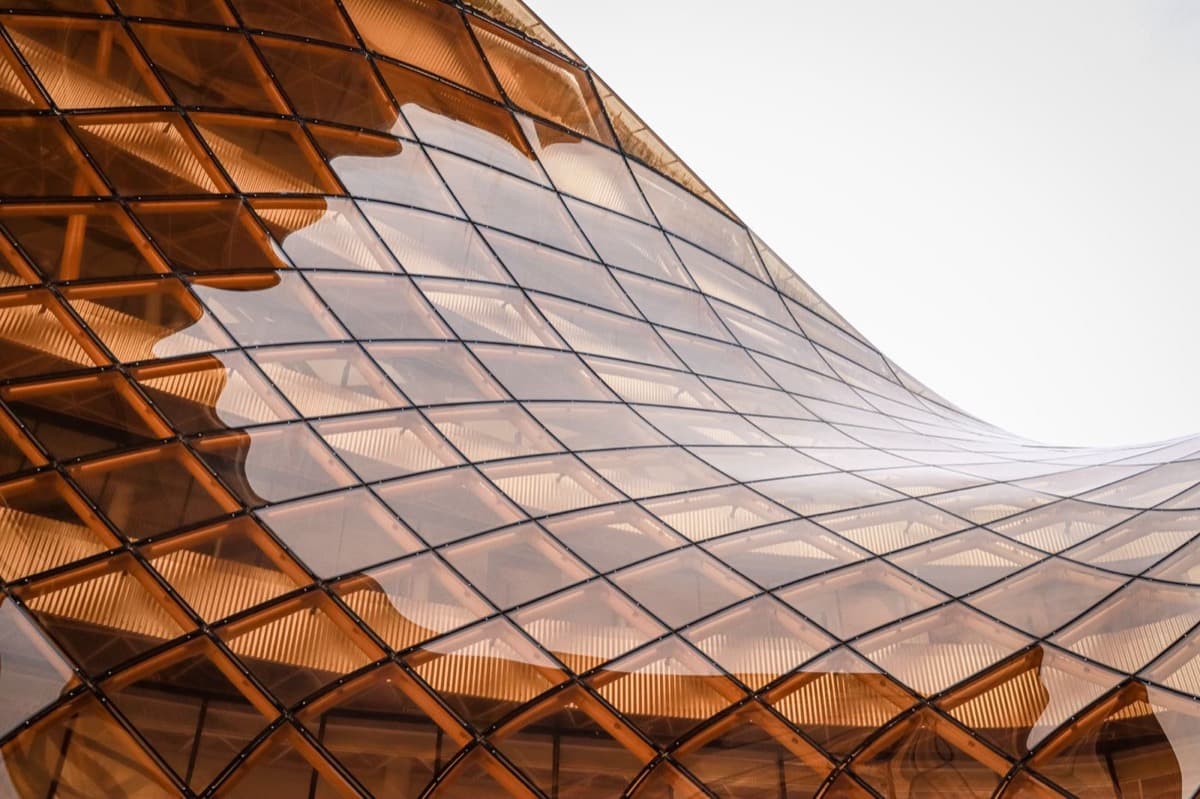
21st Century Museum: The Glass Circle That Made Kanazawa a Modern-Art City
Higashi Chaya: The Kanazawa Geisha District the War Never Touched