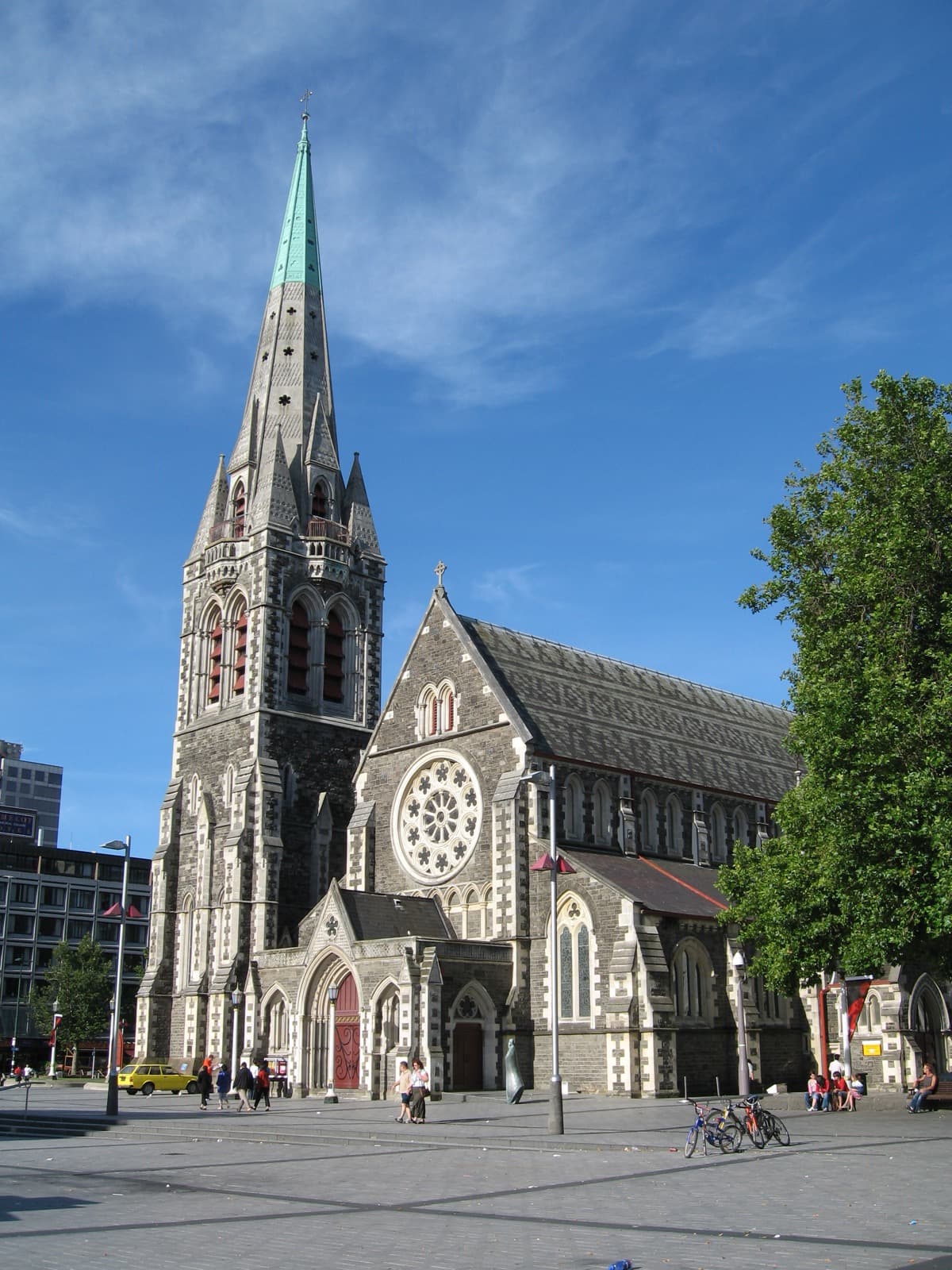
The ChristChurch Cathedral, whose spire fell at twelve fifty-one in the afternoon on the twenty-second of February twenty eleven and is now being reinstated stone by stone in full public view, is the one building that lets you read the entire rebuilt centre of Christchurch as a deliberate act of repair. Stand on the east side of Cathedral Square, look at the wounded stone tower, and you are looking at the whole city in a single frame: the grief of a shallow, deadly earthquake, and the patient work of putting a place back together. This is a walk that begins at that fallen spire and never leaves its argument behind.
The building that is the city in one frame
The cathedral's story runs the length of the city's own. Its cornerstone was laid on the sixteenth of December eighteen sixty-four, to a design by the English architect George Gilbert Scott, working in an early Gothic Revival style in stone. From eighteen seventy-three the New Zealand architect Benjamin Mountfort served as supervising architect and adapted the tower and spire. The nave and tower were consecrated on the first of November eighteen eighty-one. The spire rose sixty-three metres, about two hundred and seven feet, above the square, and for generations it was the mark people steered by.
It had been hurt before. Earthquakes in the eighteen eighties and in nineteen oh one each damaged the spire, and in time its upper part was rebuilt in timber sheathed in copper. Then the twenty eleven quake destroyed the spire completely, leaving only the lower half of the tower standing. That image, the cathedral with its spire torn away, became the enduring picture of the broken city. Heritage New Zealand lists the building as Category One, its highest heritage class. For years the city argued over whether to demolish it or save it. The answer, eventually, was to reinstate it. The reinstatement stalled over funding, then restarted. So you are watching a wound being closed, slowly, in public.
Everything else on the walk clarifies what that choice means, which is why the anchor stop is only the beginning.
Why the square was always the centre
Hear a stop from this walk
The 185 Empty Chairs: One for Each Life
To understand the cathedral, you have to understand the square it commands. When the settlement was surveyed in eighteen fifty, the plan set Cathedral Square at the crossing of the two main streets, Colombo Street and Worcester Street, and reserved it for the cathedral that would give the whole city its name. Christchurch was planned by the Canterbury Association as a Church of England settlement, and the square was meant to be its physical and symbolic heart. A statue of one of the settlement's founders, unveiled in eighteen sixty-seven and described as the first public statue in New Zealand, still marks the space.
Long before any of this, though, this was Maori land. Ngai Tahu are mana whenua here, the iwi holding customary authority, and before them lived Waitaha and Ngati Mamoe. The Maori name for the city is Otautahi, taken from the Ngai Tahu chief Tautahi, whose settlement stood on the banks of the Otakaro, the river the settlers renamed the Avon. The city was planned around one square so the cathedral would sit at its exact centre. Since twenty eleven, that same centre has become the focus of a long recovery. What was planned as the middle of a new town is now the middle of a rebuild, and it all reads outward from here.
The grief the rebuild carries
Walk to the river and the tour reaches its hardest, quietest ground. Oi Manawa, the Canterbury Earthquake National Memorial, opened on the twenty-second of February twenty seventeen, the sixth anniversary of the quake, on the south bank of the Otakaro. It is a long, gently curved wall following the river's bend for more than one hundred metres, clad in Italian Carrara marble, carrying the names of the one hundred and eighty-five people who died. Ngai Tahu gifted the name Oi Manawa, meaning the tremor, or quivering, of the heart. The quake measured magnitude six point three. Of the one hundred and eighty-five dead, one hundred and fifteen were killed in the collapse of a single building, the Canterbury Television building.
That toll has a second, gentler memorial worth carrying with you. The local artist Peter Majendie first arranged one hundred and eighty-five white chairs on the first anniversary, on the twenty-second of February twenty twelve, on the site of a church the quake had brought down. Chairs of every kind, a dining chair, an office chair, a child's chair, a wheelchair, all painted white, one for each person, inspired by Vincent van Gogh's paintings of empty chairs. On the first of April twenty twenty-three the artist closed the exhibition and invited people to take a chair home. Instead of ending, the field dispersed into the houses and gardens of the city it was made to mourn.
Faith, colour, and the last stone parliament
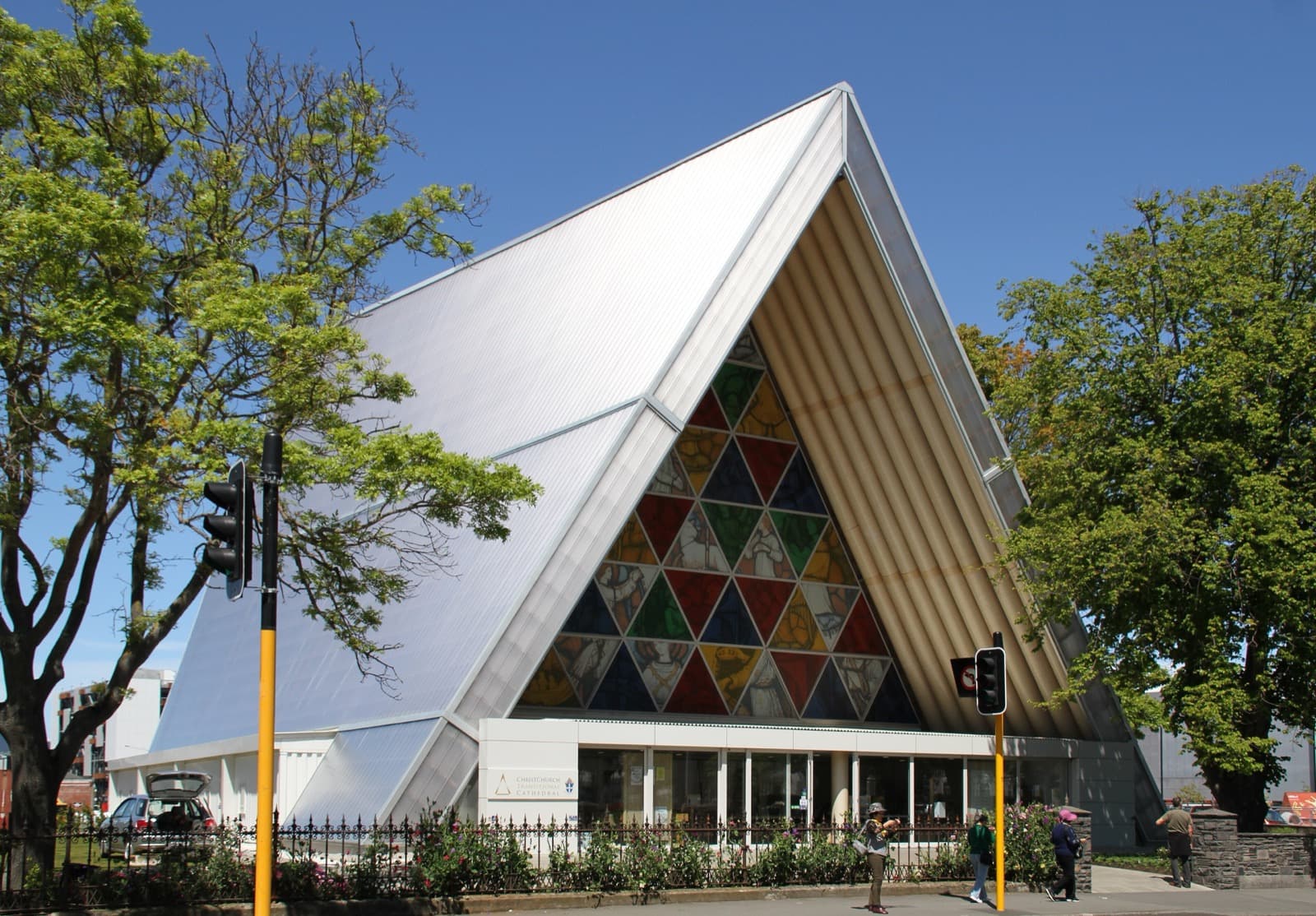
The rebuild is not only grief. At the corner of Hereford and Madras Streets stands the Transitional Cathedral, which almost everyone calls the Cardboard Cathedral. It opened on the sixth of August twenty thirteen, designed by the Japanese architect Shigeru Ban with the New Zealand firm Warren and Mahoney, built largely from ninety-eight great cardboard tubes with timber, polycarbonate and a base of shipping containers, at a construction cost of about five million New Zealand dollars. With the stone cathedral torn open, the Anglican diocese still needed somewhere to gather, so they built one quickly from the humblest materials and made it beautiful. It was meant to be transitional. It has held a wounded city together for more than a decade.
Then comes colour, and it is earned. New Regent Street opened on the first of April nineteen thirty-two, in the depths of the Depression, on the site of a former skating rink, built deliberately to lift the city's spirits. Its Spanish Mission shopfronts, painted in soft pastels and listed by Heritage New Zealand as Category One, were restored after the quake, and the heritage tram line down the lane reopened in November twenty thirteen. The tour closes at the Canterbury Provincial Council Buildings, designed by Benjamin Mountfort and built between eighteen fifty-eight and eighteen sixty-five, the only purpose-built provincial government buildings still standing in New Zealand, the last house of a form of government abolished in eighteen seventy-six. Their Stone Chamber, once regarded as one of the finest examples of High Victorian Gothic in the country, collapsed in twenty eleven, and is being pieced back together in stages.
That is the argument the fallen spire opens: not a triumphant before-and-after, but a city still, stone by stone, choosing to repair itself. The walk is flat, about three and a half kilometres, roughly ninety minutes at an easy pace, self-guided, no group and no schedule. Give Oi Manawa the slow, quiet time it asks for. When you are ready to walk it, start browsing Christchurch walking tours or head straight to Christchurch to begin at the square.
Sources
- ChristChurch Cathedral, Christchurch (Wikipedia): construction dates, architects, spire height, and earthquake damage.
- Oi Manawa Canterbury Earthquake National Memorial (Ministry for Culture and Heritage): opening, design, and the gifted name.
- 185 empty chairs (Wikipedia) and 185chairs.co.nz: the installation's origin, materials, and 2023 dispersal.
- Cardboard Cathedral (Wikipedia): Shigeru Ban design, materials, opening date, and cost.
- Canterbury Provincial Council Buildings (Heritage New Zealand): Category One listing, Mountfort design, and the Stone Chamber.
Ready to experience it?
Cathedral Square: A City Rebuilt from the Rubble
85 min · 3.4 km · easy
More from Christchurch
Explore more at your own pace.
Christchurch Travel Guide: Days, Transport, Weather, Safety, Budget
One Day in Christchurch: A Walkable Morning-to-Evening Itinerary
Christchurch: The Garden City That Rebuilt Its Heart
The Christchurch Botanic Gardens: Why a Garden City Grew Around One Oak
The Arts Centre Te Matatiki Toi Ora: The Gothic College Rebuilt Stone by Stone