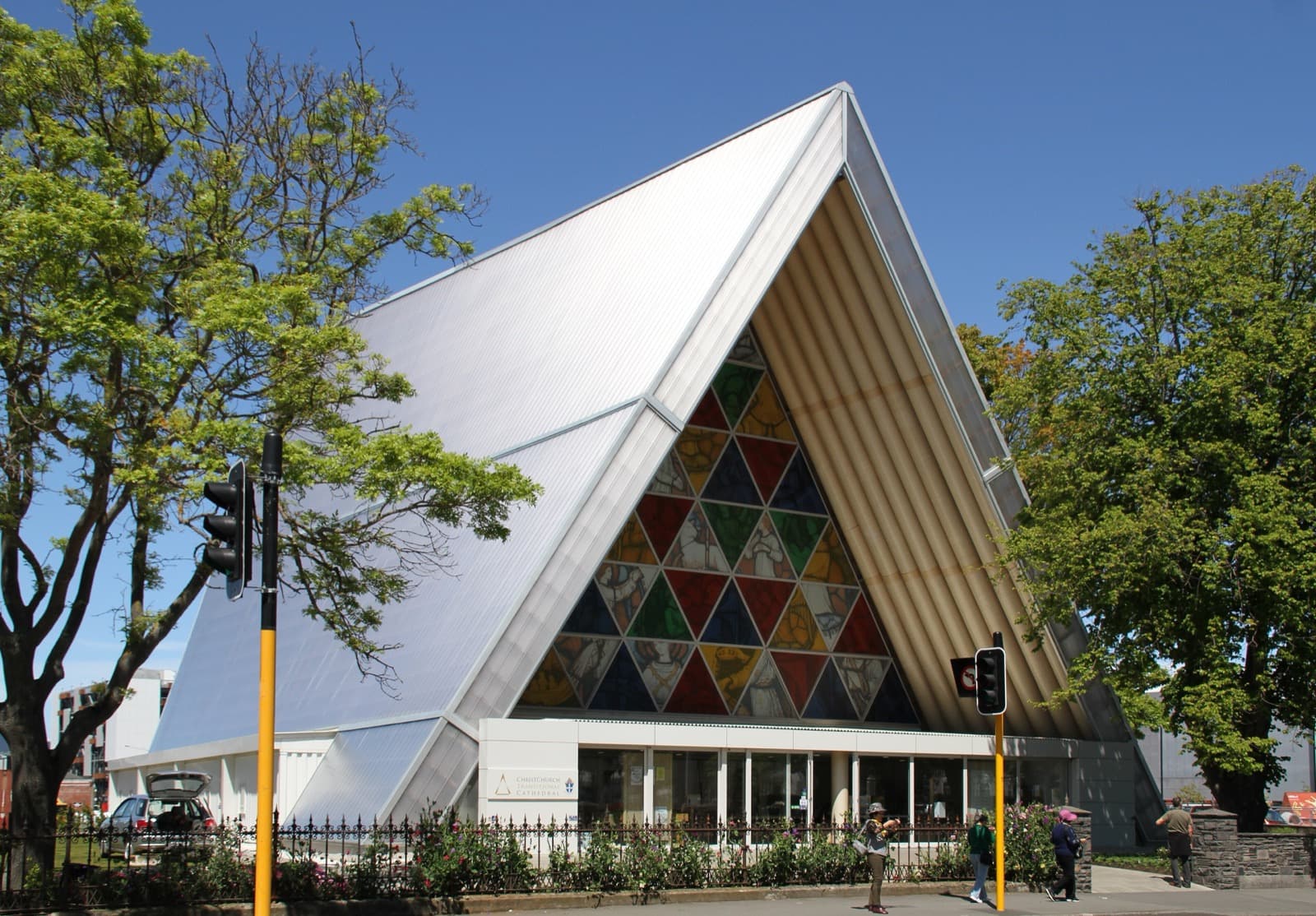
A cathedral built largely from cardboard tubes has held the faith of a broken city together for more than a decade, standing in for a wounded stone landmark while Christchurch argued over how to rebuild. That sentence sounds like a metaphor. It is not. On the corner of Hereford and Madras Streets, opposite Latimer Square, the Transitional Cathedral rises on ninety-eight great tubes of cardboard, and it has been a working Anglican cathedral since the sixth of August twenty thirteen. Almost everyone in the city calls it the Cardboard Cathedral, and the plain name carries the whole point of the place.
Why a cathedral made of cardboard exists
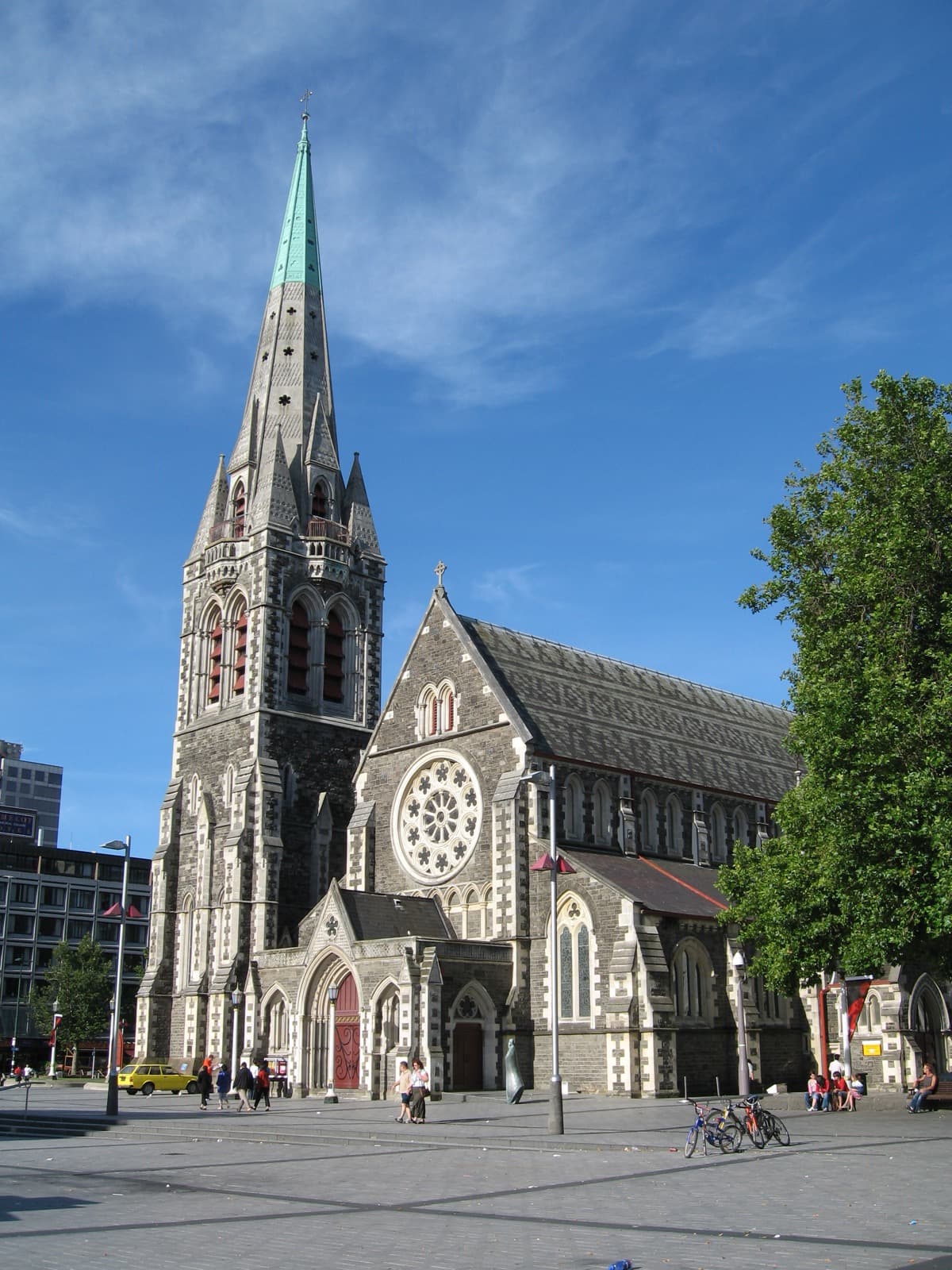
To understand the building, you have to understand what it replaced. At twelve fifty-one in the afternoon on the twenty-second of February twenty eleven, a magnitude six point three earthquake struck close to Christchurch. In Cathedral Square, the spire of the stone ChristChurch Cathedral, which had risen sixty-three metres above the square, was completely destroyed, leaving only the lower half of the tower. The nave and tower of that cathedral had been consecrated in eighteen eighty-one, and for generations the spire was the mark the city steered by. Its torn silhouette became the enduring image of the broken city, and its future became one of the longest and most bitter civic arguments of the recovery. Demolish it, or save it. The debate ran for years.
The Anglican diocese could not wait for that argument to end. A cathedral is not only a monument. It is a place a congregation gathers, week after week, and the diocese needed somewhere to gather now, not in a decade. So rather than wait, they commissioned a new one, quickly, from some of the humblest materials imaginable, and made it beautiful. That decision is the reason the word to hold onto is transitional. The building was never meant to be permanent. It was built to carry the city's faith through the long in-between, and it did.
The one thing to understand standing in front of it
Hear a stop from this walk
The 185 Empty Chairs: One for Each Life
The single idea to grasp here is that this is not a stopgap that happens to look like a church. It is a deliberate, dignified piece of architecture that treats a temporary need with permanent care. The design came from the Japanese architect Shigeru Ban, working with the New Zealand firm Warren and Mahoney. Ban has spent his career doing exactly this: building serious, humane structures out of paper and cardboard for communities struck by disaster, from Kobe to Rwanda. The year after this cathedral opened, in twenty fourteen, he was awarded the Pritzker Prize, architecture's highest honour, and the citation praised precisely his use of modest materials in ground-breaking ways.
Look at how the building is put together. The frame is ninety-eight cardboard tubes, laid in an A-frame that leans the two long walls together into a peak. The tubes are combined with timber, sheets of polycarbonate that let daylight pour through, and a base built from shipping containers. The structure rises about twenty-one metres above the altar and seats around seven hundred people. Its construction cost was roughly five million New Zealand dollars, and it was engineered to last around fifty years. That last figure is worth sitting with. A cathedral of cardboard tubes, built as a temporary measure, was designed to outlive most of the people who first walked into it.
None of this is decoration for its own sake. Every choice answers the emergency that produced it. Cardboard tubes are light, cheap, fast to raise, and forgiving in a seismic city where the ground itself is the enemy. Shipping containers gave an instant, robust base. Polycarbonate replaced the stained glass that a stone cathedral would have taken years and a fortune to commission, and it still gives the interior the shifting, coloured light people expect of a cathedral, filtered through a triangular rose window above the entrance. The building is honest about what it is made of, and that honesty is the reason it moves people.
A site with its own long memory
The ground under the Cardboard Cathedral has been set aside for the Anglican Church since the very beginning of the city. When Christchurch was surveyed in eighteen fifty, this section was allocated to the church, and an earlier building stood here until the twenty eleven earthquake brought it down. So the transitional cathedral is not an accident of available land. It sits on the same consecrated ground its predecessor did, which is why its congregation could treat it not as a shed but as a genuine cathedral home.
There is a quiet symmetry in the two buildings the tour lets you read against each other. A few streets west, the original stone cathedral is being reinstated, slowly, stone by stone, in full public view, after the city finally chose repair over replacement. Here, its cardboard understudy carries on the daily work of worship. One is heritage being pieced back together. The other is a modern answer built in a hurry and built to endure. Between them, they tell you almost everything about how Christchurch chose to recover: not with a single triumphant gesture, but with patience, improvisation, and a refusal to stop gathering.
Standing there yourself
The Transitional Cathedral is open to visitors and free to enter, though a koha, or donation, is appreciated, because it remains a working place of worship rather than a museum. Step inside when it is open. From the street the A-frame reads as a striking shape. From within, the true experience arrives: the light coming down through the polycarbonate roof and along the tubes, the scale of the thing, the plain material doing something unexpectedly grand. Give yourself a few minutes to simply sit. This is a building designed to hold both an ordinary Sunday service and the grief of a whole city, and it manages both.
The Cardboard Cathedral is the fifth stop on the self-guided Cathedral Square rebuild walk, a flat, easy route of about three and a half kilometres through the centre of Christchurch. The walk reads the whole recovery in sequence: the planned square at the city's centre, the wounded stone cathedral, the marble memorial wall that names all one hundred and eighty-five people who died, the field of empty chairs that dispersed into the city, this cardboard cathedral, and the pastel lane and stone parliament house that survived and were mended. Taken together, they turn an abstract idea, a city rebuilding itself, into something you can walk through at your own pace.
Explore the full route and the other stops on the Christchurch walking tours hub, or browse everything on offer in Christchurch before you go.
Sources
- Cardboard Cathedral, Wikipedia. Confirms the opening date of the sixth of August twenty thirteen, the architect Shigeru Ban in association with Warren and Mahoney, the seating capacity of around seven hundred, the height of about twenty-one metres above the altar, and the fifty-year design life.
- Shigeru Ban completes Cardboard Cathedral in Christchurch, Dezeen (2013). Architecture-press coverage of the ninety-eight cardboard-tube A-frame structure and its construction.
- Shigeru Ban wins Pritzker Prize 2014, Dezeen. Documents the twenty fourteen award and the citation praising his work with paper and cardboard for disaster relief.
- Christchurch earthquake kills 185, New Zealand History (nzhistory.govt.nz). Confirms the magnitude six point three quake at twelve fifty-one on the twenty-second of February twenty eleven and the death toll of one hundred and eighty-five.
- Roamer tour transcript, "Cathedral Square: A City Rebuilt from the Rubble" (fact-audited, audit score 97). Primary source for the site history, the fallen sixty-three-metre spire and eighteen eighty-one consecration, and the eighteen fifty Anglican survey allocation.
Ready to experience it?
Cathedral Square: A City Rebuilt from the Rubble
85 min · 3.4 km · easy
More from Christchurch
Explore more at your own pace.
Christchurch Travel Guide: Days, Transport, Weather, Safety, Budget
One Day in Christchurch: A Walkable Morning-to-Evening Itinerary
Christchurch: The Garden City That Rebuilt Its Heart
The Christchurch Botanic Gardens: Why a Garden City Grew Around One Oak
The Fallen Spire: Reading Christchurch's Rebuild from Cathedral Square