Botanic Gardens: The Garden City's Green Spine
80 min · 2.8 km · easy
The Christchurch Botanic Gardens are not a pretty stop on a walk. They are the argument the whole garden city makes: that a place worth living in keeps a garden at its center. Christchurch, New Zealand calls itself the garden city, and the twenty-one hectares of lawn, rose beds and enormous trees inside a loop of the Avon River are where that name comes from. A short riverside walk reads the argument stop by stop, from a memorial arch down to the willows and up a spine of Gothic stone, and it lands you here, in the gardens the founders grew out of wetland to prove the point.
One tree, and what it meant
The whole idea starts with a single oak. On the ninth of July 1863, the government gardener Enoch Barker planted an English oak in this ground to mark a royal wedding, the marriage of Albert Edward, the Prince of Wales who would much later become King Edward the Seventh, to Princess Alexandra of Denmark. That tree still stands. It is called the Albert Edward Oak, and it is the oldest tree in the gardens.
It is worth being careful with the name, because it trips people up. The oak marks the wedding of the prince, Albert Edward, not his father Prince Albert, who had died two years earlier. One tree, one wedding, and from it a garden that gave a city its identity.
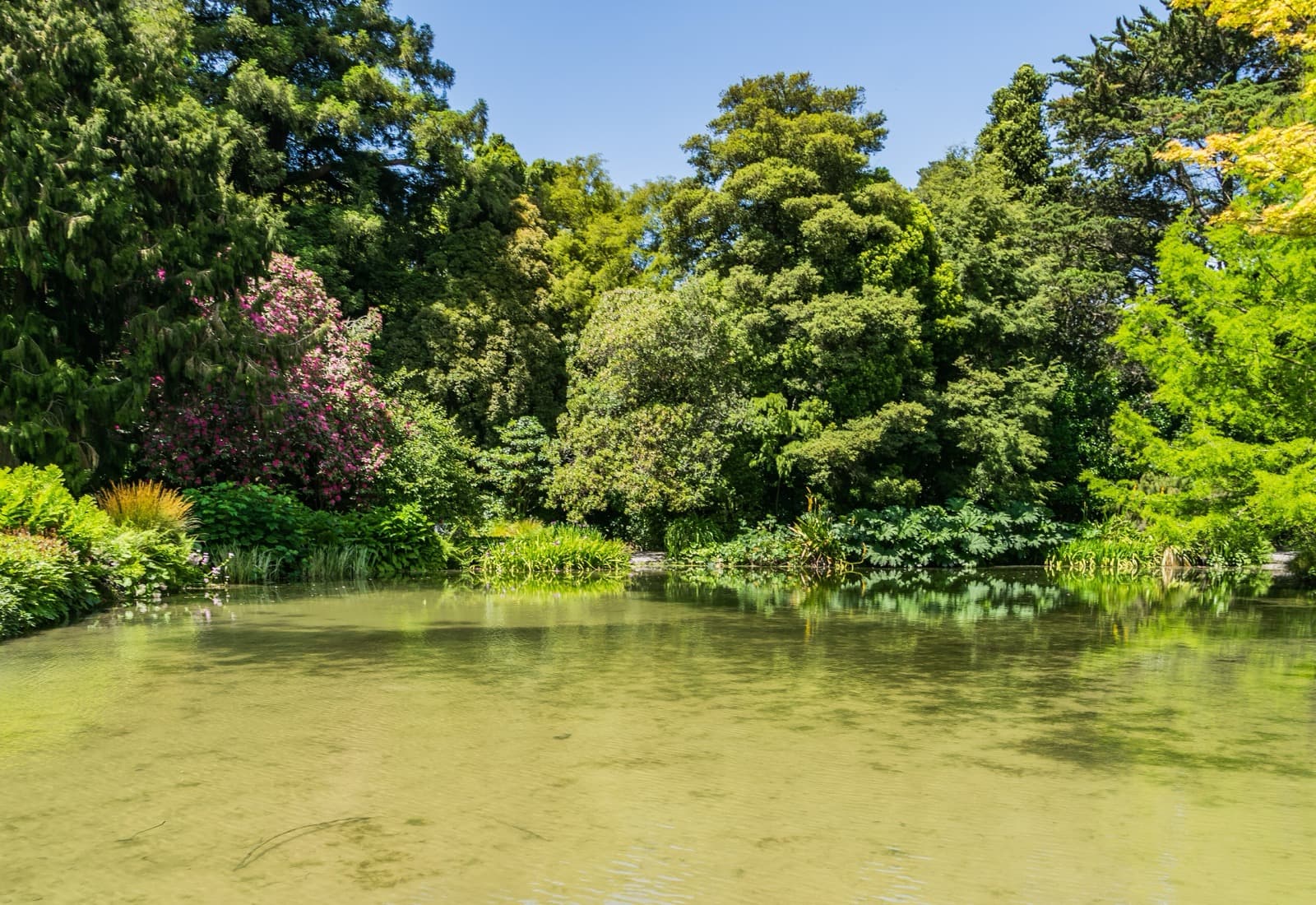
What makes the oak worth pausing over is the ground it went into. This was not parkland waiting to be dressed up. It was wetland and sand dune, a low wet patch caught in a bend of the river. Out of that the settlers grew rose gardens, native and exotic trees, and sweeping lawns, and in 1924 they added a glasshouse, Cuningham House. A colony barely a decade past its founding looked at a swamp and decided it would become the center of the town. That decision is the thesis of the entire walk, and standing under the Albert Edward Oak is where it becomes concrete.
The river that carries everything
Hear a stop from this walk
The Antigua Boat Sheds: Punts on the Ōtākaro
The gardens do not sit alone. They are wrapped inside a single great loop of the Ōtākaro, the Avon River, and the water is the thread that ties the walk together. This is the Country of Ngāi Tahu, the mana whenua who hold customary authority over Canterbury, and their presence on this river runs far deeper than the settler town that grew beside it.
The walk begins downstream at the Bridge of Remembrance, a great stone arch at the foot of Cashel Street. It is exactly what its name says. In the First World War, soldiers crossed the river here on their way to embark for the front, and the arch was raised to them, designed in 1921 by the architect William Gummer and unveiled on Armistice Day, the eleventh of November 1924. Then the arch itself was damaged in the Canterbury earthquakes and carefully repaired, rededicated on Anzac Day 2016. It is a memorial twice over now: to the soldiers who marched away, and to a city that had to rebuild the very stones that remembered them.
Follow the water upstream and the willows close in over it, and the register of the river changes completely. Here are the Antigua Boat Sheds, a long green-painted timber boatshed that opened in 1882. Heritage New Zealand records it as the only surviving nineteenth-century commercial boatshed on a river anywhere in New Zealand. Flat-bottomed punts are still poled along the Avon from here in the Edwardian manner, a boatman standing at the stern with a long pole. After the solemnity of the arch, this is the river's other face: leisure, willows, a slow afternoon with no hurry in it.
A spine of Gothic stone
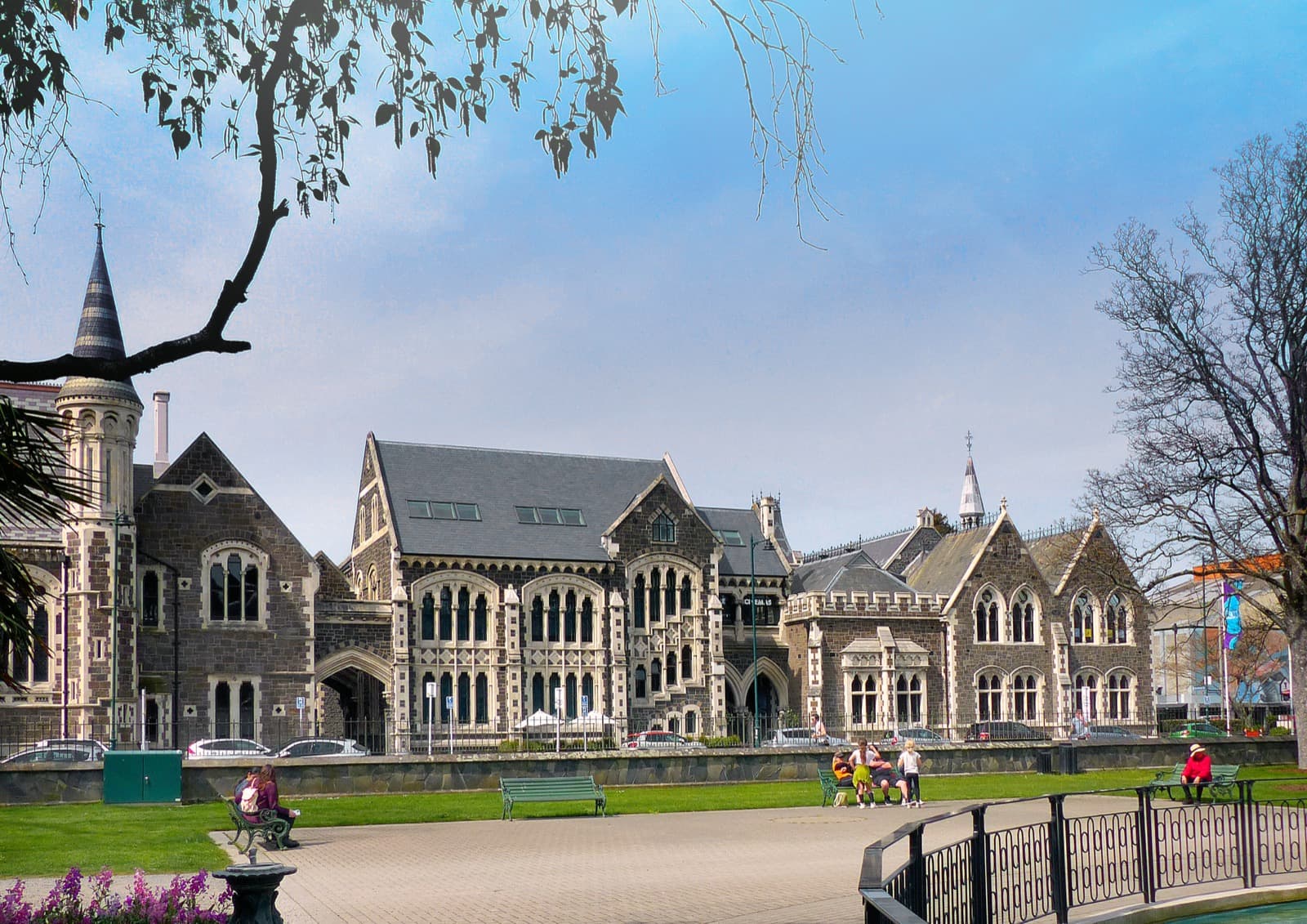
Between the boatshed and the gardens, the walk turns up Rolleston Avenue and runs a line of grey Gothic stone that shows what these founders were reaching for. The Arts Centre, which carries the gifted Māori name Te Matatiki Toi Ora, was for most of its life a university, beginning in 1877 as Canterbury College. A young physicist named Ernest Rutherford did his early research in a basement den here from 1890. The precinct was severely damaged in the earthquake of the twenty-second of February 2011 and has been rebuilt patiently, stone by numbered stone, in one of the largest heritage restoration projects in the world.
Further along stands the Canterbury Museum, another Gothic building in grey basalt, opened in 1870 and built around the collection of the geologist Julius von Haast: moa bones, the taonga of Ngāi Tahu, and material from Antarctic expeditions. As of 2026 the Rolleston Avenue building is closed for redevelopment, so you read the stone shell from outside. Then Christ's College, the oldest independent school in New Zealand, which moved to this site in 1856 with just thirty-five pupils. Its Big School of 1863 is recorded as the oldest educational building still in use in the country.
Read together, these stops say one thing. A settler colony only a few years old chose not rough sheds but Gothic quadrangles, deliberately, so its children and its scholars would grow up inside stone that looked as if it had always been there. That ambition marches straight into the gardens, where the same generation grew permanence out of green instead of stone.
Where the idea opens out
Past the gardens the ground opens into Hagley Park, an enormous green of oaks and lawns wrapping right around the Botanic Gardens. It was created in 1855 by the Canterbury Provincial Government and runs to about one hundred and sixty-five hectares, larger than Hyde Park in London. The land was reserved by law forever, open for the recreation and enjoyment of the public. A brand-new city locked open a vast green for everyone who would ever come after. In the northern part there is Victoria Lake, formed in 1897 to mark Queen Victoria's sixty years on the throne.
This is the payoff of the walk, and it is why the Botanic Gardens are the way into the whole tour rather than just a stop on it. The gardens make the argument; Hagley Park makes it civic and permanent. And the great advantage of walking it yourself is that the gardens and the park are free, with no fixed route and no schedule. You linger by the river as long as you like, at your own pace, with no group behind you and no one hurrying you along.
Ready to walk it? See the full route and the other stops in our guide to Christchurch walking tours, or explore everything on offer in Christchurch.
Sources
- Tour transcript and fact audit, Roamer "Botanic Gardens: The Garden City's Green Spine" (christchurch-avon-botanic-gardens). Primary source for dates, names, and stop details.
- Christchurch Botanic Gardens, Wikipedia. Founding in 1863, the Albert Edward Oak, and Cuningham House.
- Hagley Park, Christchurch, Wikipedia. 1855 creation, area, forever-reservation, and comparison with Hyde Park.
- Heritage New Zealand listings for the Bridge of Remembrance, Antigua Boat Sheds, and Christ's College Big School. Heritage status and construction dates.
- Christchurch City Libraries, "Hagley Park and the Christchurch Botanic Gardens." Local history of the park and gardens.
Ready to experience it?
Botanic Gardens: The Garden City's Green Spine
80 min · 2.8 km · easy
More from Christchurch
Explore more at your own pace.
Christchurch Travel Guide: Days, Transport, Weather, Safety, Budget
One Day in Christchurch: A Walkable Morning-to-Evening Itinerary
Christchurch: The Garden City That Rebuilt Its Heart
The Fallen Spire: Reading Christchurch's Rebuild from Cathedral Square
The Arts Centre Te Matatiki Toi Ora: The Gothic College Rebuilt Stone by Stone