Botanic Gardens: The Garden City's Green Spine
80 min · 2.8 km · easy
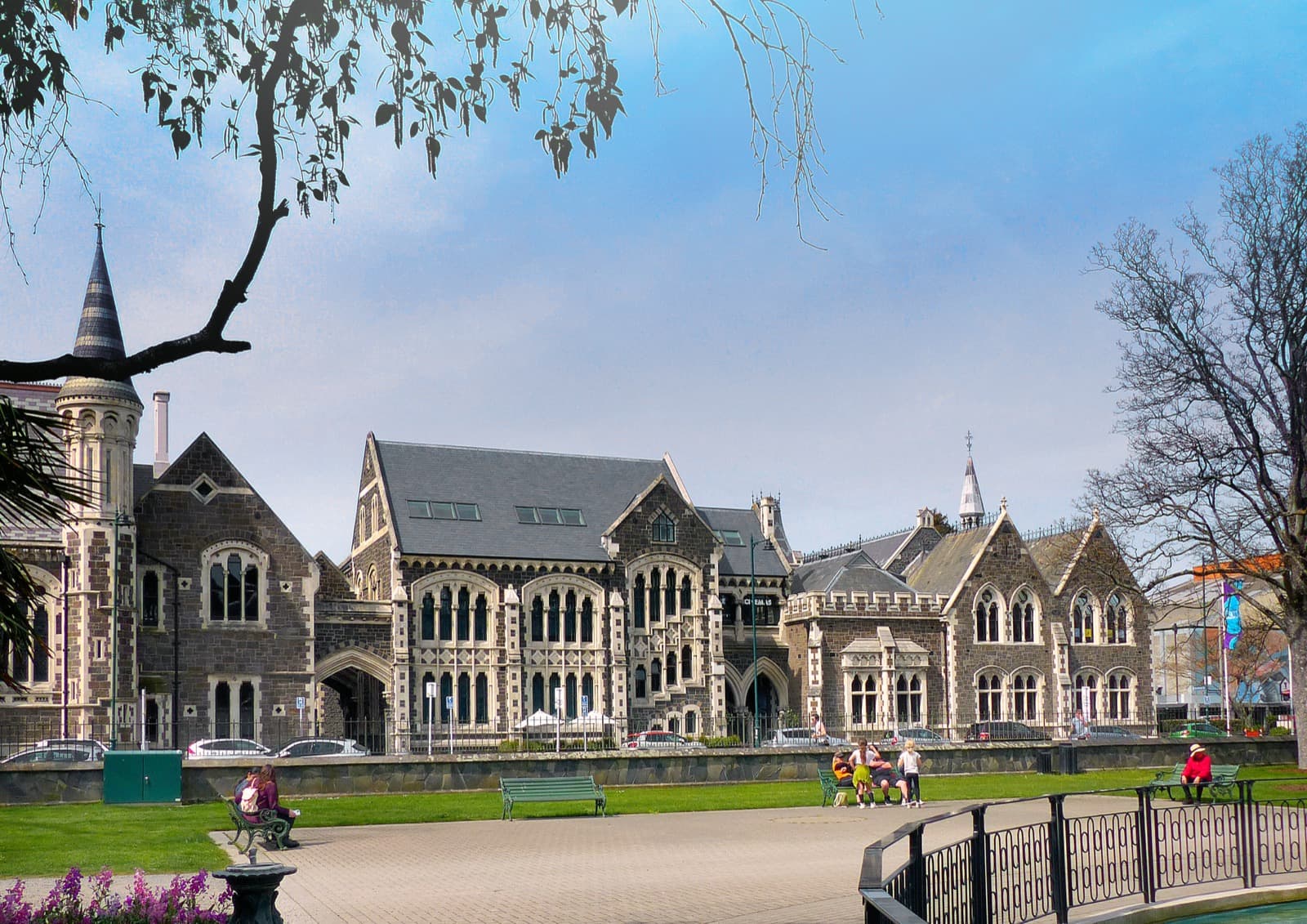
Turn up Rolleston Avenue in central Christchurch and a long range of grey Gothic stone rises beside you: pointed arches, gables, towers, a run of stone that looks as though it has always been there. This is the Arts Centre, which carries the gifted Māori name Te Matatiki Toi Ora, meaning a springboard of creative life and knowledge. For most of its life this stone was not an arts venue at all. It was a university, it sheltered one of the most important physicists of the twentieth century, and after the earthquake of February 2011 it was taken apart and put back together stone by numbered stone. Standing in front of it, that is the one thing to understand: you are looking at a settler colony's ambition made solid, and at a city's refusal to let that ambition fall.
From Canterbury College to the Arts Centre
The story starts in 1877, when the first stone building opened as Canterbury College. Over the following decades the college grew into the University of Canterbury, and the precinct grew with it: twenty-two Gothic buildings in all, extended piece by piece through to 1926. The leading architect was Benjamin Mountfort, the man who gave Christchurch much of its Gothic Revival face, with later work by Samuel Hurst Seager and others. The choice of style was deliberate. A young town on the Canterbury plain, only a few decades old, did not put up a plain functional college. It reached for pointed arches and quadrangles, for the look of an old English university carried to the far side of the world.
The university stayed here until 1974, when it moved out to its Ilam campus on the edge of the city. That could easily have been the end of the buildings' useful life. Instead the empty precinct was handed over to the arts, and the name that most visitors know it by today was set. The Māori name Te Matatiki Toi Ora came much later, gifted to the centre in 2015, a recent layer of meaning laid over a nineteenth-century shell.
If you want to see the Christchurch idea of itself in one place, this is it. The whole precinct is a single argument: that a new city becomes a real one by building stone that outlives its founders.
Rutherford's Den
Hear a stop from this walk
The Antigua Boat Sheds: Punts on the Ōtākaro
Walk the grounds and you are walking where a young physicist worked. Ernest Rutherford, who would later be honoured as the father of nuclear physics, studied at Canterbury College from 1890. He did his early research in a basement den in the Clock Tower Building, and that room, known as Rutherford's Den, is preserved on the site.
It is worth pausing on the ordinariness of it. Before the Nobel Prize, before the splitting of the atom, before any of the honours, there was a student in a Christchurch basement, running experiments in a cramped room in a college on the far edge of the British world. The den is a charged entry point (there is usually a fee to go in), but even from the courtyard the idea holds: world-changing science can begin in a small stone room a very long way from anywhere. The grounds and courtyards themselves are free to walk into, so you can step through an archway into a quadrangle without paying anything at all.
The earthquake, and the rebuild
Then came the 22nd of February 2011. The earthquake struck the city, and this stone precinct was severely damaged. Grey Gothic buildings that had stood for well over a century were cracked, shifted, and in places brought down.
What has happened since is the part that makes the Arts Centre unusual even among heritage sites. Rather than demolish and replace, or rebuild quickly in something cheaper, the decision was to put the buildings back exactly as they were. Stones were catalogued, numbered, lifted out, strengthened, and returned to their original positions. The work has run to around 290 million dollars, which places it among the largest heritage restoration projects in the world. It has been done slowly and patiently, one building at a time, over years.
Standing on Rolleston Avenue, this is the thing to hold in your mind. The stone you are looking at is not a copy and it is not a ruin left as it fell. It is the original fabric, taken down and reassembled with enormous care and expense. Every joint carries a decision: to keep this, to save it, to put the city's own past back where it stood. The precinct that once expressed a young colony's reach for permanence now expresses something later and harder won, a modern city's determination to hold on to what it built.
Standing in front of it
Give the Arts Centre a little time, because it rewards a slow read. From the footpath, take in the length of the range and the way the roofline breaks into gable after gable. Then step through one of the archways off the street into a stone quadrangle. The scale changes at once. The traffic noise drops, the walls close in, and you are inside the settlers' ambition and the rebuilders' patience at the same time.
Look for the seams if you can. In many places the restoration is close to invisible, which is the point, but the knowledge that each stone was lifted and set back changes how the whole thing reads. This is not a monument to a single event but to two ambitions layered on each other: the will to build, and the will to rebuild.
The Arts Centre sits at the middle of a short, flat, riverside walk through the green spine of the garden city. On the same route you can stand on the Bridge of Remembrance over the Ōtākaro Avon River, watch flat-bottomed punts poled from the Victorian Antigua Boat Sheds, read the Gothic outline of Christ's College, and finish in the Botanic Gardens and Hagley Park, the great green the founders reserved by law forever. The whole loop runs to about three kilometres of level path, entirely at your own pace, with no group and no schedule.
If the Arts Centre is the stop that draws you here, let it be the way into the rest. Roamer's self-guided Botanic Gardens: The Garden City's Green Spine tour carries the full story of this precinct in your ear as you stand in the quadrangle, then walks you on through the willows and the stone. For the wider picture of the city, start with the Christchurch walking tours guide and pick the route that fits your afternoon.
Sources
- Christchurch Arts Centre, Wikipedia: overview of the precinct's history as Canterbury College, its twenty-two Heritage New Zealand listed buildings, the 1974 university move to Ilam, and the roughly 290 million dollar post-earthquake restoration.
- The Arts Centre, official history page (artscentre.org.nz): the Clock Tower and Rutherford's Den opening in 1877 as the college's first stone building, Rutherford studying on the site from 1890, and the current name Te Matatiki Toi Ora.
- Dictionary of New Zealand Biography (Te Ara), Ernest Rutherford: his 1890 enrolment at Canterbury College and early high-frequency research.
- Roamer tour "Botanic Gardens: The Garden City's Green Spine": fact-audited stop narration for the Arts Centre, Rutherford's Den, and the Rolleston Avenue Gothic buildings.
Ready to experience it?
Botanic Gardens: The Garden City's Green Spine
80 min · 2.8 km · easy
More from Christchurch
Explore more at your own pace.
Christchurch Travel Guide: Days, Transport, Weather, Safety, Budget
One Day in Christchurch: A Walkable Morning-to-Evening Itinerary
Christchurch: The Garden City That Rebuilt Its Heart
The Christchurch Botanic Gardens: Why a Garden City Grew Around One Oak
The Fallen Spire: Reading Christchurch's Rebuild from Cathedral Square