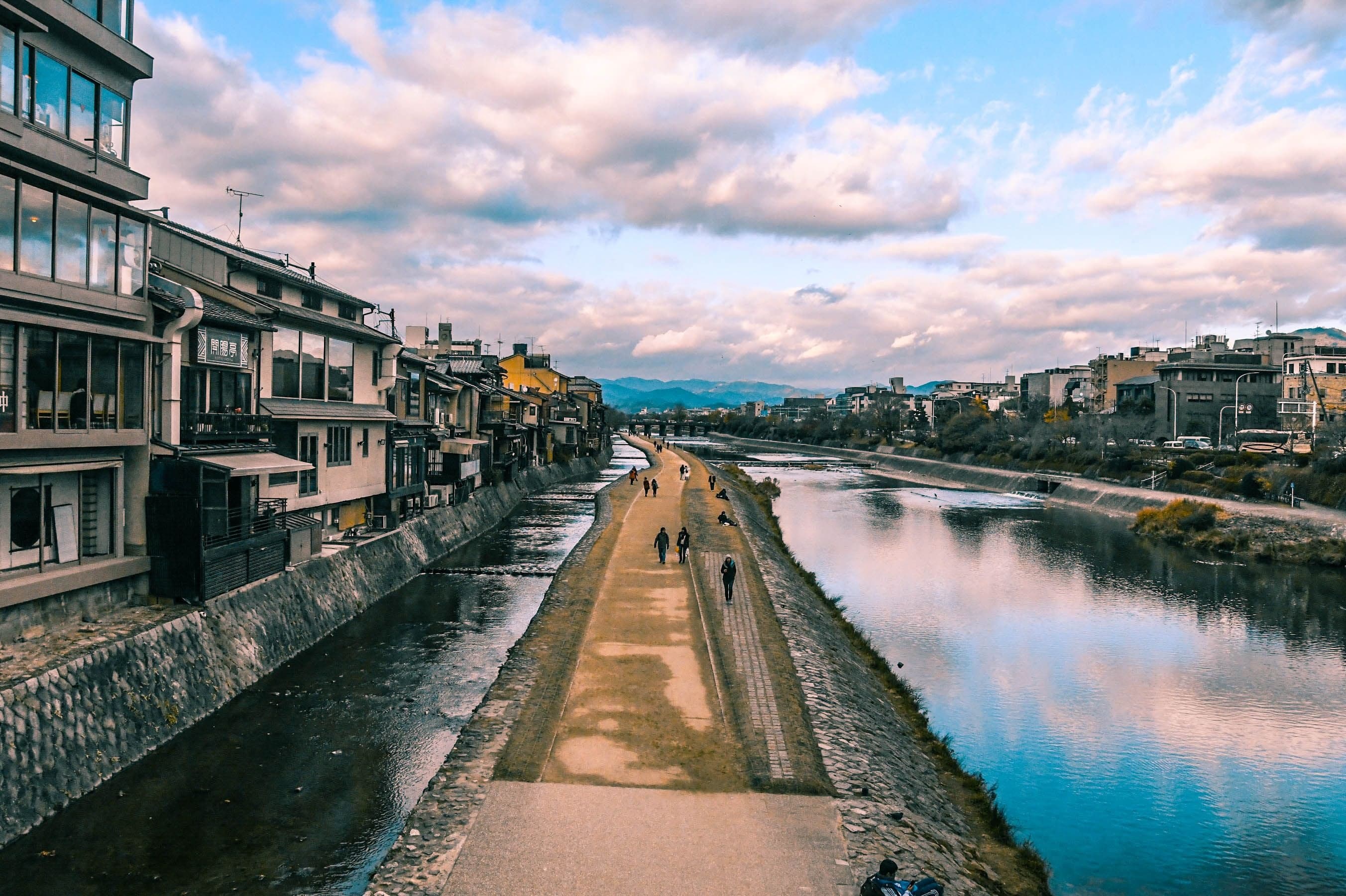
From Nishiki Market's west gate past Nishiki Tenmangu and Seigan-ji on Shinkyogoku, along the Takase canal to the Sanjo bridge, then down Pontocho's narrow lane past the Kaburenjo to the Shijo bridge over the Kamo River.
Start · Nishiki Market West Gate
DirectionsStops
- 1
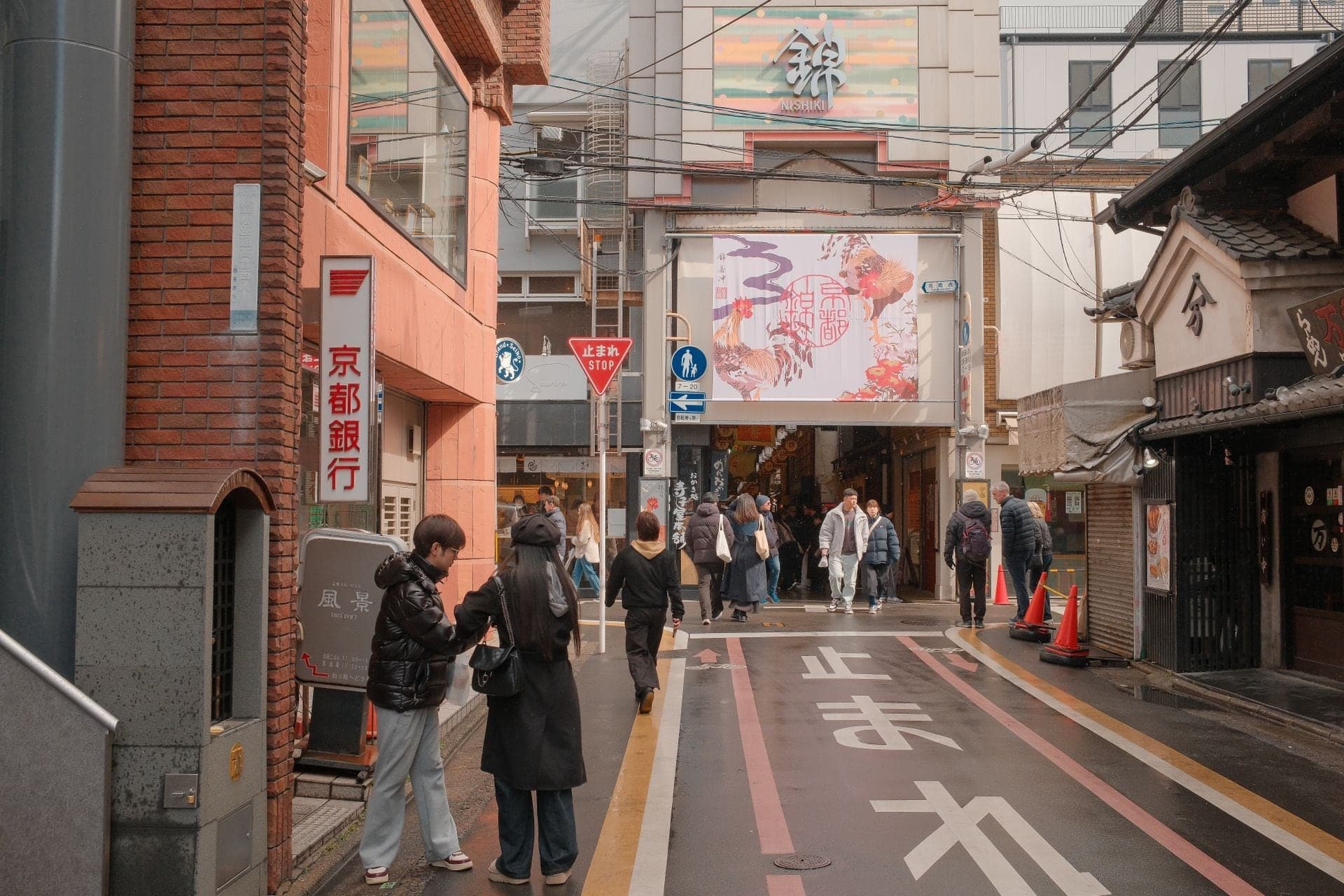
Nishiki Market West Gate
Kyoto's covered food market starts here, at Takakura-dori. The painter Ito Jakuchu named this corner in court when he fought to save the market.
- 2
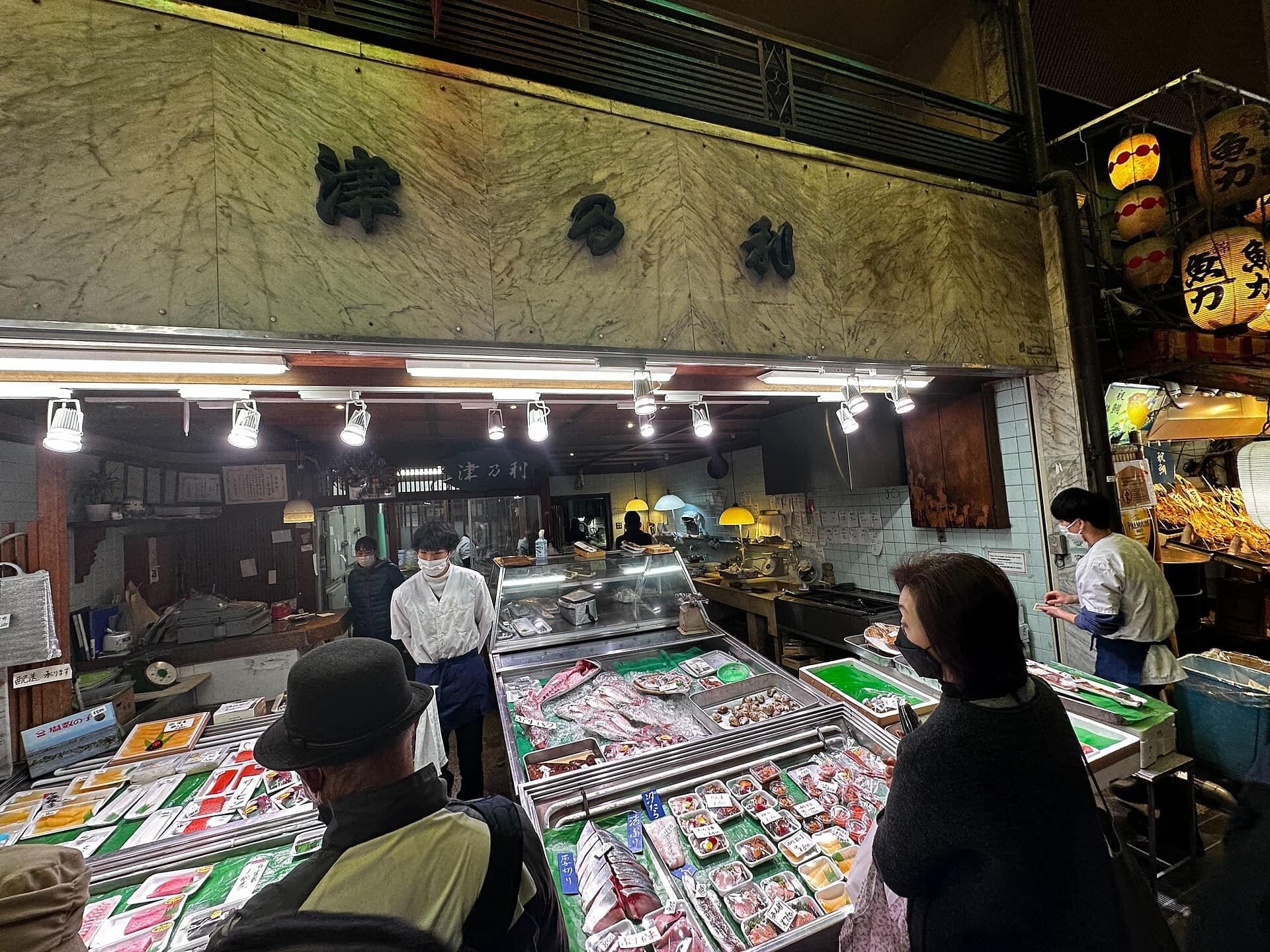
Nishiki Market: Kyoto's Kitchen
Over a hundred shops sell Kyoto vegetables and fish. Cold groundwater once kept the food cool in the shops' own wells.
- 3
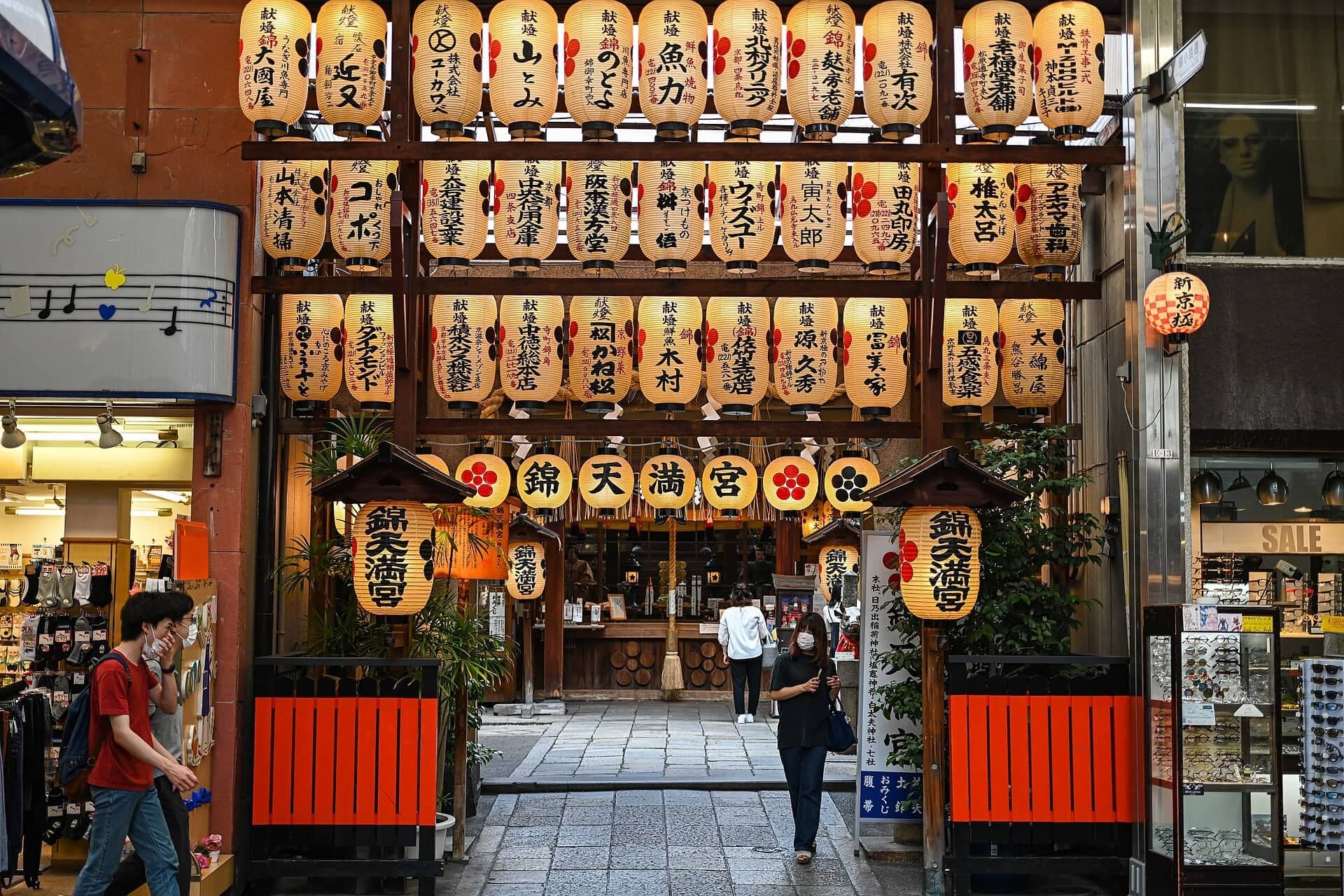
Nishiki Tenmangu: A Gate in the Shops
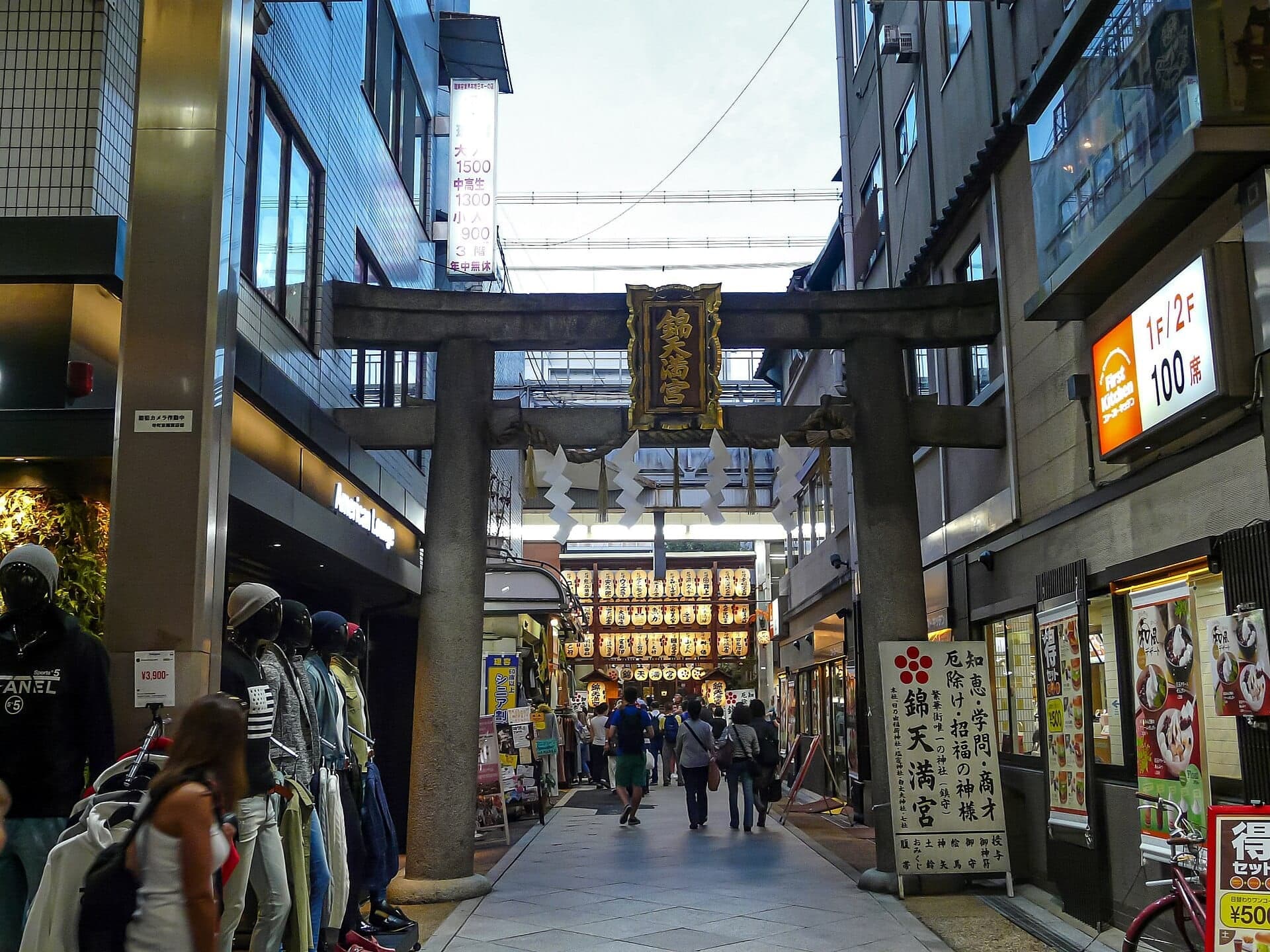
Nishiki Tenmangu's stone gate is pressed into the shops. It is a remnant of shrine grounds cut by a new street in 1872.
- 4
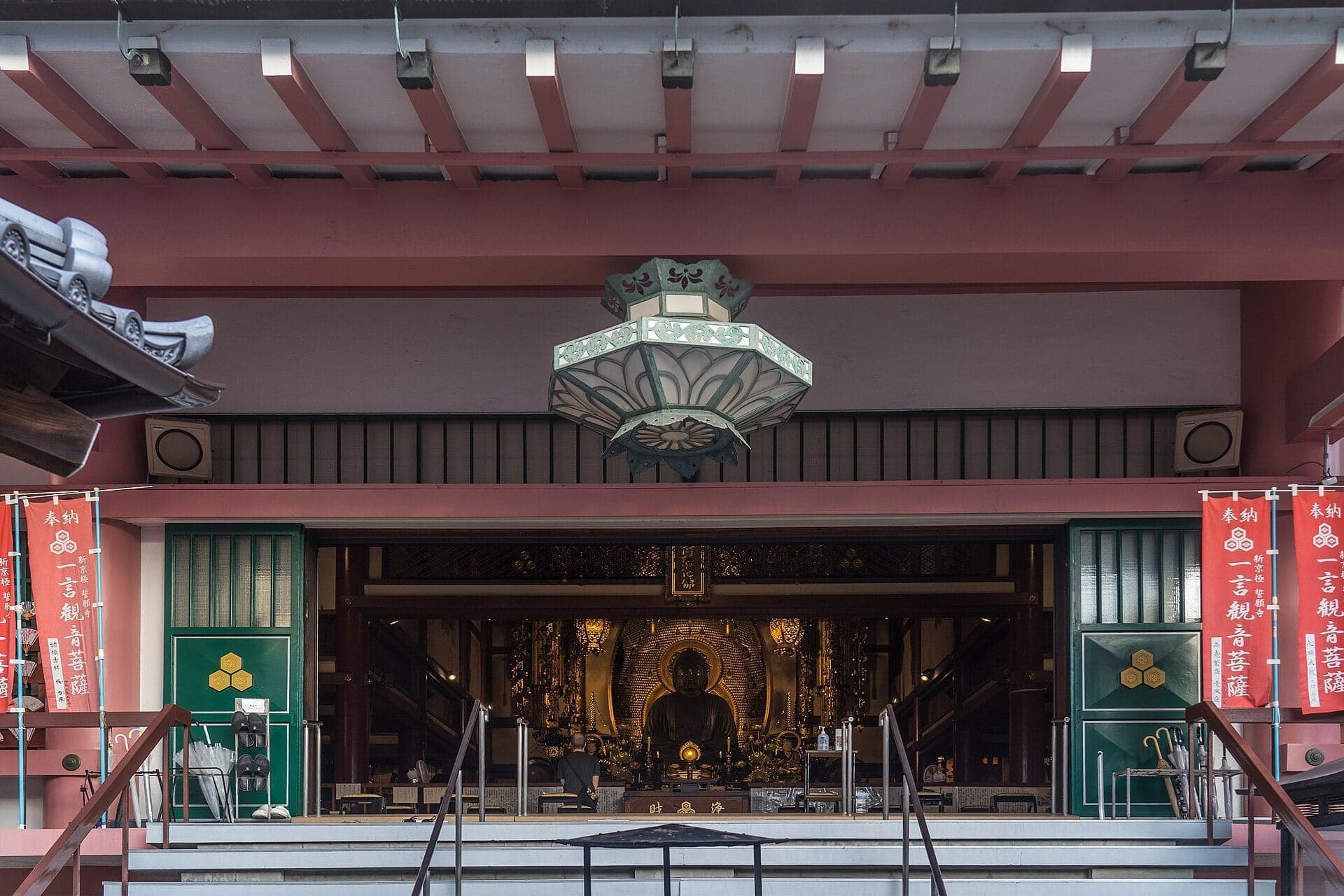
Shinkyogoku and Seigan-ji
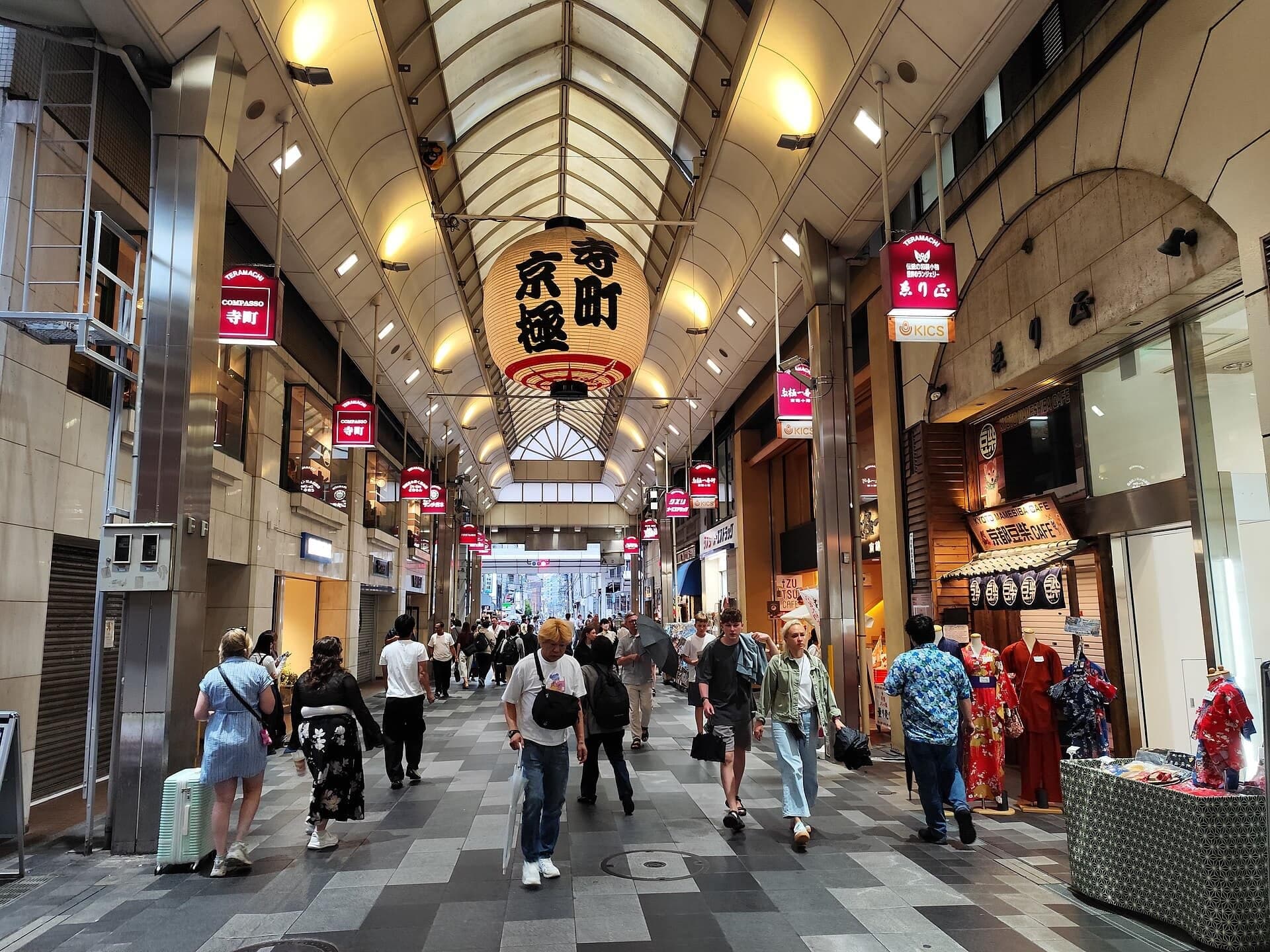
Seigan-ji opens straight onto the Shinkyogoku arcade. The street was cut through temple grounds in 1872 to lift Kyoto's spirits.
- 5
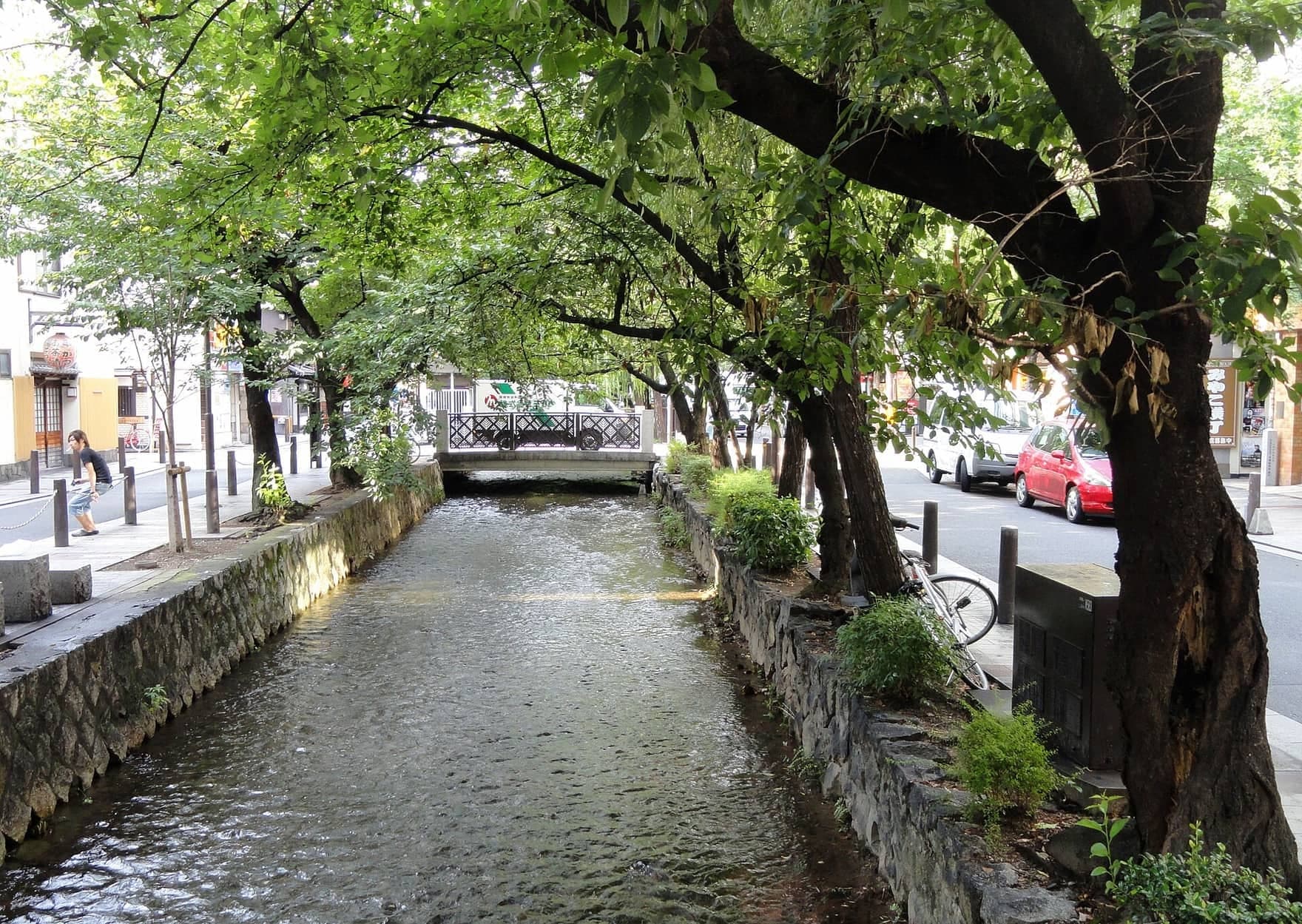
Takase River: A Merchant's Canal
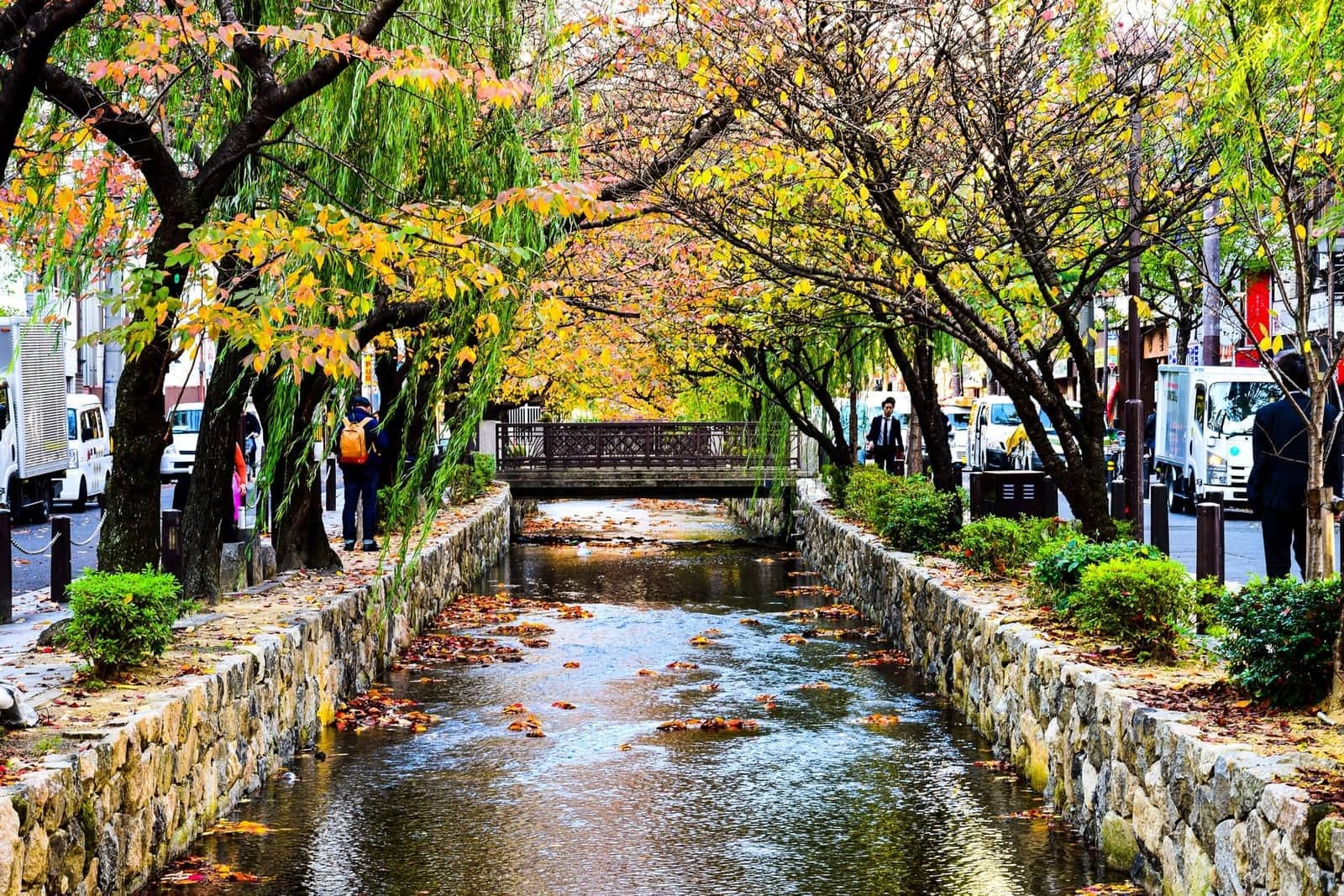
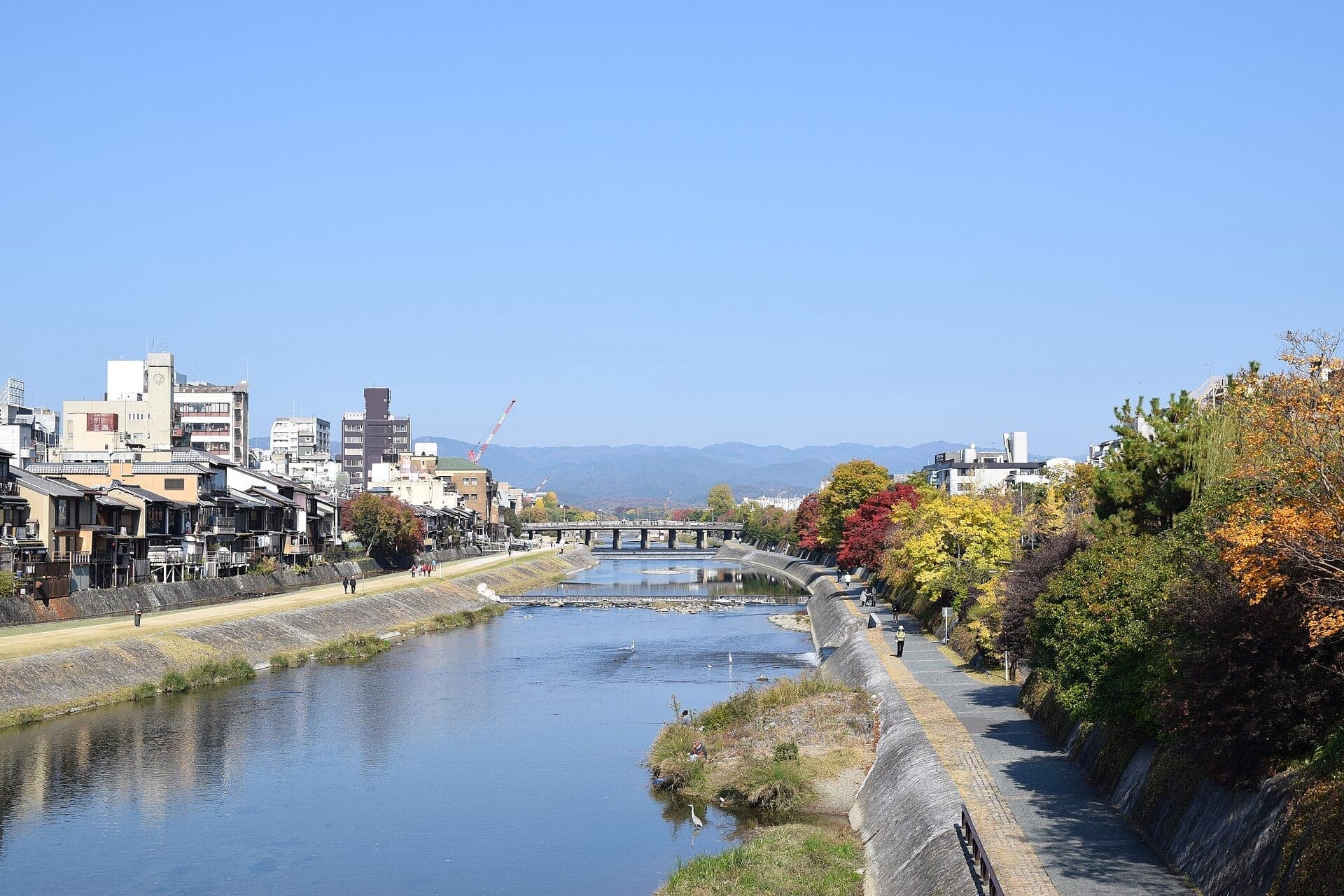
A merchant paid to dig the Takase canal in 1611 to 1614. It runs just outside Hideyoshi's old earthwork and is fed from the Kamo.
- 6
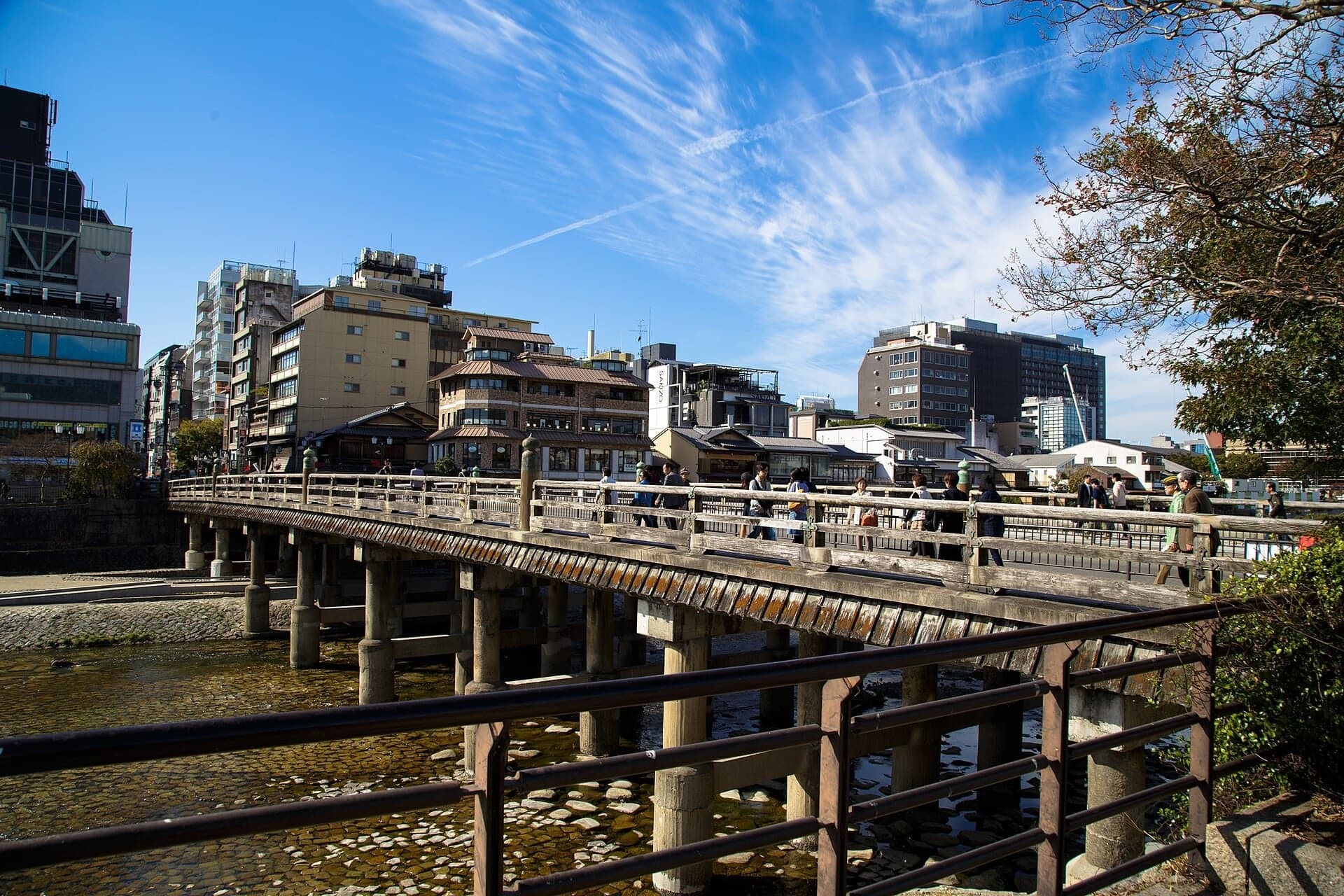
Sanjo Bridge: Start of the Tokaido
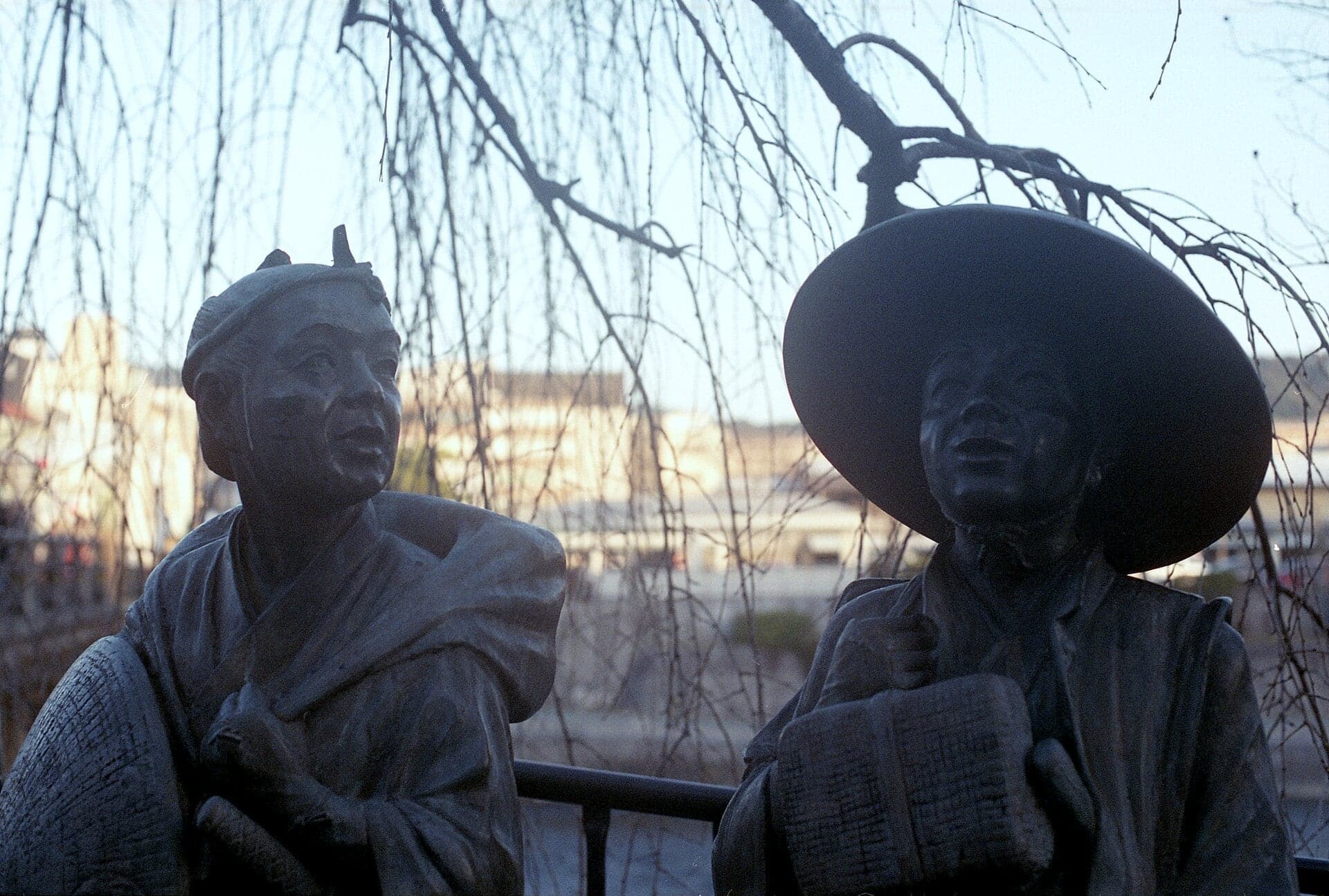
This bridge was the western starting point of the Tokaido road. Its wooden railing keeps the onion-shaped caps of a 1590 design.
- 7
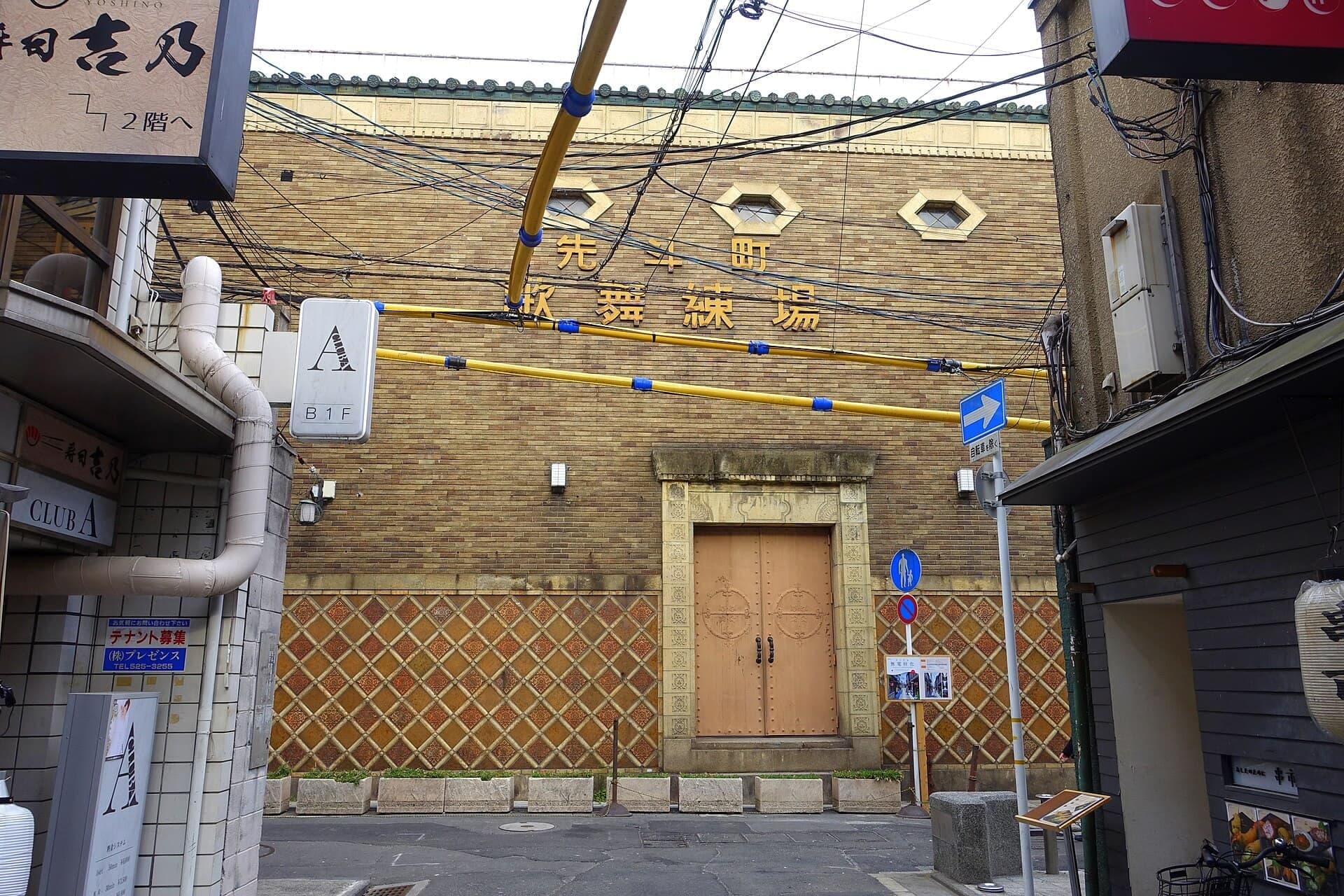
Pontocho Kaburenjo
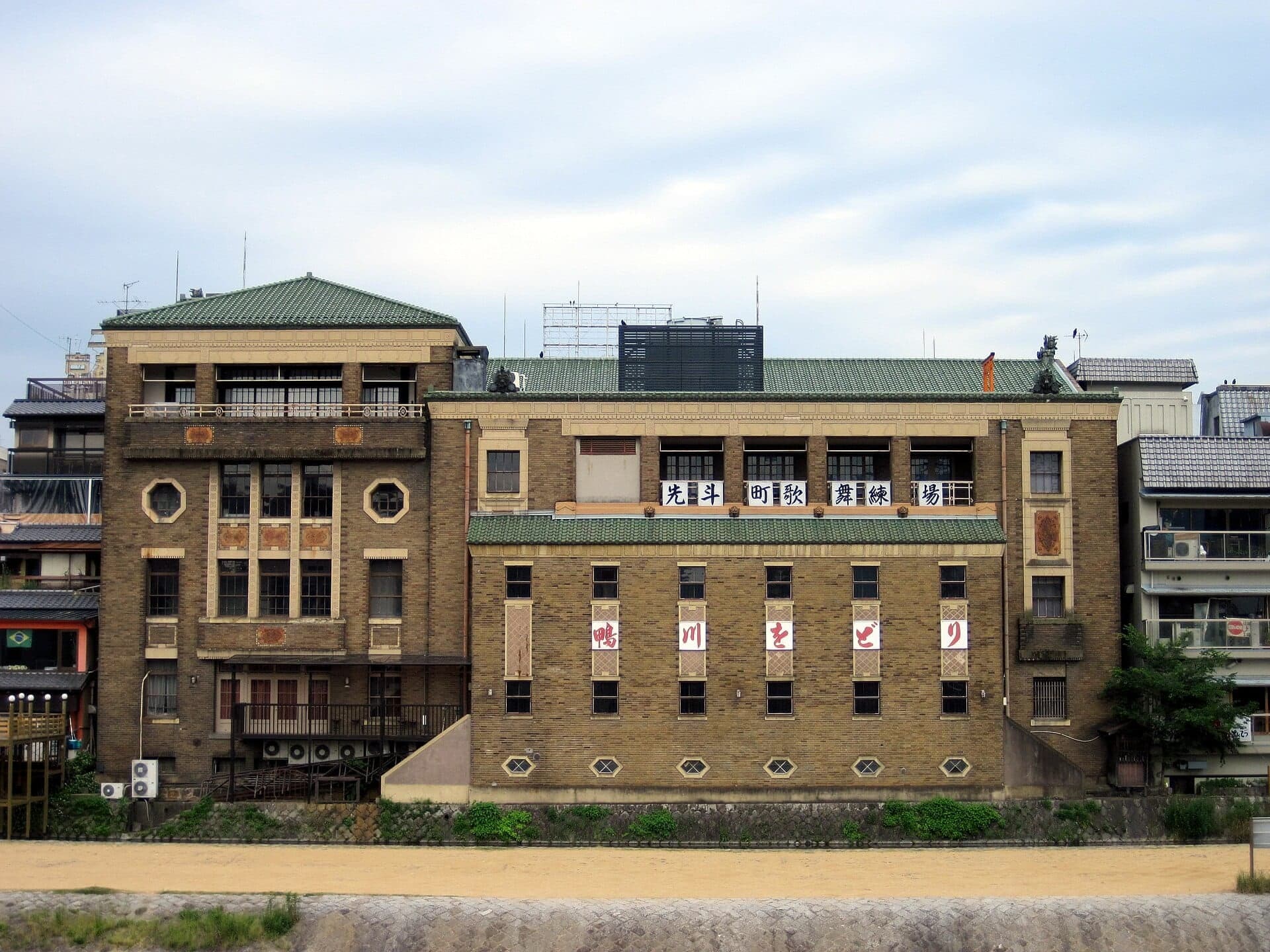
Pontocho's theater stages the Kamogawa Odori, a spring dance first held in 1872. Metal plovers, the district's emblem, are set into the paving.
- 8
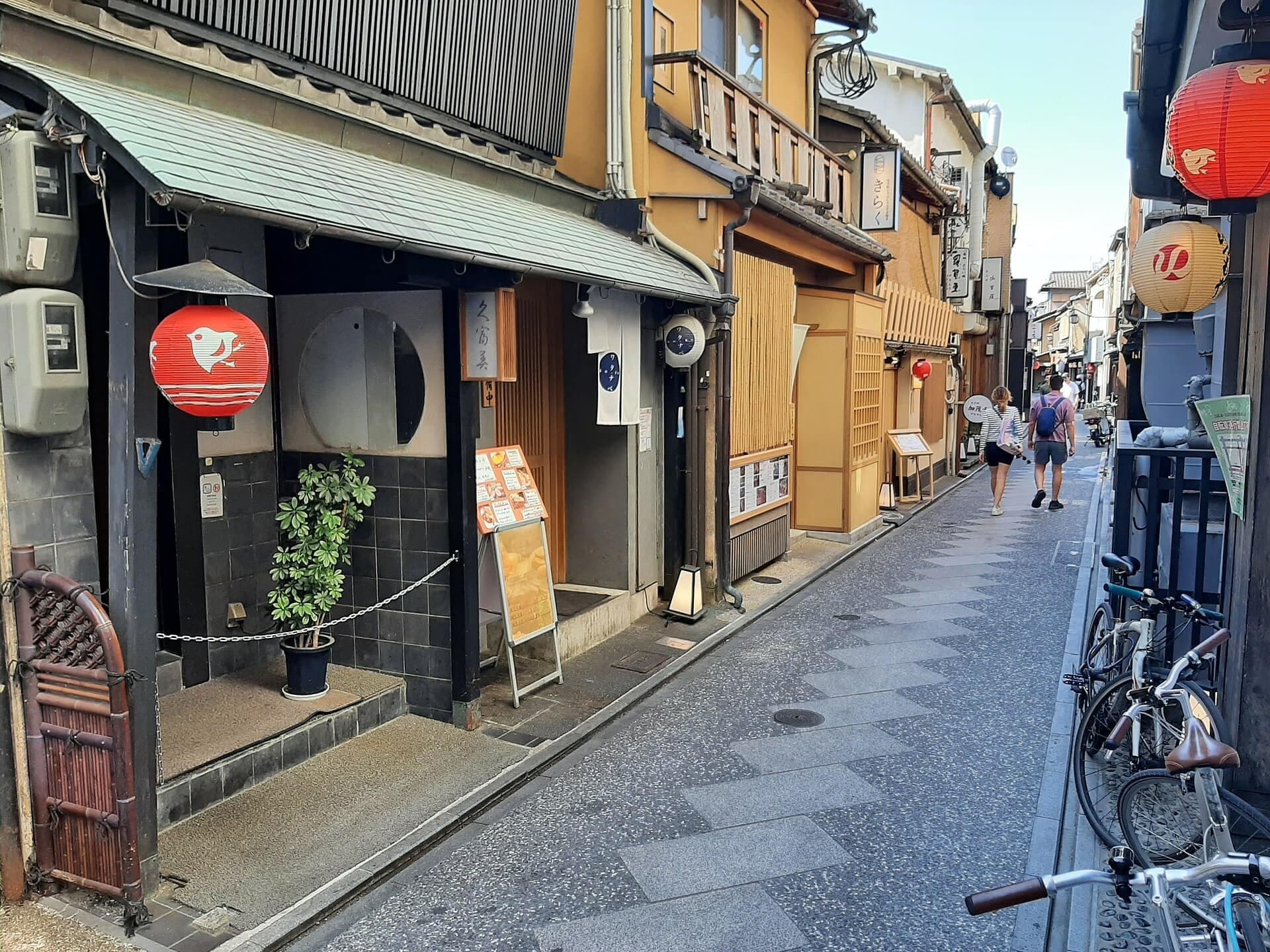
Pontocho Alley
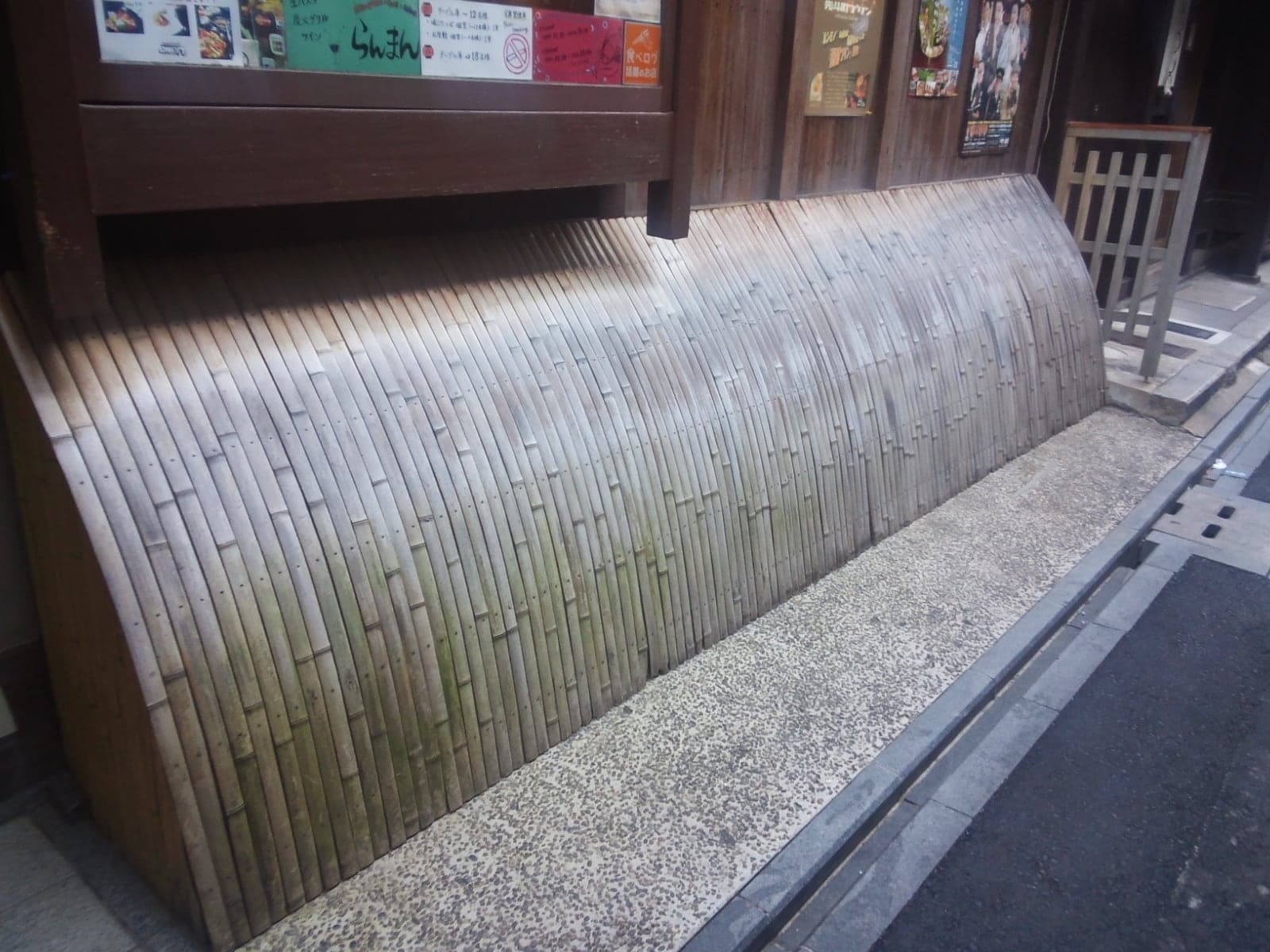
Pontocho's stone lane was never widened: at its narrowest it is 1.6 meters, unchanged since the Edo period. Its cables were buried in a job people called impossible.
- 9
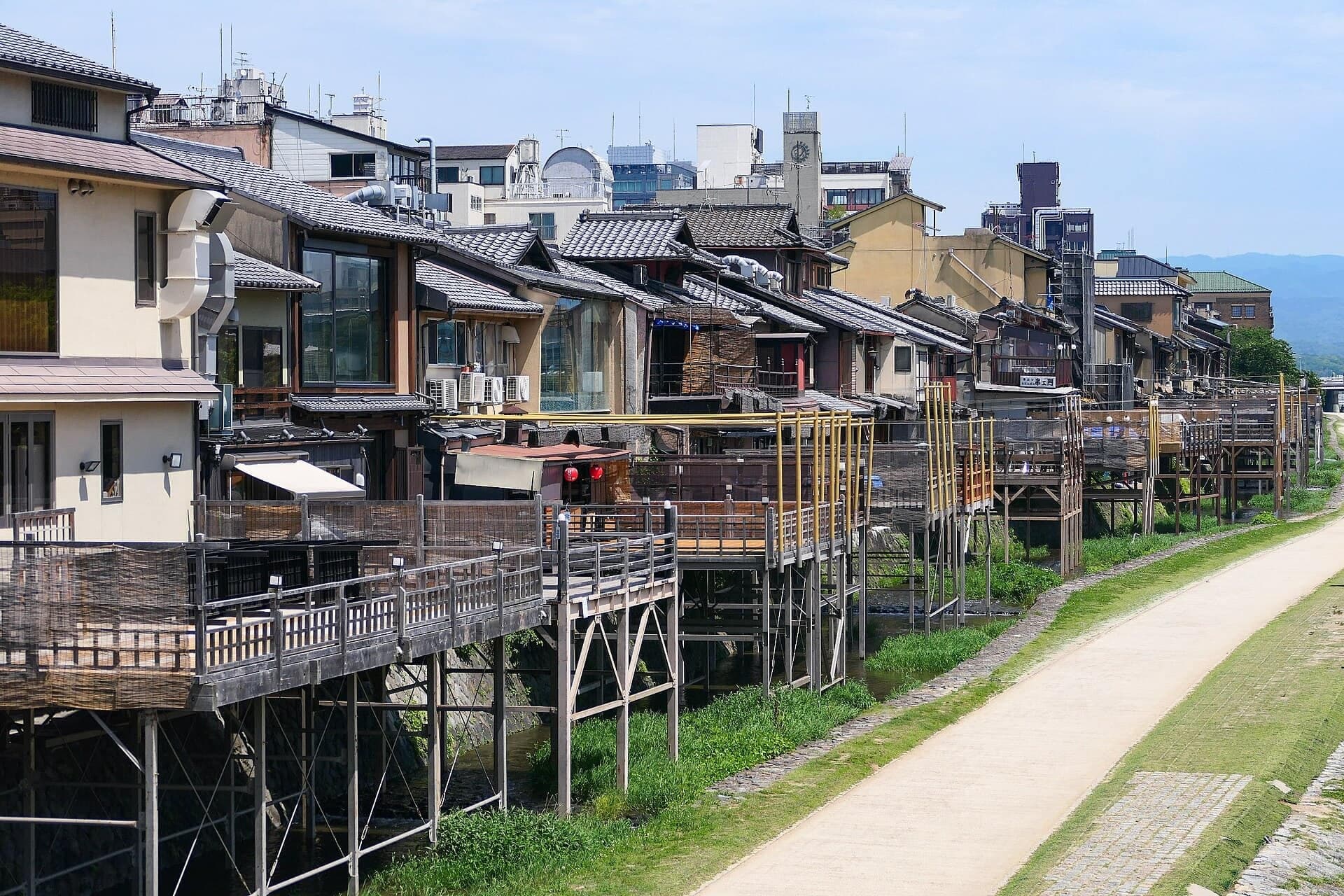
Pontocho Park: Rooms on the River
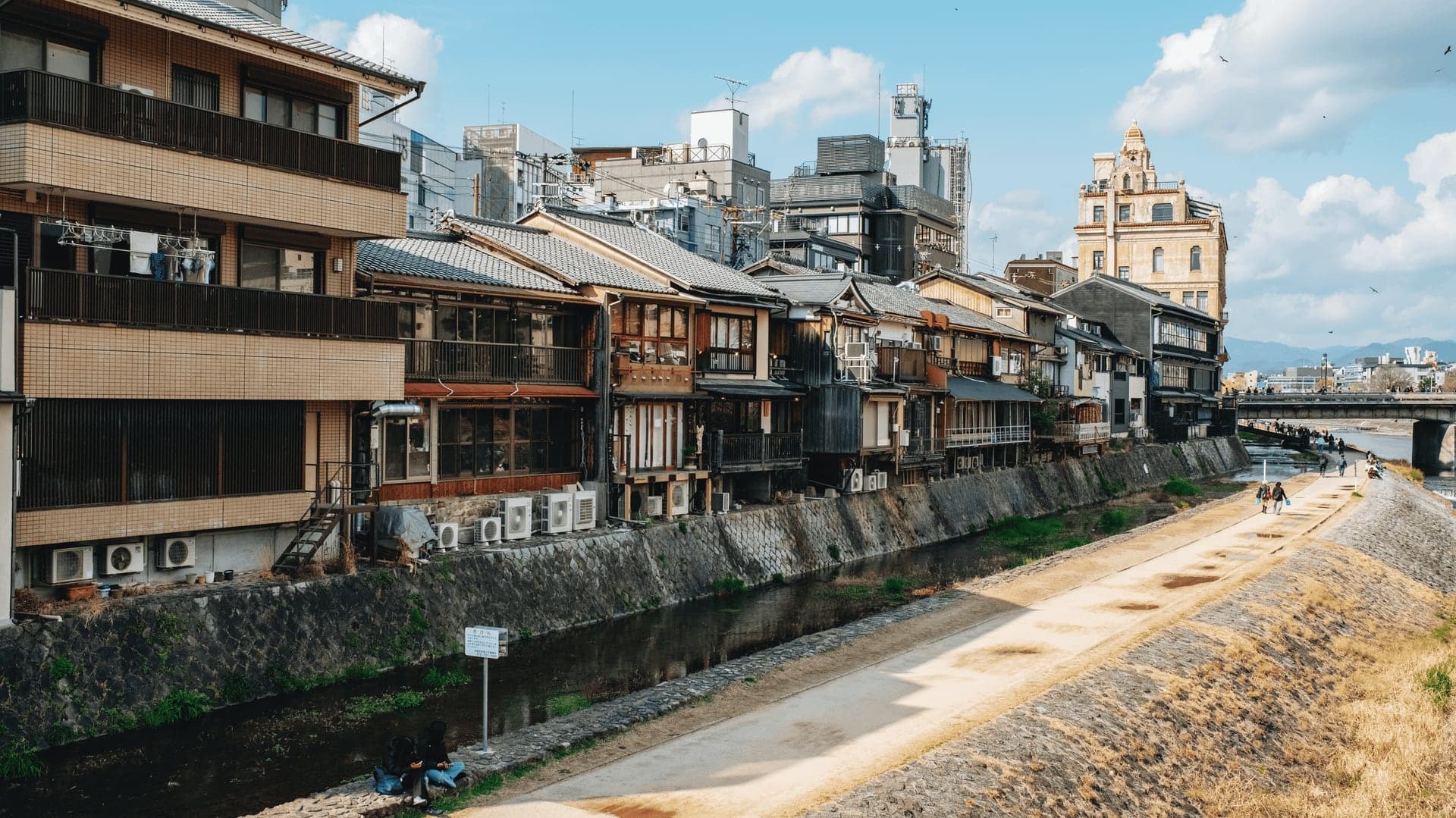
Pontocho's riverside rooms face the Kamo in one even line, built in a single generation. Summer dining platforms stand over the channel below.
- 10
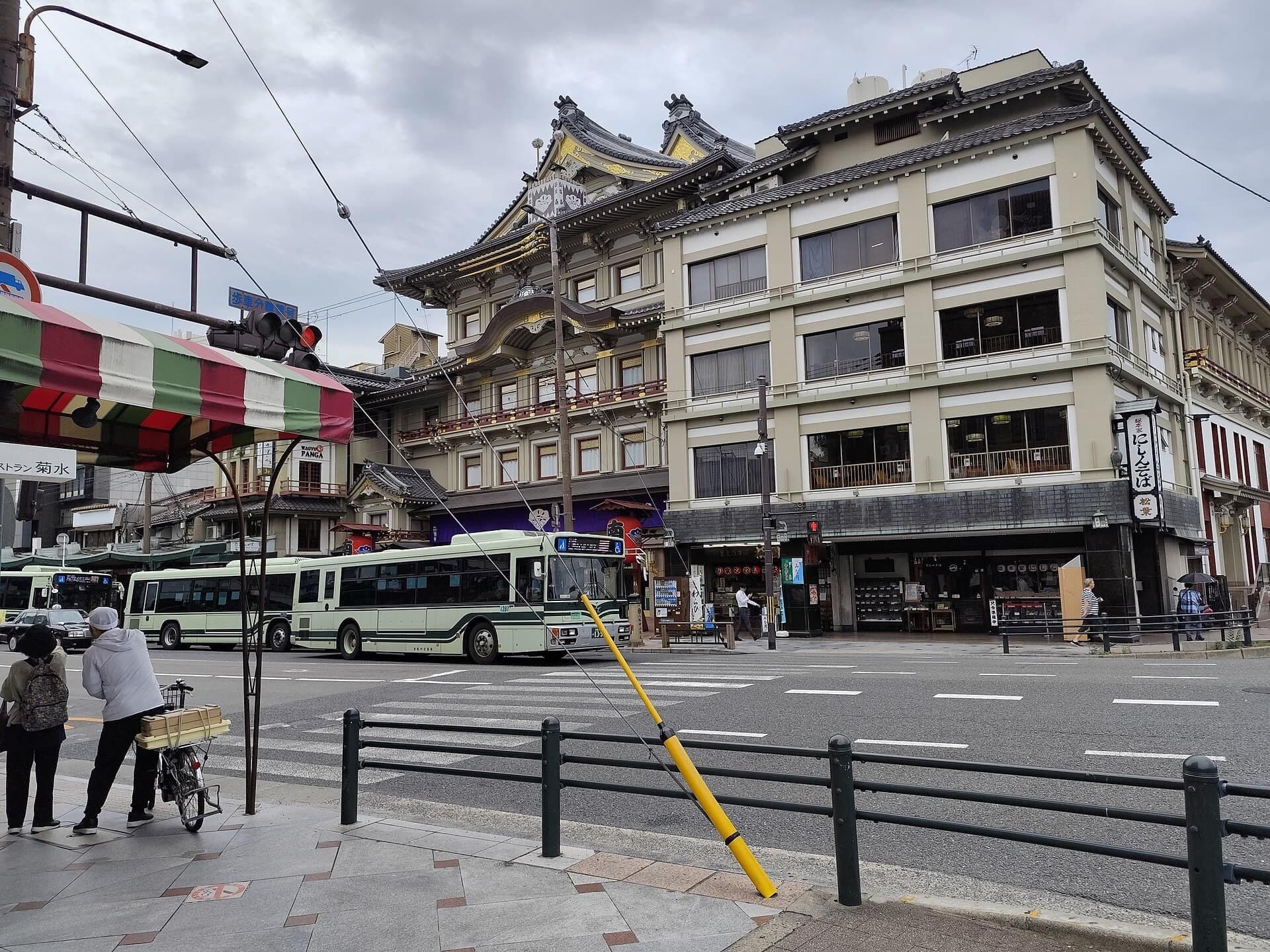
Shijo Bridge and the Kamo River
The Shijo bridge looks across the Kamo to Minami-za. Its tower marks a licensed theater; upstream, Pontocho's riverside rooms line the water.
Details
Best Time to Visit
A dry afternoon on any day but Wednesday, when many Nishiki shops close (the market has no common closing day, and many shops close 1 to 3 January). The Japan National Tourism Organization suggests reaching Nishiki as close to 11:00 as you can to beat the crowds. Starting in the afternoon brings you to the river toward dusk. After the shops close the walk still works: the market's shutters carry reproductions of Jakuchu's paintings. The summer dining platforms stand over the river from 1 May to 15 October (2026 season; some shops stop at the end of September). Checked 16 October 2026.
Pro Tips
- •Nishiki Market (stops 1 and 2): free; each shop sets its own hours and closing days, many close on Wednesdays, and many close 1 to 3 January. The association's toilet is open 10:00 to 17:00. Checked 16 October 2026.
- •In Nishiki, eat what you buy in front of or inside the shop where you bought it. The market asks visitors not to eat while walking; it is a request, not a fine.
- •Nishiki Tenmangu (stop 3): free, gates 8:00 to 20:00. The shrine advises boiling its spring water before drinking. The lion-dance fortune machine takes coins and offers a Japanese-English fortune. Checked 16 October 2026.
- •Seigan-ji (stop 4): grounds free; temple stamp desk 9:00 to 17:00, closed 12:00 to 12:45. Its rakugo memorial for Sakuden is held each year in early October. Checked 16 October 2026.
- •Pontocho Kaburenjo (stop 7): open only for performances. The Kamogawa Odori is every May (2026: 5 to 22 May, 12:30, 14:20 and 16:10, 4,000 to 7,000 JPY, per Kyoto City); the Suimeikai autumn recital runs 15 to 20 October 2026. Check en.kamogawa-odori.com for 2027 dates. Checked 16 October 2026.
- •Summer dining platforms (yuka) over the Misosogi channel: 1 May to 15 October in 2026, some shops ending in September; reservations are made shop by shop. The next season opens on 1 May 2027. Checked 16 October 2026.
- •Minami-za (seen from stop 10): an Ichikawa Danjuro special performance runs 3 to 25 October 2026 (11:30 and 16:00); the Kaomise runs 1 to 24 December 2026 (closed 9 and 17 December, with private-hire days), tickets on sale from 9 November. Checked 16 October 2026.
- •Step-free riverbank: the slope down to the Kamo starts just downstream of the Sanjo bridge's west end (stop 6), and it is also where to see the large 1669 embankment stones under the bridge. From the Shijo bridge's west end (stop 10) the bank is two flights down, 8 steps and then 18 over a small footbridge, with no ramp; the second flight is unlit.
- •Step-free: between stops 6 and 7 the route takes four steps down onto the riverside walk. To avoid them, stay on the narrow lane beside it for about 60 m; it is one-way, and cars come toward you.
- •Detour: the Ichi-no-funairi, the Takase canal's first wharf with a replica boat, is a national historic site at Kiyamachi Nijo, about 600 to 700 meters upstream of the Sanjo bridge; open air, free and always open.
- •Detour before you start: Rokkaku-do, which the Ikenobo school calls the birthplace of ikebana, is west of the market; free, grounds 6:00 to 17:00 and gated after that. Checked 16 October 2026.
Safety & Precautions
- •Between stops 4 and 5 the route crosses Kawaramachi-dori, a four-lane main road, at the crossing by the Rokkaku-dori junction. Cross with care, and wait for the walk signal if one is showing.
- •Nishiki (at its narrowest about 3.3 m) and Pontocho (1.6 m at its narrowest) get crowded at midday and in the evening. Keep to one side and let people pass.
- •Pontocho is a geiko district. Please don't follow geiko or maiko or photograph them without permission; Kyoto City asks this of visitors in Gion's Minami-gawa area and nearby (notice of 2 May 2025).
- •Pontocho's side alleys are not public routes: some are dead ends and some are private. Look in, but do not walk in.
- •Kiyamachi, along the Takase canal, is a busy nightlife street after dark. Stay with the route and keep moving.
- •Cars use several narrow streets on this walk: the side streets that cross Nishiki, Rokkaku-dori on either side of Kawaramachi-dori, the lane along the Takase canal between stops 5 and 6 (which has no pavement, and where the route crosses the canal on a small bridge and then Kiyamachi-dori, a narrow one-way street with no marked crossing), and the top of Pontocho by the Kaburenjo. Keep to the edge.
- •The Kamo riverbank is reached from the Shijo bridge's west end by two flights of steps (26 in all, no ramp, the second flight unlit), is unevenly lit at night between Sanjo and Shijo, and floods in heavy rain. Do not go down to it in typhoon or heavy-rain warnings.
- •Launching fireworks is banned along the Kamo under Kyoto Prefecture's river ordinance.
- •Resurfacing work on the Sanjo bridge was put out to tender in April 2025; its October 2026 status is unconfirmed, so expect possible lane works, not a closure.
Travel advisory: Exercise Normal Precautions (Level 1).
Gallery
Related Reading
Go deeper on what you'll see, hear, and walk through.
Read the walk
The full story of Nishiki Market and Pontocho: Kyoto's Kitchen to the River, in words. Prefer to listen? Play it narrated, from home or on location.
Introduction
Kyoto, Japan's capital for more than a thousand years, has water running under and around the streets of its old center, and this walk follows it down to the river.
You begin in Nishiki Market, Kyoto's kitchen, where cold wells once kept the fish fresh, and pass a shrine with its own spring, a temple facing a shopping arcade, and a canal a merchant paid to dig. Then you enter Pontocho, one of Kyoto's geiko districts, geiko being Kyoto's word for geisha. It stands on land taken from the river, and the walk ends on the river itself.
Three people will help tell it. The painter Ito Jakuchu, born into a vegetable wholesaler's family in this market, who fought a lawsuit to save it. Makimura Masanao, the official who cut a new street through temple grounds to lift the city's spirits. And Suminokura Ryoi, the merchant who dug the canal. Behind much of the plan stands Toyotomi Hideyoshi, who remodeled Kyoto in the fifteen eighties and nineties.
The walk is ten stops over just under two kilometers, a little over a mile, and takes about an hour and a quarter, more if you stop to eat. It is flat all the way. Nishiki's shops keep their own hours, so come in the daytime, and many close on Wednesdays. The walk begins at the entrance to Nishiki Market and ends on the Shijo bridge over the Kamo.
1. Nishiki Market West Gate
Welcome to Nishiki Market. Walk on to the mouth of the covered street, at its corner with Takakura-dori, and stop there.
Nishiki is a public street, free to walk. Each shop keeps its own hours and days. If the shutters are down when you arrive, stay anyway. You will see why.
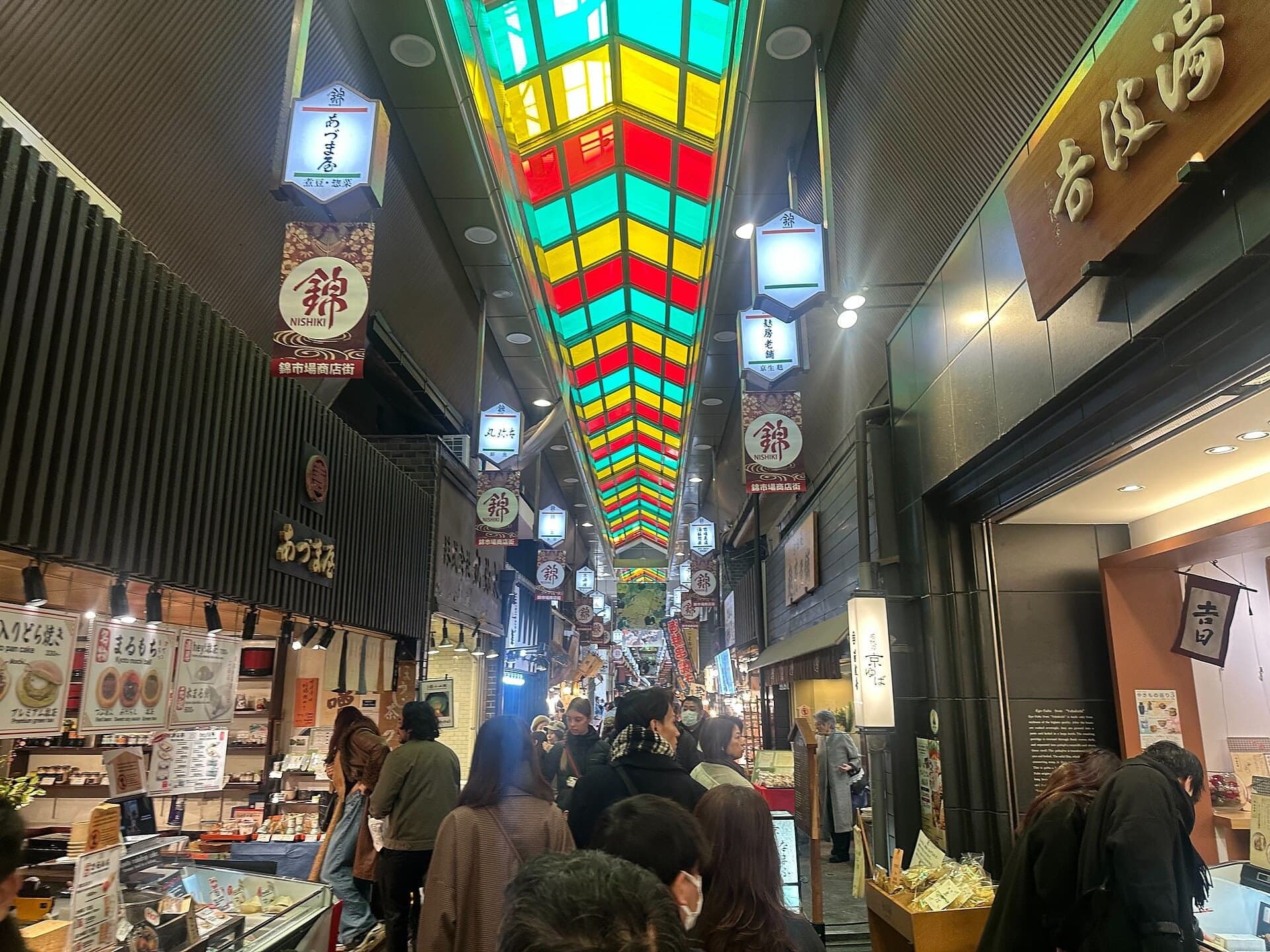
Look up at the roof. The market describes it as red, yellow and green, and calls it its symbol. It was finished in nineteen ninety-three and built without pillars, so nothing stands in the street below. Under it the market runs about three hundred and ninety meters, and at its narrowest the street is just over three meters wide.
The shogunate licensed Nishiki as a fish market in sixteen fifteen. The market's own history finds fish sellers on this street in a record of thirteen eleven, and says it may be older still. In seventeen seventy a vegetable market was approved at this end, and within a year it was in court. Rival vegetable wholesalers at Gojo went to the magistrate's office to stop it. The man who fought back had been born into a vegetable wholesaler's family in this market. He had handed the business to his younger brother and served as a town elder, and he was a painter: Ito Jakuchu. He rallied the farming villages that supplied the market, among them Mibu, home of a leafy green called mibuna. In seventeen seventy-four the vegetable market reopened.
Kyoto University keeps the record of that dispute. It ends with an address, the southeast corner of Nishiki and Takakura, and a signature, Masuya Genzaemon. That was Jakuchu's real name, and that corner is right here, at the market's mouth.
The market calls him its restorer. A monument near this entrance marks his birthplace, and Nishiki has put pictures of his paintings on its shop shutters. So when the shops close, Jakuchu comes out.
Follow the route into the market.
2. Nishiki Market: Kyoto's Kitchen
Walk on into the market and stop where the shops crowd in on both sides.
First, one request from the market itself. Please don't eat while you walk. Eat in front of the shop where you bought it, or inside it. The shops began asking this in the autumn of two thousand eighteen, as more and more visitors came. It is a request, not a rule with a fine, and a kind one.
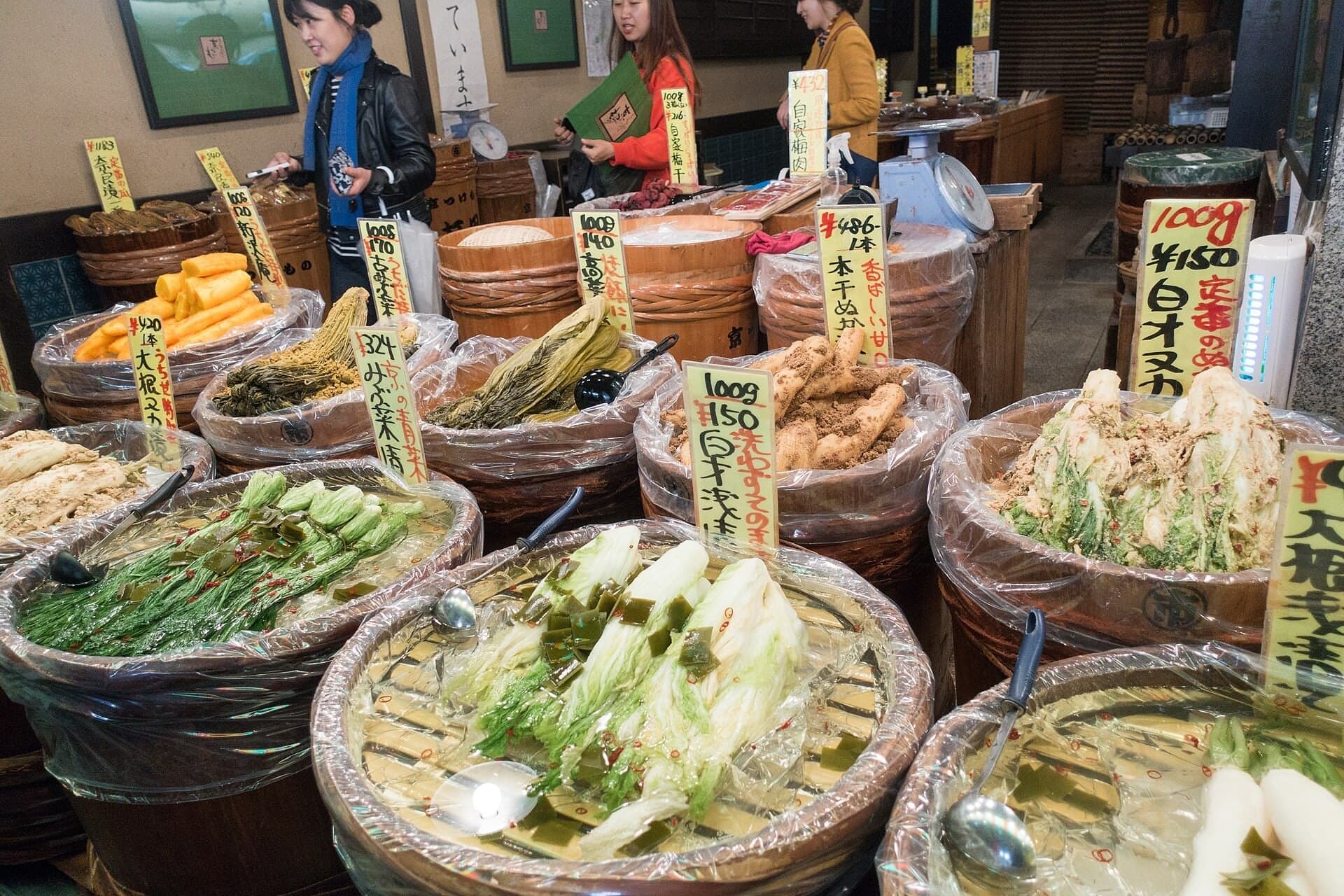
The market calls itself Kyoto's kitchen. Look at what is on the counters: fish, pickles, tofu and vegetables. The market names its own specialties. Kyoto vegetables. River fish from Lake Biwa. Hamo, the pike conger. Guji, a tilefish. A flounder called sasa-garei. Yuba, the fine skin lifted from heated soy milk. And nama-fu, fresh wheat gluten.
Kyoto vegetables, kyo-yasai, are an official category. In nineteen eighty-eight Kyoto Prefecture defined them as varieties brought here before the Meiji era began in eighteen sixty-eight. Bamboo shoots count; mushrooms do not. Counting the varieties that have died out, the prefecture lists about forty.
Now the water. Beneath this street lies groundwater that stays between fifteen and eighteen degrees Celsius all year, about sixty degrees Fahrenheit. The market calls it Nishiki's water. Shops once dug their own wells and used them as natural refrigerators for fresh food, and that cold water is why a fish market grew up here. In nineteen sixty-five the shopkeepers began a shared well-water project.
The street has changed shape more than once. In eighteen eighty-three the old guild privileges were abolished and the market shrank to seven big shops. In nineteen twenty-seven many moved to Kyoto's new central wholesale market. Today Nishiki has over a hundred shops.
Follow the route on through the market to its far end.
3. Nishiki Tenmangu: A Gate in the Shops
Walk on to the far end of the market, across the Teramachi arcade, to the stone gate that stands over the lane, and stop beneath it.
This is the gate of Nishiki Tenmangu, a shrine, free to visit. Look up at the stone crossbeam and follow it out to each end. It runs straight into the shops on both sides. The shrine describes this gate as a remnant of its grounds from before eighteen seventy-two, now pressed into the shops on either side.
Here is how that happened. The shrine is dedicated to Sugawara no Michizane, honored as the god of learning. It says it came to this spot in fifteen eighty-seven, when Hideyoshi's new city plan moved its parent temple onto Nishiki, and it has been called Nishiki Tenmangu ever since. Then came eighteen seventy-two. Under the new government's separation of Shinto shrines from Buddhist temples, the shrine was made independent, and the temple moved away. That same year a new street was cut through the grounds. The street came through, the shrine shrank, and the gate stayed where it was.
Now walk through to the shrine itself, at the end of this short lane. Two things to find there. First, water. The shrine says its spring rises from about thirty meters underground. It asks you to boil the water before drinking it, as a precaution. Second, a fortune machine. When you come near, music starts and a mechanical lion begins to dance. Put in a coin and the lion brings you a written fortune, an omikuji, and one kind comes in Japanese and English.
The shrine faces the next arcade, Shinkyogoku, the very street that cut its grounds.
Follow the route up Shinkyogoku.
4. Shinkyogoku and Seigan-ji
Walk on up Shinkyogoku until a temple front opens straight onto the arcade, and stop in front of it. This is Seigan-ji, and its grounds are free. A temple facing a shopping arcade is an unusual sight, even in Kyoto, and the temple was here first. In the fifteen eighties and…
Full narration for this stop unlocks with the tour.
5. Takase River: A Merchant's Canal
Walk on to the little bridge where this street crosses a shallow, stone-lined canal, and stop there, looking along the water. This is the Takase River, in fact a canal, dug for boats. Between sixteen eleven and sixteen fourteen a merchant named Suminokura Ryoi had it cut. He…
Full narration for this stop unlocks with the tour.
6. Sanjo Bridge: Start of the Tokaido
Walk on to the end of the bridge, where a statue of two travelers stands, and stop beside it. This is the Sanjo bridge over the Kamo. Kyoto City calls it the old western starting point of the Tokaido, the great road to Edo, today's Tokyo, with its fifty-three post stations.…
Full narration for this stop unlocks with the tour.
7. Pontocho Kaburenjo
Walk on into the top of Pontocho, the narrow street that runs beside the river, and stop by the large theater at its end. This is the Pontocho Kaburenjo, the district's theater. It opens only for performances, with tickets: the Kamogawa Odori, a spring dance held every May, and…
Full narration for this stop unlocks with the tour.
8. Pontocho Alley
Walk on down Pontocho a little way, and stop where the house fronts close in on both sides. Kyoto City measures this street at four hundred and ninety meters long, and between four point four meters and just one point six meters wide. Its own leaflet describes a street so…
Full narration for this stop unlocks with the tour.
9. Pontocho Park: Rooms on the River
Walk on into the little park that opens off the street toward the river. The river rail is just beyond, over two short flights of steps, and that is the best place to stand. You are standing on what was once the riverbed. Before the embankment, the Kamo ran wide here, full of…
Full narration for this stop unlocks with the tour.
10. Shijo Bridge and the Kamo River
Walk on out onto the Shijo bridge, staying on this side of the road, and stop about halfway across, against the river rail and out of the flow, where you can see the large theater at the far end. This is where the walk ends. You are over the Kamo itself, the river this walk has…
Full narration for this stop unlocks with the tour.
- Nishiki Market (錦市場) — Nesnad, CC BY 4.0 · source
- 錦市場 (Nishiki market) — Nesnad, CC BY 4.0 · source
- Nishiki Market — Kent Wang from London, United Kingdom, CC BY-SA 2.0 · source
- sep 22, 2021 at 15:10, Kyoto 新京極 — m-louis .®, CC BY-SA 2.0 · source
- 京都市中京区錦小路通新京極にある錦天満宮。参道にある鳥居。参道両脇のビルの壁に鳥居両端がめり込んでいる。 — Naokijp, CC BY-SA 4.0 · source
- Kyoto, Seigan-ji — Alexkom000, CC BY 4.0 · source
- 2015.10.26 Sanjo Ohashi,Kyoto — nobu3withfoxy from Iga,Mie, Japan, CC BY 2.0 · source
- 弥次喜多 — shikabane taro, CC BY 3.0 · source
- 先斗町歌舞練場 — Mariemon, CC BY-SA 3.0 · source
- Steegje met dure restaurants achterde Kamo rivier facade (westkant) — Smiley.toerist, CC BY-SA 4.0 · source
- 先斗町 竹矢来 — Yanajin33, CC BY-SA 4.0 · source
- 秋の鴨川。四条大橋から上流を撮影。 — Raita Futo from Tokyo, Japan, CC BY 2.0 · source
Images may be cropped or resized. Other photos via Unsplash and Pexels.