Akbar's red sandstone capital on its ridge west of Agra, walked in the city's own order. The Diwan-i-Am, the Diwan-i-Khas and its single pillar, the Panch Mahal, the Anup Talao and the houses called Mariam's, Birbal's and Jodh Bai's, then out by the Emperor's Gate into the free Jama Masjid, past Salim Chishti's tomb and down the stair of the Buland Darwaza.
Start · Diwan-i-Am: The Public Court
DirectionsStops
- 1
Diwan-i-Am: The Public Court
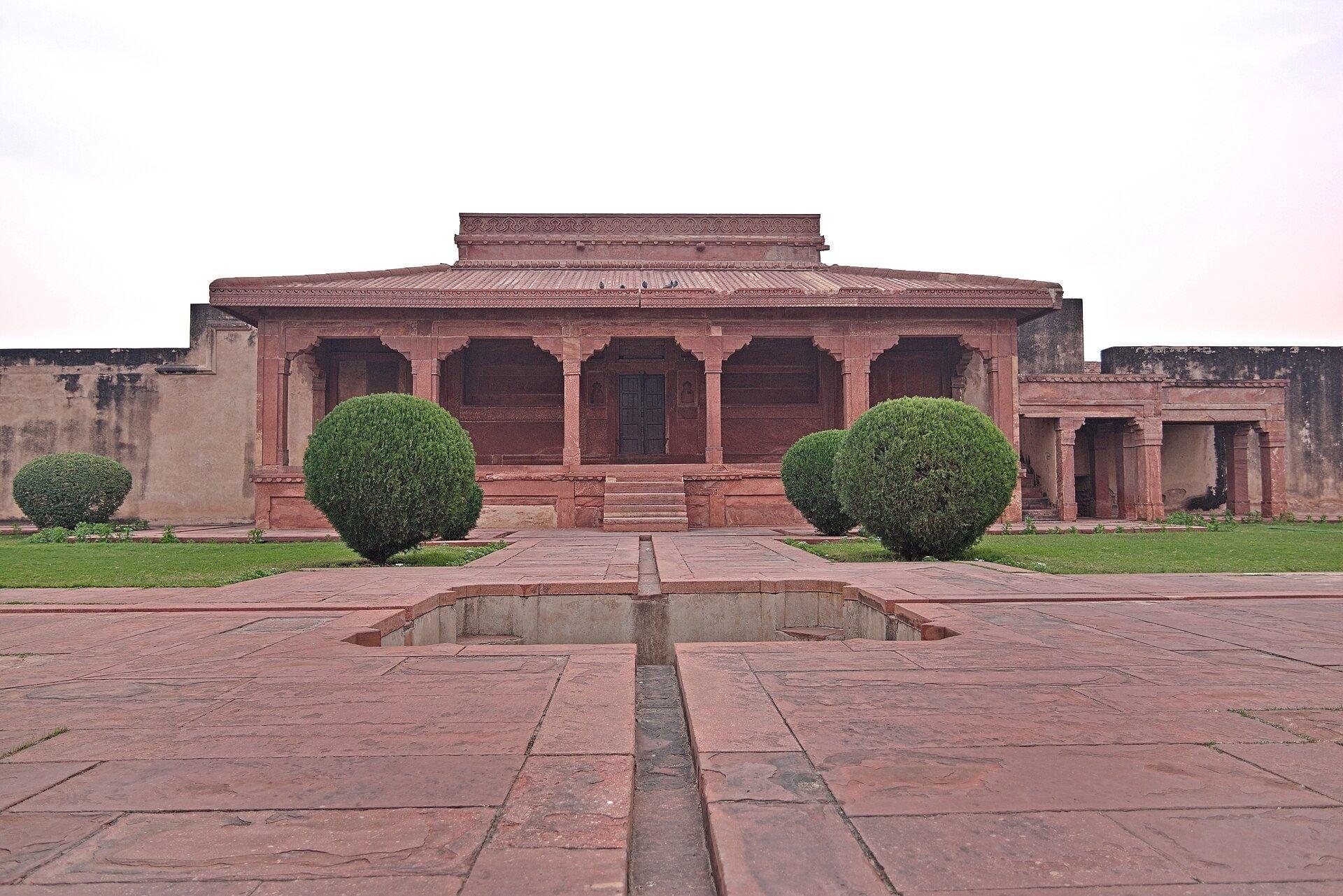
Where the emperor met his people. The Diwan-i-Am, the Hall of Public Audience: a lawn ringed by colonnades, with the emperor's screened seat on its far side.
- 2
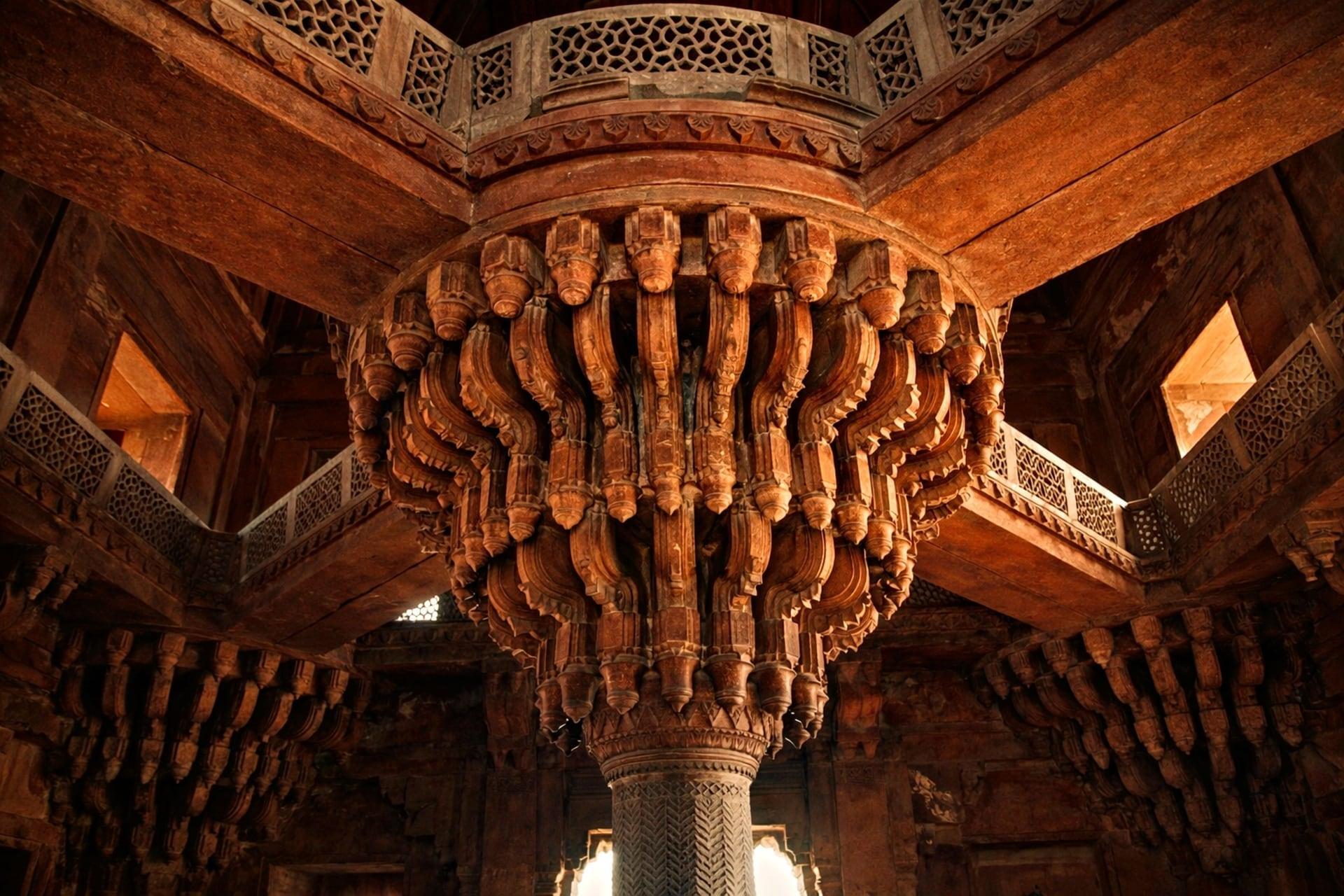
Diwan-i-Khas: One Pillar
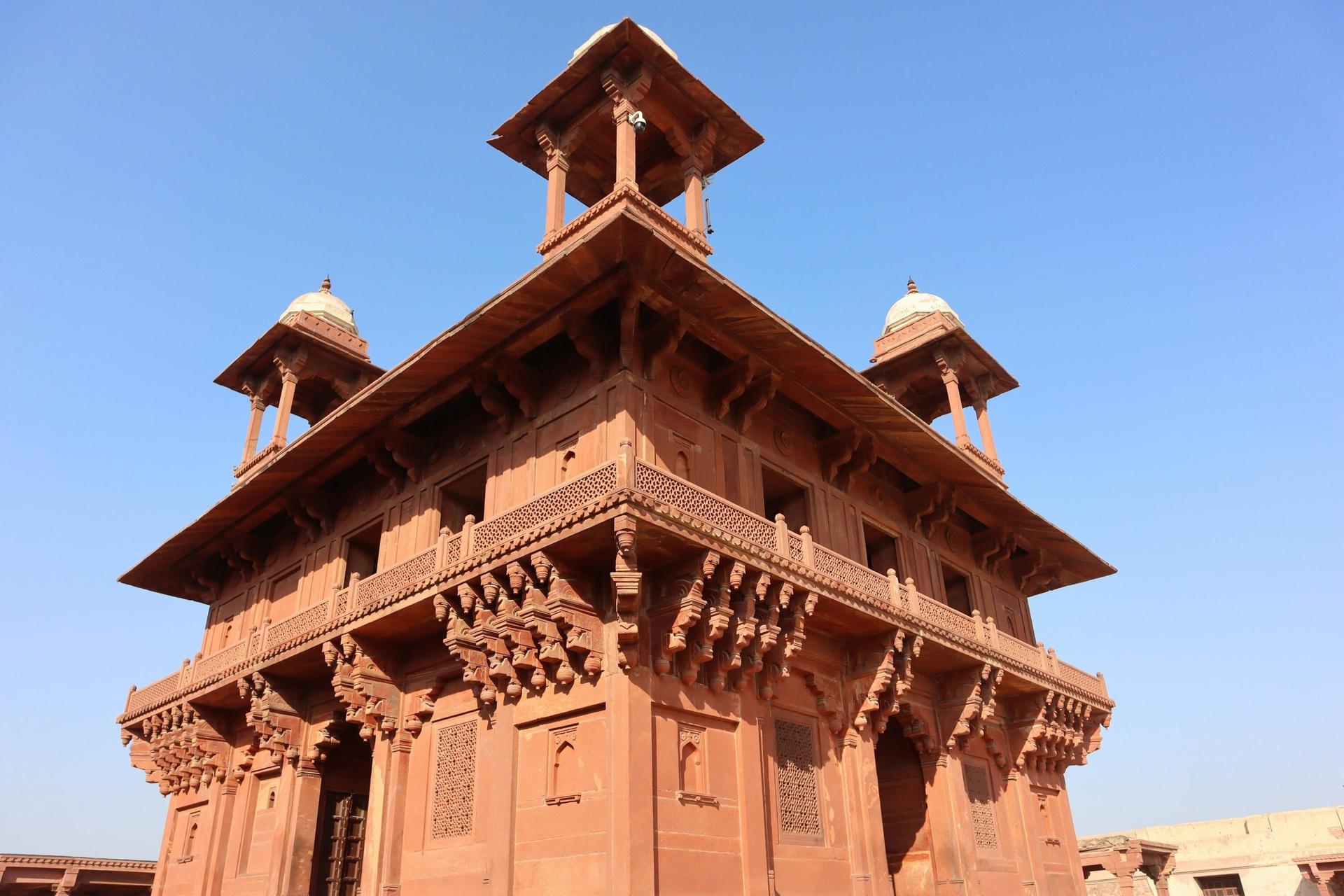
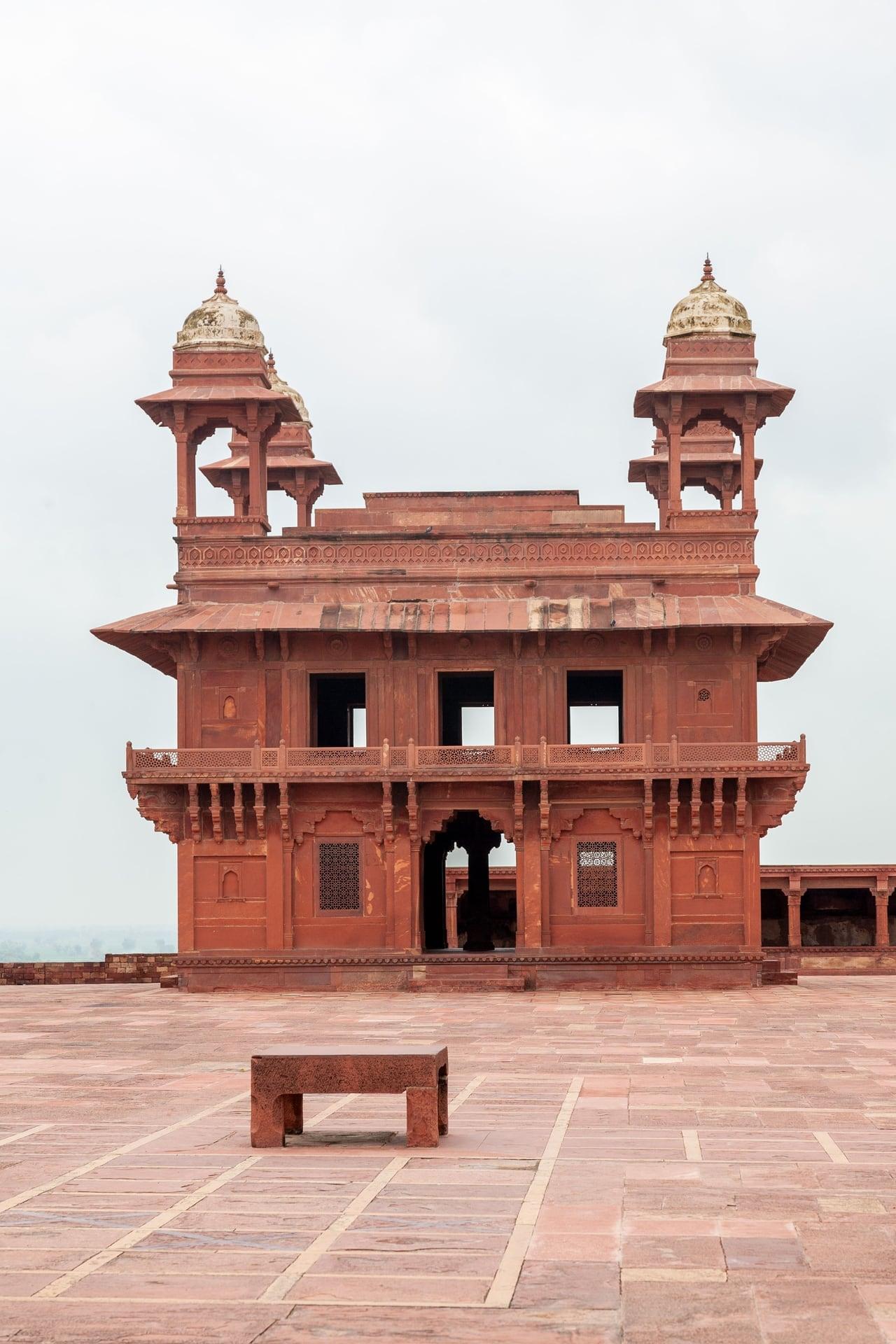
One column holds up a whole debate. The Diwan-i-Khas, a square red hall with a domed kiosk at each corner of its roof and a single carved pillar inside.
- 3
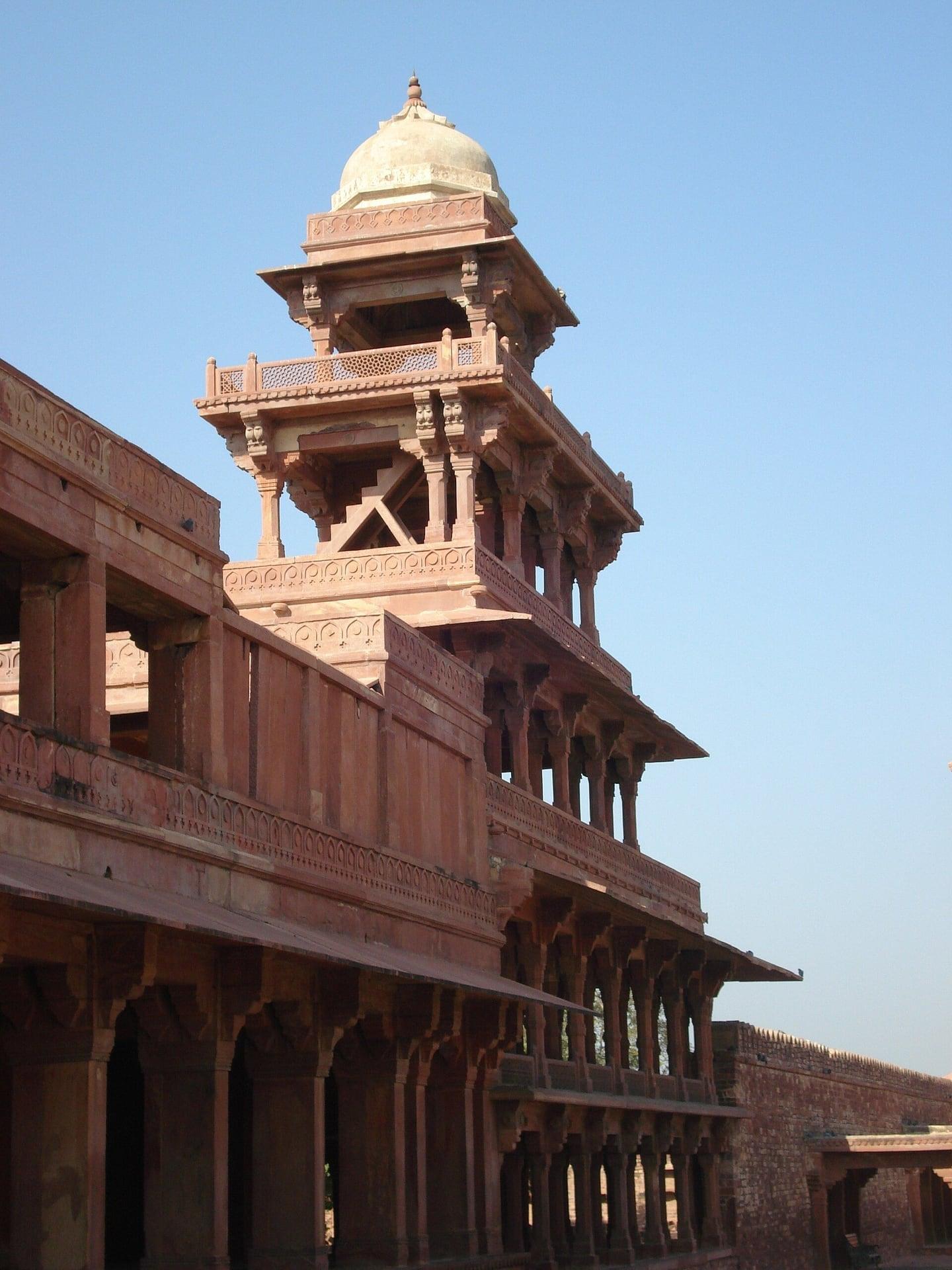
Panch Mahal: Five Stories of Air
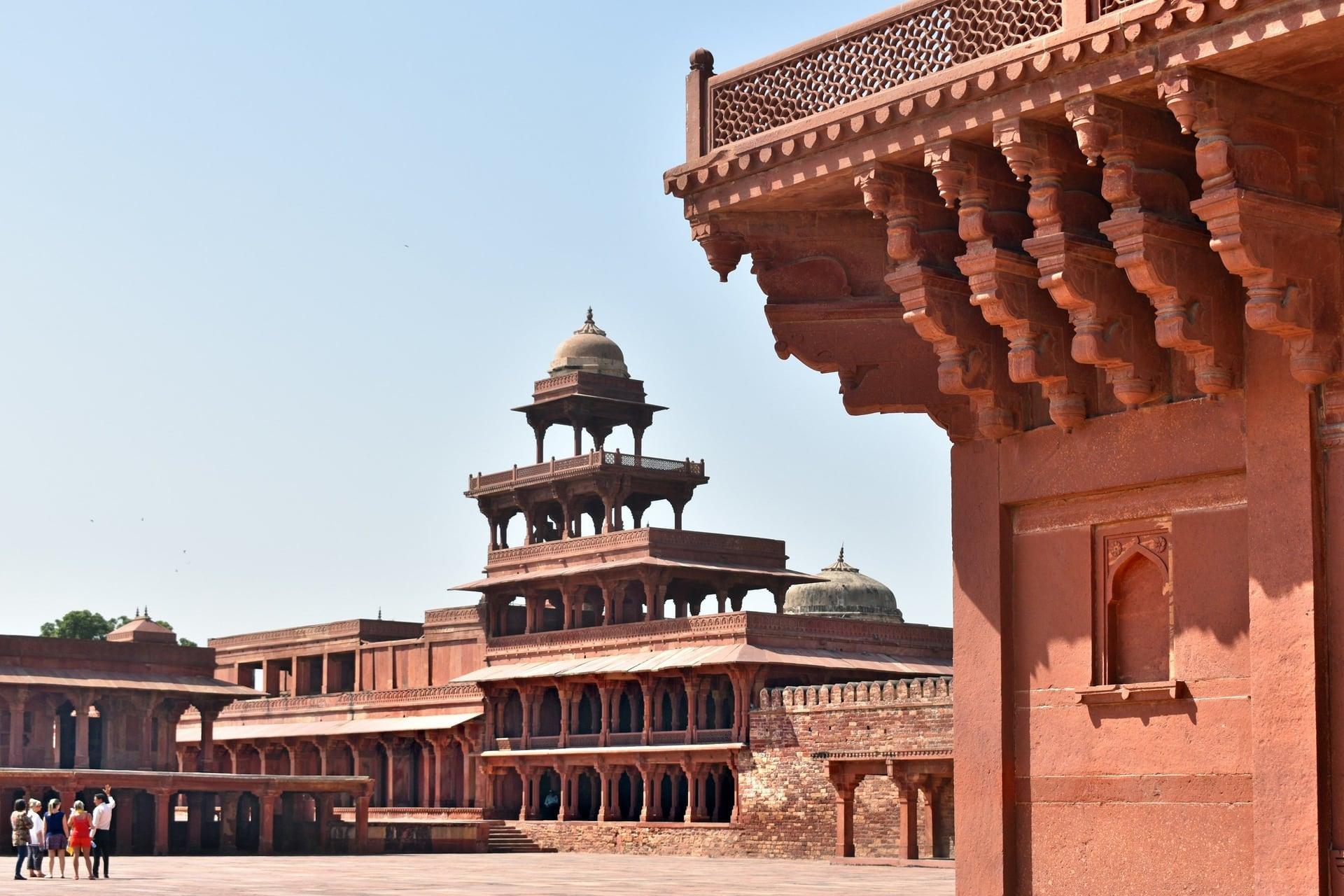
A palace built to catch the breeze. The Panch Mahal, five open stories of columns, each smaller than the last, beside a court with a game board in its paving.
- 4
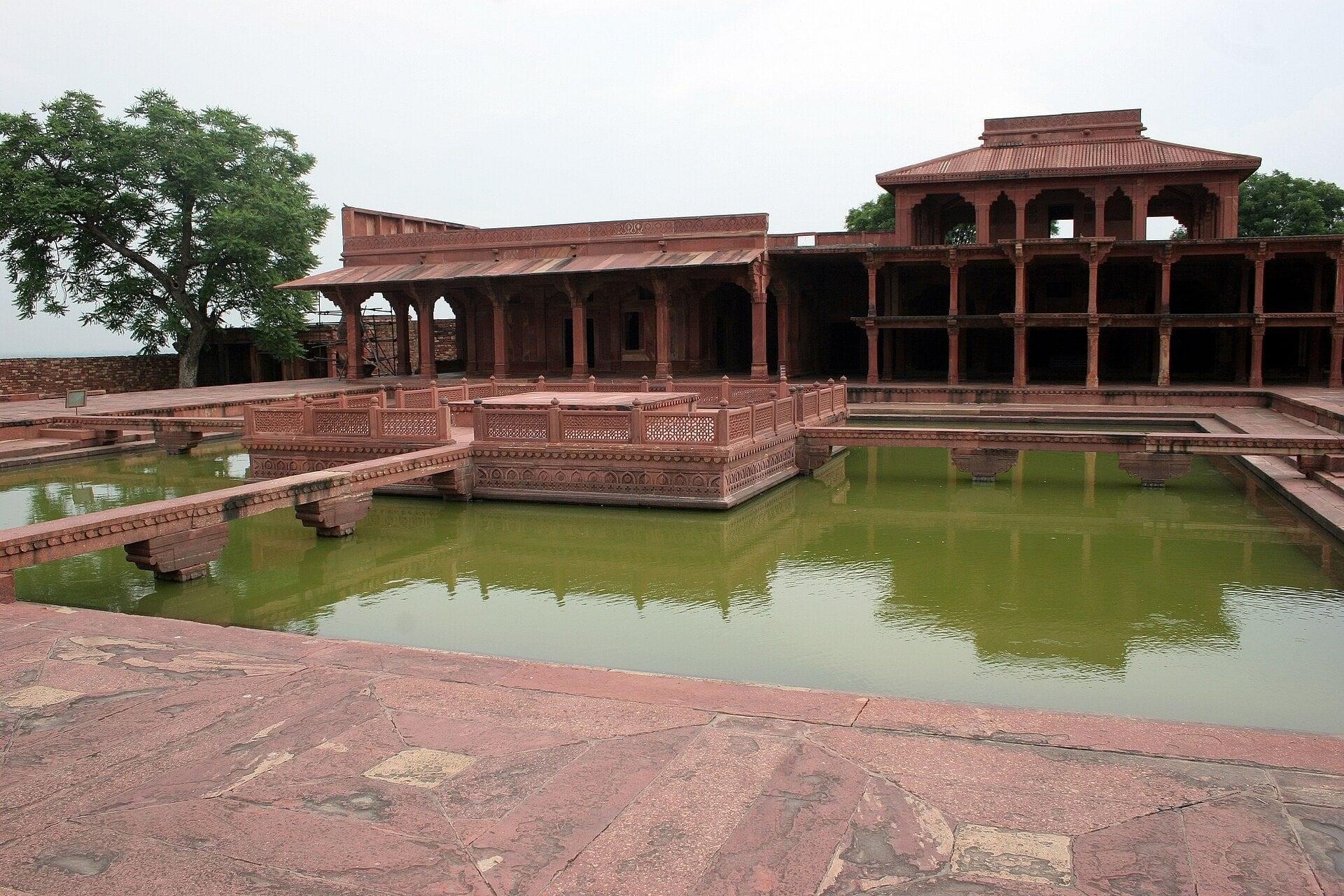
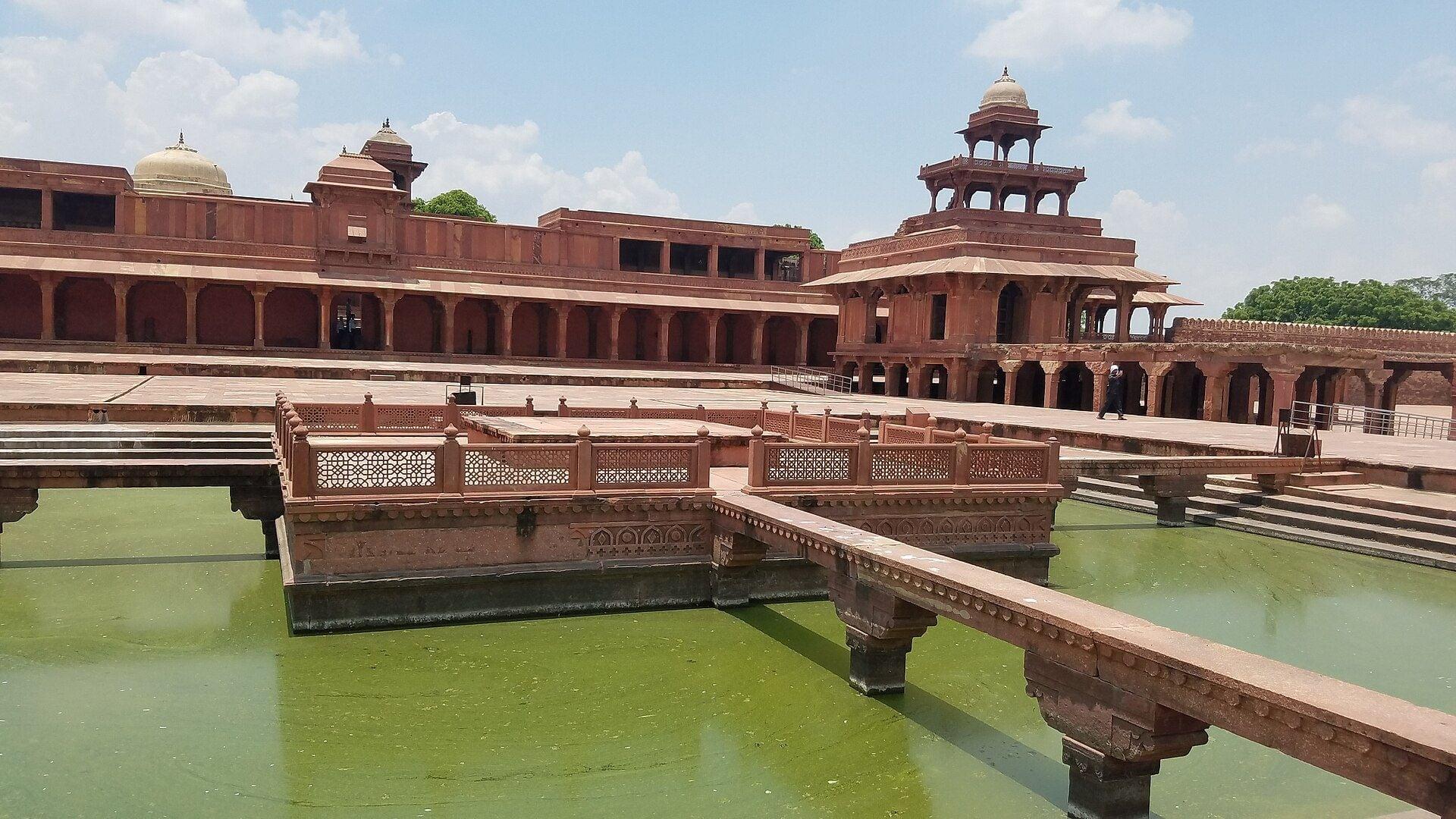
Anup Talao: The Peerless Pool
The emperor's private water garden. The Anup Talao, a square tank with a central platform and four causeways, between the Khwabgah and the Turkish Sultana's House.
- 5
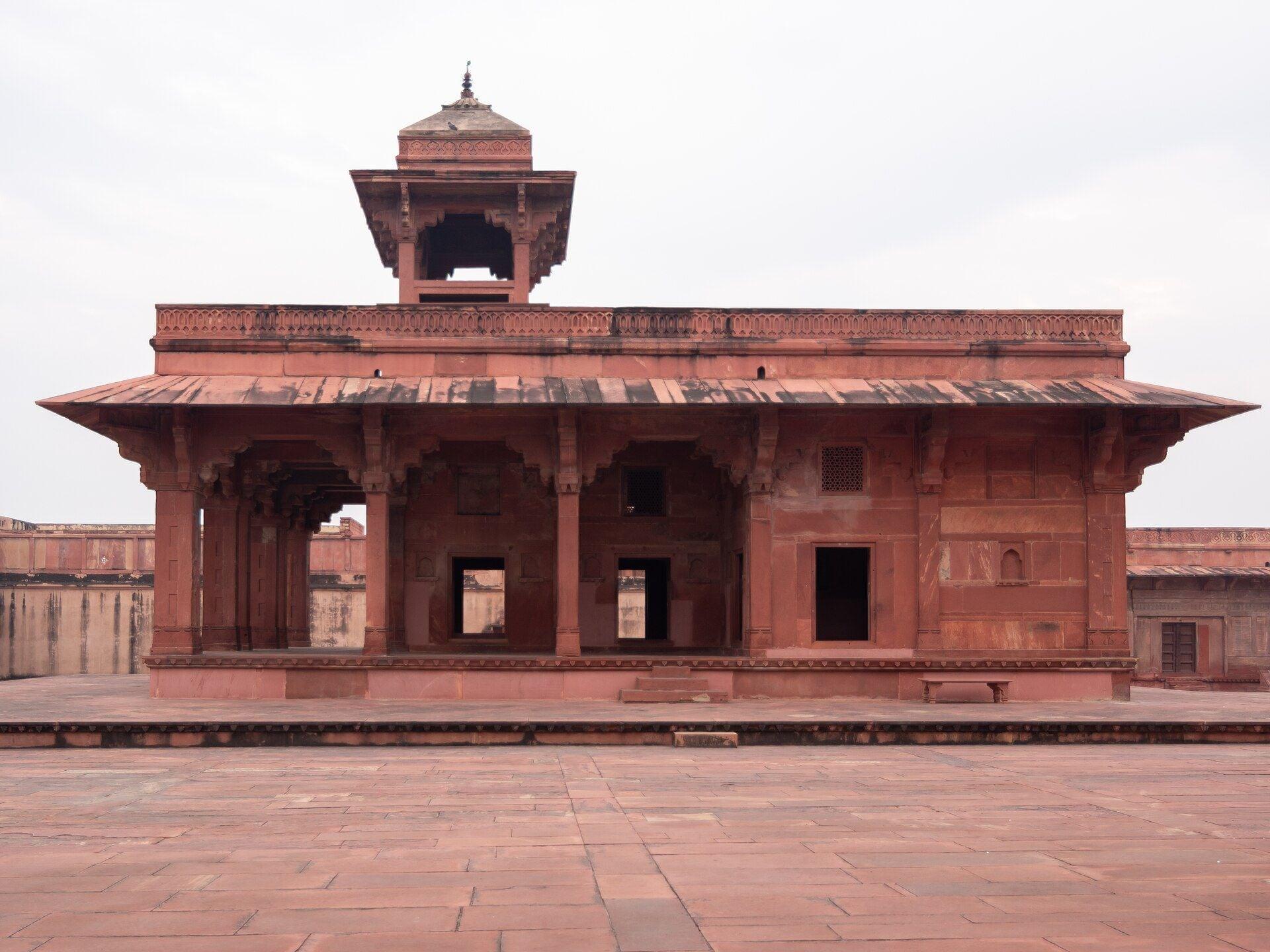
Mariam's House: The Golden House
A guides' tale meets the real queen. Mariam's House, once the Sonahra Makan or Golden House for its gilding, with traces of its old wall paintings.
- 6
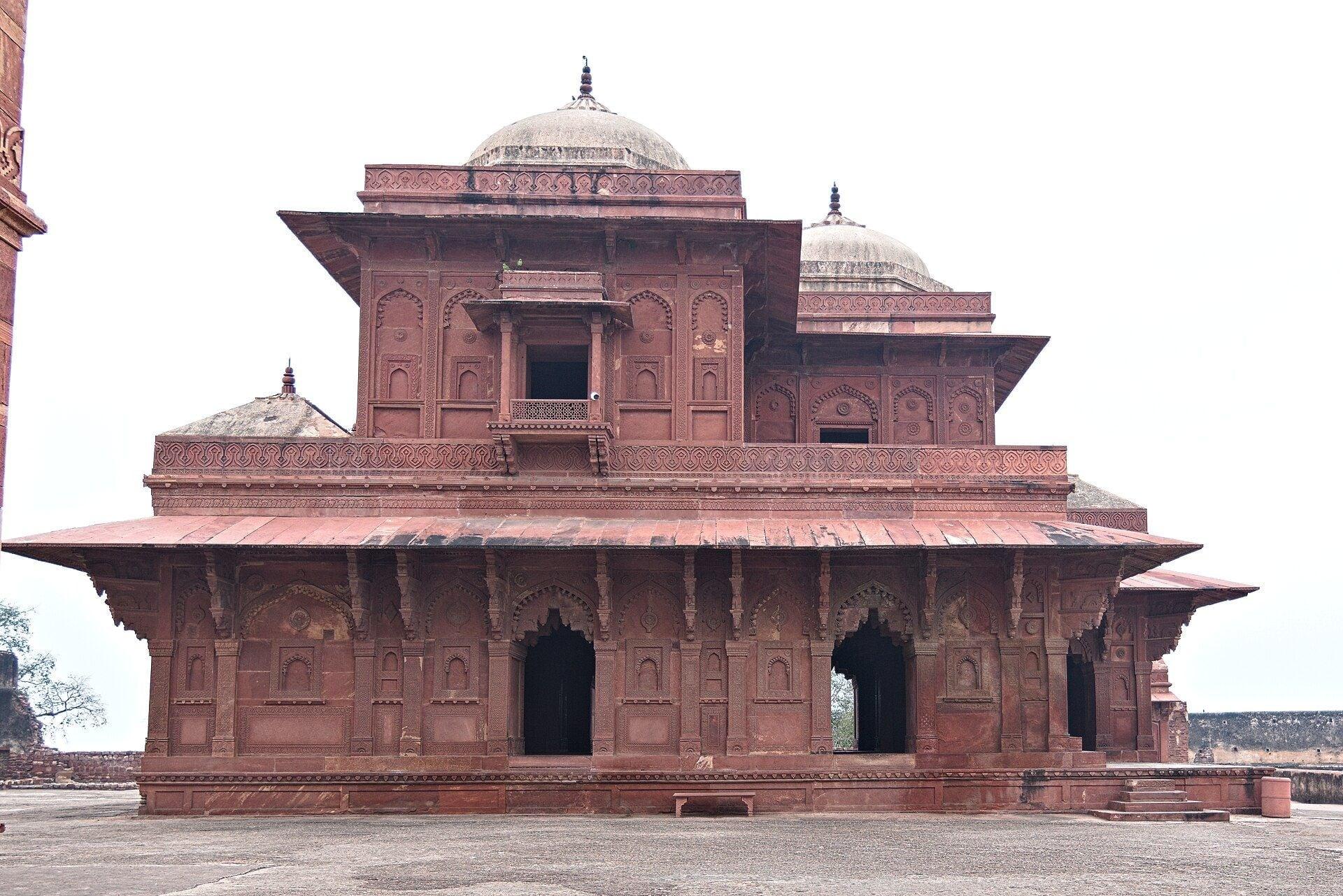
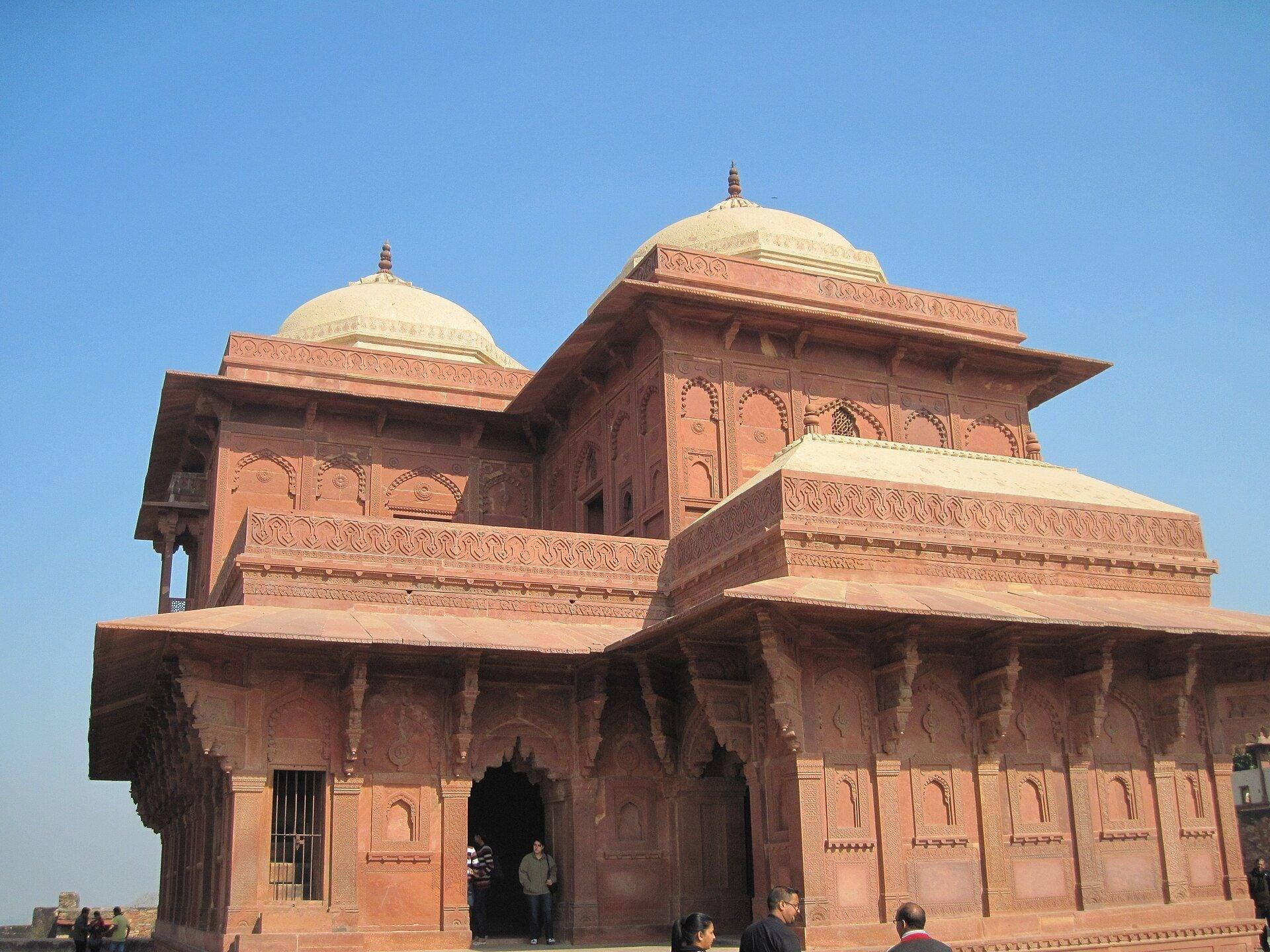
Birbal's House
A dated house with a borrowed owner. Birbal's House, a carved two story house with small domes, dated by an inscription to 1571.
- 7
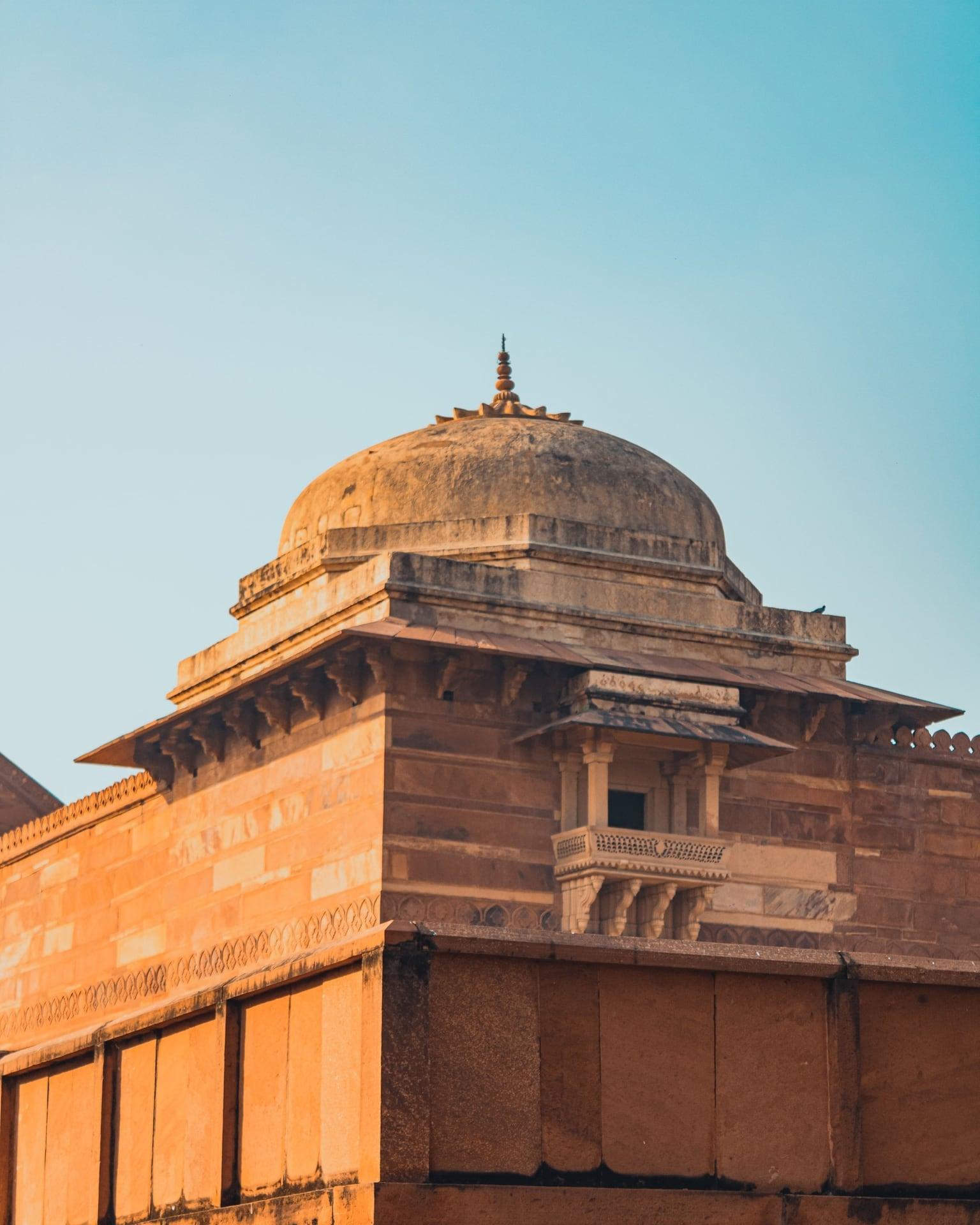
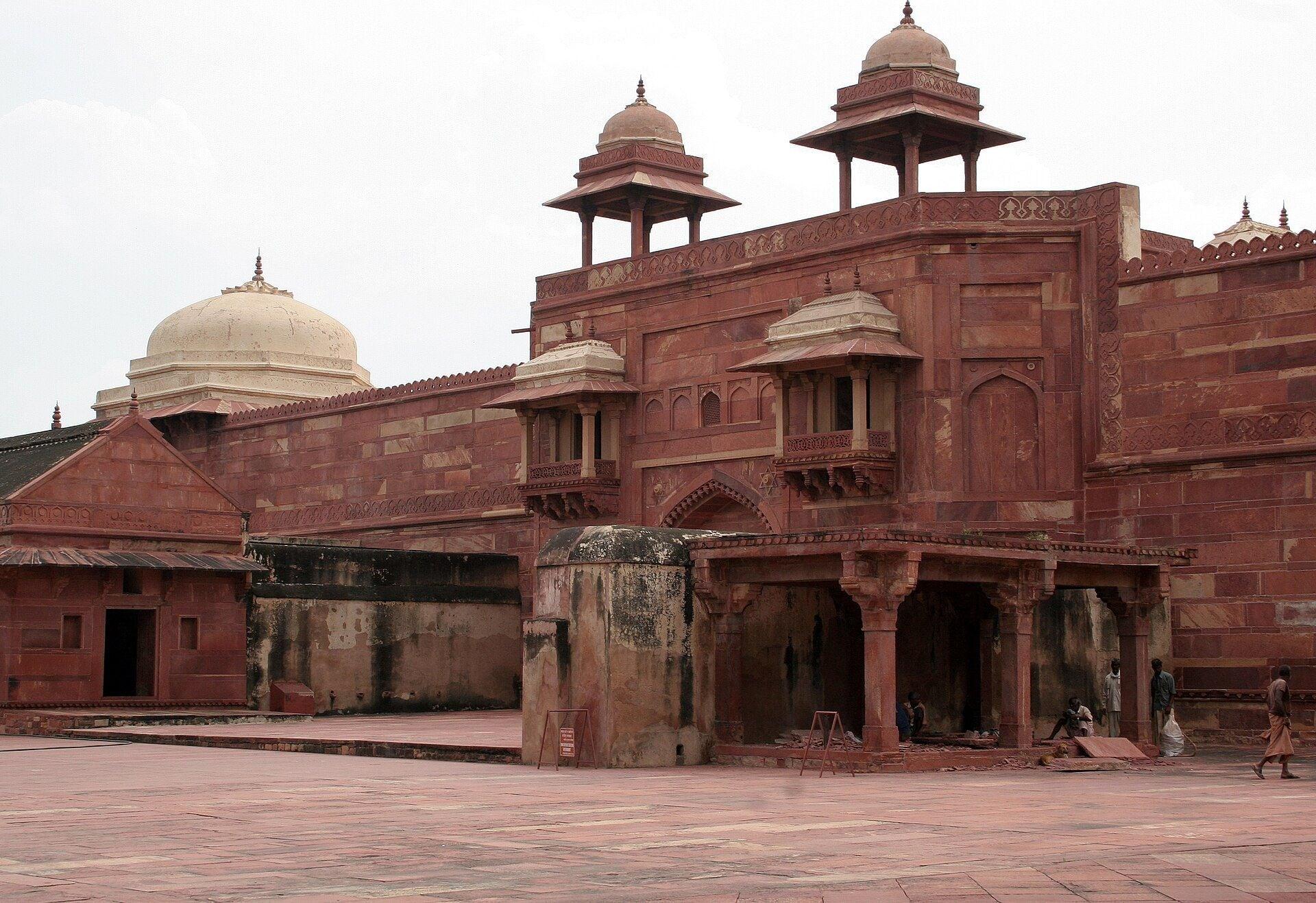
Jodh Bai's Palace: A Borrowed Name
The biggest house wears a later name. Jodh Bai's Palace, the largest building of the residential palace, with a blue glazed roof on its north and south sides.
- 8
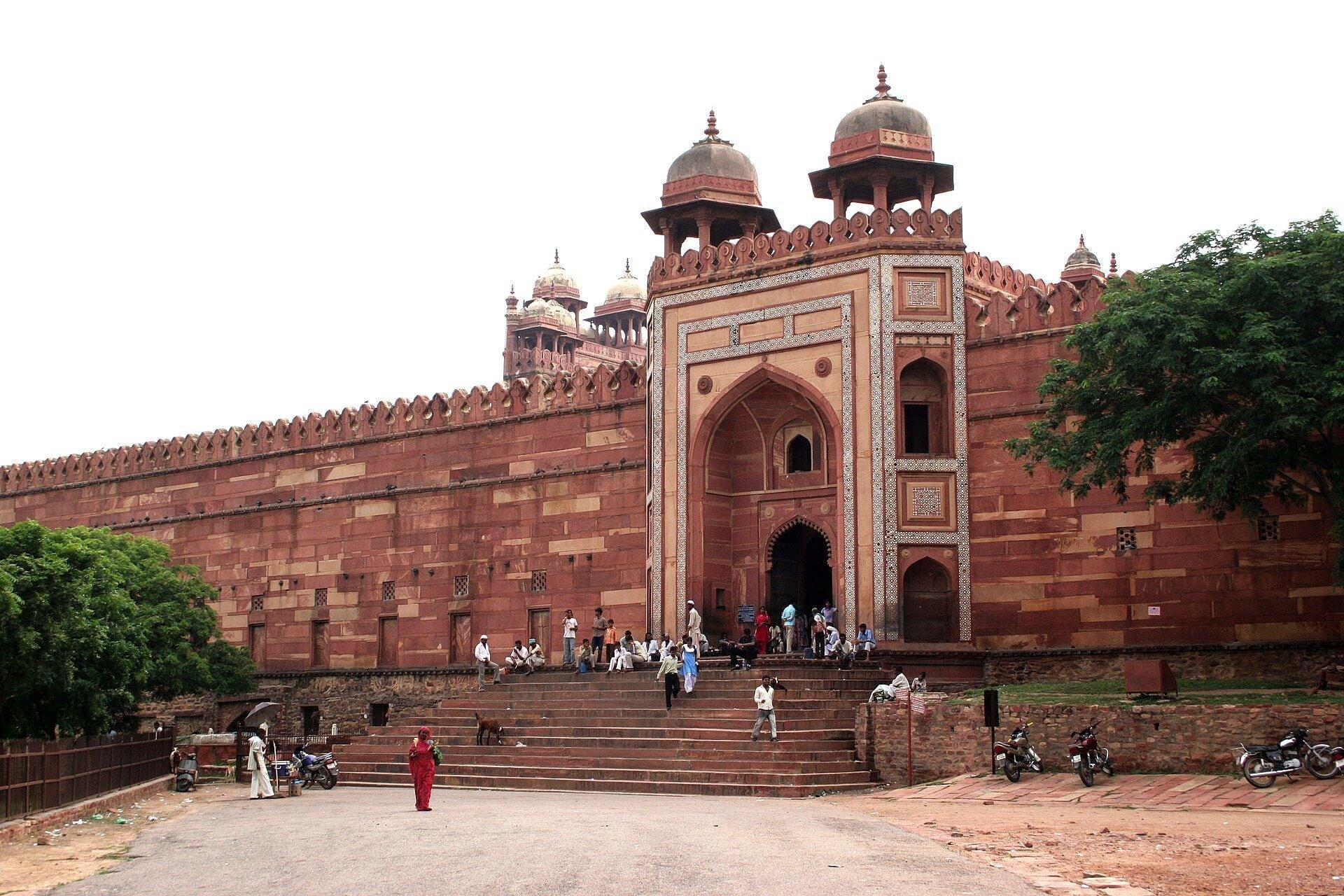
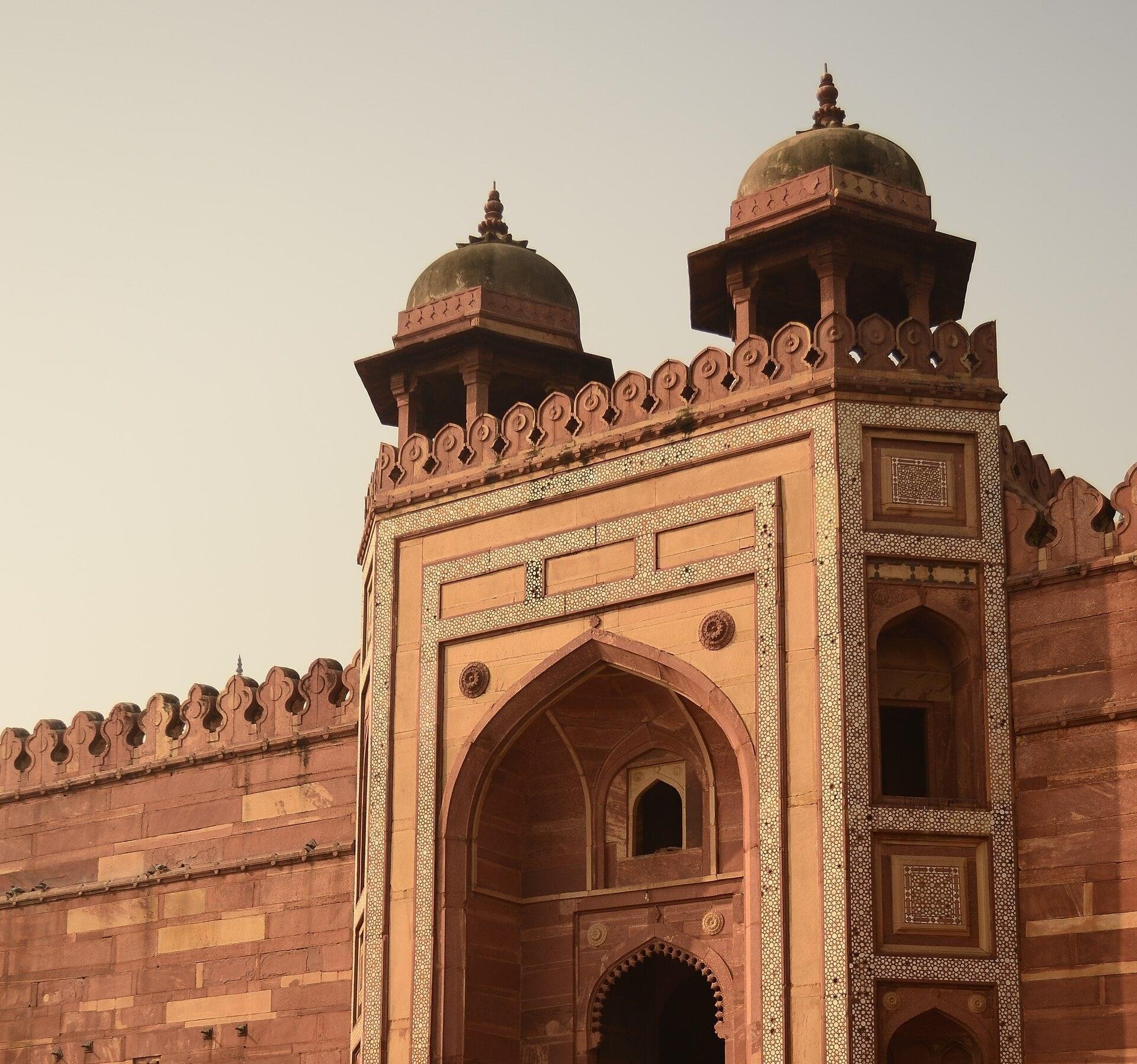
Badshahi Darwaza: The Emperor's Gate
The emperor's own way to prayer. The Badshahi Darwaza, the mosque's east gate, facing the prayer hall across the court, likely the palace's entrance.
- 9
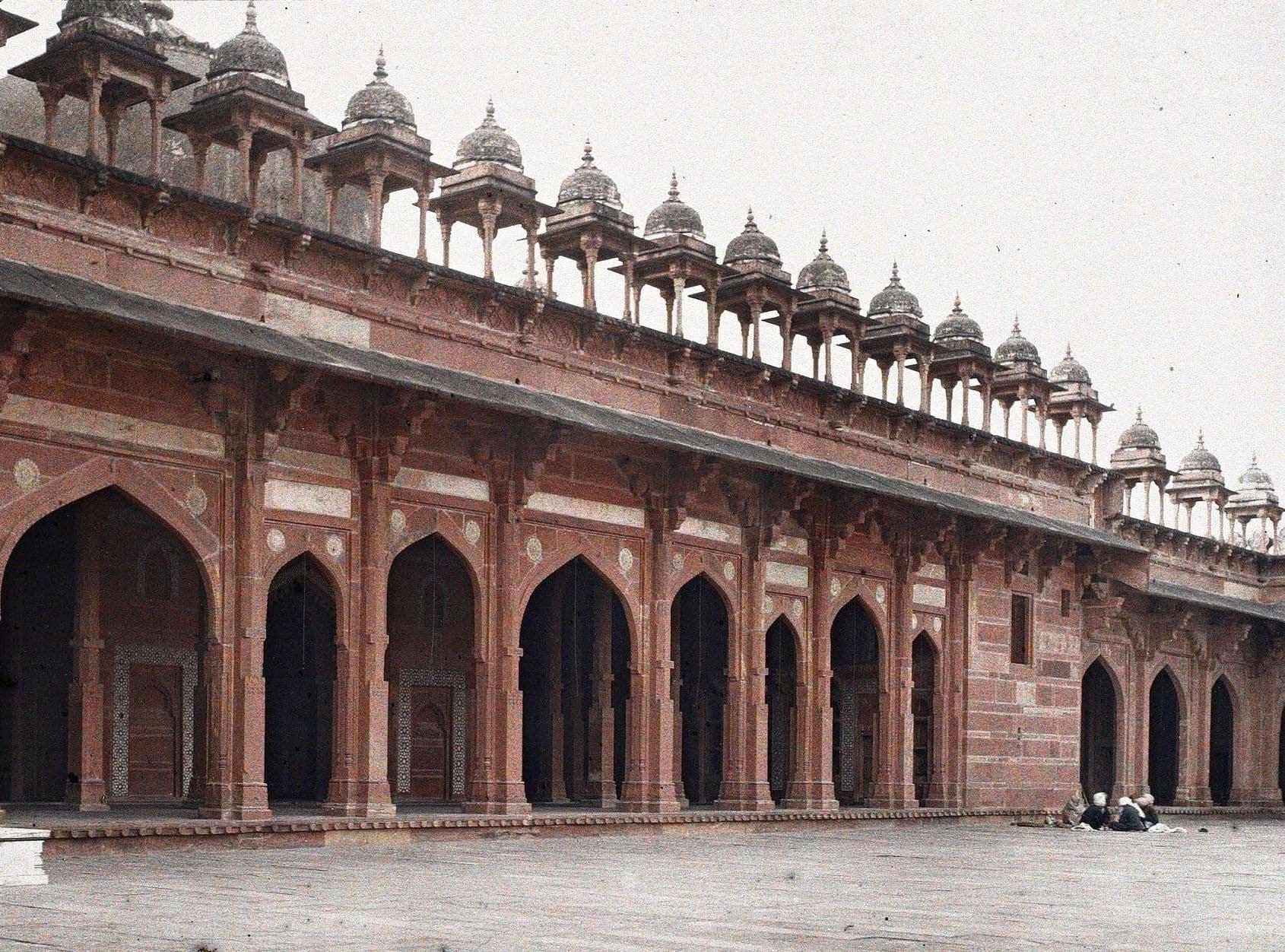
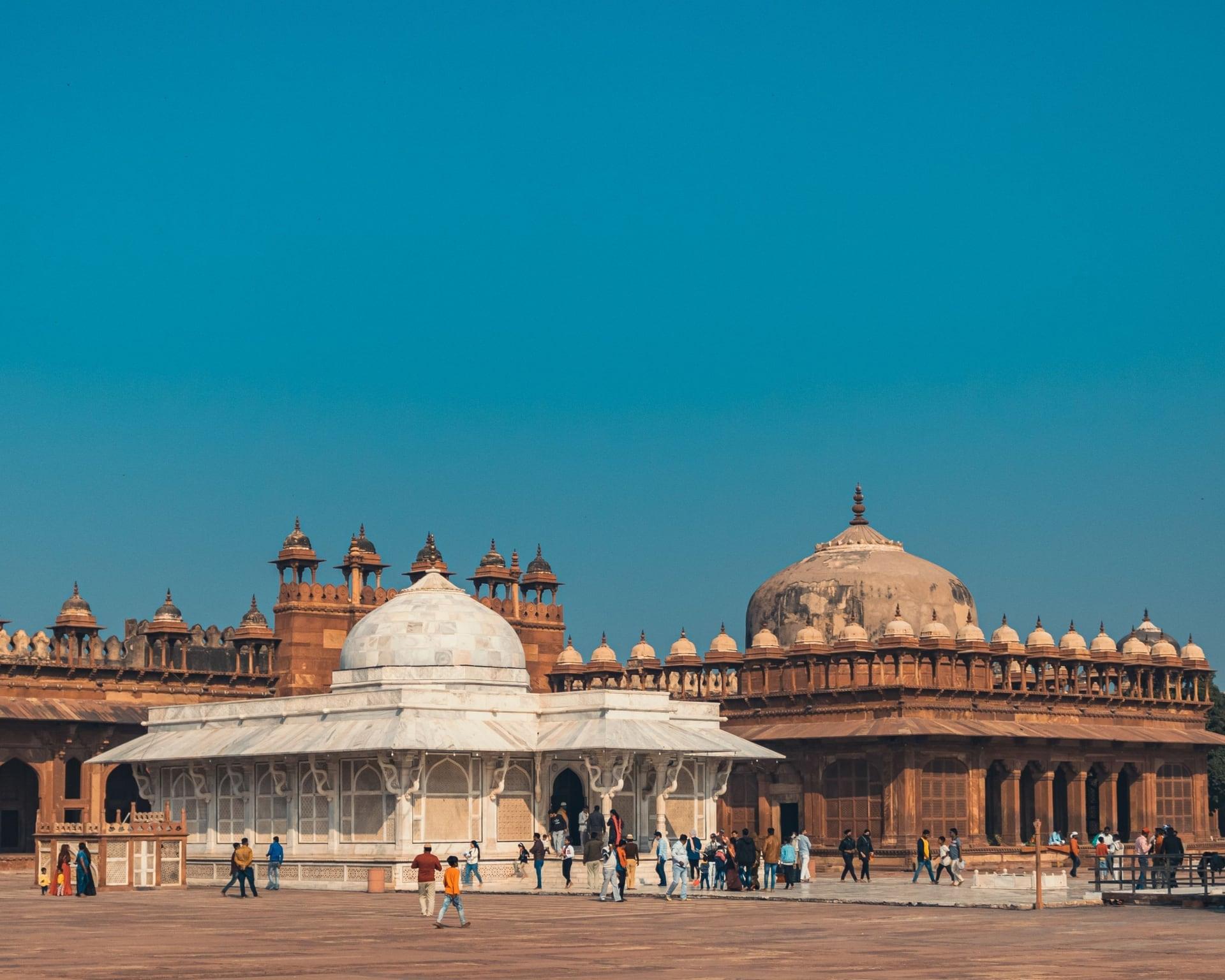
Jama Masjid Court
The mosque that came before the palace. The courtyard of the Jama Masjid, about 133 by 109 meters, with the saint's tomb, the prayer hall and the great gate.
- 10
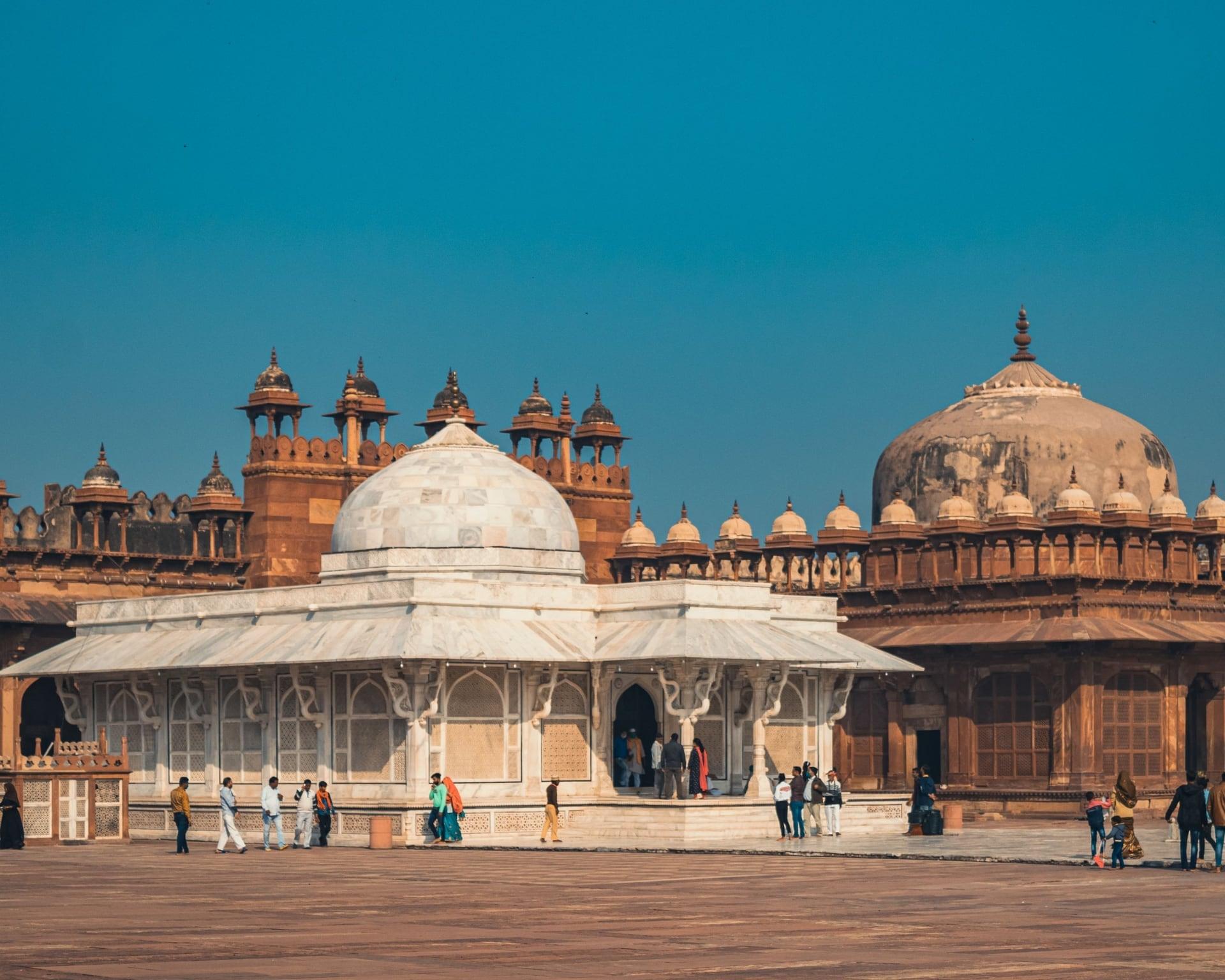
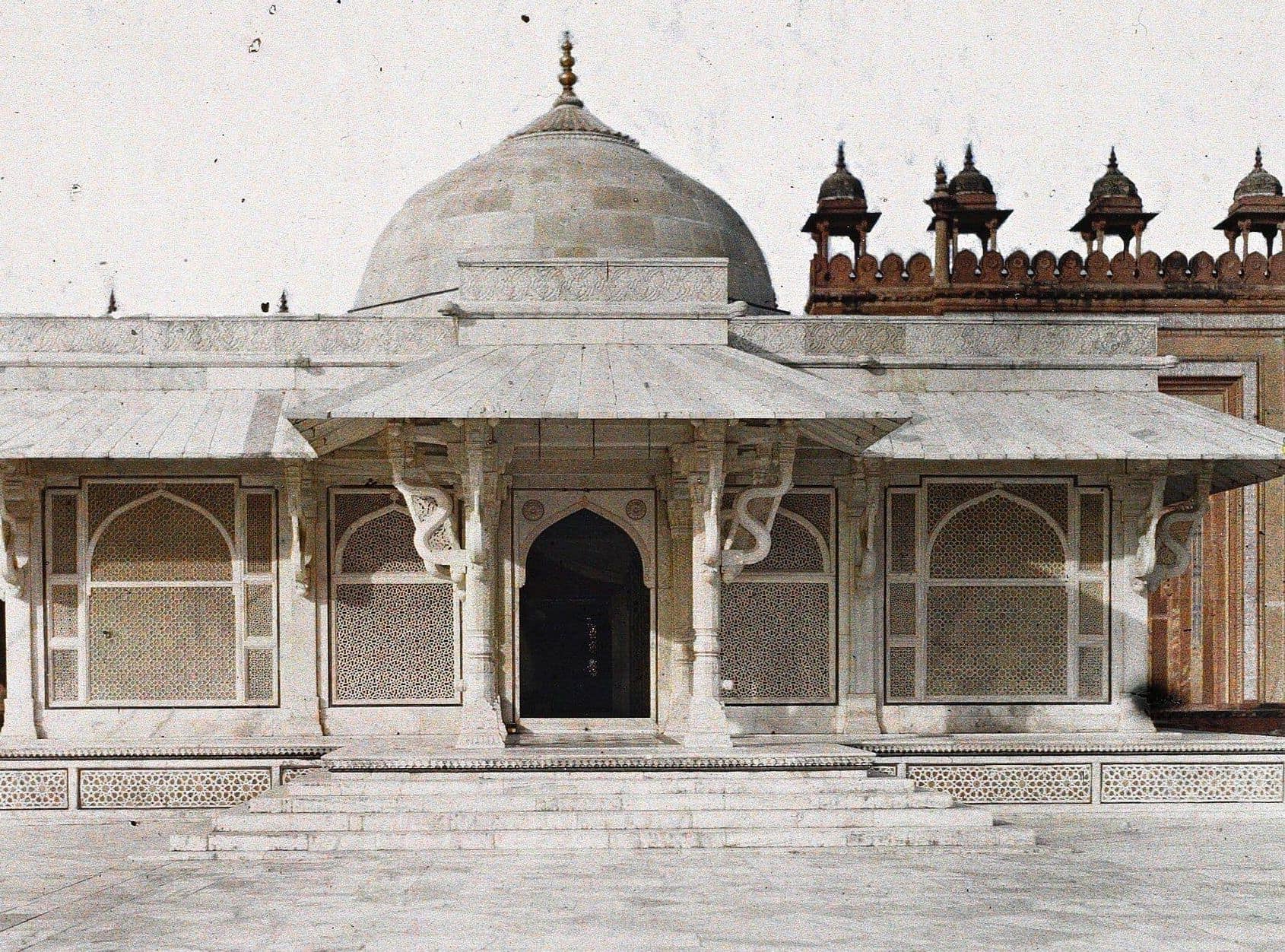
Salim Chishti's Tomb
Why the capital was built here at all. The white marble tomb of Sheikh Salim Chishti, completed in 1580-81 and still a living shrine.
- 11
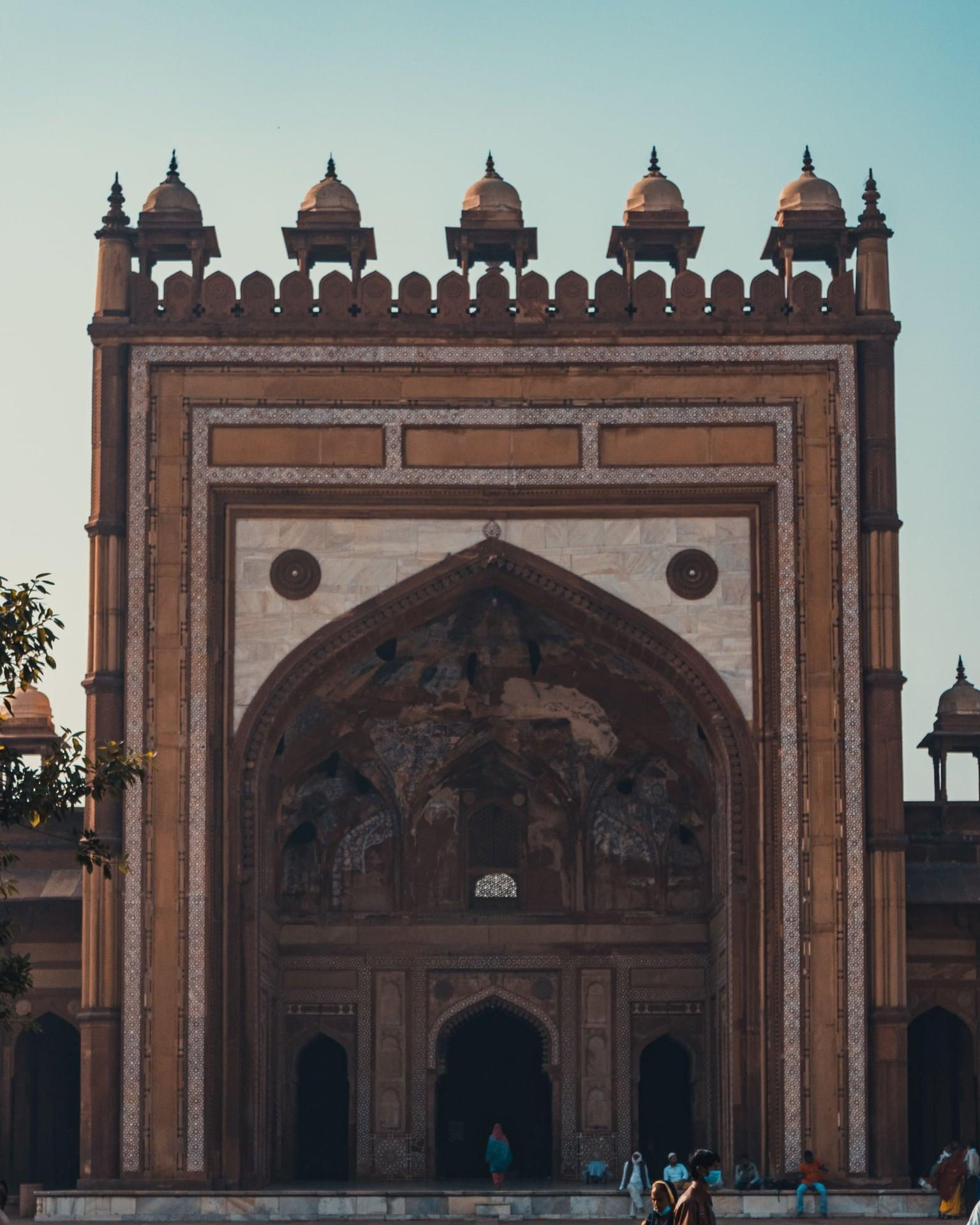
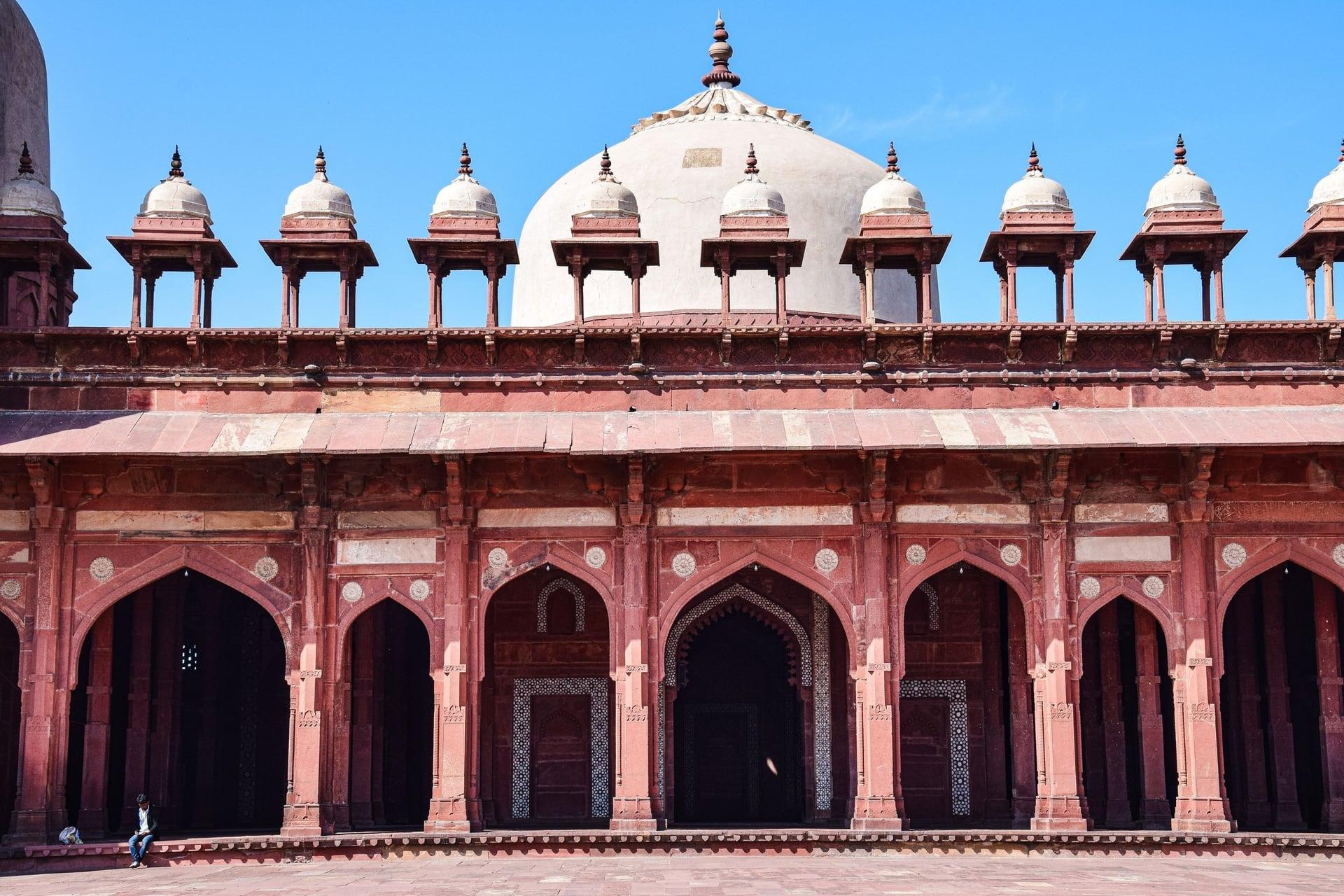
The Prayer Hall
The saint's mosque and its date verse. The prayer hall on the courtyard's west side, with its central arch and domes, dated by a chronogram to 1571.
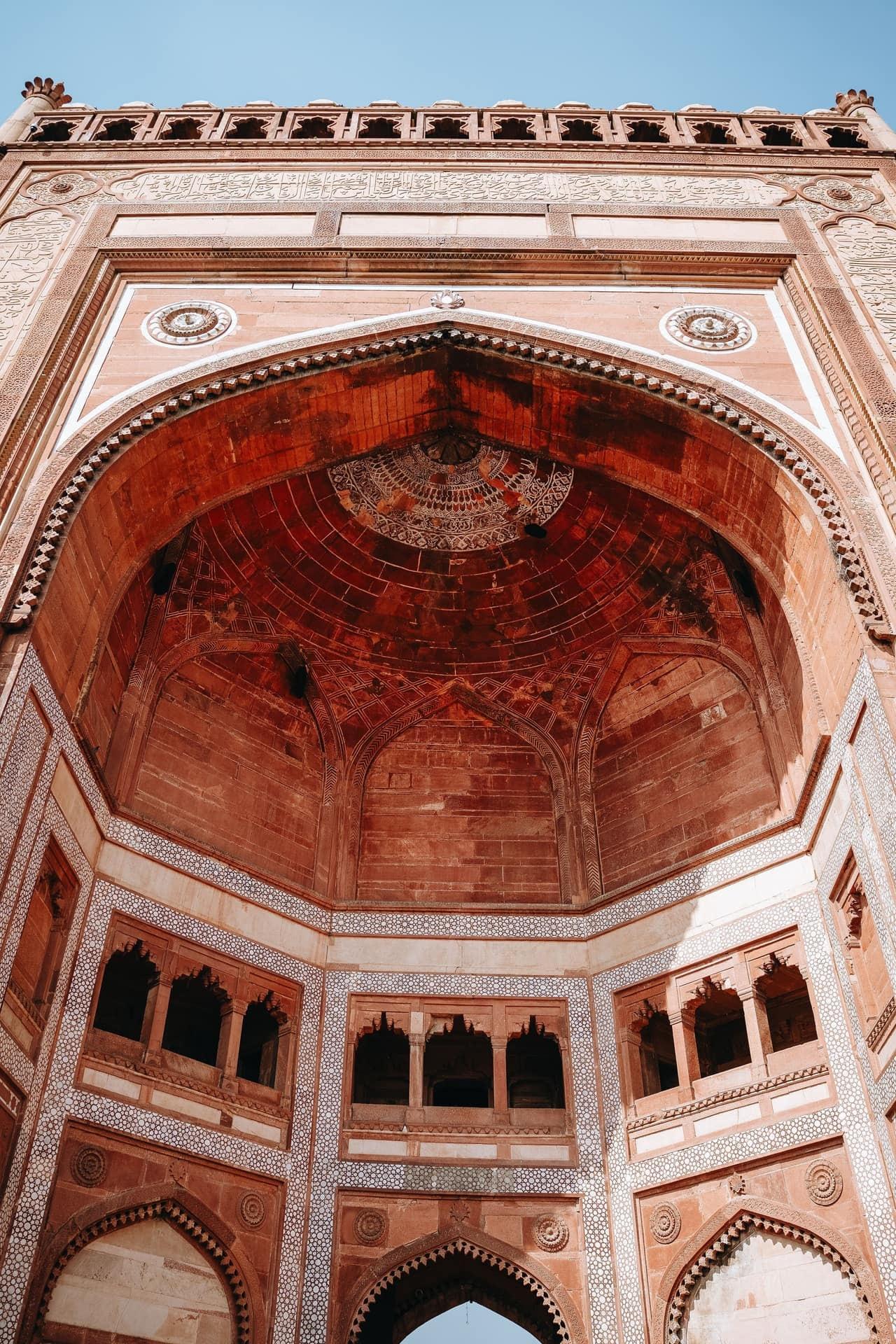
- 12
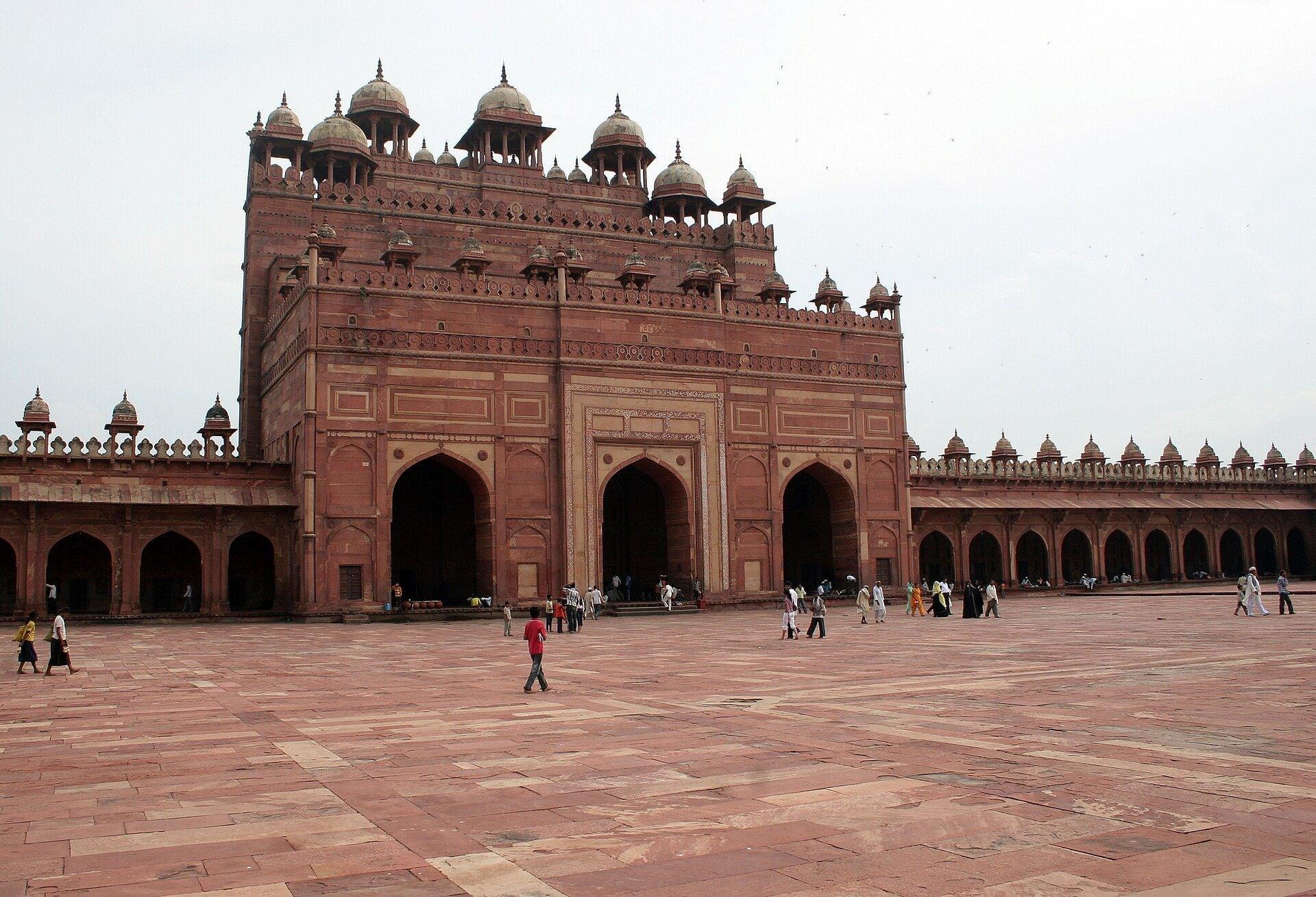
Buland Darwaza: The World Is a Bridge
A victory gate that says do not stay. The Buland Darwaza, the Lofty Gate, about 40 meters high, with its inscription on the world as a bridge.
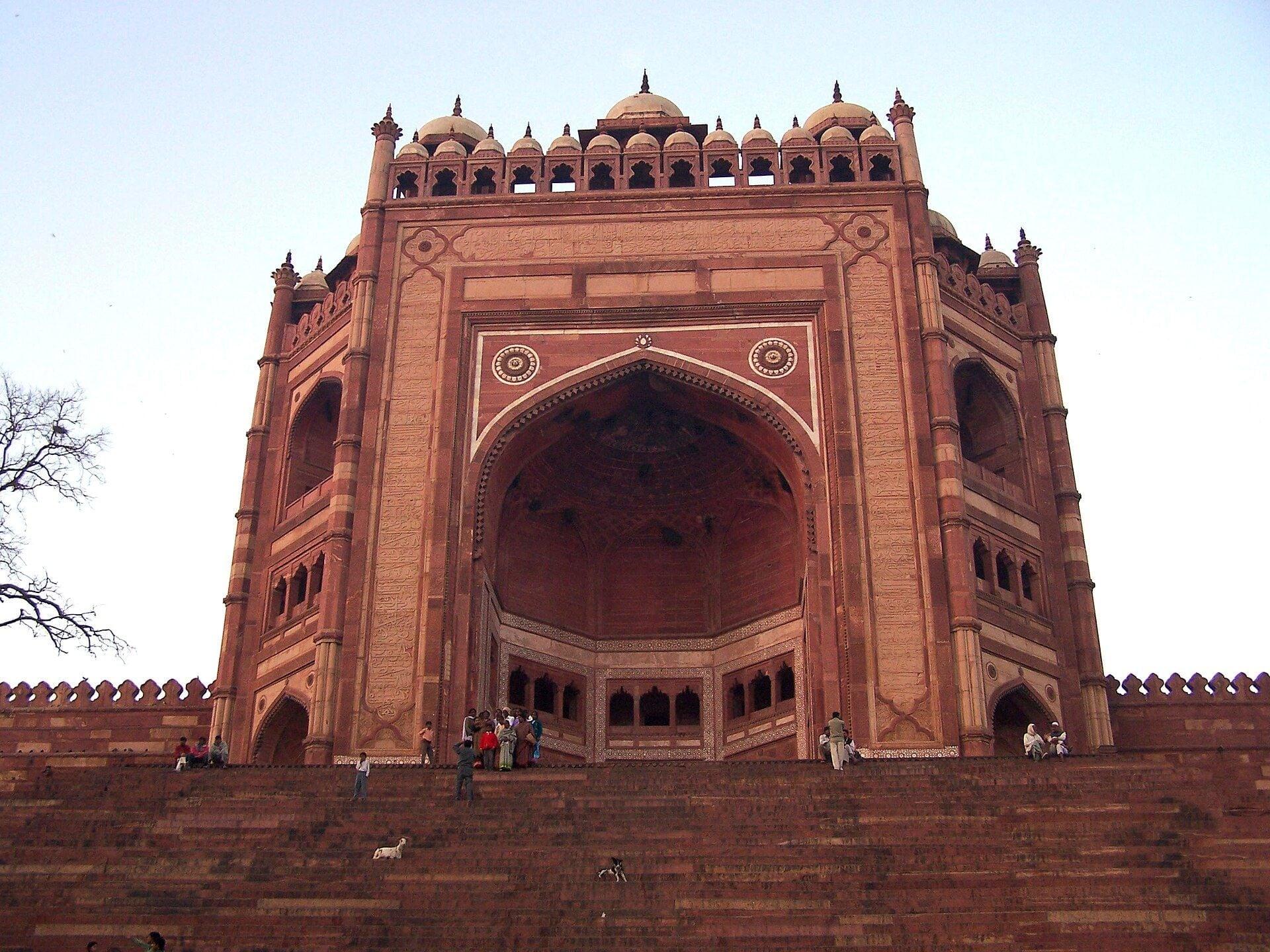
- 13
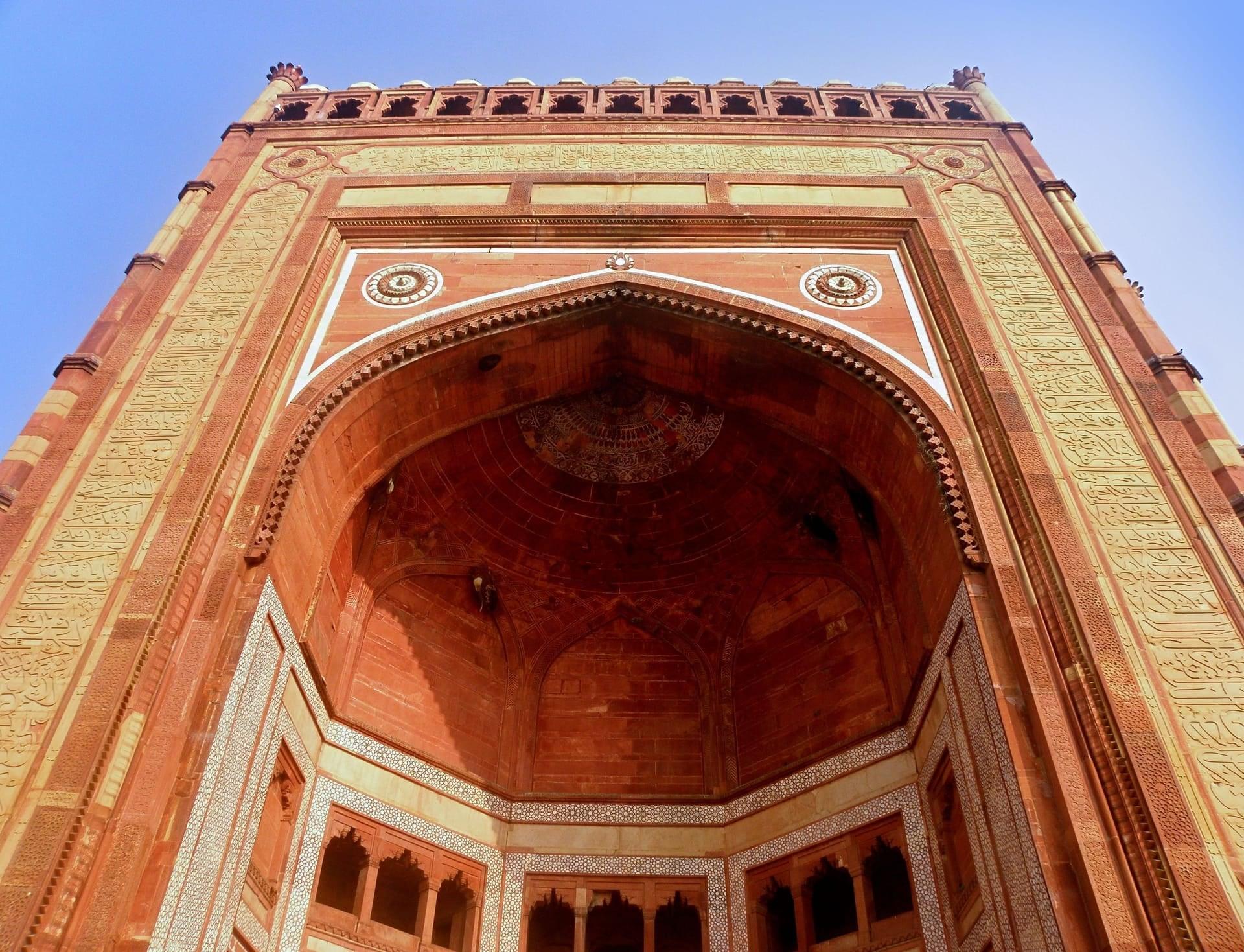
Foot of the Buland Darwaza
See the great gate at its full height. The Buland Darwaza's south face over its long stair, about 54 meters from the roadway to the top.
Details
Best Time to Visit
Morning from sunrise (about 6:50 am on 1 December, 7:07 am on 1 January) to about 11:00, or mid-afternoon, finishing before sunset (about 5:24 pm on 1 December, 5:58 pm on 1 February; computed for Agra, a minute or two later here). The palace complex is open every day, sunrise to sunset (ASI). October to March is the season; winter mornings can be misty and the courtyard stone cold underfoot, and from March it is hot by midday. Avoid Friday midday (congregational prayers in the mosque courtyard) and the dargah's Urs (date not published). Checked 22 November 2026.
Pro Tips
- •Start just inside the Diwan-i-Am court's gate, past the ticket check. Cars park below the site; battery buses run up to the monument gate. Ask for the Diwan-i-Am entrance.
- •Getting there: Fatehpur Sikri is 36 to 40 km west of Agra on NH-21 (Fatehpur Sikri Road), by taxi or by the regular UPSRTC buses from ISBT and Idgah in Agra (Agra district page). Private vehicles park at the base and authorized battery buses run to the monument gate. A slow local train runs from Agra to Fatehpur Sikri station: check the day's timetable. Checked 22 November 2026.
- •The entry ticket to the palace complex is NOT included. Buy it at the counter near the Diwan-i-Am entrance or online at asi.paygov.org.in. Foreign visitors Rs 600 at the counter (the district page prints Rs 610), Rs 550 online; Indian, SAARC and BIMSTEC visitors Rs 50 cash, Rs 35 online; under 15 free (ASI). A foreign visitor with that day's Rs 500 Agra Development Authority toll ticket from the Taj Mahal pays no further toll; no toll on Fridays. A second ticket window is mapped at the palace's south gate, by stop 7. Checked 22 November 2026.
- •Hours: the palace complex is open every day from sunrise to sunset (ASI); start at least two hours before sunset (about 5:25 pm in early December). The ASI site museum near the Diwan-i-Am counter is free, 9 am to 5 pm, closed Fridays; this walk does not enter it. The mosque and the dargah are free and open longer than the palace (district page), but their hours are not published.
- •The mosque courtyard is entered barefoot: carry your shoes in a bag, because the walk enters by the Badshahi Darwaza and leaves by the Buland Darwaza. Cover shoulders and knees; visitors who enter Salim Chishti's tomb usually cover their heads. Avoid Friday midday prayers and the Urs crowds.
- •Licensed guides are available at the ticket counters (ASI); the Agra district page advises engaging only authorized guides and avoiding unlicensed touts. Offerings at the tomb are voluntary: nobody needs to buy a cloth to visit.
- •The walk ends at the foot of the Buland Darwaza's stair, in Sikri's bazaar. For a taxi, the battery bus to the car park, or a bus to Agra, ask in the town (no official stop given). Our Akbar's Tomb walk is at Sikandra, on Agra's north western edge.
- •Photography for personal use is allowed at ASI monuments; tripods and filming need permission. Do not photograph people at prayer, and ask before photographing anyone.
Safety & Precautions
- •Three sets of steps: a short stair down to Mariam's House, the Badshahi Darwaza's steps, and the Buland Darwaza's long stair, which is steep, worn and uneven. The stone can be slippery: take it slowly.
- •The mosque courtyard is crossed barefoot: the stone is cold on winter mornings and very hot by midday from March.
- •Leaving the palace by its south gate, the route crosses an open asphalt forecourt where buses and electric rickshaws park and turn: watch for vehicles.
- •Interiors (the Diwan-i-Khas, the Panch Mahal's upper floors, Mariam's House, Birbal's House) are not confirmed open: every stop is told from outside. Stay off the Anup Talao's causeways, and do not touch the old wall paintings.
- •Weather and air: Agra's IMD normals (1991 to 2020) give December highs about 24 C and lows about 8 C, January 22 C and 7 C, March 32 C and 14 C. Little shade on the stone courts. Check the day's air quality index; a mask helps with asthma.
- •The Jama Masjid and Salim Chishti's tomb are living places of worship: keep quiet, keep out of the prayer lines, and ask before photographing anyone.
- •Unlicensed guides and sellers wait on the path to the mosque and at the foot of the stair: a polite no is enough.
Travel advisory: Exercise Increased Caution (Level 2).
Gallery
Related Reading
Go deeper on what you'll see, hear, and walk through.
Overview
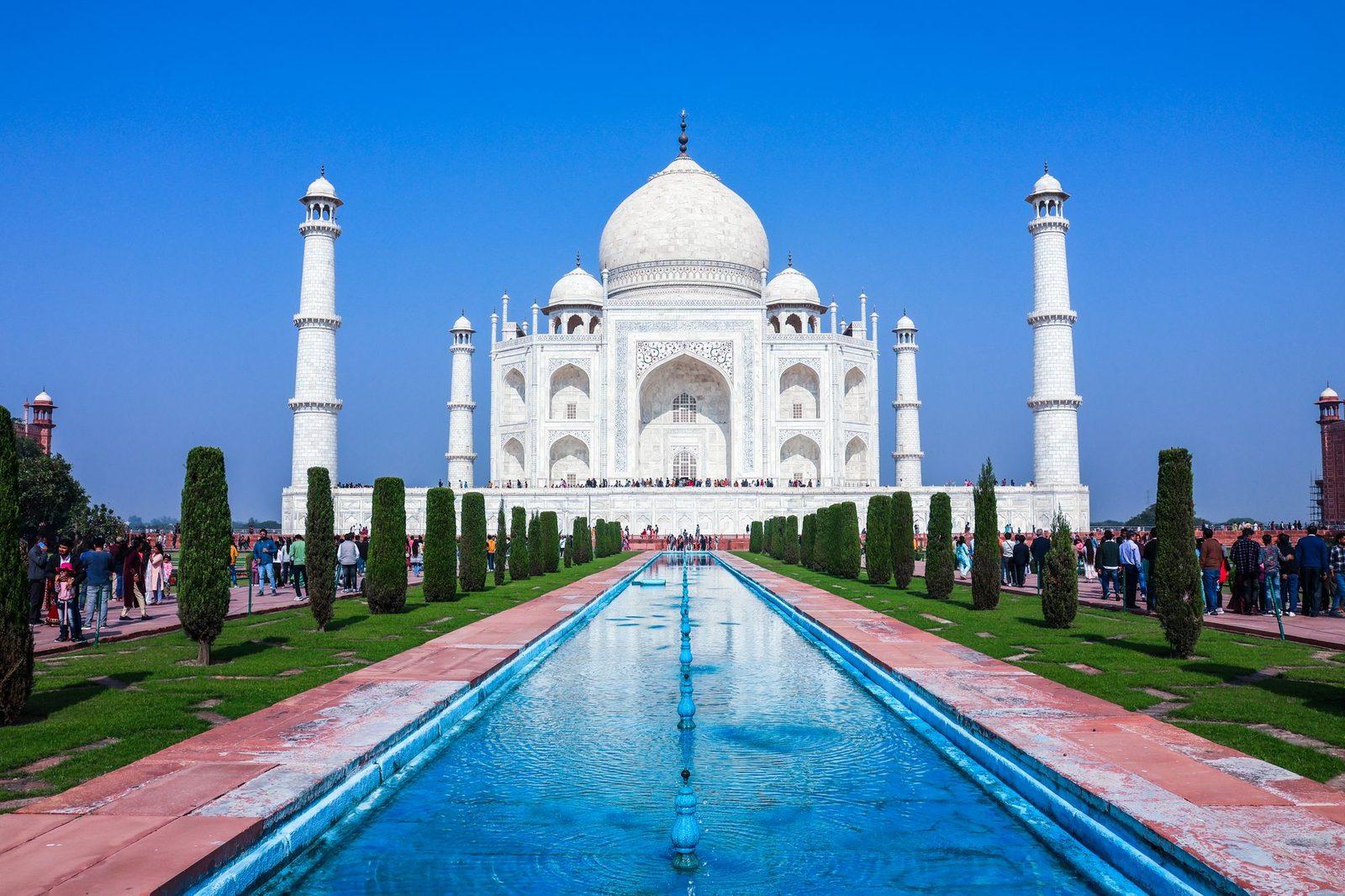
Agra Monument Tickets, Hours and Closures (Checked November 2026)
5 min
Overview
Agra Travel Guide: How Many Days, Getting Around, and Staying Safe
4 min
Thematic
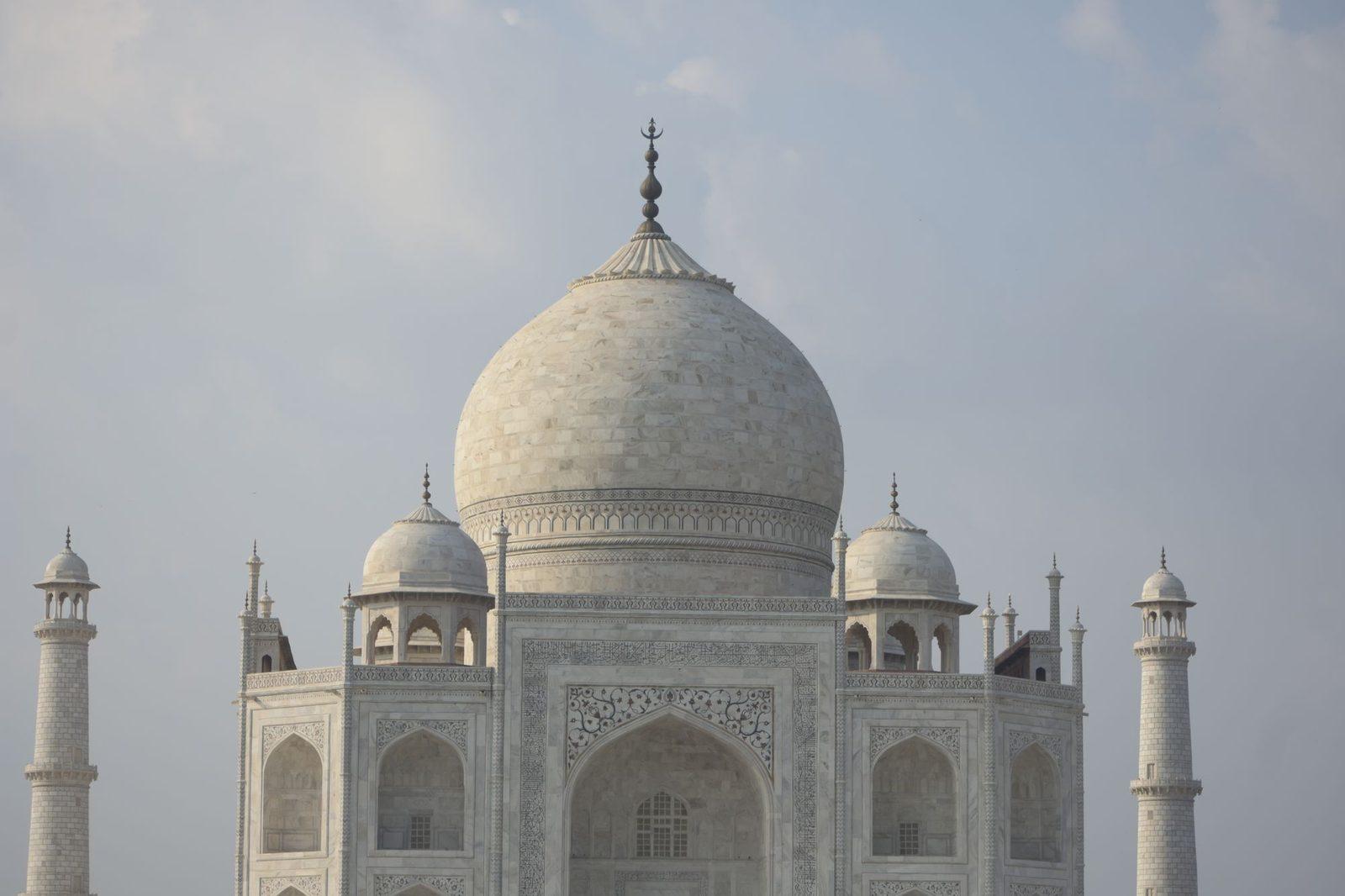
Mughal Tombs of Agra: From Akbar's Grave to the Taj Mahal
3 min
Companion
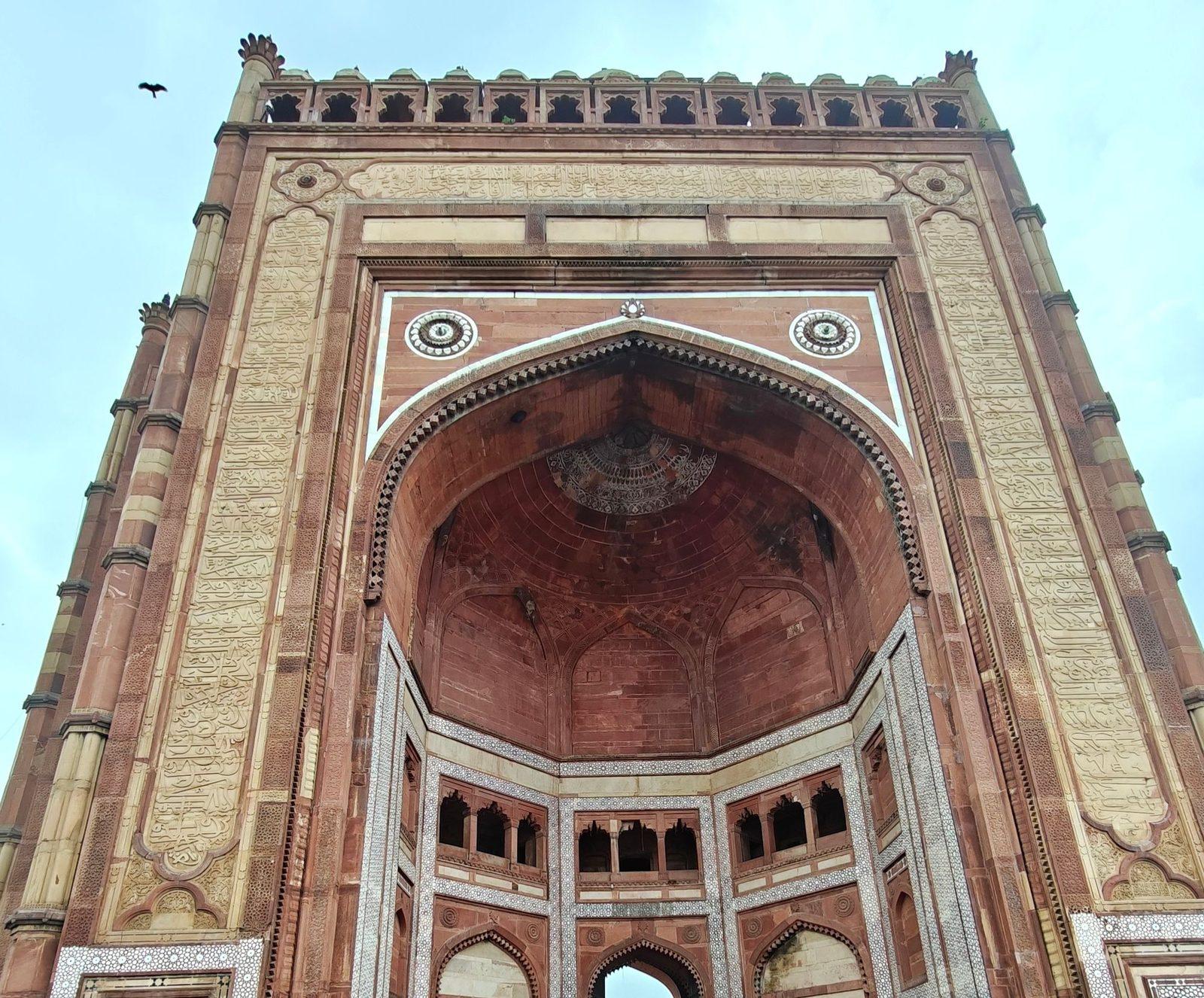
Fatehpur Sikri: Akbar's Red City and the Names It Borrowed
4 min
Deep dive
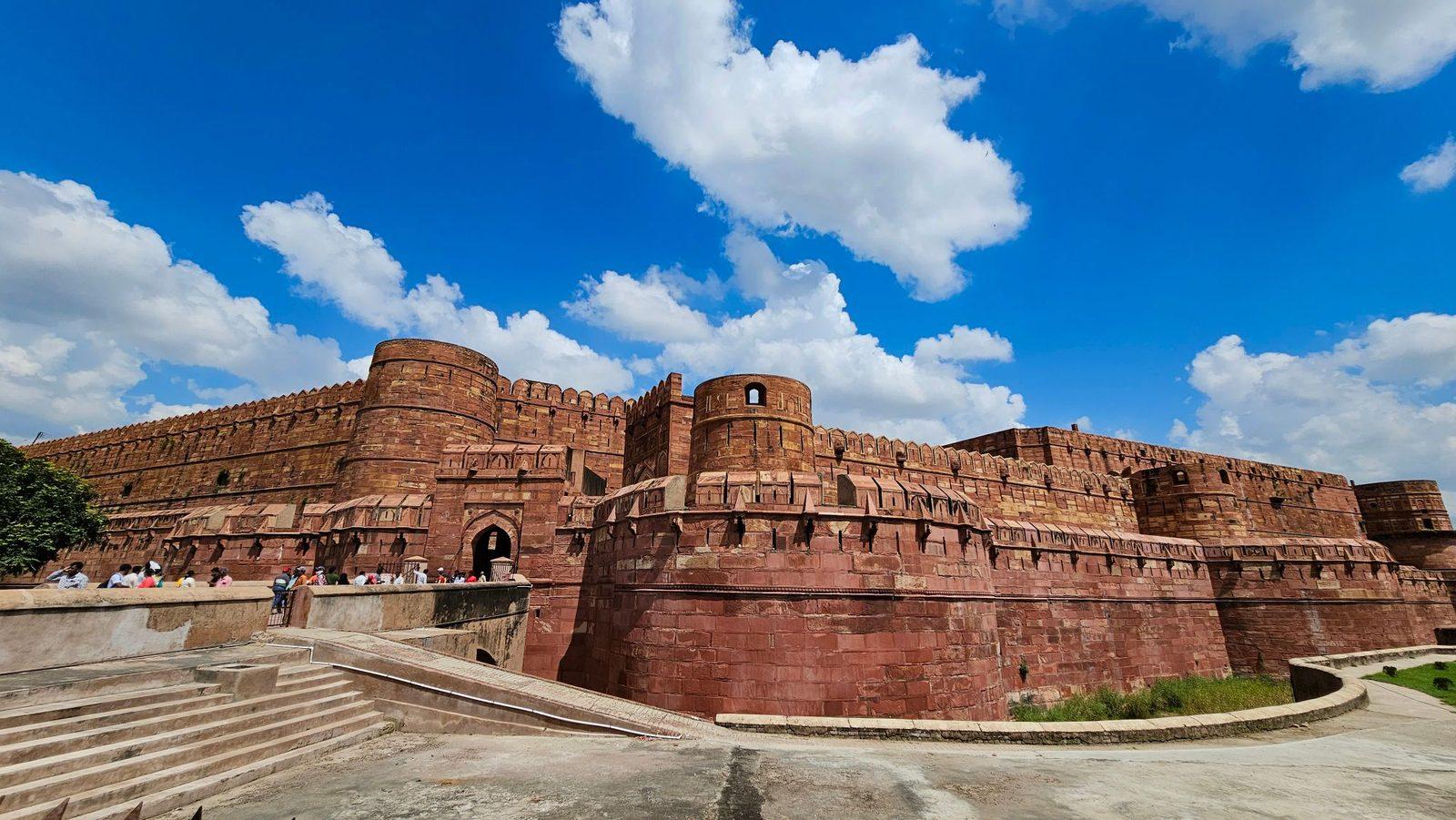
Jahangiri Mahal, Agra Fort: Akbar's Palace With His Son's Name
3 min
Read the walk
The full story of Fatehpur Sikri: The Red City Akbar Built and Left, in words. Prefer to listen? Play it narrated, from home or on location.
Introduction
Fatehpur Sikri is a whole imperial capital in red sandstone, on a ridge nearly forty kilometers west of Agra. The emperor Akbar built it from about fifteen seventy one, ruled from it until fifteen eighty five, and then left. The palace half of this walk is inside a ticketed site, and the ticket is not included with this tour: buy it at the official counter or on the Archaeological Survey of India's website. It is six hundred rupees for foreign visitors at the counter, a little less online. The mosque, the saint's tomb and the great gate are free.
The city grew around a holy man who lived on this ridge, and around the son Akbar hoped for. Its palaces kept their stone and lost their stories: many of the names you will hear were given later, and this walk tells you which.
There are thirteen stops over about one point two kilometers, about three quarters of a mile, and it takes about eighty minutes. No road is crossed. There are three sets of steps, and the last is a long, steep stair. The palace is open every day from sunrise to sunset: start at least two hours before sunset.
The mosque is a living place of prayer. Shoes come off before its courtyard, so bring a bag to carry them, and keep shoulders and knees covered. Avoid Friday midday, when the courtyard fills for prayers.
From December to February the days are mild and the mornings cold, and the courtyard stone is cold underfoot early and hot by afternoon from March. Check the day's air quality index; a mask helps if you have asthma.
The walk ends at the foot of the great gate, the Buland Darwaza, above the town of Sikri. When you arrive at Diwan-i-Am, begin with stop one.
1. Diwan-i-Am: The Public Court
You are on the path along the east side of a great lawn, inside the ticketed palace. Look across the grass. Low colonnades ring it, and in the middle of the far side the colonnade breaks for a small raised chamber, with pierced stone screens and a pitched stone roof. That was the emperor's seat.
This is the Diwan-i-Am, the Hall of Public Audience. The emperor Akbar sat in that screened box, raised and framed, while the court and the people with petitions stood out here below him. The chamber opened straight onto the palace court behind it, which is where you are going next.
A European visitor in fifteen eighty saw chains, manacles and other irons hung on one of the palace gateways, guarded by the chief executioner. Justice here was done in the open, and it was meant to be seen.
Now look at how the colonnades are built: upright posts and flat stone beams, all in red sandstone, with hardly a dome. In the Archaeological Survey's words, Sikri was the first planned city of the Mughals, and the World Heritage listing says its planning shaped later Mughal cities, among them Shahjahanabad in Delhi.
Much of the palace went up in just a few years. Akbar moved his court here from Agra in the early fifteen seventies, and he left in fifteen eighty five.
Follow the route along the lawn and out through its far corner, into the palace's inner court.
2. Diwan-i-Khas: One Pillar
You have come through the corner into the palace's inner court. The square red building beside you, with a small domed kiosk at each corner of its roof, is called the Diwan-i-Khas, the Hall of Private Audience. Even that is a label: the World Heritage listing calls it a building popularly known by that name, and also as the Jewel House.
The reason people come is inside, out of sight from here. A single carved column rises from the middle of the floor to an enormous round capital, as high as the upper windows. From that capital, four narrow galleries run out to the four corners of the room. Tradition says Akbar's throne stood on the round top of the pillar, and his ministers came to him along the galleries from the corners.
Some historians think this is where Akbar held his famous debates between scholars of different faiths, in the hall the chroniclers call the Ibadat Khana, the House of Worship. Others place that hall somewhere else entirely. Scholars have proposed several different buildings for it, and nobody has settled the question.
Past the Diwan-i-Khas, along the same side of the court, the long building is now called the Ankh Michauli, and often called the treasury; that, too, is a guess. On this side of the palace, nearly every name is a guess.
Follow the route down the court toward the tall open pavilion.
3. Panch Mahal: Five Stories of Air
The tall open pavilion beside you is the Panch Mahal, the five storied palace. Count the floors. Each one is smaller than the one it stands on, until the top is a single small kiosk on four slim columns.
There are no walls, only columns: eighty four on the ground floor, fifty six on the next, then twenty, then twelve, and four at the top. The archaeologist who surveyed Fatehpur Sikri in the eighteen nineties noticed that on the first floor no two pillars are carved alike. The ground floor was once divided by stone screens.
The World Heritage listing compares it to a Persian badgir, a wind catcher, a tower built to pull the breeze through. On an open ridge, this is a building made of shade and moving air.
Now look down at the court around you. That same survey recorded a giant board for pachisi, an old Indian race game, set into the stone paving here, with a low stone stool where Akbar is said to have sat among his nobles. The story goes that the game was played with people standing in as the pieces. It is a story, and it is told here as one.
Follow the route on down the court and through the cloister at its corner, to the water.
4. Anup Talao: The Peerless Pool
You came through a carved cloister at the corner. The small, richly carved house you passed there, at the tank's corner behind you now, is called the Turkish Sultana's House, though the name is only a label.
Turn to face the water. This is the Anup Talao, the Peerless Pool: a square tank about twenty nine meters on each side, with steps down into it and a raised platform in the middle, reached by four narrow causeways. Stay on the paving around it. The tank was once filled straight from the city's waterworks; by the eighteen nineties it depended on the rain, and its water level still varies.
A court chronicler names the Anup Talao and dates it to about fifteen seventy five, and writes that the emperor sometimes held religious discussions in a small room beside it. The chroniclers also say that a tank in this palace was emptied and filled with coins, copper, silver and gold, as a show of the emperor's wealth. Which tank, scholars still argue: one historian reads this court as having had two.
Behind you is a small chamber that tradition calls Akbar's bedroom, the Khwabgah, the Sleeping Chamber.
Follow the route along the tank and on through the passages toward the palaces beyond.
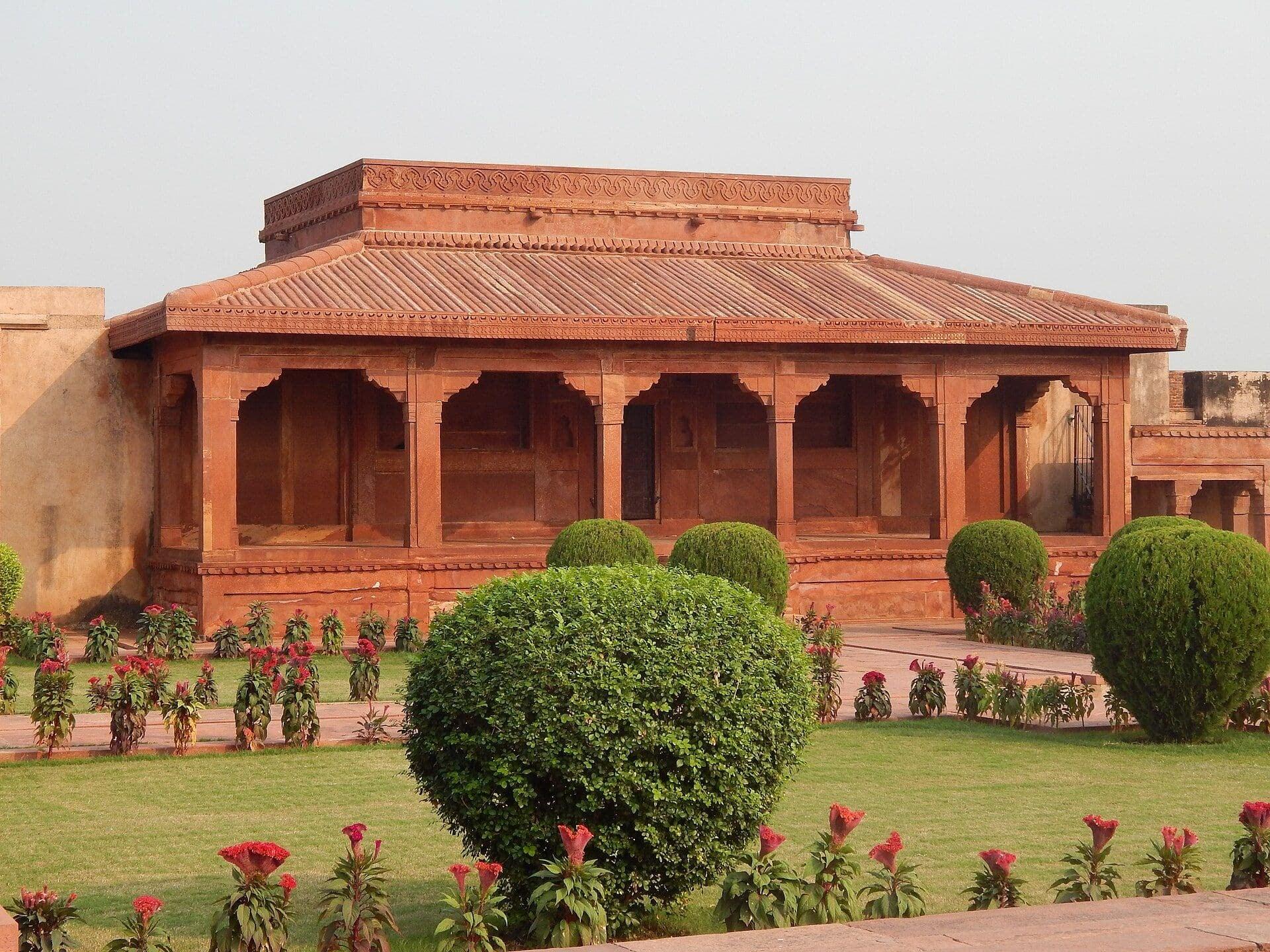
5. Mariam's House: The Golden House
At the foot of the steps, the small house beside the lane is called Mariam's House. It was once known as the Sonahra Makan, the Golden House, for the gilding that covered its walls inside and out. Traces of its paintings survive, and the World Heritage listing counts them among…
Full narration for this stop unlocks with the tour.
6. Birbal's House
Ahead at the corner, the two story house with small domes on its roof is called Birbal's House. As you turn the corner, it stands right beside you. Look at the carving. Almost every surface of its outside is cut into patterns. Birbal was real. He was a Brahmin named Mahesh Das…
Full narration for this stop unlocks with the tour.
7. Jodh Bai's Palace: A Borrowed Name
Beside you, set back across the paving, runs the long south front of what the World Heritage listing calls the largest building of the residential palace. Above its walls, look for the blue of glazed tiles on the roof. The listing describes carved pillars inside, balconies,…
Full narration for this stop unlocks with the tour.
8. Badshahi Darwaza: The Emperor's Gate
The gate at the top of the steps ahead is the Badshahi Darwaza, the Emperor's Gate. It is the mosque's eastern entrance, facing straight across the courtyard to the prayer hall, and it was probably the gate the people of the palace used. You have just come the emperor's own way,…
Full narration for this stop unlocks with the tour.
9. Jama Masjid Court
You are in the courtyard of the Jama Masjid, the congregational mosque. Take in the size of it: about a hundred and thirty three meters from this gate to the prayer hall, and a hundred and nine across. Arcades line three of its sides, with small rooms behind them where pilgrims…
Full narration for this stop unlocks with the tour.
10. Salim Chishti's Tomb
Ahead and to the right, beyond the white marble paving, is the tomb of Sheikh Salim Chishti, a Sufi holy man who lived in a cave on this ridge. He is the reason the city exists. Tradition says Akbar came to the hermit after the death of his twin sons, longing for an heir. In…
Full narration for this stop unlocks with the tour.
11. The Prayer Hall
In front of you is the prayer hall, along the western side of the courtyard, with its tall central arch and its domes. Everyone at prayer here faces this way. Two old inscriptions tell you how the city saw this mosque. On a lintel on the mosque's north side, a verse gives the…
Full narration for this stop unlocks with the tour.
12. Buland Darwaza: The World Is a Bridge
Turn to face the great arch in the south side of the courtyard. This is the Buland Darwaza, the Lofty Gate. From the courtyard you see its stepped back side. Its full height is kept for the town below. As you walk out through the arch, look at the inscriptions carved on its…
Full narration for this stop unlocks with the tour.
13. Foot of the Buland Darwaza
At the bottom of the stair, turn round and look up. This is the face the gate was built to show the world. It rises about forty meters above the courtyard you have just crossed, and the stair adds about twelve or thirteen meters more down to the road. The archaeologist of the…
Full narration for this stop unlocks with the tour.
- Diwan-i-Aam, Fatehpur sikri palace complex. — Rohit Sharma, CC BY-SA 4.0 · source
- Diwan I Aam means Hall of Public Audience. Fatehpur Sikri is a town near Agra. It was built from 1571 to 1585 as a form of homage to the mem — Halders72, CC BY-SA 4.0 · source
- Miriams house, Fatehpur sikri palace complex. — Rohit Sharma, CC BY-SA 4.0 · source
- Fatehpur Sikri — Gerd Eichmann, CC BY-SA 4.0 · source
- Birbal's house, Fatehpur shikri palace complex — Rohi Sharma, CC BY-SA 4.0 · source
- Raja Birbal's Palace,aja Birbal was Akbar's Hindu Prime Minister, N-UP-A45-a. — Bahuln89, CC BY-SA 3.0 · source
- Mesquita de Fatehpur Sikri — Ana Raquel S. Hernandes from Sao Paulo, Brazil, CC BY-SA 2.0 · source
Images may be cropped or resized. Other photos via Unsplash and Pexels.