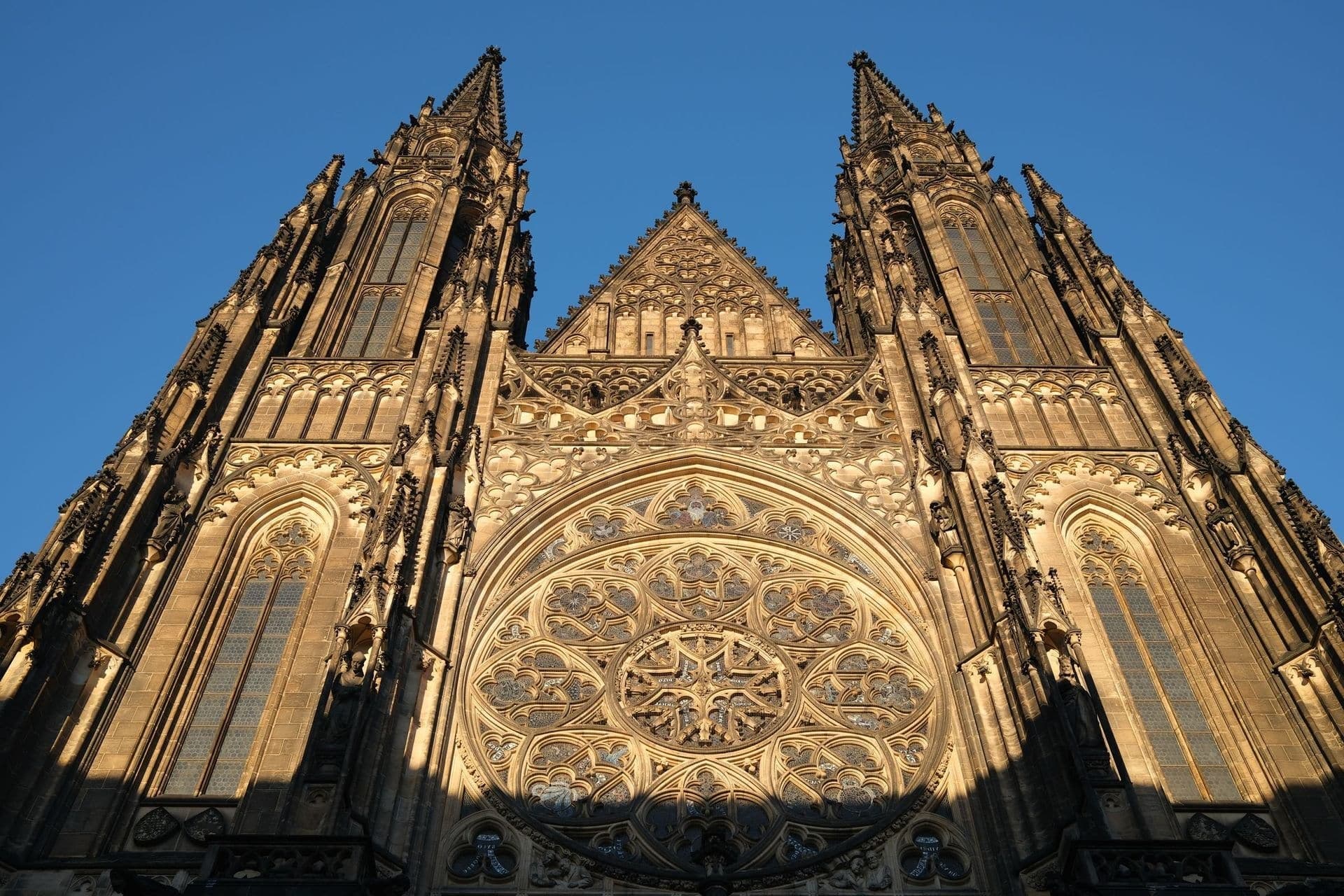
A walk of the Castle's free grounds and the quarter around them, from the Loreta and Nový Svět through three courtyards to Saint Vitus's Golden Gate and down the Old Castle Stairs. Interiors need the Castle's own ticket and are not included.
Start · Loreta and Černín Palace: A Tune and a Boast
DirectionsStops
- 1
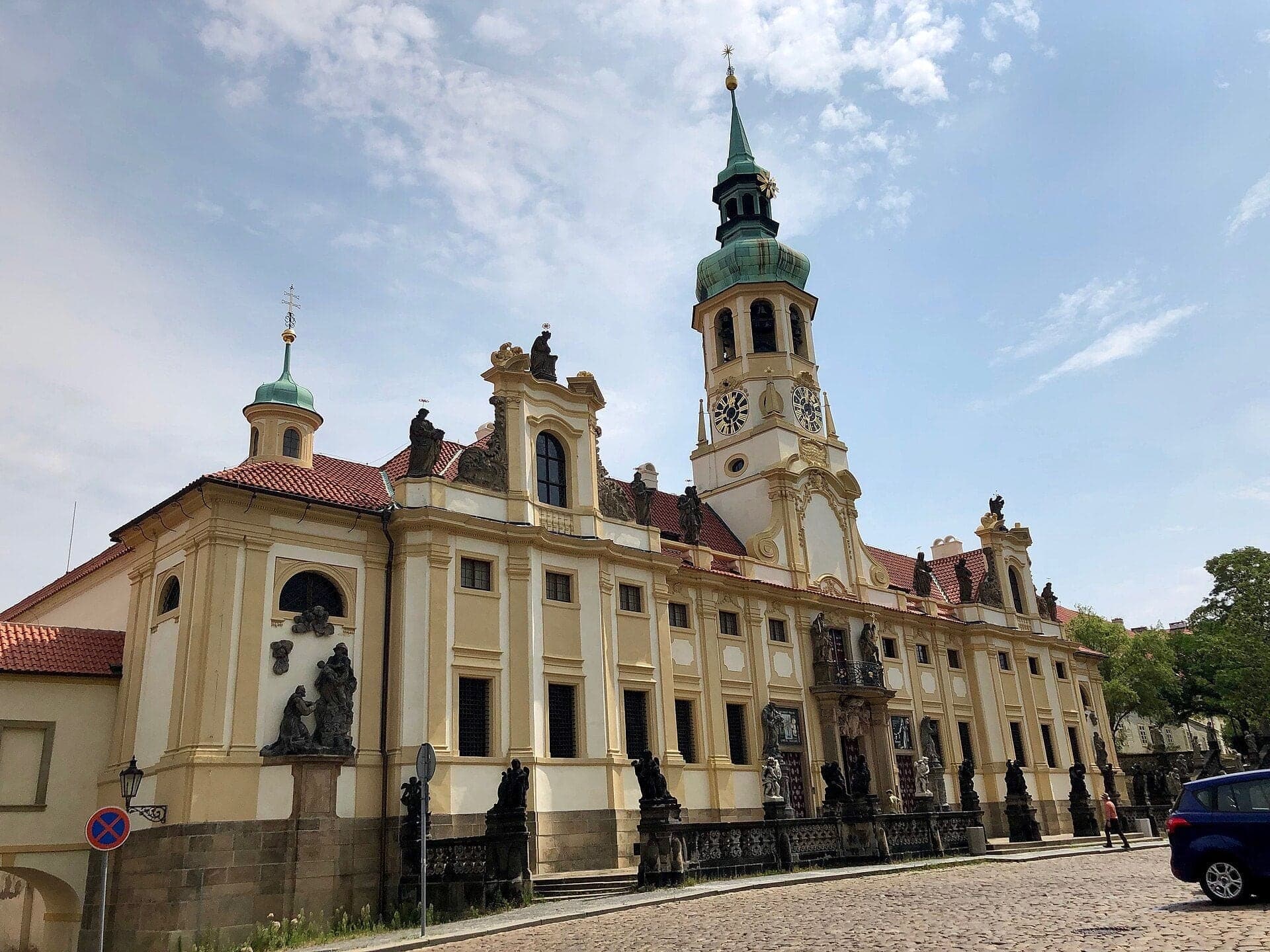
Loreta and Černín Palace: A Tune and a Boast
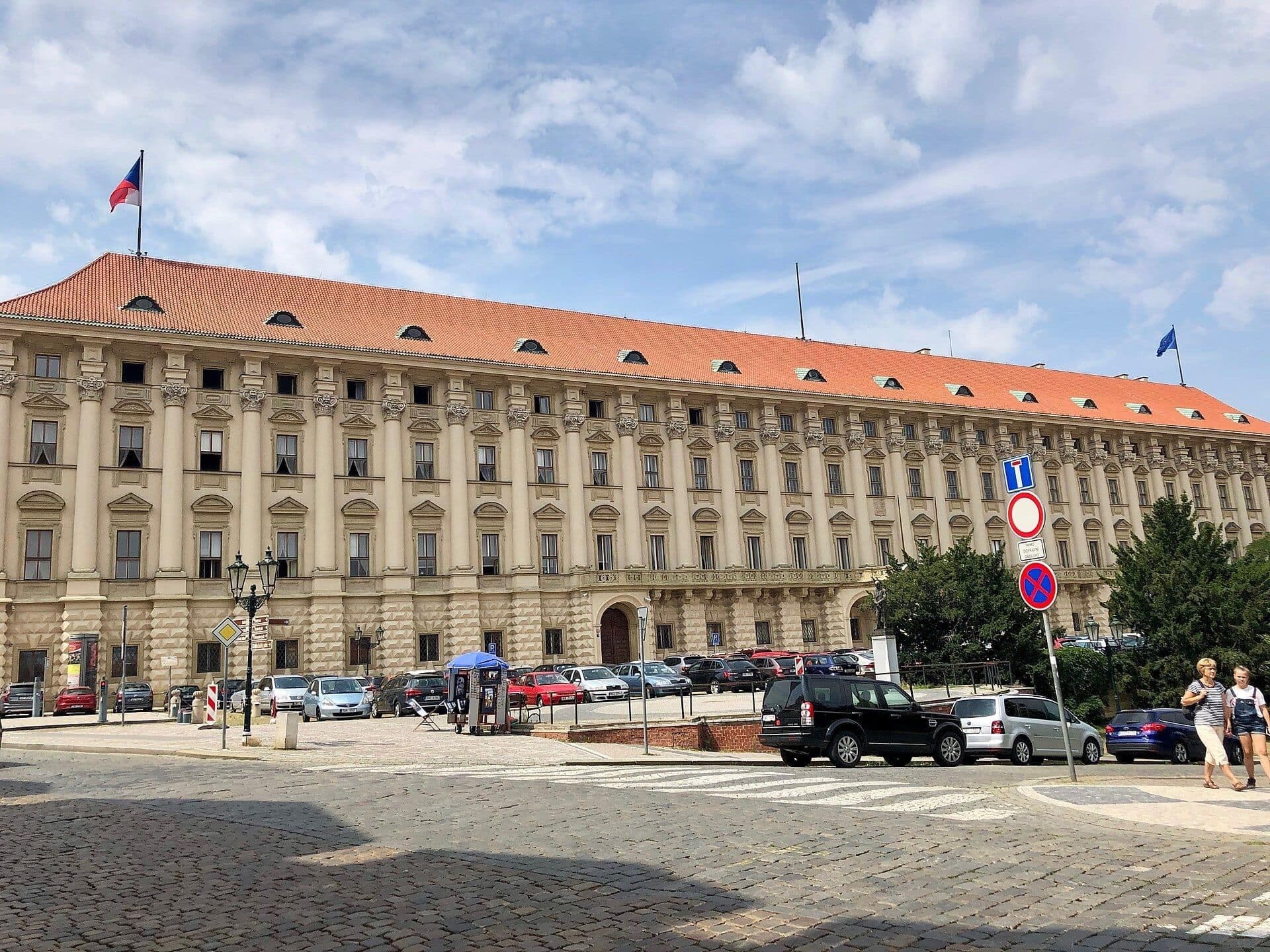
A carillon faces a very long palace, on the quiet square where the walk begins. The Loreta's museum is ticketed and the palace is a working ministry, so this stop works from outside.
- 2
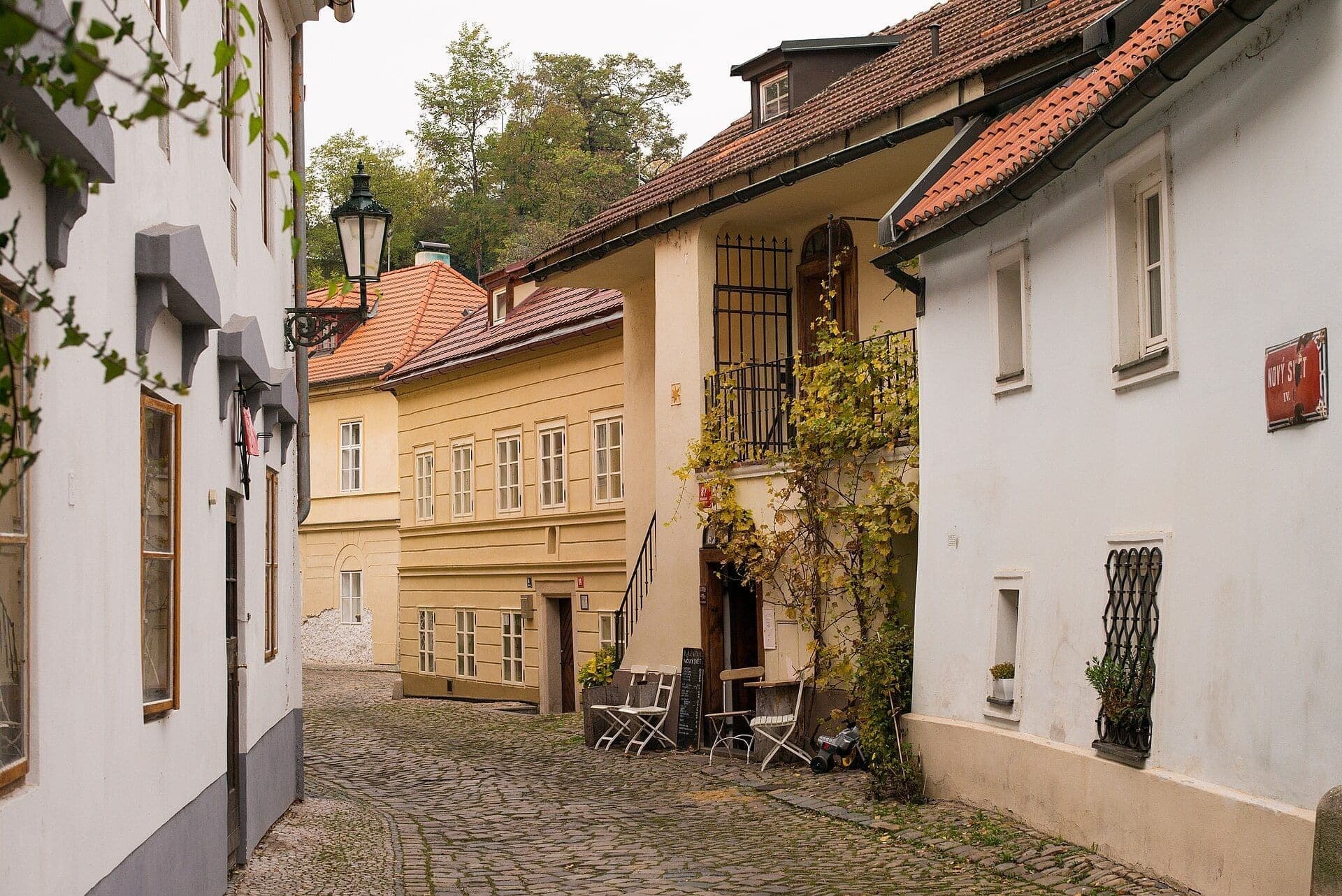
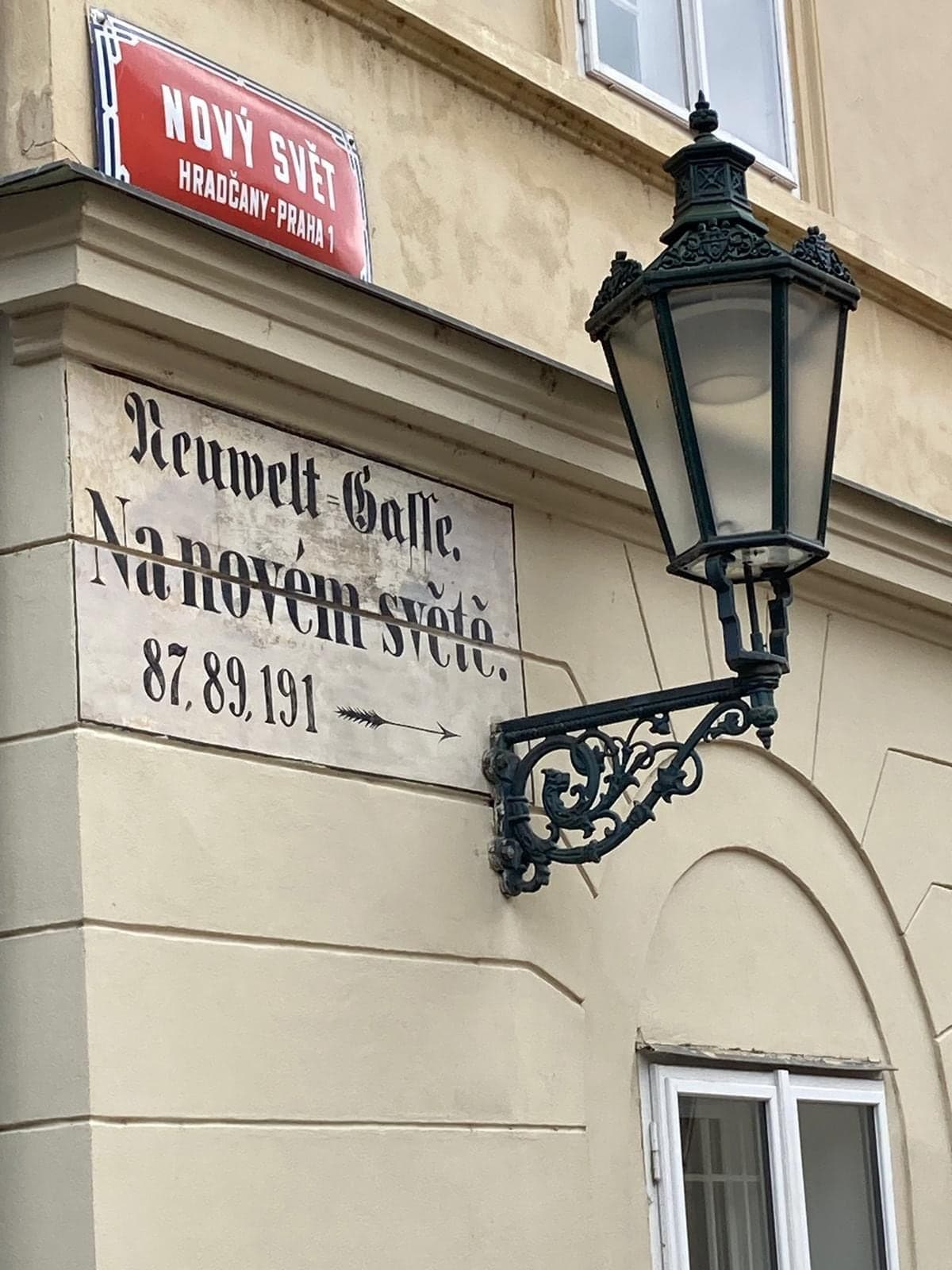
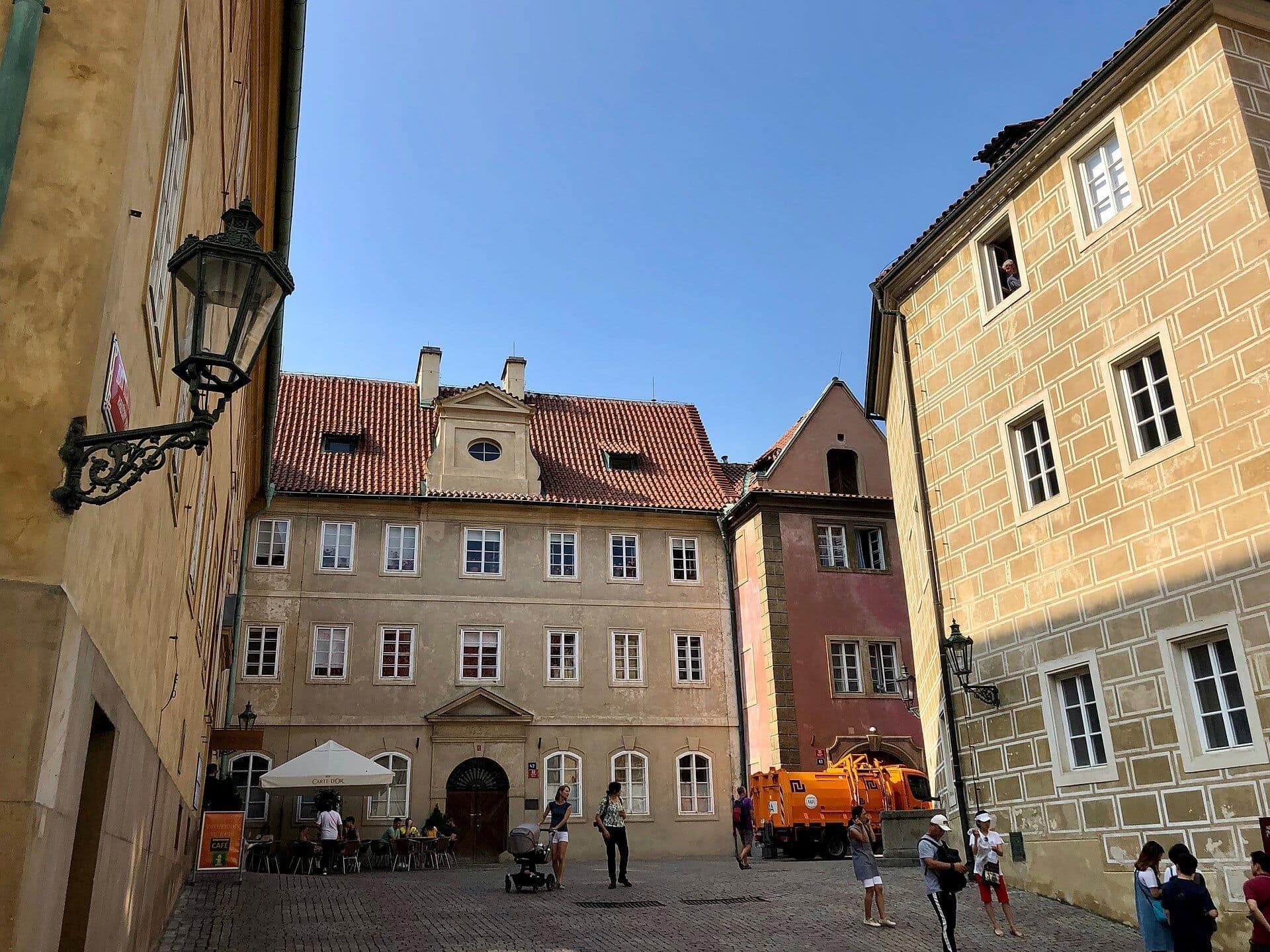
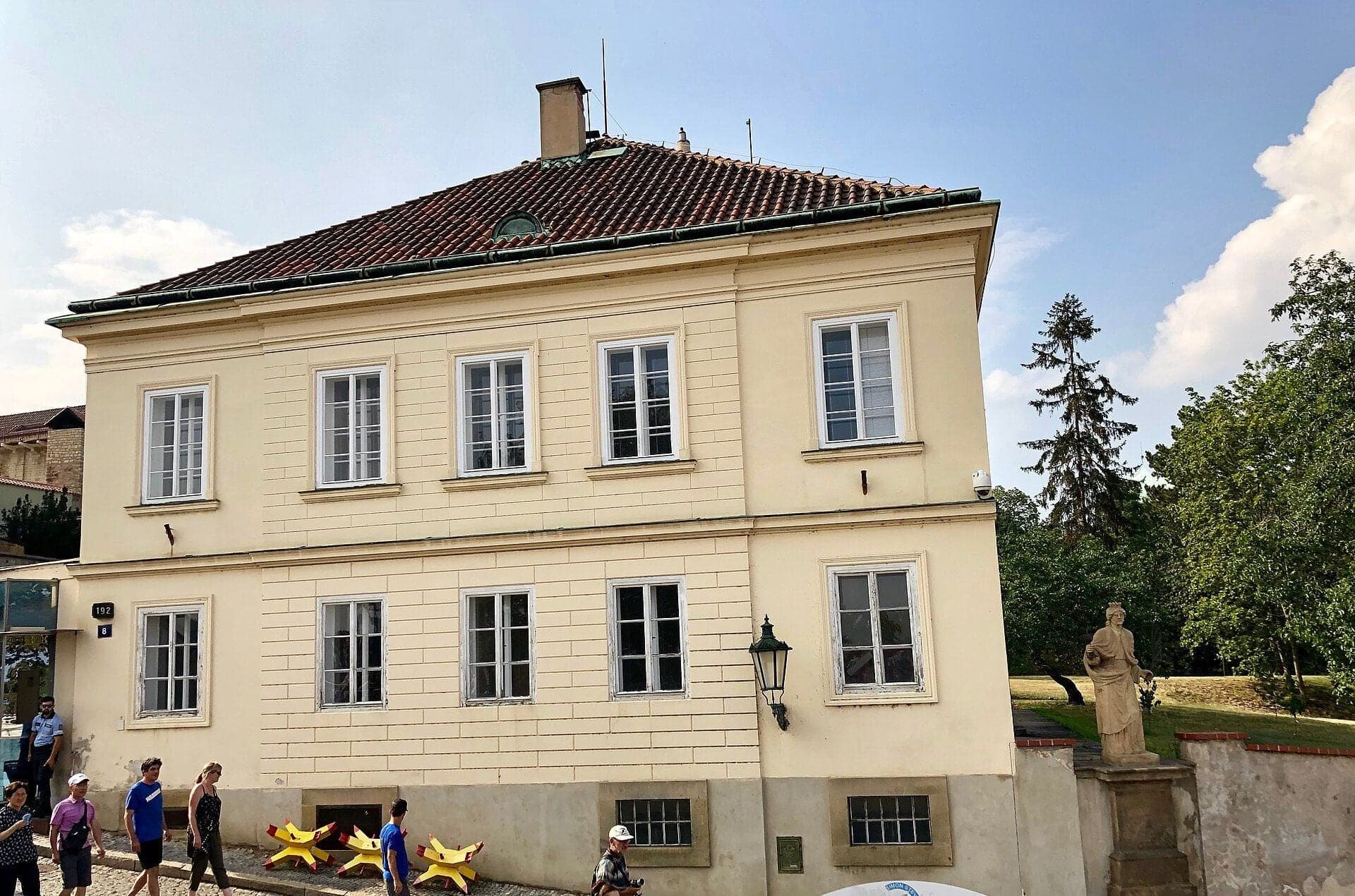
Nový Svět: Golden Names, Poor Houses
A lane follows a hidden stream, between low houses with golden names. These are homes, in a quarter that once lay outside the town.
- 3
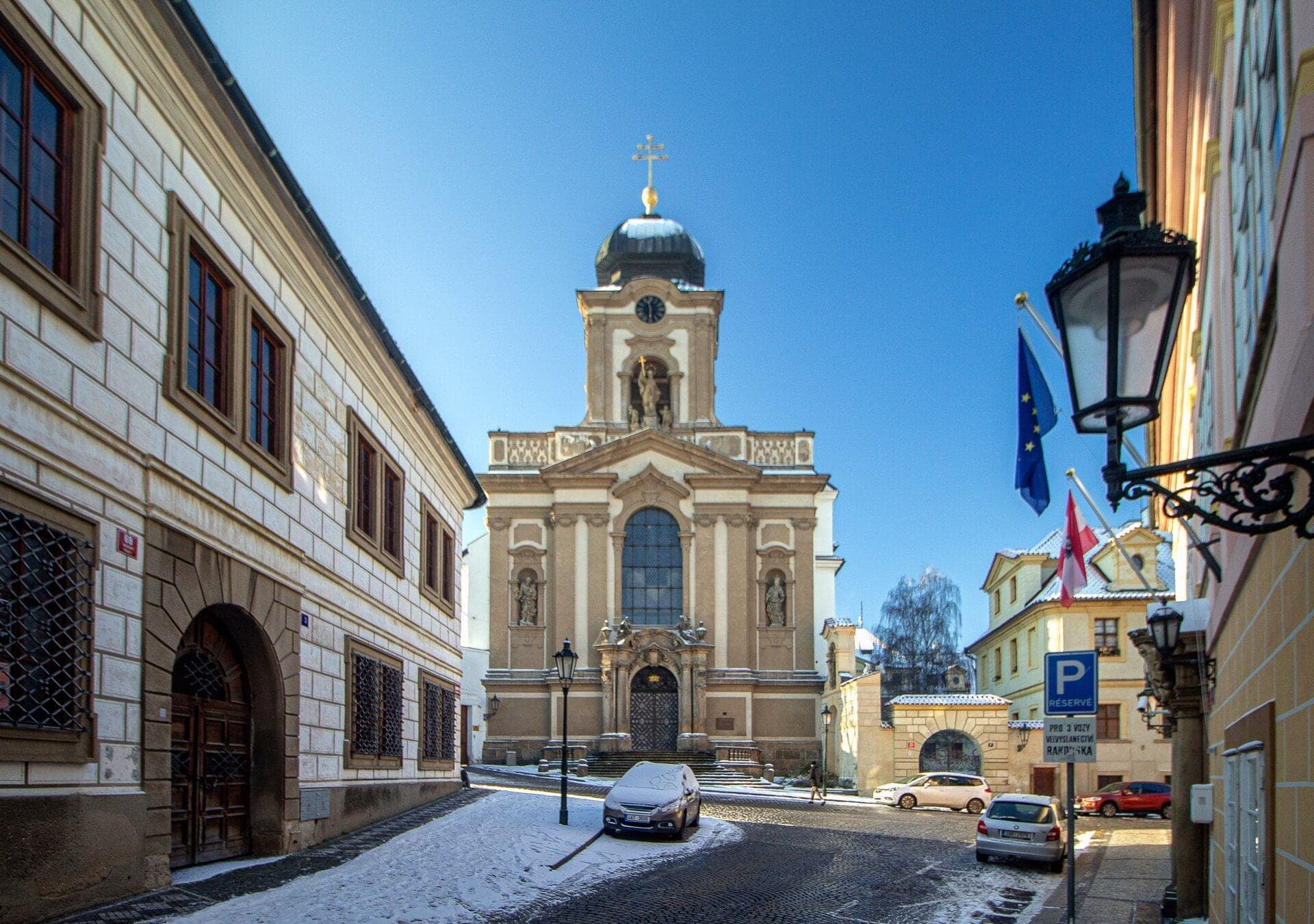
Saint John Nepomuk: Inside the Old Town Line
A son finished his father's church, under a tall clock tower. Its front faces the street, and the interior may not be open.
- 4
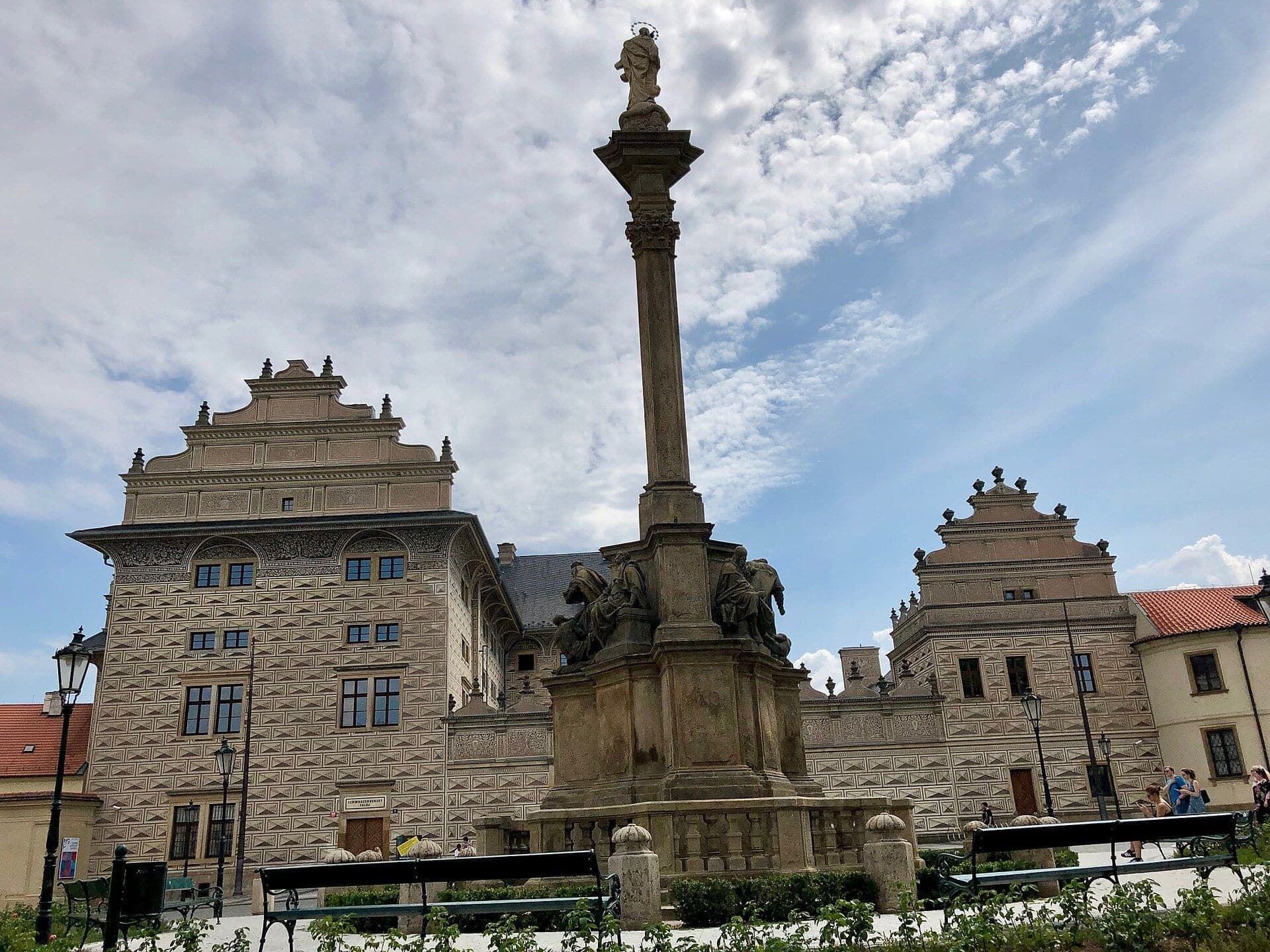
Hradčanské náměstí: The Wall That Pretends
A flat wall fakes carved stone, on a plot cleared by the great fire. The National Gallery's branch inside is ticketed and is not needed for this stop.
- 5
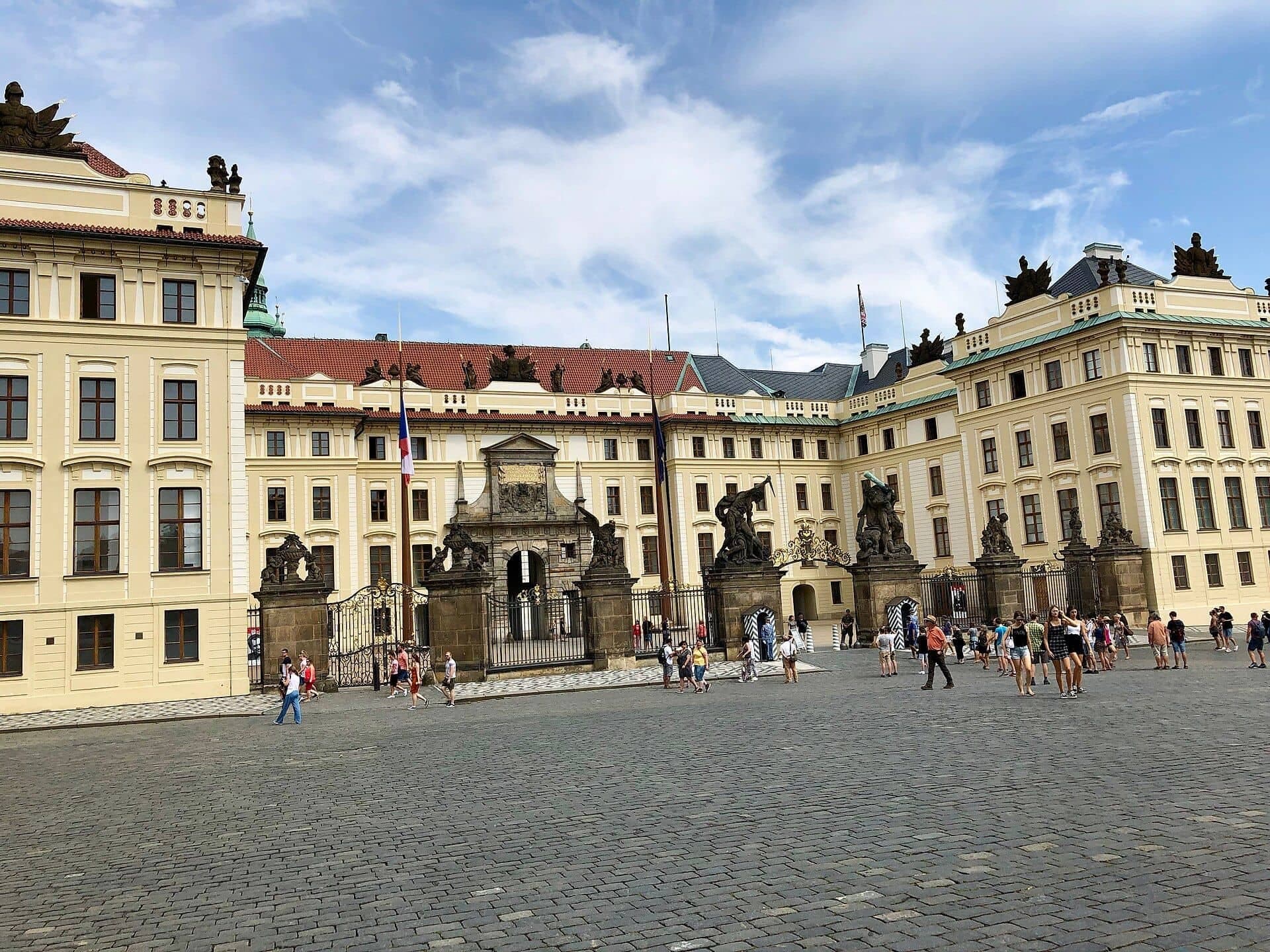
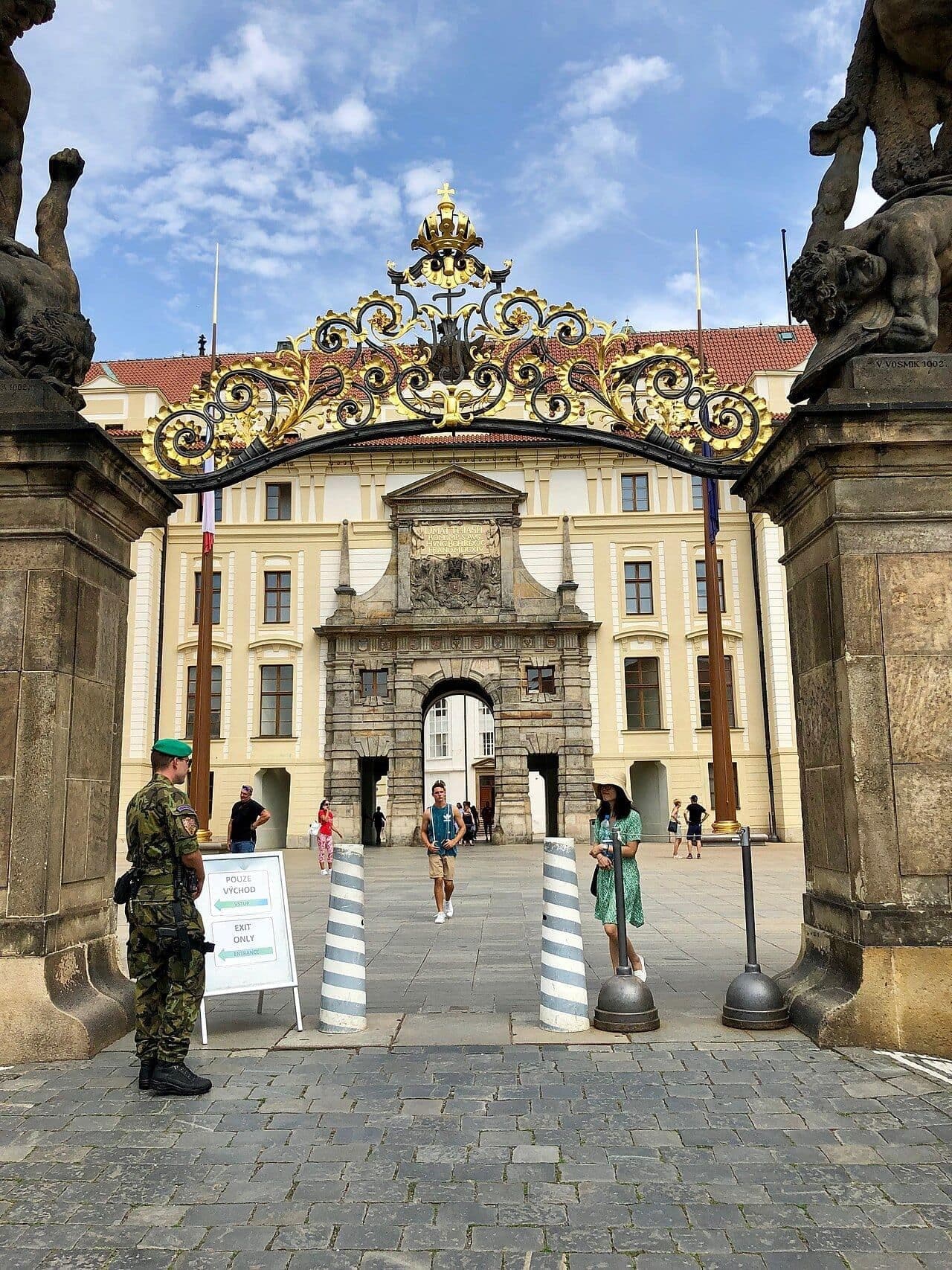
Gate of the Giants: Copies Since 1921
Fighting giants guard the grand gate, copies of 1921 seen from the square. This gate is the way out, and the way in is next door by the Fourth Courtyard.
- 6
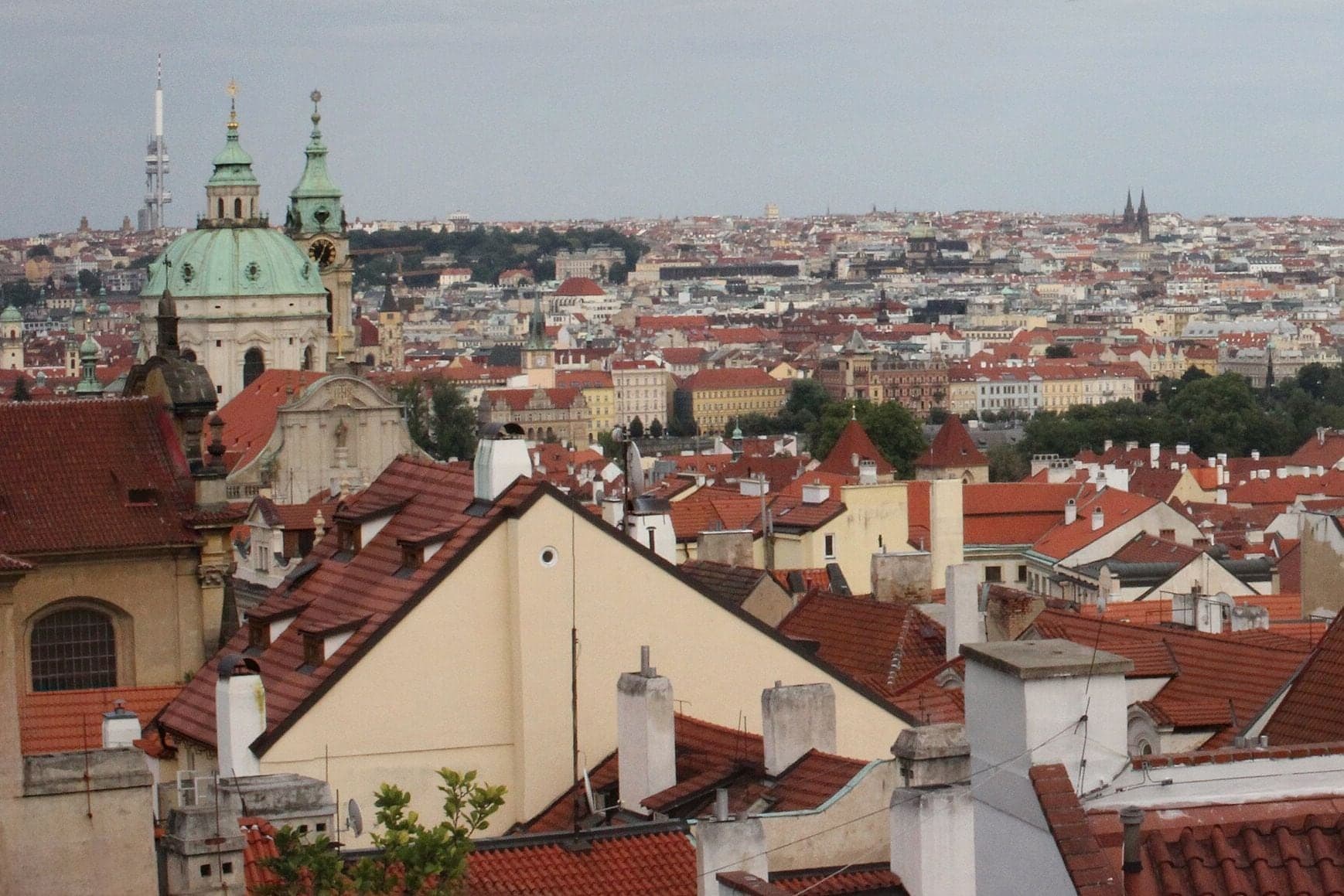
Ke Hradu Parapet: A Hill Above a River
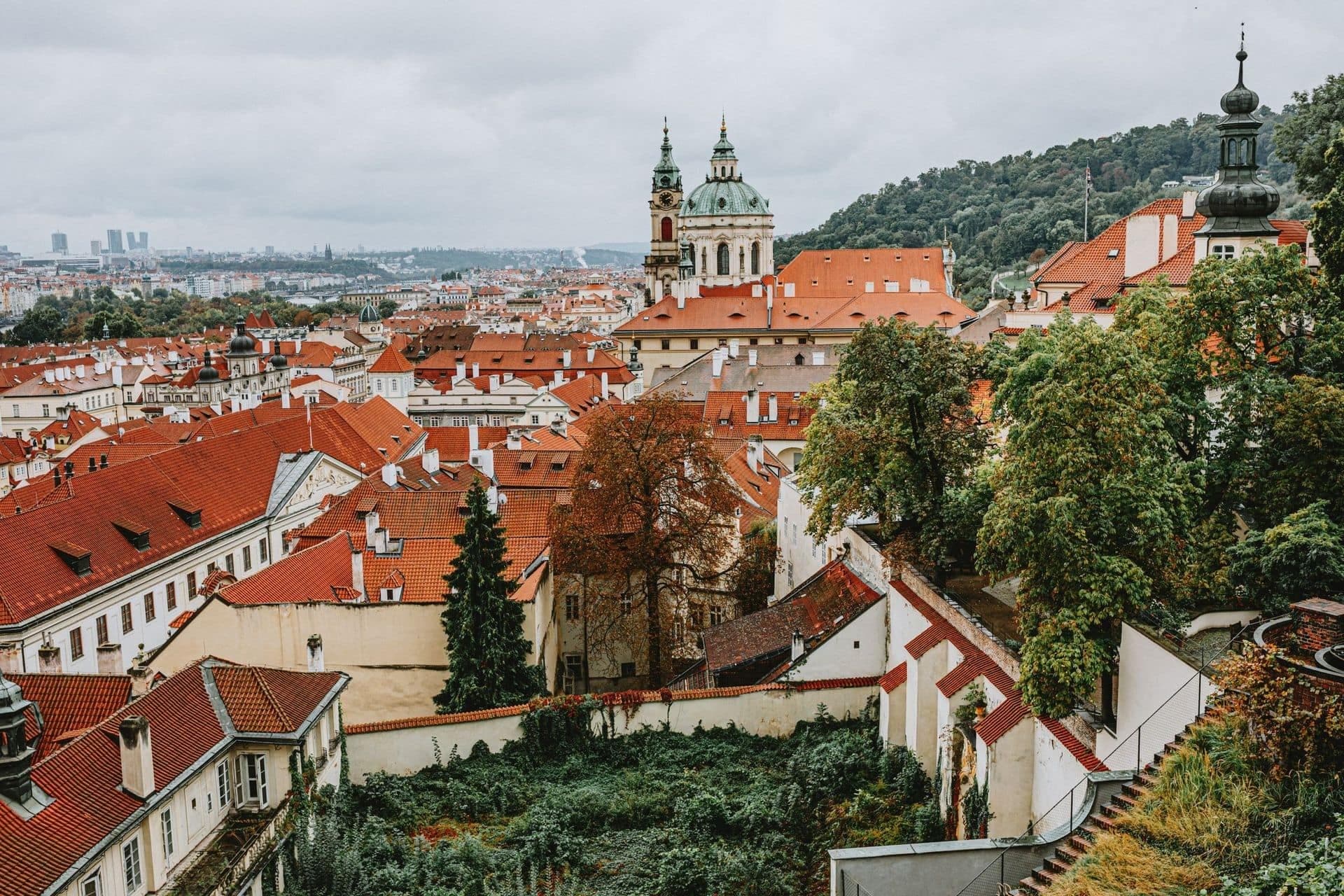
Malá Strana's roofs spread below this parapet, free and open at all hours. This is why anyone built up here, and the way in begins from here.
- 7
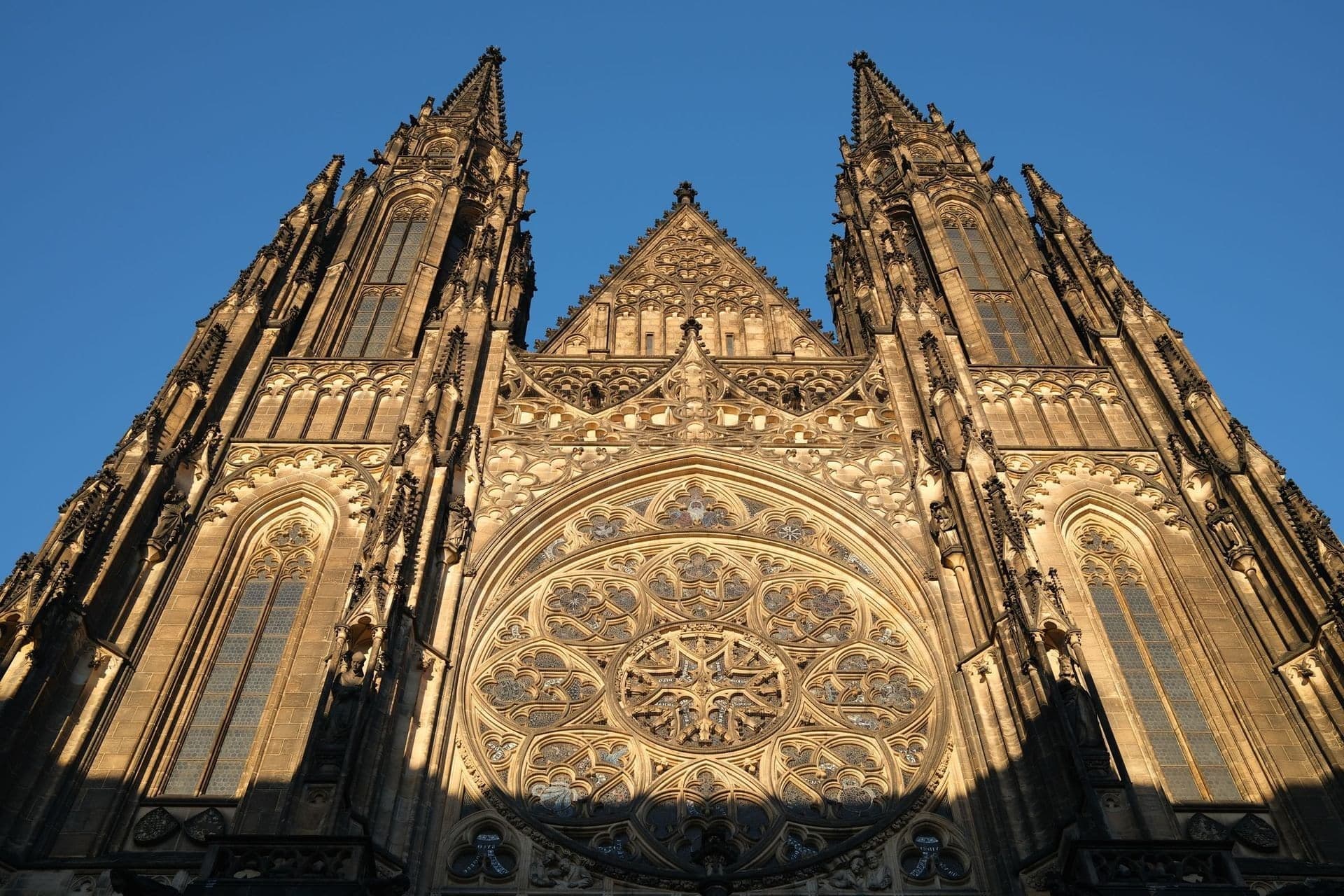
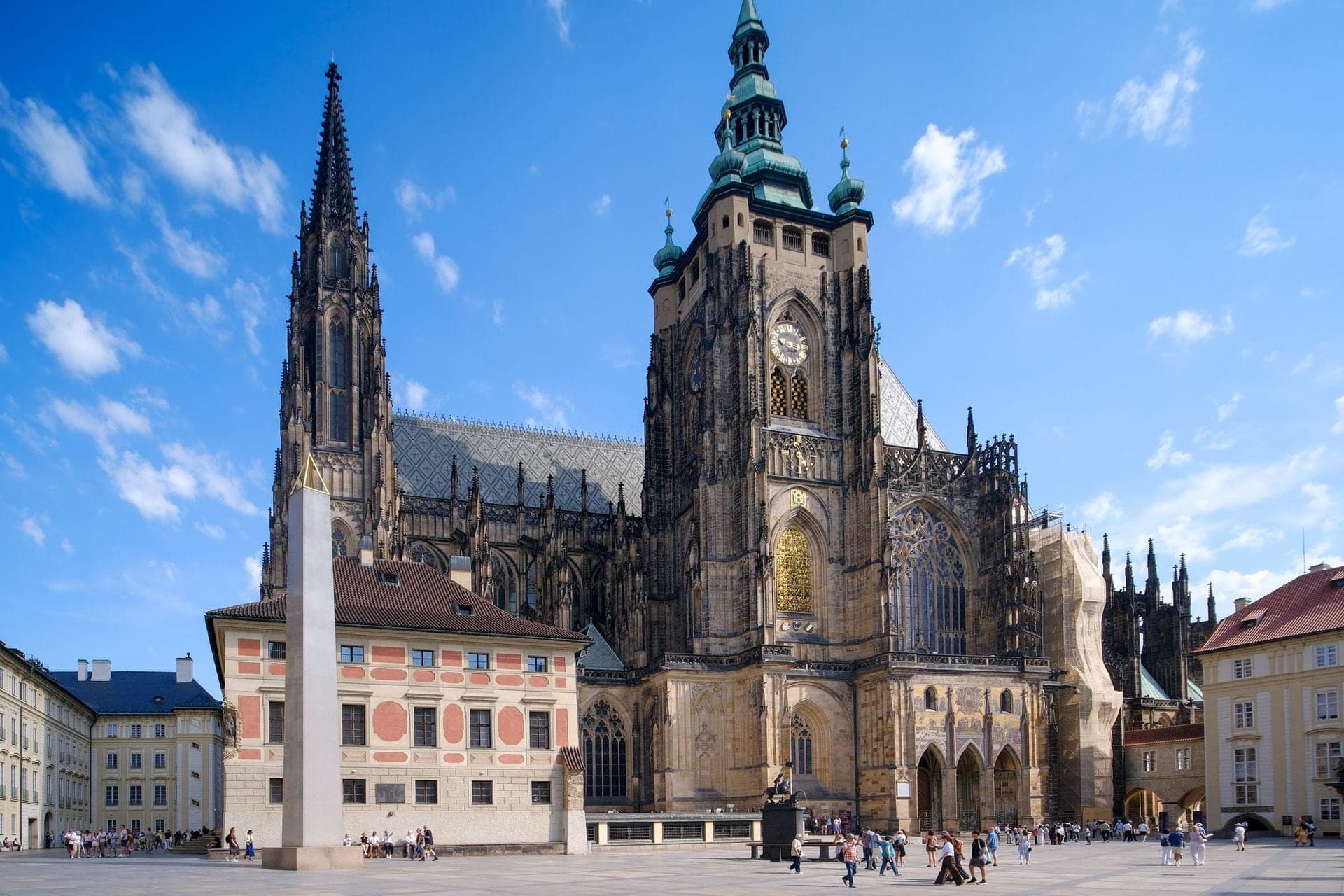
Saint Vitus Cathedral: The West Front
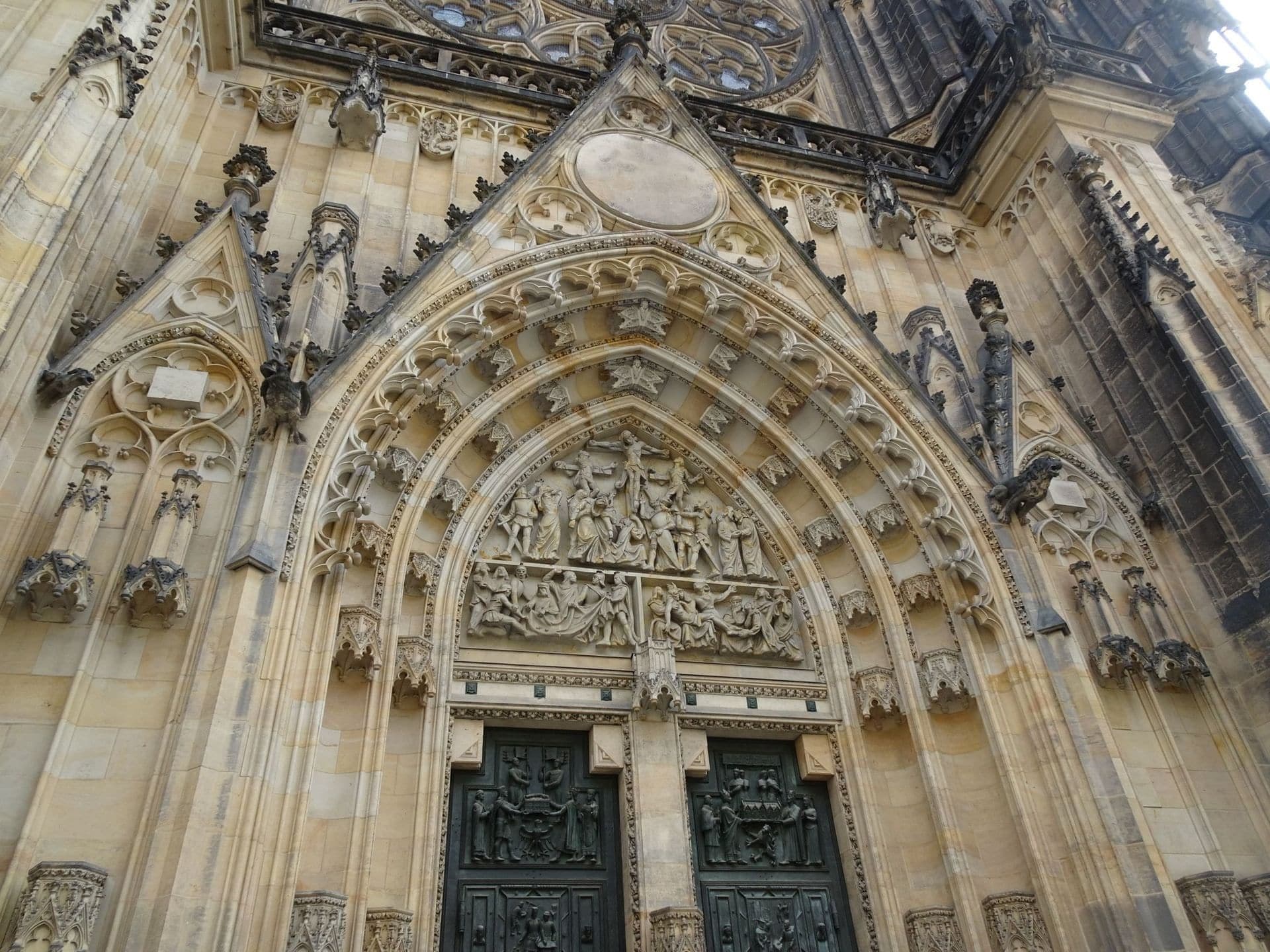
The famous front is its newest part, finished in 1929. You see it free from the courtyard, while going inside takes the Castle's circuit ticket.
- 8
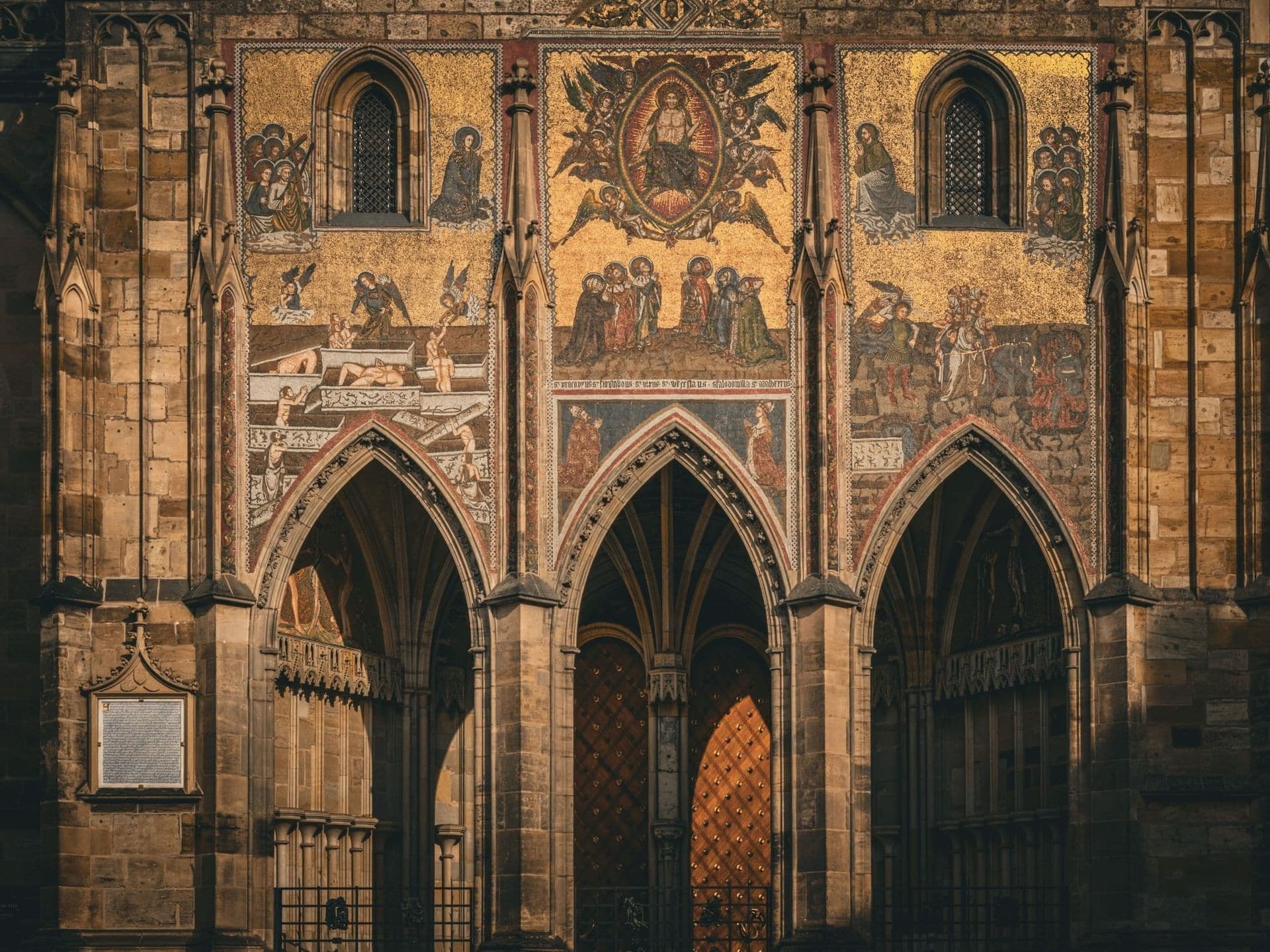
Golden Gate and the Obelisk: The Lucky Side
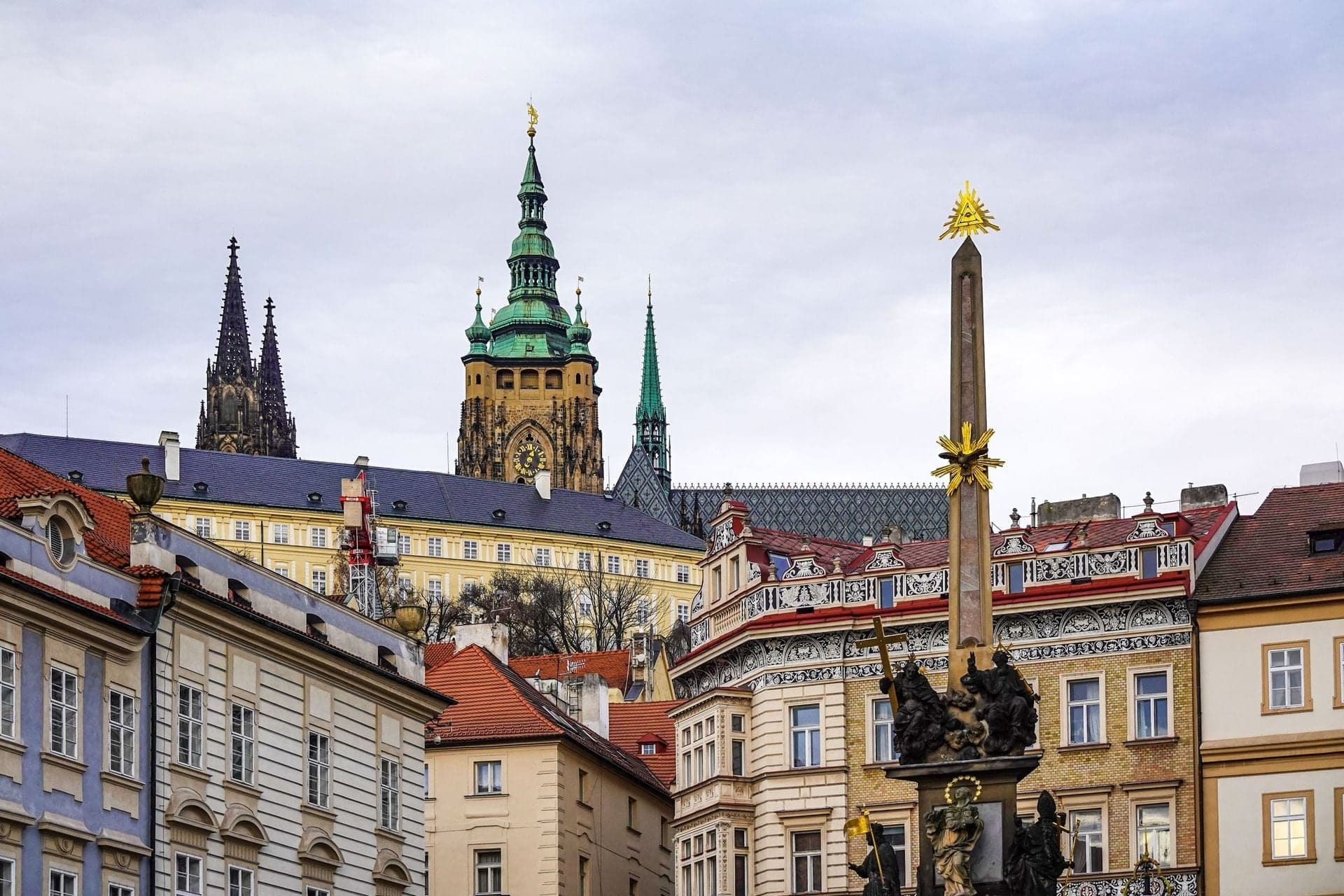
A glass mosaic kept going dark here, on the side out of the direct line of fire. The courtyard is free, and the Great South Tower has its own ticket.
- 9
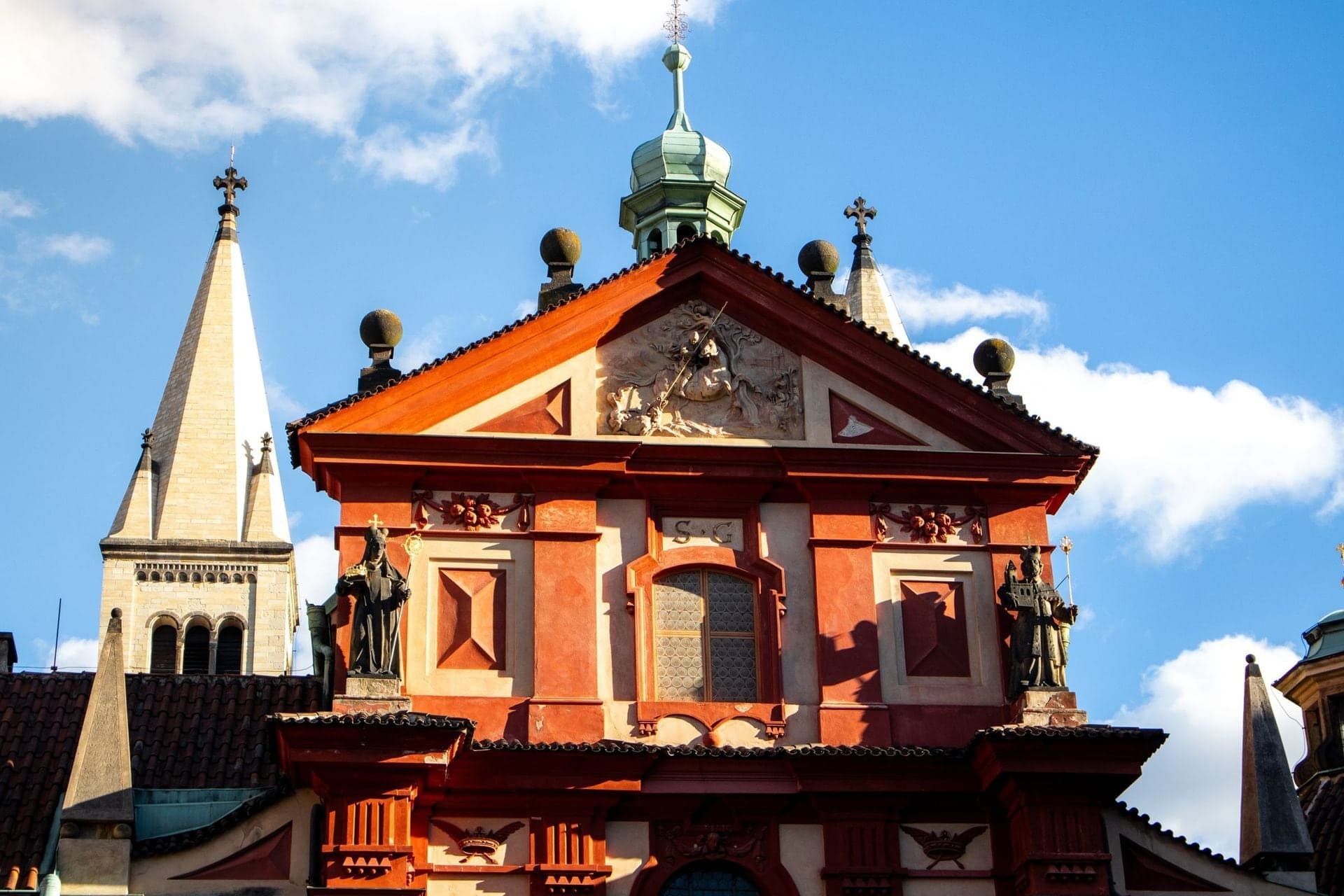
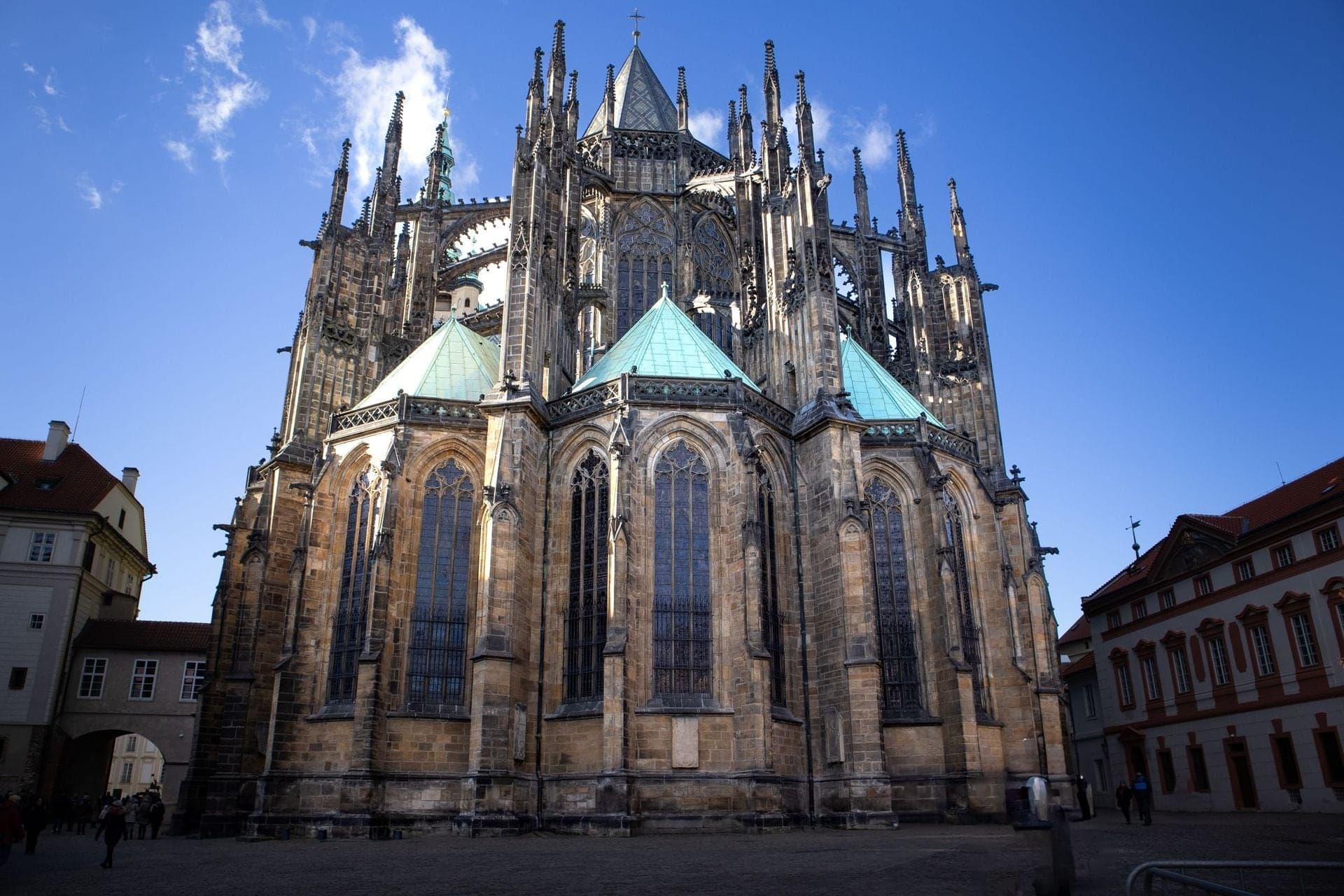
Saint George's Square: Skin and Bones
A later front dresses a much older church, facing the cathedral's stone buttresses. The basilica is on the Castle's circuit ticket, and both read well from the square.
- 10
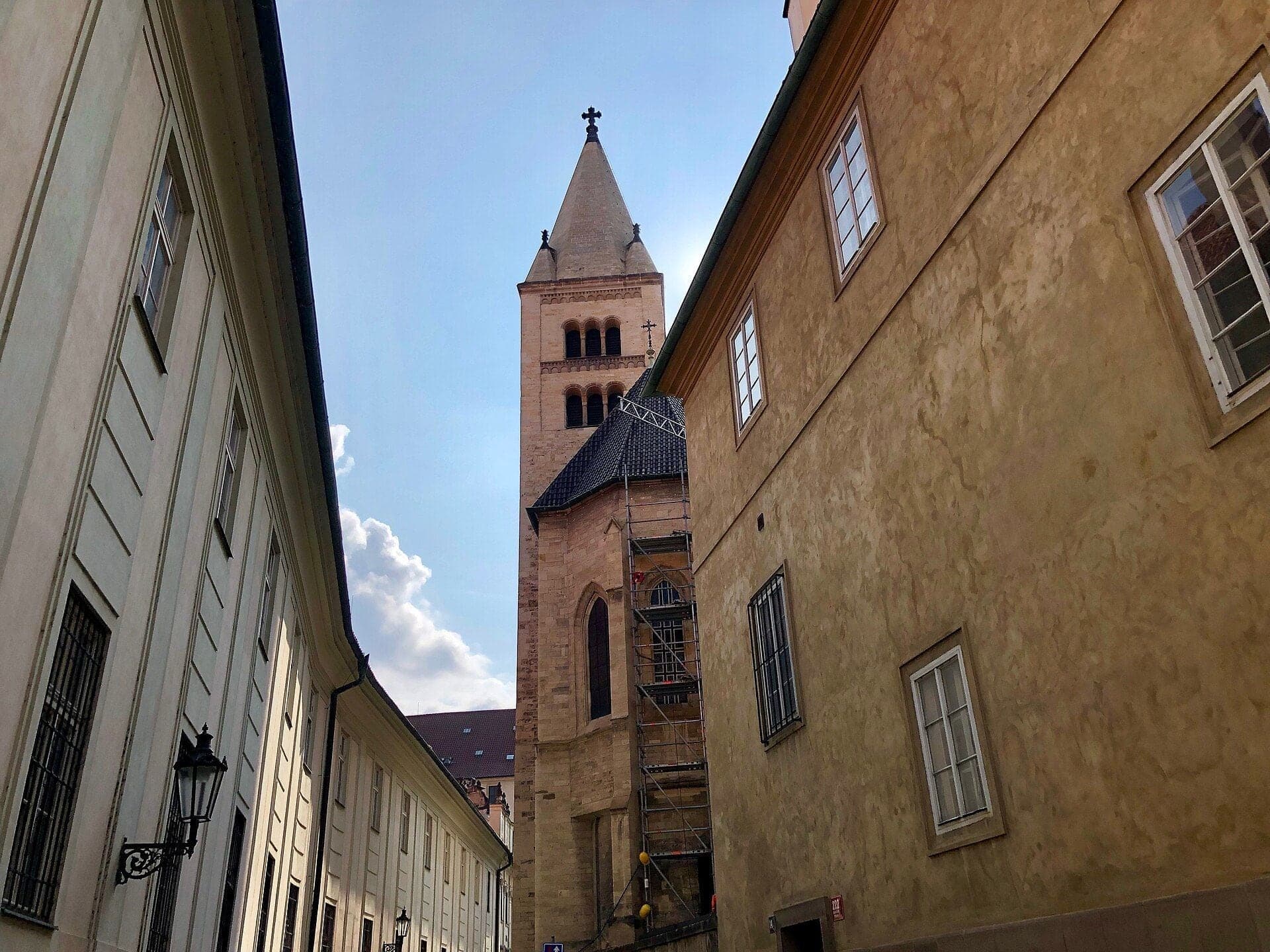
Jiřská: Golden Lane Without the Alchemists
A real street passes Golden Lane's turning, where the alchemists are fiction. The street is free, and the lane itself is on the Castle's circuit ticket.
- 11
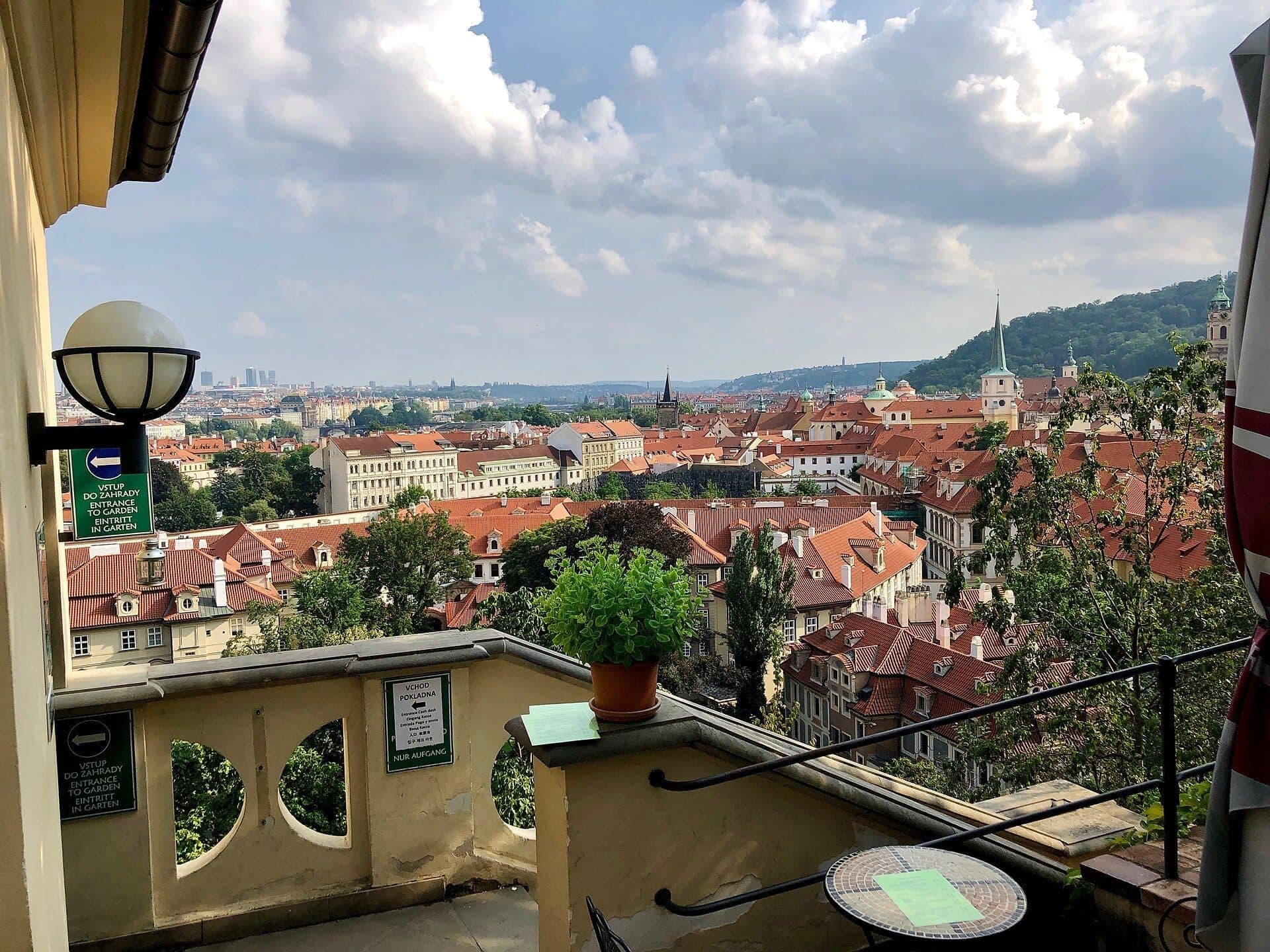
Top of the Old Castle Stairs: The Last View
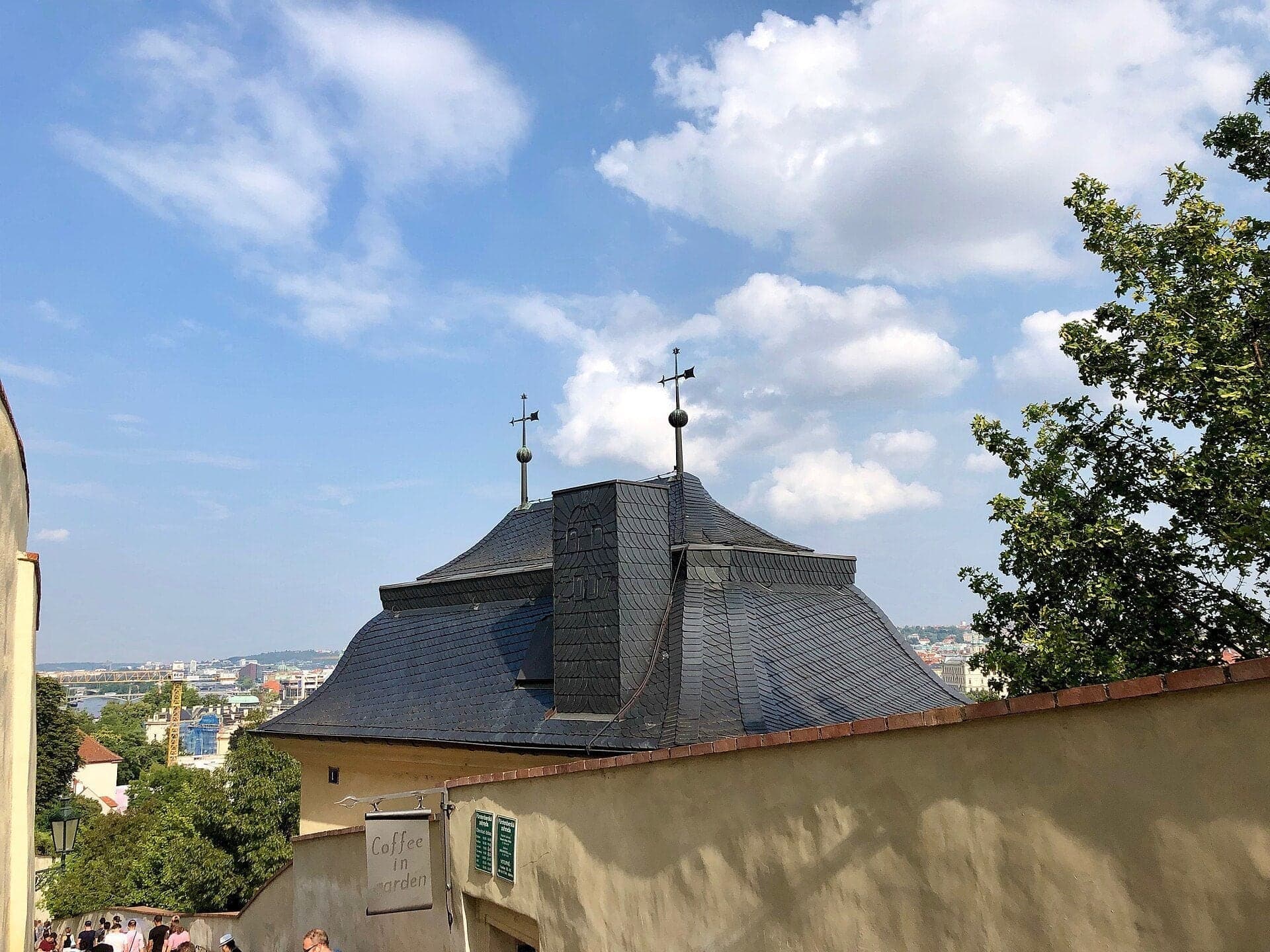
The Castle lists this terrace as a viewpoint, just outside its east gate. Below it you see the Vltava's valley, and the stairs down start close by.
- 12
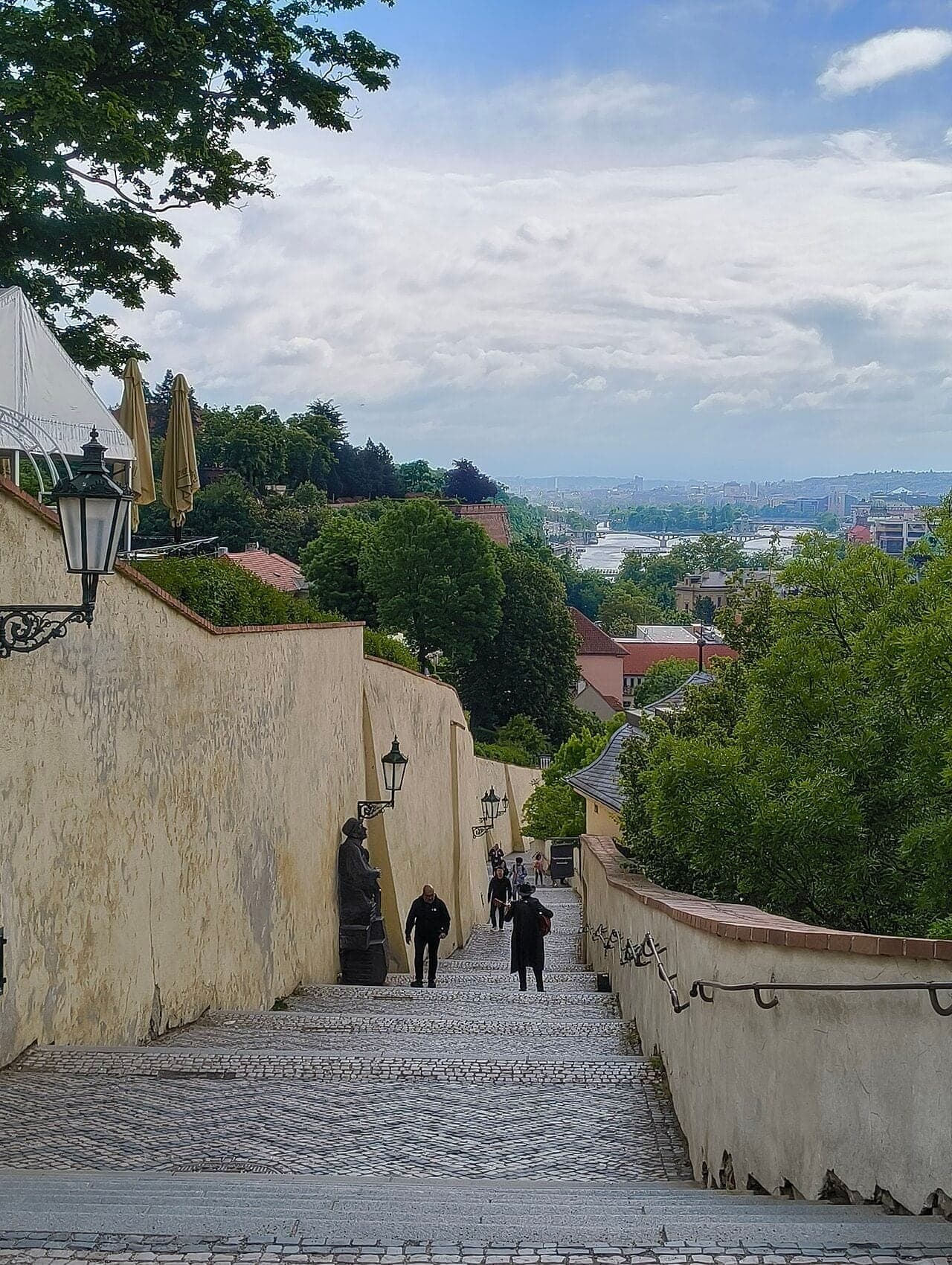
Foot of the Old Castle Stairs: Back to the City
The stairs end here in the city, by the tram line at Klárov. Malostranská Metro is close, and the streets of Malá Strana start here.
Details
Best Time to Visit
Any day between 6:00 and 22:00, the hours of the Castle grounds. Start just before the hour to hear the Loreta's carillon. Reach the Gate of the Giants on the hour between 9:00 and 18:00 for the changing of the guard, or at noon for the fanfare ceremony in the First Courtyard. If you want the interiors as well, buy the Castle's ticket and go in during the walk: buildings open 9:00 to 16:00 from 1 November to 31 March and 9:00 to 17:00 from 1 April to 31 October, and the cathedral opens only at 12:00 on Sundays. Checked 3 November 2026.
Pro Tips
- •Getting to the start: tram 22 or 23 to Pohořelec, then about 260 meters on foot down to Loretánské náměstí, using the marked crossings at the tram stop. Checked 3 November 2026.
- •Getting away from the end: Metro line A at Malostranská and trams at Klárov are about 150 meters from stop 12. Checked 3 November 2026.
- •Trams 22 and 23 run past the Castle, and the long 2026 closure ended by 17 July. Short weekend closures ran on 17, 18 and 24 October 2026, and none was listed for 3 November 2026. Check pid.cz on the day.
- •At stop 1, the short stairs beside you lead up to a wider view of both the Loreta and Černín Palace, and they are optional.
- •Interiors are not included in this walk. The Castle's Main circuit ticket (Saint Vitus, Old Royal Palace, Saint George's Basilica, Golden Lane) is 450 CZK, 300 CZK reduced, 950 CZK family, valid two days. Great South Tower 200 CZK. Prices from the Castle's list valid from 1 March 2024, and the same prices were still shown on 3 November 2026.
- •Changing of the guard: every hour 9:00 to 18:00 at the Gate of the Giants and the Powder Bridge Gate, with a fanfare ceremony in the First Courtyard daily at noon. It stopped for seven weeks in 2024 for works, so it can stop. Checked 3 November 2026.
- •First Courtyard: this walk sees it from the square, through the gate. If you want a look from inside, step through the Matthias Gate from the Second Courtyard, then come back. The Gate of the Giants is the way out, not the way in.
- •Garden on the Bastion: you pass it between the Fourth and Second Courtyards, and it is open 6:00 to 22:00 all year. A short side trip, not a stop.
- •Royal Garden, South Gardens and Stag Moat are not on this walk. They are closed from 1 November to 28 February and otherwise open from 10:00: March and October to 17:00, April to June and September to 19:00, July and August to 20:00. The Stag Moat roads also depend on frost and ice. Checked 3 November 2026.
- •At stop 11, a few optional steps lead down to the lookout at the wall. Everything else on the terrace is reached without them.
Safety & Precautions
- •This walk does not include any admission. It uses the free grounds of Prague Castle. The cathedral, Old Royal Palace, Saint George's Basilica, Golden Lane and every other interior need the Castle's own ticket.
- •Saint Vitus Cathedral's free area has been closed since 25 October 2023 until further notice, per the Castle's page as captured on 19 October 2026. Do not expect to step inside without a circuit ticket. Checked 3 November 2026.
- •Please use headphones. The Castle's Rules (Art. 6) bar amplified sound and loud speech that disturb others, so keep your phone's speaker off. Keep voices down in Nový Svět, where people live.
- •The way in from Hradčanské náměstí is through the Fourth Courtyard, next to the Gate of the Giants. The gate itself is the way out. The entrance is narrow and can queue. This comes from the Castle's pages captured on 27 September and 2 October 2026 and its 2024 plan: follow the signs if the flow has changed. Checked 3 November 2026.
- •Most security frames were removed in April 2023. Police may make a random check at the entrance, and refusing means no entry. Please leave bulky luggage elsewhere.
- •The grounds are open 6:00 to 22:00, and stops 7 to 10 need those hours. The Castle can close all or part of the complex for operational, technical, security or state reasons. No closure list could be fully read, so one on the day is not ruled out.
- •The east gate has no separately published hours. It is treated as following the complex's 6:00 to 22:00. If it is shut, go back along Jiřská to the Third Courtyard and leave the way you came in or by the Gate of the Giants. There are also gates on Jiřská and near the foot of the stairs, with no published hours. Late in the evening, allow for one being shut.
- •Stay at least half a meter from the honor guard (Rules Art. 7(9)), and do not harass them. No bikes or scooters, no walking on lawns, no picnics or blankets outside designated areas, no drones for any purpose, no flags or banners.
- •Old Castle Stairs: more than a hundred steps, with a drop of about 27 meters, slippery when wet and possibly icy in winter. Way round: the Na Opyši ramp beside them, with no steps, about 330 meters, coming out near Klárov.
- •Cobbles and mosaic paving along much of the route are slippery when wet and rough on wheels. Passages between the courtyards have rough cobbles.
- •At Klárov, past the end of the walk, cross the tram tracks and road by the marked crossing with an island. Look both ways, for trams too.
- •Taxis and residents' traffic use the lanes at Kanovnická, at stop 4 and at the Gate of the Giants, so keep to the path and the side.
- •Pickpockets work the crowd at the Ke Hradu parapet and in the passages between courtyards. Keep bags closed and in front of you.
- •Saint Vitus has no tourist visits during services, opens at 12:00 on Sundays, and has many one-off closures. Scaffolding may be on any part of the cathedral at any time.
- •Golden Lane closed all day on 13 January 2026 for safety reasons, and it can close at short notice.
Travel advisory: Exercise Normal Precautions (Level 1).
Gallery
Related Reading
Go deeper on what you'll see, hear, and walk through.
Overview
One Day in Prague: A Walkable Morning-to-Evening Itinerary
8 min
Overview
Prague Travel Guide: Days, Transport, Safety, and Budget
8 min
Thematic
Prague's Layered City: The Coronation Route, Josefov, and a Modern Grammar
9 min
Companion
St. Vitus Cathedral and the Crown at the Top of Prague's Coronation Road
7 min
Read
What to Eat in Prague
6 min
Read the walk
The full story of Prague Castle and Hradčany: Reading the Stone, in words. Prefer to listen? Play it narrated, from home or on location.
Introduction
Prague, the capital of the Czech Republic, has a castle that began in the late eight hundreds, when a prince moved his seat to a hill above the Vltava. Most of what looks ancient up here is younger than it looks. The giants on the gate are copies from nineteen twenty-one. The cathedral front in every photograph was finished in nineteen twenty-nine. The real old stone is the dark, uneven part people walk past.
Three people shape what you will see. Humprecht Jan Černín built a palace front one hundred and forty meters long. Peter Parler gave the cathedral its high choir and buttresses. Jože Plečnik remade the Castle for a new republic.
This is a walk of the Castle's free grounds and the quarter around them, not an entry ticket. Interiors need the Castle's own ticket, not included, and every stop works from outside. The grounds are open from six in the morning to ten at night. Please use headphones: the Castle's rules bar amplified sound and loud speech that disturb others.
The walk is twelve stops over about one point eight kilometers, a little over a mile, and takes about seventy-five minutes. It runs mostly downhill on cobbles, slippery when wet, and ends with more than a hundred steps, with a way round. It begins by the Loreta, near the Pohořelec tram stop, and ends at the foot of the Old Castle Stairs, near Malostranská Metro.
1. Loreta and Černín Palace: A Tune and a Boast
Welcome to Loretánské náměstí, the quiet square where this walk begins. The Loreta's museum is ticketed, and the details are on this stop's card. The palace is a working ministry, so it is outside only.
Find the decorated front with the clock tower. That is the Loreta, a shrine built around a copy of the Holy House, which dates itself to sixteen twenty-six.
If you are here at the top of the hour, listen. Every hour the tower plays a hymn to Mary. A rich merchant from Malá Strana, the Lesser Town below the Castle, gave the bells, twenty-seven of them, signed by a bell-founder in Amsterdam. A Prague clockmaker built the mechanism: a metal cylinder with pegs, like a music box, turned by the tower clock. It first rang in sixteen ninety-five, and the Loreta says it still works exactly the same way.
Now find the enormous front that runs on and on. That is Černín Palace, and the Foreign Ministry inside gives it as one hundred and forty meters. Humprecht Jan Černín, an imperial envoy, hoped for a career in Vienna and was disappointed. As a historian told Czech Radio, he came home and set out to build the biggest palace in Prague. It was a matter of prestige.
It looks untouched, but in eighteen fifty-one it was sold to the army and became barracks, and between nineteen twenty-eight and nineteen thirty-four it was rebuilt as the ministry. Jan Masaryk, the foreign minister, lived here, and on the morning of the tenth of March, nineteen forty-eight, two weeks after the Communist takeover, he was found dead in the courtyard. How he died has never been settled.
Up here, looking old and being old are different things.
Cars use this lane, so keep to the side. Follow the route down the lane and under a small covered bridge. Next is the low street at the foot of this slope.
2. Nový Svět: Golden Names, Poor Houses
Walk on down to where the lane meets the low painted houses of Nový Svět, the New World, and stop in the bend. People live here, so keep your voice down.
Look at the shape of it first. The street does not run straight, because it follows an old path along a stream, the Brusnice, on its way out to the next village. You cannot see the stream from here, but you are still walking its bend. That line on the ground has outlasted the houses beside it. This quarter burned in the Hussite wars, and it burned again in fifteen forty-one.
The houses carry grand names, such as At the Golden Pear and At the Golden Grape. By the time those names stuck, the people living here were among the poorest. One Prague newspaper suggests that they made up for it at least in the names of their houses. That is only one reading, but it is a good one to carry along the lane.
You are also outside the old town here. The town of Hradčany was marked out up on the ridge around thirteen twenty. A heritage study from nineteen eighty-three found no trace of town walls taking this side in, and it describes loose building among gardens and vineyards, more suburb than town.
One resident did leave a mark. A plaque on house number one says that Tycho Brahe, the Danish astronomer who served the emperor, stayed in that house in the year sixteen hundred.
Follow the route along the lane and into Kanovnická. Where the two meet, you cross the line where the town once began.
3. Saint John Nepomuk: Inside the Old Town Line
Walk on along Kanovnická to the corner where a tall church tower rises close above the street, and stop at the edge of the pale paving. Parked cars and residents' traffic share this lane, so stay to the side.
A little way back, where this lane leaves Nový Svět, stood one of the three great gates of medieval Hradčany, the Hospital Gate. There is nothing to look for. It matters as a line: behind you, the suburb. On this side, the town.
Now look up. This is the church of Saint John Nepomuk, and he stands in the niche on the tower. It was built for a convent of Ursuline nuns next door, and building began in seventeen twenty under Kryštof Dientzenhofer. He died in seventeen twenty-two. His son took over and reworked the plan, and Prague's tourist office calls it the son's first independent work. It was consecrated in seventeen twenty-nine.
It is a modest beginning for an important Baroque builder: a side street, and a son finishing a job his father had begun.
Today the church serves the Czech Army's chaplaincy, as a place of prayer for fallen soldiers. Its interior hours are not something to count on, so take it as a front and a tower.
Follow the route along Kanovnická, on the sidewalk, past the parked cars. Next is the square where the Castle's neighbors built their palaces.
4. Hradčanské náměstí: The Wall That Pretends
Walk on into Hradčanské náměstí, Hradčany Square, and stop on the paved path at the edge of its little park, with a long black and white palace across the lane. Stay on the path, because taxis and residents use the lane.
Look at that palace front. It seems to be built of heavy blocks of cut stone, row on row, in black and white. None of those blocks exist. It is flat plaster, scratched. The technique is called sgraffito: a dark coat under a pale one, with the pale coat cut away to draw the pattern. From across the lane, your eye does the rest.
This is the first surface on the walk that is openly pretending, and it is a very handsome lie. Prague's tourist office says it looks more like a château than a town palace.
It owes its plot to a disaster. After the great fire of fifteen forty-one, which burned Hradčany, Malá Strana and much of the Castle, a nobleman of the Lobkowicz family acquired two of the three houses that stood here. Building began in fifteen forty-five, and by fifteen sixty-seven it was finished, with its sgraffito. We call it Schwarzenberg Palace, after a family who only got it by marriage in seventeen nineteen. So even the name is younger than the wall. And the plaster you are looking at was renewed in the nineteen fifties, to the old patterns.
Two more things stand on this square. Close to you is a column, a thank-you for surviving plague. Somewhere on the square you may also spot an eight-armed gas lamp of cast iron, from eighteen sixty-eight.
Follow the route across the square. Next are the Castle's giants.
5. Gate of the Giants: Copies Since 1921
Walk on across the square toward the railing, and stop on the open paving in line with the big gate, where fighting giants stand on the piers. Taxis and permit traffic pass here, so step aside for them. This is the Gate of the Giants, the Castle's ceremonial front, and for…
Full narration for this stop unlocks with the tour.
6. Ke Hradu Parapet: A Hill Above a River
Walk on down the ramp to the parapet and stop at the wall, with the roofs of Malá Strana spread out below. This is a good place to ask why any of this is here. The answer is the plainest thing on the walk: a hill above a river. In the late eight hundreds a prince named Bořivoj…
Full narration for this stop unlocks with the tour.
7. Saint Vitus Cathedral: The West Front
Come out of the passage and stop a moment. The cathedral's doors and great round window are straight ahead, and this is the one place you see them square on. Then step clear of the passage, so people can get by, and walk on a little along the front until you can see both towers.…
Full narration for this stop unlocks with the tour.
8. Golden Gate and the Obelisk: The Lucky Side
Walk on across the open paving and stop facing the triple arch, with a great picture in glass above it. Going up the tall south tower beside it takes a separate ticket, and the details are on this stop's card. Everything else here is free to see. Compare the stone at this end…
Full narration for this stop unlocks with the tour.
9. Saint George's Square: Skin and Bones
Walk on along the side of the cathedral, beside the stone arms reaching out from its walls and under a small covered bridge, and stop in the open square with a church front ahead of you. That is Saint George's Basilica. Going inside takes the Castle's circuit ticket, and the…
Full narration for this stop unlocks with the tour.
10. Jiřská: Golden Lane Without the Alchemists
Walk on down Jiřská to where the turning for Golden Lane opens off the street, and stop there. The street is free. The lane is on the Castle's circuit ticket, and the details are on this stop's card, so this stop is told from out here. You will have seen the pictures: a row of…
Full narration for this stop unlocks with the tour.
11. Top of the Old Castle Stairs: The Last View
Walk on through the gate and along Na Opyši, and stop on the paved terrace at the side of the path, by the wall. A few steps lead down to a lookout at the wall, and they are optional. You are outside the Castle now. Its own guide marks this spot as a viewpoint, with a view over…
Full narration for this stop unlocks with the tour.
12. Foot of the Old Castle Stairs: Back to the City
Walk on to the bottom of the stairs and stop on the paved path. This is the end of the walk. You started on a square at the top of the ridge and you have come down about as far as the hill goes. Ahead is Klárov, where the city's traffic takes over again. The Castle's own…
Full narration for this stop unlocks with the tour.
- Prague: Novy Svet (V) (Explored) — R Boed from The Netherlands, CC BY 2.0 · source
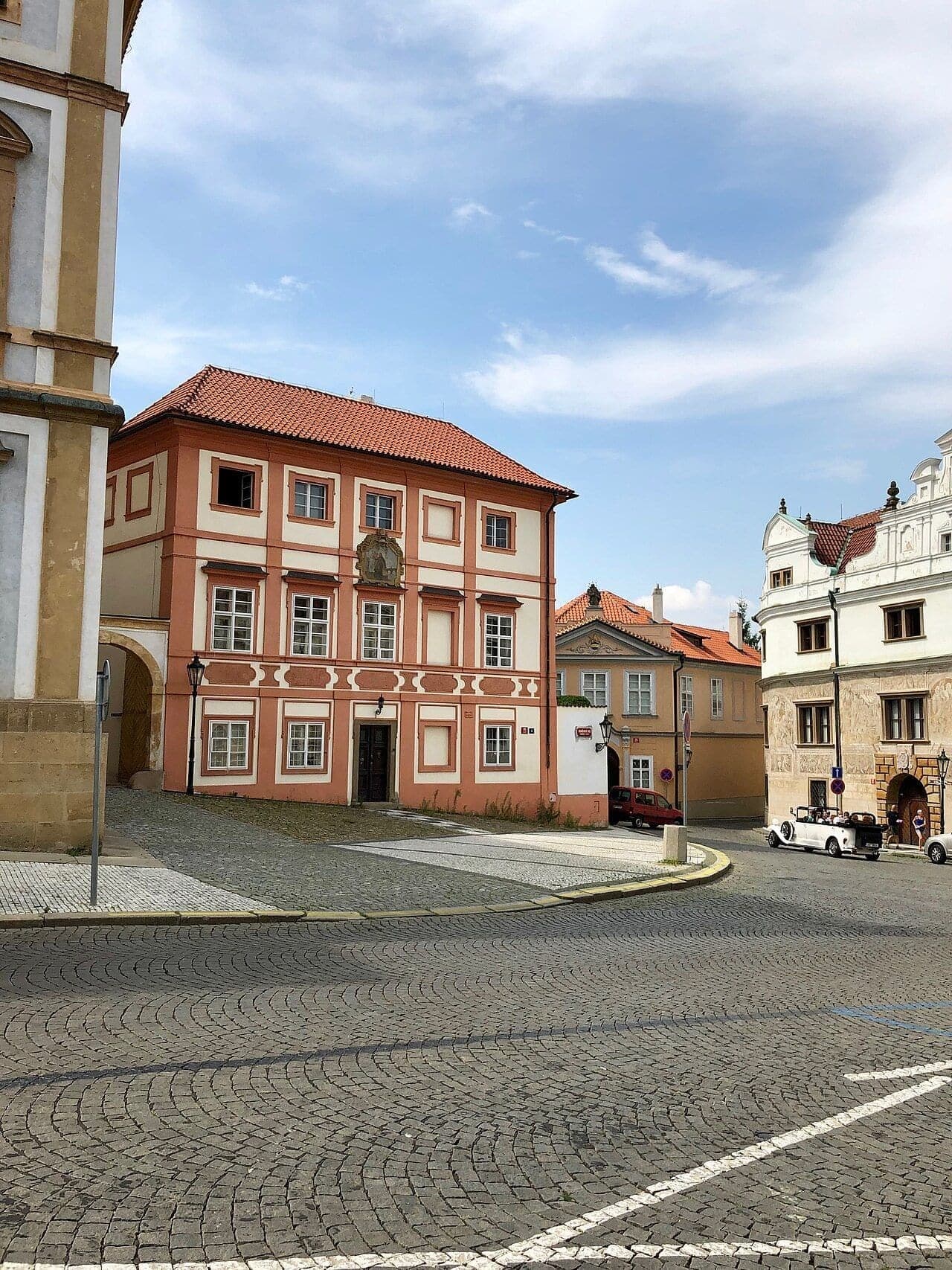
- Praha Hradčany — VitVit, CC BY-SA 4.0 · source
Images may be cropped or resized. Other photos via Unsplash and Pexels.