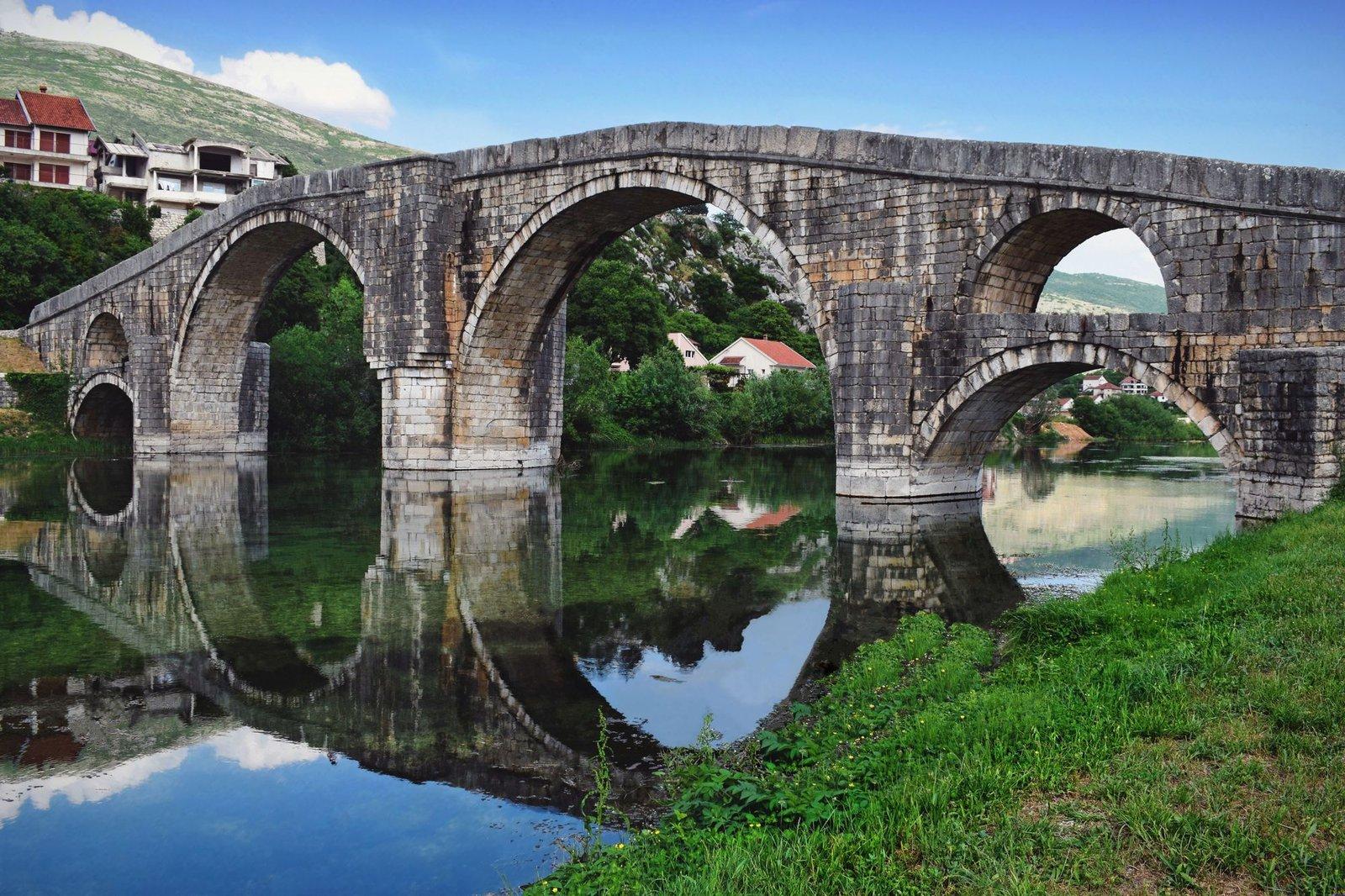
The Arslanagic Bridge is an Ottoman crossing that a hydroelectric reservoir drowned in 1965, and Trebinje chose to number its stones and rebuild it upstream rather than lose it. That decision is why you can walk across it today, about a kilometre and a quarter from the town centre, between the settlements of Gradina and Police. Few old bridges have been in two places. This one has, and the move is part of what it means.
What you are looking at
Stand on the bank before you cross and read the profile. Two great arches carry the span over the Trebisnjica, flanked by two smaller ones, and the smaller arches are opened by a second tier set above them. The Turkish heritage encyclopedia of the TDV gives the bridge a length of about 92 metres, with a largest span of about 18.6 metres. Notice the material too: the arches are built of pale tufa and travertine, with limestone piers standing in the water.
Who built it, and when
Hear a stop from this walk
The Arslanagic Bridge: Moved Stone by Stone
Here the honest answer is that sources differ, and the bridge is more interesting for it. The story the town tells, and the one the regional tourism authority repeats, is that the grand vizier Mehmed Pasha Sokolovic raised it in 1574 in memory of a son killed fighting Venice. The TDV encyclopedia also dates it to 1573 to 1574 and records it as a foundation of Sokollu Mehmed Pasha. Other accounts date it later, to the second half of the seventeenth century, and credit a different builder, named in some references as Hajdar-beg. Take 1574 as the tradition and hold the exact year lightly.
The name is on firmer ground. After the Ottomans were pushed out of Herceg Novi on the coast in 1687, many families moved inland to Trebinje. One of them was Arslan-aga, who received land east of the town and was put in charge of collecting the fee for the crossing. The bridge has carried his name, Arslanagica most, ever since. During the war of the 1990s it was renamed Perovica most, and both names are still heard; the older one has not gone away.
Drowned, then moved
From the 1960s the Trebisnjica was developed for hydroelectric power. The river is a karst river that runs partly underground through the limestone, and taming its floods meant dams and a new reservoir. In 1965 that reservoir rose over the old crossing, and a bridge that had stood for centuries went under the water.
It could have been written off. Instead, in 1966, the heritage institute asked for it to be moved upstream to a new site between Gradina on the right bank and Police on the left. The stones were numbered, the bridge was taken down piece by piece and it was reassembled on higher ground. Sources give different dates for when the rebuilding was finished; the TDV entry places the reconstruction in the early 1970s. Either way, what you walk on is the original stone in a new place. In 2006 the Commission to Preserve National Monuments of Bosnia and Herzegovina declared it a National Monument.
Why it ends the walk
The bridge closes Roamer's walk because it sums up the town. The mosque in the old town was destroyed and rebuilt. The cathedral was repaired. The poet Jovan Ducic was carried home to a hill above town. And this bridge was taken apart to keep it from drowning. Trebinje keeps carrying its layers forward rather than letting them go.
Walk it slowly and look back at the arches from the far bank. The embankment route that leads here has little shade, so bring water in summer.
The bridge is stop 9 of Historic Center: Crossroads of Empires, a self-guided walk from the plane trees of Trg slobode that you can take at your own pace and on your own schedule. Read the tour companion for the whole route, and see all routes on the Trebinje page.
Sources
- Herzegovina Tourism Region, Arslanagic Bridge: the 1574 Sokolovic tradition, Arslan-aga and the crossing fee after 1687, the 1965 reservoir, the 1966 request to move it between Gradina and Police.
- TDV Islam Ansiklopedisi, Arslanaga Koprusu: the 1573 to 1574 dating as a Sokollu Mehmed Pasha foundation, length of about 92 metres, the largest span, the double-tiered smaller arches, the numbered stones and the reconstruction in the early 1970s.
- Arslanagic Bridge, Wikipedia: the later dating, the dating to between 1650 and 1690 and the builder Hajdar-beg, the tufa, travertine and limestone construction, the National Monument decision of 25 January 2006, the wartime renaming to Perovica most.
Ready to experience it?

Historic Center: Crossroads of Empires
85 min · 2.5 km · easy
More from Trebinje
Explore more at your own pace.