The thing nobody tells you about Albanian food, before you go, is that it is extraordinary. Not in the polished, Michelin-starred, needs-a-reservation way. In the grandmothers-perfecting-the-same-recipe-for-sixty-years way. The kind of cuisine where the best meal you eat costs three euros and is served in a paper napkin at a counter that has had a two-item menu since 1957. The food trail walks you through the eating. This is the history that explains why it tastes the way it tastes.
The Ottoman base layer
The single most important fact about Albanian cuisine is that the country was under Ottoman rule for almost five hundred years, from the late 1400s until 1912. Five hundred years is not a flavouring. It is the underlying structure. The pastry techniques, the coffee ritual, the grilled meatballs, the yogurt-and-egg custards, the spirit distillation, the whole vocabulary of Albanian cooking comes from the Ottoman culinary system that extended from Bosnia to Iraq.
Byrek is the clearest example. The layered filo pastry, thin sheets of dough brushed with oil or butter and baked until golden, descends from the Ottoman börek tradition, which spread across the Balkans, the Middle East, and North Africa during the empire. The root word likely comes from Turkish bur-, meaning to twist or wrap. The Greek spanakopita, the Bosnian burek, the Turkish börek, and the Albanian byrek are all the same family of dish, refined differently in each cuisine over centuries of regional cooking. The Albanian version is distinctive in its proportions. The pastry is thinner. The fillings, salty white cheese or wilted spinach, are simpler. The portions are more generous. Every Albanian neighbourhood has a byrektore, the shop that makes byrek, and arguments about which one is best are a national pastime.
Qofte, the charcoal-grilled meatballs that Te Met Kodra has been serving since 1957, come from the same Ottoman lineage. The Turkish kofte, the Persian kufta meaning to pound or grind, the Albanian qofte, are all the same root. The Albanian variant, like the byrek, has been simplified rather than elaborated. Albanian qofte are less spiced than Turkish kofte. The mix is usually beef and lamb, sometimes just beef, with fresh parsley, mint, onion, salt, pepper, and a whisper of cumin. The emphasis is on meat quality and the char from the charcoal, not on complex spice blends. The Albanian philosophy is consistent across the cuisine. If the ingredients are good, do less to them.
Turkish coffee, kafe turke, sits at the centre of Albanian social life and is identical in method to the Ottoman original. Finely ground coffee, cold water, a small copper xhezve, low heat, never stirred, pulled off just before it foams over the rim. Served in a small cup called a fildxhan, with a glass of water alongside, sometimes a piece of Turkish delight. The grounds settle to the bottom. You do not drink the last sip. In the traditional reading, the cup is flipped, the grounds dry, and patterns are read for fortune. Most Albanians no longer believe in the fortune-telling. The ritual of slow coffee has outlasted the belief that produced it. Albania has approximately six hundred and fifty coffeehouses per hundred thousand people, one of the densest cafe scenes in the world. The Ottoman coffee culture is not a relic. It is the active social infrastructure of the country.
Raki, the clear fruit brandy that closes every Albanian meal and every Albanian negotiation, is also Ottoman, though the distillation methods came from the Persian and Anatolian shared inheritance and not from the empire's administrative culture. Albanian raki is made from grapes, plums, mulberries, quinces, walnuts, honey, or herbs, depending on the region and the season. The standard versions run forty to fifty percent alcohol. Homemade versions, which most Albanian families still produce every autumn from their own fruit, climb past sixty. Refusing raki when offered is not exactly rude. It is noticed. Accepting is the first move in a social contract.
What the Mediterranean added
Hear a stop from this walk
Komiteti — Raki, the Albanian Handshake
The Ottoman influence sits on top of an older Mediterranean base. Albania is on the Adriatic. The coast is one of the oldest olive-growing regions in the Mediterranean. Some Albanian olive trees are estimated to be over fifteen hundred years old. The country produces over a hundred thousand tonnes of olives annually. The olive oil is excellent and largely unknown outside the region. The table olives are fat and briny and arrive at every meal.
Peppers are to Albanian cooking what tomatoes are to Italian. Red, green, roasted, pickled, stuffed, dried. The fërgesë e Tiranës, Tirana's signature dish, is built on peppers. Peppers and tomatoes baked with gjizë, a soft Albanian cheese similar to ricotta, until the whole thing bubbles in a clay pot. You dip bread into it. That is the entire technique. The dish belongs to the capital. Other Albanian regions have their own fërgesë, and Albanians debate the differences with the same intensity Italians bring to pizza styles.
The Mediterranean component also brought the herbs. Fresh dill, parsley, mint, and rosemary are the backbone of Albanian cooking, used in quantities that surprise visitors used to the more sparing herb use of northern European cuisines. The mountain version of this is wild greens. Albanian villagers still forage seasonally for nettles, dandelion, sorrel, and wild asparagus, all of which appear in seasonal dishes.
What the mountains contributed
The third source of Albanian cuisine, after the Ottoman vocabulary and the Mediterranean ingredients, is the pastoral tradition of the Albanian mountains. About a third of the country is rugged highland. Sheep and goat herding has been the dominant rural economy for centuries. Lamb is the meat that anchors most of the celebratory dishes. Yogurt and white cheese are produced in volume, partly because they are practical ways to preserve milk in environments without reliable refrigeration.
Tavë kosi, the dish Albanians consider their national treasure, is the clearest mountain dish in the cuisine. Lamb is baked in a clay pot, covered with a thick mixture of yogurt, eggs, and rice or flour, until the top forms a golden crust. The yogurt is the structural ingredient. It tenderises the lamb, holds the moisture, and creates the custard top. The dish is the kind of cooking that emerges when you have lots of yogurt and not much else, and someone in a village discovers that yogurt and eggs can be made into a baked custard that goes on top of meat. It is one of the most generous expressions of pastoral cooking in any cuisine.
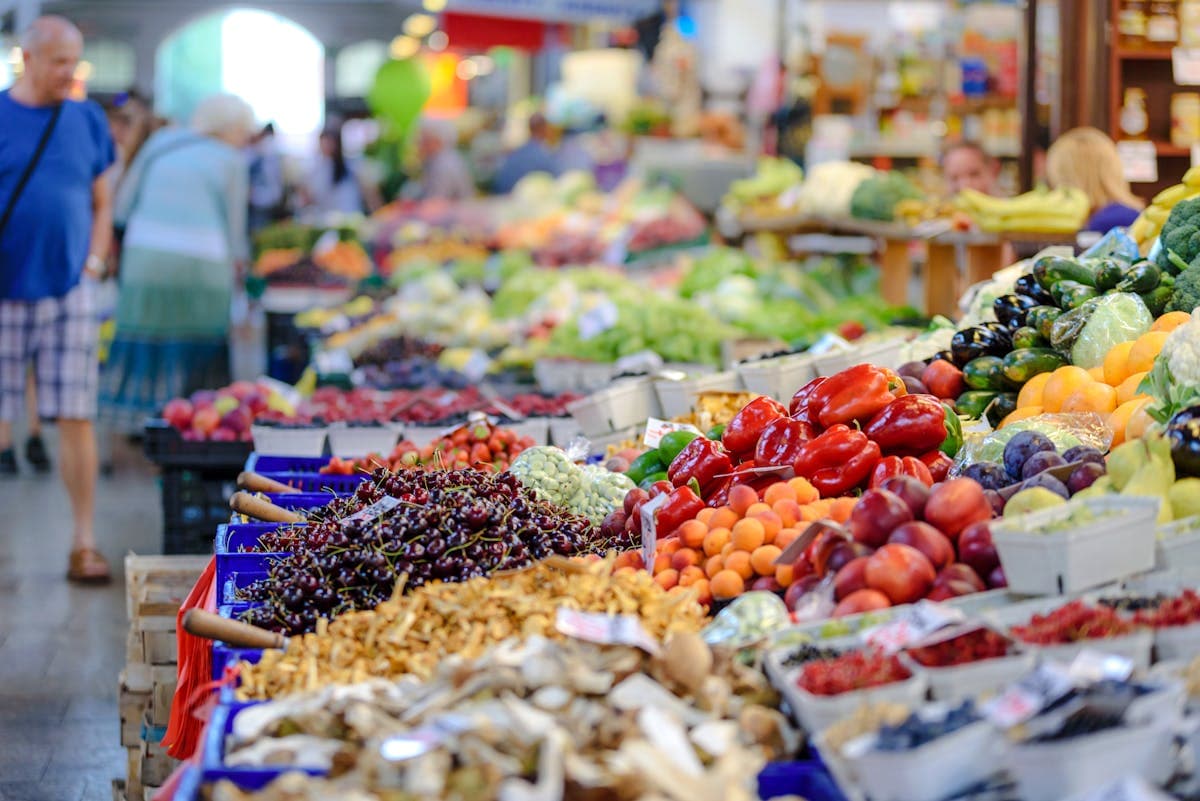
Mountain honey, mountain tea called çaj mali, mountain herbs, and the various raki versions made from mountain fruit, all belong to this strand of the cuisine. The market at Pazari i Ri, the first stop on the food trail, is where these mountain products meet the Mediterranean produce and the Ottoman pastry tradition in one space. The cheeses, the honey, the olives, the herbs, the peppers, the wheels of djath i bardhë, are all on the same tables.
What communism did and did not change
This is the part of the story that surprises people. The Hoxha regime, which transformed almost every other dimension of Albanian life, left the food largely alone. The mechanism is interesting. Albanian food was too humble, too rural, too closely tied to subsistence to attract the regime's attention as a target for ideological transformation. There were no famous restaurants worth nationalising into showpieces. There was no haute cuisine to denounce as bourgeois decadence. The food the country actually ate was peasant food, and peasant food was, in the regime's official ideology, the right kind of food.
What the regime did do was ration meat. The average Albanian family was allocated about three hundred grams of meat per person per week. Private restaurants were abolished and replaced by state-run canteens and cafeterias that served institutional versions of traditional dishes. Imported ingredients were unavailable for forty-six years. No fast food chains. No foreign cookbooks. No outside influence on what Albanians ate or how they cooked it. The borders were sealed.
The unintended consequence was preservation. While the rest of the Balkans was modernising, industrialising, opening to outside influences, accepting tourism, and adopting Western food trends, Albanian grandmothers were cooking exactly what their grandmothers had cooked, because there was no other option. When the borders opened in 1991, Albanian cuisine emerged intact. Other Balkan cuisines had to be reconstructed in the 2000s by chefs going back to old cookbooks and rural villages to recover what had been lost. Albanian cuisine had never lost it. It was sitting in the same kitchens, cooked by the same families, on the same charcoal grills.
Te Met Kodra, the qofte place the tour visits, opened in 1957 in the middle of the regime. The menu has been two items, qofte and bread, for nearly seventy years. When the family is asked why they have not expanded, the reported answer is "Why would we?" The shop survived communism because meatballs and bread were considered appropriately proletarian. It thrived after communism because Albanians had been eating those meatballs for two generations and were not about to stop. The continuity is the product.
How to actually eat in Tirana
The food trail visits seven stops because seven is the manageable number, but the city's food scene is much wider, and a few practical pieces of context help.
Albanians do not eat large formal breakfasts. The morning meal is a byrek and a macchiato, taken standing up at a counter, often before eight. The Italian espresso vocabulary, makiato, kafe, espreso, sits on top of the Ottoman Turkish coffee tradition. Both are alive. Most Albanians drink several coffees a day at several different cafes.
Lunch is the largest meal. It tends to be the moment when families gather and traditional dishes appear. Restaurants like Oda, which serves tavë kosi and fërgesë in a setting modelled on the traditional Albanian sitting room, are at their busiest between one and three in the afternoon. Dinner is later, sometimes after eight, and tends to be lighter, often meze plates of cheese, cured meats, olives, and bread, with raki.
The xhiro, the evening walking promenade, is the social spine of every Albanian town. From around six in the evening, the entire city pours into the streets. People walk in groups, stop at cafes, eat, drink, and talk for hours. The boulevard from Skanderbeg Square to the Pyramid is the main xhiro route in Tirana. The cafes in Blloku fill up. The grills along Pazari i Ri smoke up to the rooftops. If you have not eaten dinner before seven, you will eat it in this rhythm.
Cash is the working assumption at smaller places. Byrek shops, the qofte counters, most stalls in the market, do not take cards. Two thousand lek, around eighteen euros, is enough cash to eat a generous food trail. The sit-down restaurants and the bar at Komiteti at the end take cards.
The other practical piece of context is that the food culture, like the rest of Tirana, is unhurried. Coffee is the form of unhurriedness most visible to outsiders. Sitting with a kafe turke for forty minutes, doing nothing but talking, is not a tourist experience here. It is the standard speed of life. The fact that this speed survived a regime built on paranoia is, in its own way, the most quietly remarkable Albanian achievement of the last century.
Ready to experience it?
Bite by Bite
105 min · 1.1 km · easy
More from Tirana
Explore more at your own pace.
Best Self-Guided Walking Tours in Tirana (2026)
One Day in Tirana: A Walkable Capital Itinerary (2026)
The City That Did Not Forget: How to See Tirana
Tirana Travel Guide: How Many Days, Getting Around, Is It Safe (2026)
What to Eat in Tirana: An Albanian Food Guide (2026)