Behind the Concrete Curtain
75 min · 1.3 km · easy
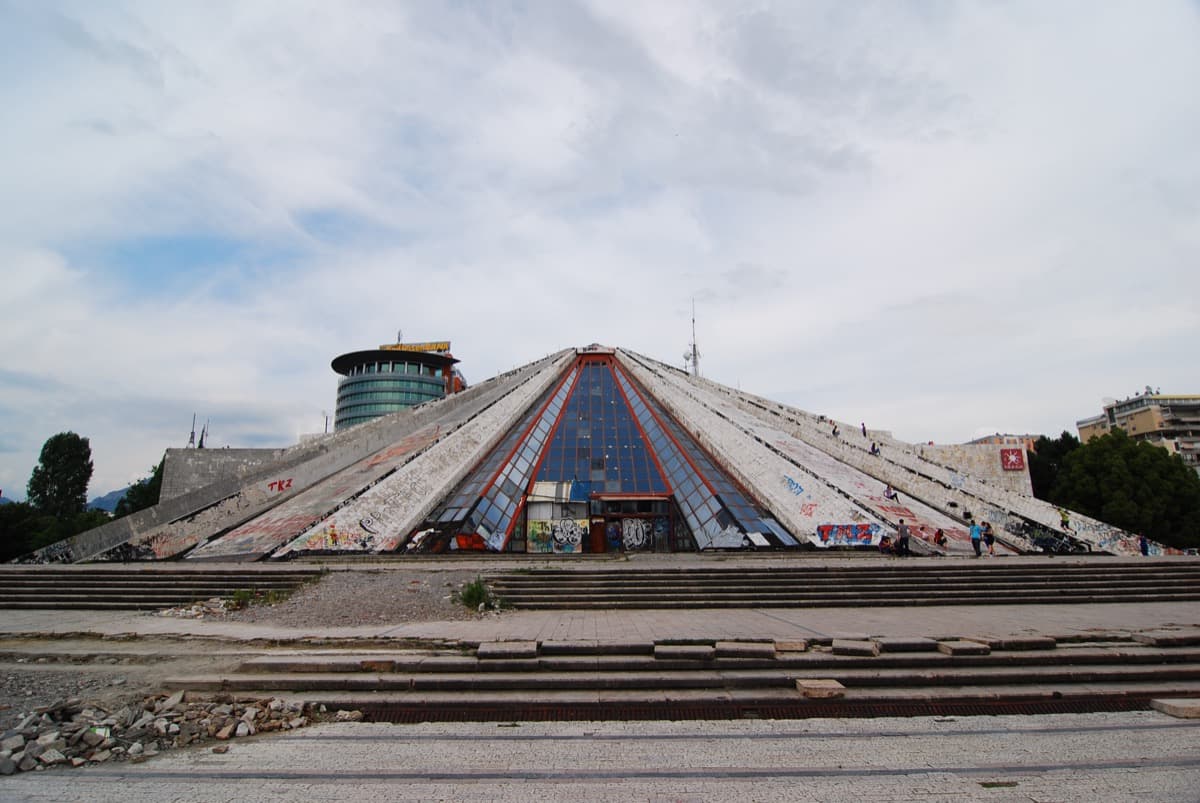
The Pyramid of Tirana sits on Boulevard Dëshmorët e Kombit about halfway between Skanderbeg Square and the University of Tirana. From a distance it looks like a low white triangle, gleaming faintly in the Albanian sun. Up close, since 2023, it looks like a piece of brutalist architecture that has grown sixteen exterior staircases. People are climbing it. Teenagers are coming and going through the entrances. The building has been many things in its thirty-six-year existence, and the staircases are the latest answer to a question nobody could resolve for thirty years. What do you do with a dictator's monument when the dictator is gone?
This is the long story of how the Pyramid got there, and why its current life as a free coding school is the most poetic ending Tirana could have written.
Life one: the daughter's monument, 1988 to 1991
Enver Hoxha died on the eleventh of April, 1985, after forty-one years as the absolute ruler of Albania. He was seventy-six. The Albanian Party of Labour, the communist apparatus he had built, immediately began planning the monument that would carry his memory forward. Hoxha had been the cult of personality at the centre of Albanian life for two generations. His name was on the university. His statue stood in the main square. His writings were taught in schools. The monument had to match the scale.
The commission went to his daughter, Pranvera Hoxha, an architect, and her husband Klement Kolaneci, also an architect. Pranvera was forty-one years old at the time. She had trained as an architect in Tirana and had worked on various state projects in the 1970s and 1980s. Designing the monument to her father was the largest commission of her career and one of the largest architectural commissions in Albanian history. The team included other state architects, but the design is generally credited to Pranvera and Klement as the lead figures.
The building they produced is a sloping pyramidal form, eight sides meeting at a peak, faced in white marble. It was the most expensive structure in Albanian history at the time of construction, in a country where the average monthly salary was about fifteen dollars and where meat was rationed at three hundred grams per person per week. The interior was filled with the dictator's personal effects, his books, his photographs, his decorations, the apparatus of a cult of personality. Schoolchildren were bussed in from across the country. The building opened on October the fourteenth, 1988, three years and six months after Hoxha's death. It was called the Enver Hoxha Museum.
The Party intended the museum to be eternal. It lasted three years.
Life two: the conference centre and nightclub, 1991 to 1999
Hear a stop from this walk
The Pyramid of Tirana
When the regime collapsed in 1991, in the protests that began with the toppling of Hoxha's statue in Skanderbeg Square on February the twentieth and ended with the resignation of the communist government in March, the Hoxha Museum became impossible to run as designed. The monument to a dictator could not function as a state institution when the state had repudiated the dictator. The exhibits were removed. The marble cladding stayed. The building sat empty for several months while the new government tried to decide what to do with it.
The first reuse was as the International Cultural Centre, a conference and exhibition space. The space was vast, the architecture was distinctive, and the central location made it useful for the kind of events that a post-communist capital was suddenly hosting, donor conferences, exhibitions of Western art, meetings with international NGOs. The building took on the function of a generic neutral venue without ever really losing its association with what it had been.
In the mid-1990s, the lower levels were partly converted into a nightclub. This was during the chaotic boom-and-bust years of early post-communist Albania, when the financial pyramid schemes that would collapse in 1997 were inflating, when Albanian club culture was forming, and when the symbolic resonance of dancing inside the dictator's monument was, for the generation that had been teenagers during the regime, irresistible. The club operated for several years.
In 1997, when the pyramid schemes collapsed and Albania experienced months of civil unrest, the Pyramid was looted. Furniture was taken. The marble cladding was stripped in places. Government armouries were emptied during the same months and weapons appeared on the streets in numbers that have shaped Albanian politics ever since. The coincidence of names, the pyramid building and the pyramid schemes, has produced bitter Albanian humour for thirty years. The Pyramid was, briefly, the most visible symbol of Albanian collapse in two registers simultaneously.
Life three: the NATO base and TV studio, 1999 to roughly 2010
When NATO conducted air strikes against Yugoslavia during the Kosovo War in 1999, the Pyramid of Tirana served as a logistics base. NATO needed a large central building with access to communications infrastructure. The Pyramid had both. For several months in 1999, it housed coordination operations for the air campaign and for the humanitarian effort surrounding the refugee crisis. About four hundred and fifty thousand Kosovar Albanians crossed the border into Albania during the war, the largest refugee flow in Europe since the Second World War. The Pyramid was one of the operational hubs.
After the war, the building was used for various broadcast and exhibition purposes. Top Channel, a major Albanian commercial broadcaster, operated television and radio studios in the upper levels for several years. The exterior steadily deteriorated. The white marble continued to be stripped, sometimes by official salvage operations and sometimes by unofficial ones. The glass panels fell out or were broken. Vegetation pushed through cracks in the concrete. The building was becoming a ruin.
Successive Albanian governments debated what to do with it. The arguments were fierce and stayed unresolved. The Berisha government in the 2000s favoured demolishing the Pyramid and building a new parliament building in its place. The proposal was blocked by widespread public opposition, partly aesthetic, partly political. Civil society groups, architects, and many ordinary Tiranians argued that demolishing the Pyramid would be its own kind of erasure, that pretending the dictator had not happened was a worse response than letting his monument stand as evidence. Opinion was sharply divided.
Life four: the playground ruin, roughly 2010 to 2018
For about a decade, the Pyramid was a ruin in the centre of the city, and what happened to it during that decade is the part of the story most outsiders find hardest to believe. Tirana's teenagers began climbing the sloping concrete sides and using them as a giant slide. Not occasionally. Routinely. Every weekend, in good weather, the sides of the Pyramid filled with teenagers sliding down on cardboard, in jeans, on the seats of their pants. The slope was steep enough to make the slide thrilling and shallow enough not to be obviously suicidal. There were no rules. There was no fence. The building was technically property of the state but practically a piece of unsupervised urban infrastructure.
A whole generation of Tiranians grew up associating the Pyramid not with the dictator who had built it as a monument to himself, but with the most exciting unsupervised play opportunity in the centre of the city. The teenagers who slid down it in 2012 are now in their early thirties. They are the generation that is now starting to run businesses, get elected to local councils, and shape Tirana's cultural identity. Their relationship to the building is fundamentally not the relationship the regime intended.
This is the period that the eventual renovation explicitly preserved. The MVRDV design, when it came, did not erase the playground. It formalised it.
Life five: the staircases and the school, 2018 to present
The renovation of the Pyramid was commissioned in 2017 from the Dutch architecture firm MVRDV. The lead designers were Winy Maas and the MVRDV Tirana team, working with Albanian project partners. Construction took place between 2018 and 2023. The official inauguration was on the sixteenth of October, 2023, coinciding with the Western Balkans Summit in Tirana.
The design choices are the most architecturally significant part of the entire Pyramid story, because they refused both of the two intuitive options. Option one would have been demolition. Option two would have been restoration, putting the marble back, treating the building as a heritage object, and figuring out a new programme for the interior. MVRDV did neither. They kept the brutalist concrete shell, every slab, every angle, untouched in its weathered post-communist condition. They added sixteen exterior staircases cascading down the sloping sides. They added a western-side lift for accessibility. They left one section of slope deliberately smooth so people could still slide down it. They incorporated the original stone facade tiles into the new staircases, so anyone climbing the building is walking on pieces of the dictator's monument. They filled the interior with colourful modular classroom blocks that pop against the raw concrete.
The interior is now TUMO Tirana, a free after-school programme for ages twelve to eighteen. TUMO is an educational franchise originally developed in Armenia and now operating in cities across the world. Students choose between fourteen learning areas including programming, robotics, animation, music, film, graphic design, and 3D modelling. The programmes are designed by international experts. Attendance is free. Over seven hundred Tirana teenagers attend regularly. The student body is sourced from across the city, including from neighbourhoods that have historically been excluded from elite educational pathways.
The MVRDV design won the 2024 BIG SEE Grand Prix and has been featured in architecture publications worldwide as an exemplar of adaptive reuse. The most cited element of the design is the decision to preserve the smooth sliding section. It captures, in a single architectural gesture, the philosophy that runs through the whole project. The Pyramid was a dictator's monument. It was also, for a decade, a teenagers' slide. The renovation honours both, not because both are equally important, but because the building's history includes both and the design refuses to pretend otherwise.
What you actually see today
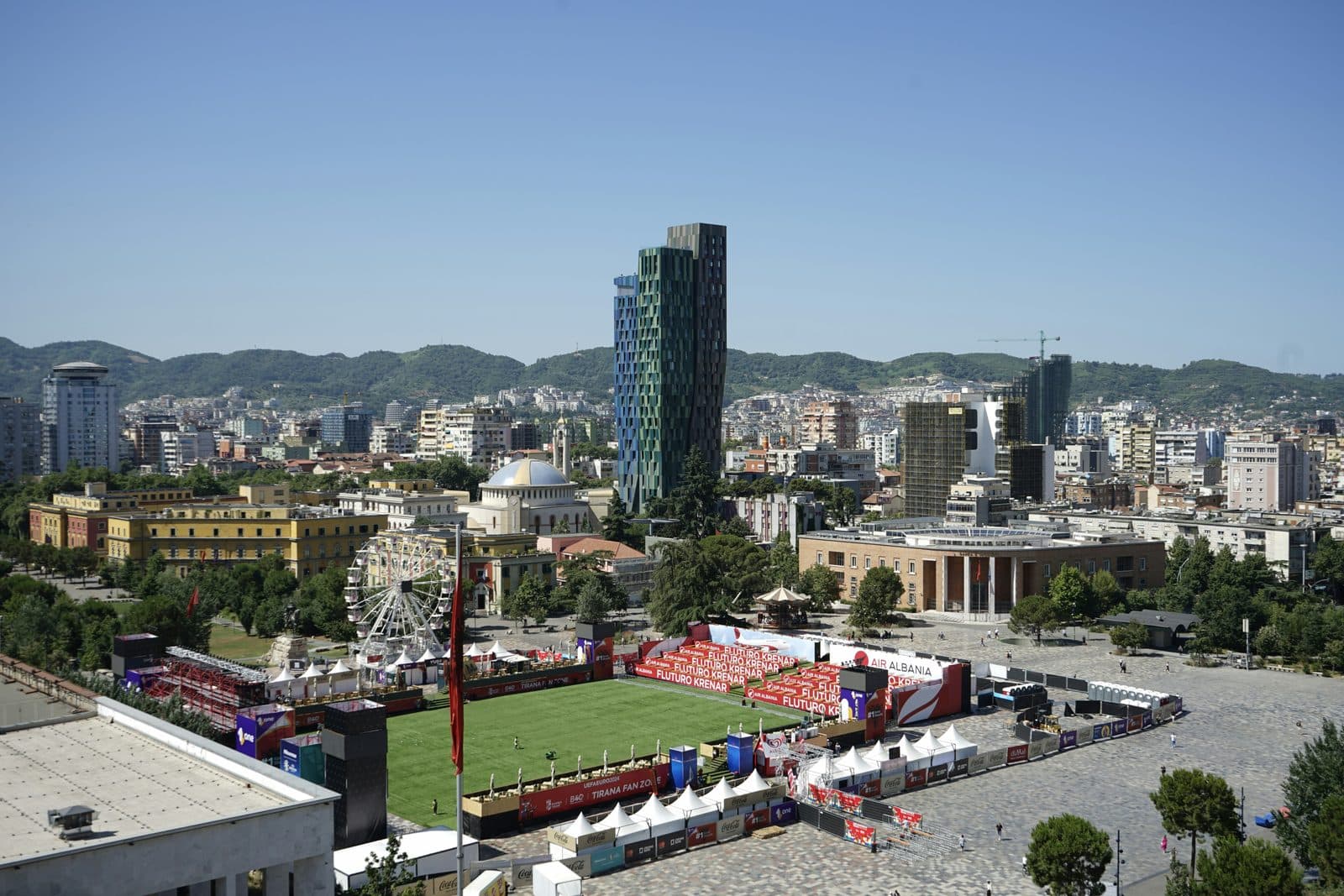
When you climb the Pyramid now, you climb on staircases made partly from the original marble. From the top, you can see the boulevard Mussolini's architects built in 1941, the square paved with stones from every Albanian region, the painted apartment blocks Edi Rama started repainting in 2003, the New Bazaar, the National History Museum with its Socialist Realist mosaic still on the facade, the green flank of Mount Dajti to the east. You can see every era of Tirana from the roof of the building that was meant to be the regime's final word.
Inside, you can walk past classrooms where students are working on animation software, learning to code in Python, designing video games. The teenagers are largely uninterested in the building's history. They are there for the programmes. The casual relationship to the architecture is, in its own way, the most successful possible outcome. The dictator wanted his monument to be eternal. The actual eternity it has achieved is being a building that current Albanian teenagers think of as their coding school. The man is forgotten in the way the regime feared most. He is irrelevant.
This is what the Pyramid means now. It is the most concentrated single instance of Tirana's broader strategy of repurposing rather than erasing. The forty-seven years of communism are not pretended away. The thirty years of post-communist drift are not pretended away. The decade of being a teenagers' slide is not pretended away. The current life as a school sits on top of all the previous lives without trying to claim it has resolved them. The slope you climb is the same slope the slide was. The dictator's daughter designed the original. A Dutch firm finished the present. Both architects are part of the story the building tells.
You can go inside if you have time. The view from the top is worth the ten-minute climb. The most important thing to notice is how unremarkable the teenagers find it. The Pyramid is just their school. That is the ending the city wrote, and it is the only ending that was ever going to be enough.
Ready to experience it?
Behind the Concrete Curtain
75 min · 1.3 km · easy
More from Tirana
Explore more at your own pace.
Best Self-Guided Walking Tours in Tirana (2026)
One Day in Tirana: A Walkable Capital Itinerary (2026)
The City That Did Not Forget: How to See Tirana
Tirana Travel Guide: How Many Days, Getting Around, Is It Safe (2026)
What to Eat in Tirana: An Albanian Food Guide (2026)