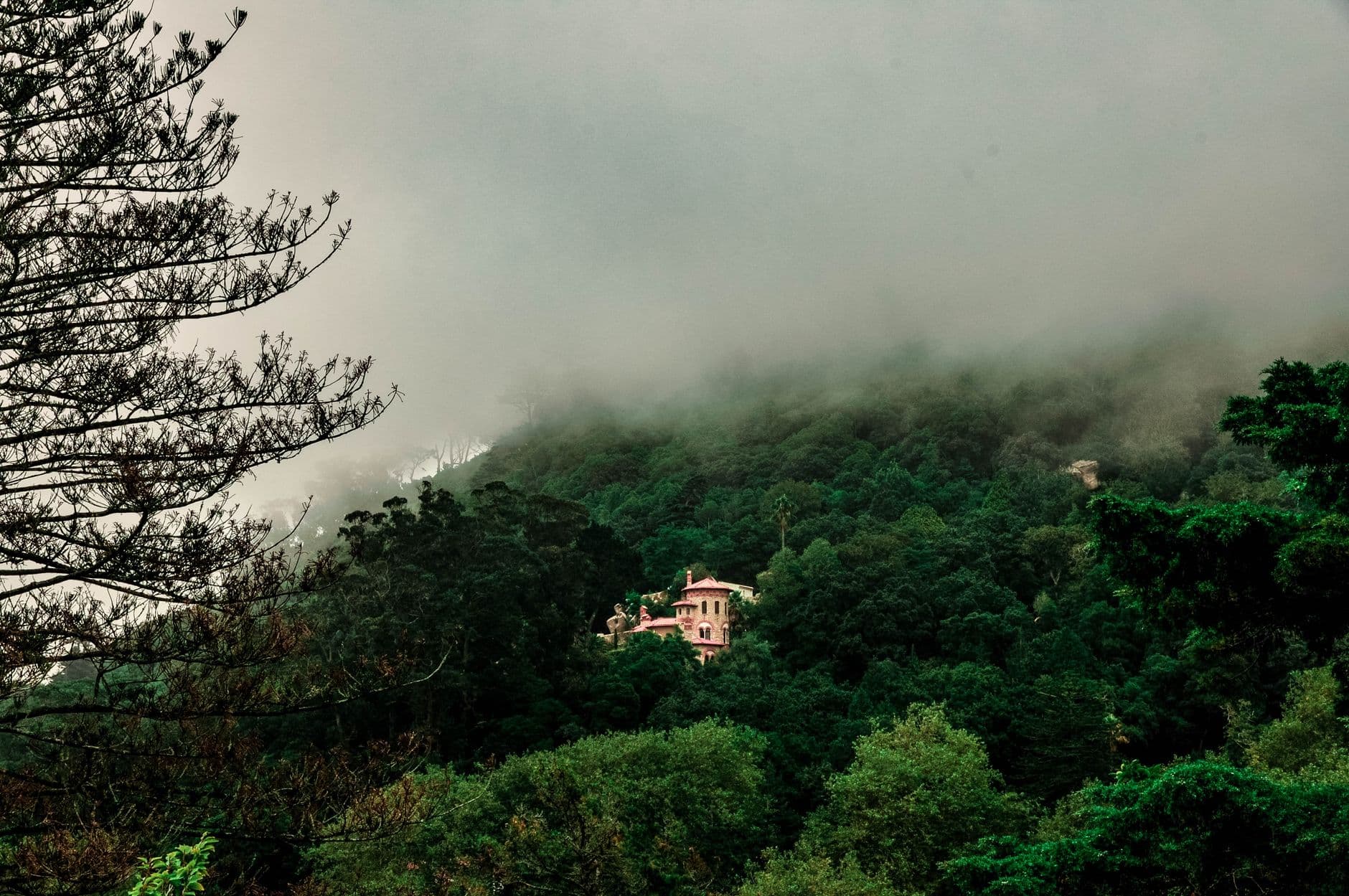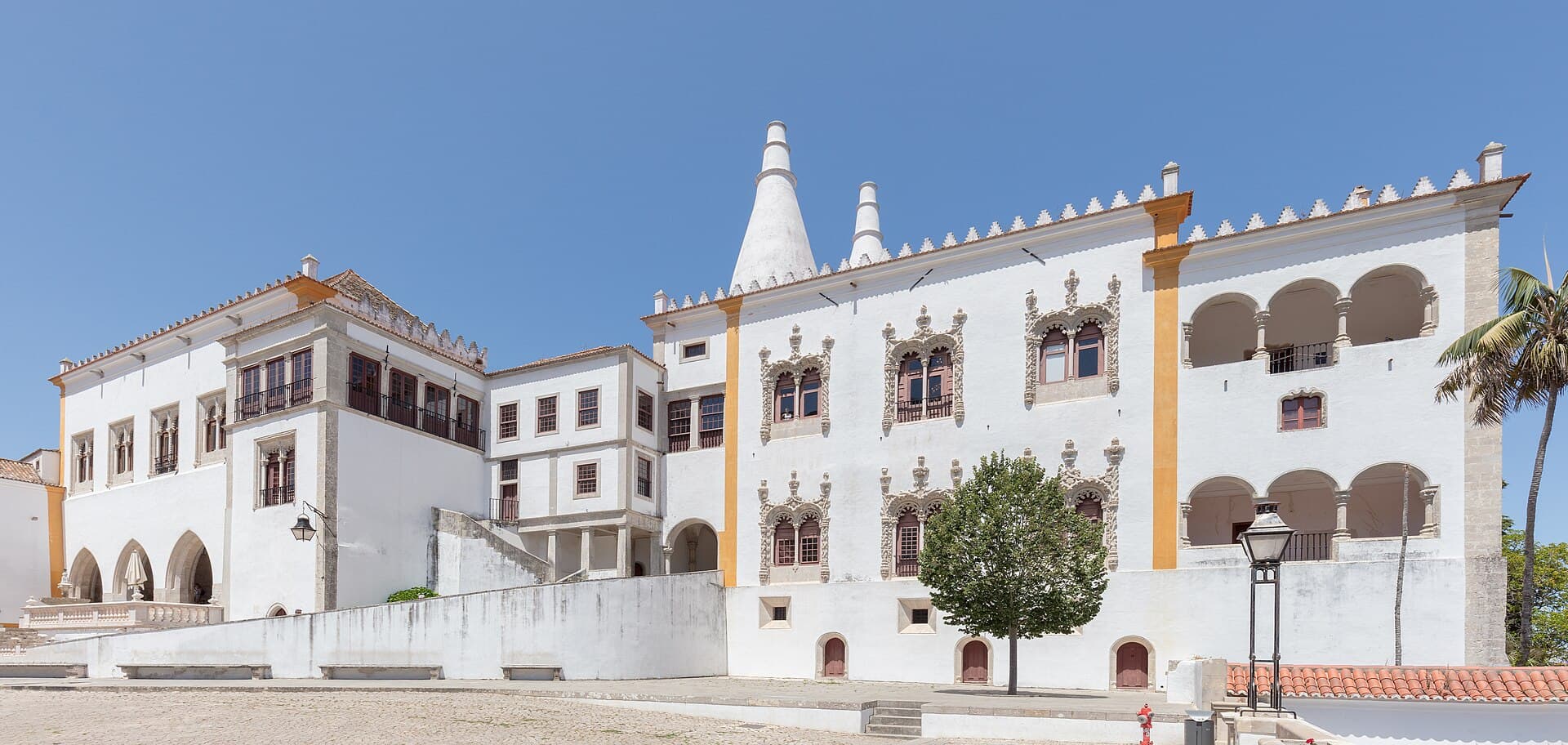
Portuguese kings held court inside one building at the foot of the Sintra mountain for nearly five hundred years, and that single fact explains why the old royal town exists at all. The Palacio Nacional de Sintra, the town palace, was a working royal summer residence lived in more or less continuously from at least the early fifteenth century to the late nineteenth. Before anyone raised the fantasy palaces on the ridge that made Sintra famous, the monarchy came down here for one plain, physical reason: up on the Lisbon plain the summers were brutal, and here on the mountain the air stayed cool and damp and the springs ran clear. Stand in the square in front of the palace and you are looking at the origin of the whole place. That is the argument this walk makes, and the palace is the way into it.
The palace is the town, and the town is the point
Most visitors go straight up the hill to Pena and Regaleira and never read the older Sintra underneath the crush. The old-town walk does the opposite. It stays in the vila, the historic quarter at the mountain's foot, and treats the National Palace not as a ticketed attraction but as the anchor of an entire settlement. The building is the best-preserved medieval royal residence in Portugal, and its long, unbroken royal use is exactly what makes it exceptional. Most medieval palaces in Europe were rebuilt, abandoned, or lost. This one accumulated its styles in place, across centuries, while the court kept returning.
The dates give the story its spine. Afonso Henriques, the first king of Portugal, took Sintra from Moorish rule in the twelfth century, with local sources dating the Christian conquest to 1147. The palace you see took shape later. Around 1415, King Joao the First launched the main building campaign, raising the front facade, the central courtyard, the great kitchens, and two of the finest rooms, the Swan Room and the Magpie Room. His grandson Afonso the Fifth was born inside these walls in 1432 and died in Sintra in 1481. John the Second was acclaimed king in this palace. Then, around the turn of the sixteenth century, Manuel the First sponsored a fresh wave of work, including the Coats of Arms Room, built between 1515 and 1518, with seventy-two heraldic shields set across its ceiling. What layers up across those centuries is a single building holding Gothic, Manueline, Moorish, and Mudejar work at once. The palace is part of the Cultural Landscape of Sintra, inscribed by UNESCO as World Heritage in 1995.
You can read all of that from the outside, free. The interior is a paid visit and worth it if you have time, but the walk deliberately works from the square, so you can tour first and decide on tickets after.
What the chimneys tell you
Hear a stop from this walk
Palacio Nacional de Sintra: The Town Palace of Kings
Look up from the palace and two enormous white cones rise over the roofline. They are the emblem of Sintra, printed into the town's own logo, and the pleasure of them is that they are not decoration. They are chimneys, working fifteenth-century chimneys that stand in place of a ceiling directly over two great royal kitchens built in Joao the First's campaign. When a court came up the mountain for the summer it did not come light: it could number in the hundreds, and all of them had to be fed. Whole game was roasted on open spits, which meant smoke, a great deal of it, and these towering cones vented the heat and smoke high above the town. You will see them cited at about thirty-three metres, though that figure comes from heritage and visitor sources rather than a confirmed measurement, so hold it loosely. What is certain is that when the great earthquake struck on the first of November, 1755, and shook this whole region, the chimneys stood. They are still crowning the kitchens they were built to serve.
That practicality is the walk's through-line. Everything here served a court that came for the climate, not the view.
Reading the vila from the square
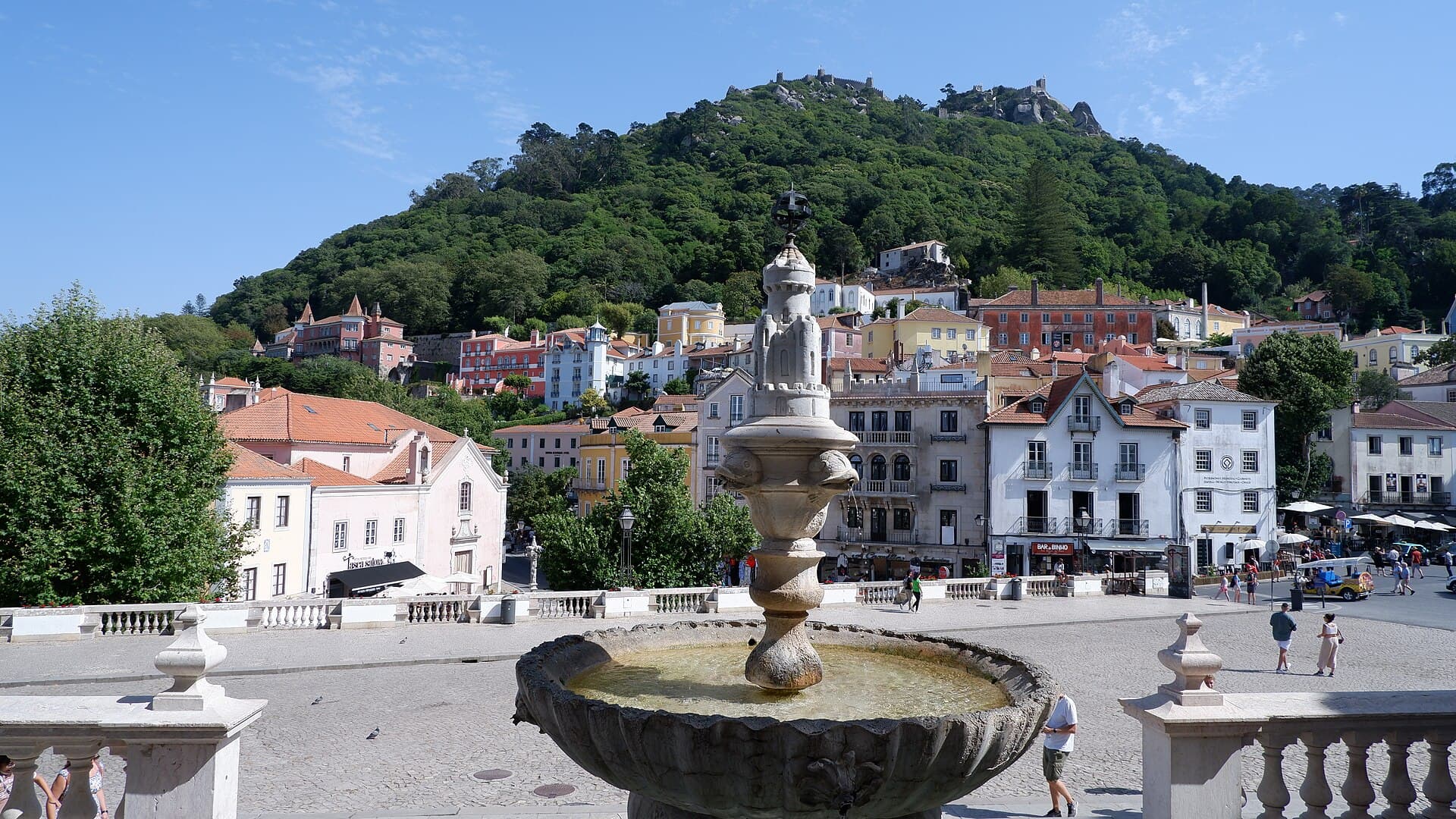
From the palace the tour opens into the Largo Rainha Dona Amelia, the central square of the old town, named for Amelia of Orleans, the last queen consort Portugal ever had before the monarchy fell in 1910. This is the arrival point, about ten to fifteen minutes on foot up from the train station, and it is where the whole logic of the place sits in one view: the palace on one side, the parish church just off the square, a clock tower, and the narrow old lanes radiating out, lined with pastry houses and shops. It is not a grand planned plaza. It is the organic centre of a town that grew from a Moorish village into a royal retreat, and its irregular, climbing shape says exactly that. Beside the square stands the Pelourinho, the pillory on three steps, a marker of civic justice, though the one here is a 1940 replica by Jose da Fonseca, a name worth holding onto because his work appears again at one of the fountains.
The sweets and the springs
Two more stops turn the origin story edible and drinkable. Sintra tastes of the queijada, a small cheese tart of requeijao blended with eggs, sugar, flour, and cinnamon, and the travesseiro, a puff-pastry pillow folded around almond and egg cream. The queijada's traditional thirteenth-century origin is a lovely story rather than documented fact, but the record shows something better: queijadas were once used to pay foros, the feudal rents owed to landholders, so the tart was practically currency. Commercial production is documented from 1756 under a baker named Maria da Sapa. The travesseiro is younger, generally placed in the twentieth century.
Then the fountains, which are the spine of the whole argument running literally with water. The Fonte Mourisca, on the Volta do Duche, wears a Moorish-revival face of horseshoe arch and neo-Mudejar tile, but its honest date is 1922, again the work of Jose da Fonseca, dismantled in 1960 when the road was widened and re-erected in its present spot about twenty years later. The water is the point. Sintra's springs rise from the granite of the Serra de Sintra, which catches Atlantic rain and mist and holds it. That cool, well-watered climate is the documented reason the kings summered here. The walk closes at the Igreja de Sao Martinho, the parish church whose roots run into the Middle Ages, which held formal parish status by 1283 and was largely destroyed by the 1755 earthquake, then rebuilt in the sober Pombaline style to designs by Mateus Vicente de Oliveira.
If you want the full route stop by stop, start from the anchor palace and read outward. Browse the Sintra walking tours or plan the day around Sintra itself. Go slow. The town rewards it, which is why the kings kept coming back.
Sources
- Sintra National Palace, Wikipedia: royal building campaigns, regnal dates, and the four-style blend cited throughout.
- Parques de Sintra, National Palace of Sintra (official): the palace's continuous royal use, kitchens, and the Coats of Arms Room.
- Comercio com Historia (Portuguese government heritage registry), Queijadas da Sapa: the 1756 commercial production date under Maria da Sapa.
- Visit Sintra (official tourism), Travesseiros and Fonte Mourisca: the pastry's twentieth-century origin and the fountain's 1922 Moorish-revival design and relocation.
- Paisagem Cultural Sintra (municipal heritage), Igreja Paroquial de Sao Martinho: parish status by 1283 and the Pombaline rebuilding after 1755.
Ready to experience it?
Sintra Old Town: The Cool Mountain of Kings
80 min · 1.1 km · easy
More from Sintra
Explore more at your own pace.
One Day in Sintra: A Walkable Itinerary From Morning to Evening
Sintra Travel Guide: Days, Transport, Tickets, and Timing
Sintra: The Fantasy Mountain That Was Built on Purpose
The Moorish Castle Above Sintra Is Real, and It Was Composed on Purpose
Quinta da Regaleira: The Garden Built to Be Read