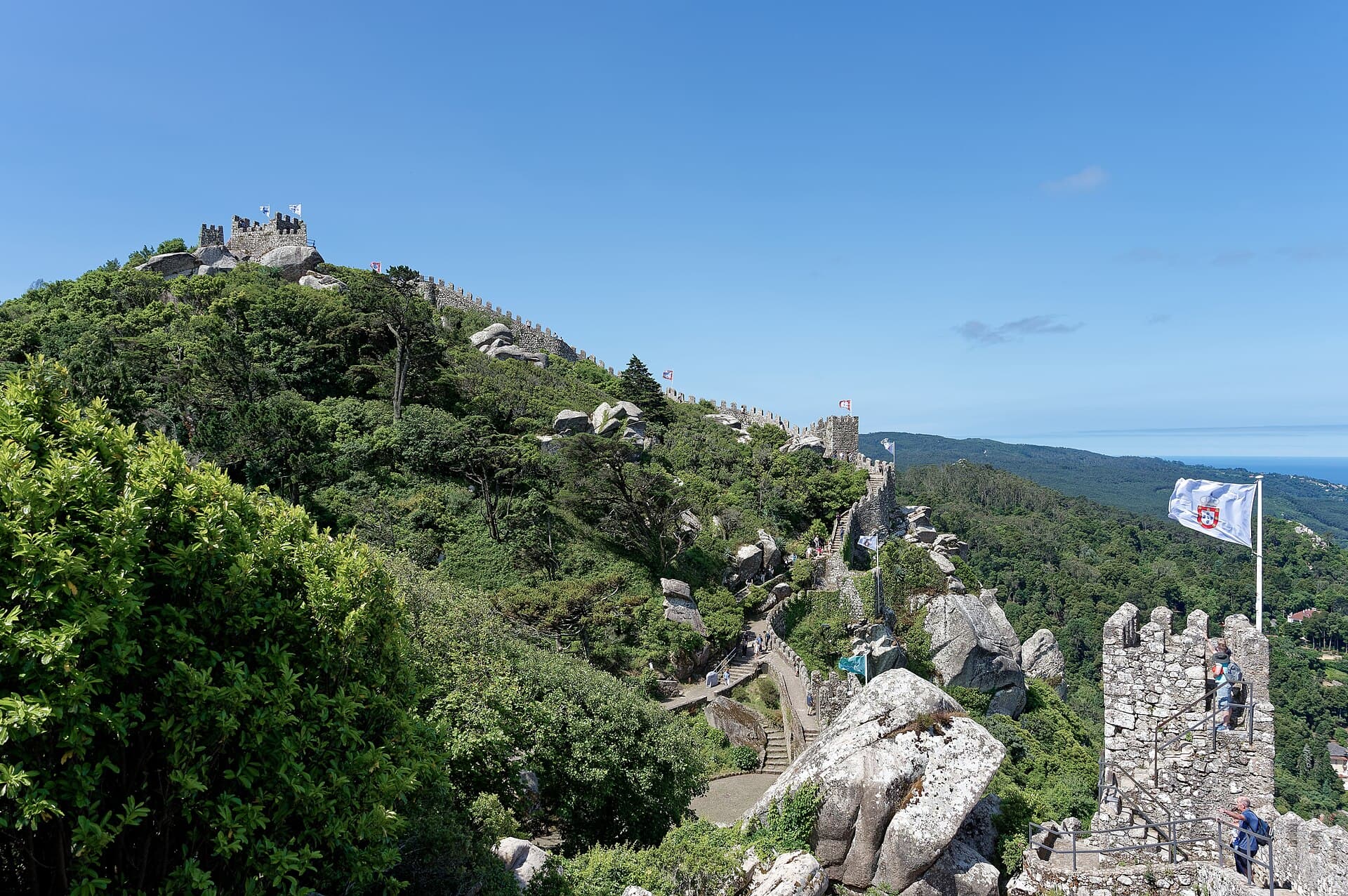
The Castle of the Moors is the oldest structure on the Serra de Sintra, and it is also the clearest evidence that this mountain was authored. The Moors built the fortress here in the eighth and ninth centuries as a working watchpost over the farmland below. Yet the serpentine walls you climb today, the reforested slopes around them, and the carefully placed overlooks that make you stop and gasp were all engineered in the eighteen hundreds by King Ferdinand the Second, who restored a genuine ruin not to defend anything but to make it beautiful. Read the castle correctly and you have the key to the entire Pena mountain walk: everything that looks ancient here was, in large part, composed.
Why the Castle Is the Right Way In
Most people climb this mountain for the painted domes of Pena Palace, and the palace deserves the attention. But the Castelo dos Mouros is the more instructive stop for anyone trying to understand what they are actually looking at. It is the one place on the ridge that predates the Romantic era by roughly a thousand years. Its history is documented and hard: together with Santarem it was a key point in the Muslim military plan for the central province, and in the year eleven forty-seven, after the great siege of Lisbon under Afonso Henriques, the castle surrendered to Christian forces. A Jewish community lived inside the walls afterward, until the expulsions under Manuel the First, and then the site was abandoned. The seventeen fifty-five earthquake cracked its chapel and loosened its stones.
That is a real medieval fortress with a real timeline. So when the same nineteenth-century design logic reaches even this building, the point lands with full force. From eighteen thirty-eight onward, Ferdinand the Second acquired the ruin and had it restored. His engineer, the German mining specialist Wilhelm Ludwig von Eschwege, consolidated the crumbling walls, reforested the slopes, and cut small nooks and overlooks into the circuit so that a walker rounding a corner would meet a framed view of the valley. The old castle was itself turned into a viewpoint. The medieval stone is authentic. The experience of walking it is a nineteenth-century construction.
The Engineering Reading
Hear a stop from this walk
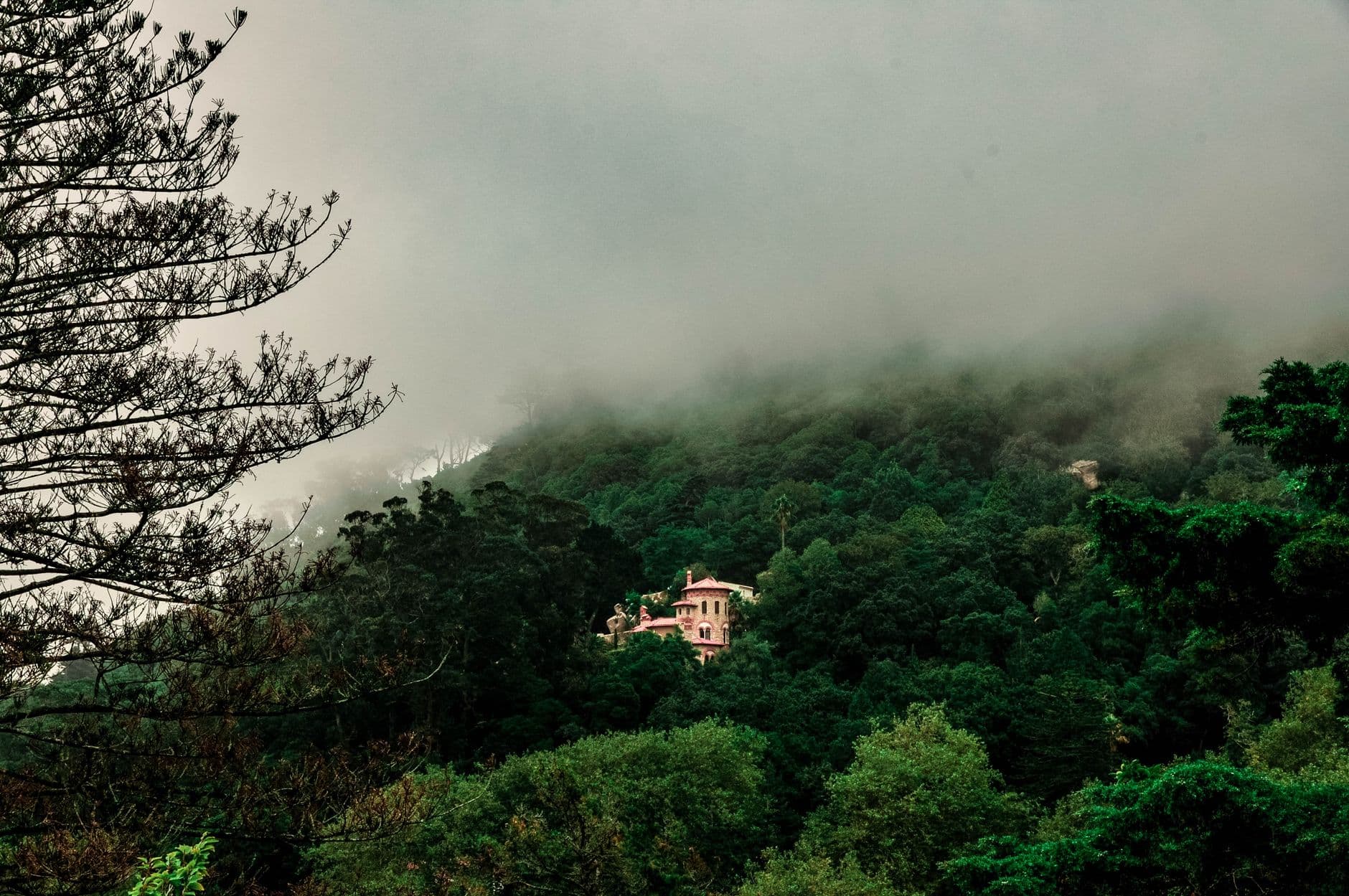
Serra de Sintra: The Mountain of the Moon
Think of it as adaptive reuse before the term existed. Eschwege was not rebuilding a defensive system. He was stabilizing a picturesque object and tuning its sightlines. Consolidating loose masonry along a ridge, replanting bare granite slopes to soften the silhouette, and siting overlooks to capture specific panoramas are all deliberate design moves. The romance a modern visitor feels on those walls is not a leftover of the Middle Ages. It is the output of a restoration brief written in the eighteen thirties.
This matters because it changes how you should look at the rest of the mountain. Once you accept that the oldest thing here was curated, the newer things stop pretending. You can walk Sintra and its mountain with clear eyes instead of vague enchantment.
The Same Hand, Six Times Over
The full route has six stops across roughly five and a half kilometres, and it climbs steeply, so plan for two and a half to three hours, more if you go inside the monuments. Every stop repeats the castle's lesson in a different material.
The mountain itself, the Serra de Sintra, rises to about five hundred and twenty-nine metres and runs some sixteen kilometres out to Cabo da Roca, where Europe ends at the Atlantic. The ancients called it Lunae Mons, the Mountain of the Moon. In nineteen ninety-five UNESCO inscribed the Cultural Landscape of Sintra, and it was the first site in Europe ever listed as a cultural landscape, a place shaped by human imagination rather than nature alone. UNESCO's own citation names this the first centre of European Romantic architecture.
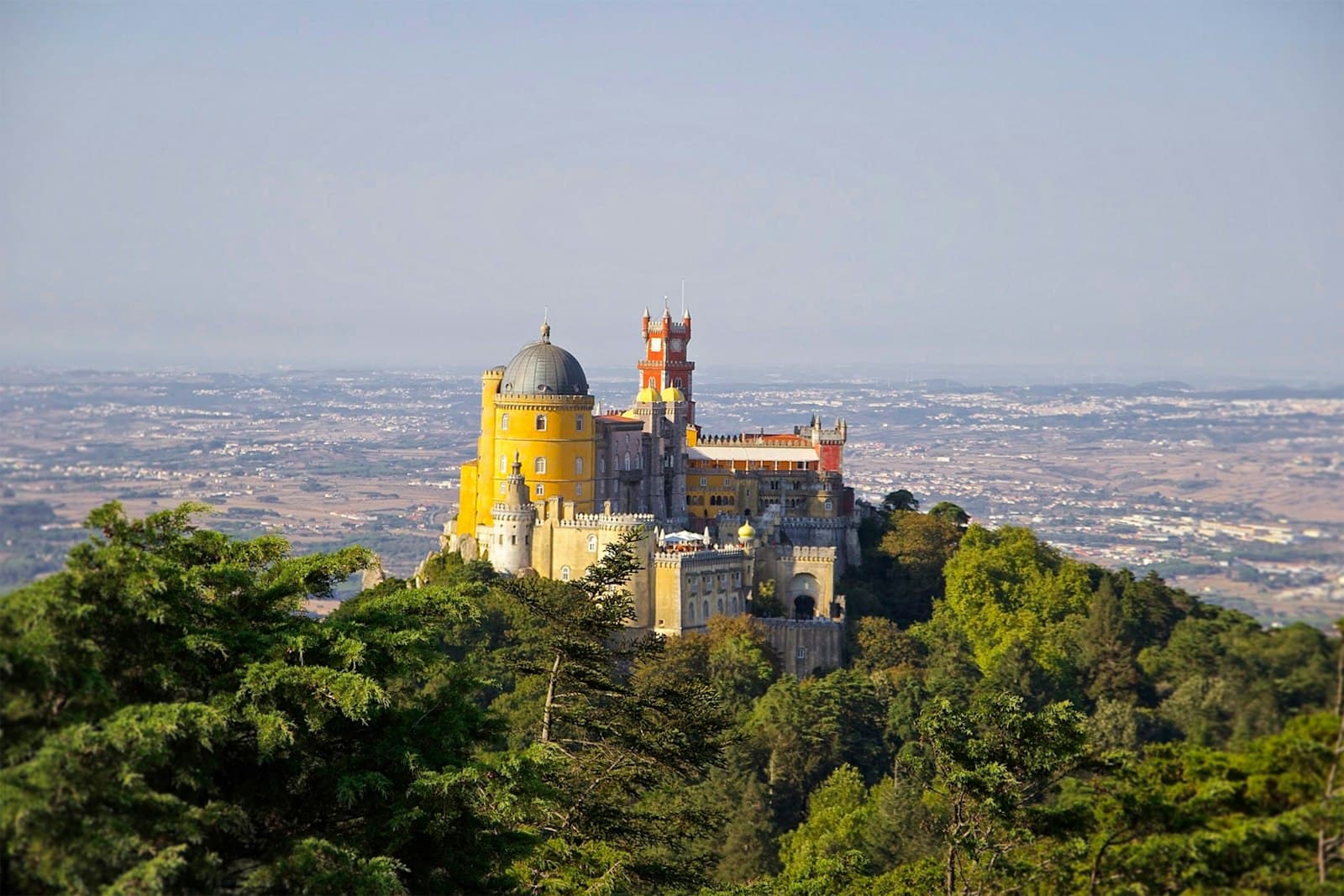
Pena Palace is the masterpiece of that authorship. It grew not from a medieval fortress but from a Hieronymite monastery founded in fifteen eleven under Manuel the First, ruined by lightning and the seventeen fifty-five earthquake, and left empty after eighteen thirty-four. Ferdinand bought the ruin in eighteen thirty-eight, hired the same Eschwege, and built the palace between eighteen forty-two and eighteen fifty-four. Its official description calls it an intentional mixture of Neo-Gothic, Neo-Manueline, Neo-Islamic, and Neo-Renaissance styles. Nothing here is accidental medievalism. It is counted among the Seven Wonders of Portugal.
The Parque da Pena extends the trick into the forest. Across roughly eighty-five hectares Ferdinand planted what Parques de Sintra calls the most important arboretum in Portugal, gathering species from every continent: Californian sequoias, Asian ginkgos, southern tree ferns, and great camellia collections introduced from Asia in the eighteen forties. What reads as primeval woodland is a garden arranged tree by tree to look as though no one arranged it.
The Chalet da Condessa d'Edla brings the same instinct down to human scale. Ferdinand built it with the opera singer Elise Hensler, born in Switzerland in eighteen thirty-six and long resident in Boston, between eighteen sixty-four and eighteen sixty-nine. Much of the chalet's timber cladding is flat plaster painted to imitate wood, trimmed with intricate Portuguese cork. It burned in nineteen ninety-nine and reopened to the public in twenty eleven.
Finally, Cruz Alta, the High Cross, marks the summit at five hundred and twenty-nine metres, where the whole authored landscape resolves into one view toward Lisbon, the River Tagus, and the Atlantic. Even the marker is remade: a cross first stood here around fifteen twenty-two under Joao the Third, Ferdinand later replaced it, lightning felled that one in nineteen ninety-seven, and the current cross was carved from a single block of limestone in two thousand and eight.
Walk It in the Right Order
The tour is built so the argument accumulates. You feel the mountain's microclimate, then meet the genuinely old castle, then watch the invented palace, the planted forest, and the intimate chalet each replay the castle's logic, until the summit shows you the finished composition with the real sea behind it. Buy timed tickets to Pena and the Castle of the Moors in advance, wear closed shoes with grip for the wet cobblestones, and pack a light waterproof layer, because the mountain makes its own weather.
If you want the full set of routes up this ridge, including the esoteric Regaleira walk and the royal old town, start with the Sintra walking tours overview and choose your climb.
Sources
- Castle of the Moors, Wikipedia: construction in the eighth and ninth centuries, the eleven forty-seven surrender, and Ferdinand the Second's restoration.
- Moorish Castle, Visit Sintra (Parques de Sintra): official history of the fortress and its nineteenth-century curation.
- Pena Palace, Wikipedia: the monastery origin, Eschwege's involvement, and the eclectic Romantic design.
- Cultural Landscape of Sintra, UNESCO World Heritage Centre: the nineteen ninety-five inscription and the first-centre-of-Romantic-architecture citation.
- Park and National Palace of Pena, Parques de Sintra: the arboretum, camellias, and the Chalet of the Countess of Edla.
Ready to experience it?
Pena Palace: The Fairy Tale Built on Purpose
150 min · 5.6 km · challenging
More from Sintra
Explore more at your own pace.
One Day in Sintra: A Walkable Itinerary From Morning to Evening
Sintra Travel Guide: Days, Transport, Tickets, and Timing
Sintra: The Fantasy Mountain That Was Built on Purpose
Sintra National Palace: The Royal Town Beneath the Famous Peaks
Quinta da Regaleira: The Garden Built to Be Read