San Miguel de Allende is not a Mexican town with American visitors. It is the only colonial Mexican town whose modern shape was set, deliberately and on the record, by an American art school operating on United States veterans' education benefits. The contradictions of that origin still run every conversation about the city today, between the people who own the cafes and the people who pour the coffee, between the silver families and the silver shoppers, between the muralists and the gallery owners who sell their work to people whose Spanish is purely transactional.
The story is almost too neat. In 1937 a young American named Stirling Dickinson stepped off the train from Mexico City, walked into the central plaza, looked up at the pink towers of the Parroquia, and decided to stay. He had means but not a fortune. What he had above all was time, and the conviction that a beautiful place lightly populated by serious people was the right place to be.
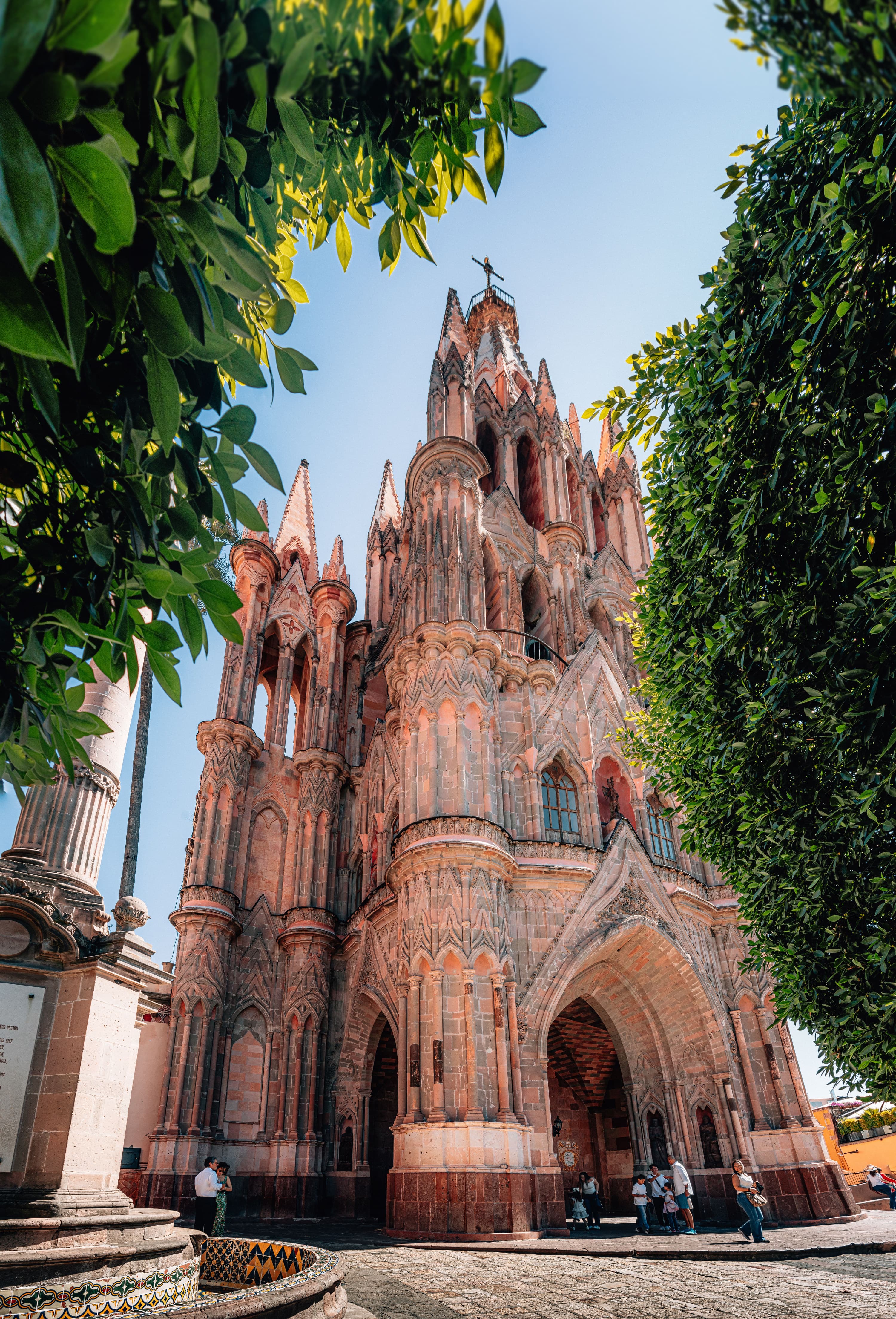
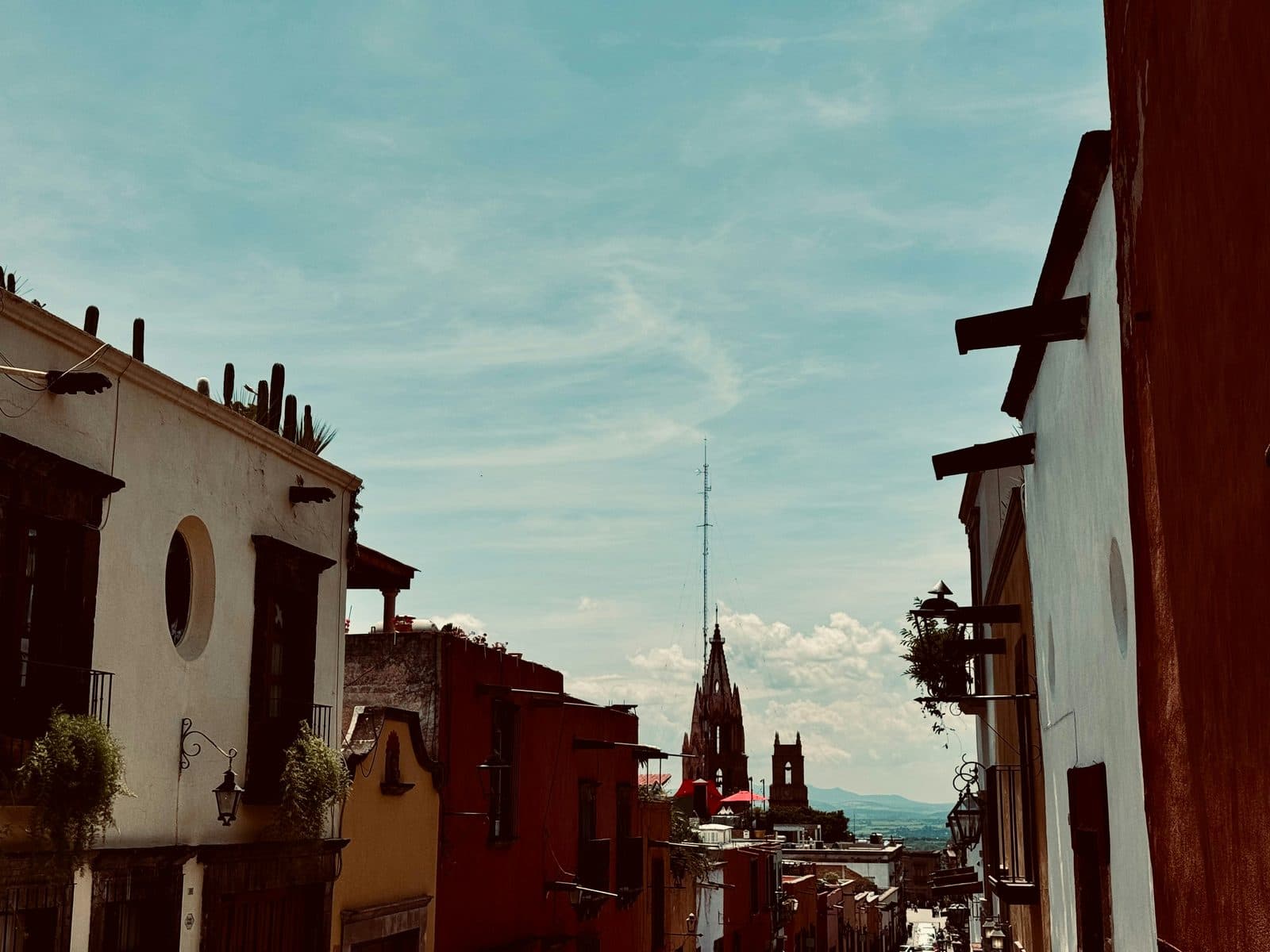
San Miguel in 1937 was a town of about ten thousand. The silver veins that had funded its baroque churches in the 1700s were exhausted. The Mexican Revolution had emptied out the haciendas. The railroad bypassed it. Houses were available for almost nothing. Some had no roofs. The Parroquia stood pink and impossible in the middle of a town that had been quietly going extinct for a hundred years.
In 1938 an art school, the Escuela Universitaria de Bellas Artes, opened in a former convent, co-founded by the Peruvian painter Felipe Cossío del Pomar and Dickinson.
The 1946 hinge
Most of what makes modern San Miguel an outlier comes down to one decision made in Washington in the late 1940s. The Servicemen's Readjustment Act of 1944, the GI Bill, paid for veterans to attend approved educational institutions. The eligibility list initially covered only schools in the United States. After 1945, US veterans came to San Miguel to study art on it. A young American veteran could enroll in painting in San Miguel, pay roughly nothing in rent, eat well, drink well, and have his tuition paid by the same government that had recently shipped him to the Pacific.
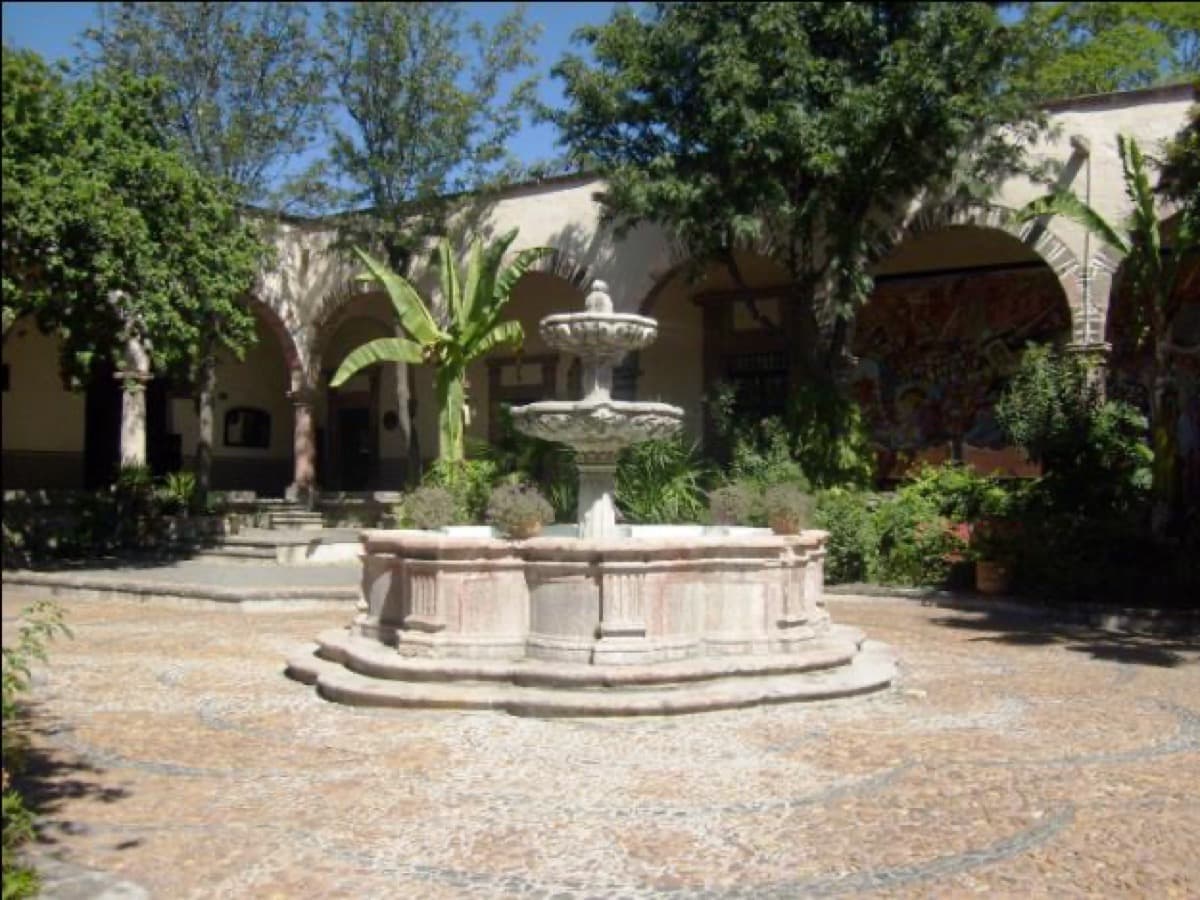
The mechanism worked. In 1948 and 1949 the muralist David Alfaro Siqueiros ran a mural-painting workshop for a group of US war veterans at Bellas Artes, in the old Convent of the Conception, and began a mural there that was never finished. By the early sixties, the Instituto Allende and the old Bellas Artes building, reopened in 1962 as the Centro Cultural Ignacio Ramírez El Nigromante, were the gravitational centres of a real working art colony alongside the still-mostly-Mexican town.
A handful of those students stayed. Most went home. The pattern they established, however, did not go home. They had demonstrated, in real time, that an American with modest means could live well in San Miguel and make work there. That information escaped into the wider American art and literary world and never stopped propagating.
The second wave
Hear a stop from this walk
Bellas Artes: A Convent, a Dome and an Unfinished Mural
The 1960s wave was bohemian. The 1980s and 1990s wave was retirement. As the Mexican peso devalued repeatedly through the 1980s, the same dollar that had paid for an art student's room in 1955 now paid for a retired schoolteacher's house. Direct flights to nearby León multiplied. The town that had once attracted veterans and beatniks now attracted couples in their sixties from Texas, California, and the Pacific Northwest.
This wave was bigger. The veterans came in cohorts of dozens. The retirees came in cohorts of hundreds, and they bought houses instead of renting them. Real estate in the centro historico, which had stayed nearly free for two centuries, began rising in the early 1990s and has not stopped rising. By the 2010s, the centro real estate was priced in US dollars and substantially out of reach of any local family that had lived there for generations.
The current resident foreign population is estimated at somewhere between ten and fifteen thousand, in a metropolitan area of about a hundred and sixty thousand. That is the densest foreign concentration in any Mexican city. It is also, importantly, mostly concentrated in maybe forty blocks of the historic centre, while the working population of the city lives in the surrounding colonias that most visitors never see.
The 2008 declaration
In 2008, UNESCO inscribed the protective zone of San Miguel and the nearby Sanctuary of Jesús Nazareno de Atotonilco as a World Heritage Site. The official citation praises the town's role as a melting pot between Spanish, Creole, and Amerindian cultures, its sixteenth-century street plan, and the way its buildings, from baroque to the Parroquia's late-1800s Gothic front, sit together on it. The American art-colony layer of the story is not part of the UNESCO citation. From the heritage perspective, the town is being preserved for what it was in 1810, not for what it became in 1955.
This is a useful tension to hold. The international tourism that the UNESCO designation accelerated runs through a town shaped by an entirely different international community. Most visitors today are not Americans in residence. They are short-stay tourists from Mexico City and from across the world, and the city they encounter, with its rooftop bars, its boutique hotels, its English-menu restaurants, was built to serve a different kind of foreigner over the previous sixty years.
What is gained, what is lost
The case for San Miguel's foreign layer is real. The art colony saved the architecture. Without the cash that the GI Bill students and the later retirees brought in, the colonial buildings would have continued to collapse the way they were collapsing in 1937. The Fábrica La Aurora textile mill, closed in 1991, would not be a thirty-gallery complex without the buying power of foreign collectors. The Instituto Allende building, a former 1735 hacienda, would not have been restored. The town is more visually intact in 2026 than it was in 1937, and that is causally connected to the people who came.
The case against is also real. Rents inside the centro have priced out the families whose grandparents lived there. Local artisans now compete with foreign-owned galleries selling work at margins those artisans cannot match. The school system bifurcates along bilingual lines from kindergarten. The Mexican holidays are celebrated in English at certain restaurants and in Spanish at others. The town remains majority Mexican in headcount and increasingly foreign in ownership of its prime real estate.
Most colonial Mexican towns face a different version of this same pressure from domestic tourism alone. San Miguel faces it on top of, and entangled with, an unusually old and unusually concentrated foreign community. The result is a city that is genuinely good at hosting visitors, genuinely strange to live in, and unwilling to resolve into a single story about itself.
How to see it
If you walk the two tours in this city, you will see both versions at once. The Historic Center tour, eleven stops in a loop from the Jardín, takes you through the older city: the spring where the town began, the first main square of 1555, the churches, the house of the Allende family and the house of the Canal family, whose secret junta of 1808 fed the 1810 conspiracy, and Bellas Artes, where Siqueiros taught the veterans. That city is preserved like a fly in amber. The art and rooftops tour takes you through the 1937-onward city, the Instituto Allende, the converted factory at La Aurora, the gallery row on Calle Aldama. Walk them both on the same day and the layered nature of the place becomes physical.
San Miguel does not pretend to be a Mexican village uncorrupted by foreigners. It is also not a foreign enclave that happens to be in Mexico. It is a particular collision that happened in a particular place between 1937 and now, and the reason it is worth a careful visit is that almost no other town in the Americas presents the same set of trade-offs in the same physical frame.
Frequently asked questions
- How many self-guided walking tours are there in San Miguel de Allende?
- Roamer currently has 2 self-guided audio walking tours in San Miguel de Allende. Every tour is free to start: the introduction and first stop play in full, and every later stop plays a short preview before you decide to buy.
- How much does a self-guided walking tour in San Miguel de Allende cost?
- Each tour is free to preview and $4.99 for lifetime access. If you want more than one, a 7-day pass is $12.99 and a 30-day pass covering every tour is $19.99, which works out to well under a dollar a day.
- Can I do the San Miguel de Allende tours offline?
- Yes. Tours can be downloaded in advance in the Roamer app and played with no signal, which is useful when you are travelling without mobile data.
- How long are the San Miguel de Allende walking tours?
- They run about 90 minutes each, covering 2.5 to 2.7 km on foot, with 11 stops on the longest route. You set the pace and can pause any time.
Mexico eSIM· 10% off with ROAMER10
Ready to experience it?
Historic Center: San Miguel in Pink Stone
90 min · 2.7 km · easy
More from San Miguel
Explore more at your own pace.
One Day in San Miguel de Allende: A Walkable Itinerary (2026)
San Miguel de Allende Travel Guide: How Many Days, Getting Around, When to Go (2026)
What to Eat in San Miguel de Allende: A Food Guide (2026)
How San Miguel Stayed an Art Colony When Every Other Mexican Town Became a Souvenir
Why Mexican Independence Was Planned in a Silver Town