When a town becomes famous for art, the art tends to leave. The pattern is well established: a few painters move into a cheap neighborhood, write home about how good the light is, get followed by friends, then by galleries, then by visitors, then by people who like the visitors. Within twenty years the painters cannot afford the rent and move somewhere else. The neighborhood keeps the name. The art is gone. This has happened to Greenwich Village, to Soho in lower Manhattan, to Williamsburg, to Berlin's Mitte, to Oaxaca's Jalatlaco, to Guanajuato's Pípila slopes.
It has not, so far, happened to San Miguel de Allende. The art colony here is now eighty-nine years old. It is the longest continuously operating art colony in Latin America, and one of the longest in the Americas. The tour you just walked is, in effect, a museum of how it has stayed alive.
The reason it has stayed alive is that someone built physical infrastructure that requires working artists, twice. Once in 1937, with the founding of the school that became the Instituto Allende. Once in 2003, with the conversion of the closed Fábrica La Aurora textile mill into a gallery and studio complex. Without those two interventions, San Miguel would today be a beautiful film set for an art colony that had moved on. Because of them, it is still an art colony with a city wrapped around it.
The school that anchored a town
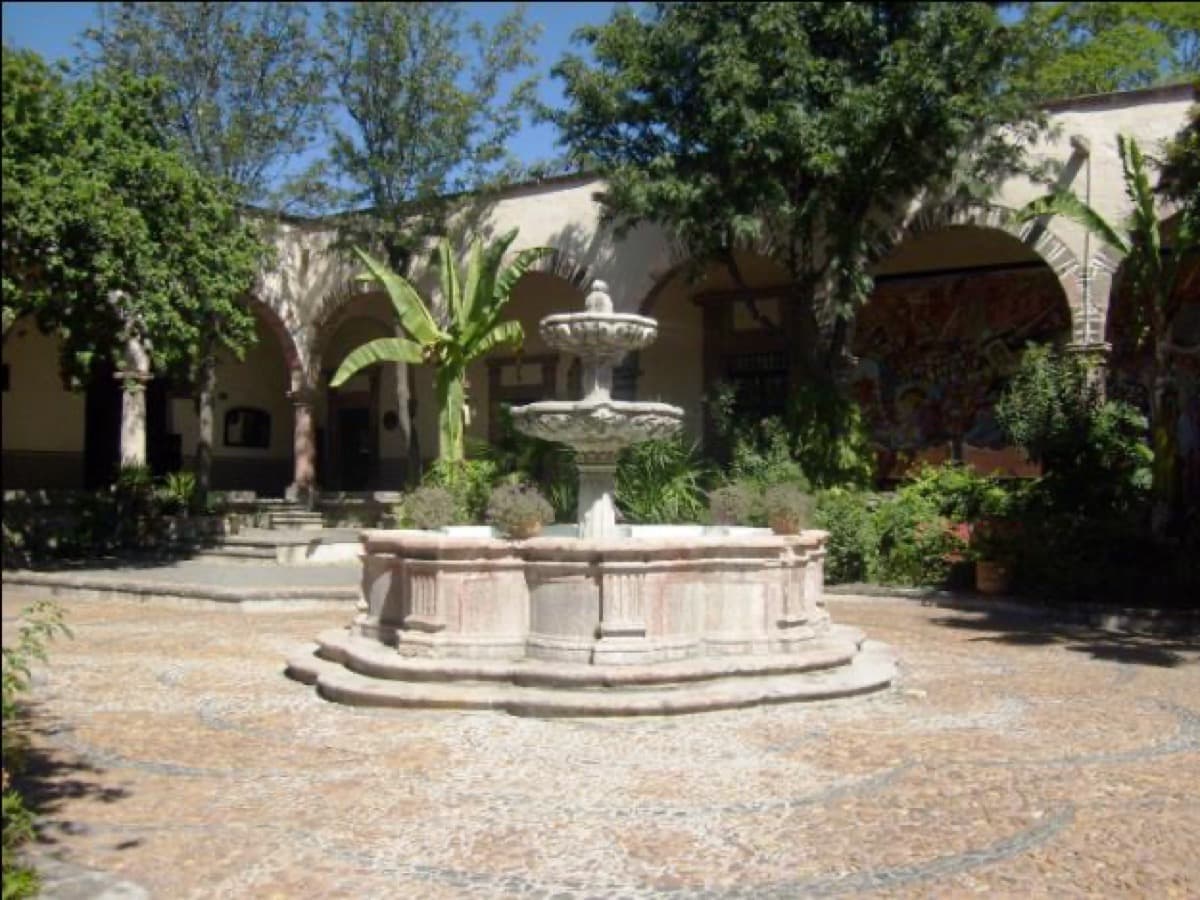
The institution at the centre of stop six on the tour was originally founded in 1938 by a small group of local intellectuals as the Escuela Universitaria de Bellas Artes, then renamed and reorganized in 1950 as the Instituto Allende by Stirling Dickinson, the Peruvian painter Felipe Cossío del Pomar, and the former governor of Guanajuato state, Enrique Fernández Martínez. The reorganization mattered because of who it was for. The Instituto was deliberately set up to be eligible for the United States GI Bill, the postwar veterans' education benefit, and that eligibility was granted in 1950.
The mechanism then ran as follows. A young American man, recently discharged from World War Two or later from the Korean War, could enroll at the Instituto Allende in painting, sculpture, ceramics, or weaving. His tuition, his books, and a small stipend were paid by the United States government. He could live in San Miguel on roughly seventy-five dollars a month. The course of study lasted up to four years. By the late 1950s, the Instituto was enrolling several hundred Americans a year, in a town whose total population was around twelve thousand.
The point is not the numbers, though the numbers were significant. The point is that the school produced a continuous flow of foreigners who had to be working artists to be in San Miguel at all. The GI Bill paid for art instruction, not for vacationing. The visa structure made the school the legitimate reason for residence. The result was a population of foreigners that, unusually, was made of working artists by definition rather than wealthy retirees by accident.
That fact compounded. The veterans who stayed needed studio space. The galleries that emerged in the 1960s and 1970s grew up around them. The Mexican muralist tradition, particularly the Siqueiros workshop briefly held in San Miguel in 1948, gave the school a real connection to the Mexican art world rather than letting it become a foreign ghetto. The Instituto's status as a legitimate university-affiliated art school meant its credits transferred and its degrees mattered.
The GI Bill flow tapered after the Vietnam-era veterans aged out in the late 1970s, but by then the second generation was already in place. The infrastructure remained: studios, supply stores, framers, galleries, foundries. Working art needs all of these. The Instituto kept producing students. The town kept producing the buildings to house them.
The factory that became the second anchor
Hear a stop from this walk
Bellas Artes: A Convent, a Dome and an Unfinished Mural
When the Fábrica La Aurora cotton mill closed in 1991, it was the largest single structure in the centro and one of the largest in the region. Three full city blocks of saw-tooth-roofed industrial space, built starting in 1902 by an investor consortium called Garay y Compañía to take advantage of cheap labour and the Querétaro-León cotton trade. The mill ran for eighty-nine years and employed around six hundred people at its peak. Its closure in 1991 was triggered by the slow collapse of the Mexican textile sector under NAFTA-era pressure from cheaper imports.
The factory could have been demolished. That was the default. Industrial sites of this size in Mexican secondary cities are usually demolished and redeveloped as supermarkets or apartment complexes. The decision, made jointly by the families who owned the property and a coalition of galleries and artists, was instead to keep the structure intact and convert the interior to studios and exhibition halls. The conversion began in 2003 and the complex opened to the public in 2005.
By 2010, La Aurora housed roughly forty galleries, antique dealers, restorers, framers, and artists' studios. By 2020 the number had stabilized at over fifty operating tenants. The complex is not subsidized. It runs on commercial rents. What it does, however, is keep those rents within reach of a working artist or a small gallery, partly because the building's industrial scale produces vast amounts of leasable floorspace and partly because the owning family has chosen to keep rates below what the centro would charge.
La Aurora matters because it solved a problem that the Instituto could not solve alone. The Instituto produces students; it does not house them after graduation. The galleries on Calle Aldama and the Hidalgo and Ancha de San Antonio are too small and too expensive for the kind of long-term studio space serious artists need. La Aurora gave the colony its industrial back of house. It is the kind of building that San Francisco's Mission District, Brooklyn's Williamsburg, and Berlin's Wedding all once had and have now lost to luxury conversion. San Miguel still has it.
Why this is not stable
The pattern is fragile. The tour walks you past three pressure points that could break it.
The Mercado de Artesanías at stop four is competing on price with imported decorative goods that look like Mexican folk art but are made in Indonesia or China. The actual hojalata workers, the rebozo weavers, and the Talavera ceramicists who supply the market are aging and not consistently being replaced by apprentices. This is a national problem in Mexico, not a San Miguel problem, but it shows up here as a thinning of the craft layer at the bottom of the colony's pyramid.
The Calle Aldama gallery row at stop eight is increasingly the affordable option for what used to be in the centre, where rents have risen above what an emerging artist can pay. Aldama is two streets removed from the Jardín. If real estate pressure pushes Aldama itself out of reach, the next street is further from the touristic flow and the gallery economics weaken.
The Instituto Allende itself, the institution at stop six, has shrunk from its 1960s peak. It still operates. It still produces artists. It is no longer the gravitational centre of an art world the way it was sixty years ago. Other institutions, including the public Centro Cultural Ignacio Ramírez El Nigromante, have taken on parts of its role.
None of this is a crisis. The colony today is denser and more visible than at any earlier point in its history. But the conditions that produced it, cheap rent, a steady flow of working students, and a few specific buildings that could absorb large numbers of artists, are not automatic. They were arranged.
What the tour does, walking from the toy museum on the corner of the Jardín through the converted factory to the gallery row, is show you the physical evidence of those arrangements. The colony is not a vibe. It is a set of buildings doing specific jobs. As long as the buildings hold and someone keeps using them as intended, the colony holds.
Mexico eSIM· 10% off with ROAMER10
Ready to experience it?
Historic Center: San Miguel in Pink Stone
90 min · 2.7 km · easy
More from San Miguel
Explore more at your own pace.
How San Miguel Became an American Town in Mexico
One Day in San Miguel de Allende: A Walkable Itinerary (2026)
San Miguel de Allende Travel Guide: How Many Days, Getting Around, When to Go (2026)
What to Eat in San Miguel de Allende: A Food Guide (2026)
Why Mexican Independence Was Planned in a Silver Town