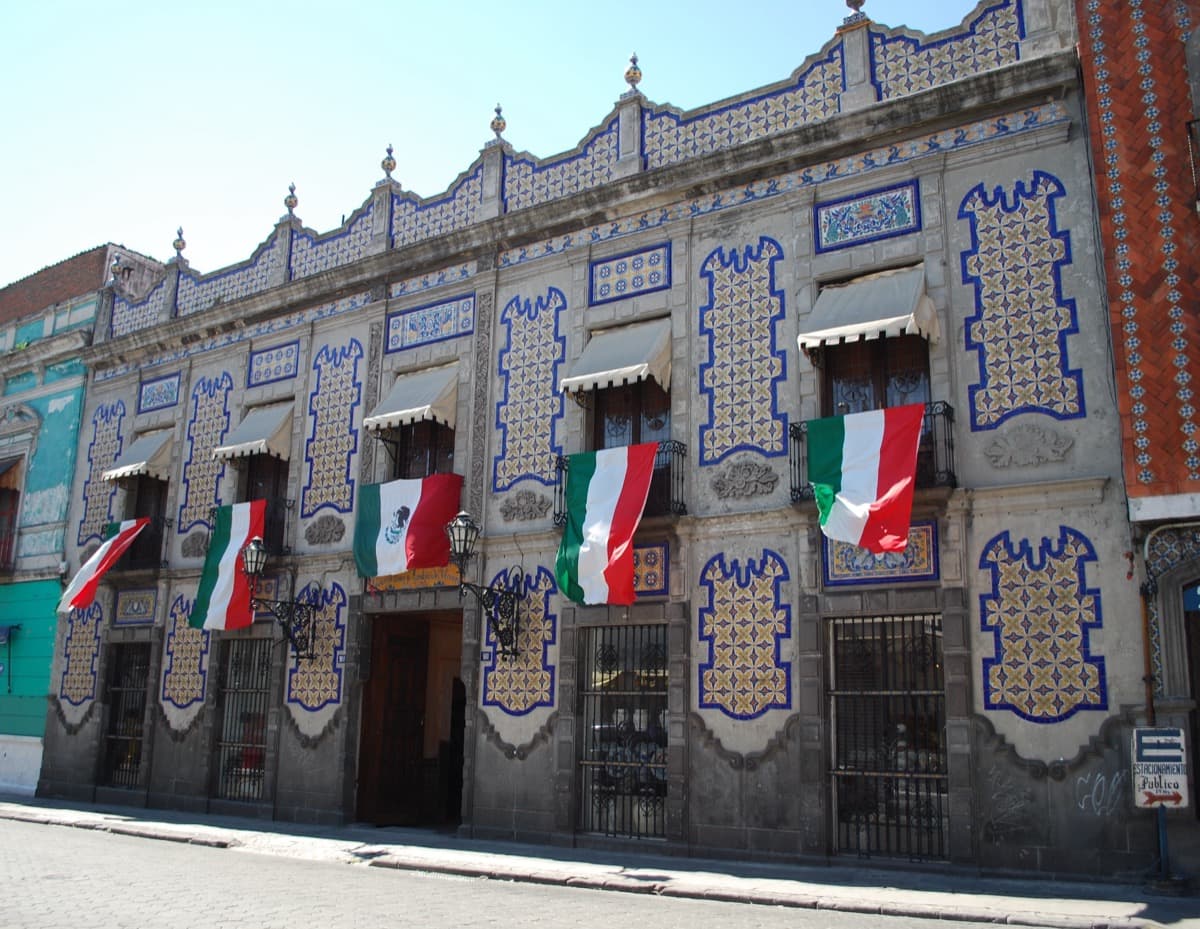
Uriarte Talavera sits at Avenida 4 Poniente 911 in Puebla's historic centre, four blocks west of the Zócalo, in a building that has been making ceramics on the same site continuously since 1824. That is two hundred and one years of unbroken production from the same address. There is nothing comparable in the Americas in any craft, and very little comparable in Europe.
The workshop is open for guided tours during business hours, usually in Spanish but in English on request. The full walk-through takes about forty-five minutes and passes through every stage of the production process. By the end of it, the words "Talavera" and "majolica" mean different things to you, and you can see, on the shelves of the showroom at the exit, why a single dinner plate at the high end can cost several hundred dollars.
Where the technique came from
Talavera is the Mexican branch of a five-hundred-year-old pottery lineage. The technique is tin-glazed earthenware, in which a porous fired-clay body is coated in a tin-based opaque white glaze and then painted with metal-oxide pigments before a second firing. The technique was developed in the Islamic world, refined in medieval Persia, carried into Iberia during the centuries of Moorish rule, and matured in the workshops of Talavera de la Reina in central Spain. It crossed the Atlantic in the late sixteenth century, when Spanish potters established themselves in Puebla.
What they found in Puebla was a combination of two things they could not have planned for. The local clay turned out to be excellent for the technique, fine-grained, low in iron, capable of withstanding the high-temperature double firing. And the local labour force, drawn from indigenous communities in the surrounding valleys, already had centuries of pre-Hispanic ceramic experience. The fusion product, neither pure Spanish majolica nor a pre-Hispanic survival, emerged within a generation.
By 1653 the colonial government had codified the craft. The Pueblan Ordinances of that year specified the permitted clays, the permitted mineral pigments, the four-year apprenticeship a potter had to complete before he could produce work to be signed under his own name, and the inspection regime for quality. The system was a guild structure modelled on Spanish precedent and adapted to colonial conditions. It held for about two hundred years.
The system collapsed in the nineteenth century, along with most of the colonial guild structures, after independence and the subsequent disruption of New Spain's economy. Many workshops closed in the 1820s and 1830s. Uriarte, founded in 1824 by Dimas Uriarte, is one of the few that survived the transition into the independent republic without interruption.
What the workshop actually does
Hear a stop from this walk
Zocalo — Puebla's Culinary Capital
The production cycle takes about four months from raw clay to finished tile or vessel. The stages are sequential and largely manual.
The clay arrives from local quarries and is mixed with a second clay type to balance the body's shrinkage. The mixed clay is wedged, kneaded, and then either thrown on a wheel by hand or pressed into moulds for architectural tiles. A vessel is shaped, refined, and then placed on wooden racks in the drying rooms for several weeks. The drying is slow because the clay must release moisture evenly to avoid cracking in the kiln. Hundreds of unfired pieces sit on these racks at any one time.
The first firing converts the dried clay to bisque, a porous, soft, fragile state in which the surface is ready to accept the glaze. The bisque pieces are then dipped in the tin-based glaze, which dries into a powdery white coating. This is the canvas. The painters apply the design at this stage, working with mineral-pigment paints loaded onto brushes. The painting is done from memory, without sketching or tracing. A trained painter knows the patterns by heart and works at a steady rhythm. A complex pattern can take a day or more for a single vessel.
A note about the brushes. The painters at Uriarte use brushes made from cat hair, specifically the long guard hairs from the back of a domestic cat. The hairs hold pigment better than synthetic bristles and allow finer lines than any commercial brush available. The brushes are hand-bound, and a single brush is used for a long time, since the cost in cat hair is non-trivial. This is the kind of detail that, when you hear it during the tour, recalibrates what kind of object you are looking at.
The painted piece goes back into the kiln for the second firing, which reaches over a thousand degrees Celsius. The heat fuses the glaze, locks the painted design into the surface, and produces the slightly glossy, slightly variable surface that is the visible signature of authentic Talavera. The second firing is the moment of greatest risk. A piece that has survived weeks of drying and a successful first firing can still crack or warp in the second. The loss rate is real.
The legal fence around the name
In the year 2000, the Mexican government established a denominación de origen, a denomination of origin, for Talavera. The protection is structurally similar to the protected designations for Champagne wine or Roquefort cheese. To legally use the name "Talavera," a workshop must be located in one of the certified municipalities, primarily in Puebla and Tlaxcala states, must use the traditional clays and mineral pigments, must follow the hand-shaping and double-firing process, and must submit to periodic inspection. A small number of workshops hold the certification. Uriarte is one of them. The rest of the Mexican market that uses the word "Talavera" loosely is, by Mexican law, mislabelling. The legal enforcement is incomplete in practice, but the standard is clear.
In 2019 UNESCO added the Talavera pottery-making process of Puebla and Tlaxcala, along with related production in Talavera de la Reina and Puente del Arzobispo in Spain, to its Representative List of the Intangible Cultural Heritage of Humanity. The designation protects the knowledge system more than the objects. The reason the Mexican government, the Spanish government, and UNESCO all bothered with these layered protections is that the technique is not robust. Without active workshops training new apprentices, it could be lost in two generations. The certification regime is partly a financial guarantee that the workshops can survive long enough to keep training.
What you see on the tour
The Uriarte tour passes the wedging table, the wheels, the drying racks, the bisque kilns, the glazing room, the painting studio, and finally the second kiln. The most concentrated stop is the painting studio, where you can stand a metre behind a painter and watch a complex pattern come down on a bisque-fired plate without any preliminary sketching. A master painter at Uriarte has typically spent more than five years in apprenticeship, and many of them have spent a decade learning before producing signed work for sale. The repetitive precision is hypnotic, and once you have watched a swallowtail or a vine motif being laid down freehand at speed, the prices in the showroom feel less arbitrary.
The showroom is the natural exit. The pieces span every scale and price point, from small dishes around two hundred and fifty pesos up to architectural commissions and large vessels priced in the thousands of dollars. Almost everything is one of a kind, or at most one of a small run, because the painting is freehand and no two pieces are identical. If you only buy one Talavera object, the workshop's recommendation is to buy a small piece of certified work rather than a large piece of unverified pottery from a market stall. The difference in weight, glaze depth, and design crispness is visible even at this scale.
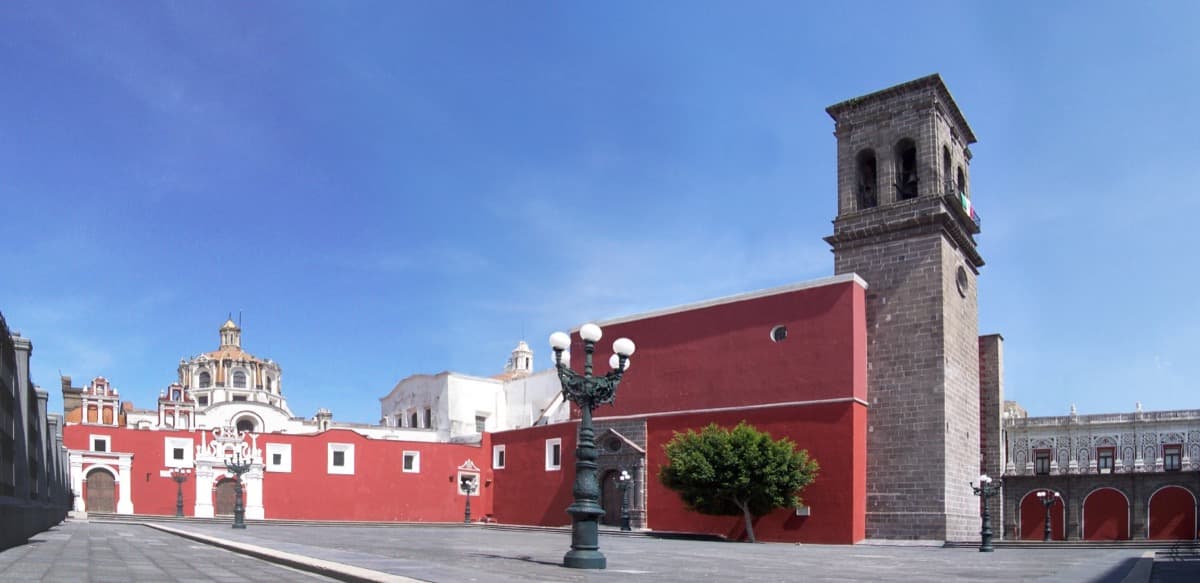
The workshop is the fourth stop on the Puebla: Mole as a Paradox tour, sequenced after the Calle de los Dulces and the Templo de Santo Domingo. The placement matters. By the time you walk into Uriarte, you have looked at the Talavera that decorates the Santo Domingo facade as a finished surface, without thinking about how it got there. Forty-five minutes inside the workshop changes that. Walk back out into the historic centre afterward and the tiled domes you passed in the morning will read differently. They are made of objects you now understand how someone built.
The unbroken transmission, in a craft this slow and this exacting, is the rarer thing than the objects themselves.
Mexico eSIM· 10% off with ROAMER10
Ready to experience it?
Puebla: Mole as a Paradox
105 min · 3 km · easy
More from Puebla
Explore more at your own pace.
Best Self-Guided Walking Tours in Puebla (2026)
One Day in Puebla: A Walkable Centro Histórico Itinerary (2026)
Puebla Travel Guide: How Many Days, Getting Around, When to Go (2026)

What to Eat in Puebla: A Food Guide (2026)
Barroco Poblano: Why Puebla's Churches Don't Look Like Spain's