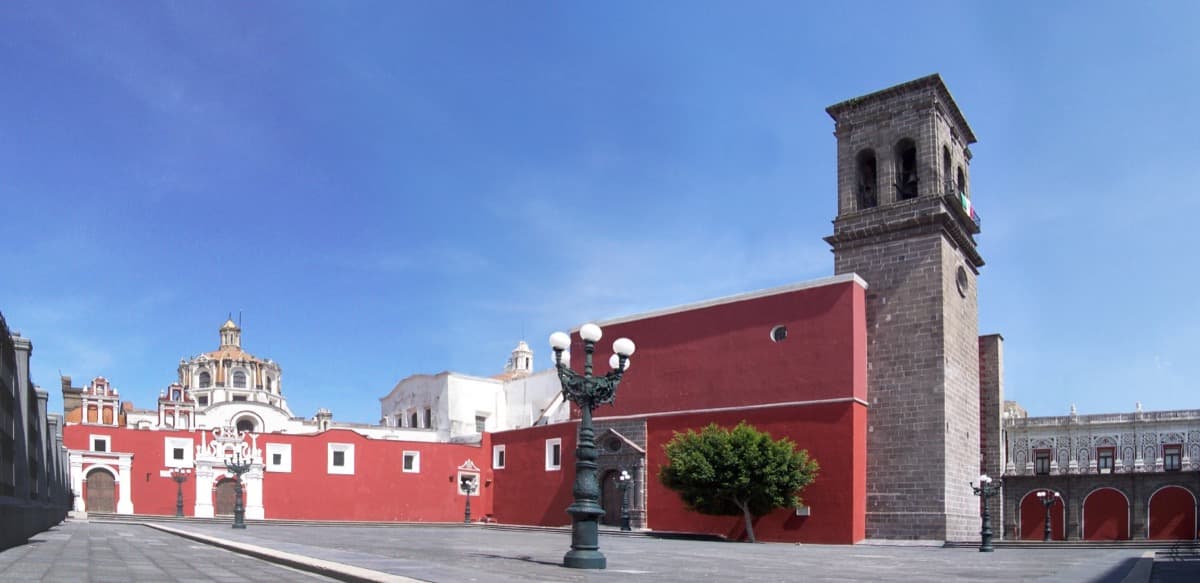
The Capilla del Rosario sits inside the Templo de Santo Domingo on the corner of Avenida 5 de Mayo and Avenida 4 Poniente, six blocks north of the Puebla Zócalo. From the street it gives away nothing. The exterior of Santo Domingo is dignified but unremarkable. The main nave, when you walk in, is handsome and high but recognisable as a Dominican church anywhere in the colonial Spanish world.
Then you turn right into the north transept, and the room changes.
Every surface inside the chapel is covered in gilded stucco. The walls. The pilasters. The undersides of the arches. The base of the dome. The dome itself. The ribs of the dome. Around five hundred square metres of carved plaster in total, finished with an estimated twenty-three karats' worth of gold leaf, sculpted into a theological programme so dense the iconography is almost impossible to read in a single visit. The room is not large. Perhaps fifteen metres on each side under a single dome. The density is what overwhelms.
The chapel was inaugurated on 16 April 1690, after forty years of construction.
What it took to build
The Dominican order had been in Puebla since 1534, building the main Templo de Santo Domingo through the late sixteenth century. The Capilla del Rosario was a later addition, commissioned in 1650 and dedicated to the Virgen del Rosario, the order's principal Marian devotion. The funding came primarily from donations by the wealthy merchant families of Puebla, who were beginning to use church patronage as a way of consolidating their social position alongside the older landed Spanish elite.
The technique deployed inside the chapel is estofado, a process in which gold leaf is applied over carved plaster that has been painted with a base of red bole or coloured pigment. The surface is then selectively burnished and selectively dulled, so that some areas reflect light strongly and others recede into shadow. Where the leaf is deliberately thinned, the colour beneath shows through, giving the gold a warmer, more variable tone than flat gilding would. The technique allows the figures to read in three dimensions, since the carving is genuine relief and the leaf brings the surface alive.
Forty years of skilled labour went into the chapel. The names of the lead artisans are not all recorded, but the master craftsmen were drawn from the indigenous artisan community that had been making Talavera tiles and decorative plasterwork for the religious orders since the late sixteenth century. They were, in the strict sense, the same craft community that produced the colour-saturated tile facades of San Francisco and the polychrome interior of the Iglesia de Santa Mónica. The Rosary Chapel was their most concentrated single commission.
The theological programme
Hear a stop from this walk
Biblioteca Palafoxiana
The chapel is organised around the fifteen mysteries of the rosary. These are divided into three groups of five: the joyful mysteries from the Annunciation through the finding of Christ in the temple, the sorrowful mysteries from the Agony in the Garden through the Crucifixion, and the glorious mysteries from the Resurrection through the Coronation of the Virgin. Each mystery is depicted in a medallion in the chapel, with allegorical figures of associated virtues, Faith, Hope, Charity, Justice, Prudence, Temperance, Fortitude, surrounding them. The Virgin of the Rosary presides from the centre of the dome, where the visual programme converges.
Saints of the Dominican order fill the lower niches. Dominic himself receives the rosary from the Virgin in one panel, the order's founding myth made literal. Catherine of Siena, Thomas Aquinas, Rose of Lima all appear. Around them, in lower-relief, are angels, cherubs, garlands of fruit, vines, flowers, and the dense organic profusion that distinguishes Pueblan baroque from its European templates.
Look up at the dome and the iconographic and spatial schemes match. The Virgin is at the apex. The Holy Spirit descends in the form of a dove. Light enters through hidden windows in the dome's drum and bounces off the gold, so that the source of illumination is invisible and the effect is of light radiating from the iconography itself. The chapel is designed to feel internally lit. On a sunny morning, the impression that the gold is generating its own light is genuinely difficult to shake.
What makes it Pueblan
The chapel is sometimes described as a Mexican knock-off of European baroque, which is wrong, and sometimes as pure indigenous invention, which is also wrong. It is a hybrid product. The architectural programme, the iconography, the typology of a side chapel dedicated to the Rosary, all of these are European. The Dominican order shipped patterns and prints across the Atlantic for two centuries. The bishop in Puebla in 1650 had a clear idea of what the chapel was supposed to look like in outline.
What is not European is the execution. The density of the carved vegetation has no direct parallel in Spanish chapels of the period. The way figures emerge from a thicket of foliage, the way ornament colonises every available surface without leaving the smooth fields of blank wall that European baroque tends to preserve, the way colour saturates the gilding through the visible coloured ground beneath, these are characteristic of Pueblan craft. They appear in the same forms on Talavera tile panels of the same decades. The same hands worked on both.
The Dominican chronicler Francisco de Burgoa, writing in 1690, called the chapel the eighth wonder of the world. The phrase was rhetorical hyperbole at the time, but it stuck. Three hundred and thirty-five years later, it still appears in nearly every guidebook description of the chapel, and no one has seriously argued against it. The chapel has been compared, at various points, to the Royal Chapel at Versailles and to the more elaborate Bavarian rococo churches of the early eighteenth century. Both comparisons miss something. Versailles is theatrical in a way the Rosary Chapel is not. The Bavarian rococo churches are lighter and airier. The Rosary Chapel is denser, more relentlessly figural, more iconographically saturated than either.
How to look at it
The temptation is to absorb the chapel as an overall effect, which it certainly is, and stop there. The reward is to look closely at one or two figures at a time. The medallion of the Visitation, on the south wall, shows the Virgin meeting Elizabeth in a thicket of carved flowers and vines so dense that the figures emerge in low relief from a backdrop that itself reads as carved scripture. The Coronation of the Virgin, near the apex of the dome, is the visual climax of the programme, and it is where the gilding is at its most active. The Dominican saints in the lower niches, particularly Catherine of Siena with her wedding ring, repay slow attention.
The chapel is open for free during the main hours of Santo Domingo, normally from around 9 in the morning to early evening. Photography is permitted without flash. The best light is between 10 and 11 in the morning, when the sun is high enough to enter the dome but low enough that the gilding is still warm. Most visitors give the chapel ten minutes. It rewards forty.
A note about the rest of Santo Domingo. The main nave is worth time on its own merit. The choir stalls are carved in fine wood and date to the early eighteenth century. The convent attached to the church, dissolved during the nineteenth-century Reform Laws and now partially restored, contained a school for indigenous students from the surrounding villages. The Dominican order in Puebla was, in this period, more engaged with indigenous communities than the historical reputation of the colonial church usually allows. The Rosary Chapel is partly the visible artistic product of that engagement. The craftsmen who built it were the descendants of the communities the order was educating.
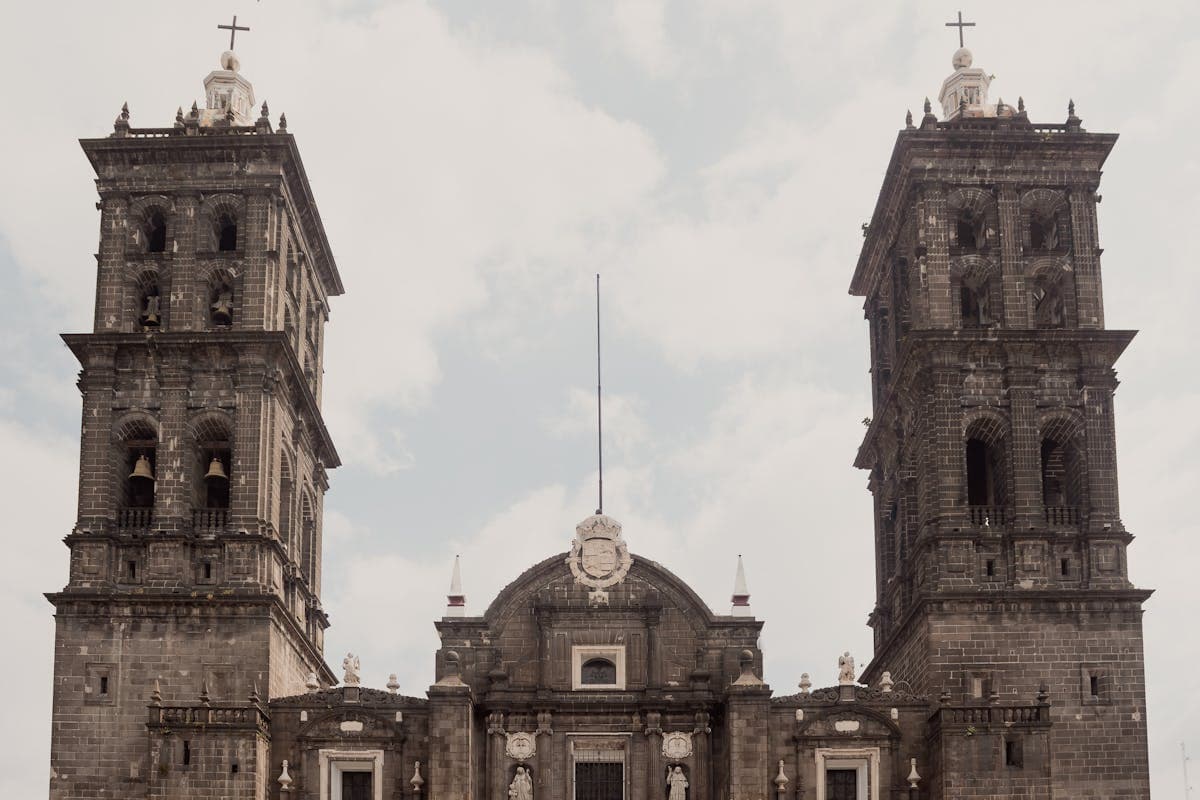
The chapel is the climax stop on the Puebla: 18 Baroque Churches in 15 Blocks tour, and the audio guide arrives there after passing through the more restrained cathedral and the satirical tile facade of the Casa de los Muñecos. The sequence is deliberate. By the time you walk into the transept, you have seen what restraint looked like in colonial Puebla and what political-satirical ornament looked like. The chapel is what Pueblan baroque looked like when the Dominicans gave the local craftsmen the budget, the timeline, and the permission to push the technique as far as it could go.
Forty years later, this is how far it went.
Mexico eSIM· 10% off with ROAMER10
Ready to experience it?
Puebla: 18 Baroque Churches in 15 Blocks
100 min · 2.5 km · easy
More from Puebla
Explore more at your own pace.
Best Self-Guided Walking Tours in Puebla (2026)
One Day in Puebla: A Walkable Centro Histórico Itinerary (2026)
Puebla Travel Guide: How Many Days, Getting Around, When to Go (2026)
What to Eat in Puebla: A Food Guide (2026)
Barroco Poblano: Why Puebla's Churches Don't Look Like Spain's