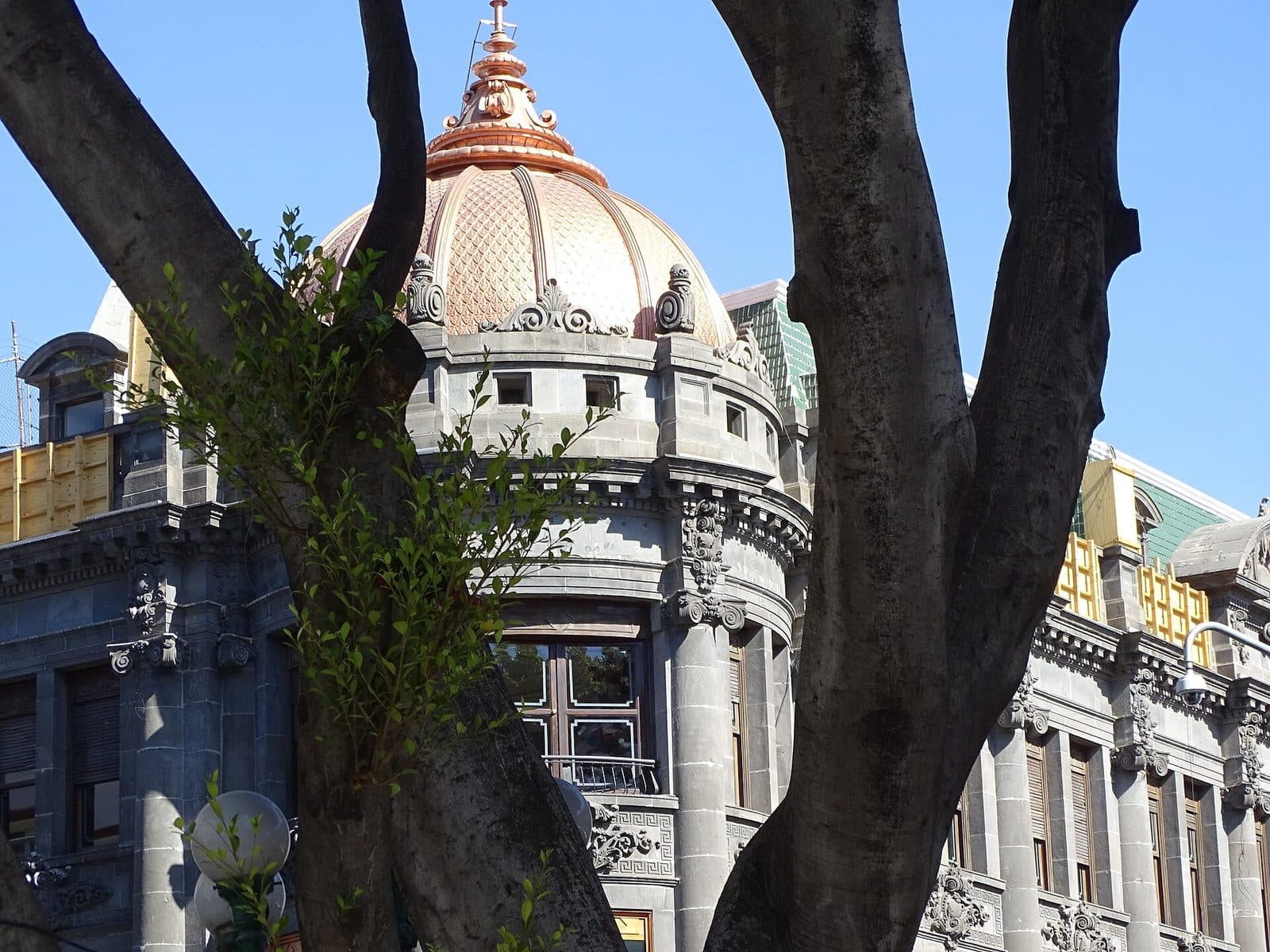
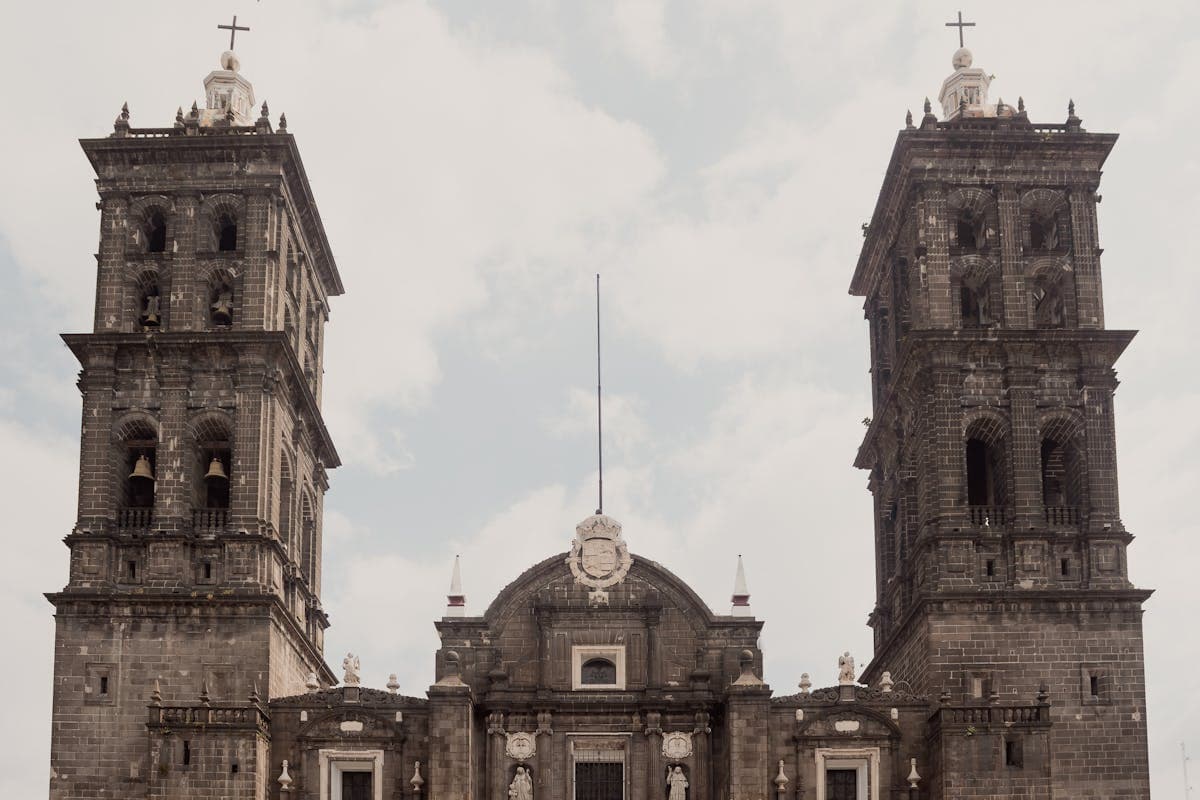
Stand on the south side of the Puebla Zócalo and look at the cathedral. Two towers, nearly seventy metres tall, taller than the towers of any other colonial church in Mexico. The body of the building is austere by Mexican standards. The interior is restrained, the main altarpiece neoclassical and marble. By the conventions of colonial cathedral architecture, this is a serious, almost severe building.
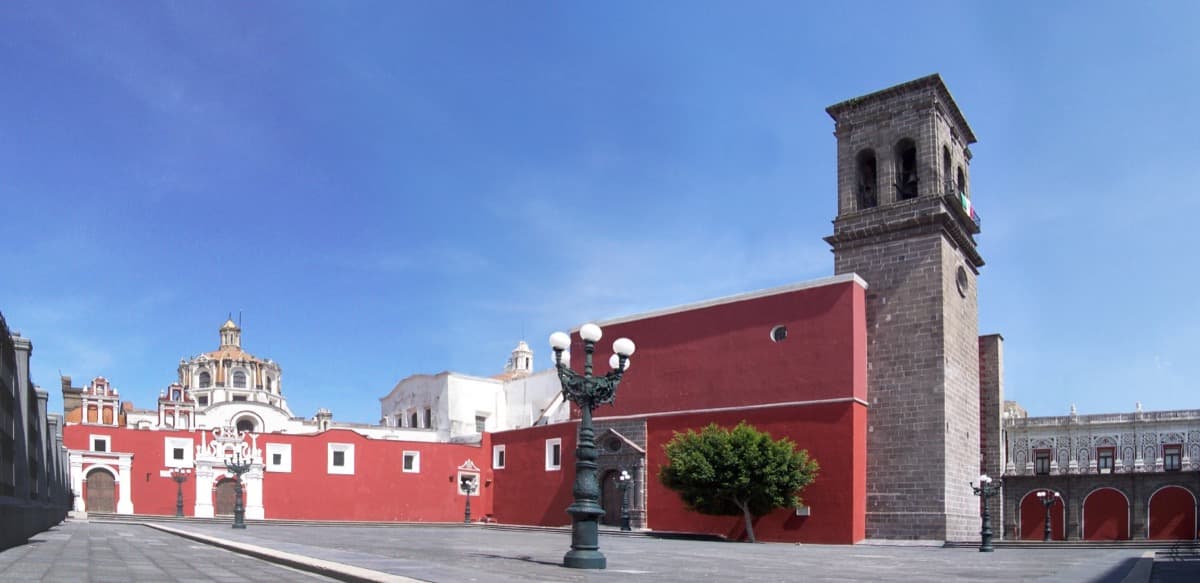
Now walk five blocks north on Calle 5 de Mayo and enter the Templo de Santo Domingo. Turn right inside the nave. You are looking at the Capilla del Rosario, finished in 1690. Every surface from the floor tiles to the apex of the dome is covered in gilded stucco, carved into saints and cherubs and vines and fruit so densely that the visual rhythm overwhelms before the iconography registers. There is nothing about this room that is restrained.
The two buildings are five blocks apart and were under construction in overlapping decades. They look like the products of two different civilisations. In a sense, they are.
The grammar Spain sent
Spanish baroque, as it crossed the Atlantic in the late sixteenth century, was already a hybrid. It had absorbed Italian techniques during Spain's century-long political grip on parts of Italy. It carried Counter-Reformation theology into ornament, dense iconographic programmes meant to instruct illiterate worshippers while overwhelming their senses. The grammar travelled to New Spain in two forms: in the books and pattern-prints that architects carried from Spain, and in the persons of the religious orders themselves. Franciscans, Dominicans, Augustinians, Jesuits, each order with its own preferred visual language and its own pipeline of European-trained designers.
What the Spanish orders found in Puebla in the late sixteenth century was a labour force unlike any they had encountered elsewhere. Puebla had been planned in 1531 on empty ground, with the explicit goal of becoming a model city. By the time the great church-building boom started a hundred years later, the local craft economy had developed something the conquerors had not planned for: a class of indigenous artisans, primarily in the surrounding villages, who had been making Talavera tiles for Spanish patrons since around 1580.
These craftsmen knew European decorative motifs intimately. They had been painting them on tiles for three or four generations. They also knew, because they had been making functional tiles for kitchens and homes and pulquerias, how those motifs could be improvised on, simplified, recombined, given local meaning. When the Dominicans wanted a chapel covered in gilded stucco and the Franciscans wanted a façade encrusted with tile, the people who actually shaped the materials were not Spanish architects. They were Poblano craftsmen executing European drawings through Mexican hands.
The product has its own name. Barroco Poblano. It is gilded, tiled, colour-saturated. It is more ornate than the comparatively austere baroque of central Mexico and more disciplined than the wild exuberance of Oaxacan or Andean baroque. The Pueblan craftsmen found a register that was European in vocabulary and recognisably Mexican in inflection.
The Capilla del Rosario as climax
Hear a stop from this walk
Biblioteca Palafoxiana
The Capilla del Rosario inside Santo Domingo is the canonical example. Dominican artisans worked on it for forty years, from 1650 to 1690. The chapel occupies a transept of the main church, perhaps fifteen metres on a side, and the gold leaf covers around five hundred square metres of carved stucco. The theological programme is organised around the fifteen mysteries of the rosary, each rendered in a medallion surrounded by allegorical virtues, with Dominican saints filling the niches and the Virgin of the Rosary presiding from the centre of the dome.
The technique behind the gilding is estofado, in which gold leaf is applied over carved and painted plaster. The result is not flat. The figures stand out from the surface in low relief, and the painted detail beneath the gilding shows through where the leaf was deliberately thinned. Light enters through hidden windows in the dome and bounces off the gold, creating a warm reflective glow that changes throughout the day.
The chapel was inaugurated in April 1690 with a viceregal ceremony elaborate enough to be a state event. The Dominican chronicler Francisco de Burgoa called it the eighth wonder of the world in print within months. The phrase stuck. No one has bothered to formally challenge it, partly because no plausible competitor has emerged in three centuries.
What is striking, in retrospect, is how local the chapel feels despite its European programme. The organic profusion of carved vegetation, the almost jungle-like density of the foliage, the way figures emerge from a thicket of carved plant life, these are not direct quotations from any European chapel. They are what happens when craftsmen who had grown up looking at the volcanic-flank flora of Puebla state translated a European theological commission into the visual world they actually knew.
The cathedral as counter-example
The Puebla cathedral is the necessary counter-example. Built between 1575 and 1649 under Bishop Juan de Palafox y Mendoza, it follows the Herreresque style named after Juan de Herrera, the architect of El Escorial in Spain. Herreresque is austere, geometric, monumental. It is the style of imperial Spain at its most disciplined, and it was deliberately chosen by Palafox to project authority rather than enchantment.
The cathedral exists because the Spanish church wanted Puebla to have a building that read as fundamentally Spanish, not Mexican. The Capilla del Rosario exists because, by the time the chapel was commissioned forty years later, the artistic conversation in Puebla had moved on. The Dominicans were willing to let local craftsmen take the lead in a way that the cathedral's earlier patrons had not been.
Walk through both buildings in sequence and you can read the shift. The cathedral is what Spain wanted Puebla to be. The Rosary Chapel is what Puebla turned out to be once the same imported grammar passed through three generations of Pueblan hands.
The walking sequence on the tour
The Puebla: 18 Baroque Churches in 15 Blocks tour is designed to land this argument across eight stops without ever stating it directly. The sequence moves from the Zócalo through the cathedral, the Biblioteca Palafoxiana, the Casa de los Muñecos with its satirical Talavera-tile facade, the Capilla del Rosario as the architectural climax, the smaller jewel-box churches of San Cristóbal and the Templo de la Compañía, and ends at the Iglesia de San Francisco, the oldest church in Puebla and the order that did most of the early evangelisation. The dating runs from 1535 to the late eighteenth century. The progression of decorative density goes from the modest Franciscan facades, through the cathedral's Herreresque restraint, into the full Pueblan baroque of Santo Domingo, and back down again toward the more parish-scaled churches at the end.
What the tour points at, without saying so, is that the most ornate moment is not the cathedral. It is the side chapel of a Dominican church. And the people who actually carved and gilded the side chapel were not in any architect's office.
That is the part of Mexican baroque history that the buildings themselves tell better than any textbook. The signature style of colonial Puebla is not a transplant. It is a translation.
Mexico eSIM· 10% off with ROAMER10
Ready to experience it?
Puebla: 18 Baroque Churches in 15 Blocks
100 min · 2.5 km · easy
More from Puebla
Explore more at your own pace.
Best Self-Guided Walking Tours in Puebla (2026)
One Day in Puebla: A Walkable Centro Histórico Itinerary (2026)
Puebla Travel Guide: How Many Days, Getting Around, When to Go (2026)
What to Eat in Puebla: A Food Guide (2026)
The Convent Paradox: Why Puebla's Most Baroque Food Came Out of Monastic Kitchens