The Church of São Francisco de Assis in Ouro Preto is Aleijadinho's acknowledged masterpiece because he did two jobs at once: he designed the building and he carved its soapstone, and he did both while a still-undiagnosed illness was slowly deforming and destroying his hands. Most great churches are a committee. A patron pays, an architect draws, a workshop of carvers executes, and the individual authorship dissolves into the whole. This one is different. Here the plan and the chisel belong to the same man, Antonio Francisco Lisboa, remembered as Aleijadinho, and that is why art historians treat the church less as a monument and more as a portrait.
One Hand Behind the Whole Building
Aleijadinho was born around 1738 to a Portuguese master builder and an enslaved African woman. He grew up inside the gold-boom town then called Vila Rica, the rich town, surrounded by churches that other men had gilded a generation before he was old enough to hold a tool. By the time São Francisco rose, he was no longer a young apprentice absorbing the Portuguese Baroque idiom around him. He was inventing.
The dates show how long the work stretched. Permission to build was requested in 1752. Construction began in 1765. The town council approved the church in 1771, and interior work carried on into the following century. Across those decades, the illness that no one has ever agreed on took hold. It deformed his hands and cost him fingers, and by tradition assistants tied his chisel to what remained of his grip so he could keep carving. Hold that fact beside the delicacy of the stone he produced. The nickname Aleijadinho translates roughly as the little cripple, a name attached to a body that was failing while the work grew more refined.
What to Look For on the Facade
Hear a stop from this walk
Igreja de São Francisco de Assis: The Masterpiece
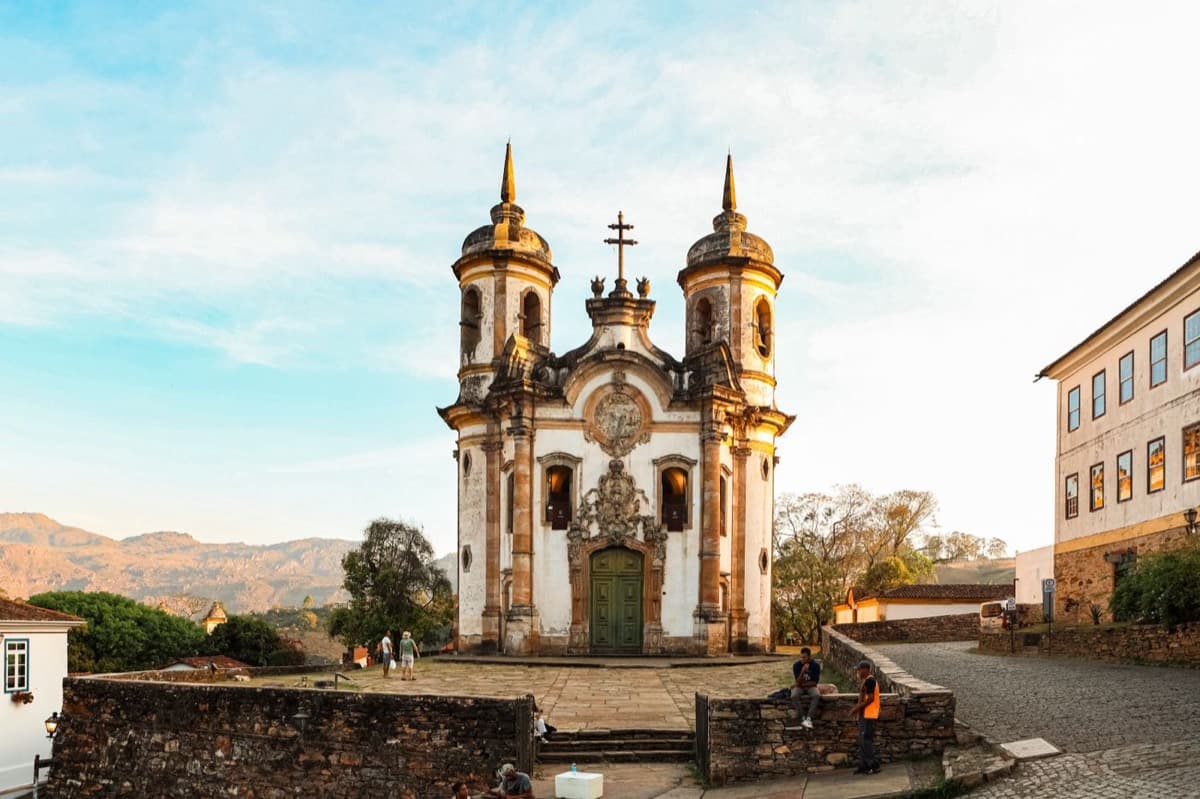
Stand in front and read the soapstone frontispiece over the door. The central relief shows Saint Francis receiving the stigmata, framed by the round oculus above it, closed not with glass but with sculpted stone. Then look at the two bell towers. They are circular. That sounds like a small detail until you know that round bell towers were a genuine novelty in Brazilian architecture at the time. Church towers in the colony were square, following inherited Portuguese habit. Aleijadinho broke the habit. The curve of those cylinders, set against the flat plane of the facade, is the mark of an architect who is thinking about how a building meets the sky, not a builder copying a pattern he was handed.
Soapstone, the material of the frontispiece, matters to this story. It is soft enough to carve in fine detail yet weathers to a warm gray that reads clearly against the white plaster. Aleijadinho used it across Minas Gerais, and it became almost a signature. On this facade it lets him pack narrative and ornament into a doorway rather than a wall, concentrating the eye exactly where a visitor enters.
Two Masters Under One Roof
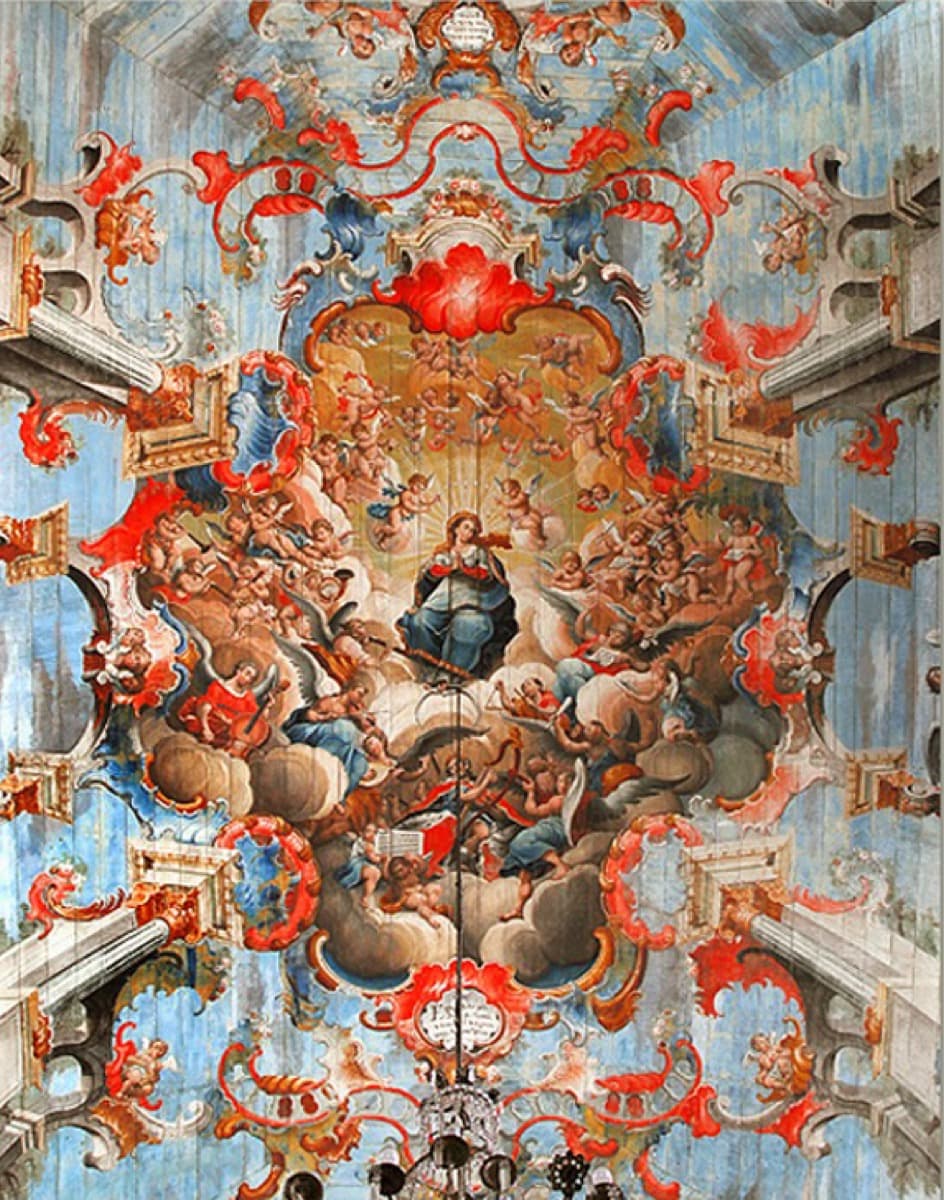
If you can step inside, look up. The nave ceiling was painted by Manuel da Costa Ataíde, known as Mestre Ataíde, between roughly 1801 and 1812. The composition is called the Glorification of Our Lady Among Musician Angels, and it is his most famous work, an illusionistic sky that seems to open above the nave. Ataíde is worth knowing on his own terms. Elsewhere in Ouro Preto he designed and painted the main altar of the Carmo church in 1813, so his hand recurs across the town the way Aleijadinho's does.
That gives this one building an unusual density. Two of colonial Brazil's greatest talents are working at full stretch in the same room: Aleijadinho's carved stone below, Ataíde's painted heaven above. Neither is decorating the other's leftover space. The stone and the ceiling were conceived as a single devotional experience, and the effect is that you feel authored to, not merely surrounded.
Why the Recognition Is More Than Local Pride
It would be easy to assume the fame is regional enthusiasm, a hometown treasure talked up by the people who live near it. The record says otherwise. Ouro Preto's historic center became Brazil's first cultural property inscribed on the UNESCO World Heritage List, in 1980, and São Francisco de Assis sits at the core of that ensemble. Brazil's national heritage institute, IPHAN, singles the church out as well. And on June 10, 2009, it was named one of the Seven Wonders of Portuguese Origin in the World, one of only two Brazilian landmarks on that list. The building is not famous because it is old. It is famous because a single, physically failing artist bent a whole architectural language toward something new and then carved the proof into the stone himself.
The Honest Frame
There is a discipline worth keeping when you walk Ouro Preto. Much of what tradition calls Aleijadinho is attributed by story rather than proven by document, since records were lost and biographies were written long after his death. But São Francisco is on firmer ground than most: the design and the carving here are genuinely credited to him, which is exactly why it anchors the case for his genius.
The other honest thread is harder. The gold that made this town, and paid for its churches, came from mines worked by enslaved Africans, the same people to whom his own mother belonged. The beauty and that truth are one story, not two. You can admire the round towers and the painted sky and still carry the weight of how the wealth behind them was dug.
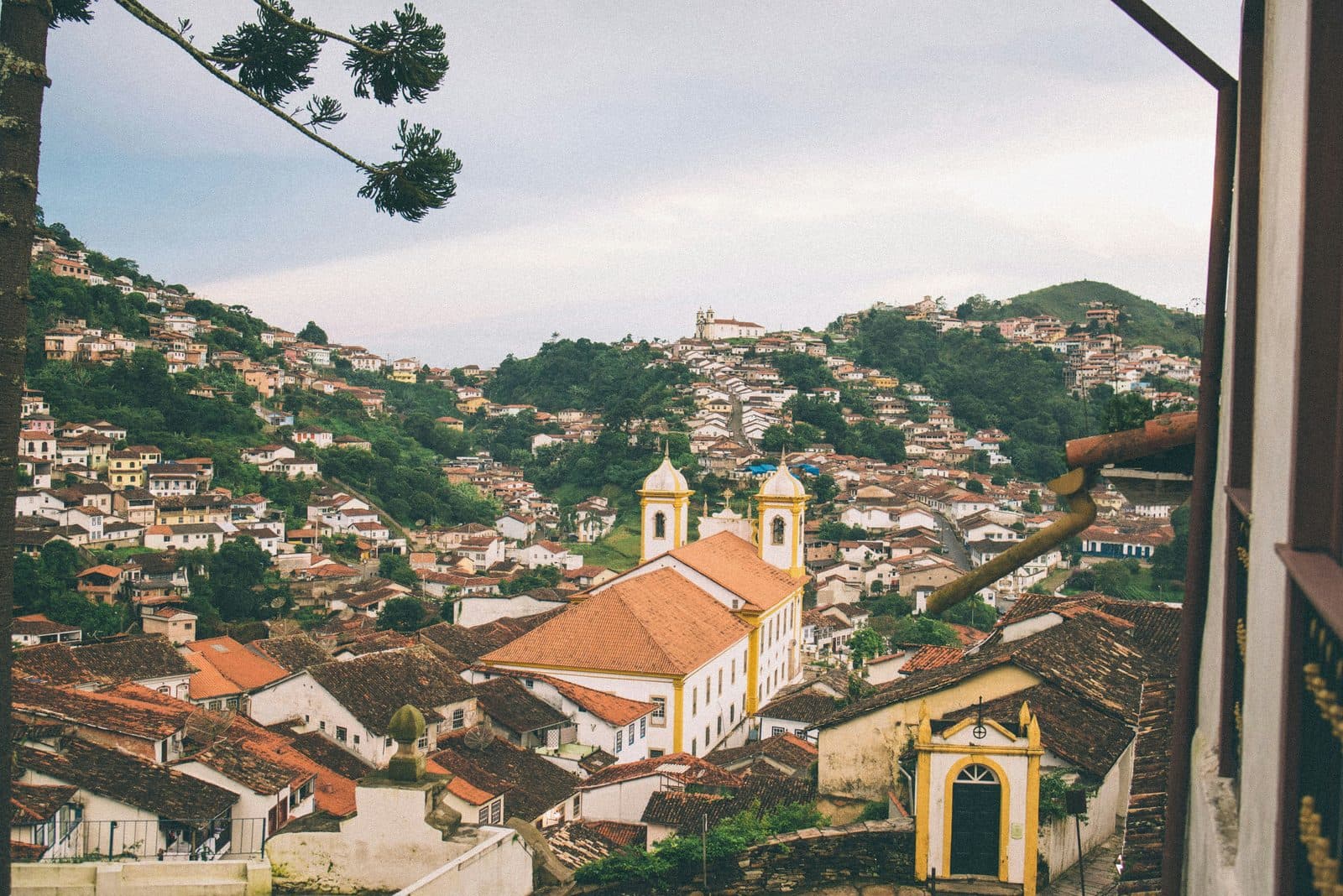
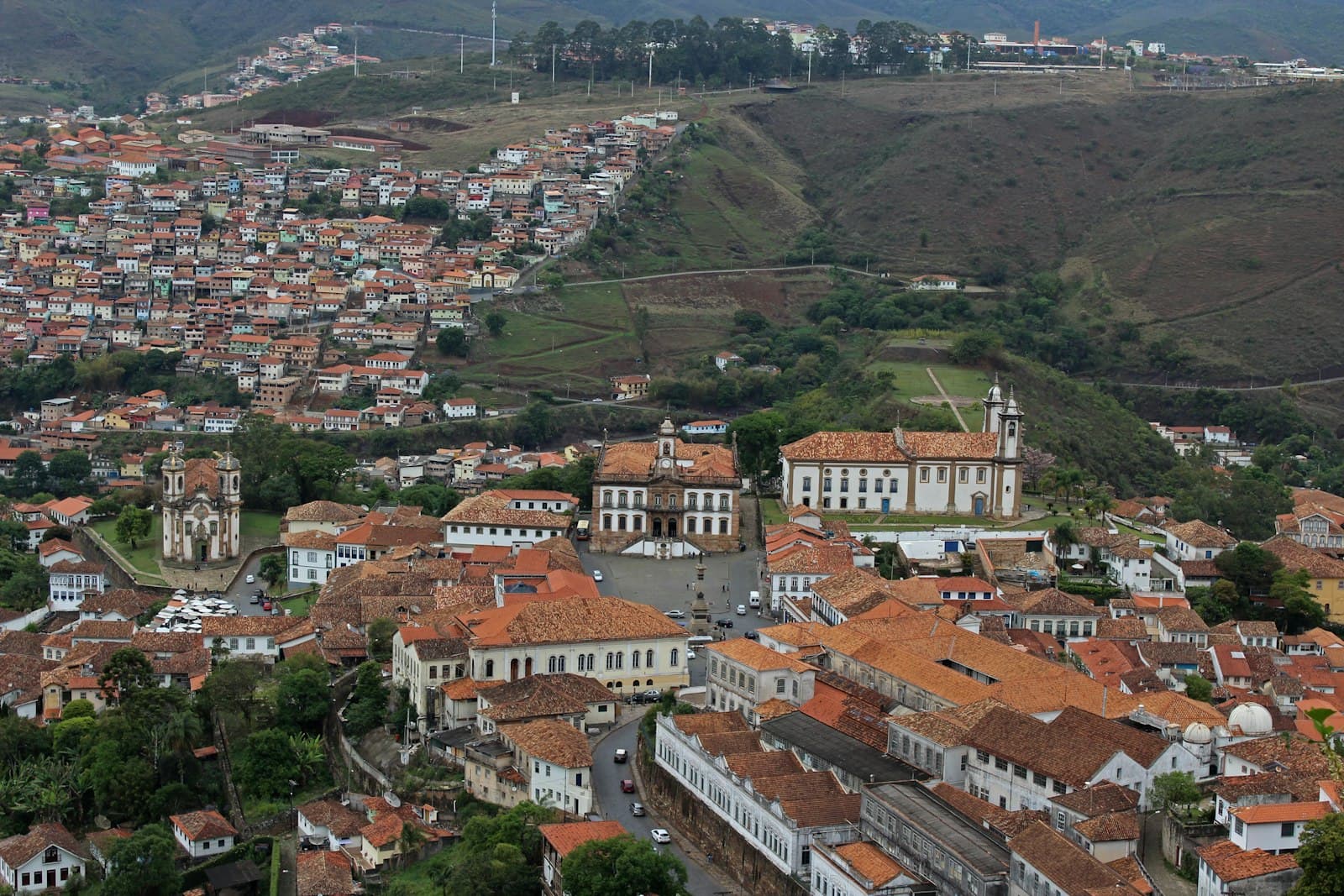
You can face the church directly from across the small valley, where it looks toward an older church on the opposite slope. That paired view is one of the most photographed sights in the town. Now you know which side of it holds the masterpiece, and why a dying man's hands are the reason.
To see São Francisco de Assis in sequence with the churches his father designed and the church where he is buried, walk it as the anchor of Aleijadinho's Ouro Preto in Brazil, Ouro Preto.
Sources
- Church of Saint Francis of Assisi (Ouro Preto), Wikipedia: design and construction dates, Aleijadinho's authorship, Ataíde ceiling, 2009 designation.
- Historic Town of Ouro Preto, UNESCO World Heritage Centre: confirms Ouro Preto as Brazil's first cultural World Heritage inscription, 1980.
- Church of São Francisco de Assis, Ouro Preto, Smarthistory: art-historical reading of the facade, soapstone, and interior program.
- The 7 Wonders of Portuguese Origin, New7Wonders: confirms the June 10, 2009 designation and the two Brazilian sites among the seven winners.
Brazil eSIM· 10% off with ROAMER10
Ready to experience it?
Historic Center: Aleijadinho's Ouro Preto
90 min · 1.2 km · hard
More from Ouro Preto
Explore more at your own pace.
One Day in Ouro Preto: A Walkable Baroque Itinerary (2026)
Ouro Preto Travel Guide: How Many Days, Getting There, When to Go (2026)
The Town Gold Built and Broke: How to Read Ouro Preto
What to Eat in Ouro Preto: A Minas Gerais Food Guide (2026)
Basilica do Pilar: The Gold-Drenched Church at the Heart of Ouro Preto