Most capital cities scatter the institutions of government across many neighbourhoods. Paris distributes its power between the Louvre, the Assemblée Nationale, the Élysée, Notre-Dame on the Île de la Cité, the Arc de Triomphe at the end of the Champs-Élysées, and the Panthéon in the Latin Quarter.
London does not do this. Within a single half-mile between Westminster Bridge and Trafalgar Square sit: the seat of Parliament, the office of the Prime Minister, the coronation church of English and British monarchs since 1066, the national war memorial, the site where Charles the First was beheaded, the principal Government departments along Whitehall, and the headquarters of the Established Church's bureaucracy. You can walk the full concentration in twenty-five minutes.
This is unusual enough to need explanation. The explanation is that two medieval real-estate decisions, made within a generation of each other, anchored the church and the Crown to the same physical site, and once those anchors were set, everything else in British constitutional life had to be built around them.
The two medieval decisions
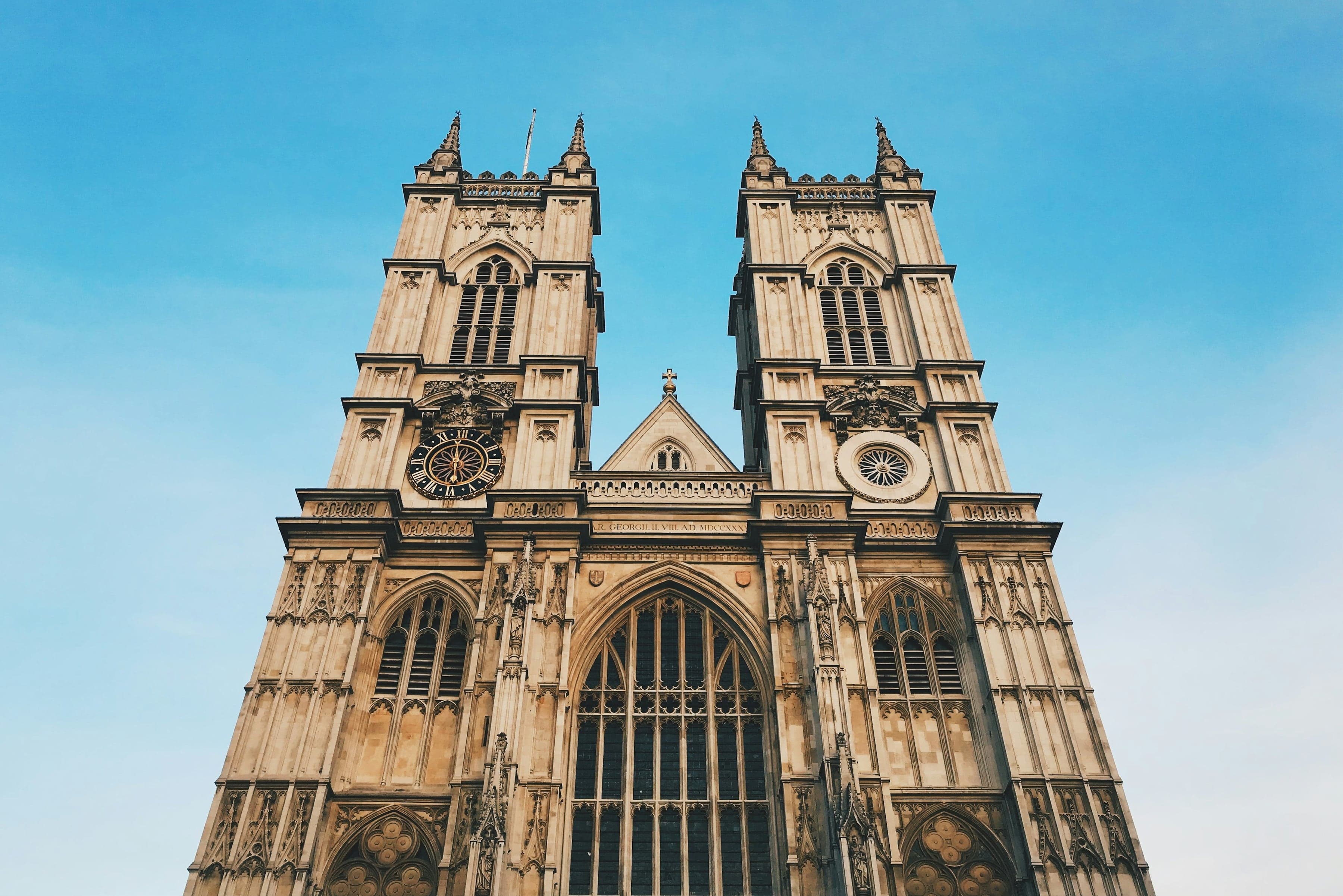
The first decision was Edward the Confessor's, in the 1050s, to rebuild and enlarge an existing Benedictine abbey on Thorney Island, a marshy patch of land in the tidal Thames about a mile and a half upstream from the City of London's walls. The abbey, originally founded in the 960s, sat in open countryside well outside the medieval City. Edward chose to relocate his royal residence from the City to a new palace beside the rebuilt abbey, where he could oversee the construction and pray daily. He was buried inside the abbey when he died in January 1066. His successor, Harold Godwinson, was crowned there days later.
The second decision was William the Conqueror's, in December 1066, to be crowned in the same abbey. William was making a political point about continuity: he wanted to be crowned in the church that had been built by, and held the bones of, the last legitimate Saxon king. By crowning himself in Edward's abbey, William was claiming Edward's legitimacy. The coronation set the precedent. Every English and British monarch since 1066 has been crowned in the same building, except the two who were never crowned at all, Edward the Fifth and Edward the Eighth.
Those two decisions, taken sixteen years apart, set the gravitational centre of English government for the next thousand years.
How the gravity well filled in
Hear a stop from this walk
Victoria Tower Gardens: Pankhurst at Parliament's Door
Once the Crown was anchored at Westminster, every subsequent layer of British constitutional life had a reason to be near the Crown. Parliament emerged as an institution in the late thirteenth century out of the King's Great Council, which met where the King was, and it did not always meet at Westminster. Henry the Third sat his early Parliaments in the Painted Chamber of the Palace of Westminster, adjacent to the Abbey, but it was only by the fifteenth century that Parliament was generally based at Westminster. The Commons first met in the Abbey's Chapter House in 1352. The medieval Palace of Westminster, with its Chapel of St Stephen's, later became the customary meeting place for the Commons, which formally adopted St Stephen's Chapel as its chamber after the dissolution of the chantries in 1547.
The executive arm of government followed. The crown's principal officers of state had offices near the King. As royal administration grew in the late medieval and early modern period, those offices clustered along a single road north of the Palace of Westminster, leading up toward Charing Cross. That road was Whitehall, named for the Palace of Whitehall, which Henry the Eighth had seized from Cardinal Wolsey after Wolsey's fall and made the main royal residence in London. After most of Whitehall Palace burned down in 1698, the residential function of the Crown moved to St James's Palace and later to Buckingham Palace, but the executive offices that had grown up around Whitehall stayed where they were. They are still there: the Cabinet Office, the Treasury, the Foreign Office, the Ministry of Defence, all on the same half-mile road. The Prime Minister's office is at Number 10, in a side street off Whitehall built up in the 1680s by Sir George Downing, a diplomat who had served Cromwell's republic, changed sides, and in 1662 had three of the regicides arrested in Delft and sent home to be put to death. Robert Walpole moved into Number 10 in 1735.
The Anglican Church, established as a state religion under Henry the Eighth, kept its administrative headquarters at Lambeth Palace, directly across the river from Westminster, where the Archbishop of Canterbury has lived since around 1200. Lambeth Palace is technically not in the Westminster half-mile, but it is close enough that the Archbishop can walk across the bridge to be present at events of state. The functional connection holds.
The judiciary used to meet at Westminster Hall, the great medieval hall of the Palace of Westminster, which survived the fire of 1834. The Hall held the principal English law courts, including the Court of King's Bench and the Court of Common Pleas, from the early Middle Ages until 1882, when the courts moved to the new Royal Courts of Justice on the Strand. For seven centuries the legal system sat in the same palace as Parliament, though the Hall itself was not used for parliamentary meetings. It was also the stage for the great state trials: William Wallace in 1305, Thomas More in 1535, Guy Fawkes in 1606 and, from 20 January 1649, King Charles the First. Today the Supreme Court sits on Parliament Square itself: since October 2009 it has occupied the former Middlesex Guildhall, on the site of the Abbey's old Sanctuary Tower, where fugitives once sought refuge.
The pattern is consistent: every major institution of British government, religion, and law settled near the Westminster anchor because the anchor was already there.
The Banqueting House and the king-killing
The half-mile holds one other building that is constitutionally critical: the Banqueting House on Whitehall, designed by Inigo Jones and completed in 1622. The building was used for state banquets and court masques, but its position in British constitutional memory is fixed by what happened in front of it on 30 January 1649.
Charles the First, having lost the English Civil War, was tried in Westminster Hall by a special High Court of Justice convened by the Rump Parliament. He was found guilty of high treason. A scaffold was built out from the front of the Banqueting House, the building Charles's father, James the First, had commissioned. Charles walked to it beneath the ceiling he had installed there, Rubens's painting of his father being carried up to heaven. The plaque under his bust says he stepped out of a window; a witness wrote of a passage broken through the wall. He was beheaded by a masked executioner whose identity remains uncertain.
Historic Royal Palaces calls Charles the only English monarch to be tried and executed for treason. His son was eventually restored to the throne as Charles the Second in 1660, and the Restoration government tried to bury the memory of the regicide. But the site is unmistakable: the Banqueting House still stands, a lead bust of the executed king has sat above its entrance since 1950, and a service is held for him there every 30 January. The half-mile contains the building he walked through to his death, the hall where he was tried, and the legislature that ordered it.
That same half-mile, three centuries later, would host the Cenotaph for the dead of the First World War, designed by Edwin Lutyens in 1919. The empty tomb on Whitehall is now the focus of every Remembrance Sunday service, and the Queen or King lays the first wreath there each November. The continuity is striking. The street that saw a king's head cut off in 1649 honours the war dead of two world wars.
Trafalgar Square and the civic end
The northern boundary of the half-mile is Trafalgar Square, laid out from the 1820s onwards and named in 1830, with Charles Barry's terrace and fountains following in the 1840s, in the wedge of land formed by the convergence of Whitehall, the Strand, the Mall, and Charing Cross Road. The square memorialises the Battle of Trafalgar of 1805, and Nelson's Column at its centre was finished in 1843, but its real function is as one of London's great public-protest plazas. The square has hosted Chartist rallies in the 1840s, suffragette demonstrations in the 1900s, the Bloody Sunday riot of 13 November 1887, the anti-Vietnam protests of 1968, and a steady run of climate, anti-austerity, and anti-Brexit demonstrations in the twenty-first century.
The square's location is not accidental. It sits at the end of Whitehall, opposite the entrance to the long boulevard of the Mall, which terminates at Buckingham Palace. To protest at Trafalgar Square is to physically face the institutions of government from an open square at the head of Whitehall. The location was chosen, consciously or otherwise, to give dissent a stage that is visible from power.
At the other end of Whitehall, dissent has its own address in Parliament Square. From 2001 Brian Haw lived in a peace camp on the pavement opposite Parliament's gates. In 2005 Parliament passed a law requiring permission for demonstrations near the square, and in 2006 the Court of Appeal ruled that it covered him too. His protest outlasted two prime ministers. Power and dissent have shared the half-mile for centuries.
What this means for a walk
The Westminster tour, Westminster: The Rebels at Parliament's Gates, walks this ground from the other side, through the statues of the people who defied it. It is a loop of ten stops, about 2.9 kilometres and an hour and a half, starting at Westminster station. Boudica's chariot at the foot of Westminster Bridge. The Cenotaph and the gates of Downing Street. The Banqueting House, where the king walked to the scaffold. Horse Guards Parade, behind the garden wall of Number 10. The Blue Bridge in St James's Park. The Churchill War Rooms. The west front of Westminster Abbey, the coronation church. Parliament Square, where Nelson Mandela, Mahatma Gandhi and Millicent Fawcett have joined the statesmen. Westminster Hall and Cromwell's statue in its sunken garden. Victoria Tower Gardens for Emmeline Pankhurst. Trafalgar Square is left for after the walk, at the top of Whitehall, where the Covent Garden and Soho walk begins if you want to keep going. The tour's argument is the other half of this one: Westminster ends up honouring the people who defied it, reluctantly, late, and on its own terms.
What you are walking is a thousand-year accumulation of British civic life onto a single piece of ground, anchored by the original abbey and palace of Edward the Confessor. The half-mile reads as if it had been laid out deliberately, as if some master planner had decided to consolidate British government into one walkable district. It was not planned. It accreted. Each addition arrived because the previous one was already there, and the gravity well kept pulling new institutions toward the same patch of marshy land near the river.
That is the pattern that broke here, and the reason it broke is a story about how medieval real-estate decisions, made by two kings who died nearly a thousand years ago, still shape where the British government meets, where its monarchs are crowned, and where its dead are remembered. The half-mile is not a coincidence. It is the slow physical accumulation of one decision Edward made and one decision William made, refusing to be undone.
Ready to experience it?
Westminster: The Rebels at Parliament's Gates
90 min · 2.9 km · easy
More from London
Explore more at your own pace.
British Museum: What to See, Floor by Floor
The Arnolfini Portrait: The Mirror, the Meaning and the Myths
The Fighting Temeraire: Turner's Last Voyage of a Trafalgar Ship
The Lewis Chessmen: Kings, Queens and Berserkers in Room 40
The Parthenon Sculptures: What Is in Room 18 and How It Got There