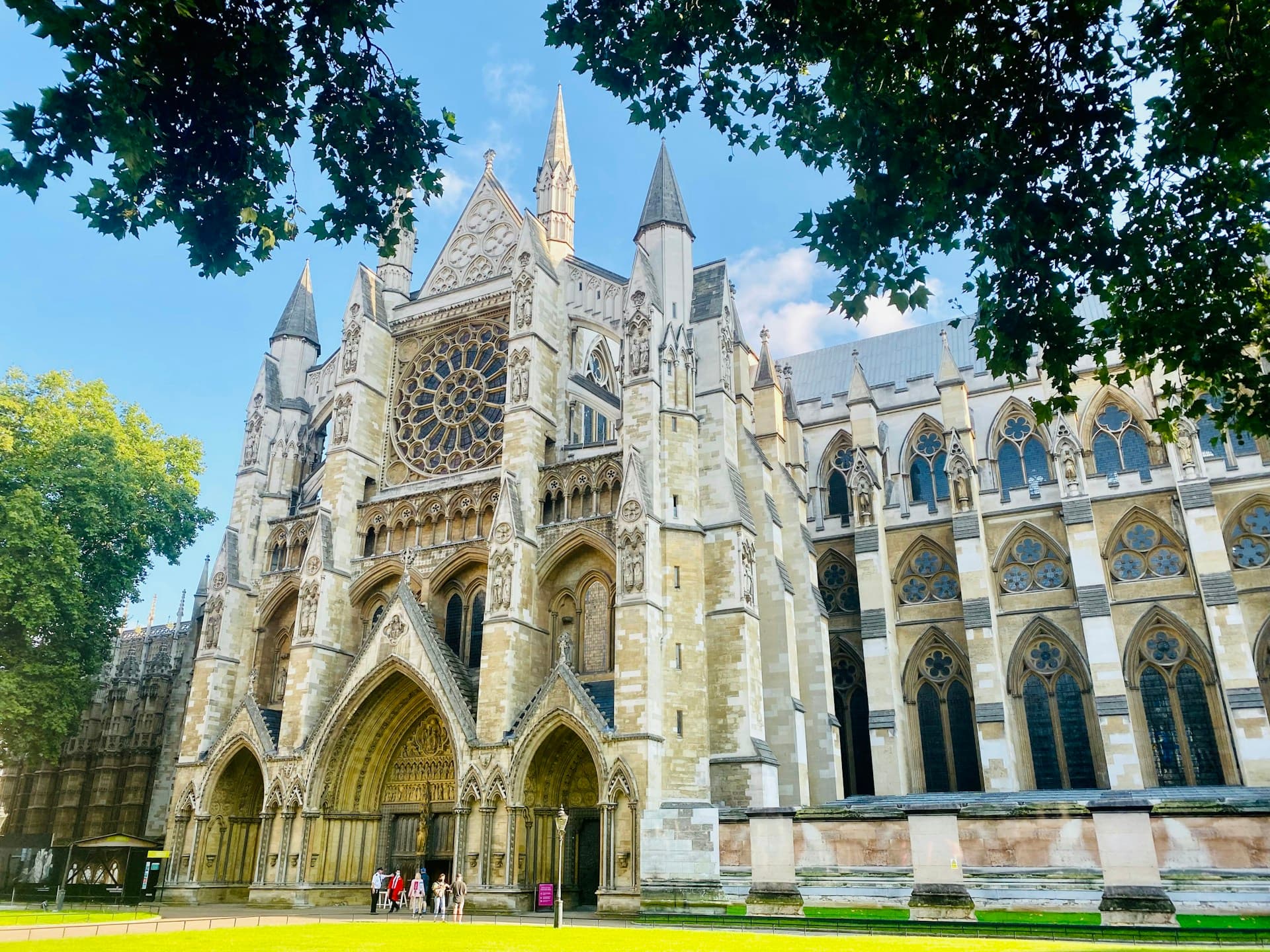
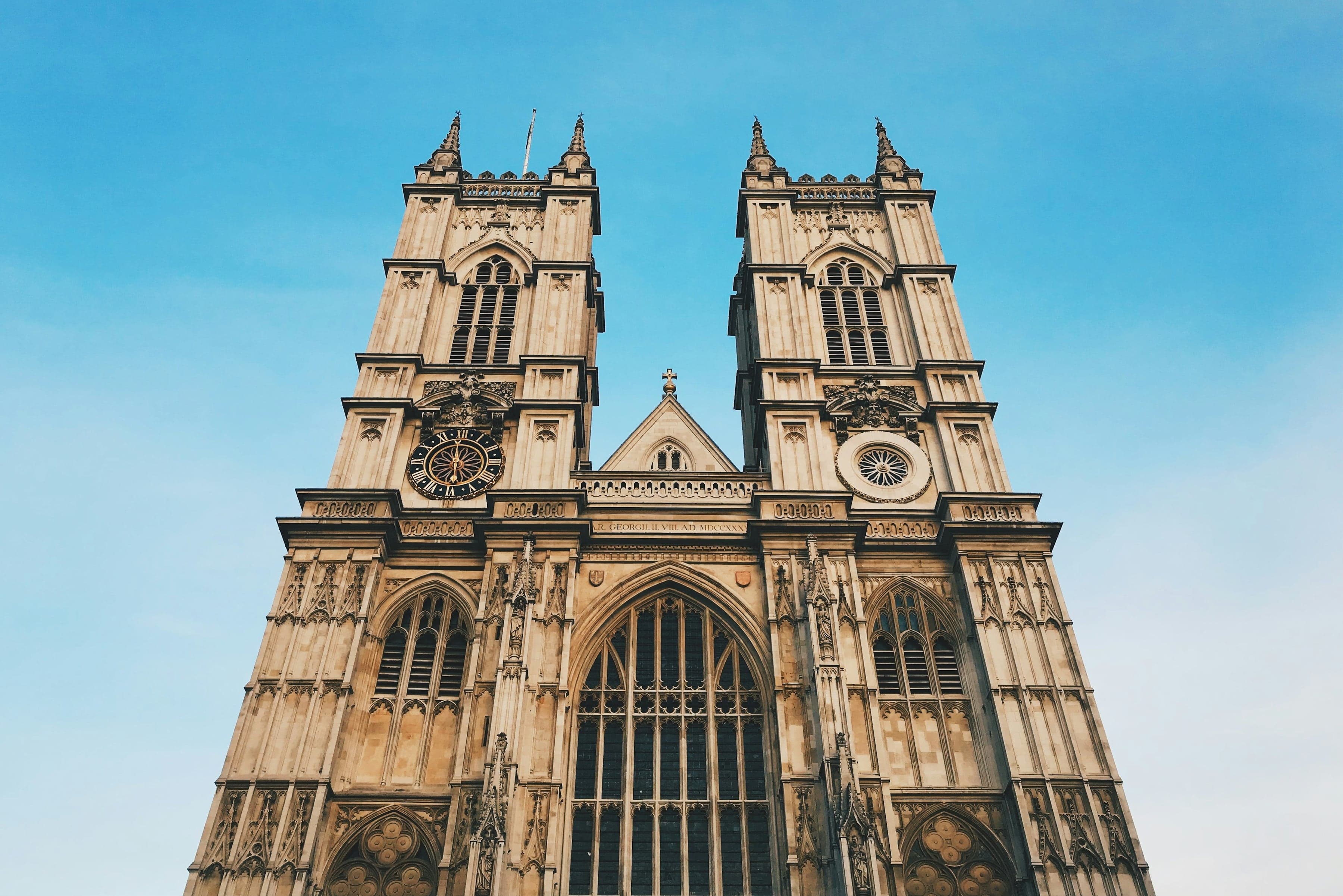
Westminster Abbey, formally the Collegiate Church of Saint Peter at Westminster, stands on a low rise on the north bank of the Thames, between the Houses of Parliament and Victoria Street. To approach it from the river you walk past Parliament, turn west, and the Abbey's twin western towers rise above the trees of Parliament Square. The towers themselves were finished in 1745, to a design by Nicholas Hawksmoor, who had died nine years before, in a Gothic style intended to match the medieval body of the building. Henry the Third began rebuilding the church behind them in 1245, and its nave took about another century and a half to finish. The eastern chapel, with its delicate fan vault, is the work of Henry the Seventh, completed in 1516. A church has been at work on this site for nearly a thousand years.
The most useful way to understand the Abbey is not as a church but as a piece of working state machinery. It has performed the coronation of every English and British monarch since 1066 except Edward the Fifth and Edward the Eighth, neither of whom was crowned: by the Abbey's own count, 39 coronations and 40 monarchs. It holds around 3,300 burials in the church and cloisters, and many more memorials, among them monarchs, statesmen, scientists, writers, and military commanders. It keeps a daily round of Anglican services, and operates as a tourist attraction generating significant revenue. It does all of this simultaneously, and has done so, more or less continuously, since the 1240s. The continuity is its main constitutional importance.
What the Abbey actually is
The Abbey was founded in the 960s as a Benedictine monastery, on a marshy patch of land called Thorney Island formed where the Tyburn stream entered the Thames. Edward the Confessor, who ruled England from 1042 to 1066, decided to rebuild the abbey on a grand Romanesque plan and to relocate his royal residence to the adjacent site. The new abbey was consecrated on 28 December 1065, when Edward was too ill to attend. He died a few days later, on 5 January 1066. He was buried inside the building he had just completed.
His successor Harold Godwinson was crowned in the Abbey on 6 January 1066, the day of Edward's burial. Harold was killed at Hastings nine months later. William of Normandy was crowned in the same building on Christmas Day 1066, and it was chaos: the acclamation was given in English and in French, the Norman soldiers outside took the noise for an attempt on the new king's life, and they set fire to the houses around the Abbey. The coronation set a precedent that has held for nearly a thousand years, broken only by the two monarchs who were never crowned, Edward the Fifth and Edward the Eighth.
The Romanesque building of 1065 is gone. In 1245 Henry the Third pulled down the eastern part of Edward's church and began the Gothic church that stands today. It was consecrated in 1269, and the nave took about another 150 years to finish. Henry built the new abbey explicitly as a setting for the cult of Edward the Confessor, whom the Church had canonised in 1161. The body of the saint-king was moved into a new shrine behind the high altar, where it remains. The architecture of Henry's church was modelled on the High Gothic cathedrals of northern France, particularly Reims and Amiens, but adapted for English use. The proportions are taller and narrower than typical English Gothic churches. The Abbey reads, in its main body, as a piece of French Gothic in English hands.
Successive monarchs added to the building over the following centuries. Edward the First commissioned the Coronation Chair, completed around 1300, to hold the Stone of Scone he had seized from Scotland in 1296. Henry the Seventh built the eastern Lady Chapel between 1503 and 1516 as his own tomb chapel, with its astonishing fan-vaulted ceiling. The western towers, designed by Nicholas Hawksmoor, were completed in 1745, after his death. The body of the building, however, is the Gothic church Henry the Third began.
How the coronation ritual works
Hear a stop from this walk
Victoria Tower Gardens: Pankhurst at Parliament's Door
The coronation ceremony itself is the most institutionally important thing that happens in the Abbey. It is the only ritual in British public life that creates a constitutional act. After 1066 each monarch became monarch by being crowned. The legal status of the act has softened over the centuries (modern British monarchs become monarch the moment their predecessor dies, not at coronation) but the coronation remains the formal ceremonial of state.
The ritual has changed remarkably little. The core elements have been continuous since at least the coronation of Edgar at Bath in 973, written down in an order of service known as the Second English Coronation Ordo. The Ordo specifies recognition, anointing, oath, investiture with regalia, crowning, enthronement, and homage. Each of these elements is performed in the Abbey, in essentially the same sequence, for every monarch.
The anointing is the constitutionally critical moment. The monarch sits in the Coronation Chair. The Archbishop of Canterbury pours holy oil on the monarch's head, breast, and hands. The act is performed under a cloth of state, screened from view: it is the only point in the modern coronation where the cameras stop filming, because the act is regarded as the sacramental moment of the ceremony. The oil anoints the monarch as God's representative on earth, a Carolingian and Byzantine ritual import dating from before the English monarchy existed.
The investiture follows: spurs, sword, orb, ring, sceptres, and finally the St Edward's Crown placed on the monarch's head. The crown itself, first used for Charles the Second in 1661, is made of solid gold and weighs 2.2 kilograms.
The Coronation Chair itself is a specific physical object: a high-backed oak chair, made on the orders of Edward the First around 1300, painted with gilding and figural scenes that have mostly worn away, with a hollow space beneath the seat designed to hold the Stone of Scone. Edward took the Stone from Scone in Perthshire in 1296 as a symbol of English domination of Scotland. The Stone is a block of red sandstone, about sixty centimetres long, with iron rings set into the ends, used by Scottish kings to sit on at their own coronations. By placing the Stone beneath the seat of the English coronation chair, Edward physically subordinated the Scottish coronation tradition to the English one.
The Scots regarded the theft as an open wound. On Christmas Day 1950, four Scottish students broke into the Abbey at night, levered the Stone out of the Chair, and smuggled it back to Scotland. They were never prosecuted. The Stone was returned to the Abbey in 1951. In 1996 the British government, in a gesture toward Scottish nationalism, transferred custody of the Stone to Scotland on the understanding that it would return to Westminster for each future coronation. The Stone was duly transported back to London in April 2023 for the coronation of Charles the Third and returned to Edinburgh Castle afterwards. The Coronation Chair has held the Stone at nearly every coronation since Edward the First's time.
The burials
The Abbey contains the bodies of seventeen English, Scottish, and British monarchs, including Henry the Third (who rebuilt the church), Edward the First (who commissioned the chair), Henry the Seventh (who built the Lady Chapel), Elizabeth the First, Mary the First (in the same tomb), Charles the Second, William the Third, Mary the Second, George the Second, and others. Edward the Confessor's shrine is the central focus. Monarchs were normally placed in chapels surrounding the saint-king's tomb, so that the holiest part of the building was the most royally crowded.
Burial in the Abbey became an honour bestowed on non-royal Britons of state importance from the early modern period onward. Sir Isaac Newton, who died in 1727, was buried in the nave with a baroque monument. The placement of Newton was deliberately prominent. The precedent established by Newton was extended through the eighteenth and nineteenth centuries. Charles Darwin was buried near Newton in 1882. The Abbey's own account of that burial records no controversy: the Dean, it says, did not hesitate to give his assent.
Stephen Hawking's ashes were interred on 15 June 2018, not far from the graves of Newton and Darwin. His memorial stone is inscribed with his equation for Hawking radiation. The placement reads as a continuation of the Newton-Darwin line: three British scientists who substantially redrew the relationship between physics, biology, and the universe, laid to rest near one another.
Poets' Corner, the south transept of the Abbey, contains the burials and memorial stones of about a hundred writers. The first burial was Geoffrey Chaucer, who died in 1400. Chaucer was buried there for circumstantial reasons: he had been Clerk of the King's Works and held a tenancy of a house on the Abbey grounds, so the burial was logistically convenient. His grave was unmarked for about a hundred and fifty years, until Nicholas Brigham erected a proper tomb for Chaucer in 1556. The accident of Chaucer's location created the tradition: later writers, including Edmund Spenser, who was buried near him in 1599, John Dryden, Samuel Johnson, and Charles Dickens, were buried near him too. The tradition continues into the twenty-first century, though memorial stones, not actual burials, are now the norm.
What survives matters
The Abbey is unusual among major European religious buildings in not having been destroyed and rebuilt during the religious upheavals of the sixteenth and seventeenth centuries. Henry the Eighth dissolved the Benedictine monastery in 1540 but kept the church itself, which is today a royal peculiar (a church directly under the crown's authority, outside diocesan jurisdiction). The Reformation stripped the building of its medieval altars, statuary, and stained glass, but did not destroy the structure. The Civil War armies of the 1640s and 1650s damaged some monuments and broke some statues, but did not raze the building. The Great Fire of 1666 stopped well short of Westminster. The Blitz of 1940-41 produced one significant strike: an incendiary bomb landed on the roof of the lantern tower in May 1941, causing a fire that was contained by Abbey wardens before it could spread. The lantern was rebuilt after the war.
The result is that the Abbey has functioned continuously without interruption since the 1240s. The Benedictine monks left in 1540. The coronations continued. The burials continued. The choirs continued. Much of the fabric is the church Henry the Third began. The Coronation Chair is the same chair Edward the First commissioned. The Stone of Scone is the same stone Edward took from Scone in 1296. The continuity is not symbolic. It is real. A single building has performed essentially the same constitutional function for nearly a thousand years.
What to look for when you go in
Before you go in, look up at the west front, where the Westminster walk stops, by the red granite column in front of the towers. Above the Great West Door is a row of ten niches that stood empty for centuries. In 1998 the Abbey filled them with ten Christian martyrs of the twentieth century, among them Martin Luther King, Oscar Romero and Dietrich Bonhoeffer. Entry for visitors is ticketed, but attending a service such as Evensong is free, through the Great West Door.
If you go inside, the path through the nave takes you past the Tomb of the Unknown Warrior, a black marble slab set into the floor near the western door. The Warrior was an unidentified British soldier killed in the First World War, exhumed from a battlefield in France, transported back to London, and buried on 11 November 1920 in soil from the Western Front, the same day the Cenotaph on Whitehall was unveiled. It is the only gravestone in the Abbey that people may not walk on. Royal brides traditionally place their bouquets on the slab after weddings, in a tradition begun by Queen Elizabeth (the Queen Mother) in 1923.
The Coronation Chair is on display inside the Abbey. The marks of about seven centuries of use are visible on the wood: gouges, gilding loss and carved graffiti. The chair is not a museum piece. It is the working coronation furniture of the British state, last used in May 2023 and presumably to be used again whenever the next coronation occurs.
The fan vault of the Lady Chapel, above your head if you walk through it, is one of the technical masterpieces of late medieval stone construction. Pendant fans of carved stone hang from the ceiling like geometric chandeliers. The work was done between 1503 and 1516. The vault is one of the latest and most ambitious examples of English perpendicular Gothic. It exists in the same building as a Saxon shrine and an Anglo-Saxon coronation tradition, all under one continuously occupied roof. That is the working machine, and what you are walking through is its main hall.
Ready to experience it?
Westminster: The Rebels at Parliament's Gates
90 min · 2.9 km · easy
More from London
Explore more at your own pace.
British Museum: What to See, Floor by Floor
The Arnolfini Portrait: The Mirror, the Meaning and the Myths
The Fighting Temeraire: Turner's Last Voyage of a Trafalgar Ship
The Lewis Chessmen: Kings, Queens and Berserkers in Room 40
The Parthenon Sculptures: What Is in Room 18 and How It Got There