
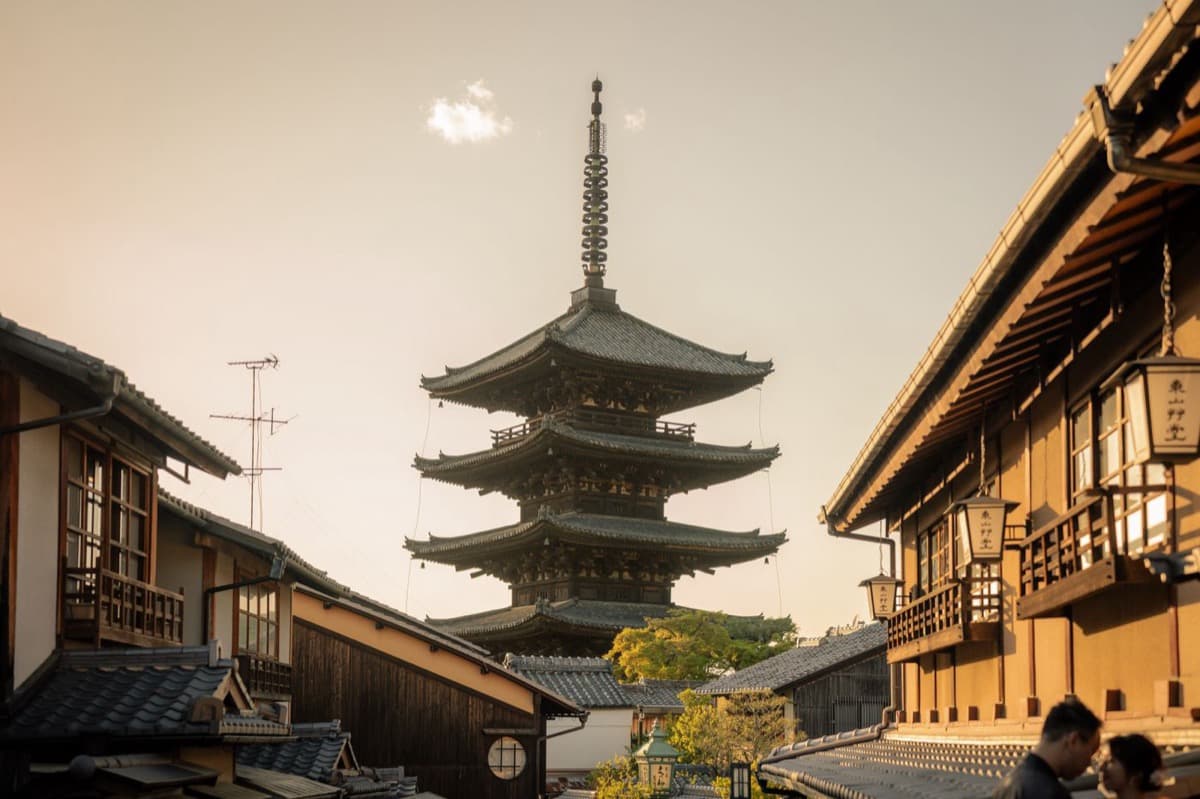
Higashiyama: The Engineered Hillside
90 min · 2.5 km · moderate
Kyoto and Tokyo are not really rivals. They are two halves of the same trip. Kyoto is the thousand-year-old imperial capital, a city of temples, wooden machiya houses, and preserved streets you experience on foot. Tokyo is the modern metropolis, one of the largest urban areas on Earth, defined by scale, speed, food, and constant reinvention. If you want tradition and quiet lanes, Kyoto answers that. If you want energy, neon, and endless neighborhoods, Tokyo answers that. And because the bullet train links them in a little over two hours, the honest answer for most first-timers is: do both.
Kyoto vs Tokyo at a glance
| Kyoto | Tokyo | |
|---|---|---|
| Character | Old imperial capital, tradition | Modern megacity, reinvention |
| Signature sights | Temples, shrines, wooden lanes | Skyline, neighborhoods, food |
| Feel on foot | Compact, low, made for walking | Walkable district by district, huge overall |
| Pace | Slower, contemplative | Fast, dense, layered |
| Ideal stay | 2 to 3 days | 3 to 4 days |
| Best for | First-timers wanting old Japan | First-timers wanting the modern city |
The case for Kyoto
Hear a stop from this walk
Yasaka Shrine: Engineered Against Plague
Kyoto was Japan's capital for over a thousand years, and it largely escaped the wartime bombing that flattened much of Tokyo. What survives is a working city built around temples, shrines, imperial gardens, and the wooden townhouses called machiya. The point of Kyoto is not to tick off a list of monuments but to walk. The Higashiyama hillside, the geisha district of Gion, and the vermilion gate tunnels of Fushimi Inari are all experiences you have with your feet.
That makes Kyoto ideal for a self-guided walking tour, where you set the pace and linger where you want. Our Higashiyama: The Engineered Hillside tour reads the preserved slope as a piece of design rather than a postcard, and Gion and the Floating World walks the entertainment district that gave us the geisha image. If you are weighing which routes suit your trip, our guide to the best walking tours in Kyoto lays them out.
Choose Kyoto if you want tradition, atmosphere, and streets that reward slow attention.
The case for Tokyo
Tokyo is the opposite proposition: not preserved, but perpetually rebuilt. It is less a single city than a federation of distinct neighborhoods, each with its own character, stitched together by one of the best rail systems on the planet. Asakusa keeps the old downtown feel around Senso-ji temple; Harajuku and Omotesando are fashion and youth culture; Yanaka is a rare pocket of low-rise streets that survived. You do not walk across Tokyo. You walk a district, then take the train to the next.
That structure is why Tokyo rewards a neighborhood-by-neighborhood approach. Our Asakusa and Senso-ji: Where Tokyo Came to Pray and Play tour covers the old-Tokyo heart around Senso-ji, and Yanaka: The Surviving Low City walks one of the few areas that kept its pre-war grain. The full set is in our best walking tours in Tokyo guide.
Choose Tokyo if you want scale, variety, food, and the feeling of a city that never stops moving.
Can you do both in one trip?
Yes, and you probably should. The Tokaido Shinkansen connects Tokyo and Kyoto in roughly 2 hours and 15 minutes on the fastest Nozomi service, with trains running many times an hour from central stations in both cities. That is faster and more comfortable than most short-haul flights once you count airport transfers.
The standard first-timer itinerary is a week split between the two: three to four days in Tokyo, two to three in Kyoto, with the train ride as a painless middle. If you have a Japan Rail Pass, note that it does not cover the fastest Nozomi trains, but the slightly slower Hikari services on the same line are covered and only add around twenty minutes.
So which should you choose?
If you have one trip and want the widest impression of Japan, do both. If you are forced to pick one:
- Pick Kyoto for temples, tradition, wooden streets, and walking. It is the more concentrated, more atmospheric city, and the easier one to experience on foot.
- Pick Tokyo for scale, food, pop culture, and the energy of a living megacity. It rewards more days and more curiosity about the present.
Either way, the way to actually feel these cities is on foot, at your own pace, with narration you can pause. Start with our best walking tours in Kyoto and best walking tours in Tokyo.
Frequently asked questions
- Is Kyoto or Tokyo better for first-timers?
- Most first-time visitors to Japan do both, and the standard advice is to base yourself in Tokyo for the modern city and day-trip or overnight to Kyoto for the temples. If you can only pick one and you want tradition, wooden streets, and temples, choose Kyoto. If you want scale, neon, food, and pop culture, choose Tokyo.
- Can you visit both Kyoto and Tokyo in one trip?
- Yes, easily. The Tokaido Shinkansen bullet train connects them in roughly 2 hours and 15 minutes on the fastest Nozomi service, running many times an hour. A one-week Japan trip that splits time between the two cities is one of the most common itineraries there is.
- How many days should I spend in each?
- A good baseline is three to four days in Tokyo and two to three days in Kyoto. Tokyo rewards more time because it is so large; Kyoto's core sights are more concentrated, though the surrounding temples and Nara can easily absorb an extra day.
- Is Kyoto more walkable than Tokyo?
- In its historic districts, yes. Kyoto's Higashiyama and Gion are dense, low, and made for walking. Tokyo is walkable neighborhood by neighborhood but far too large to cross on foot, so you walk a district and take the train to the next one.