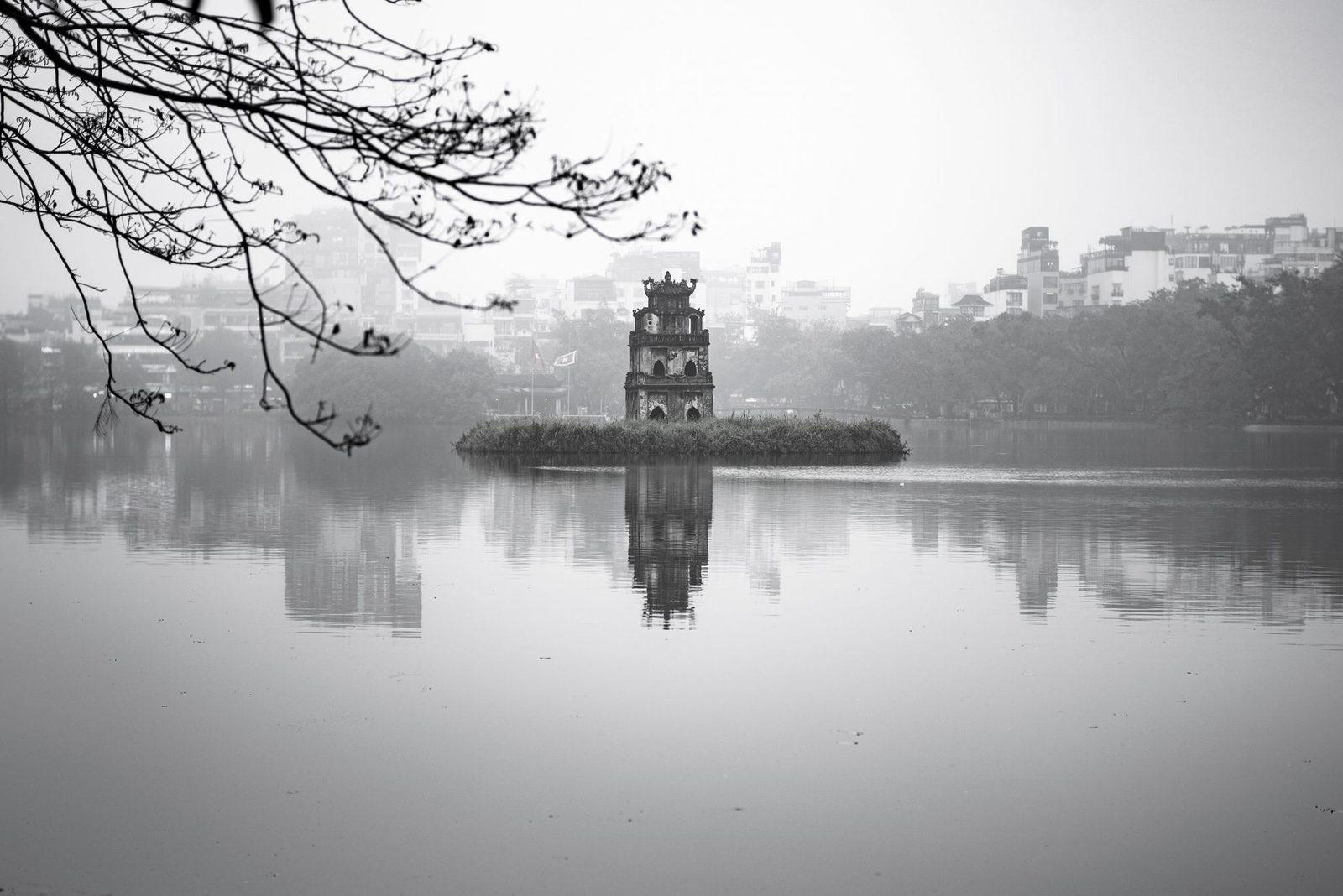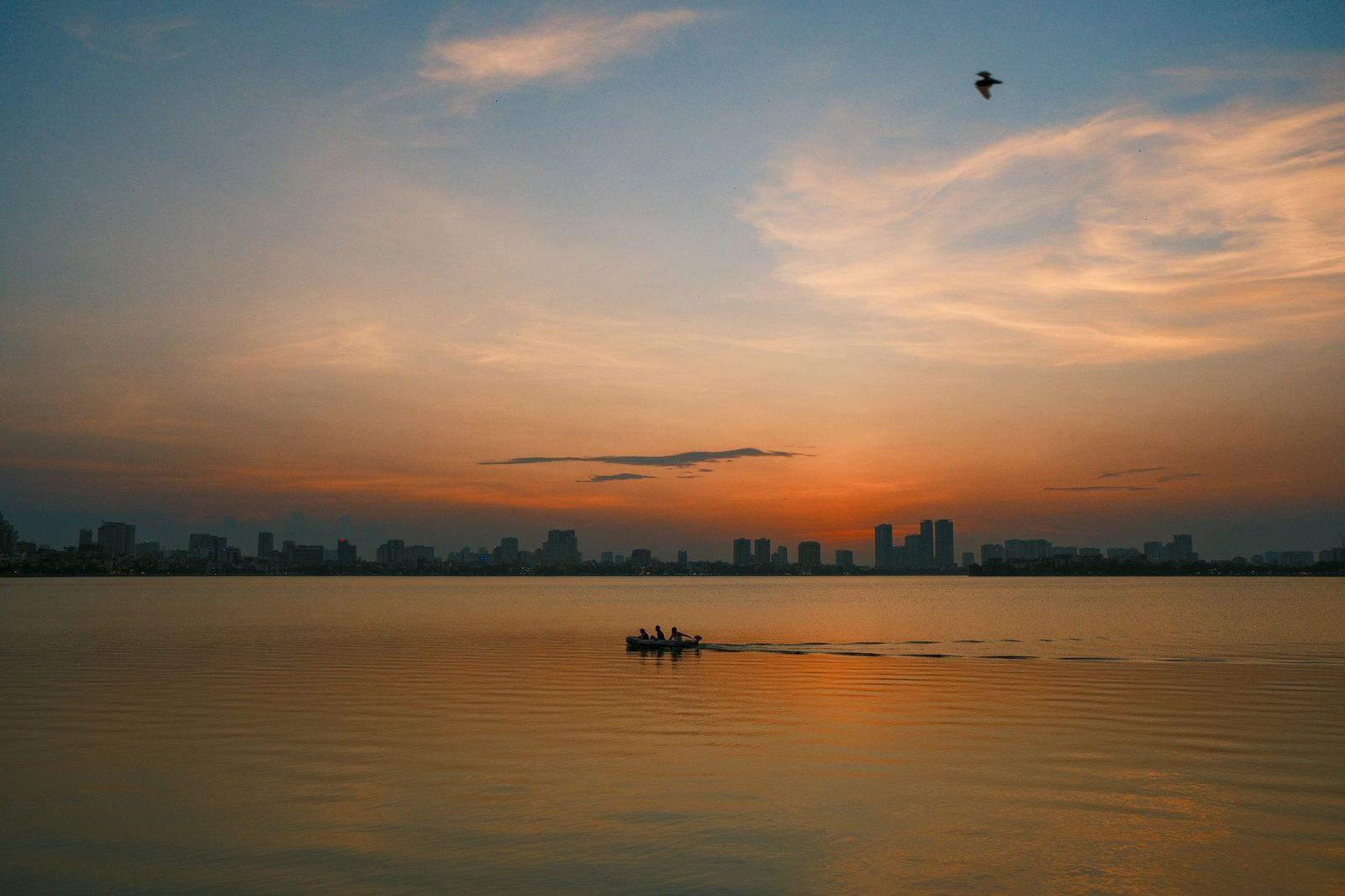
Hanoi's northern lakes are a landscape people made. West Lake, the city's largest, is a bend of the old Red River left behind; the World Lake Database describes it as a former segment of the river's course. Truc Bach, beside it, was once part of the same water, until a fishermen's path cut it off. The path was mended every year, then widened into a road, and the two lakes have lain on either side of it ever since. Round the smaller lake stand the pieces of an older city that lived off the water: a guardian temple, a pagoda moved to an islet, a shrine to a puppy, a shore named for silk and an island of bronze casters.
One road, two lakes
By the Hanoi Times account, from the seventeenth century fishermen built a narrow embankment between two lakeside villages as a shortcut, and had to repair it every year. One record from the citadel's conservation center dates a dam here called Co Ngu to 1642. In the early 1960s the path was widened and renamed Thanh Nien, Youth Road. Walk it and West Lake opens on one side, Truc Bach on the other.
Both lakes have shrunk. The World Lake Database gives West Lake 466 hectares in 1960 and 413 in 1992; the city's own 2026 planning counts its water differently, so the walk gives no figure for today.
The guardian of the north
Hear a stop from this walk
Ngu Xa Lakeside: Sunset over the Causeway
The walk starts at Quan Thanh Temple, also called Tran Vu Temple, at the south-east corner of Truc Bach. It is dedicated to Huyen Thien Tran Vu, guardian of the north, and is one of four sacred temples that guarded the Thang Long citadel, one for each direction. Its buildings are in a nineteenth-century style. Inside sits the reason to go in: a black bronze of the guardian, 3.96 meters tall and about 4,000 kilograms. Records give its casting date as 1677 and name the official who directed the work, Vu Cong Chan. It is recognized as a national treasure. The pin stays at the gate; the statue is told, not seen, unless you step inside.
A memorial on the causeway
Partway up the causeway, on the Truc Bach side, is a small memorial. On 26 October 1967, during the Vietnam War, which Vietnam calls the American War, the US Navy pilot John McCain was shot down over Hanoi, ejected, and came down in Truc Bach. He was held as a prisoner of war until March 1973 and later became a United States senator. The memorial's inscription records his capture here. Its original text had his name and service wrong and was reworded in 2015, according to Viet Nam News. A rebuild, larger and in stone, was planned for 2024 and 2025; no report we found confirms it was finished, so you may see the older memorial or its replacement. His years as a prisoner belong to our French Quarter walk's stop at Hoa Lo Prison.
The pagoda that moved
Across Thanh Nien, on an islet in West Lake, stands Tran Quoc Pagoda. The citadel conservation center's page tells its founding as legend: built under Ly Nam De in the sixth century on the Red River bank, and moved to the islet in the early 1600s after the land cracked. The name means protecting the nation. Its bodhi tree grew from a sapling of the Bodh Gaya tree, planted during the Indian president's state visit in 1959. The tall red stupa over the trees is recent, begun in 1998 and finished in 2003.
Back on Truc Bach, a small temple sits on its own islet at the end of a footbridge about eighteen meters long. Its older name, Cau Nhi, refers to a puppy said by legend to carry a prophecy in its fur, and the story ties it to Ly Cong Uan, born in a Year of the Dog, who made Thang Long his capital in 1010.
Silk on one shore, bronze on the island
On the north shore the lake's name comes with a story. The Hanoi Times tells of a Trinh lord's lakeside palace where palace women were later sent, and where they raised silkworms and wove a thin white silk called Truc silk; the lake took a related name. It is told as the story the name carries. A rhymed prose poem of 1801 about West Lake names two weaving wards and five casting communes on these shores.
The casters are still across the water. Ngu Xa means five communes, after the five villages its bronze workers came from in Bac Ninh and Hung Yen, under the Le dynasty or in the seventeenth century depending on the source. In 2022 two family workshops were still casting on the island. At its main junction the village pagoda keeps a bronze Amitabha made between 1949 and 1952, about 3.95 meters tall and about 12.3 tonnes, almost exactly the height of the Quan Thanh guardian at three times the weight. Our piece on Hanoi's bronze casters goes further, and Ngu Xa Street is the place for pho cuon, rolled pho.
Before you go
The walk is ten stops over about 1.7 km and takes about an hour. It is flat and step free. It crosses Thanh Nien twice at zebra crossings with no signal, and the last stretch follows lakeside lanes with no sidewalk, shared with motorbikes. The temples and pagodas open by day at hours that are not published; cover shoulders and knees if you go in.
It is made to finish at sunset on Ngu Xa's western shore, facing back across the lake to the causeway: about a quarter past five in December, nearer six by mid-February, so start about an hour before. Walk it at your own pace with West Lake and Truc Bach: Two Lakes and a Causeway, and if you want more afterward, our Imperial Citadel walk ends a short way east of Quan Thanh Temple.
Ready to experience it?

West Lake and Truc Bach: Two Lakes and a Causeway
60 min · 1.7 km · easy
More from Hanoi
Explore more at your own pace.

Best Culture Walking Tours in Hanoi (2026)
Best History Walking Tours in Hanoi (2026)
Hanoi's Bronze Casters: Quan Thanh's Guardian and the Island of Ngu Xa
Hanoi's Railway Through the City: From Long Bien Bridge to Train Street
Hoan Kiem Lake: The Returned Sword and the City Around It