Two great bronzes stand on the shores of Truc Bach Lake, a few hundred meters apart. One is a guardian cast in 1677 that sits in Quan Thanh Temple. The other is a Buddha made between 1949 and 1952 for the pagoda on Ngu Xa, an island village of bronze casters. Between them they tell how a craft settled on Hanoi's northern lake and stayed.
The guardian of the north
Quan Thanh Temple, also called Tran Vu Temple, stands at the south-east corner of Truc Bach. It is dedicated to Huyen Thien Tran Vu, guardian of the north, and is one of four sacred temples that guarded the Thang Long citadel, one for each direction. Its buildings are in a nineteenth-century style. The reason to step inside is the statue in the main hall: a black bronze of the guardian, 3.96 meters tall and about 4,000 kilograms, by the Vietnam News Agency's figures.
Records give the casting date as 1677. Tuoi Tre names the official who directed the work, Vu Cong Chan, who lived from 1618 to 1698, and says the bronze replaced an earlier wooden statue. Today it is recognized as a national treasure. Many guides credit the Ngu Xa casters with making it; the sources we read name only the official who led the casting, so that credit is best heard as popular rather than proven.
Five communes on an island
Hear a stop from this walk
Ngu Xa Lakeside: Sunset over the Causeway
Across the lake, Ngu Xa sits on its own island. The name means five communes, after the five villages its bronze workers came from, in Bac Ninh and Hung Yen. Vietnam Law Magazine dates their arrival to the Le dynasty, between 1428 and 1527; VietnamPlus dates the village to the seventeenth century. Either way, bronze casting was counted among the prominent crafts of Thang Long, and this was one of its homes.
A poem shows how the craft looked from the shore. A rhymed prose piece of 1801 about West Lake, quoted by the Hanoi Times, names two weaving wards and five casting communes round these waters. The weavers are the story behind Truc Bach's name. The casters are still here: in 2022 Vietnam Law Magazine found two family workshops still casting on the island, and VietnamPlus showed artisans at work in 2024. The workshops are homes, so look from the lane.
A Buddha made as the colonial era ended
At the island's main junction, the village pagoda, Chua Than Quang, stands beside the communal house. Inside is a bronze Amitabha made between 1949 and 1952, about 3.95 meters tall and about 12.3 tonnes. Set it beside the Quan Thanh guardian and the numbers make their own comparison: almost exactly the same height, at about three times the weight. One magazine calls it the country's oldest bronze Buddha, which cannot be right for a statue of the 1950s, so take the size, not the superlative.
Something to eat
Ngu Xa Street is also Hanoi's place for pho cuon, rolled pho: cooked beef and herbs wrapped in uncut sheets of pho noodle, as the city's tourism department describes it. Where the dish began is told several ways, so enjoy it without the origin story.
Seeing them
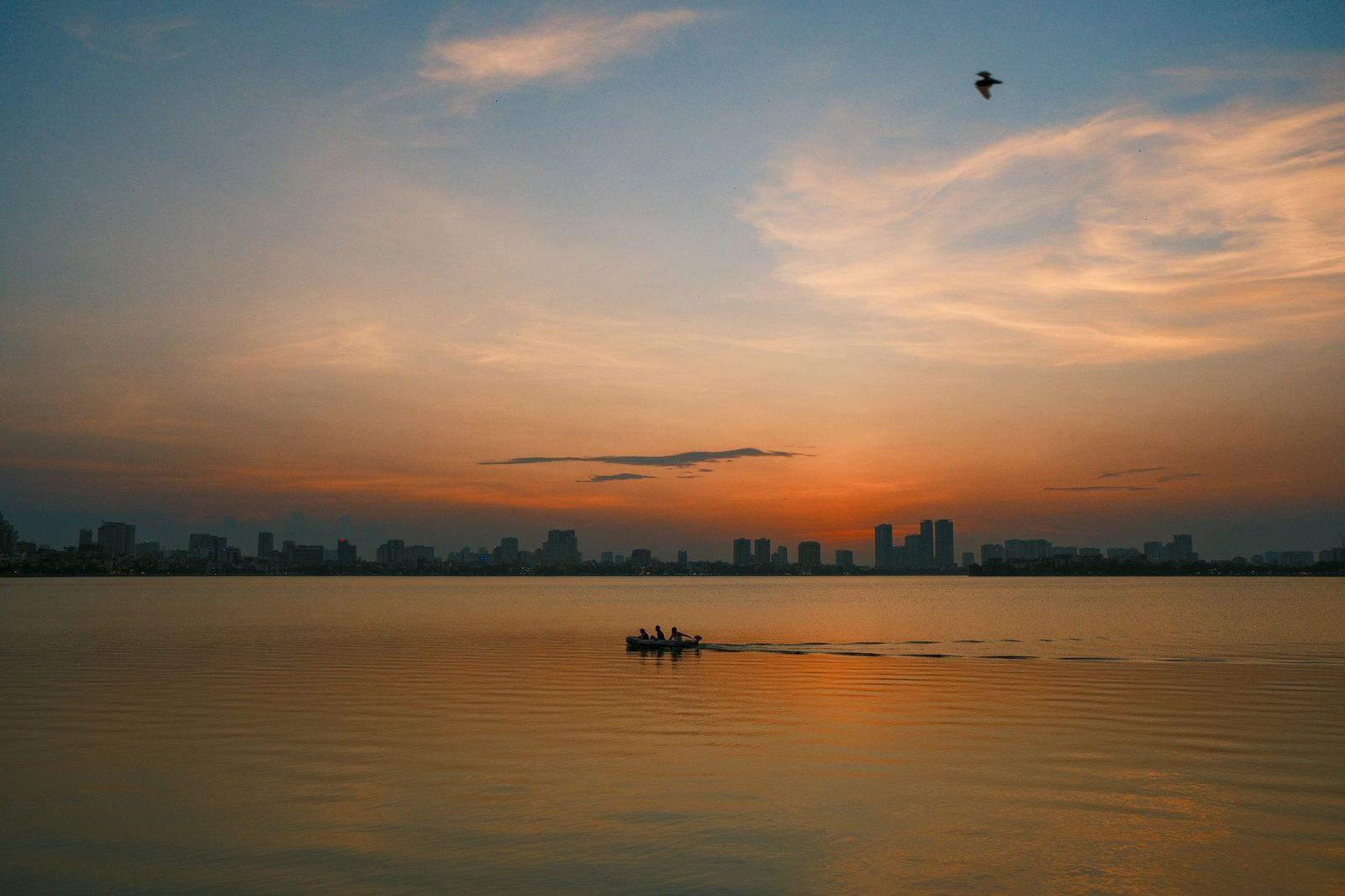
Quan Thanh Temple is the first stop and the Ngu Xa pagoda the ninth on our walk round the smaller lake, West Lake and Truc Bach: Two Lakes and a Causeway. Both open by day at hours that are not published; cover shoulders and knees if you go in, and step inside only if the doors are open. Our West Lake and Truc Bach companion tells the rest of the lakes' story, and the walk ends on Ngu Xa's western shore at sunset, so you can take the casters' island at your own pace before the light goes.
Ready to experience it?

West Lake and Truc Bach: Two Lakes and a Causeway
60 min · 1.7 km · easy
More from Hanoi
Explore more at your own pace.

Best Culture Walking Tours in Hanoi (2026)
Best History Walking Tours in Hanoi (2026)
Hanoi's Railway Through the City: From Long Bien Bridge to Train Street
Hoan Kiem Lake: The Returned Sword and the City Around It
West Lake and Truc Bach: Two Lakes, a Causeway and a Village of Bronze Casters