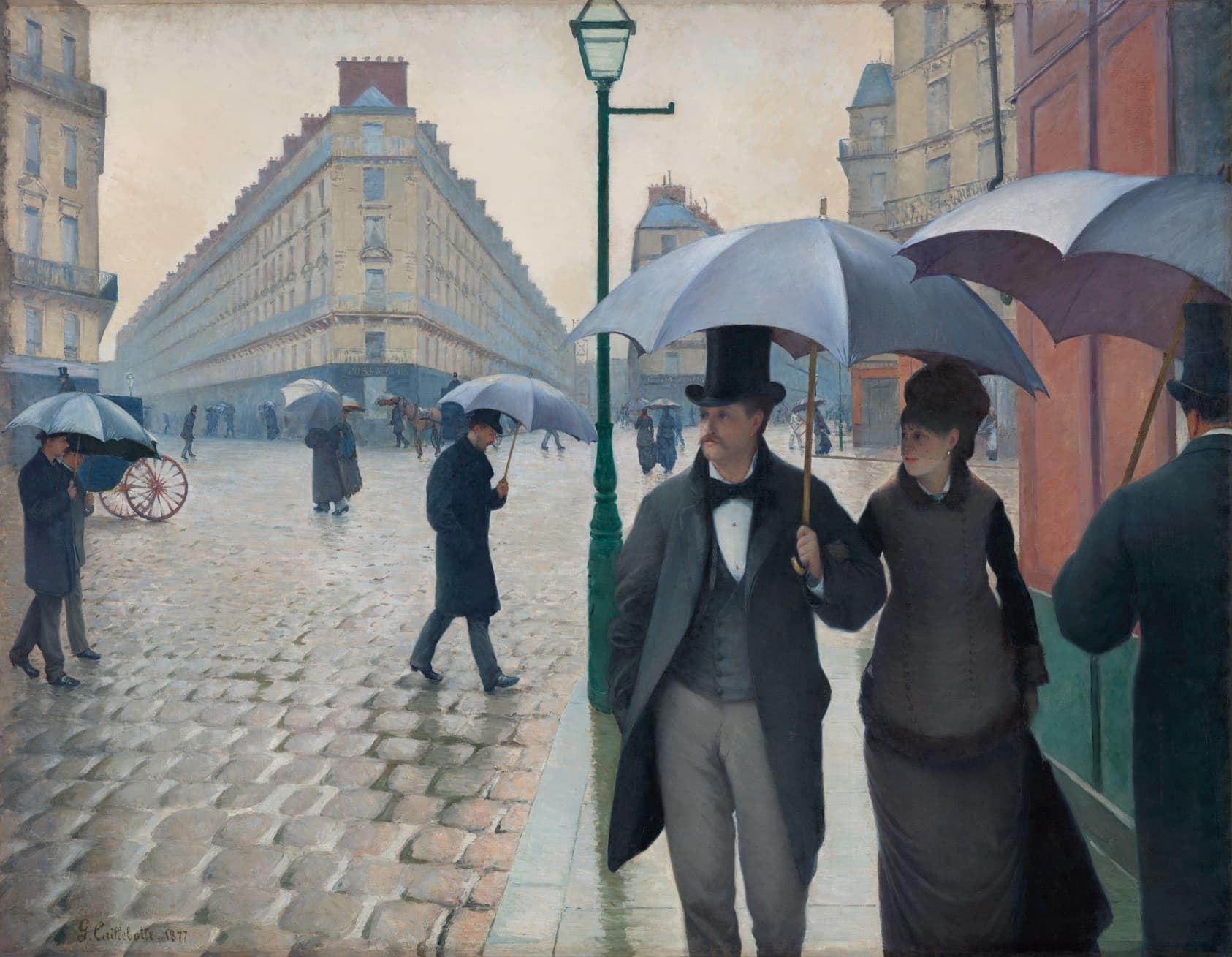
Paris Street; Rainy Day is an 1877 oil painting by Gustave Caillebotte. It hangs in Gallery 201 on Level 2 of the Art Institute of Chicago, which bought it in 1964. It matters because it is Caillebotte's largest and most ambitious work, and it caught a newly rebuilt Paris at street level.
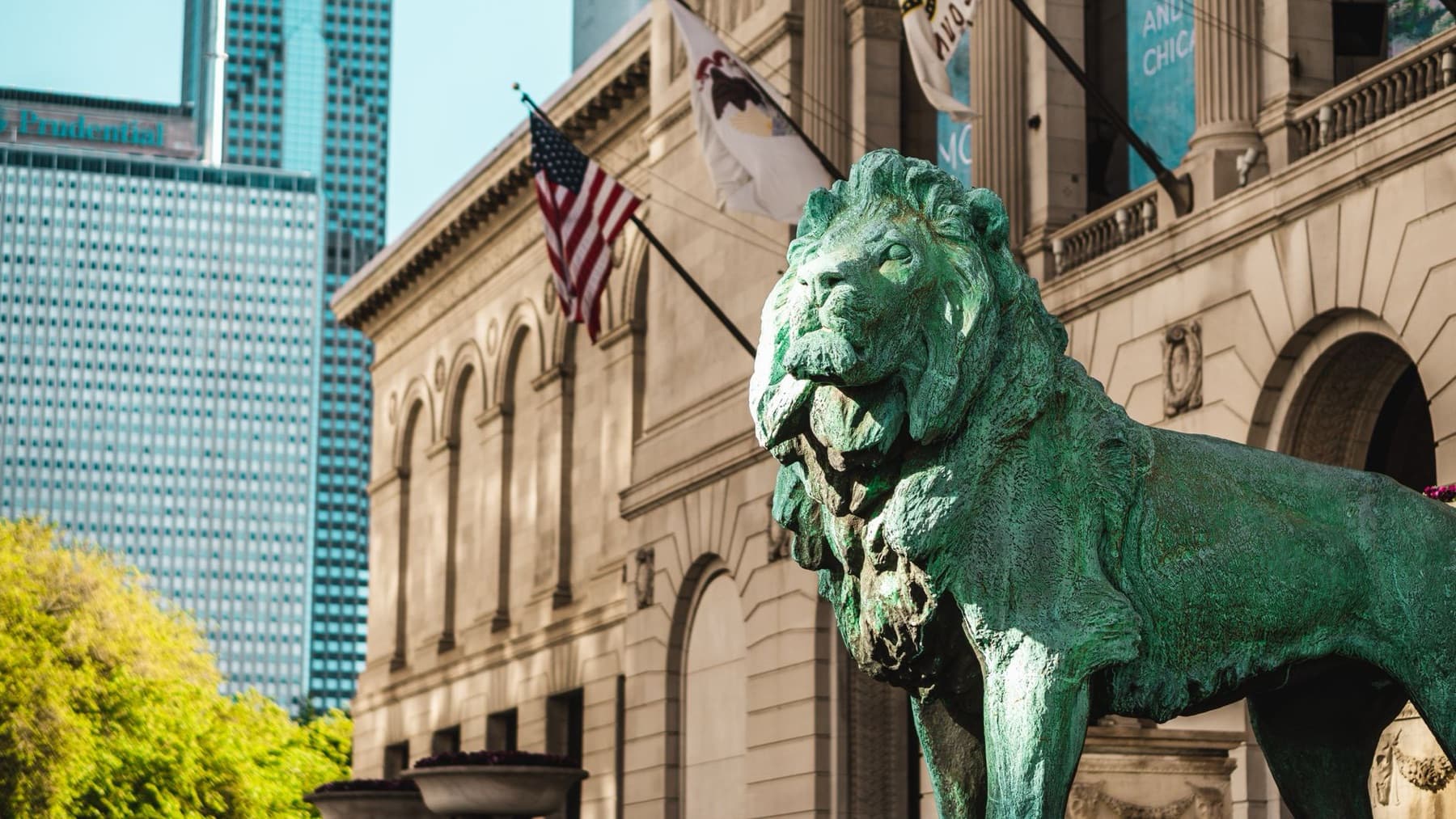
If you are looking for Paris Street; Rainy Day, it is in Gallery 201 on Level 2 of the Art Institute of Chicago. Gustave Caillebotte painted it in 1877, and the museum bought it in 1964. It is among the best-known paintings in the building, and the museum calls it Caillebotte's largest and most ambitious work.
How big is Paris Street; Rainy Day?
The canvas measures 212.2 by 276.2 centimetres, which is 83 1/2 by 108 3/4 inches. That is a little over nine feet wide. The museum's record lists the medium as oil on canvas and the place of origin as Paris. Photographs flatten the scale. In the room the street corner is close to life size, and the two figures at the centre are not far from it.
A real corner, a short walk from home
Hear a stop from this walk
Daley Plaza: Steel That Rusts on Purpose
Caillebotte did not invent this street. The museum says the painting captures a busy intersection a short walk from his home, and that his Paris pictures rarely stray beyond the neighbourhoods he knew. Wikipedia names the streets: the Rue de Turin, Rue de Moscou, Rue Clapeyron and Rue de Saint-Pétersbourg, meeting at what is now the Place de Dublin in the eighth arrondissement.
The date matters. Paris was in the middle of a decades-long rebuilding under Napoleon III and the prefect Georges-Eugène Haussmann, which turned medieval lanes into wide boulevards and tall, uniform stone apartment blocks. This corner sits at the edge of that new Paris. The museum's short description sums up what the picture is about: an everyday moment and everything that was new, including the latest fashions, the grand boulevards and the retractable umbrella, which it describes as just invented.
The rain you never see
Look for raindrops and you will not find any. The museum's text says Caillebotte did not paint them explicitly. He suggests the weather in two ways: the umbrellas, and the subtle reflections on the wet cobblestones. The sky and the grey-blue stone do the rest. It is a good lesson in how much a painter can leave out.
Walking straight at you
The two figures in the foreground, a man and a woman sharing an umbrella, seem to be walking straight into the viewer. The museum notes that something outside the frame has caught their attention. We never learn what.
Two details of the composition are worth knowing before you step up. The museum says the dramatic cropping may have been inspired by photography, which was then newly popular. And a green lamppost runs down the middle of the canvas, which Wikipedia notes splits the picture into two halves and helps set up the sense of depth.
The museum also points out that artists of the time rarely tried to show people in motion, and that Caillebotte placed each of the figures in the background with care to give the feeling of bustling streets. Wikipedia counts 24 people in all, most of them well-to-do pedestrians dressed for a cold, wet day, with a few workers in the background: a maid, two cab drivers and a house painter carrying a ladder.
Impressionist, but not quite
Caillebotte showed this painting at the third Impressionist exhibition in Paris in April 1877, where the museum's exhibition history lists it as number 1, under the title Rue de Paris; Temps de pluie. He shared the Impressionists' interest in modern city life. The museum says, though, that he approached it with a more Realist technique. Instead of dissolving the scene into flickering brushstrokes, he built a precise, deep street with careful perspective.
Wikipedia notes that this made him an awkward fit for the group even then: critics praised the painting's precision, and some saw him as Impressionist in name only.
How it ended up in Chicago
After Caillebotte's death in 1894 the painting passed down through his family. By the museum's provenance it went through relatives in France, then to Walter P. Chrysler, Jr. of New York in 1954, then to the dealer Wildenstein and Company, which sold it to the Art Institute in 1964. The museum says it has been a visitor favourite ever since, and that it came to Chicago well before Caillebotte's place among the Impressionists was widely recognised.
What to look for in front of it
Stand in the middle first and let the couple walk toward you. Then follow their gaze to the edge of the frame and wonder what they are looking at.
Next, drop your eyes to the cobblestones. Find the reflections, and notice how the whole sense of a wet day comes from them and from the umbrellas, not from any rain.
Then look up at the buildings. The pale stone fronts are smooth, tall and nearly identical, which is exactly what the new Paris looked like. Finally, hunt for the small figures: the person carrying a ladder, the cab, the maid. They are easy to miss and they make the street feel like a place rather than a stage.
How this fits the Roamer guide
Roamer's audio guide to the Art Institute of Chicago has a story for Paris Street; Rainy Day itself and one for the Impressionism room around it, on Level 2. You can find it in the Art Institute of Chicago guide. For the rest of the museum, floor by floor, read what to see at the Art Institute of Chicago.
Cover image: Gustave Caillebotte, Paris Street; Rainy Day, 1877, Art Institute of Chicago, CC0, via the Art Institute of Chicago.
Ready to experience it?
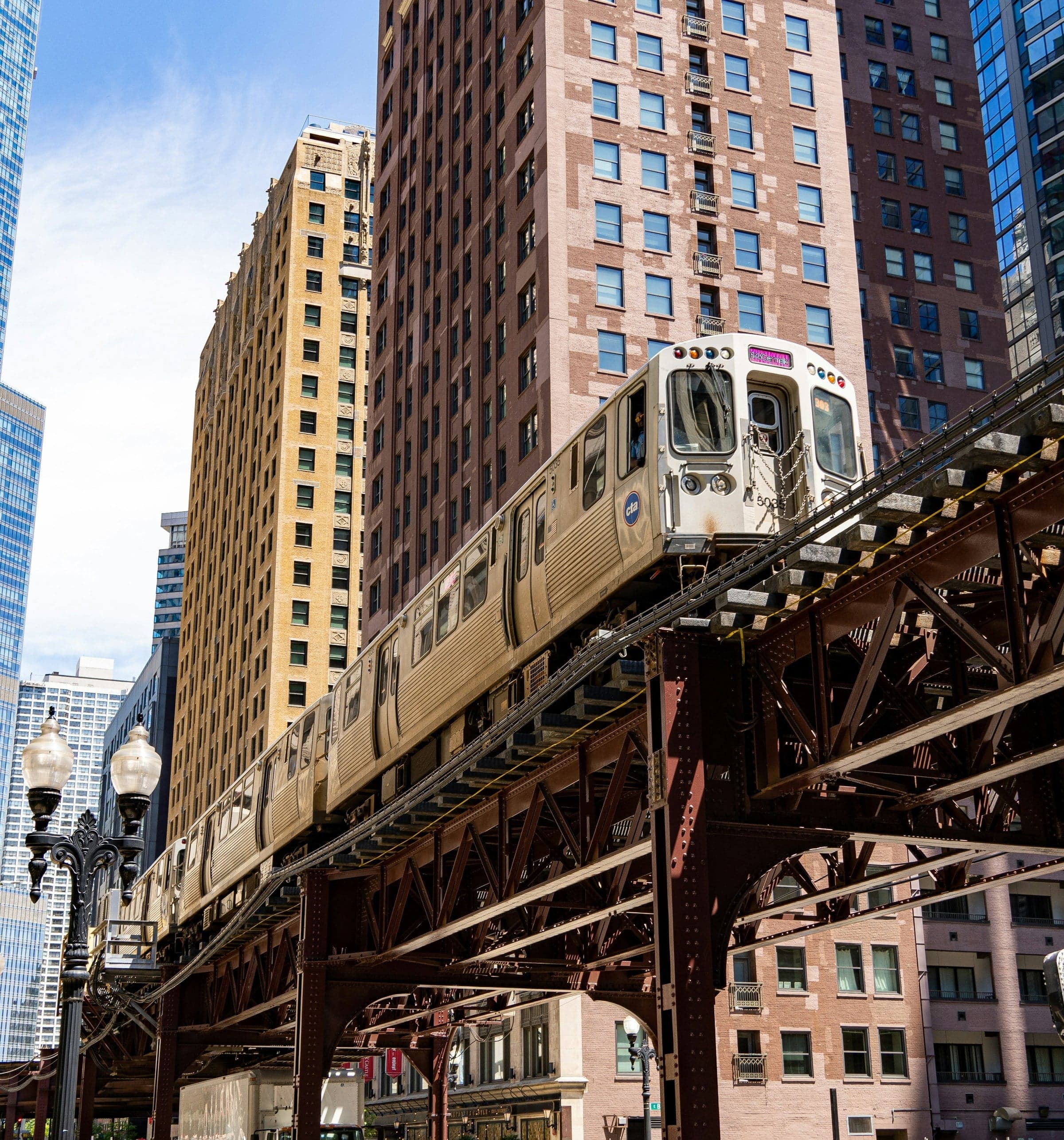
The Loop: The Frame Behind the Wall
90 min · 2 km · easy
More from Chicago
Explore more at your own pace.
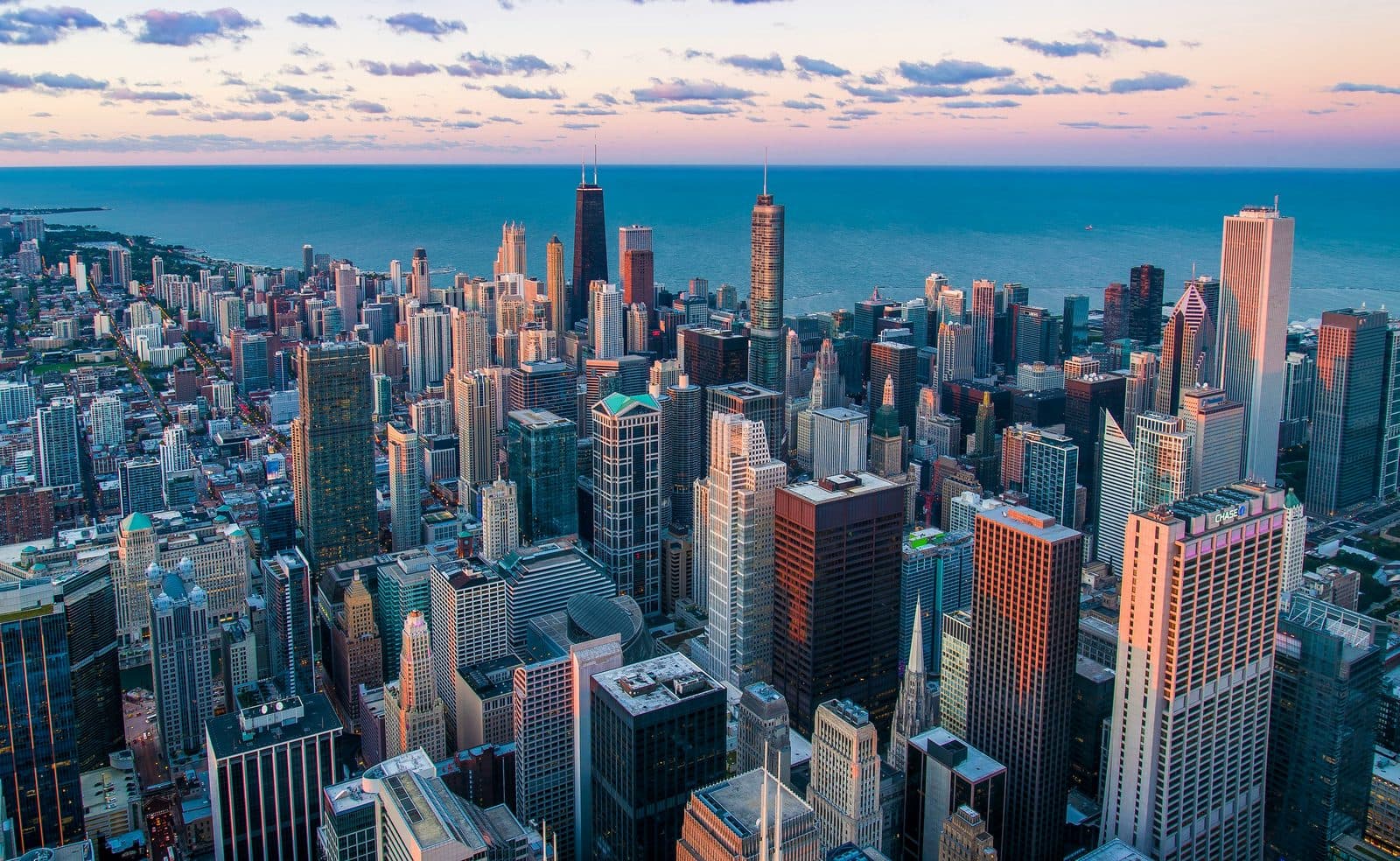
Chicago Travel Guide: How Many Days, Getting Around, When to Go (2026)
One Day in Chicago: A Walkable Downtown Itinerary (2026)
A Sunday on La Grande Jatte: Seurat's Park of Dots, in Chicago
Art Institute of Chicago: What to See, Building by Building
Thorne Miniature Rooms: Sixty-Eight Interiors at One Inch to the Foot