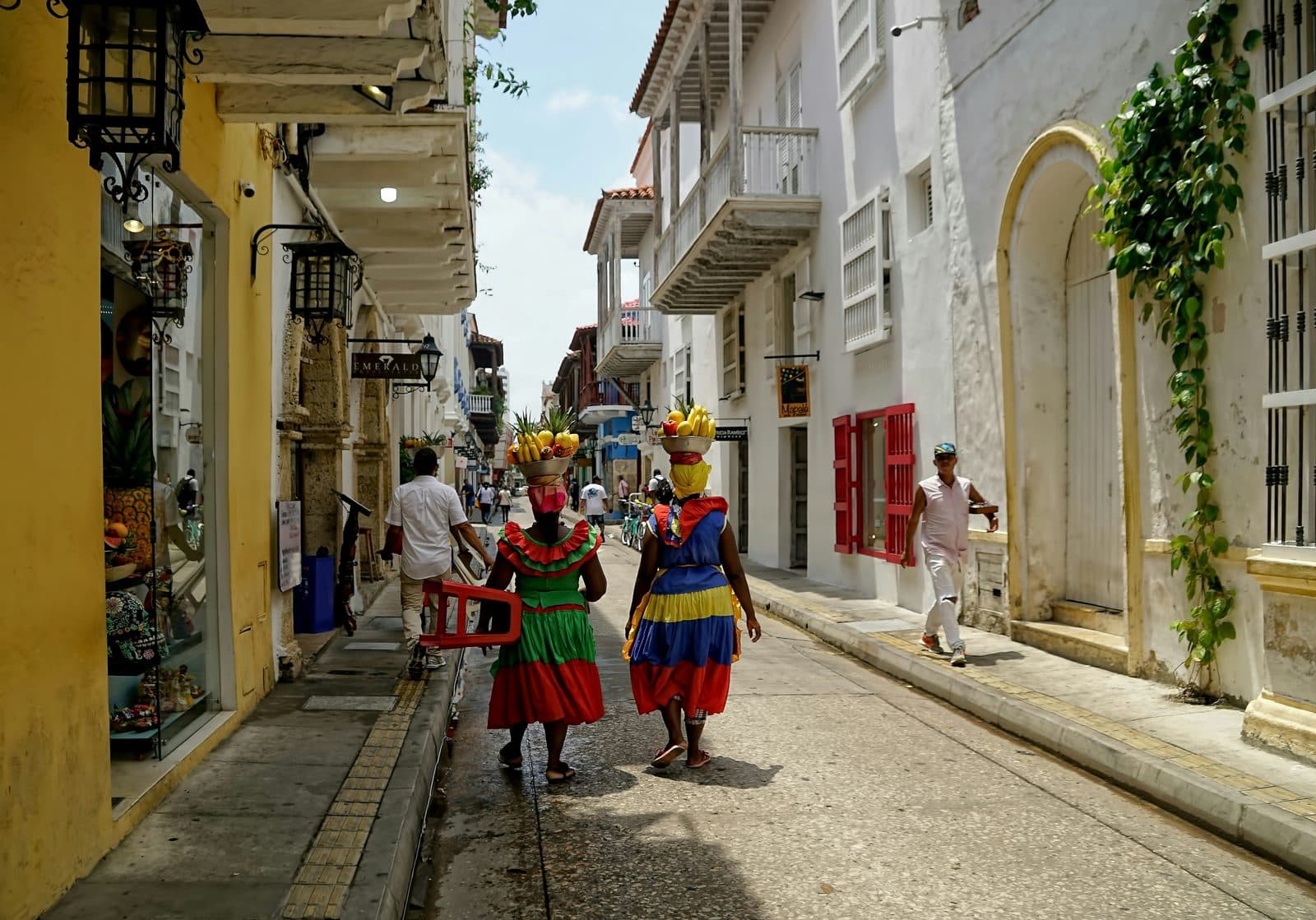
Cross the street outside the Clock Tower Gate. You have just left one Cartagena and entered another. Behind you, inside the walls, is the city the colonial postcard sells. Pastel facades, horse-drawn carriages, the cathedral tower, the candy arcades. In front of you, across what used to be the moat, is Getsemaní. Same period architecture, lower in places, a little more lived-in, paint peeling in the right way. For two centuries Getsemaní was where Cartagena's Black population was allowed to live because they were not allowed inside the walls. It is also where Colombian independence was actually declared, where the music that defines the Caribbean coast was invented, and where most of what is interesting about modern Cartagena is happening right now.
The tour walks this argument across seven stops. Two inside the walls, four in Getsemaní, one back inside at San Pedro Claver, one at the convent-turned-Sofitel where García Márquez found a skeleton in 1949 that he eventually turned into a novel. The thesis is simple. Cartagena is two cities laid against each other across one street, and the city outside the walls is older than most visitors realize, more important than the city inside, and currently in the middle of a fight to remain itself.
How Getsemaní came to be
The legal architecture of colonial Cartagena divided people into three groups. White Spaniards and their descendants lived inside the walled centro. Enslaved Africans lived wherever they were owned, working in the houses, the docks, the cathedral construction sites, the forts. The third group, free Black people, formed gradually across the colonial period: through manumission (purchased freedom), through escape and return, through children born free to free mothers, through Spanish slaveholders freeing enslaved people in wills, through the slow accumulation of small legal freedoms that the colonial bureaucracy could grant.
This third group was not allowed to live inside the walls. They settled on the strip of marshy land between the centro and the harbor, just outside the main gate. By the early 1600s that area had a name, Getsemaní, and a population. It had its own churches (the Trinidad church on the central plaza was built in the seventeenth century), its own commercial life, its own militias. The Spanish authorities tolerated it because it sat between the walls and the docks, which meant it provided a labor pool close to the port. They also did not have a choice.
Across the wider Caribbean, the most extreme version of Free Black self-organization went further: the palenques, fortified inland settlements founded by escaped slaves. The most famous was San Basilio de Palenque, about fifty kilometres south of Cartagena, founded in the early 1600s under the leadership of Benkos Biohó. After failed Spanish military expeditions to retake it, the Crown gave up. In 1713 Palenque was formally recognized as a free community by royal decree, making it the first officially free African settlement in the Americas. The people of Palenque still speak Palenquero, a creole language that mixes Spanish with Kikongo and other Bantu languages from Central Africa, and in 2005 UNESCO named its cultural traditions a Masterpiece of Oral and Intangible Heritage.
The palenquera women who sell coconut sweets under the Portal de los Dulces in Cartagena's walled city come from this lineage. The cocadas they sell are recipes from West African kitchens transmitted through generations of women. The fruit-bowl-on-the-head tradition is a West African body memory. The bright dresses are a deliberate cultural claim. Buying a cocada from a palenquera is not a tourist transaction. It is buying a piece of the first free Black community in the hemisphere.
How Cartagena declared independence
Hear a stop from this walk
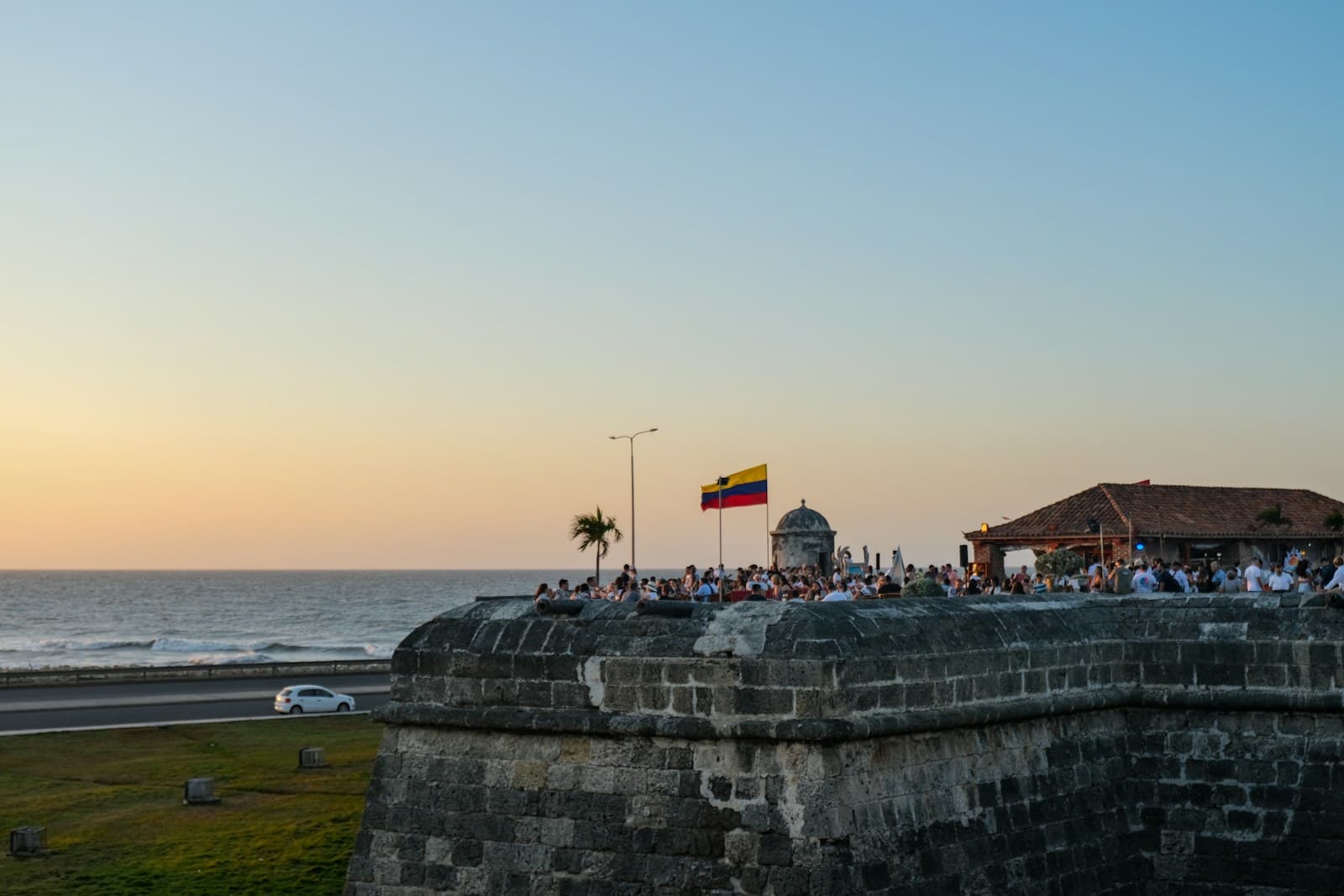
Baluarte de Santo Domingo: Where the Wall Began
The standard version of Latin American independence puts educated creole elites in the foreground, men who read Rousseau in Bogotá and Quito and Caracas, who quoted Thomas Jefferson, who organized juntas. That version is partial. In Cartagena, the decisive moment of independence was led by a Black blacksmith and a militia of working-class Black and mixed-race men from Getsemaní.
His name was Pedro Romero. He was born in Cuba, worked as an artisan in Cartagena, and organized the Getsemaní lanceros, the neighborhood militia. By 1811 the creole leadership in Cartagena's cabildo had been negotiating with the colonial governor for months. They wanted independence, but they wanted a managed independence on their terms. The negotiation stalled.
On the night of November 11, 1811, Romero and the lanceros broke into the arms depot, marched to the governor's palace, and surrounded it. They made the choice binary. Independence would be declared that night, or there would be consequences. The cabildo declared. Cartagena became the first city in what is now Colombia to formally separate from Spain. The independence holiday in Cartagena is still November 11. The standard Latin American narrative has Bolívar liberating Colombia in 1819. In Cartagena that is true, but it is not the first chapter. The first chapter is Pedro Romero, on a November night in a Black working-class plaza, forcing the question.
Spain reconquered Cartagena in 1815 under Pablo Morillo, who executed several creole leaders and besieged the city for months. Romero died during the siege. By 1821 the city was free again, this time permanently. The Spanish would never take it back. The independence of Colombia, the country, has a complex and contested set of dates. The independence of Cartagena, the city, started in Getsemaní.
How the neighborhood sounds today
The Calle de la Media Luna is the main commercial spine of Getsemaní. In the 1970s and 80s it was the testing ground for a genre called champeta. Caribbean sailors had been carrying African records (soukous from the Congo, highlife from Ghana, makossa from Cameroon) into Cartagena's port for decades. In the poorest Black neighborhoods of the city the records were absorbed, blended with local rhythms, and broadcast through enormous homemade sound systems called picós.
A picó was not a stereo. The largest were three stories tall, custom-painted with massive elaborate artwork, named like ships (El Conde, El Guajiro, El Gran Papi) and toured between neighborhoods for open-air dances called verbenas. Each picó had a crew, a DJ treated like a rock star, and a sonic identity. The Colombian establishment hated champeta. Radio stations refused to play it. Clubs banned it. The word champeta itself came from the short machete that market workers carried; it was used as an insult before being reclaimed.
What the establishment could not do was stop it. Champeta grew block by block, picó by picó, until by the 2000s it had broken into mainstream Colombian popular music and from there into international Latin music. Today champeta is sampled by global producers, performed by major artists, and celebrated in festivals. The original sound is still on the Media Luna on a weeknight, in the picós set up outside the bars, in the bass that rattles windows on the cross streets.
The same neighborhood that invented champeta is now the highest-rent area in Cartagena per square metre. The pressure on long-time residents to leave is acute. Family homes have become boutique hotels. Corner stores have become cocktail bars. The street art that made the neighborhood internationally famous (much of it organized by the local collective Vertigo Graffiti, often centered on palenquera women and African heritage) is celebrated and is also accelerating the displacement of the community it celebrates. Getsemaní in 2026 is in the middle of arguing with itself about whether it can stay Getsemaní.
How to read the convent at the end
The tour ends at the Convento de Santa Clara, founded in 1621 as a cloistered convent for the daughters of wealthy colonial families. It is now the Sofitel Legend Santa Clara, a luxury hotel. In 1949, a young reporter named Gabriel García Márquez covered the renovation of the convent's crypt. The workers had found a skeleton, a girl, with twenty-two metres of copper-coloured hair still attached. The image stayed with him for forty-five years. In 1994 he published Of Love and Other Demons, a novel about a colonial-era girl named Sierva María, raised by African slaves in Cartagena, who speaks Yoruba better than Spanish, and who is locked in this convent because the church decides she is possessed.
It is the right ending for the tour because it holds the same argument in one building. Colonial wealth and African inheritance and Catholic dogma and modern hospitality, layered in the same masonry. García Márquez understood that Cartagena is the city where these layers do not blend smoothly. They sit on top of each other, visible. The tour walks them in order. The convent is where they finally collide in the same room.
Colombia eSIM· 10% off with ROAMER10
Ready to experience it?
Walled City: The People Who Built It Lived Outside
90 min · 2.1 km · easy
More from Cartagena
Explore more at your own pace.
Cartagena Travel Guide: How Many Days, Getting Around, When to Go, Is It Safe (2026)
One Day in Cartagena: A Walkable Old City Itinerary (2026)
What to Eat in Cartagena: A Caribbean-Colombian Food Guide (2026)
Walls Built From Failure: How Cartagena Got Fortified
Blas de Lezo and the Siege of 1741: Cartagena's Most Important Battle