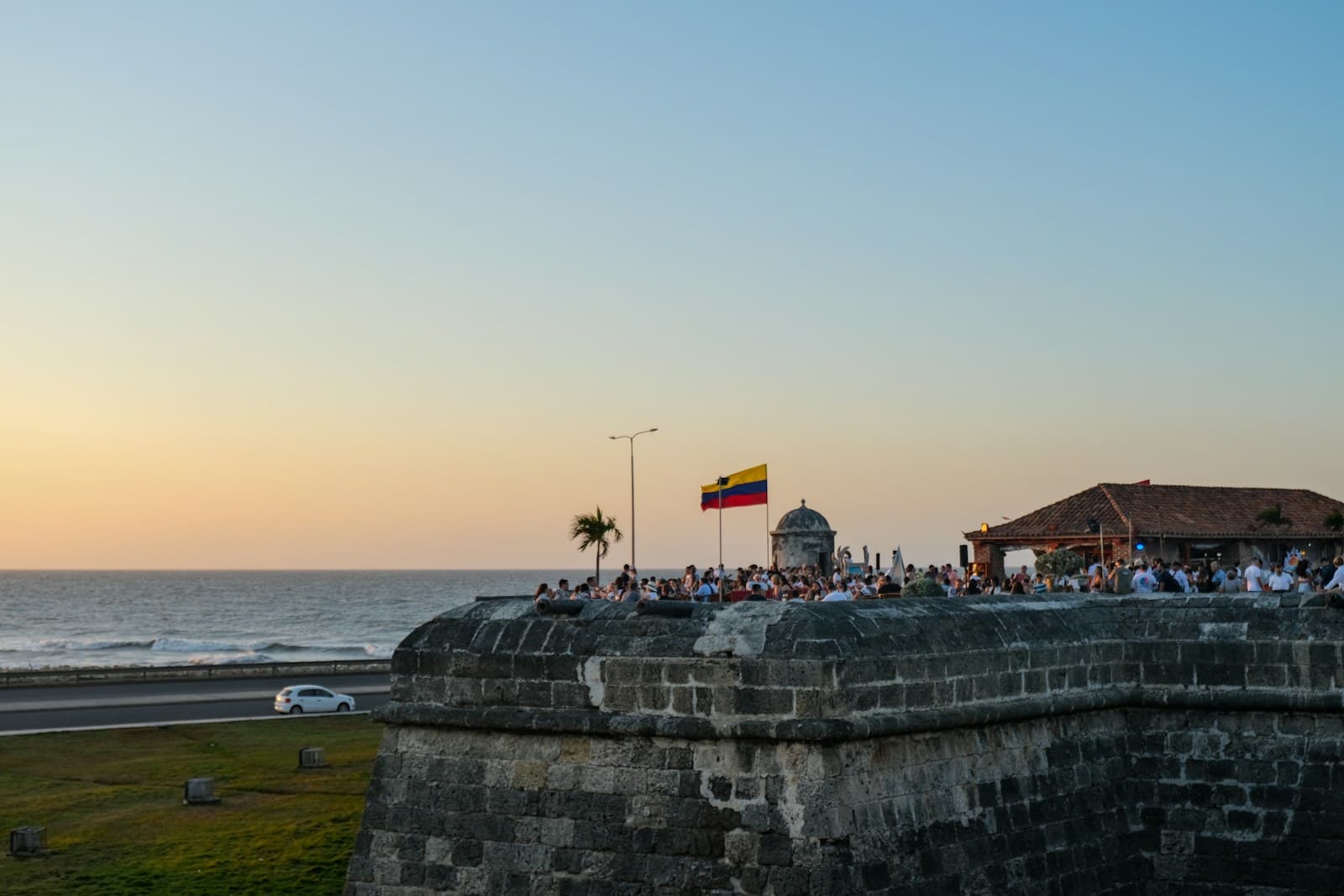
The Convento de Santa Clara sits at the northern edge of the walled centro, on the corner of Calle de Cuartel and Calle del Torno. From the outside it looks like a long stretch of plain colonial wall pierced by a single arched door. There is a small brass plate that reads Sofitel Legend Santa Clara. There is no sign that this was once one of the most important cloistered convents in colonial Cartagena, that a girl with twenty-two metres of copper-coloured hair was buried inside its crypt, or that the image of that hair was carried for forty-five years by a young journalist who eventually became the most consequential Latin American novelist of the twentieth century. Walk through the door and the inner courtyard reveals the cloister: arches, a fountain, ancient trees, the original chapel preserved off to the side. The building is the same building Gabriel García Márquez walked through in 1949 to report on a renovation. The hotel layer is the most recent geological deposit on a much older site.
This is why this convent is the right place to end a tour of Cartagena. It is the building where the city's contradictions are most visibly stratified.
The cloistered convent
The convent was founded in 1621 by the Order of Saint Clare, a contemplative branch of the Franciscan family established in the early thirteenth century by Saint Clare of Assisi, a companion of Saint Francis. The Poor Clares, as they are commonly called, take vows of poverty, chastity, obedience, and enclosure. The enclosure vow meant that once a woman entered the convent, she did not leave it. Visitors spoke to nuns through a turning wooden grille set into the wall, called a torno, which is the namesake of the street the convent fronts. Bread, letters, and small goods could pass through the torno. The women inside could not.
The convent's residents were largely the unmarried daughters of wealthy colonial families. For a woman in seventeenth and eighteenth century Cartagena, a society that offered essentially two adult roles to white women of means (marriage or the convent), Santa Clara was an alternative to a marriage market she had no real say in. Some of the women entered with genuine vocation. Others entered because their families could not provide an acceptable dowry for marriage and could provide one for the convent. The convent was effectively a parallel system for organizing the lives of women the colonial economy did not have other plans for.
Inside the enclosure the daily rhythm was monastic. Bells at fixed hours. Hours in the chapel singing the divine office. Meals taken in silence. Work in the kitchens, the laundry, the garden. The cloister was the central space, an arcaded square around a fountain, the architectural form Cistercian and Franciscan houses had developed in medieval Europe and that the Spanish brought intact to the New World. The cloister at Santa Clara, with its arches and its ancient trees, is the same one the women circled for three hundred years.
The convent operated continuously from 1621 until the late nineteenth century, when shifting Colombian church-state relations and changes in religious orders reduced its population. By the twentieth century it was no longer an active religious house. The building passed through other uses (hospital, eventually a derelict structure) before being sold to a hotel developer in the 1990s. The renovation that turned it into the Sofitel Legend Santa Clara was completed in 1995.
The crypt and the hair
Hear a stop from this walk
Baluarte de Santo Domingo: Where the Wall Began
In 1949, before the hotel conversion, the convent was being renovated as a hospital expansion. The crypt under the church needed to be cleared. Cloistered convents typically buried their dead within their own enclosure, often in walled-up niches inside the building rather than in conventional graveyards. When the workers opened a niche near the high altar, they found what they expected: a skeleton, presumed to be a nun, buried centuries earlier. They did not expect what was attached to the skull.
A cascade of copper-coloured hair, roughly twenty-two metres long when laid out, had grown (or appeared to have grown) from the skull through the sealed centuries of the niche. Hair does not actually continue growing after death, despite the persistent folk belief. What seems to have happened at Santa Clara is that the woman had been buried with already very long hair, possibly bound at the time of interment, and the dry, sealed conditions of the crypt had preserved the keratin almost perfectly while the skin around it receded. The visual effect, twenty-two metres of intact copper hair coming from a clean skull, was of impossible growth.
The story circulated in Cartagena. The local newspaper, El Universal, sent a young reporter to cover it. He was twenty-two, recently a law school dropout, working as a journalist and writing fiction in his off hours. His name was Gabriel García Márquez. He saw the skeleton. He filed the article. The image of the hair, the girl, the crypt, did not leave him. He would describe it decades later as the kind of image that lodges in a writer's mind and refuses to be used until it finds the right context.
The context took forty-five years to arrive.
The novel
In 1994, García Márquez published Del amor y otros demonios, translated into English as Of Love and Other Demons. The novel is short, around 160 pages. It is set in colonial Cartagena. The protagonist is Sierva María de Todos los Ángeles, a twelve-year-old girl, the daughter of a faded marquis and a neglectful aristocratic mother, who has been raised almost entirely by the family's African enslaved servants. She speaks Yoruba better than Spanish. She wears the beads of the Afro-Caribbean Santería practice. She moves through the city's African spiritual world more easily than its Spanish Catholic one.
One day in a market a stray dog bites her. The dog is rabid. The diagnosis is not made in time. As her behaviour becomes increasingly strange (the result of rabies and trauma, in the novel's reading), the church decides she is possessed by demons. She is taken to the Santa Clara convent for exorcism. The young priest assigned to her case, Cayetano Delaura, falls in love with her. She, having been raised by the enslaved women who actually loved her, recognizes love when she sees it and returns it. The church separates them. She dies in the convent.
The novel is García Márquez at his most Cartagena-specific. The book sets the colliding spiritual systems of the city directly against each other. Yoruba practice on one side. Latin Catholic exorcism on the other. Power, in the form of the church and the colonial state, decides which is allowed to be called real. Love, the only force in the book that operates outside the legitimacy structures, has no protection and is crushed. The girl at the end is buried in the convent crypt with her hair, growing after death (in the novel's magical-realist reading) into the twenty-two-metre cascade that the workers find centuries later. The frame story of the novel is exactly the moment in 1949 that García Márquez witnessed as a reporter.
What the novel does, more than any other piece of writing about Cartagena, is put the African layer of the city at the same narrative level as the Spanish layer. Sierva María is not exotic background. She is the protagonist. The enslaved women who raised her are not minor figures. They are the moral center. The Spanish church is not an unexamined backdrop. It is the antagonist. The novel reorganizes who the story of Cartagena is about. That reorganization, more than any historical analysis, is what shifted how a generation of readers thought about the colonial Caribbean.
The Sofitel layer
The current building is a luxury hotel. The cloister is the centerpiece of the lobby. The chapel survives as a private event space. Rooms occupy what were the cells. The crypt where the skeleton was found is no longer accessible as a working crypt; the renovation reorganized the lower levels. The hotel preserved the architectural shell with care, and the conversion has been generally well regarded by Colombian heritage observers, but the layer is the layer. A building that was the most enclosed and severe institution in colonial Cartagena is now a place where guests check in for a room with air conditioning and a balcony.
A visitor can read this as either ironic or honest. The argument for ironic is obvious: the convent that locked women away for three hundred years now charges seven hundred dollars a night to people on holiday. The argument for honest is that Cartagena has always been a city of stacked, mutually incompatible uses of the same building, the same plaza, the same wall stretch. The cathedral was used as a stable by Drake's troops in 1586 and as a Catholic cathedral in every year before and after. The Plaza de los Coches was a slave market, then a carriage stand, then a tourist plaza. The Inquisition palace, where over eight hundred trials happened, is now a museum where the same instruments of torture sit behind glass and a giftshop sells fridge magnets. The convent-to-Sofitel transition is one more layer in a city that has never stopped repurposing itself.
García Márquez understood this. The novel's frame story, the workers finding the skeleton in 1949, is itself already a building in transition. The girl has been buried for centuries. The renovation is now in progress. The hair is the past insisting on being seen as the building moves to its next use. That is also Cartagena. The past does not stay buried here. It pushes through.
Stand in the cloister of the Sofitel Legend Santa Clara and look at the trees in the centre. Some of them are old enough that García Márquez would have walked past them in 1949. Some are old enough that the original Poor Clares would have walked past them in the seventeenth century. Some are old enough that Sierva María, if she had been real, would have walked past them. Then the hotel staff brings the bill. That sequence, in order, is the soul of the city.
Colombia eSIM· 10% off with ROAMER10
Ready to experience it?
Walled City: The People Who Built It Lived Outside
90 min · 2.1 km · easy
More from Cartagena
Explore more at your own pace.
Cartagena Travel Guide: How Many Days, Getting Around, When to Go, Is It Safe (2026)
One Day in Cartagena: A Walkable Old City Itinerary (2026)

What to Eat in Cartagena: A Caribbean-Colombian Food Guide (2026)
The Other City Across One Street: Getsemaní and the Soul of Cartagena

Walls Built From Failure: How Cartagena Got Fortified