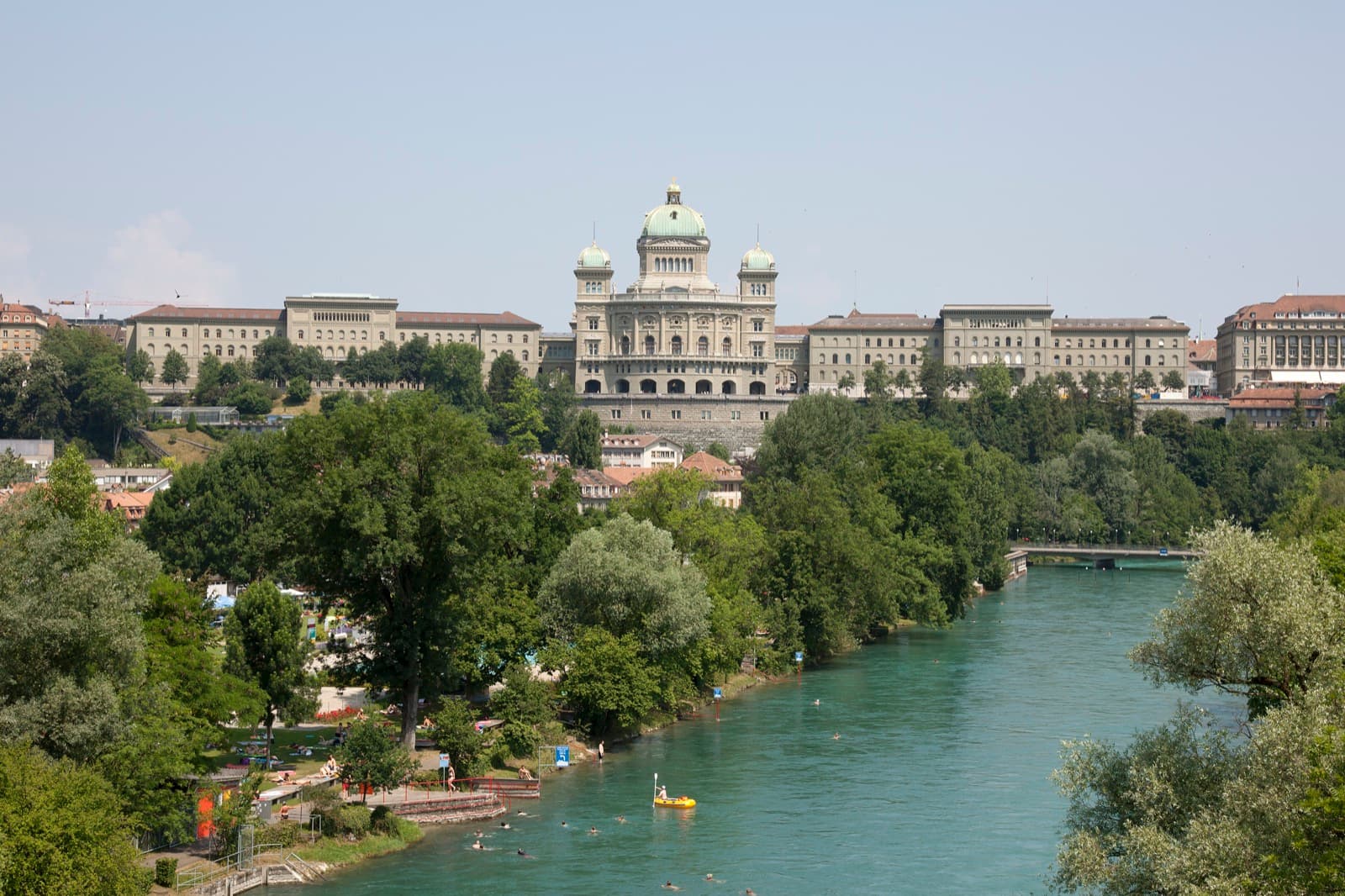
Bern reads two ways at once, and the Federal Palace is where both readings start. It is the young half of the story: the seat of the Swiss parliament and government, a building raised above the River Aare to house a nation that became a federal state only in 1848. The old half waits downhill, at the tip of the same rocky spur, where a medieval duke founded the town around 1191. Power and origin share one rock. Stand on the Bundesplatz, the square in front of the palace, and you are standing at the hinge between those two stories: the federal city of Switzerland and the city of the bear.
The young half: a nation with a face
The central parliament building was built between 1894 and 1902, to plans by the architect Hans Wilhelm Auer, and it was handed over on the first of April, 1902. Its copper dome, weathered to a soft turquoise, rises 64 metres over the city. That turquoise is not paint. It is the natural patina of weathered copper, the slow chemistry of a century of Alpine weather written onto the roof. Under the dome sit the two chambers of the Federal Assembly, the National Council and the Council of States, together with the Federal Council, which is the executive.
The whole seat of the confederation was assembled over half a century, not built in one gesture. A West Wing went up in the 1850s, the central assembly building came at the turn of the century, and an East Wing was raised around 1890. The neo-Renaissance style was chosen to give a young confederation a dignified public face, the architecture of a state deciding what it wanted to look like.
Bern was chosen as Switzerland's federal city, its federal seat, on the twenty-eighth of November, 1848, by the Federal Assembly of the new federal state. That date settled a long argument about where the institutions of the country should sit. It is worth holding onto, because it is the anchor for everything the rest of this walk descends toward. The parliament here is 700 years newer than the ground where the town began.
The square that used to be a car park
Hear a stop from this walk
The Nydegg Church and the First Castle
The Bundesplatz itself is a small lesson in how public space changes. Until quite recently this open forecourt of the parliament was a car park. In the 2004 redesign it was given a fountain of 26 water jets, one for each of the 26 Swiss cantons, rising up to about seven metres on a warm day. Children run through it in summer. It is a rare thing, a national symbol you can get soaked in, and it turns the seat of federal power into a place families gather rather than a place people file past.
That detail matters for how you should use this stop. Bern's arcaded old town is heavily packaged into scheduled group tours, and the quiet luxury of walking it on your own clock is the whole point. Take your time in the square. Start early or later in the day and you can have the fountain to yourself before the tour groups arrive. There is no bus waiting, no guide counting heads. You set the speed.
Why a duke chose this spur
The palace stands right at the edge of the ridge, above the Aare, so a nation's parliament looks out over the water that wraps the old town. This is not a coincidence of the nineteenth century. It is the reason Bern exists at all.
By tradition the town was founded around 1191 by a duke of the House of Zaehringen, whose castle stood on the rocky spur inside the great bend of the river. A city set inside a river loop is naturally defended on three sides, with only a narrow neck of land to guard. Every stop on this walk follows that shape. From the Casino terrace, a short step east of the square, you look straight down to the green water and across the valley by way of the Kirchenfeldbruecke, a steel arch bridge built in the early 1880s and financed, oddly, by an English-run land company that needed a way to sell building plots on the far bank.
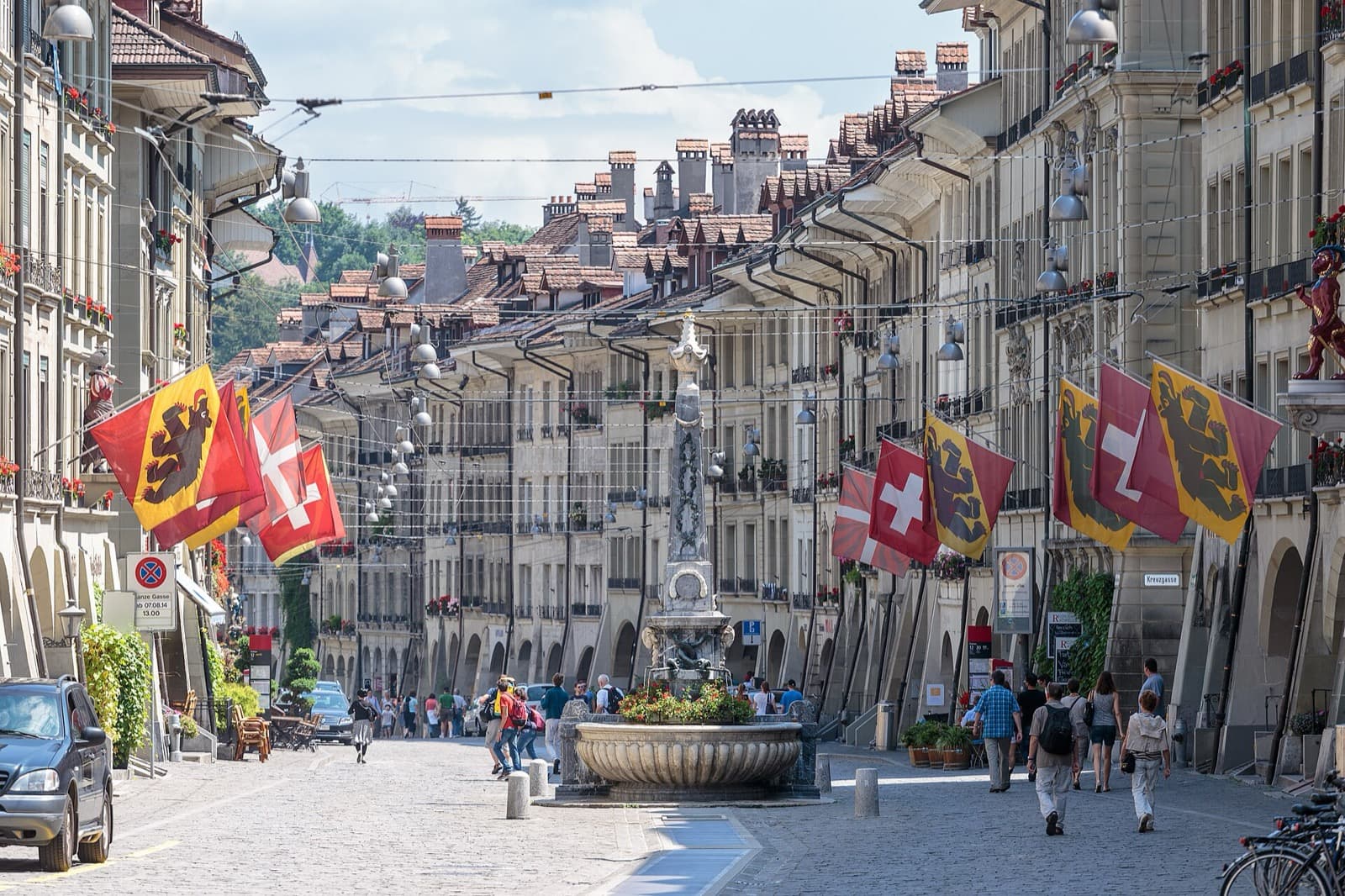
From there the route descends through the Gerechtigkeitsgasse, the lane of justice, the oldest and easternmost part of the town. Some six kilometres of covered arcades run through these streets, so you can walk much of the old city sheltered from rain or sun. The medieval plan here has barely changed since the twelfth to the fifteenth century, and after a great fire in 1405 the whole town was rebuilt in local sandstone, which is why it has such a unified grey-gold colour. That intact medieval core was inscribed on the UNESCO World Heritage List in 1983.
Where the town actually began
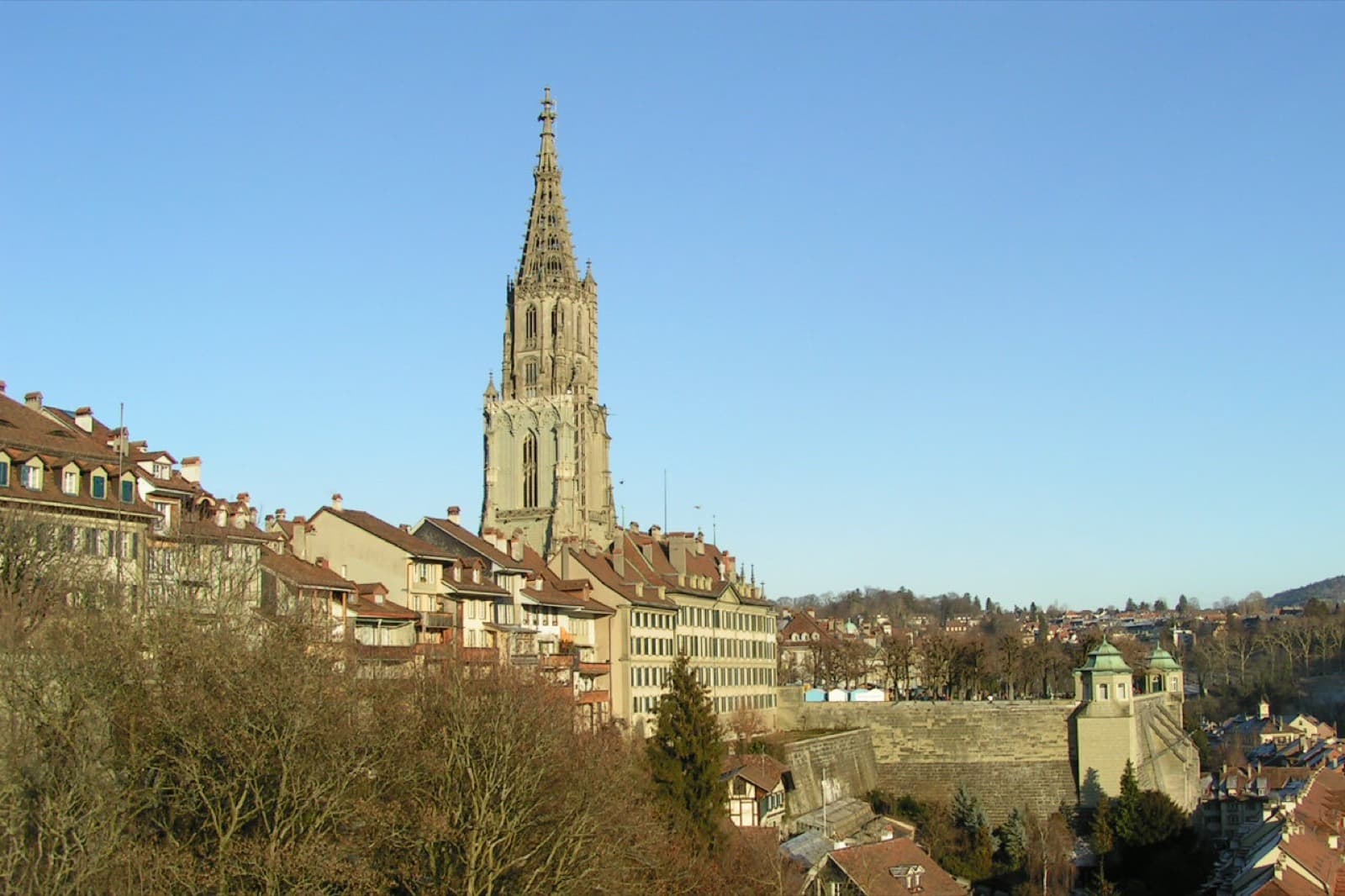
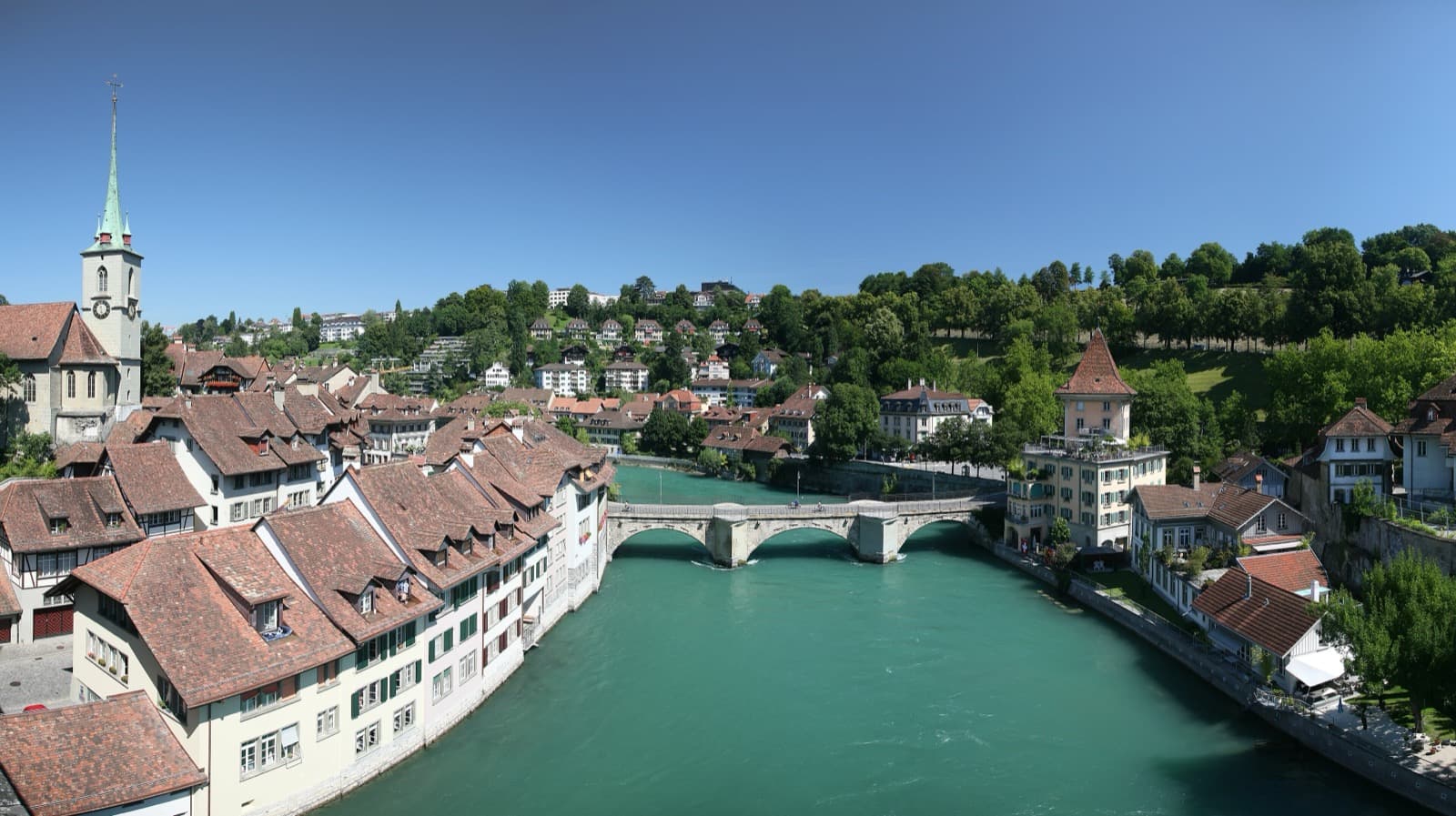
At the tip of the spur stands the Nydegg Church, a Gothic building raised on the exact ground where the Zaehringen castle once stood. The townspeople themselves pulled that castle down in the thirteenth century and built a quarter over it. This is the founding ground, and it holds the walk's other symbol.
The old story says the founding duke promised to name his new town for the first animal killed in the hunt, and that animal was a bear, a Baer, so the town became Bern. It is a good story, and the city has carried the bear on its coat of arms for centuries. But scholars since the 1980s have doubted it and many favour a Celtic origin for the name instead. Hold it as tradition, not documented fact. What is documented is the layout under your feet: a modern parliament on the ridge, a medieval founding ground at the tip, one continuous rock.
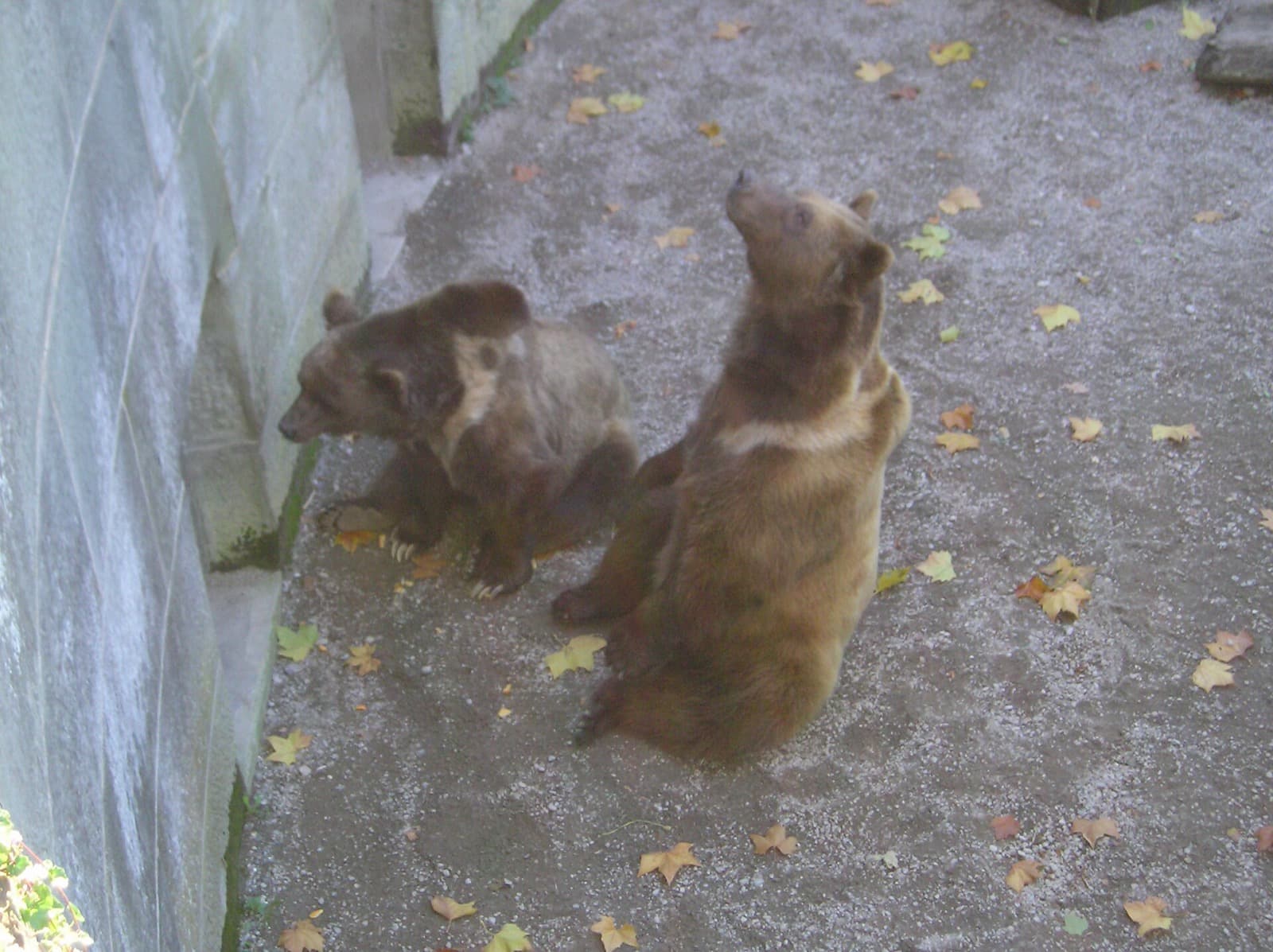
From the founding ground the walk crosses the Untertorbruecke, the oldest of Bern's bridges over the Aare, built in stone between 1461 and 1489 and for centuries the town's only fixed crossing. On the far bank is the BaerenPark, where the city keeps its living bears. By tradition Bern has kept bears since 1513, said to have been brought home from the Battle of Novara. The open riverside park opened in 2009, replacing a cramped stone pit from 1857, and the two together measure a century and a half of changing ideas about how animals should be kept.
The walk ends at the Rosengarten, a rose terrace above the bears, where the whole sandstone city is seen curled inside its river with the minster tower rising above the roofs. A bronze Albert Einstein, who lived in Bern, sits on a bench facing the view. From the Federal Palace to that bench is about two kilometres and roughly 85 minutes at an unhurried pace. You can plan the full route through our Bern walking tours hub, or read more about the wider city on our Bern page before you set out. Begin at the Bundesplatz, and let the two stories unfold as one.
Sources
- Federal Palace of Switzerland, Wikipedia: construction dates 1894 to 1902, architect Hans Wilhelm Auer, dome height, and the wings assembled across the nineteenth century.
- Bundesplatz (Parliament Square), Switzerland Tourism: the 26-jet cantonal fountain and the 2004 redesign of the former car park.
- Old City of Berne, UNESCO World Heritage List: the 1983 inscription and the survival of the medieval plan inside the Aare loop.
- Nydeggkirche, Wikipedia: the Zaehringen castle site, the traditional 1191 founding, and the folk-etymology debate over the bear name.
- Bern and bears, Tierpark Bern: the 1513 tradition, the 1857 bear pit, and the 2009 riverside park.
Ready to experience it?
Bundeshaus: The Bear and the Federal City
85 min · 2 km · moderate
More from Bern
Explore more at your own pace.
Bern Travel Guide: How Many Days, Getting Around, Best Time, and Safety
One Day in Bern: A Walkable Morning-to-Evening Itinerary
Reading Bern: The Sandstone City Built to One Rule
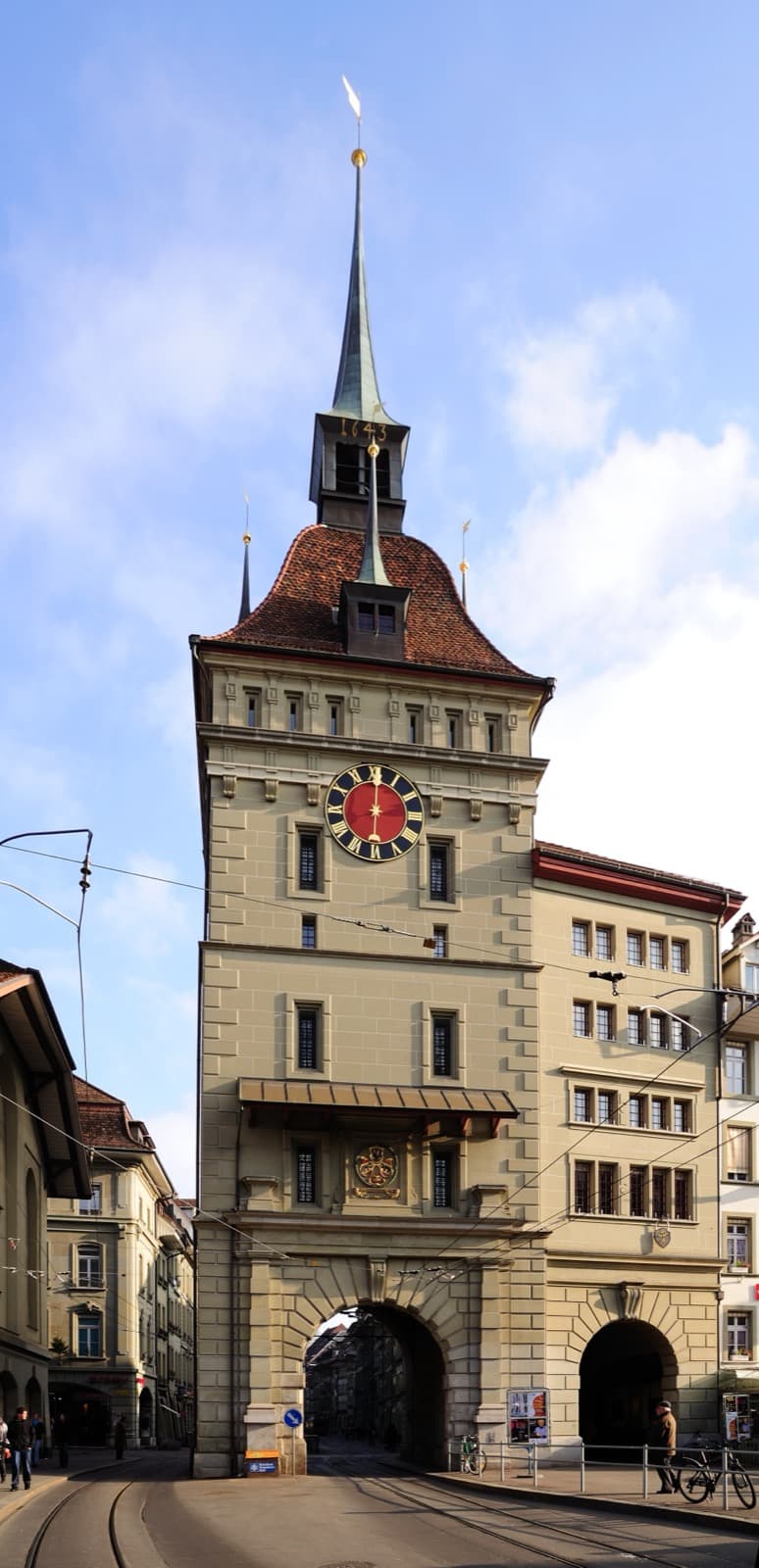
The Zytglogge: How Bern's First City Gate Became a Clock
BaerenPark in Bern: How a Founding Legend Became Living Bears