The Nikolaikirche keeps the oldest upright masonry in Berlin, yet the old town around it is almost entirely new. Stand by the rounded end of the big brick church in the Nikolaiviertel, the Saint Nicholas quarter, and both claims are true at once. Under the twin spires sit stones laid in the 1200s. Around you, the gables, arcades, lamps and shop signs mostly date from the 1980s, when East Berlin built a quarter of prefabricated panels on a cleared field to give its new capital center a past.
Three layers in one church
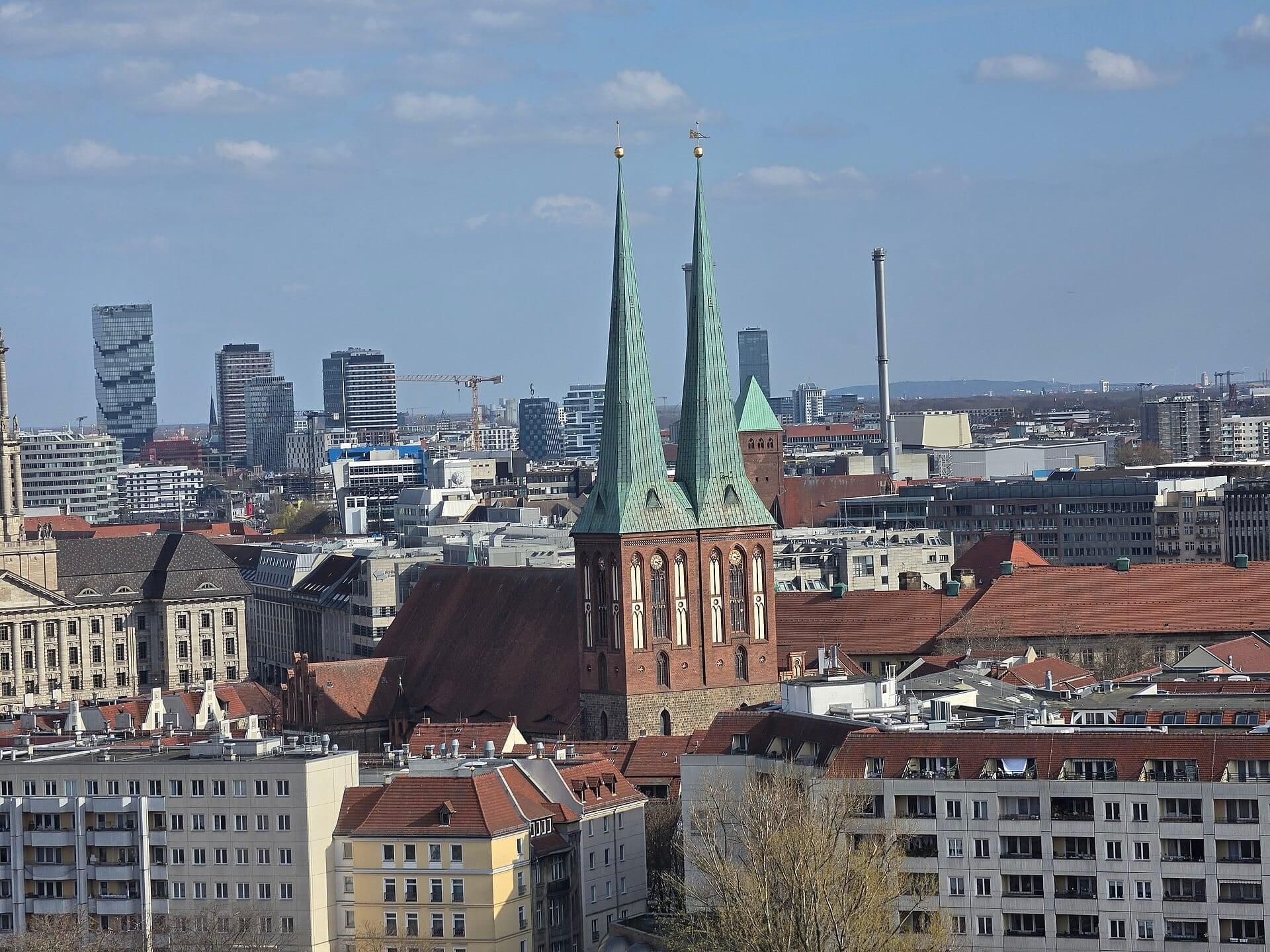
Read the church from the bottom up. Berlin's heritage office says the three lowest stories of the west tower, built of squared granite blocks, survive from a Romanesque church begun probably around 1230, and that this base is the oldest masonry still standing upright in the city. Above and in front of it rises a different material and a different century: a late Gothic hall church in brick, with an ambulatory and a ring of chapels, built from about 1380 to 1470. The rounded end you face when you arrive is that ring of chapels. The twin spires are younger again. They are neo-Gothic, designed by Hermann Blankenstein and built from 1876 to 1878.
So the profile everyone photographs is a nineteenth-century crown on a medieval body on a thirteenth-century foot.
A shell refilled
Hear a stop from this walk
Town Wall on Waisenstrasse: Kept by the Houses
At the end of the Second World War the church was destroyed down to its outer walls and the base of its tower. For decades it stood as a ruin in an empty field. In the 1980s it was rebuilt: a new roof, new vaults, new piers, a new interior, and the spires again in a simpler form. It opened in 1987 as a museum, which it still is, run by the Stadtmuseum Berlin. The city museum also records that in 1991 the first parliament for the whole of reunited Berlin met here.
Inside, grey slabs in the floor mark the foundations of the first, Romanesque church. Digs on this sand rise found something older still: Berlin's oldest known cemetery, about 120 to 150 burials from the late 1100s and early 1200s. From the positions of the graves the heritage office draws a striking conclusion. Berlin, it says, did not come into being through a single act of founding. People were already living on this spot.
The island of tradition
Now look at the lanes. For decades after the war this was open ground. The heritage office records that of the historic fabric, besides the badly damaged church, only the Knoblauchhaus and five houses on Poststrasse survived. Between 1979 and 1987, for the city's 750th anniversary, East Berlin built a new quarter here under the architect Günter Stahn: about 800 flats, 33 shops and 22 inns.
The method is what makes it worth a slow walk. Many houses are large prefabricated concrete panels, the same building system used across East Germany, given vaulted arcades on the ground floor or gable groups assembled from prefabricated parts. Next to them stand freer copies of baroque townhouses. The lanes follow the narrow, irregular medieval plan, and replica lamps, signs and street furniture finish the effect. Some landmarks were rebuilt from real models but, as the heritage office notes, not on their original sites: the inn Zum Nussbaum and the Gerichtslaube among them. The quarter's official name was the residential area at the Marx-Engels-Forum. The heritage office calls it a "Traditionsinsel," an island of tradition, meant to complete the new capital center by reaching back to the lost image of the historic city.
That is the honest way to see it. Not a fake, and not a survival, but a deliberate answer: a state that had cleared the old town decided, forty years later, that its capital needed one again.
What to look for
Find the granite blocks at the foot of the tower, then compare them with the brick above. Walk round to the chapels at the east end. Then look at any arcade in the lanes and find the seams between the panels. Taking it at your own pace is the point here: this is a stop where five minutes of looking tells you more than any date.
The church is stop 4 of Nikolaiviertel and Alexanderplatz: Four Churches, One War, which runs from the medieval town wall on Waisenstrasse to the Haus des Lehrers. For how the whole walk fits together, read the tour companion. See every route on the Berlin page.
Sources
- Landesdenkmalamt Berlin, Denkmaldatenbank: Nikolaikirche (09011267): the granite tower base of about 1230 as the oldest upright masonry in the city, the brick hall of about 1380 to 1470, Blankenstein's spires of 1876 to 1878, the floor slabs.
- Landesdenkmalamt Berlin, Denkmaldatenbank: Nikolaiviertel ensemble (09011266): built 1979 to 1987 under Günter Stahn, panels and prefabricated gables, 800 flats, 33 shops and 22 inns, the surviving buildings, rebuilt landmarks off their sites, "Traditionsinsel".
- Landesdenkmalamt Berlin, Denkmaldatenbank: soil monument at the Nikolaikirche (09010173): the oldest Berlin cemetery and the conclusion that Berlin had no single founding act.
- Stadtmuseum Berlin, Nikolaikirche: the church as a museum and the 1991 parliament.
Ready to experience it?
Nikolaiviertel and Alexanderplatz: Four Churches, One War
75 min · 2.2 km · easy
More from Berlin
Explore more at your own pace.
Best Architecture Walking Tours in Berlin (2026)
Brandenburg Gate, Tiergarten and Reichstag: Three Places Every Regime Re-Read
East Side Gallery: Painted on the Back of the Border
Nikolaiviertel to Alexanderplatz: Four Churches, Four Answers to One War
Unter den Linden to Museum Island: Stone Where It Shows