The Historic Center walk, "Historic Center: The White Stone and the Earthquakes", runs eleven stops over about 1.9 kilometers, roughly 85 minutes. It starts in the Plaza de Armas, circles the cathedral, goes out to the Dominican and Jesuit churches, loops south to La Merced and back past the Casa Goyeneche and the museum that keeps Juanita, and ends at the carved front of San Agustín. Different orders, different owners, different centuries. One stone, and one habit: rebuilding in the same place.
What sillar is, and what it is not
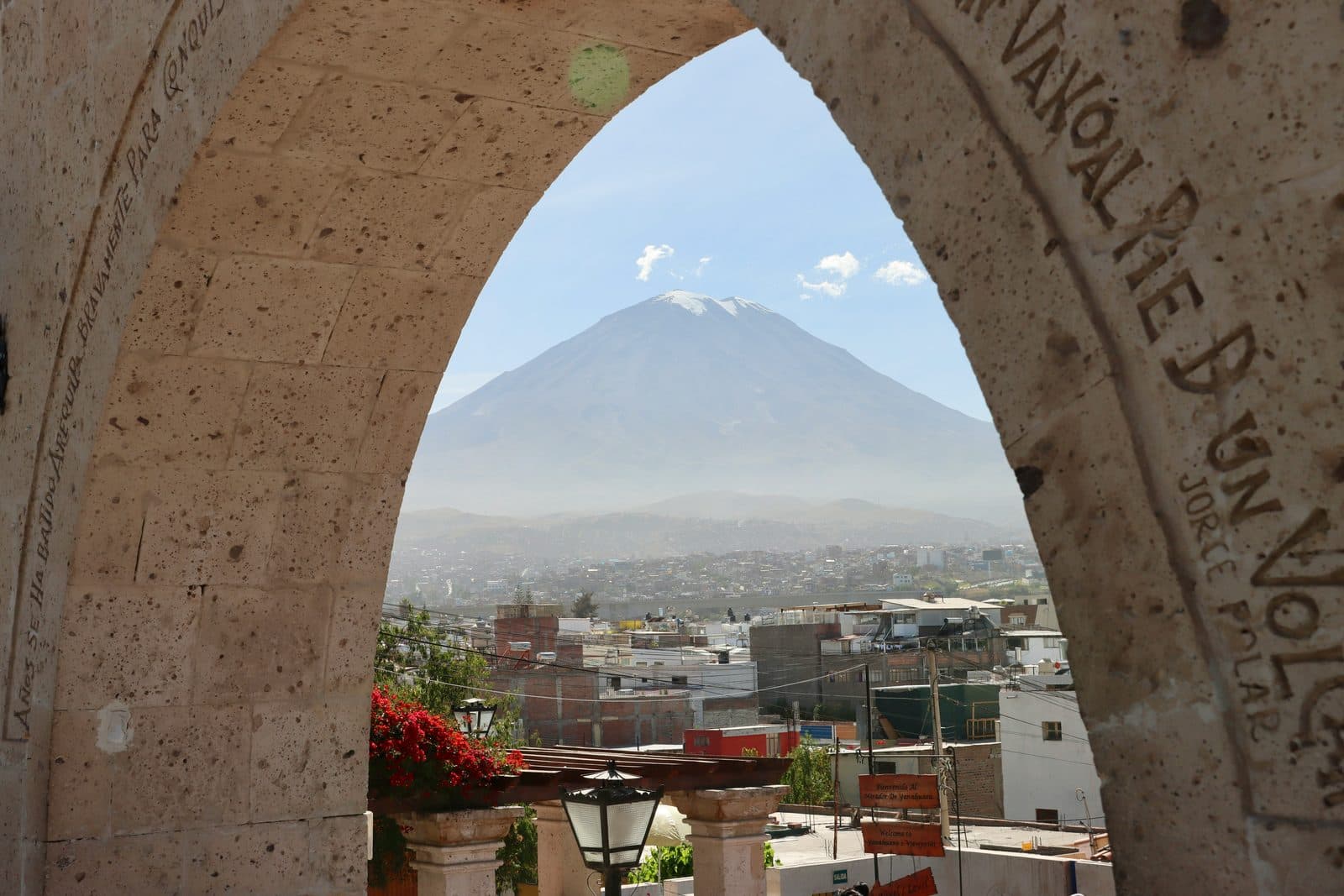
Sillar is not lava, and it did not come from El Misti. About 1.65 million years ago, long before El Misti grew, a huge eruption spread a flow of hot ash and pumice across this area, and hot gases cemented it into rock. Geologists call it an ignimbrite, and Peru's geological survey and the International Union of Geological Sciences think the volcano that produced it now lies buried under Chachani, El Misti's neighbor. The deposit has a lower white layer and an upper pink one. The white is the building stone, and UNESCO describes the historic center as built of "white or pink volcanic rock (sillar)".
Peru's Ministry of Culture describes sillar as porous and absorbent, a stone that holds its temperature, lighter than brick but more resistant to crushing. That made it right for thick walls and vaults. It is also soft, which made it right for carving. The Ministry credits the stone for the city's nickname, the White City.
It is still cut by hand outside the city, in the Añashuayco ravine about half an hour by car from the plaza, and in 2014 Peru declared the cutting and carving of sillar part of the nation's cultural heritage. The colonial churches, though, drew their stone mostly from quarries toward Yura. Añashuayco was opened in the nineteenth century.
A calendar of earthquakes
Hear a stop from this walk
San Agustín: The Front That Stood
UNESCO divides Arequipa's architecture into periods, and the lines between them fall on disaster years: the village from 1540 to 1582, Baroque splendour from 1582 to 1784, Rococo and neoclassicism from 1784 to 1868, then modern building from 1868 to 1960. The earthquake of 1582 was the turning point for the stone itself. UNESCO's evaluators record that it brought the systematic use of sillar, which until then had been used only in the doorways of the main church and in a handful of houses.
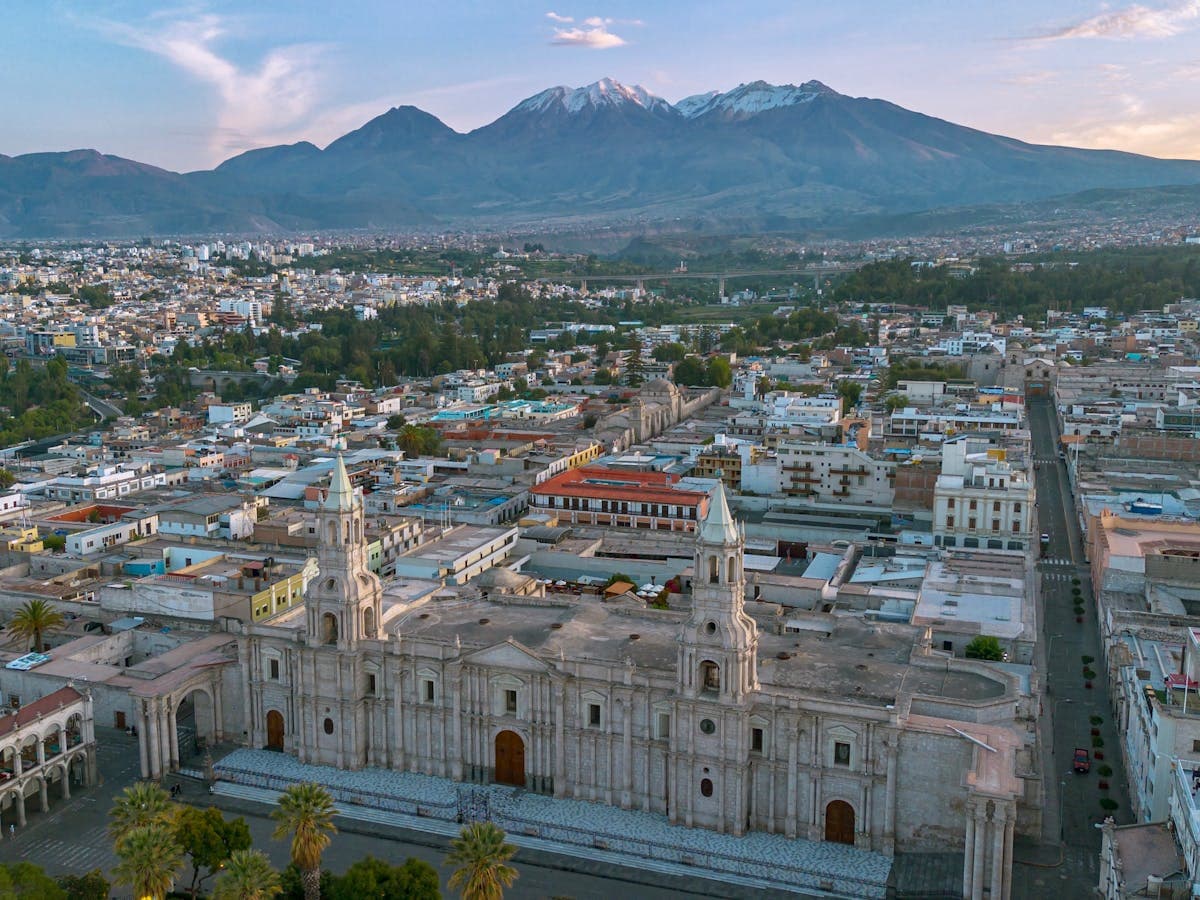
The cathedral is the clearest record. A cross marked the spot on founding day, 15 August 1540, and building began in 1544. The earthquake of 1582 brought the first church down. Rebuilding began in 1590, the eruption of Huaynaputina in 1600, seventy-five kilometers away, broke it again, and an earthquake in 1604 finished it off. The church that followed went up between 1621 and 1656. After a fire in December 1844, the local master builder Lucas Poblete rebuilt it in sillar in a neo-Renaissance style, with brick vaults, and he repaired it again after the earthquake of 1868. On 23 June 2001 an earthquake of magnitude 8.4 struck off the coast. The top of the left-hand tower fell and pierced the vault, and the right-hand tower stood. The fallen tower was rebuilt around an inner frame of reinforced concrete; the standing one was strengthened with carbon fiber, and its carved stones were set back over it.
Even what looks colonial on the plaza is younger than it seems. The town hall's arcade was redesigned by the architect Eduardo de Brugada in 1877, got its upper floor in 1913 and 1914, and was rebuilt after earthquake damage in 1960. The bronze fountain in the middle, from the 1730s or 1740s, is older than the arcades around it.
Carved flat, like a tapestry
Soft stone invites carving, and Arequipa's carvers cut it in a particular way: shallow, flat relief that covers almost every surface. The walk passes the milestones. Santo Domingo's side door, carved in the 1600s, is among the oldest carved fronts in the city, and UNESCO's evaluators read it as an allegory of the Last Judgment: look for angels blowing trumpets, and Saint Paul with his sword under a scallop shell. At La Compañía, the Jesuits' church, a side door of 1654 by the master Simón Barrientos shows Saint James on horseback and two sirens with angels' wings. The main front of 1698, two stories of carving that Peru's tourism inventory calls a thick tapestry, mixes cactus stems, grapes, scallop shells, Renaissance masks and a two-headed eagle. The same inventory says that front became a model for the region as far as Lake Titicaca.
What to call this carving is still argued. It was long labeled mestizo baroque; the historian Antonio San Cristóbal rejected that label as itself Eurocentric and called it planiform, flat-surface, architecture. But scholars agree that Andean stonecutters carved it.
One house, the whole calendar
The Casa Goyeneche, now a free museum of Peru's central bank, packs the city's history into one front. It was first built around 1558, rebuilt after the earthquake of 1582 and the eruption of 1600 by the master stonemason Gaspar Báez, who also drew La Compañía's first plans, enlarged in 1734, and badly damaged by an earthquake the bank's museum dates to 1782. The Goyeneche family bought it in that state, and a bishop of the family gave it its final form between 1837 and 1840, with Lucas Poblete, the cathedral's builder.
The white was not always bare
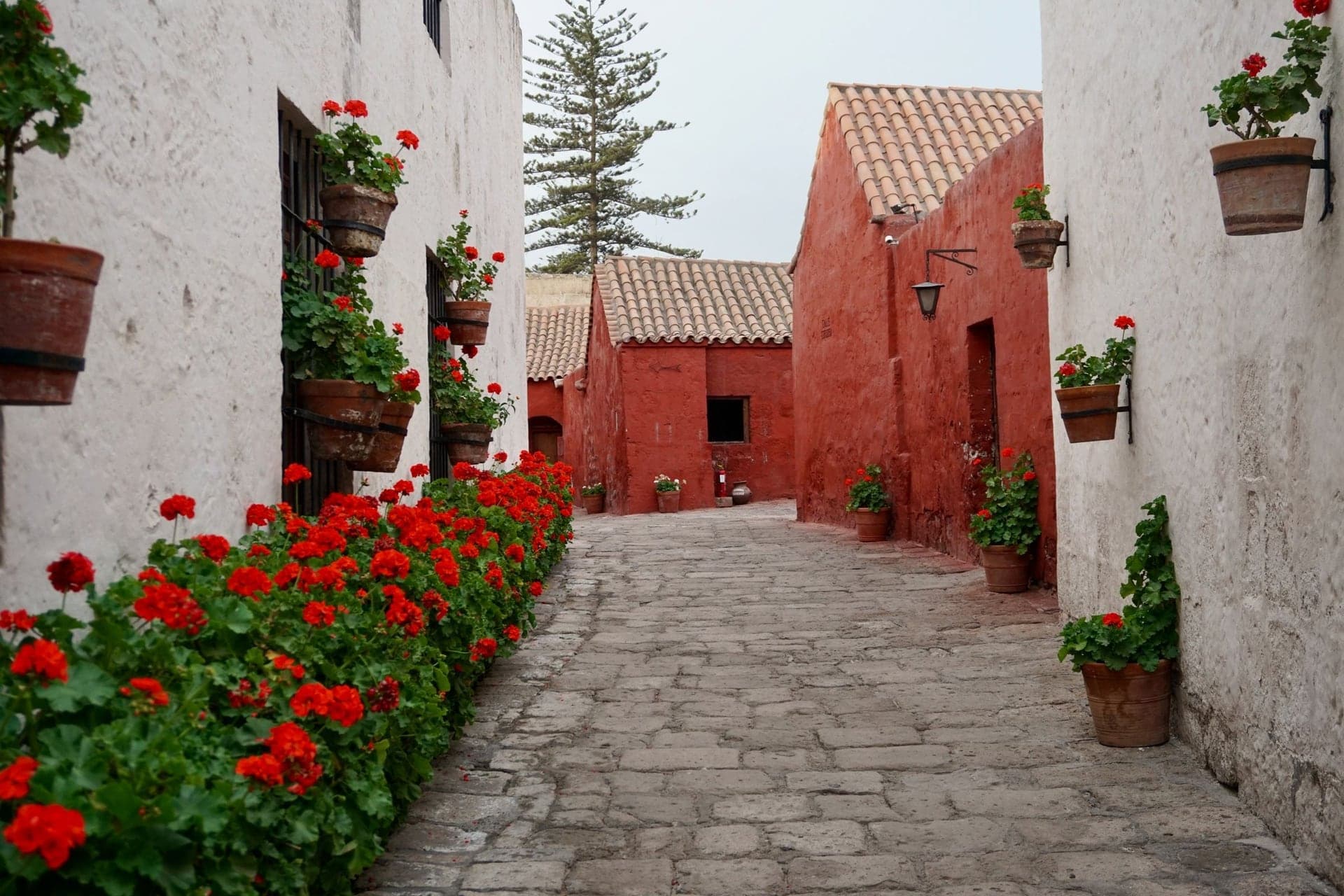
Because sillar is porous, builders protected it with limewash, sometimes colored. UNESCO's evaluators record that in the 1960s and 1970s many fronts were stripped of their plaster and paint, and the argument over that has never quite ended. Some of the white you see today was once painted.
A habit to take with you
Before you read a plaque, read the wall. Is the carving flat and dense, or is the stone plain and laid in courses, as in the lane behind the cathedral? Is the front older than the church behind it, as at Santo Domingo and at San Agustín, where the earthquake of 1868 did grave damage and the carved front stood? Almost every front on this walk carries the date of a disaster it came through, or of the rebuilding that followed.
Ready to experience it?
Historic Center: The White Stone and the Earthquakes
85 min · 1.9 km · easy
More from Arequipa
Explore more at your own pace.
Arequipa Travel Guide: How Many Days, Altitude, When to Go (2026)
Best Self-Guided Walking Tours in Arequipa (2026)
One Day in Arequipa: A Walkable White-City Itinerary (2026)
Best History Walking Tours in Arequipa (2026)
What to Eat in Arequipa: A Food Guide (2026)