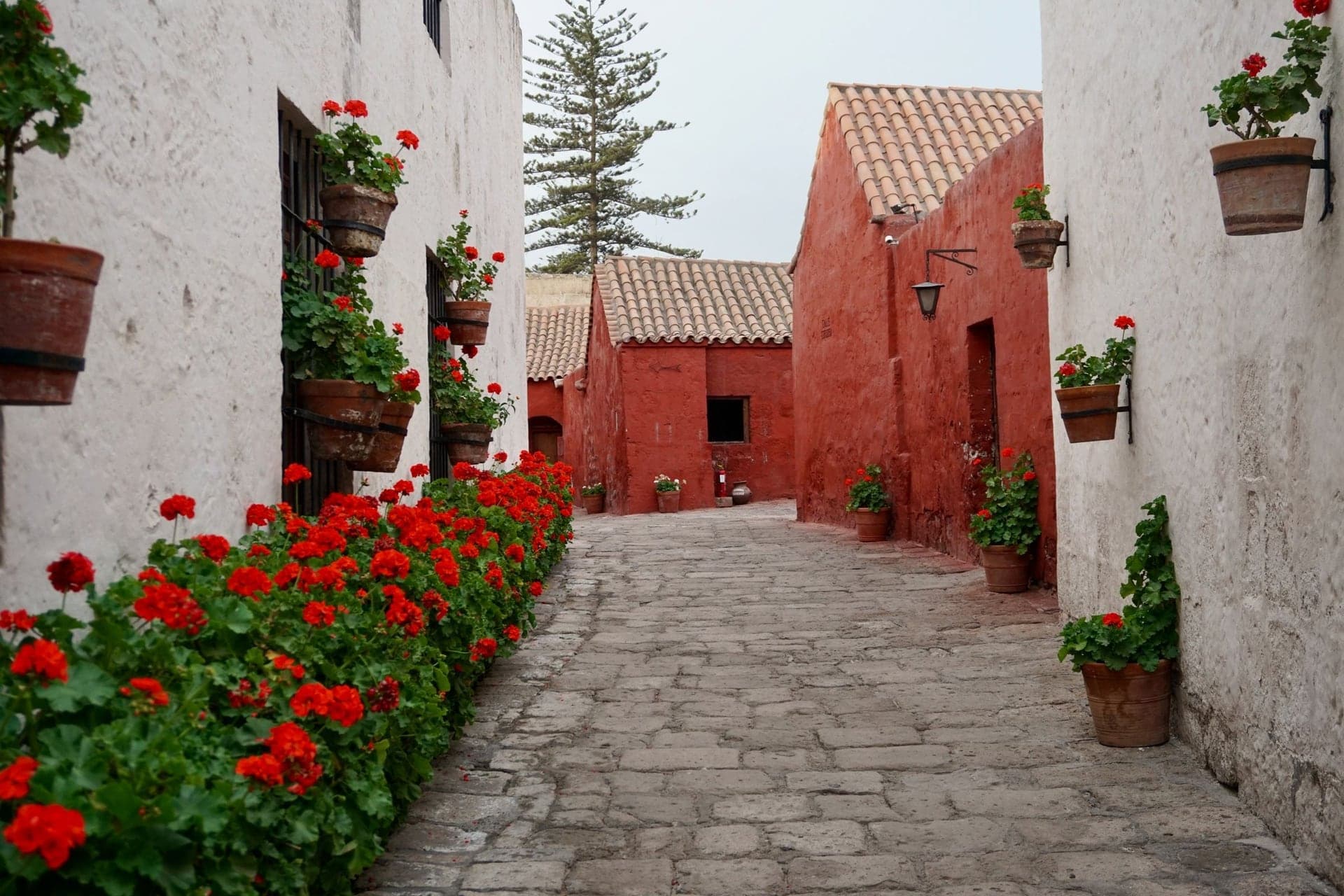
Inside the walls of the Monastery of Santa Catalina run six narrow streets named after cities in Spain: Sevilla, Córdoba, Toledo, Granada, Málaga and Burgos. A town inside the town needed street names. Calle Córdoba is one of the most photographed, and it is the best place to ask the two questions the painted lanes raise: what are the colors, and what lies behind the walls?
How the streets were made
The lanes were not laid out as streets. After the earthquakes that began in 1582 wrecked the convent's shared buildings, the monastery records, families built private cells for their daughters, and for nearly two centuries the cells and cloisters were altered and rebuilt. Rows of little houses, roofed first with tiles and later with vaults of sillar, the city's volcanic stone, lined up to make lanes. When and by whom the Spanish names were chosen is not recorded.
The white wall
Hear a stop from this walk
Claustro Mayor: The Great Cloister
Calle Córdoba's own wall is white, not red or blue. The monastery describes a long white wall with barred windows and pots of geraniums, and it gives that wall a job: it separates the maze that visitors can walk from the newer convent of the nuns of Santa Catalina, where they live today by the rules of convent life. Most walls on the visit belong to the past. This one still works.
When the monastery opened to visitors on 15 August 1970, after damage in the earthquakes of 1958 and 1960, it opened most of the complex, not all of it. A small community still lives on the other side of this wall: in 2018 it counted twenty professed nuns, four novices, a postulant and two aspirants.
The first cell on Calle Córdoba is the Sala de Hostias, where, in the middle of the twentieth century, the nuns made the wafers for communion.
What the red and the blue are
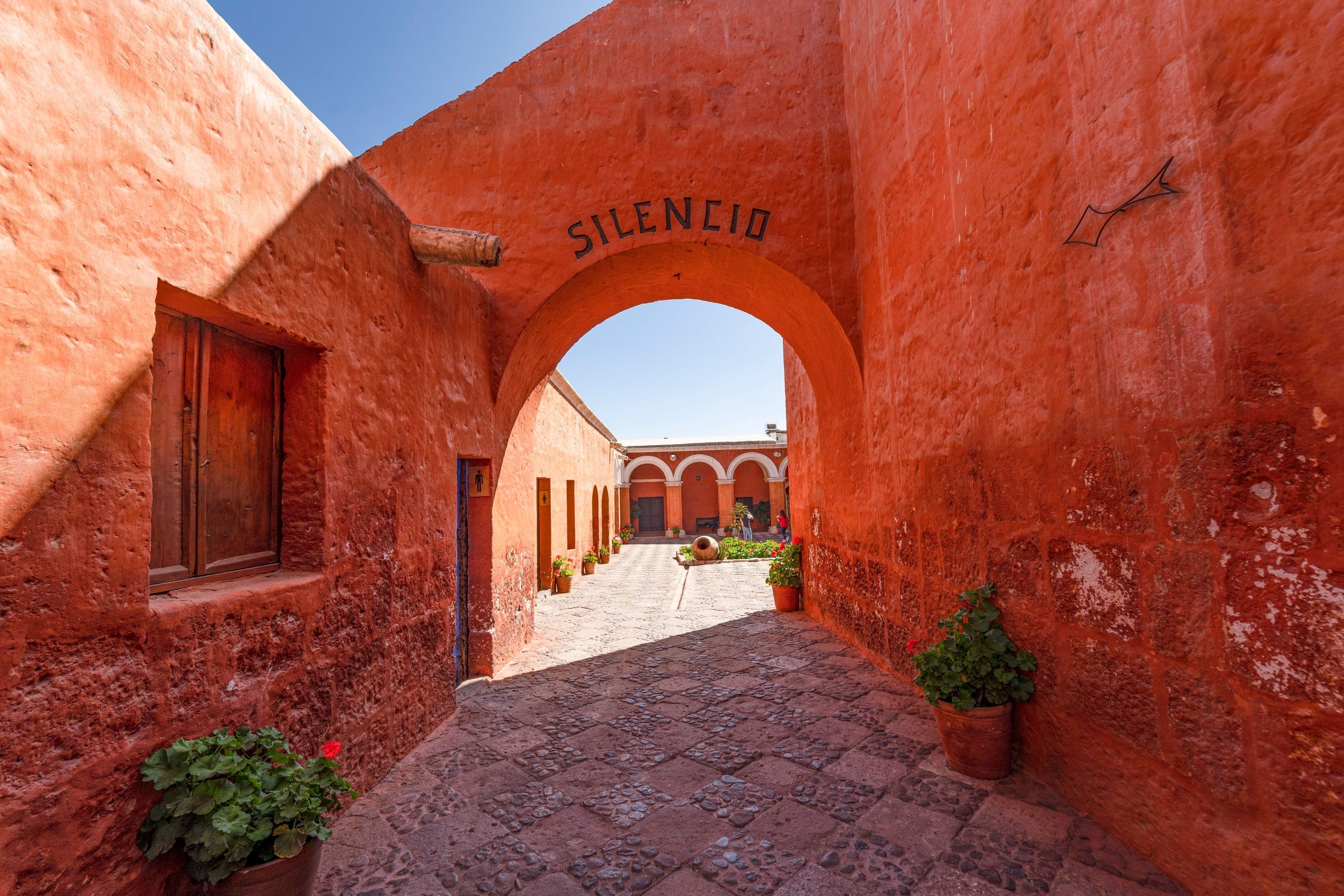
The famous colors are on the lanes and cloisters around it. Calle Toledo, the longest and narrowest street, with the oldest buildings, is red: the monastery calls it red ochre, or almagre, red earth. The Cloister of the Orange Trees is indigo blue, and Calle Málaga an intense ochre.
A long-repeated story says the red is cochineal, the costly insect dye. The only technical study of the walls, by Marisol Velazco Gutiérrez in 2023, found no cochineal. The cells are painted in lime paint colored with indigo and with red, orange and yellow ochres, pigments the study describes as cheap and easy to obtain. The paint was thrown on with broqueles, boards covered in sheepskin, a technique called chaglapeo, and the lime protected the porous stone beneath.
The same study found that the paler, softened outer layers are modern, laid over a much older tradition, and that yellow turns up only in the recent layers. In the great cloister, the monastery adds, restorers removed later repaints layer by layer to reach older painted baskets of flowers, fruit and birds. What you photograph on these lanes is kept in the old colors and renewed again and again. It is not a colonial surface sealed in time.
Walking it
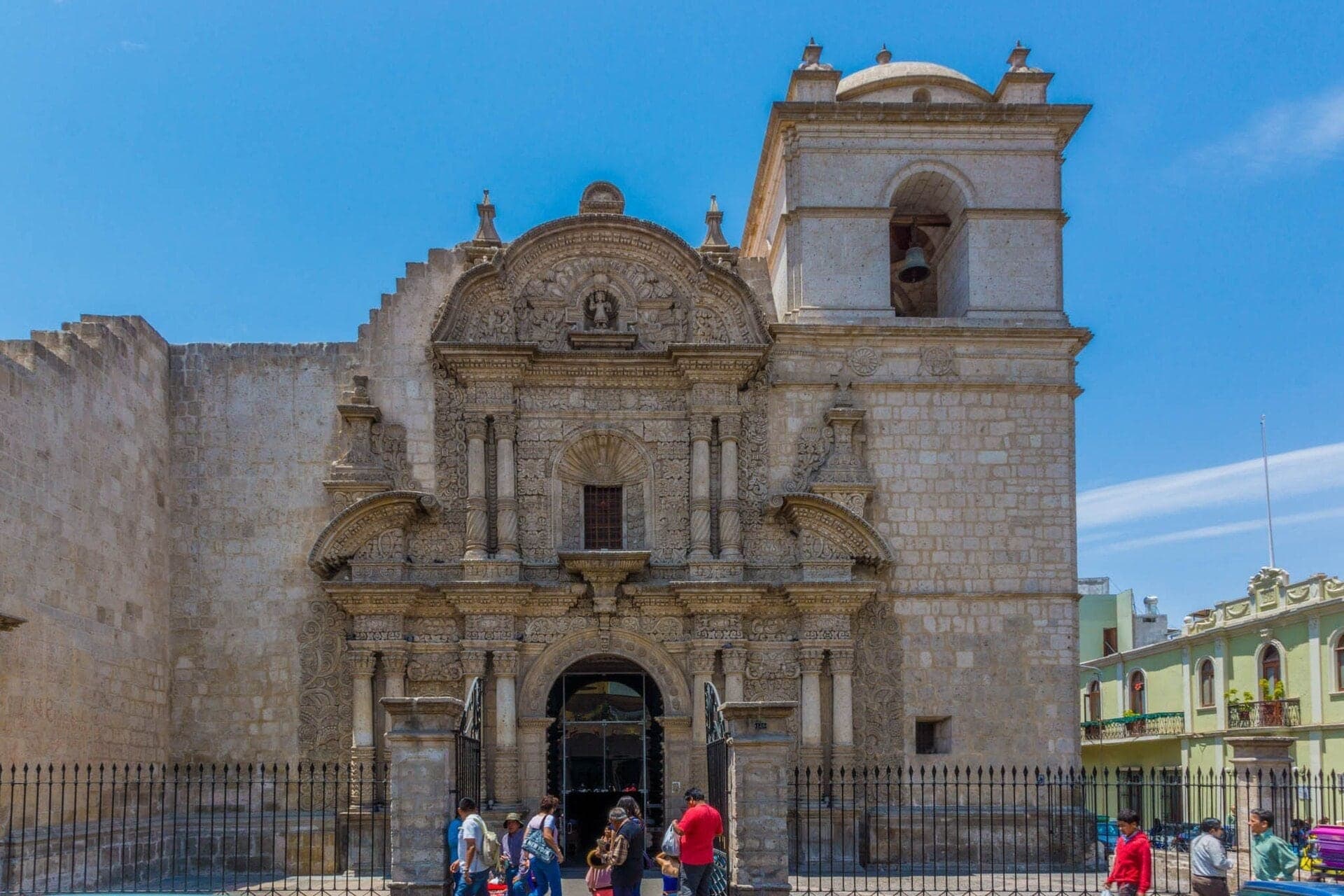
Calle Córdoba is the ninth stop of our Santa Catalina walk, "Santa Catalina Monastery: A Bare Wall and the Town Inside", and one of seven stops inside the ticketed monastery. The walk goes round the outside first, six stops in about forty minutes, from the carved Casa del Moral past the convent's bare walls (on Calle Bolívar you stand across from the part where the nuns live) to the Franciscans' square and the monastery door. Inside, the stops play when you tap them, in any order. Tickets are 50 soles for adults, cards accepted, and the monastery is open daily from 9:00 to 17:00, and until 20:00 on Tuesdays and Wednesdays. Checked 6 October 2026.
Stand on Calle Córdoba for a minute before you photograph it. For the small community behind this white wall, the convent María de Guzmán founded in 1579 is still closed to the world.
Ready to experience it?
Santa Catalina Monastery: A Bare Wall and the Town Inside
150 min · 0.9 km · easy
More from Arequipa
Explore more at your own pace.
Arequipa Travel Guide: How Many Days, Altitude, When to Go (2026)
Best Self-Guided Walking Tours in Arequipa (2026)
One Day in Arequipa: A Walkable White-City Itinerary (2026)
Best History Walking Tours in Arequipa (2026)
What to Eat in Arequipa: A Food Guide (2026)