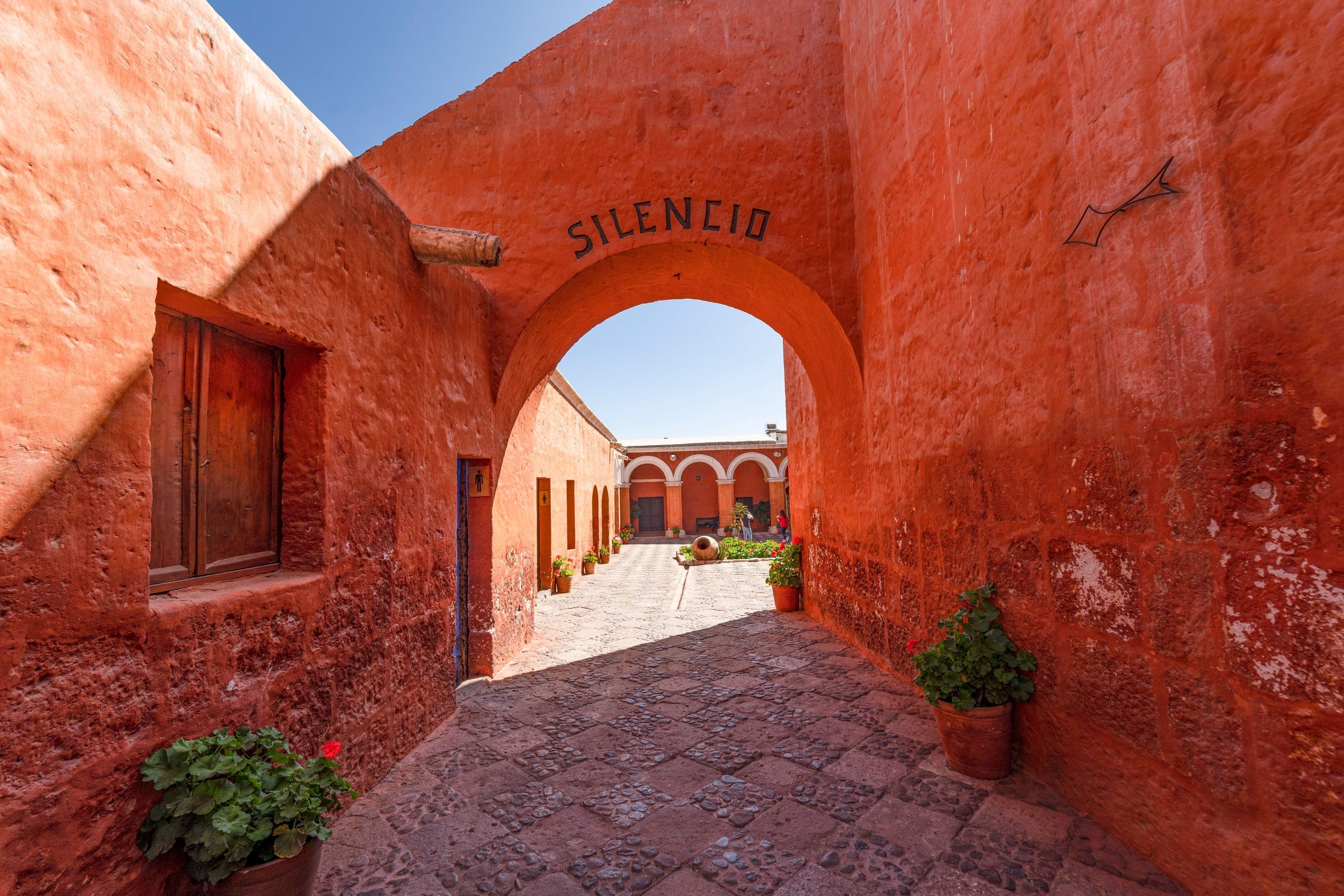
Walk round Arequipa's Santa Catalina Monastery, from the carved Casa del Moral past its bare walls to San Francisco, then go in for seven stops among red and blue lanes. The outside walk works on its own.
Inside the monastery · ticketed · 7 stops you tap
Start · Casa del Moral: A Doorway That Shows Everything
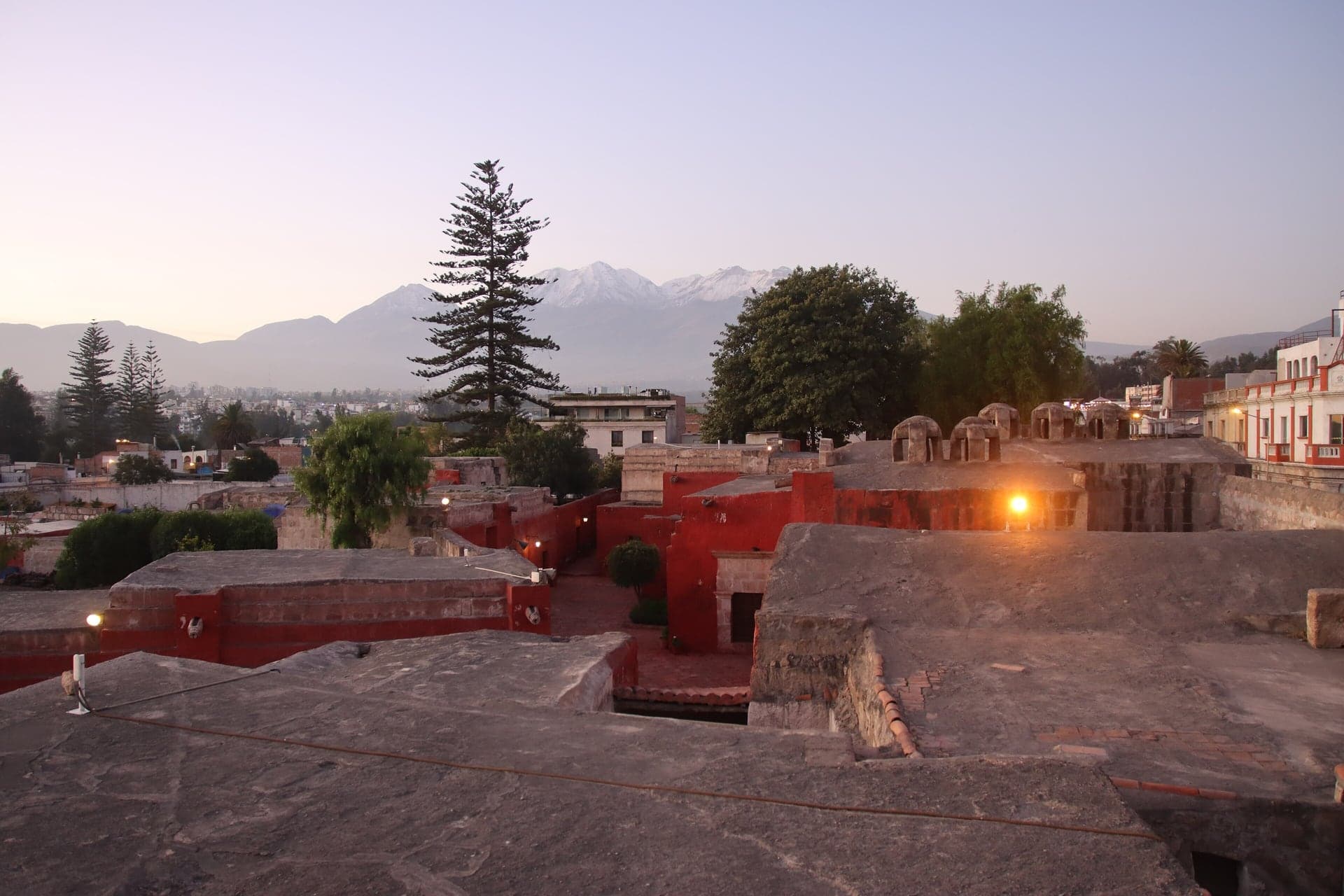
DirectionsStops
- 1
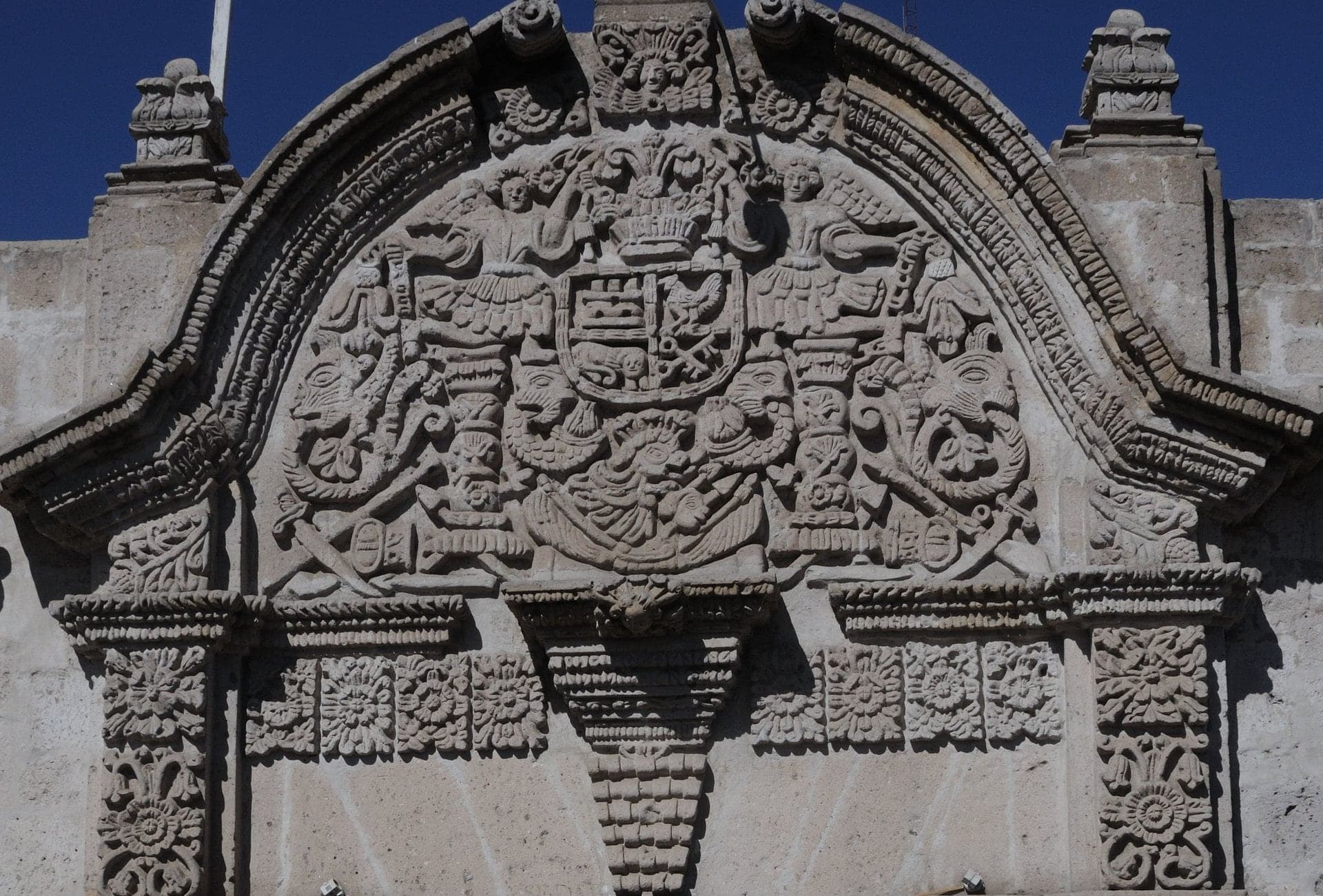
Casa del Moral: A Doorway That Shows Everything
A carved doorway puts a family's rank on the street. Crowned arms, flat relief and puma-headed waterspouts on a colonial house a block from the convent.
- 2
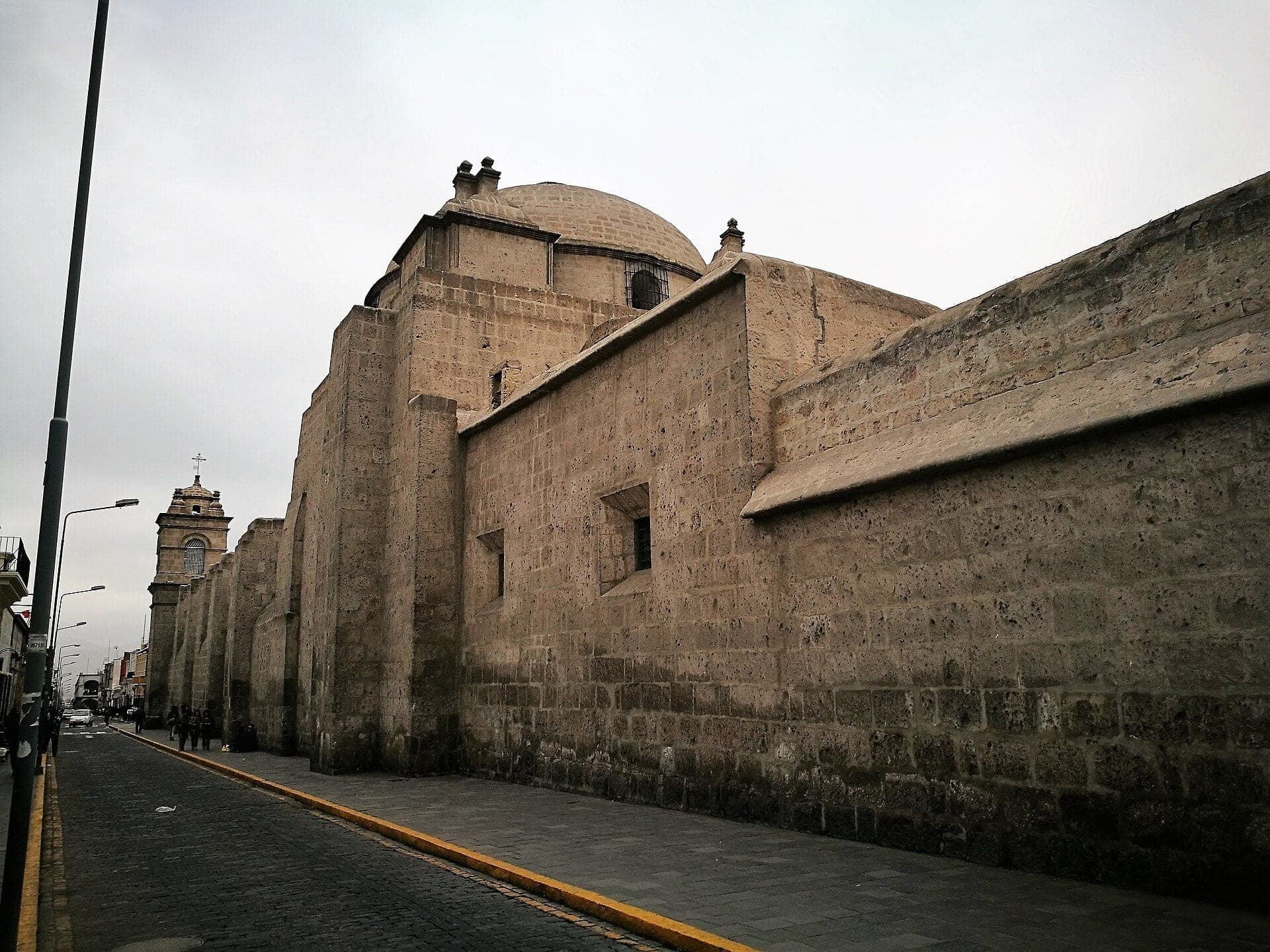
Calle Bolívar: The Side Visitors Never See
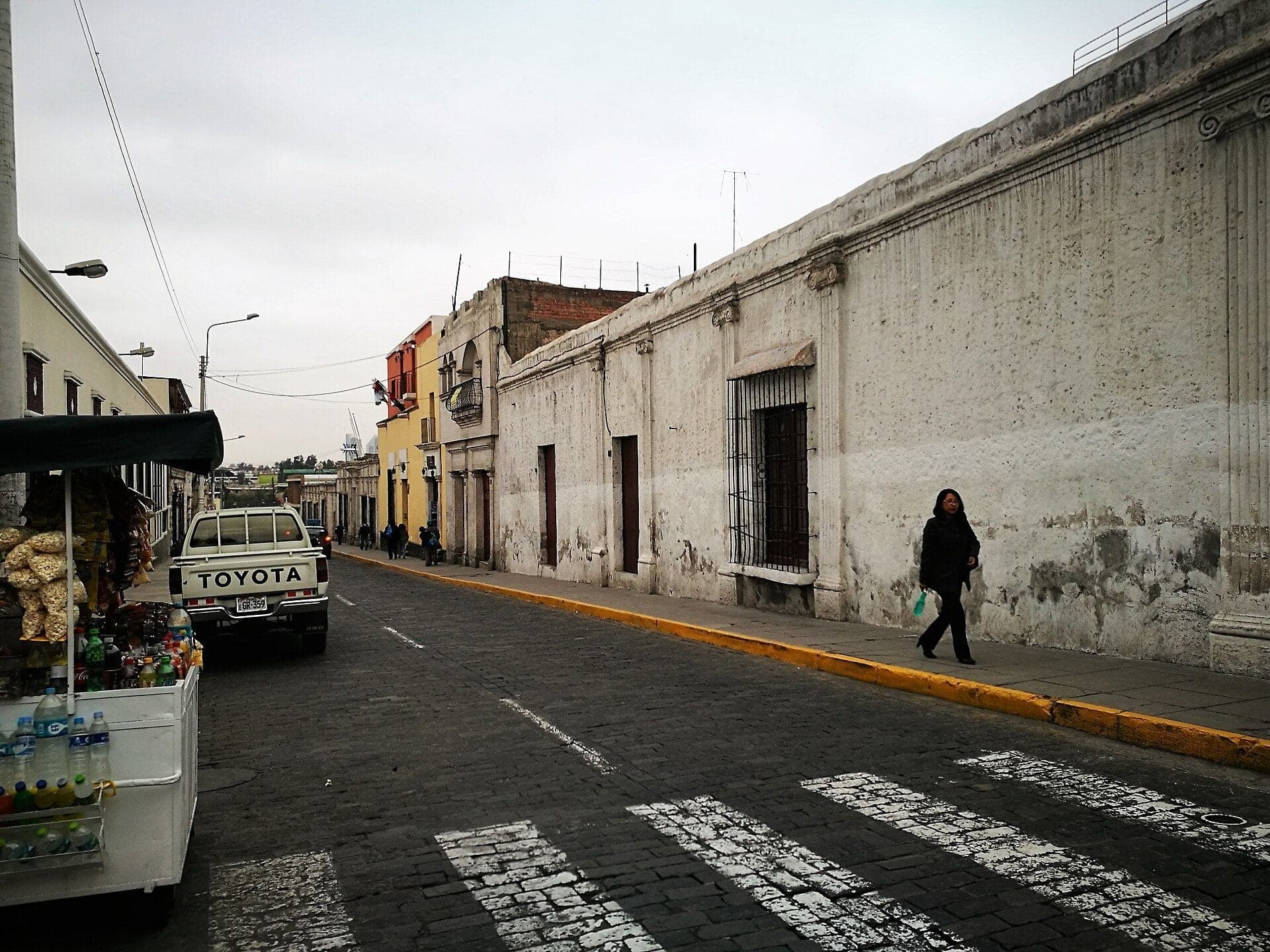
The quiet side of the convent that visitors never see. Beyond these walls a small community of nuns still keeps part of Santa Catalina closed.
- 3
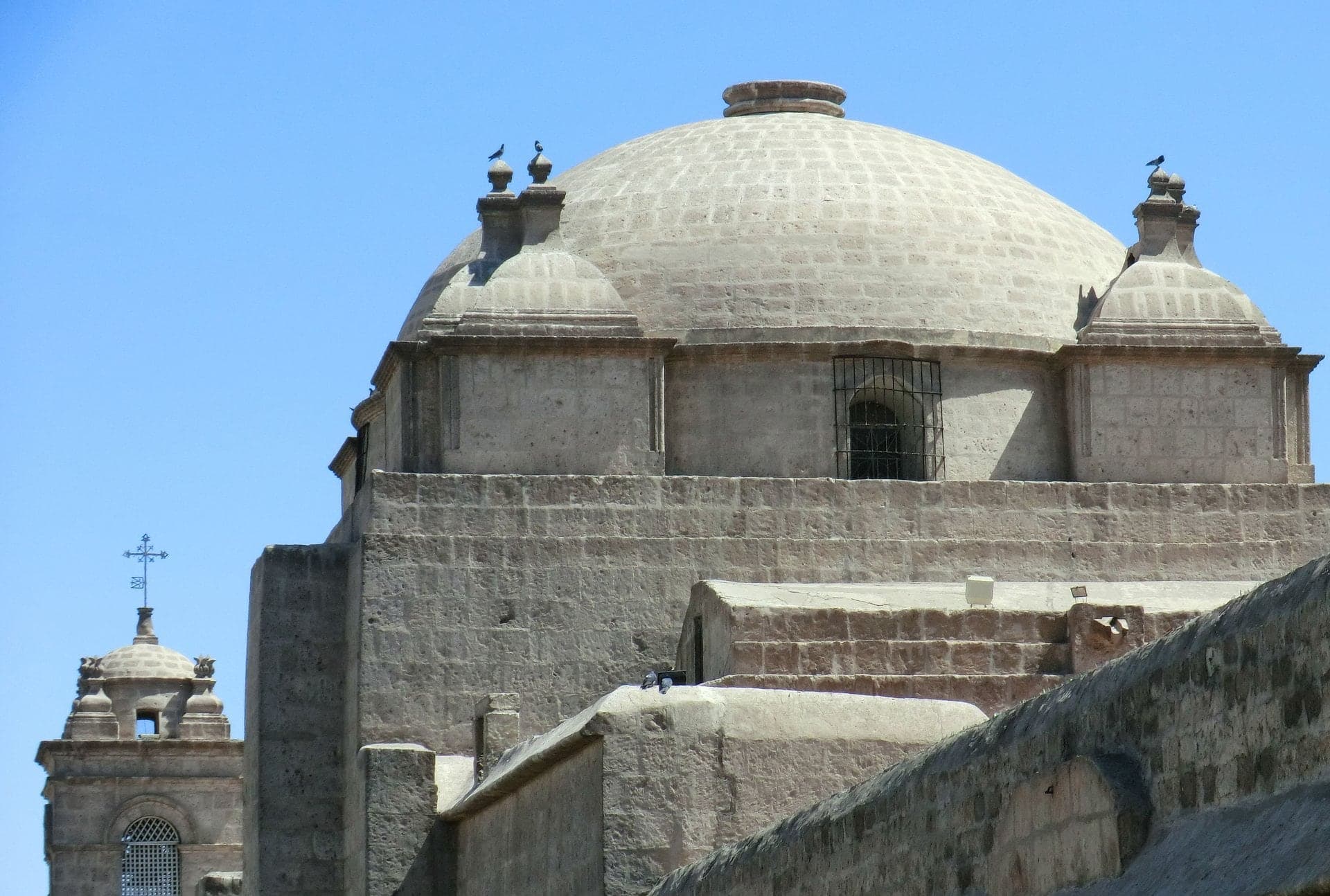
Calle Zela: Where the Color Comes From
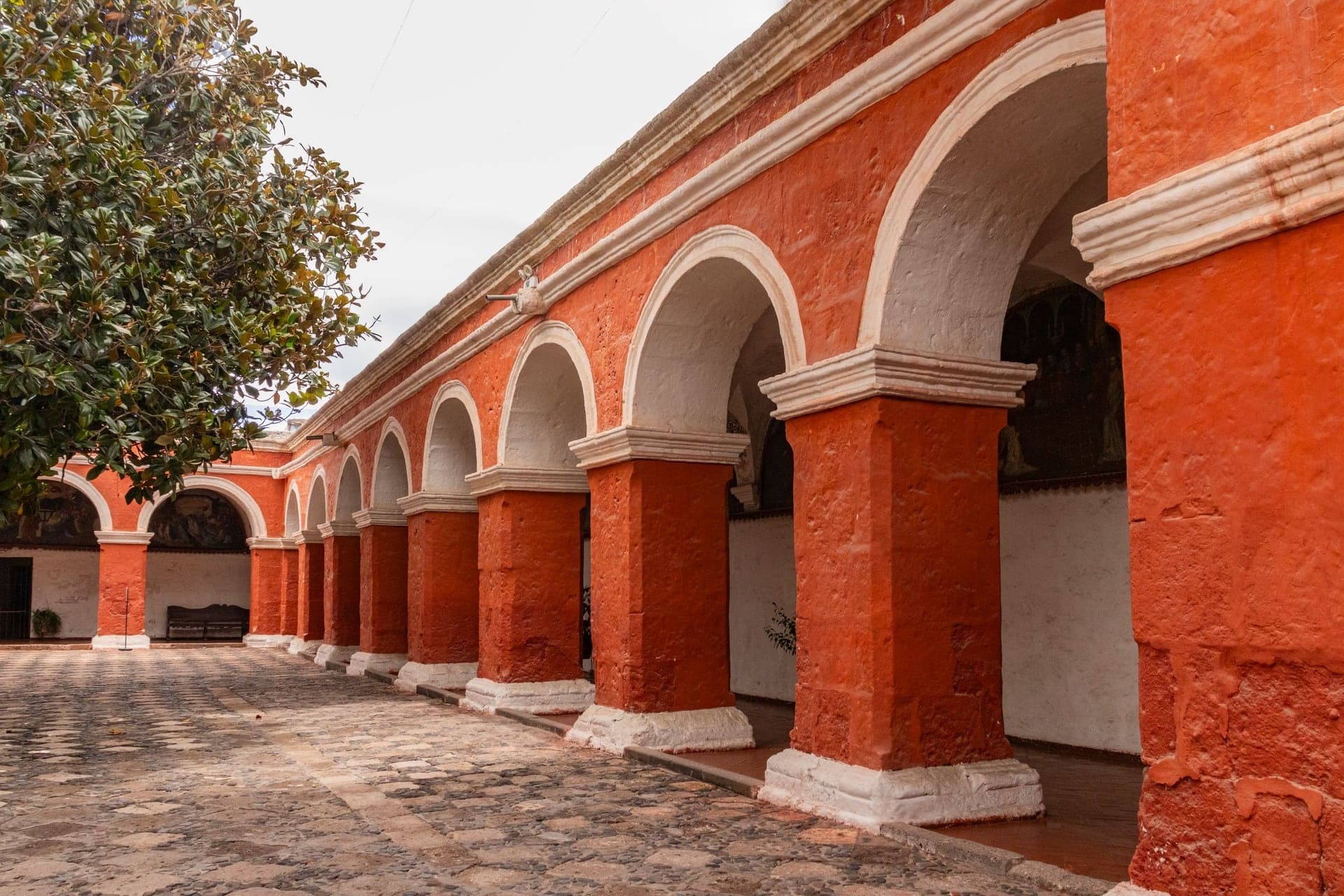
The convent's north wall hides the secret of its color. Red earth and indigo in limewash, laid on with sheepskin boards behind bare stone.
- 4
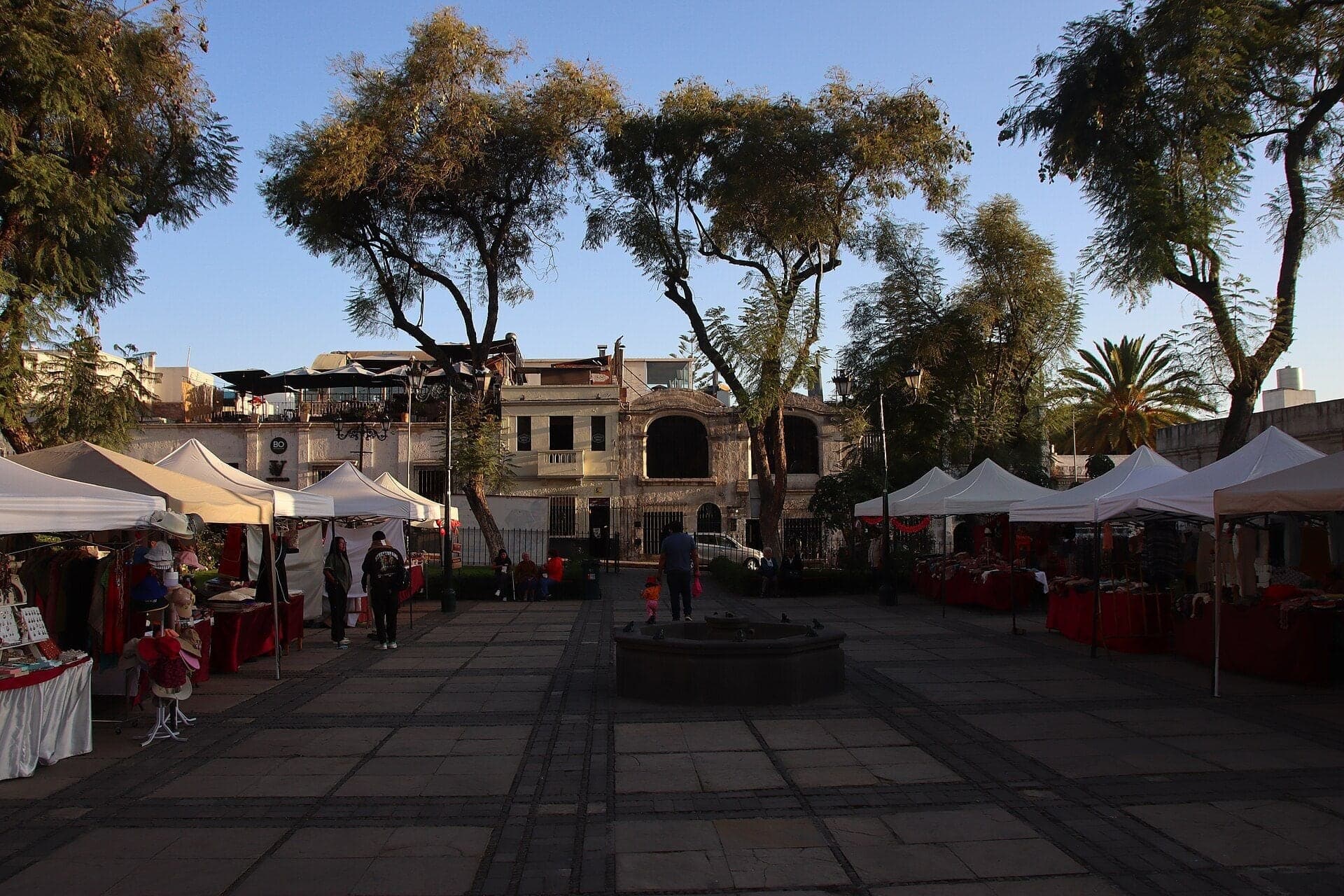
Fundo El Fierro: From Jail to Craft Market
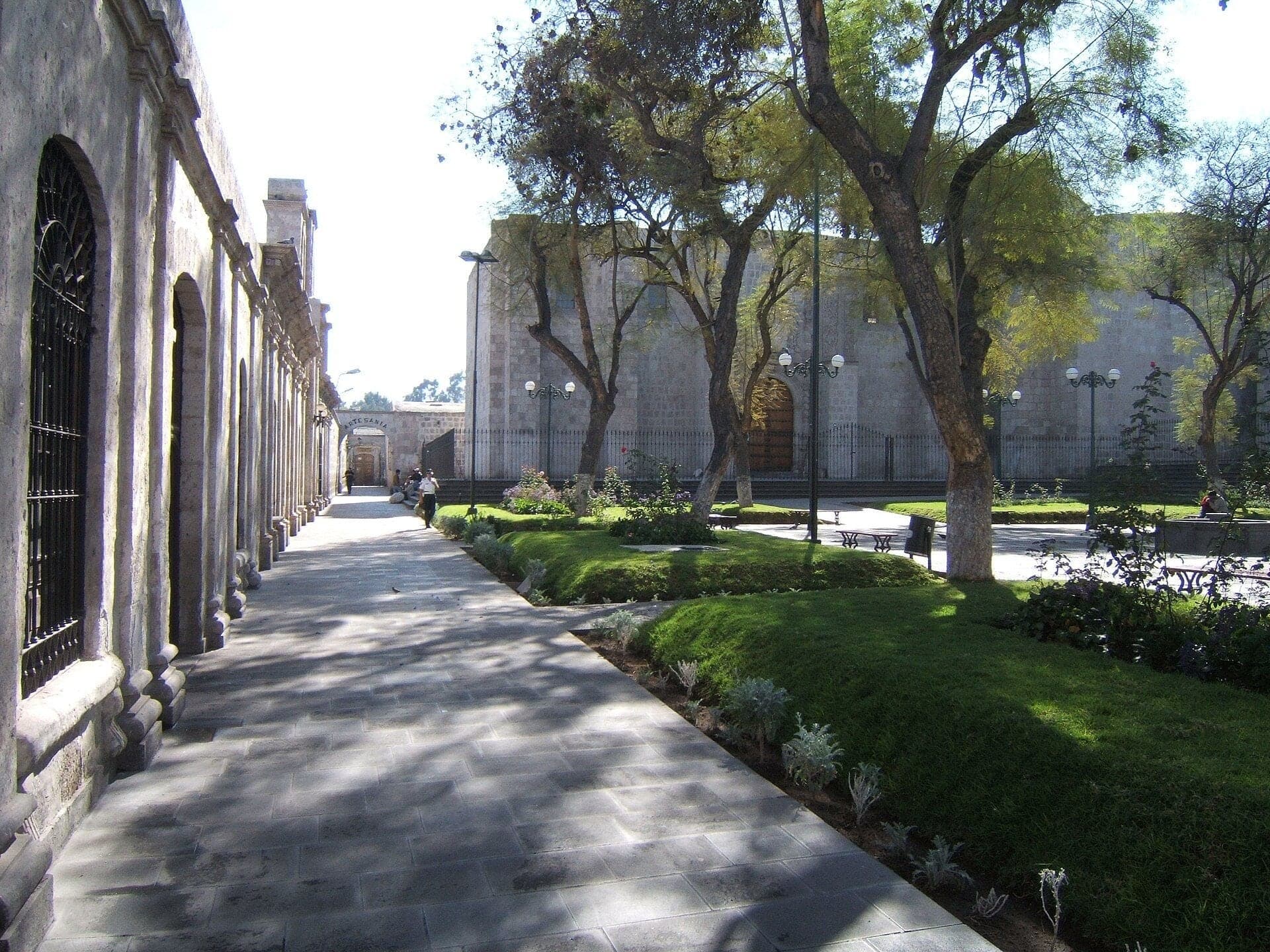
An old jail that now sells carved stone and silver. Artisans' stalls and the city's municipal history museum share the Fundo El Fierro's courtyard.
- 5
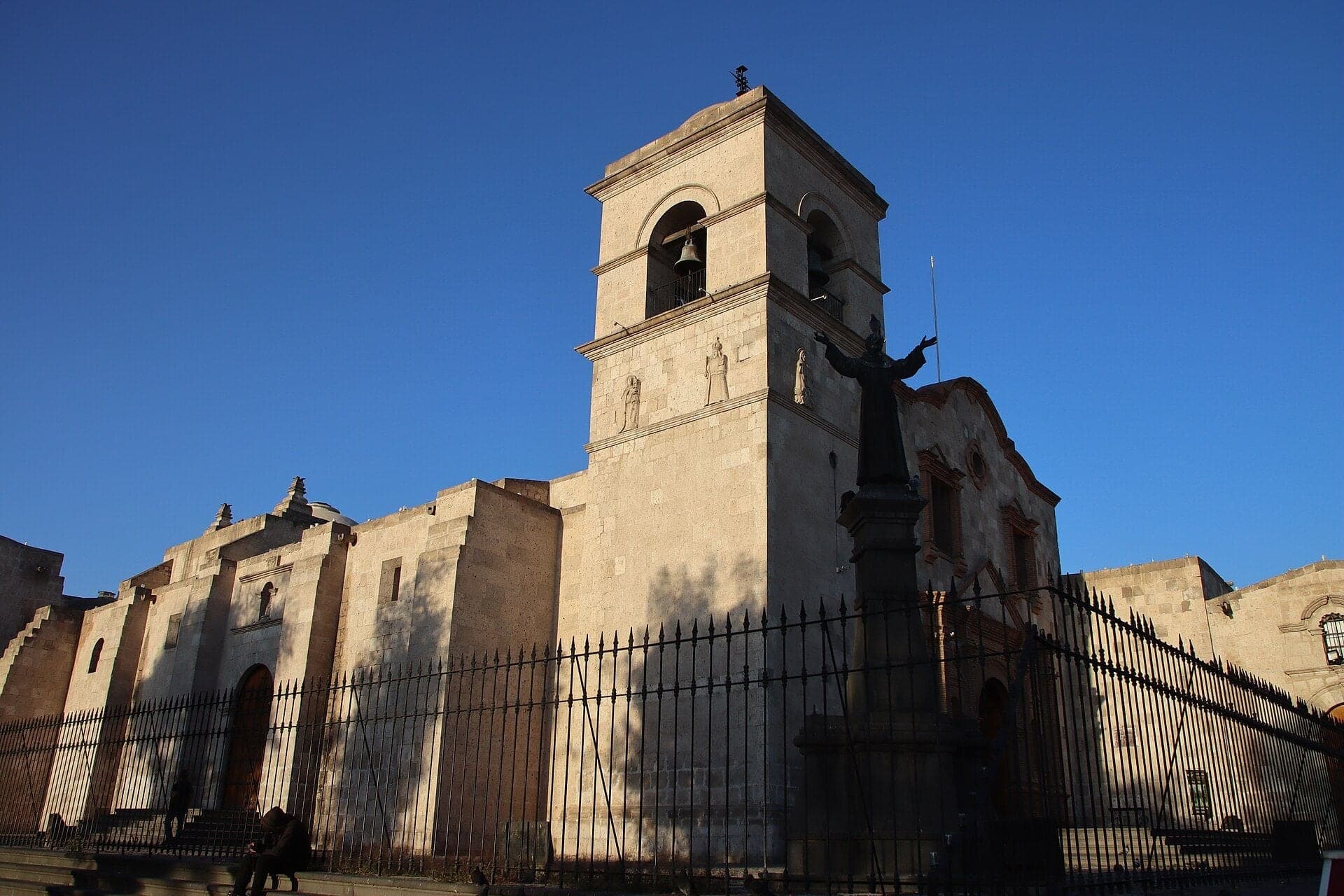
San Francisco: A Square That Was a Cemetery
A Franciscan church of sillar and brick faces a former cemetery. Begun to a plan of 1569, it was nearly lost in the 2001 earthquake and restored by 2004.
- 6
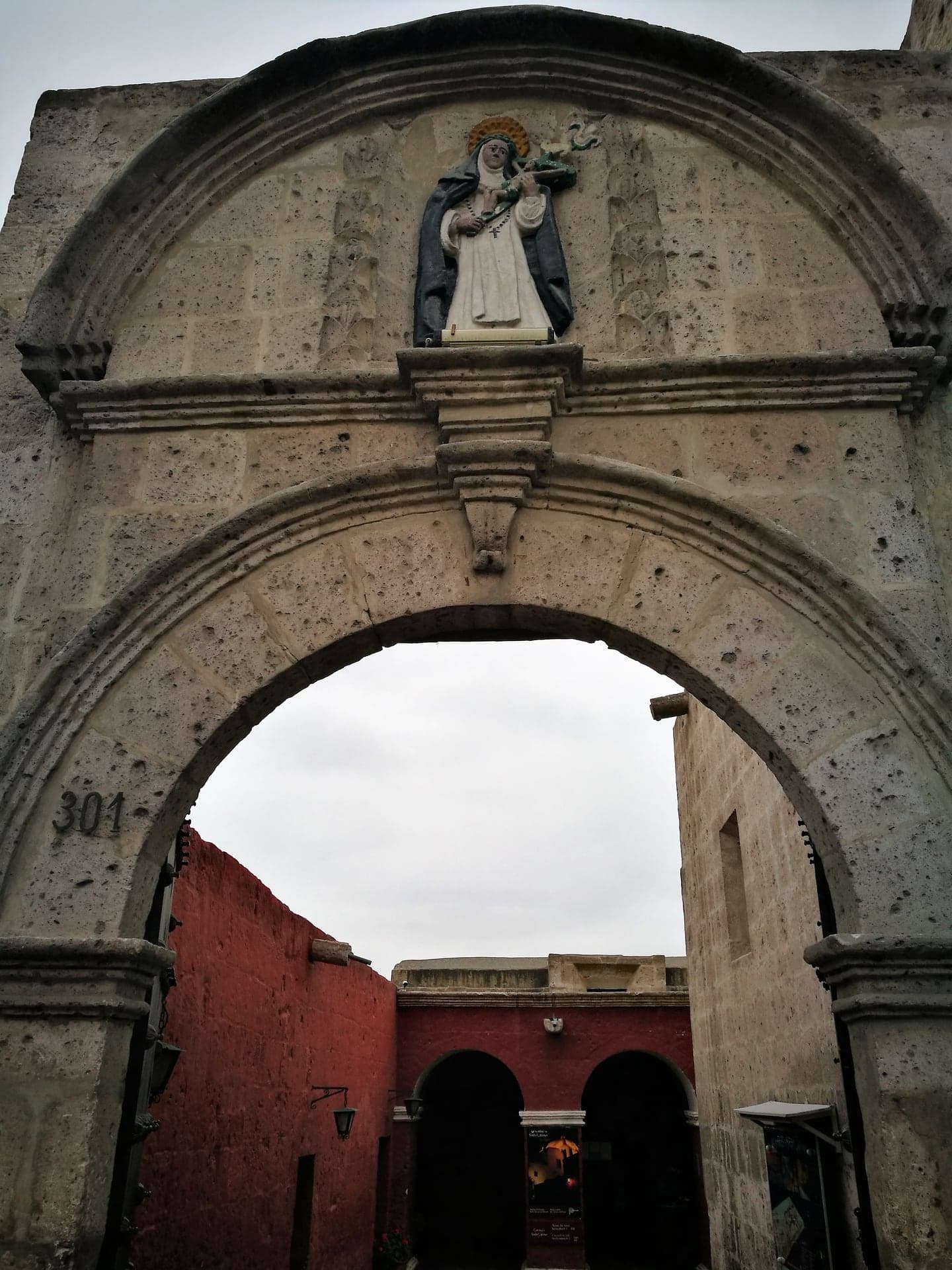
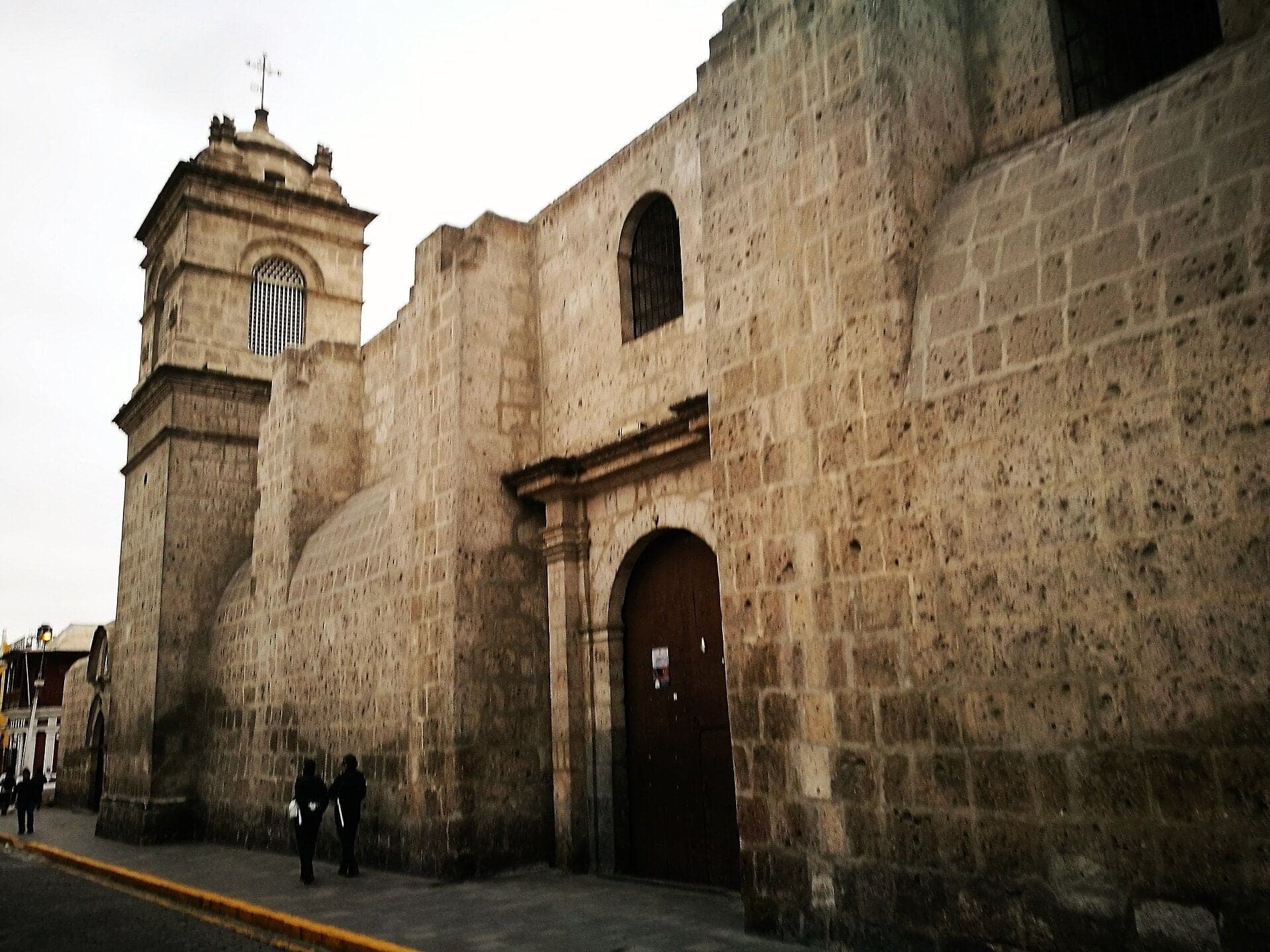
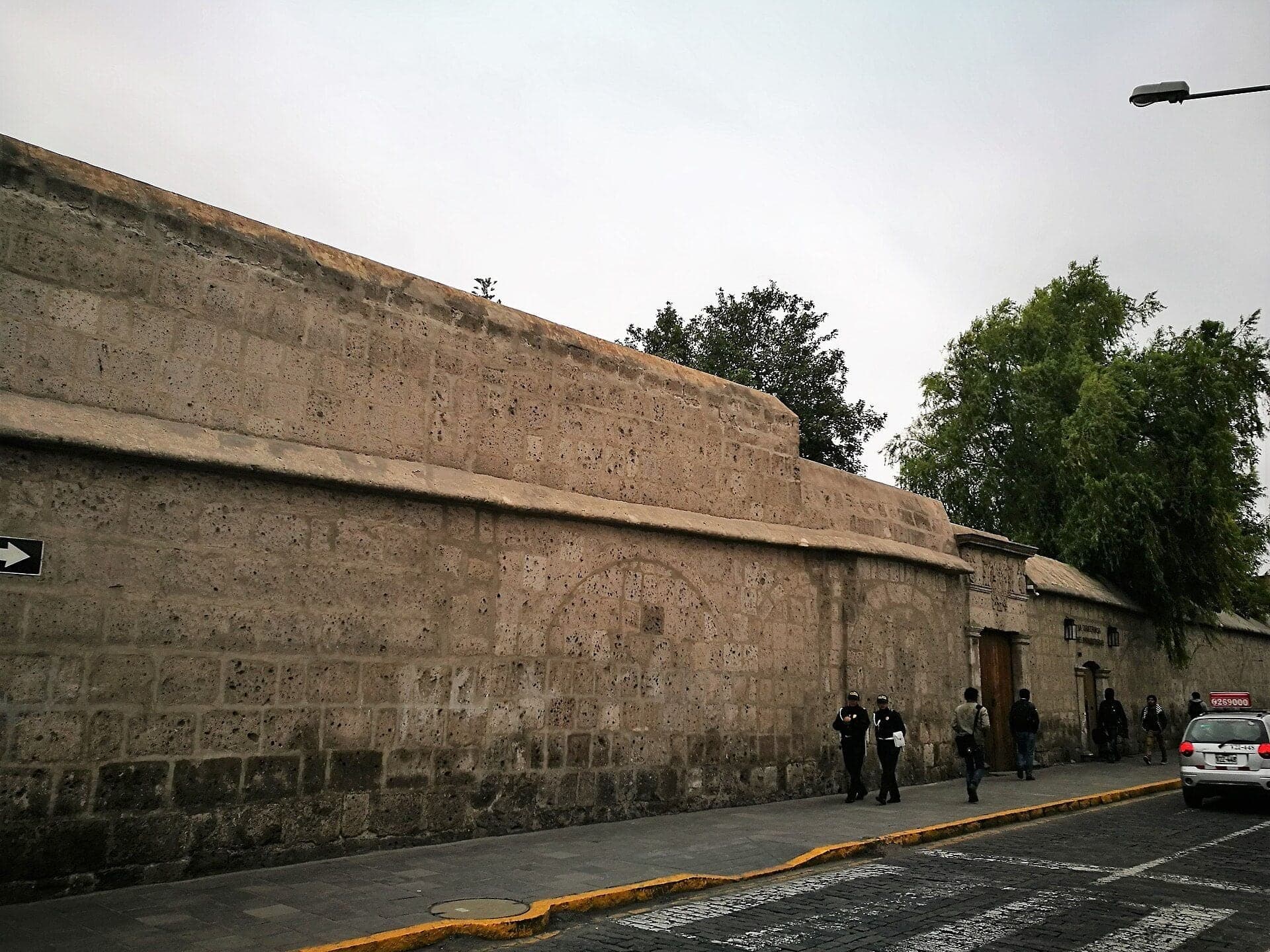
Santa Catalina Monastery: A Wall That Shows Nothing
A bare stone wall hides a walled town of nuns. Founded in 1579 and opened to visitors in 1970, the monastery keeps all its famous color inside.
- Inside the monastery · ticketed · tap each stop to play
- 7
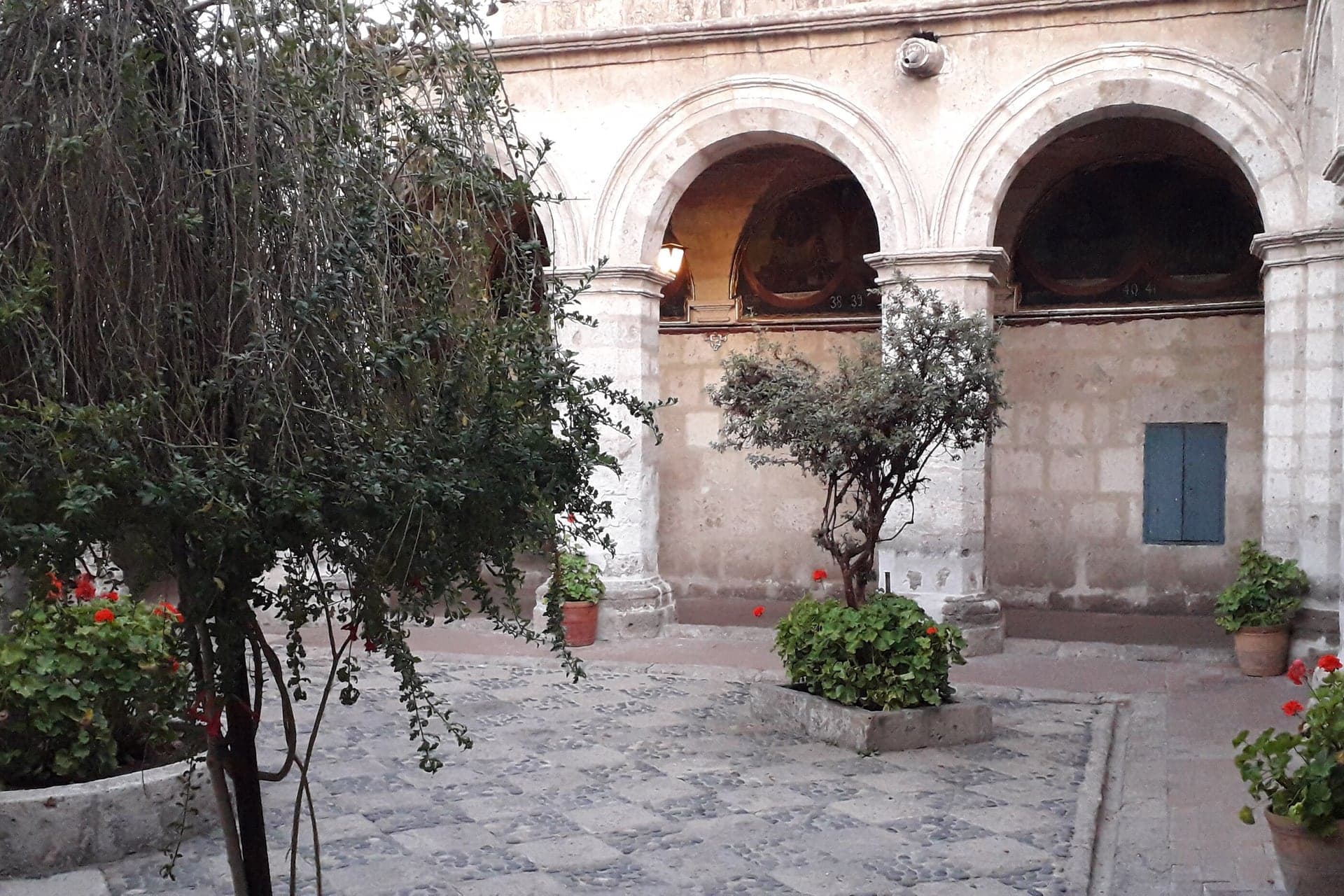
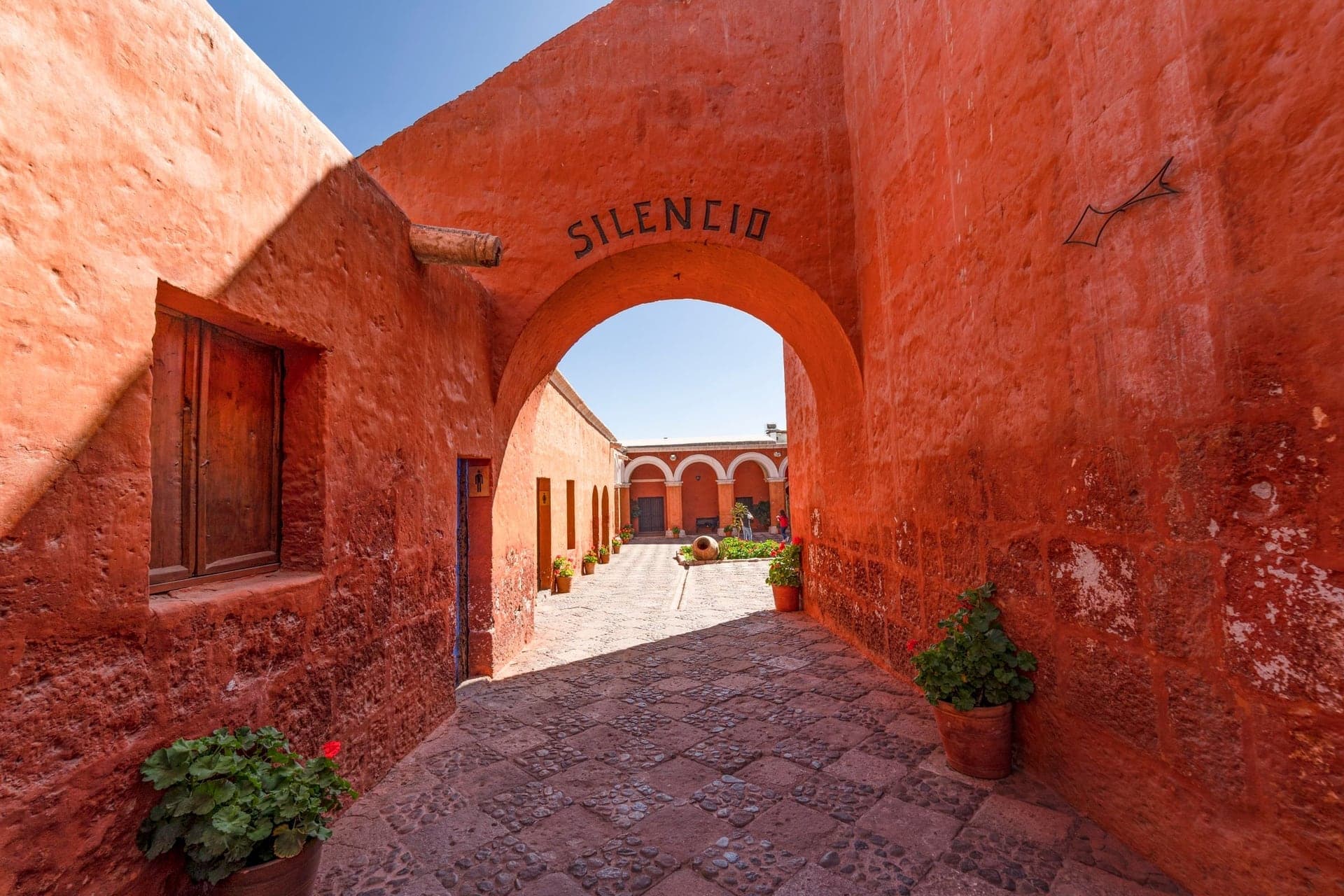
Novices' Cloister: Silence First
A small cloister where the newest nuns lived apart from everyone. Brick vaults on bare sillar columns, reached through the arch of Silence and a chessboard courtyard.
- 8
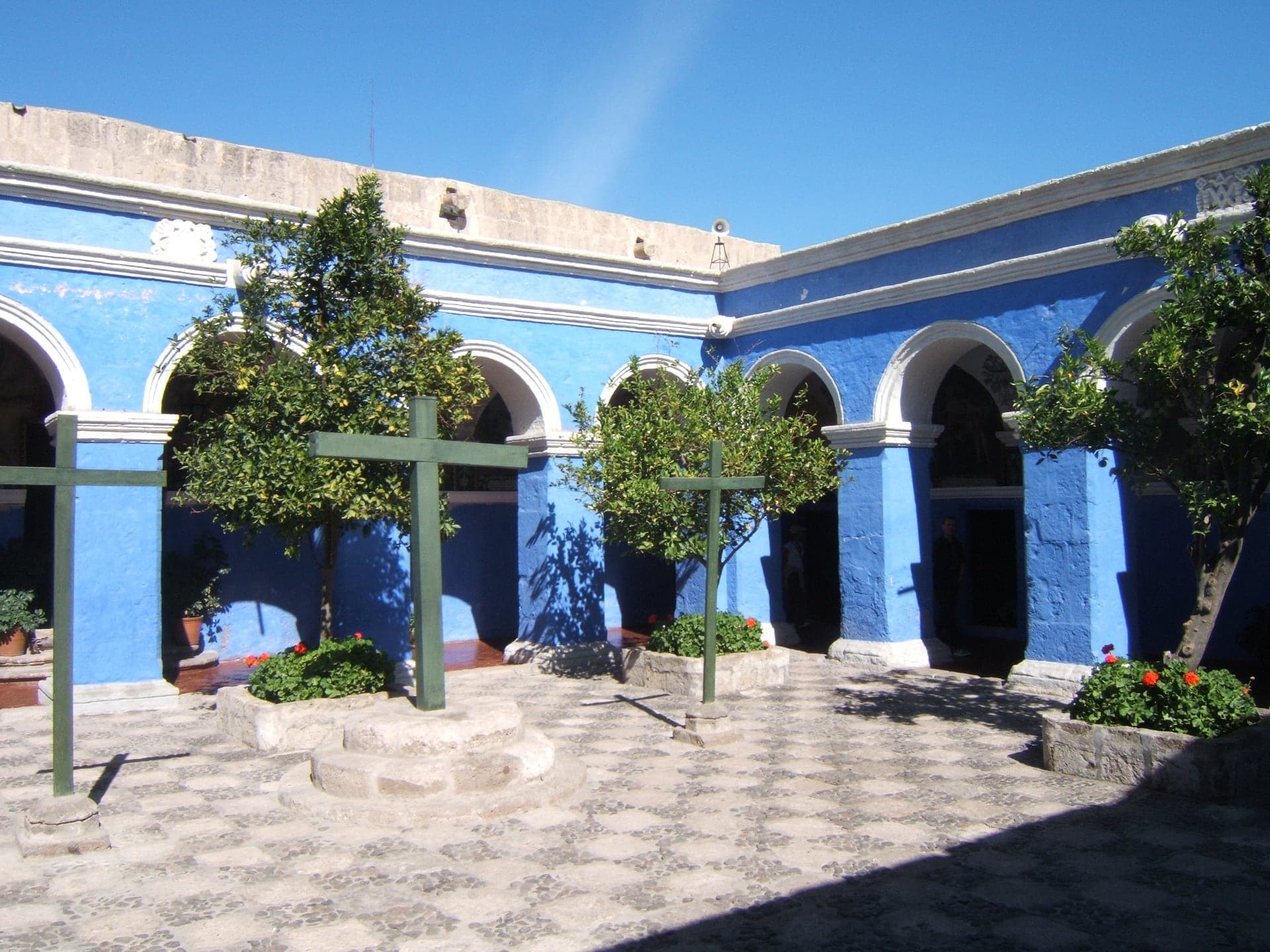
Claustro de los Naranjos: A Picture Book in Indigo
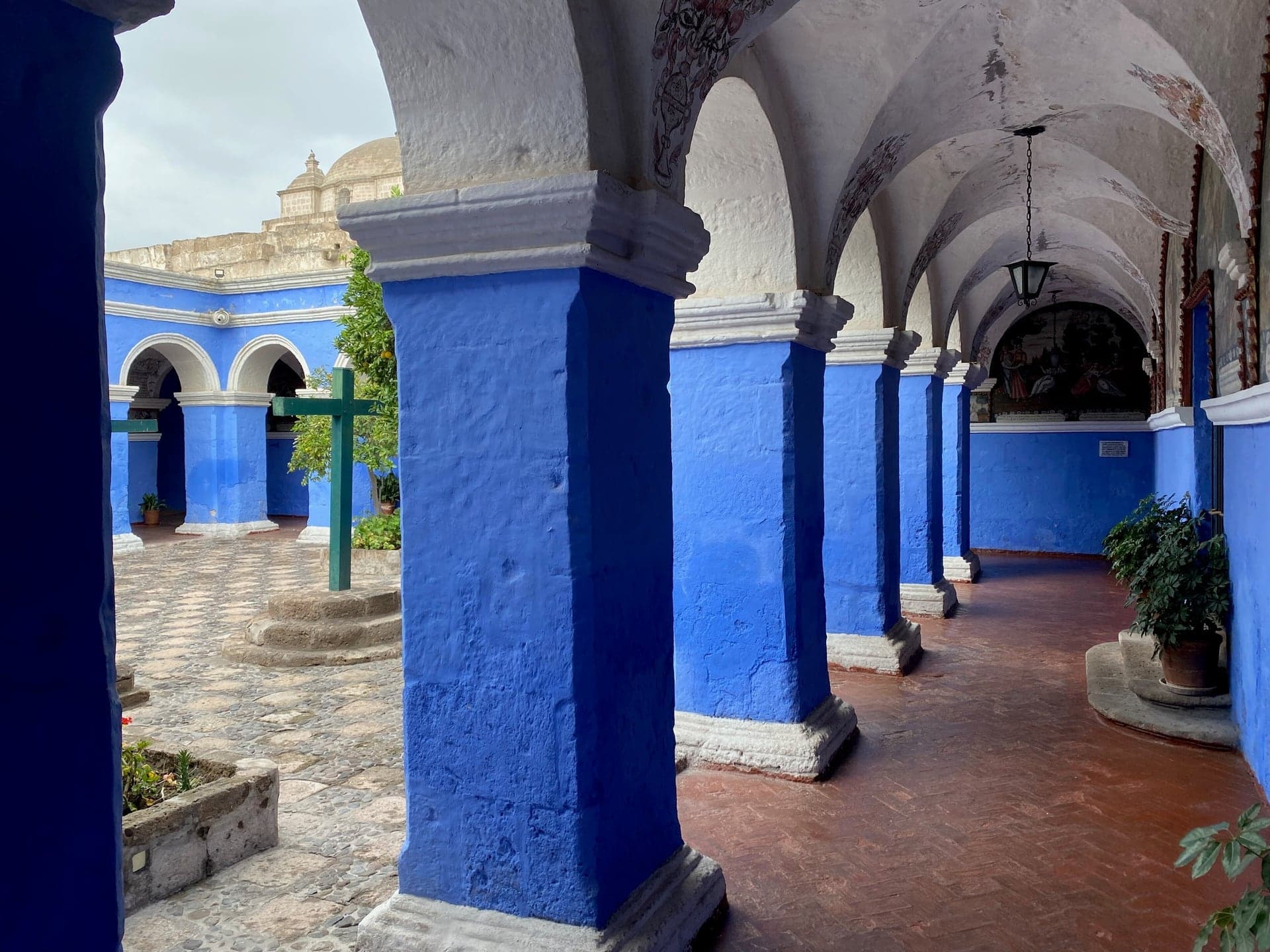
A cloister named for its orange trees, painted deep indigo blue. Its arches carry emblems of divine love, and three wooden crosses stand in its garden.
- 9
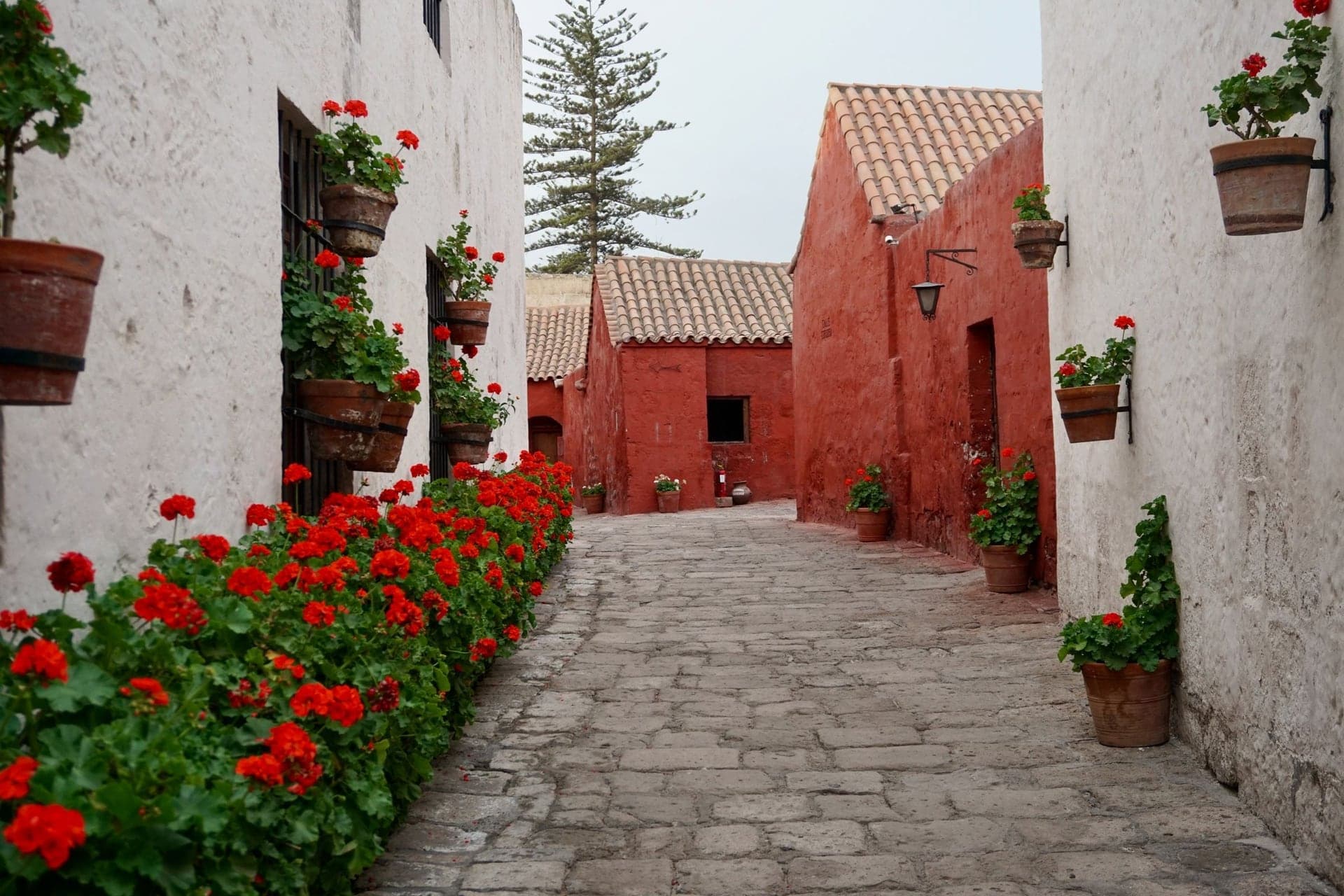
Calle Córdoba: The Wall That Still Works
A long white wall marks the edge of the visit. Beyond it lies the newer convent where a small community of nuns lives today.
- 10
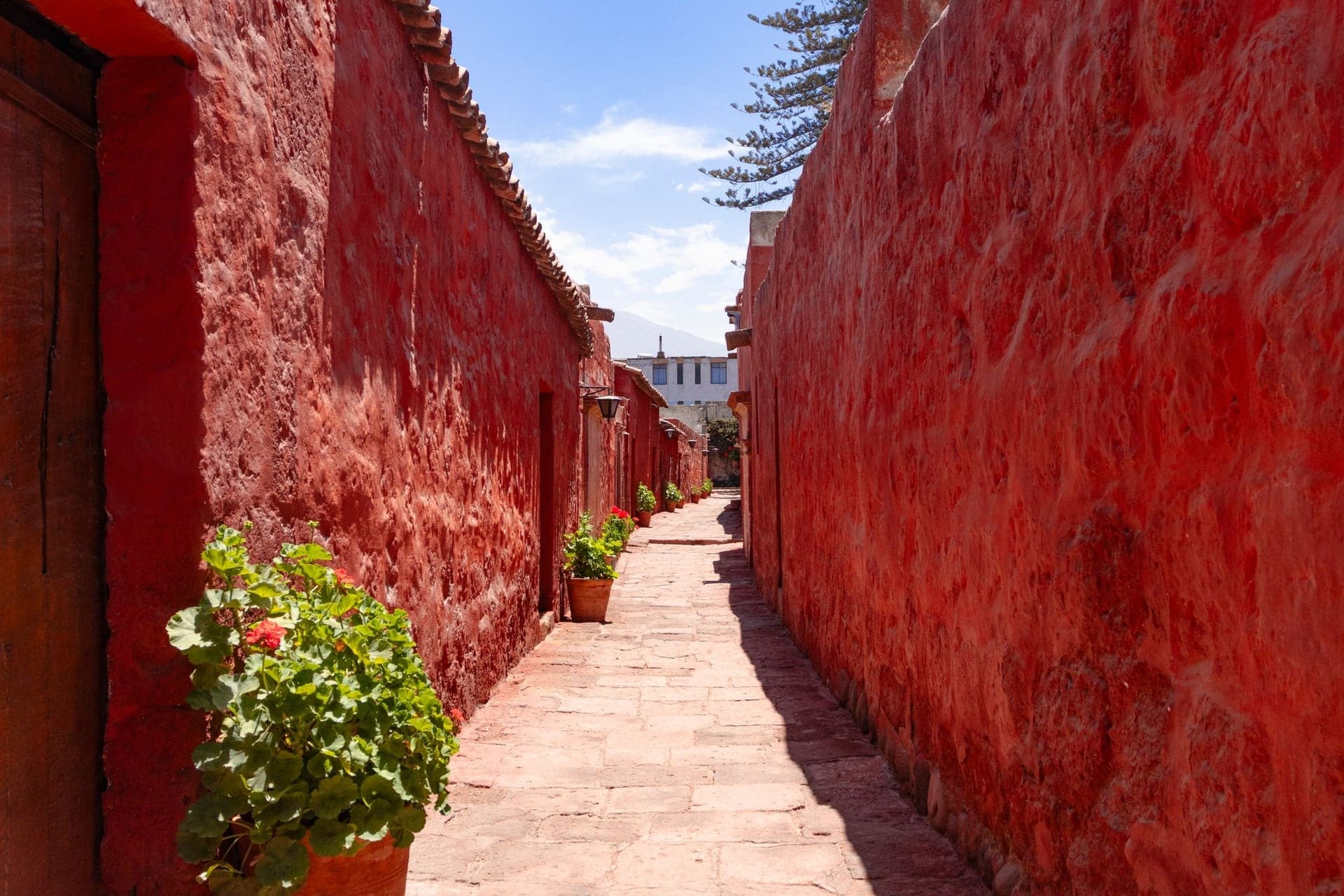
Calle Toledo: The Red Street
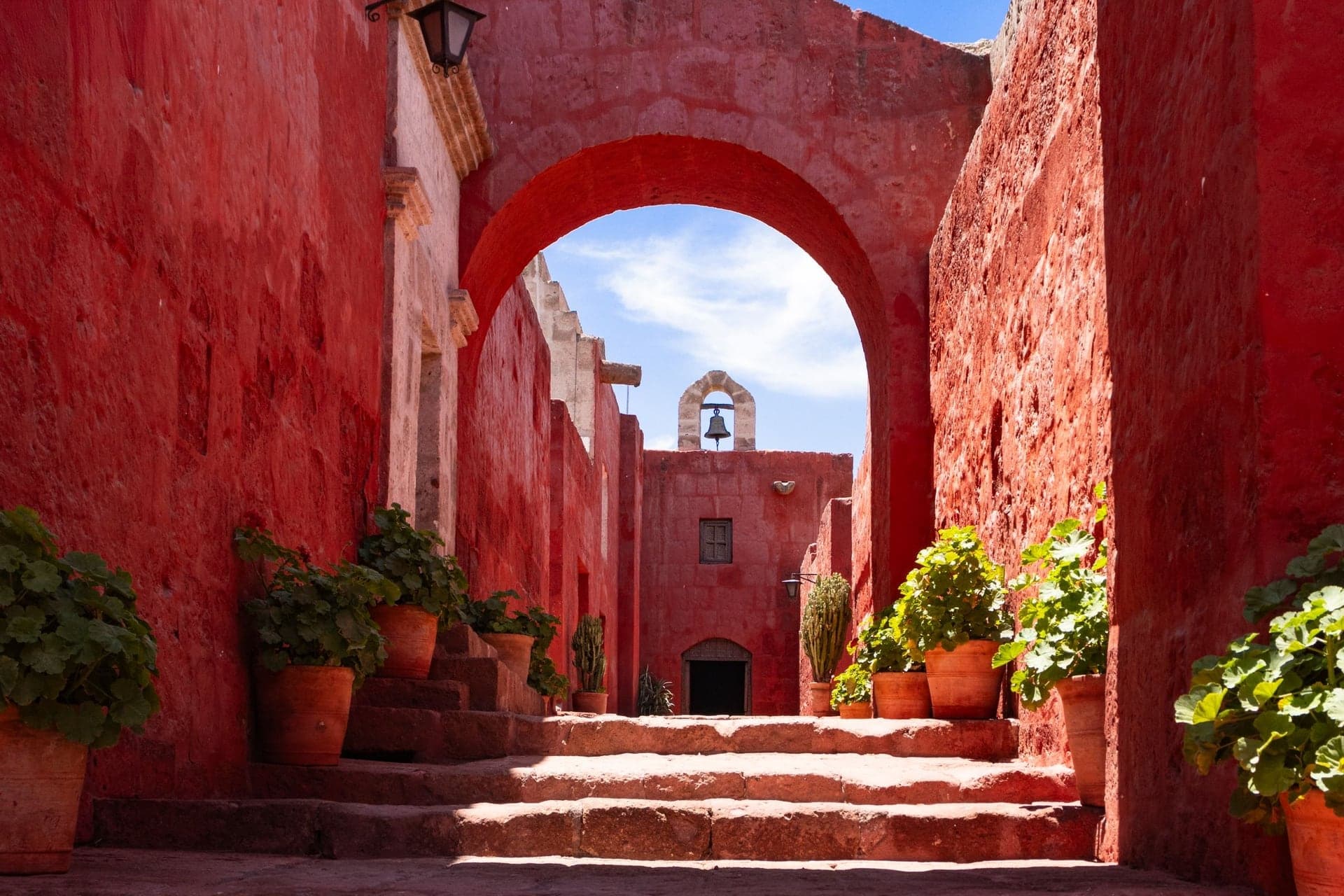
The longest and narrowest lane in the monastery, washed in red earth. It holds the oldest buildings, and Calle Sevilla, once the main street, joins it here.
- 11
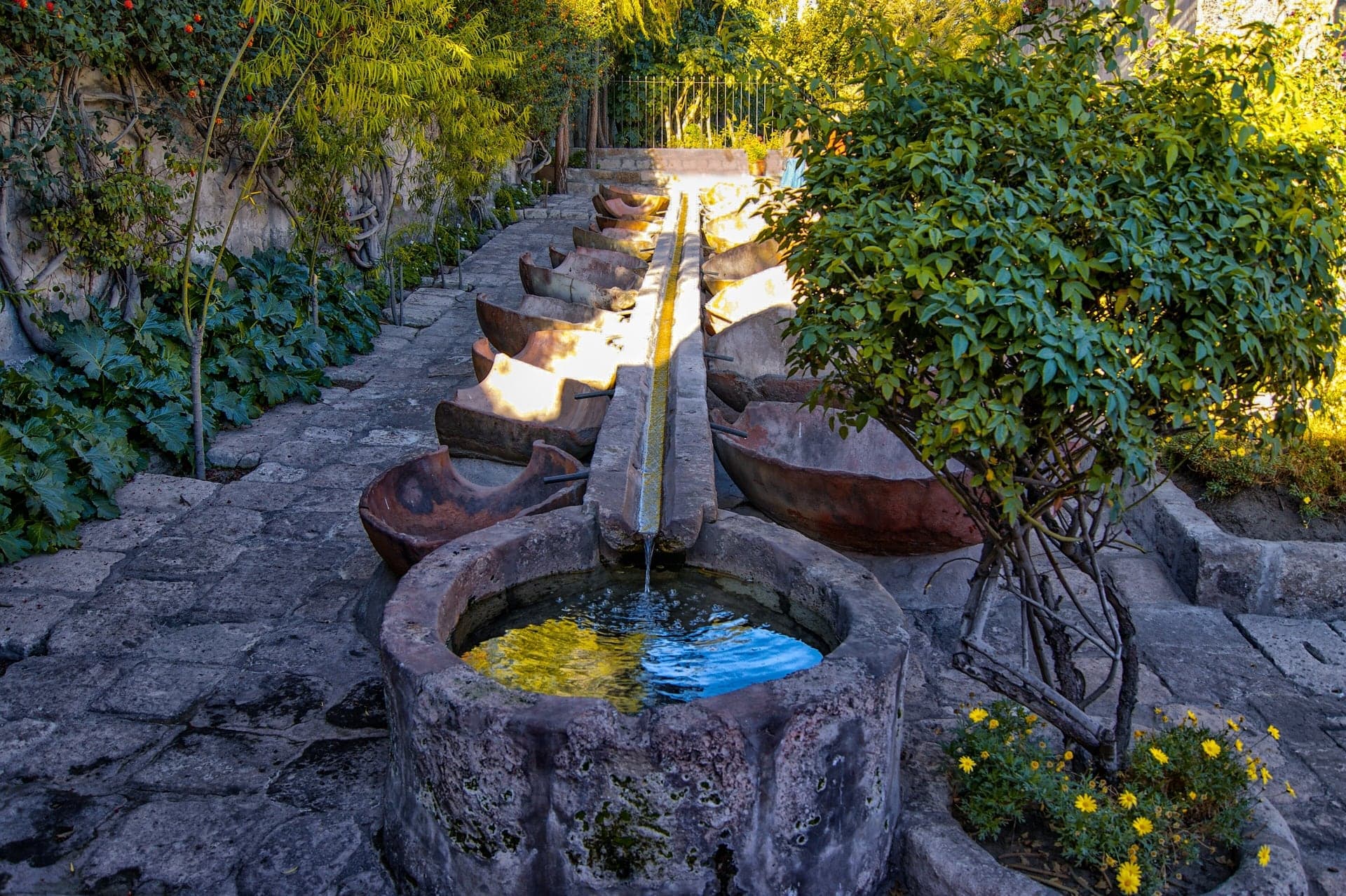
The Laundry: Wine Jars Turned Washtubs
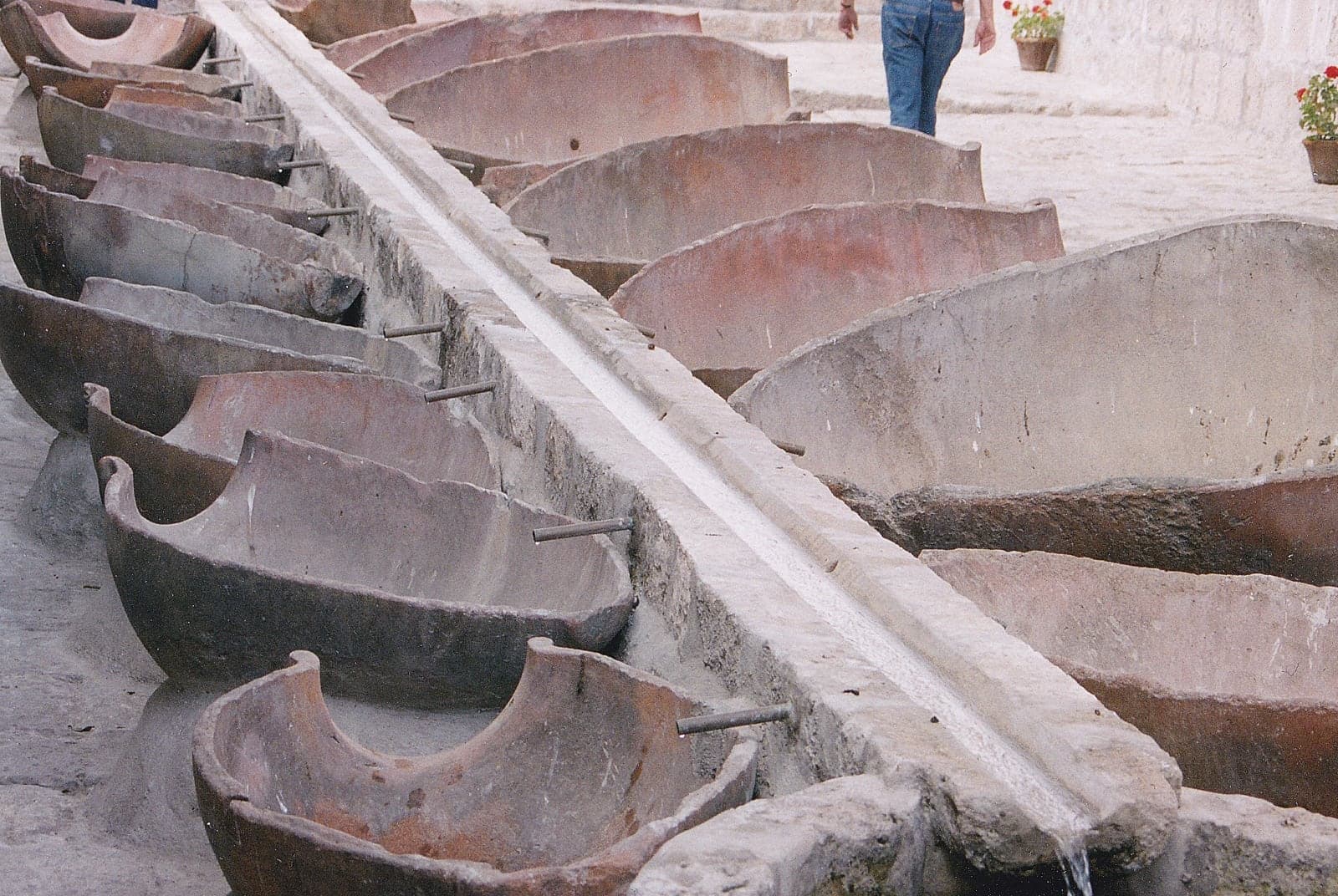
Twenty big clay jars cut in half became the nuns' washtubs. Water reached them along stone channels, close to the plain gate of the old cemetery.
- 12
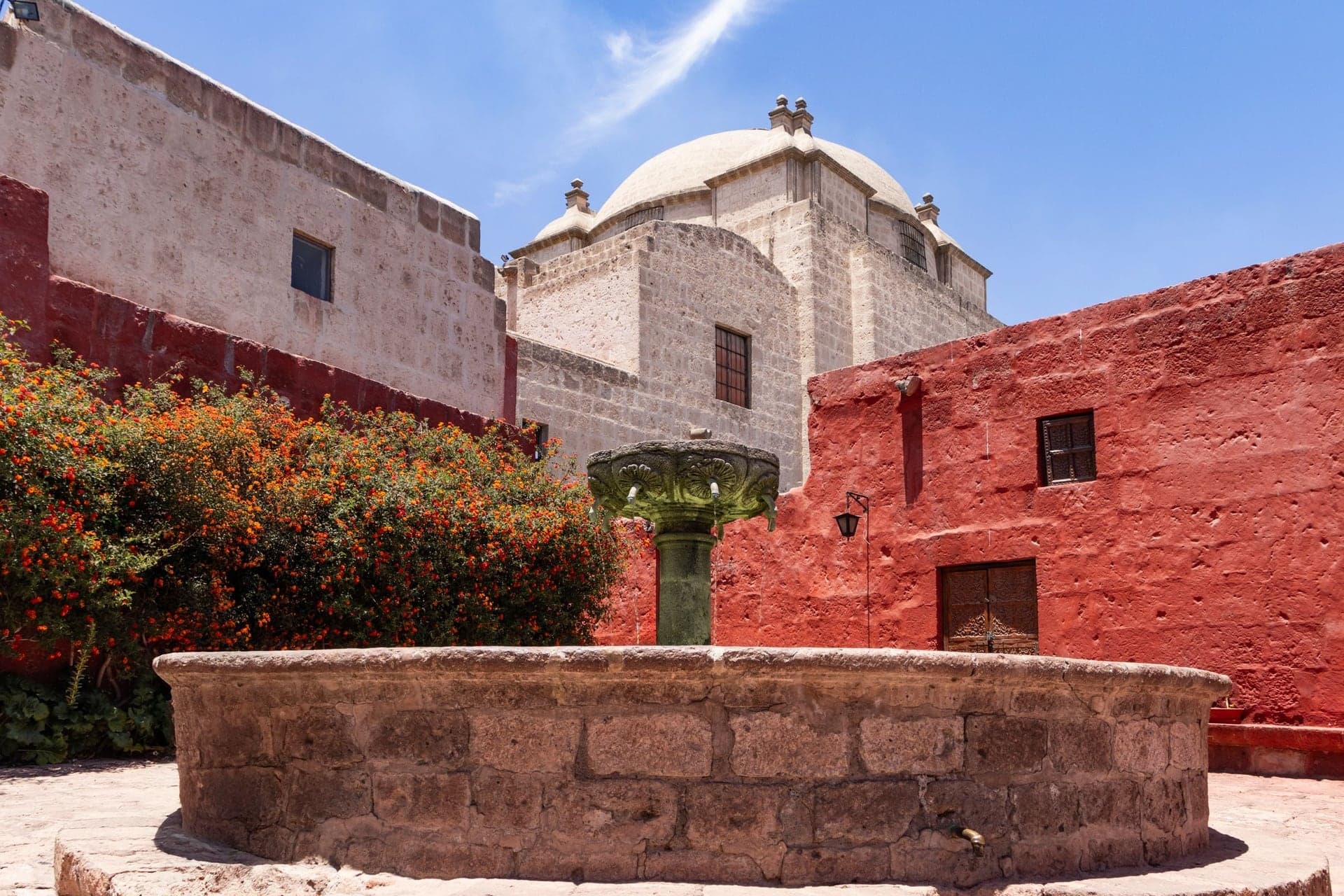
Plaza Zocodover: A Sunday Market for the Nuns
A little square of red walls and a Sunday swap market. The nuns traded here among themselves, and a steep stair climbs to a roof lookout toward the volcanoes, when it is open.
- 13
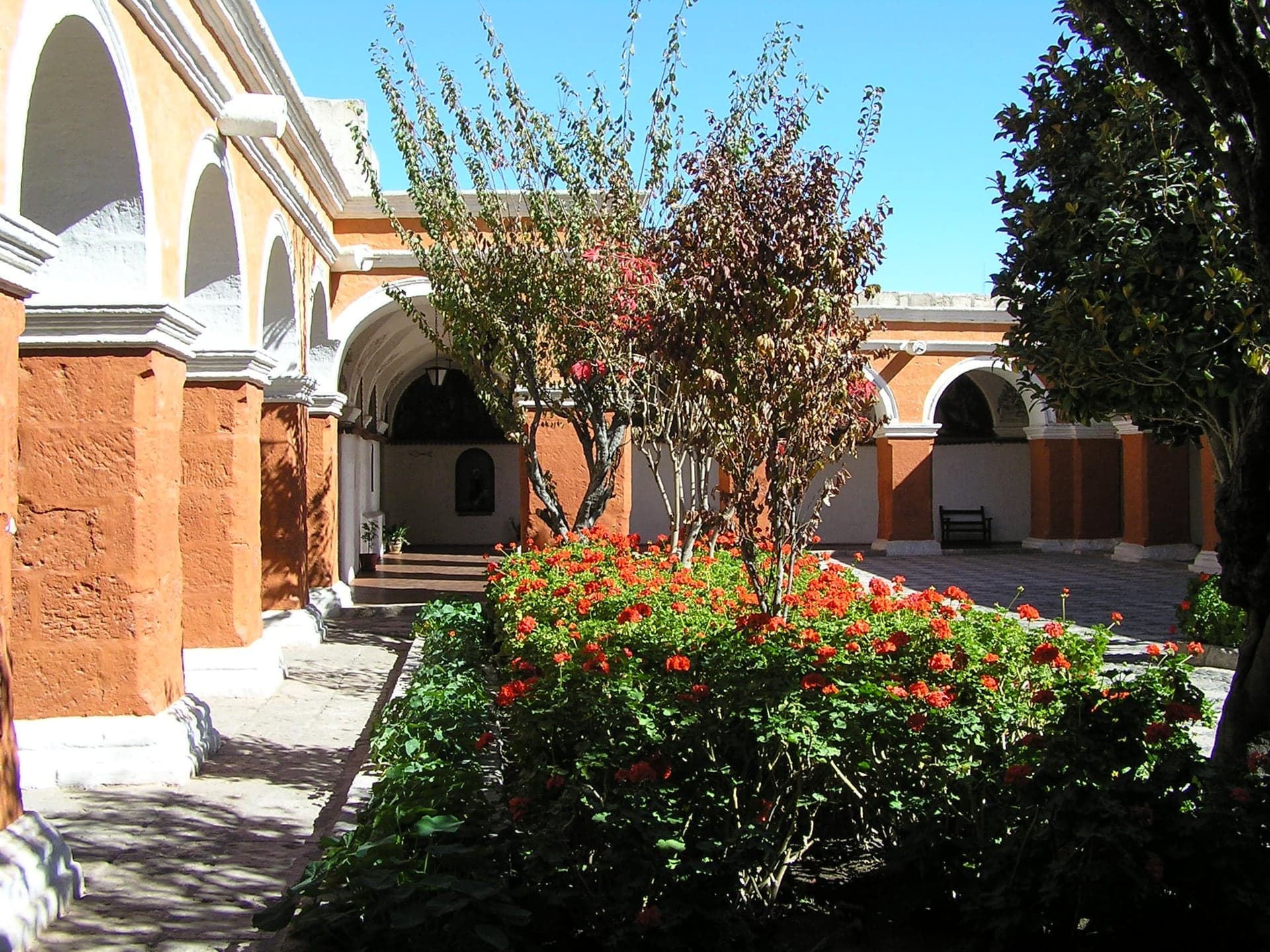
Claustro Mayor: The Great Cloister
The largest of the monastery's three cloisters, built between 1715 and 1723. Thirty-two paintings in its arches tell the lives of Mary and of Jesus.
Details
Best Time to Visit
Any afternoon if you start the outside walk by about 1:30 PM, so you have the full hour and a half to two hours inside before the monastery closes at 5 PM; or a Tuesday or Wednesday, when it stays open until 8 PM (last entry 7 PM) and you can start as late as about 4:30 PM. A clear day for the volcanoes from the roof lookout, if it is open. Checked 6 October 2026.
Pro Tips
- •Getting to the start: the Casa del Moral is at Calle Moral 318, about five minutes' walk north of the Plaza de Armas. By taxi, ask for the corner of Calle Moral and Calle Bolívar.
- •To go inside, start the outside walk by about 1:30 PM: it takes about forty minutes, the visit takes one and a half to two hours on your own, and the monastery closes at 5 PM. On Tuesday and Wednesday it stays open until 8 PM (last entry 7 PM). Closed Good Friday, 25 December and 1 January. Checked 6 October 2026.
- •Santa Catalina Monastery: adults 50 soles, foreign or Peruvian; cards accepted, tickets also online. Guides are optional and hired at the door. Photos are allowed, without flash indoors. Checked 6 October 2026.
- •Inside the monastery, the café serves traditional desserts made by the nuns, and the shop sells the convent's own products.
- •Two short detours from the top of Calle Santa Catalina, between stops 3 and 4: about five minutes west along Calle Puente Grau is the Puente Grau bridge, built in the 1880s and meant from the start as a viewpoint, with El Misti and Chachani upstream; or east along Calle Puente Grau to the traffic lights at Calle Jerusalén and up into San Lázaro, the sillar lanes that tradition calls the city's first barrio, and Campo Redondo, a steep little square named for a conquistador. Walk San Lázaro by day.
- •The roof lookout at Plaza Zocodover, if it is open, is up a steep stair. The stop works from the square below.
- •The Casa del Moral is a small house museum; no official hours or price are published. Check at the door. Checked 6 October 2026.
- •San Francisco: the tourism ministry's 2016 sheet gave the church as free and the convent museum as 5 soles, open Monday to Saturday 09:00 to 12:00 and 15:00 to 17:30. These hours are old: check at the door. Checked 6 October 2026.
Safety & Precautions
- •The gate at the north end of the little pedestrian San Francisco street (between stops 3 and 4) has no published hours and it may be shut at night. If it is shut, walk back down Calle Santa Catalina past the first corner to the second stretch of Calle Zela, turn left along it to the San Francisco square, and walk a few steps up the pedestrian street to the Fundo El Fierro: tap its stop to play it.
- •Between stops 3 and 4, cross the end of Calle Zela, then Calle Santa Catalina at the zebra crossing just south of the Zela corner and keep to the right-hand sidewalk up Santa Catalina and along Calle Puente Grau, a busy one-way street whose traffic comes toward you. You do not need to cross Puente Grau.
- •Sidewalks on Calle Moral and Calle Bolívar are narrow, and Calle Zela has a stop for tour coaches: watch for traffic. Between stops 5 and 6 you cross the second stretch of Calle Zela, which has no marked crossing; its cars come from your left.
- •Inside the monastery there are steps in places: the laundry is a level down, the lanes are paved with uneven river cobbles, and the stair to the roof lookout, if it is open, is steep.
- •Arequipa sits at about 2,300 meters: walk slowly, drink water and wear sun protection. Most of the outside walk has little shade.
- •If you take the Puente Grau detour, the sidewalk near the bridge crosses the mouths of a side street and a slip road with no marked crossing: stop at each and watch for buses and cars. In San Lázaro, some lane mouths have had chains or barriers since a 2025 dispute over the pedestrian zone: walk round them.
Travel advisory: Exercise Increased Caution (Level 2).
Gallery
Related Reading
Go deeper on what you'll see, hear, and walk through.
Read the walk
The full story of Santa Catalina Monastery: A Bare Wall and the Town Inside, in words. Prefer to listen? Play it narrated, from home or on location.
Introduction
Arequipa, in the south of Peru, is built of sillar, a pale volcanic stone, below its volcanoes. At its heart stands a convent the size of a city block, the Monastery of Santa Catalina, and from the street it shows almost nothing: a long, bare wall of stone. All its famous color is inside.
This walk goes round the outside first, and ends by going in. It begins at a carved house a block away that does the opposite, putting its pride on the street in stone. Then it follows the convent's walls, crosses to the Franciscans' little square, which was once a cemetery, and comes back down to the monastery door.
There are thirteen stops in all. The first six are outside: just under a kilometer, about half a mile, and about forty minutes, and they work on their own. The other seven are inside the monastery, which is ticketed and optional; allow an hour and a half to two hours more if you go in, about two and a half hours in all. Arequipa sits at about two thousand three hundred meters, so take the one gentle climb slowly.
Two women come back along the way: María de Guzmán, the wealthy widow who founded the convent, and Ana de los Ángeles, a nun who was handed to it as a child of three.
1. Casa del Moral: A Doorway That Shows Everything
Welcome to Arequipa, and to the Casa del Moral, the House of the Mulberry, named for an old mulberry tree in its courtyard. Find the carved doorway in the grey stone wall across the narrow street. The house is usually dated to the early seventeen hundreds, though some sources place it earlier, and today it is a small house museum of colonial furniture, paintings and old maps. If the door is open, you can ask to visit; its hours and prices are not published, so check on the day.
From the street, the doorway is the whole show. Start at the bottom: a plain rectangular door, framed by flat pilasters. Above it rises a great half circle of stone, packed with carving. Scrolling leaves and curling, creature-like figures crowd round a shield, and over the shield sits a crown. At the top of the door frame, a winged cherub's head looks down. Along the band of stone above the door runs a row of small carved flowers.
Notice how flat it all is. The carving does not stand far out from the wall. It lies close to the surface and covers it, like the pattern on a woven cloth. That is how the stonecutters of this region carved their soft volcanic stone, sillar.
Now look higher, to the top of the wall, where stone spouts stick out to throw the rainwater clear. Their ends are carved as puma heads.
This house puts its rank where every passer-by must see it: a crown over the door, and pumas along the roofline. Hold on to that. A block away stands a convent that does exactly the opposite.
Follow the route to the corner, cross Calle Bolívar there, watching for traffic from your right, and walk up its far side. Next, the side of the convent that visitors never see.
2. Calle Bolívar: The Side Visitors Never See
Walk on up Calle Bolívar and stop on this side of the street, across from the convent. The visitors' route through the monastery reaches this street only along the stretch you just walked. Beyond the walls across from you lies the part of the convent the nuns still keep to themselves, closed to everyone else. The monastery's own plan marks it simply as the new monastery: the nuns' home today.
Take in what the convent gives the street here: no welcome and no way in for visitors. Walls like these, up to about four meters high, were not built to be looked at. They were built so that nobody could look in.
Behind them grew a town within the town. The earthquake of fifteen eighty-two badly damaged the convent's first buildings, and in the rebuilding, families built private cells for their daughters along lanes named for Spanish cities. The nuns did not live alone in them. By about seventeen ninety-five, a history of the convent counts sixty-two lay women serving the community, and seventy more, enslaved women among them, serving individual nuns.
One nun from those centuries has since been beatified. Ana de los Ángeles Monteagudo was handed to the sisters here at the age of three, to be educated. She became a novice in sixteen eighteen and prioress in sixteen forty-seven, and she died in sixteen eighty-six. On the second of February, nineteen eighty-five, Pope John Paul the Second came to Arequipa and beatified her, the last step before sainthood. Inside, on the visitors' route, a cell is dedicated to her.
María de Guzmán, the widow who founded the convent, meant it to be closed to the world. For the nuns who still live here, it still is.
Follow the route to the corner, cross back over Calle Bolívar, watching for traffic from your left, and walk along the convent's north side. Next, where the color comes from.
3. Calle Zela: Where the Color Comes From
Walk on along Calle Zela and stop on this side of the street. Across from you runs the convent's north wall. The street is named for Francisco de Zela, an early rebel against Spanish rule. Tour coaches stop along here, so if one is standing in the way, look over it to the top of the wall.
Just beyond that wall, on the visitors' route, are the monastery's café, which serves traditional desserts made by the nuns, and the old laundry, where the nuns washed clothes in big clay jars cut in half.
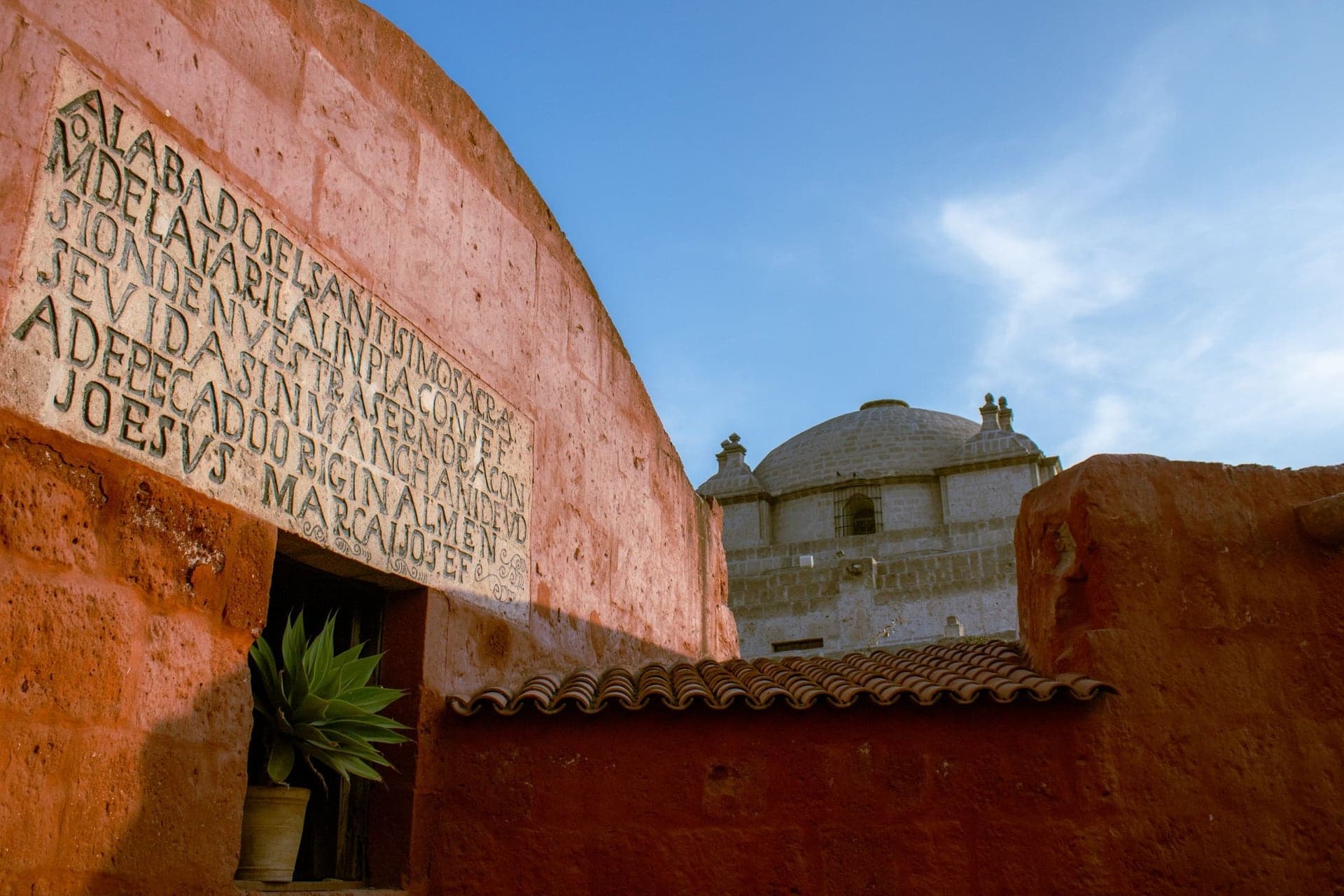
Here is where the color comes from. The famous walls in there, deep red and blue, are not painted with any rare dye. They are limewash, colored with cheap, easy-to-find pigments: red, orange and yellow ochre, which are colored earths, and indigo for the blue. A study of the cells found the paint was laid on with boards covered in sheepskin, a technique called chaglapeo. The lime also protected the porous stone underneath.
The same study found a surprise. The paler, softened tones in the outermost layers are modern, laid over a much older tradition. Yellow, for one, turns up only in the recent layers.
So the stone out here is bare, and the color in there is renewed, again and again, like a house that is lived in.
Follow the route: at the corner cross the end of Calle Zela, then cross Calle Santa Catalina at the zebra crossing just beyond it, and keep to the right-hand sidewalk, up the hill and round the corner, to a gate into a little pedestrian street. If that gate is shut, walk back down Santa Catalina past this corner to the second stretch of Calle Zela, turn left along it, to the San Francisco square; the Fundo El Fierro is a short walk up the pedestrian street, so tap its stop to play it. Next, an old jail.
4. Fundo El Fierro: From Jail to Craft Market
Walk on down the little pedestrian street, and stop across from the gateway into a courtyard on your right. This is the Fundo El Fierro, and it has had more than one life. It once served as one of the city's jails. Today its courtyard holds artisans' stalls and the city's municipal history museum.
Arequipa's craftspeople show their work here: wrought iron, carved sillar, silver and leather. Around the fifteenth of August, the city's anniversary, they have long held a fair. Browsing the stalls costs nothing. If the stalls are open, look for the carved sillar. It is the same soft volcanic stone as the doorway of the Casa del Moral, still being cut and carved by hand.
The museum keeps the city's own memories. Among its pieces is a flag flown on the second of May, eighteen sixty-six.
Just ahead, this street opens onto a little square with a church across it. In this part of town, buildings rarely keep one job for long, and that square has had even more lives than this courtyard.
Follow the route down the pedestrian street. Next, a square that was a cemetery.
5. San Francisco: A Square That Was a Cemetery
Walk on to where the pedestrian street meets a little garden square, the Plazuela de San Francisco, and stop at its edge. The square opens on your left. Turn to face it, and the church of San Francisco looks back at you across the garden. The Fundo El Fierro is just behind…
Full narration for this stop unlocks with the tour.
6. Santa Catalina Monastery: A Wall That Shows Nothing
Walk on down the car-free street and stop on this side, a few steps before the arched doorway in the wall across from you. This is the door of the Monastery of Santa Catalina. Going in is ticketed, fifty soles for adults, and well worth it; the details are on this stop's…
Full narration for this stop unlocks with the tour.
7. Novices' Cloister: Silence First
This is the Novices' Cloister, and the way to it makes a point. The way into the monastery proper passes under the arch of Silence, a reminder, in the monastery's own words, that this is a house of prayer and penance. Beyond it lies the Patio del Silencio, the courtyard of…
Full narration for this stop unlocks with the tour.
8. Claustro de los Naranjos: A Picture Book in Indigo
This is the Claustro de los Naranjos, the Cloister of the Orange Trees, and its color is the first thing to take in. The monastery itself calls it indigo blue. It is the same simple recipe used across the monastery: lime, colored with indigo for the blue, laid on and renewed…
Full narration for this stop unlocks with the tour.
9. Calle Córdoba: The Wall That Still Works
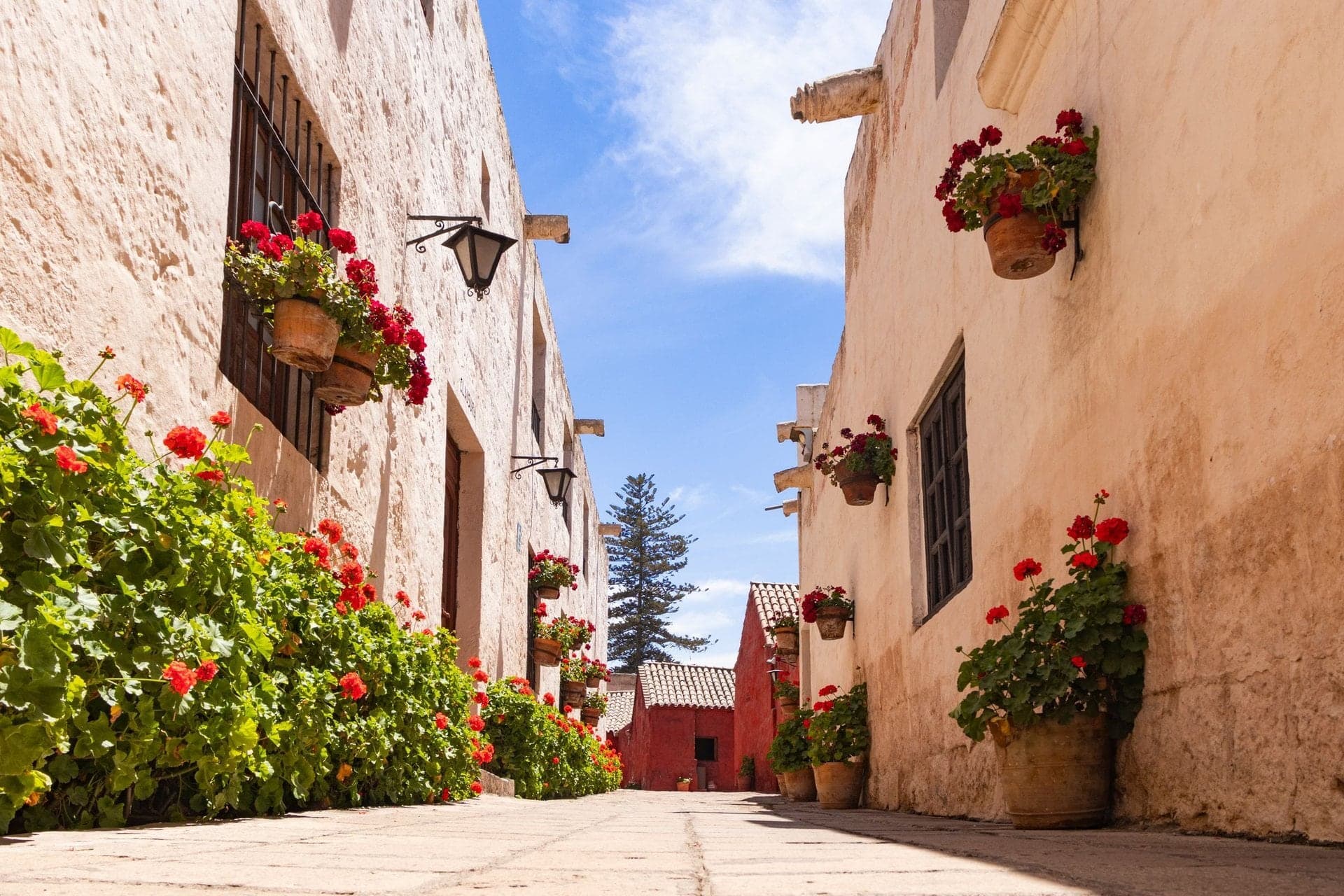
This is Calle Córdoba, one of six streets inside the monastery named after cities in Spain: Sevilla, Córdoba, Toledo, Granada, Málaga and Burgos. A town inside the town needed street names. Look at the long white wall here, with its barred windows and its pots of geraniums.…
Full narration for this stop unlocks with the tour.
10. Calle Toledo: The Red Street
This is Calle Toledo, and its color has a name. The monastery calls it red ochre, or almagre: red earth. It is not a dye made from insects, as is often said, but colored earth mixed into lime, thrown onto the walls with boards covered in sheepskin, a technique called…
Full narration for this stop unlocks with the tour.
11. The Laundry: Wine Jars Turned Washtubs
This is the monastery's laundry, down in the open air, and it is one of the simplest sights in here. Look at the row of big clay jars, cut in half and laid on their sides. There are twenty of them, with a pool, and the stone channels that brought them water. Jars like these,…
Full narration for this stop unlocks with the tour.
12. Plaza Zocodover: A Sunday Market for the Nuns
This is Plaza Zocodover, named, like the streets around it, after a place in Spain. It is a small square framed by walls painted red, with the dome of the monastery's church rising above them. In the square stands a plain stone fountain, with bronze spouts from the seventeen…
Full narration for this stop unlocks with the tour.
13. Claustro Mayor: The Great Cloister
This is the Claustro Mayor, the great cloister, built between seventeen fifteen and seventeen twenty-three: the largest of the monastery's three cloisters, a long rectangle running beside the church. Look up into the arches. There are thirty-two paintings: twenty-three on the…
Full narration for this stop unlocks with the tour.
- Richly decorated stone portal of Casa del Moral in the historic centre of Arequipa. — Josep M. Gracia, CC BY-SA 4.0 · source
- Carrer Moral d'Arequipa — Pitxiquin, CC BY-SA 4.0 · source
- Pared de Santa Catalina des del carrer de Santa Catalina d'Arequipa — Pitxiquin, CC BY-SA 4.0 · source
- Campanar i lateral de Santa Catalina d'Arequipa — Pitxiquin, CC BY-SA 4.0 · source
- Monasterio de Santa Catalina — Monzón Cárdenas, Christian, CC BY-SA 3.0 · source
- Pared del Monestir de Santa Catalina d'Arequipa des del Carrer Santa Catalina — Pitxiquin, CC BY-SA 4.0 · source
- Church of St. Francis, Arequipa — Draceane, CC BY-SA 4.0 · source
- Church of St. Francis, Arequipa — Draceane, CC BY-SA 4.0 · source
- Plaza San Francisco in Arequipa — Smiley.toerist, CC BY-SA 4.0 · source
- Entrada al monestir de santa Catalina des del carrer homònim amb imatge de la santa — Pitxiquin, CC BY-SA 4.0 · source
- Cloitre des novices, couvent monastère Santa Catalina, Arequipa — Oubalol, CC BY-SA 4.0 · source
- Het Santa Catalina klooster in Arequipa — Smiley.toerist, CC BY-SA 4.0 · source
- This is a photo of a monument in Peru, identified by ID — Gopana95, CC BY-SA 4.0 · source
- Washstand in the courtyard of Santa Catalina convent in Arequipa, Peru. — Bernardita Stuven Marambio, CC BY-SA 4.0 · source
- Pools Santa Catalina monastery Arequipa in Peru — Peter van der Sluijs, CC BY-SA 3.0 · source
- Monastery of St. Catharine, Arequipa — Draceane, CC BY-SA 4.0 · source
- Arequipa 2005 — ogwen, CC BY-SA 3.0 · source
Images may be cropped or resized. Other photos via Unsplash and Pexels.