The Monastery of Santa Catalina de Siena was founded in 1579. A wealthy widow, María de Guzmán, gave her fortune to it and became its first prioress. The founding act, authorized by the viceroy Francisco de Toledo, was signed on 10 September and endorsed by Arequipa's council and the bishopric of Cusco. It was a Dominican house for women, and it was meant to be closed to the world. In the monastery's own words, it stayed that way for almost four centuries.
A wall that shows nothing
Walk along Calle Santa Catalina and the monastery gives the street almost nothing: a long, bare wall of sillar, the city's pale volcanic stone, left unpainted and braced by stepped buttresses, with one arched doorway and, at the corner of Calle Ugarte, a square bell tower built in 1748. Walls up to about four meters high enclose about 20,000 square meters. The famous red and blue are all inside.
A block away, the Casa del Moral does the opposite. Its carved doorway sets a crowned shield over the door, and the stone waterspouts along its roofline end in puma heads. One house put its rank on the street in stone; the convent turned its back to the street.
A town inside the town
Hear a stop from this walk
Claustro Mayor: The Great Cloister
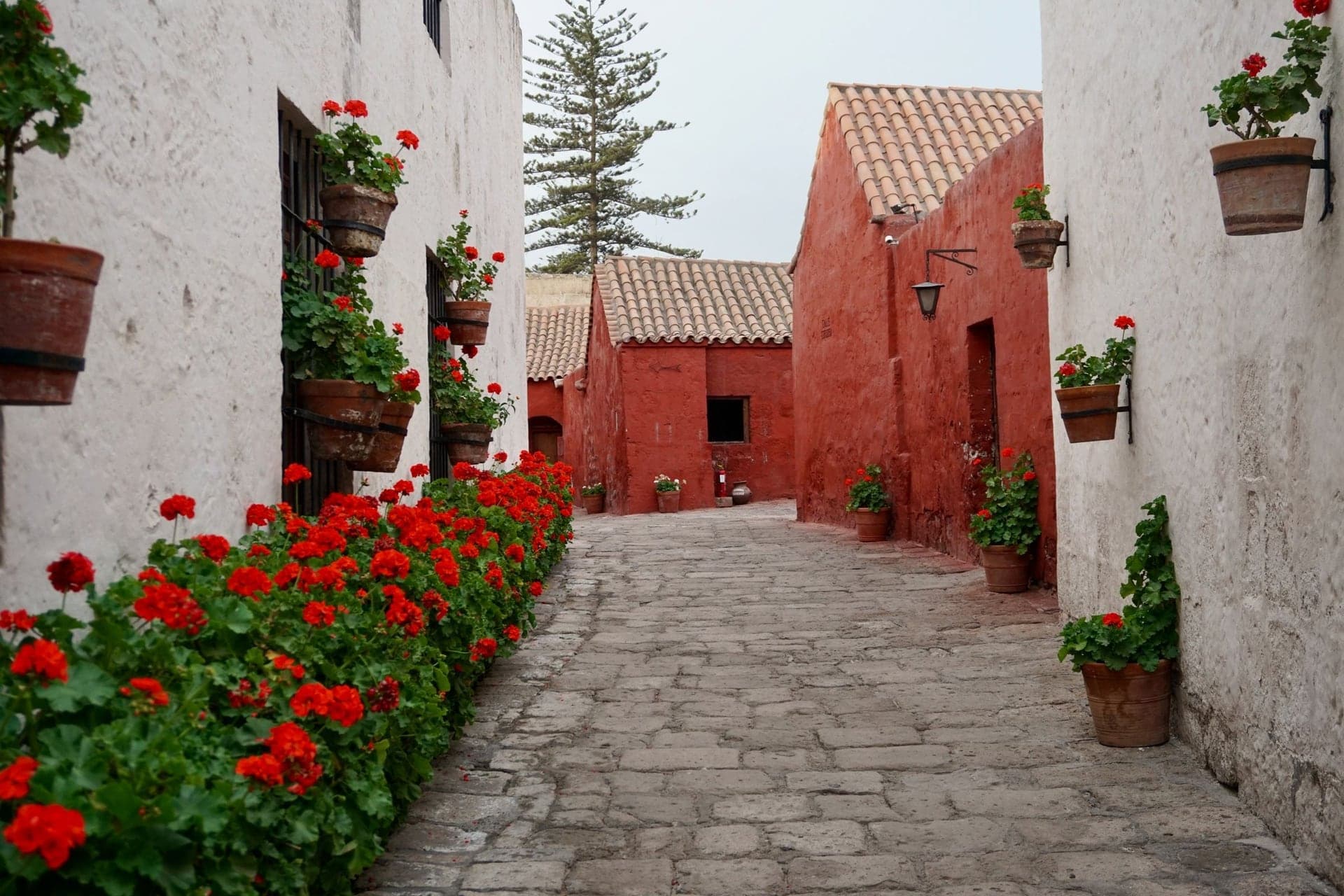
The earthquake of 1582 badly damaged the convent's first buildings. In the rebuilding, families built private cells for their daughters, and over nearly two centuries the cells and cloisters were altered and rebuilt, until rows of little houses, roofed first with tiles and later with sillar vaults, made lanes. Six of them are named after cities in Spain: Sevilla, Córdoba, Toledo, Granada, Málaga and Burgos. There is a town square too, Plaza Zocodover, where, the monastery says, the nuns swapped goods on Sundays, their own version of a village market.
The nuns did not live alone. For about 1795, a history of the convent counts sixty-two lay women serving the community and seventy more, enslaved women among them, serving individual nuns.
One nun of those centuries has since been beatified. Ana de los Ángeles Monteagudo was handed to the nuns at the age of three, to be educated. She became a novice in 1618 and prioress in 1647, and she died in 1686. Pope John Paul II beatified her in Arequipa on 2 February 1985, and her beatification file, the monastery notes, records sixty-eight predictions that came true.
A story often told about the convent, of a nun sent from Rome in 1871 who freed the servants and sent back the dowries, appears in none of the monastery's own texts. The date 1871 does appear there, for something plainer: the year the old chapel became one kitchen for the whole community.
Where the color comes from
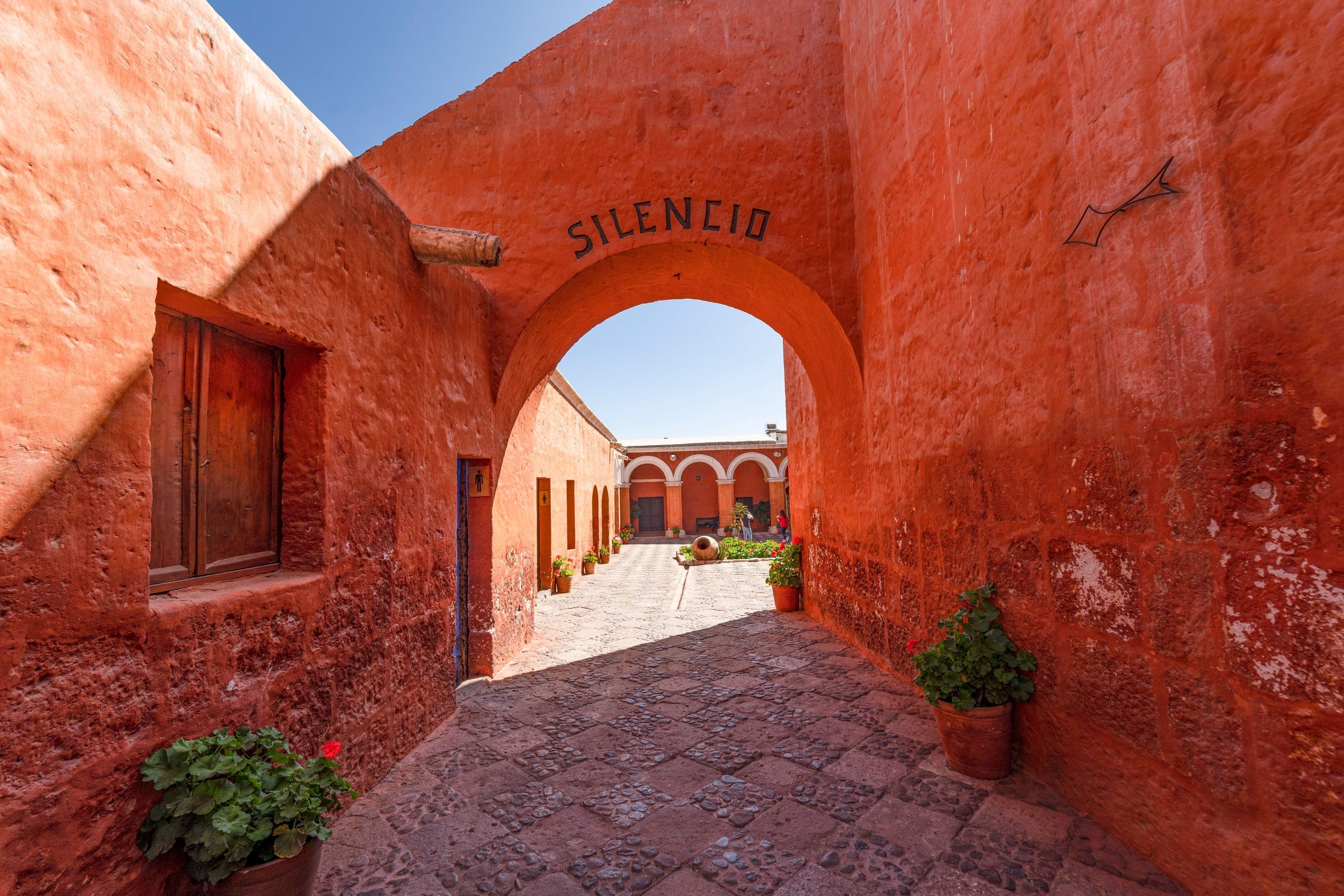
The deep red and blue inside are not rare dyes. The only technical study of the walls, by Marisol Velazco Gutiérrez (2023), found lime paint colored with cheap, easy-to-find pigments: red, orange and yellow ochre, which are colored earths, and indigo for the blue. The monastery itself calls Calle Toledo's color red ochre, or almagre, red earth, and calls the Cloister of the Orange Trees indigo blue. The often-repeated claim that the red is cochineal, the insect dye, finds no support in that study. The paint was thrown on with boards covered in sheepskin, a technique called chaglapeo, and the lime protected the porous stone beneath.
The study also found that the paler outer layers are modern, laid over a much older tradition, and that yellow turns up only in the recent layers. What you see is kept in the old colors and renewed again and again, like a house that is lived in. It is not the original coat.
1970, and the wall that still works
After damage in the earthquakes of 1958 and 1960, most of the monastery opened to visitors on 15 August 1970, partly to pay for its upkeep. Not all of it. On Calle Córdoba, a long white wall with barred windows and pots of geraniums separates, in the monastery's words, the maze that visitors walk from the newer convent where the nuns live today. In 2018 the community counted twenty professed nuns, four novices, a postulant and two aspirants.
Walking it
Our walk, "Santa Catalina Monastery: A Bare Wall and the Town Inside", goes round the outside first: six stops on a loop of just under a kilometer, about forty minutes, from the Casa del Moral along the convent's walls on Calle Bolívar and Calle Zela, to the Franciscans' little square, which was once a cemetery, and back to the monastery door. That part works on its own. Then, if you buy a ticket, come seven more stops inside, from the Novices' Cloister through the blue Cloister of the Orange Trees, Calle Córdoba, red Calle Toledo, the laundry and Plaza Zocodover to the great cloister. Inside, the stops do not start on their own: tap each one as you reach it, in any order. Allow an hour and a half to two hours inside, about two and a half hours in all.
Tickets are 50 soles for adults, foreign or Peruvian, and cards are accepted. The monastery is open every day from 9:00 to 17:00, and until 20:00 on Tuesdays and Wednesdays, with last entry at 19:00. It closes on Good Friday, 25 December and 1 January. Checked 6 October 2026.
Ready to experience it?
Santa Catalina Monastery: A Bare Wall and the Town Inside
150 min · 0.9 km · easy
More from Arequipa
Explore more at your own pace.
Arequipa Travel Guide: How Many Days, Altitude, When to Go (2026)
Best Self-Guided Walking Tours in Arequipa (2026)
One Day in Arequipa: A Walkable White-City Itinerary (2026)
Best History Walking Tours in Arequipa (2026)
What to Eat in Arequipa: A Food Guide (2026)