Historic Center: The White Stone and the Earthquakes
85 min · 1.9 km · easy
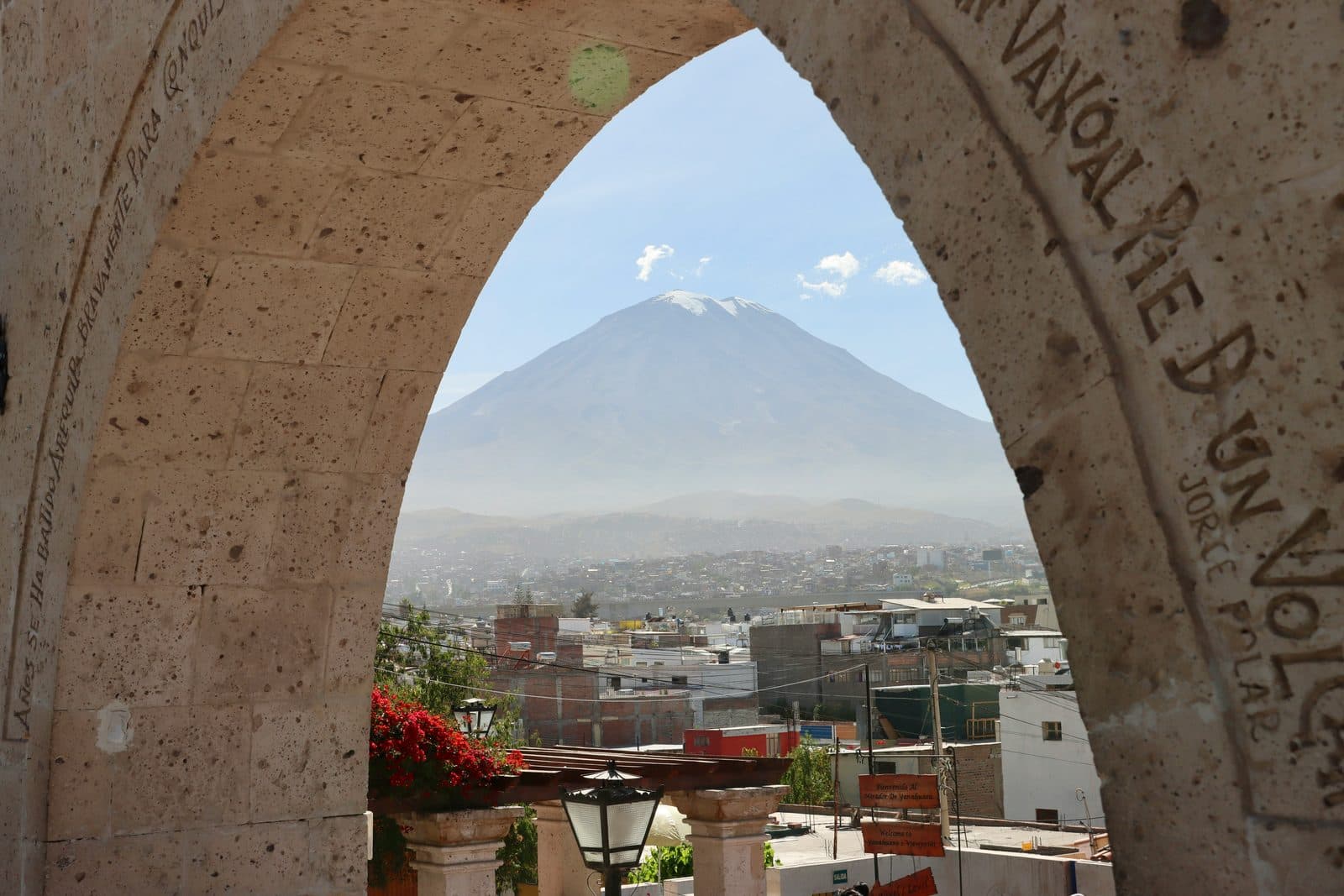
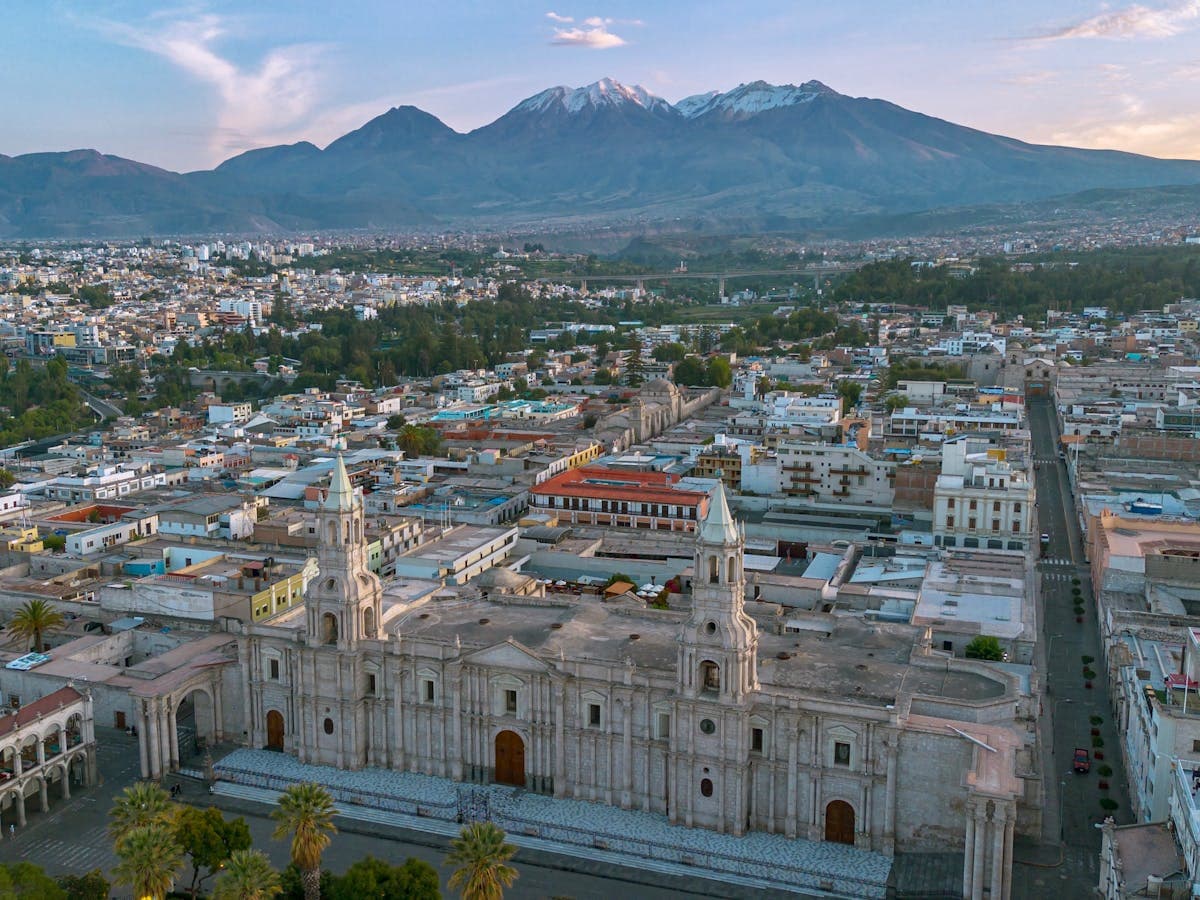
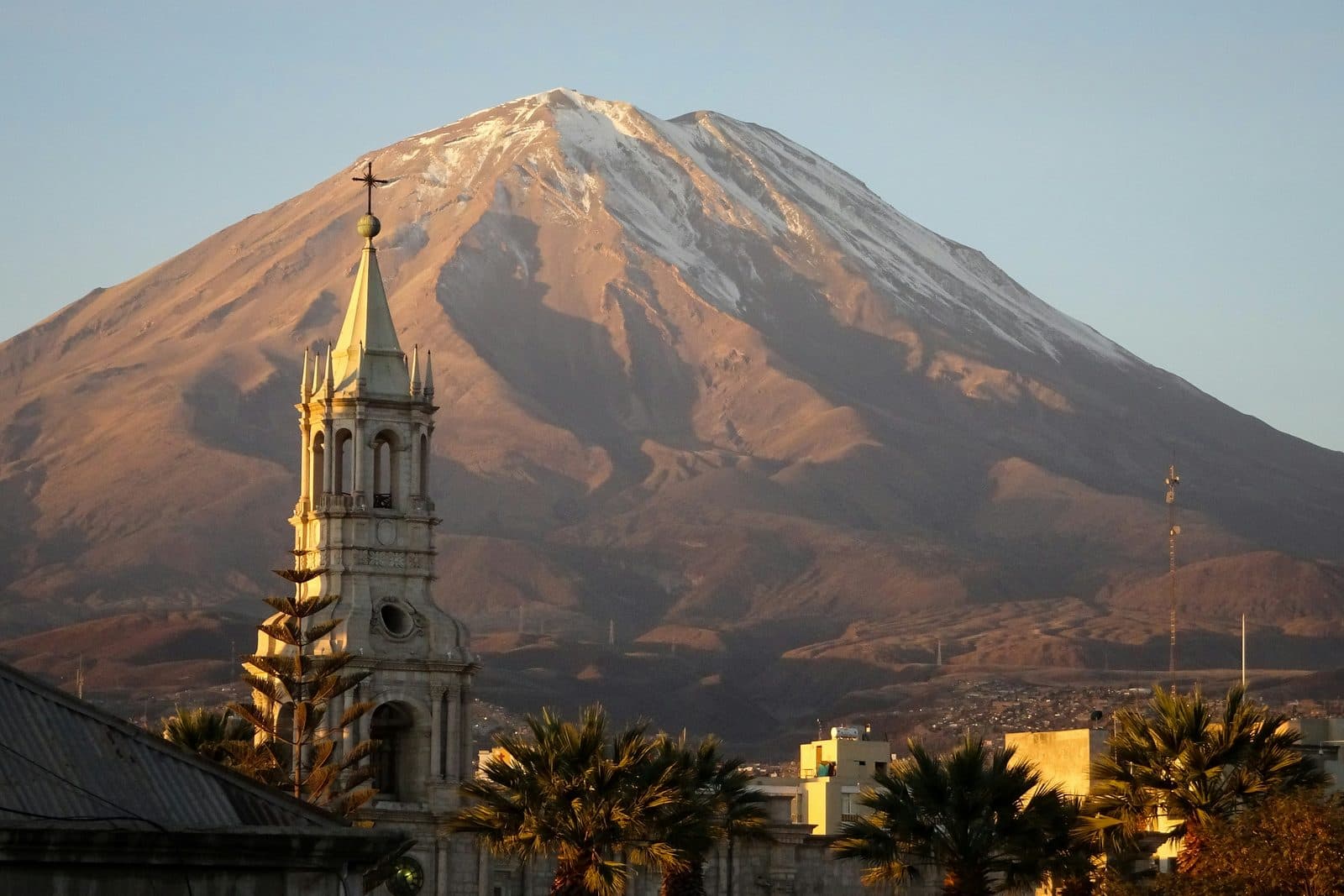
Stand in the Plaza de Armas of Arequipa and look around. The cathedral filling one side is white. The arcades on the other three sides are white. Most of the historic center that UNESCO listed in 2000 is built of the same pale stone, and the whiteness is the stone itself. Now look over the cathedral roof, just left of its right-hand tower. On a clear day you will see El Misti, a near-perfect cone 5,822 meters high, less than twenty kilometers away.
It is an active volcano. Peru's geophysical institute monitors it and records twenty to thirty small tremors under it every day, and its last eruptions, in the reign of the Inca Pachacútec in the 1400s, left up to ten centimeters of black ash on this valley. It is tempting to say the city is built of El Misti. It is not.
What sillar is
Sillar is an ignimbrite: pumice and ash from a huge eruption, cemented into rock by hot gases. Arequipa's building stone, which geologists call the Arequipa Airport Ignimbrite, is about 1.65 million years old, far older than El Misti, and the volcano that produced it is thought to lie buried under Chachani, the broad volcano beside El Misti. The deposit has a lower white layer, the building stone, and an upper pink one.
Three properties made the city. Sillar is light: Peru's Ministry of Culture describes it as less dense than brick yet more resistant to crushing. It is soft enough to carve, so carvers could cover a whole front in relief. And it is porous: it absorbs water and holds its temperature, so builders protected it with limewash, sometimes colored. The Ministry credits the stone for the city's nickname, the White City.
Sillar is still cut by hand outside the city, in the Añashuayco ravine. In 2014, when Peru declared the cutting and carving of sillar part of the nation's cultural heritage, about five hundred cutters were working the region's quarries. The colonial city's stone came mostly from quarries toward Yura; Añashuayco was opened in the nineteenth century.
How the earthquakes shaped the city
Hear a stop from this walk
San Agustín: The Front That Stood
Arequipa sits on moving ground. Peru's geological survey lists the great shocks: 1582, 1604, 1687, 1784 and 1868, and in recent memory 23 June 2001, magnitude 8.4. In 1600 the eruption of Huaynaputina, seventy-five kilometers away and the largest explosive eruption in the Andes in recorded history, shook the city as well. UNESCO's periods for the city's architecture break on these years, and UNESCO's evaluators note that the 1582 earthquake brought the systematic use of sillar: before it, the stone had been used only in the doorways of the main church and in a handful of houses. Vaults followed, of brick at first and of sillar from the seventeenth century.
The cathedral shows the pattern. It was begun in 1544, brought down by the earthquake of 1582, broken by the eruption of 1600 and finished off in 1604, rebuilt between 1621 and 1656, burned in 1844 and rebuilt by the local master builder Lucas Poblete, and repaired again after 1868. In 2001 the top of its left-hand tower fell through the vault. La Compañía, the Jesuits' church at the corner of the plaza, was wrecked in 1868 too, and restored after 2001. The continuity in this city is in the plan and the stone, not in any single wall.
The carving
The soft stone produced a way of carving: shallow, flat relief spread over the whole surface, like a tapestry. La Compañía's main front, finished in 1698, is the great example: cactus stems and leaves, bunches of grapes, four-petaled flowers, scallop shells, Renaissance masks and a two-headed eagle, in two stories of carving that Peru's tourism inventory says became a model for the region as far as Lake Titicaca. What to call the style is still argued. It was long labeled mestizo baroque, and the historian Antonio San Cristóbal rejected that label as itself Eurocentric. But scholars agree that Andean stonecutters carved it, and UNESCO's evaluators called the city's ornamented architecture a masterpiece of the creative integration of European and native characteristics.
The other Arequipa
Our two walks divide the white city into two registers. The Historic Center walk, "Historic Center: The White Stone and the Earthquakes", is the public city: the plaza, the cathedral, the carved doors of Santo Domingo, La Compañía and San Agustín, the Casa Goyeneche, and the museum that keeps Juanita, the girl found frozen near the summit of Ampato in 1995.
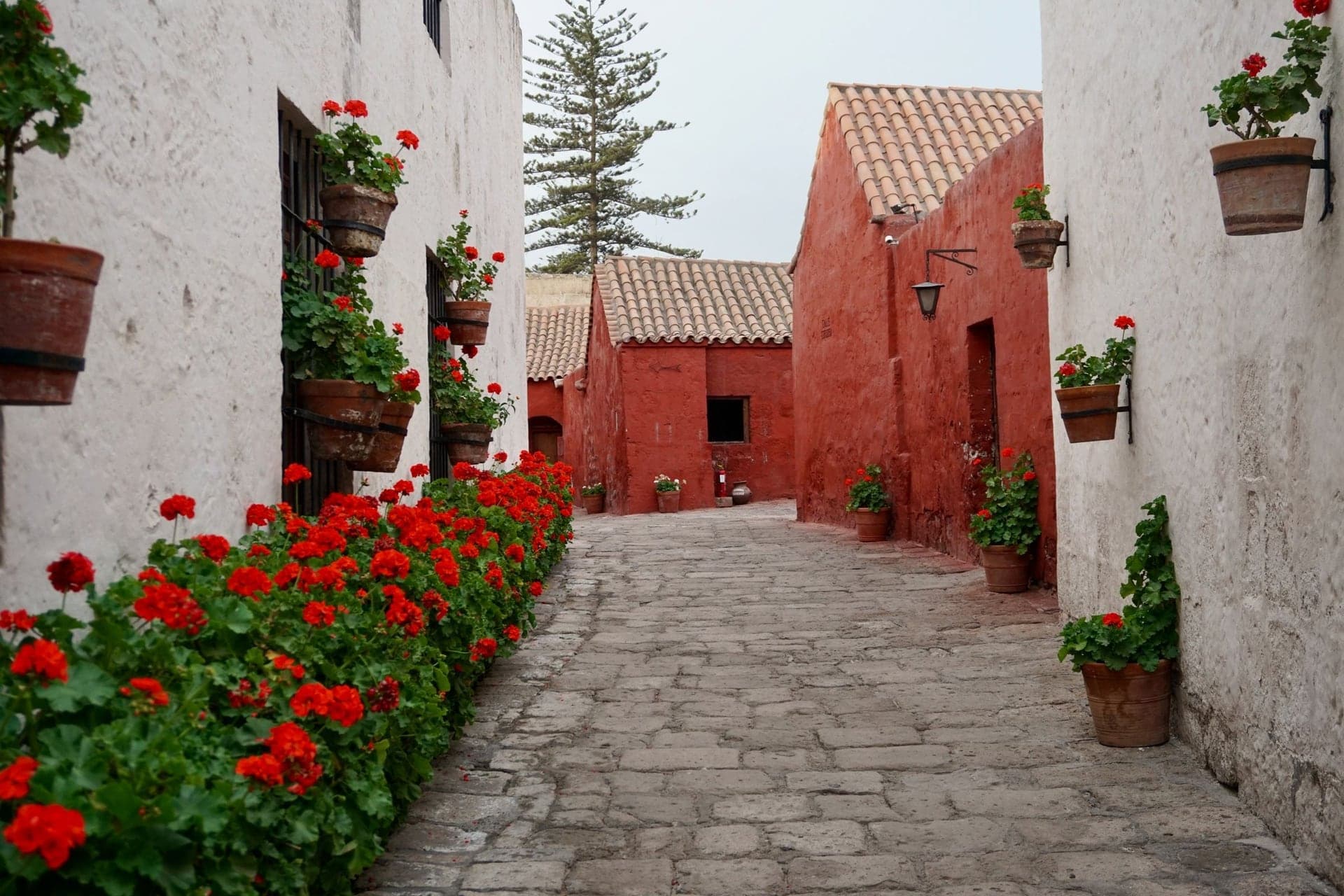
The Santa Catalina walk, "Santa Catalina Monastery: A Bare Wall and the Town Inside", is the private one. The Monastery of Santa Catalina, founded in 1579, covers about 20,000 square meters behind sillar walls that show the street almost nothing, and it stayed closed to the world for almost four centuries. Inside is a town of cells and lanes named after cities in Spain, washed in red earth and indigo. It opened to visitors on 15 August 1970, and a small community of nuns still lives in one part of it. The walk goes round the outside first, then takes you in.
How to walk
Walk the Historic Center first, about 85 minutes, to put the stone in your eye. Look hard at La Compañía's front, and at the plain coursed sillar in the lane behind the cathedral, the stone before anyone decorated it. Then walk round Santa Catalina and go in. The walls inside are the same rock, washed in lime.
Sometime during either walk, look up. If the sky is clear, El Misti will be there. The stone around you is older than the volcano, and the earthquakes are what the city has been answering ever since it was founded.
Frequently asked questions
- How many self-guided walking tours are there in Arequipa?
- Roamer currently has 2 self-guided audio walking tours in Arequipa. Every tour is free to start: the introduction and first stop play in full, and every later stop plays a short preview before you decide to buy.
- How much does a self-guided walking tour in Arequipa cost?
- Each tour is free to preview and $4.99 for lifetime access. If you want more than one, a 7-day pass is $12.99 and a 30-day pass covering every tour is $19.99, which works out to well under a dollar a day.
- Can I do the Arequipa tours offline?
- Yes. Tours can be downloaded in advance in the Roamer app and played with no signal, which is useful when you are travelling without mobile data.
- How long are the Arequipa walking tours?
- The Historic Center walk is 11 stops over about 1.9 km and takes about 85 minutes. The Santa Catalina walk is 6 outdoor stops on a loop of just under 1 km, about 40 minutes, then 7 optional stops inside the ticketed monastery, about two and a half hours in all if you go in. You set the pace and can pause any time.
Ready to experience it?
Historic Center: The White Stone and the Earthquakes
85 min · 1.9 km · easy
More from Arequipa
Explore more at your own pace.
Arequipa Travel Guide: How Many Days, Altitude, When to Go (2026)
Best Self-Guided Walking Tours in Arequipa (2026)
One Day in Arequipa: A Walkable White-City Itinerary (2026)
Best History Walking Tours in Arequipa (2026)
What to Eat in Arequipa: A Food Guide (2026)