
A downhill walk through the quarter under the Alhambra's southern hill, from Manuel de Falla's lane past a sultan's hall hidden in a house, a friars' church and a hero's castle of a house, to the statue of a Granada-born Jewish scholar.
Start · Antequeruela: Falla's Lane
DirectionsStops
- 1

Antequeruela: Falla's Lane
A composer chose a small house up here. The walk begins where a stone-paved lane drops off the road under the Alhambra's southern hill.
- 2

San Cecilio: The Silk Workers' Parish
A parish set up in 1501 served silk workers. Its little square looks down over the Campo del Príncipe.
- 3

Campo del Príncipe: A Cross on the Move
A stone cross the neighbors paid for stands here. It came down to this tree-lined square forty-two years after it was set up.
- 4

Comendadoras de Santiago: A Queen's Vow
A convent founded to keep a queen's vow. Its long street front hides a forecourt, a church and nuns who live enclosed.
- 5

Cuarto Real de Santo Domingo: The Hidden Hall
A sultan's domed hall hides inside a later house. Its garden estate is the city's only royal one left inside the old walls.
- 6

Santo Domingo: Friars on the Sultans' Garden
Friars given the sultans' garden built this church. In 1512 a door was cut through the city wall to let the town in.
- 7

Plaza de los Girones: A House Turned Inward
A plain corner house keeps Nasrid rooms inside. From the street it shows almost nothing, the way Granada houses were built.
- 8
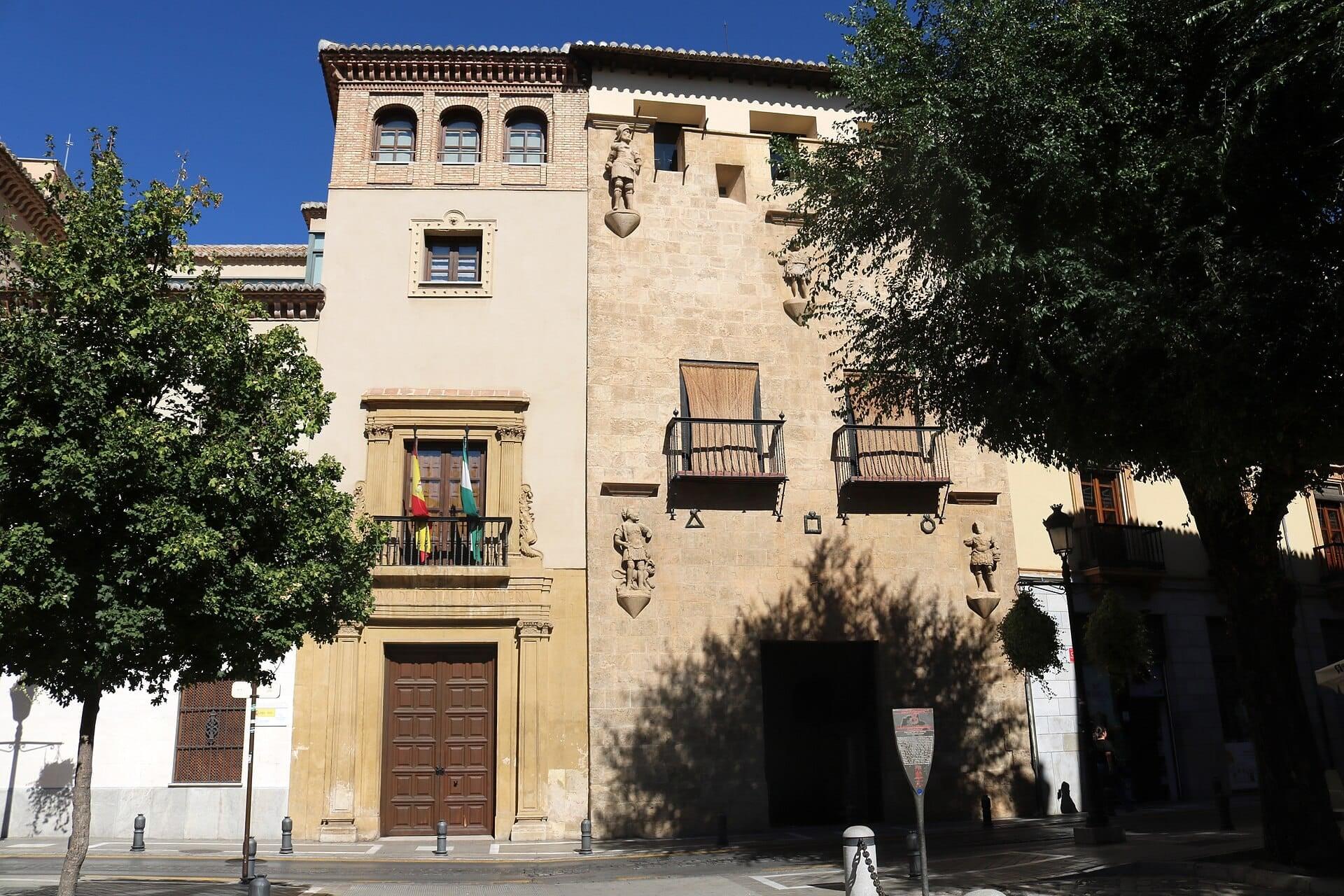
Casa de los Tiros: A House Dressed as a Castle
Heroes of myth guard a converted family's front door. A Castilian commander dressed this house as a hero's castle in the 1530s.
- 9

Yehuda ibn Tibbon: Granada's Translator
A statue honors a Granada-born Jewish scholar. It stands where accounts place the city's Jewish quarter, at the walk's end.
Details
Best Time to Visit
Tuesday to Saturday mornings, when the Cuarto Real and the Casa de los Tiros are both open. Sunday morning works well too: the Cuarto Real is free on Sundays from 10:00 to 14:00 in winter and 09:30 to 13:30 in summer, and the Casa de los Tiros opens from 09:00 to 15:00. On Mondays both are closed, though every stop still works from outside. Checked 8 November 2026.
Pro Tips
- •Getting to the start: the Alhambra minibus leaves from Plaza Isabel la Católica 4, on Calle Pavaneras. The C35 runs every 30 minutes from 07:00 to 22:00, every day, and serves the stop named Auditorio Manuel de Falla, Carmen de los Mártires on its way up. The C30 leaves from the same place every 15 minutes on weekdays (07:00 to 23:15) and every 8 minutes on Saturdays and holidays; its stop at the Auditorio is on the operator's older diagram, so check the stop board. A single ticket is 1.60 EUR from the driver. From the stop, walk a short way down the road to stop 1. Checked 8 November 2026.
- •Walking up instead: from Calle Pavaneras, go up Calle Santa Escolástica and the Cuesta del Realejo, a climb of about 55 meters.
- •The Casa Museo Manuel de Falla is a few steps from stop 1 on Calle Antequeruela Alta. A press report of April 2026 gives Tuesday to Friday 09:00 to 14:30 and Saturday 10:00 to 15:30, closed Sunday, Monday and holidays, 3 EUR (reduced 1 EUR), free on Wednesdays from 09:00 to 11:00. The museum's own site was under maintenance: check before you go.
- •The Carmen de los Mártires, a free public garden, is up the road beyond the minibus stop. Saint John of the Cross was prior of the convent that stood here from 1582 to 1588. Its hours could not be confirmed at an official source on 8 November 2026: check before you go.
- •The Cuarto Real's main gate is on Plaza de los Campos, which you pass between stops 5 and 6. Entry is free on Sundays.
- •From stop 8, the Placeta de la Puerta del Sol is up the steps of the Cementerio de Santa Escolástica behind the Casa de los Tiros. The view from it has not been checked. Come back the same way.
Safety & Precautions
- •Between stops 4 and 5 the route uses residents' lanes (Callejón del Señor, Cuesta del Pescado and Calle Cuarto Real de Santo Domingo) with no sidewalk and residents' cars. Walk in single file and step aside for cars.
- •People live in these streets. Keep voices down, and do not photograph residents' doors and windows.
- •There is one short flight of steps between stops 1 and 2. To avoid it, stay on the roadway of Calle Parra de San Cecilio.
- •The walk's one climb is up the Cuesta de Aixa, between stops 5 and 6, about 15 meters.
- •The lanes are paved with stone, slippery when wet and rough on wheels.
- •The route crosses Calle Molinos, Calle Santiago and Calle Pavaneras, which carry buses, at crossings without lights. Look both ways.
- •The C35 minibus passes through the Campo del Príncipe and Plaza de Santo Domingo. Keep to the paths.
- •The bus operator announced works on Calle Santiago from 27 April 2026. If the sidewalk at stop 4 is fenced off, follow the diversion signs.
- •Keep bags closed and in front of you on the crowded minibus.
- •The Comendadoras de Santiago is an enclosed convent and the Casa de los Girones is used as offices: this walk sees both from the street.
Travel advisory: Exercise Increased Caution (Level 2).
Gallery
Related Reading
Go deeper on what you'll see, hear, and walk through.
Read the walk
The full story of Realejo: Where the Sultans' Gardens Went, in words. Prefer to listen? Play it narrated, from home or on location.
Introduction
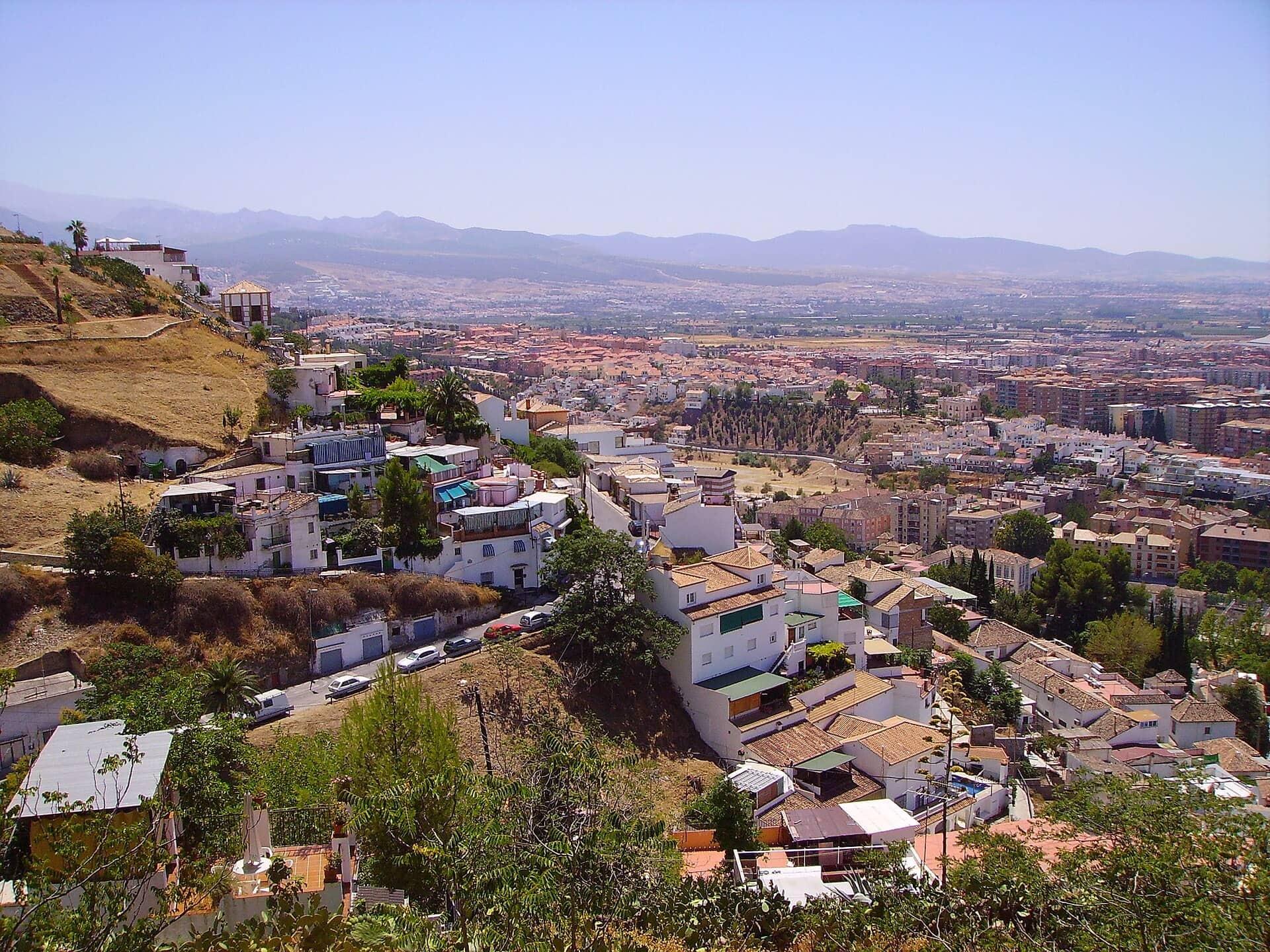
Granada, in Andalusia in southern Spain, has a quarter under the Alhambra's southern hill that grew out of royal gardens. The Nasrid sultans, the Muslim rulers of Granada until fourteen ninety-two, kept garden estates here inside the city walls. Within ten years of the surrender, the Catholic Monarchs handed those gardens and houses to friars, to nuns and to Castilian nobles. The name Realejo is usually tied to those royal gardens.
Three people turn up along the way. Manuel de Falla, the composer, who lived on a lane at the top of the quarter. Gil Vázquez Rengifo, a Castilian commander who dressed his house as a hero's castle. And Yehuda ibn Tibbon, a Jewish scholar born in Granada, whose statue ends the walk.
The walk is nine stops over about a kilometer and a half, about a mile, and takes about fifty minutes, longer if you go inside. It runs mostly downhill on stone-paved lanes, with one short flight of steps and a way round it, and one short climb near the middle. Two stops have small ticketed museums, and every stop works from outside.
The start is up the hill, so take the Alhambra minibus, the C thirty-five or the C thirty, from Plaza de Isabel la Católica. Get off at the Auditorio Manuel de Falla stop and walk a short way down the road. The walk ends on Calle Pavaneras, a short walk from where the minibus starts. When you reach Manuel de Falla's lane, begin with stop one.
1. Antequeruela: Falla's Lane
Welcome to the Antequeruela, at the top of the Realejo, where this walk begins. Walk down the road to where a narrow lane, Calle Parra de San Cecilio, leaves it and starts to drop, and stop there.
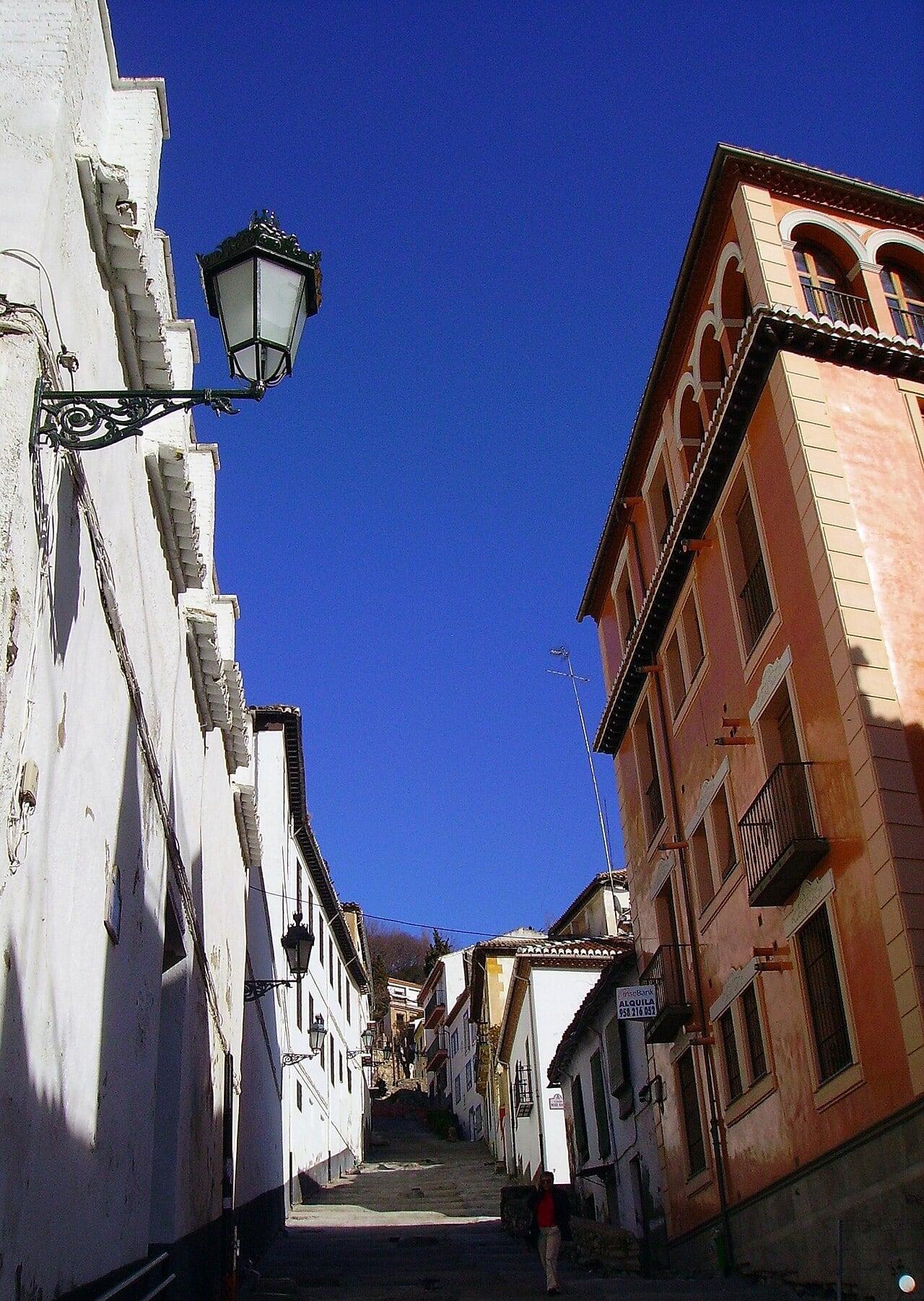
You are on the southern slope under the Alhambra, and from here the whole walk runs down into the quarter below. Look along the lanes: white walls, high and mostly blank. Behind walls like these Granada hides its carmenes. A carmen is a walled house with a garden on terraces, kept out of sight of the street. Keep the word. This walk comes back to it.
A few steps from here, on the short dead-end lane called Calle Antequeruela Alta, is the house where Manuel de Falla, the Spanish composer, lived from the early nineteen twenties until nineteen thirty-nine, when he left for Argentina. He did not choose a palace. He chose a small house on a lane under the Alhambra. It is now a small city museum, with its own ticket and short hours, so check them before you walk along to it. Walk along that lane and you can see how modest it is: a house with its own walled garden, a carmen of his own.
Near the minibus stop stands a big hotel with a tower dressed in Nasrid style; you may have seen it on the way down. Keep that tower in mind. On this walk the real Nasrid work is hidden away inside later buildings, and the obvious Moorish look usually belongs to something newer.
The lanes here are paved with stone, and they are slippery when wet. Follow the route down this lane. There is one short flight of steps on the way: to avoid it, stay on the lane's roadway. Next is a parish church on a little square.
2. San Cecilio: The Silk Workers' Parish
Walk on down into the little square of San Cecilio, and stop in front of the church.
This parish was founded in fifteen oh one, nine years after Granada surrendered. Its parish sat on the city's eastern edge, above the big open square you will see next. Its people, the records say, lived mostly by growing and working silk. In seventeen fifty-two the parish counted five hundred and ten households, one thousand three hundred and thirty-one people.
Now look at the church itself. A seventeenth-century description gave it good chapels, a tower and two doors. See how much of that you can still pick out from the square.
Two old stories cling to this church. One says it was the last church where Christians kept worshipping all through the centuries of Muslim rule. That tradition was already being told in the sixteen hundreds, and historians treat it as legend. The other says it was once a synagogue. A historian of Granada's Jews found that unlikely, and another historian calls it without any foundation. Granada's Jews do belong to this side of the city, and we come back to them at the end of the walk, with what the records can actually support.
What the records do show is plainer. Within a decade of the conquest, the new Christian city was already setting up parishes like this one at its edges.
Follow the route across the street into the big square below. Look both ways as you cross: there are no lights. Next is a stone cross under the trees.
3. Campo del Príncipe: A Cross on the Move
Walk on into the Campo del Príncipe, the big square with trees, and stop on the path by the stone cross with the carved figure of Christ.
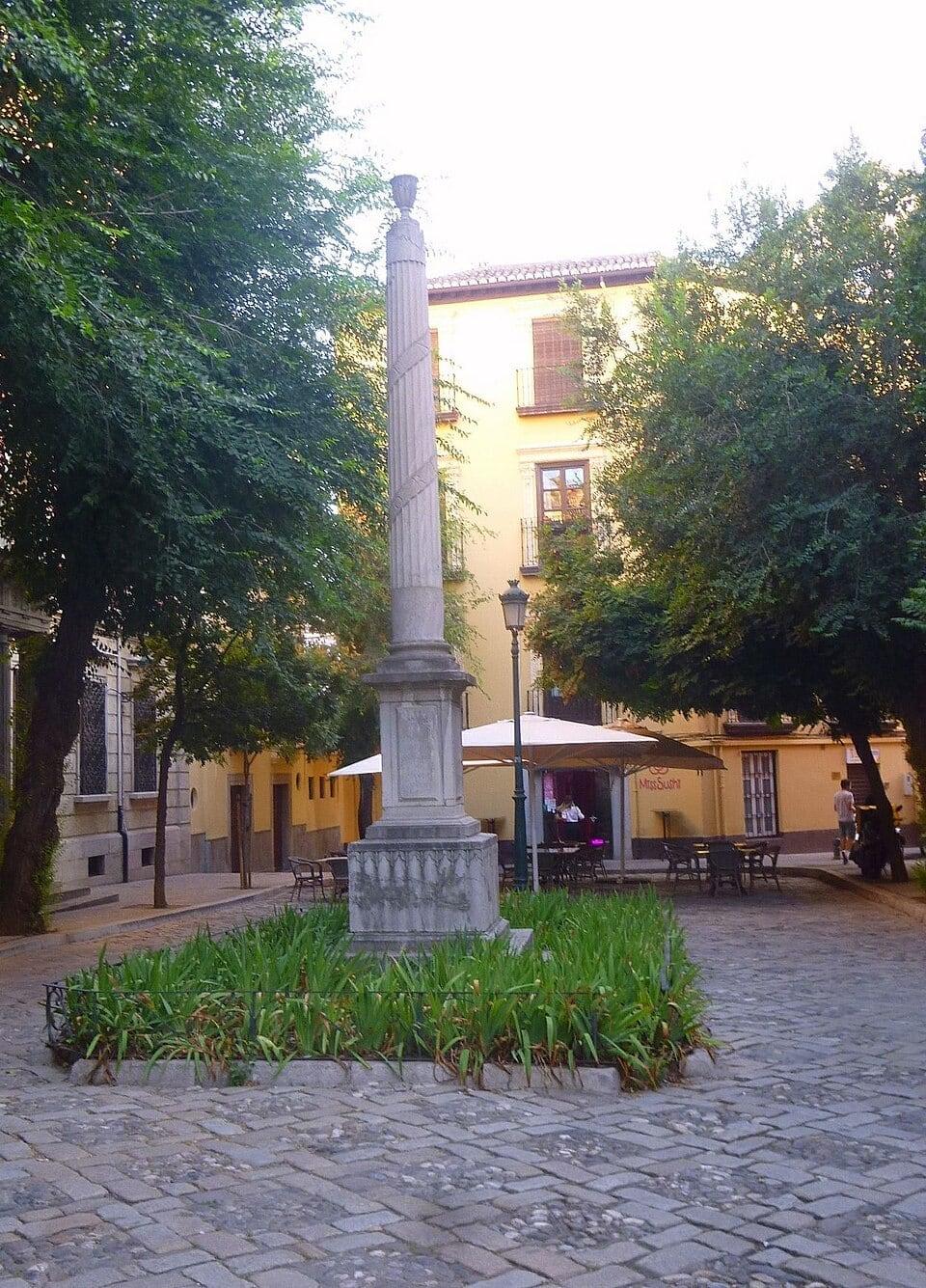
This is the Cristo de los Favores, the Christ of Favors, and it did not start here. In sixteen forty, neighbors from the Realejo, parishioners of the church you just left, set this stone cross up in a square up the hill. In sixteen eighty-two they moved it down to this square, with the bronze railing that surrounded it and its four lanterns.
A writer of the sixteen hundreds called it a massive, marvelous cross of brown and white stone. Look at it now and check the stone against his words.
This was the neighborhood's own monument, set up by the people of one parish and moved by them to the biggest open space they had. It is still theirs. On Good Friday crowds gather at the cross to ask for favors.
The square's name is said to come from a prince, a son of the Catholic Monarchs. Today it is the Realejo's living room, with café tables along its edges.
As you walk on, keep an eye on the walls. The Realejo is the home neighborhood of the painter Raúl Ruiz, known as El Niño de las Pinturas, who has painted its walls for many years. Murals get painted over and lost, so this walk points to none in particular. If you see one, enjoy it where it is, and remember that a living artist made it.
The C thirty-five minibus comes back through this square, so keep to the paths. Follow the route out of the square and down to Calle Santiago. Two streets on the way carry buses and have no lights, so cross with care. Next is the long wall of a convent.
4. Comendadoras de Santiago: A Queen's Vow
Walk on along Calle Santiago and stop on the sidewalk. The convent's long, plain buildings run along this side of the street. Keep to the sidewalk: buses use it. This is the convent of the Comendadoras de Santiago, the nuns of the Order of Santiago. The nuns here live enclosed,…
Full narration for this stop unlocks with the tour.
5. Cuarto Real de Santo Domingo: The Hidden Hall
Walk on to the corner where the lane meets the Cuesta de Aixa, and stop on the sidewalk by the long garden wall. Behind it is the Cuarto Real de Santo Domingo, open most days for a small ticket, free on Sundays and closed on Mondays: the details are on this stop's card. Inside…
Full narration for this stop unlocks with the tour.
6. Santo Domingo: Friars on the Sultans' Garden
Walk on into Plaza de Santo Domingo and stop on the path, facing the church's stone porch across the square. A minibus stops at the edge of this square, so keep clear of the road. This is the church of the friars who took the Cuarto Real. In March fourteen ninety-two, weeks…
Full narration for this stop unlocks with the tour.
7. Plaza de los Girones: A House Turned Inward
Walk on into Plaza de los Girones, the small square, and stop. Now look back at the tall corner house you passed just before the square, where Calle Ancha de Santo Domingo opens into it. That is the Casa de los Girones. Look at its front: piers of bare brick framing white…
Full narration for this stop unlocks with the tour.
8. Casa de los Tiros: A House Dressed as a Castle
Walk on into Plaza del Padre Suárez and stop where you can see the stone house front that looks like a fortress tower. That is the Casa de los Tiros. It is a museum run by Andalusia's regional government, with a small ticket that many visitors do not pay at all, and the details…
Full narration for this stop unlocks with the tour.
9. Yehuda ibn Tibbon: Granada's Translator
Walk on along Calle Pavaneras to the bronze statue at the junction, and stop beside it. The statue is Yehuda ibn Tibbon. He was born in Granada in about eleven twenty, to a Jewish family, and became a physician and a philosopher. At twenty-eight, when the Almohads took over, he…
Full narration for this stop unlocks with the tour.
- House of Manuel de Falla in Granada. Now a municipal owned museum. — Agracier, CC BY-SA 4.0 · source
- Interesante portada de Juan de Marquina. — José Luis Filpo Cabana, CC BY-SA 4.0 · source
- Granada-Casa en Campo del Príncipe — Javi Guerra Hernando, CC BY-SA 4.0 · source
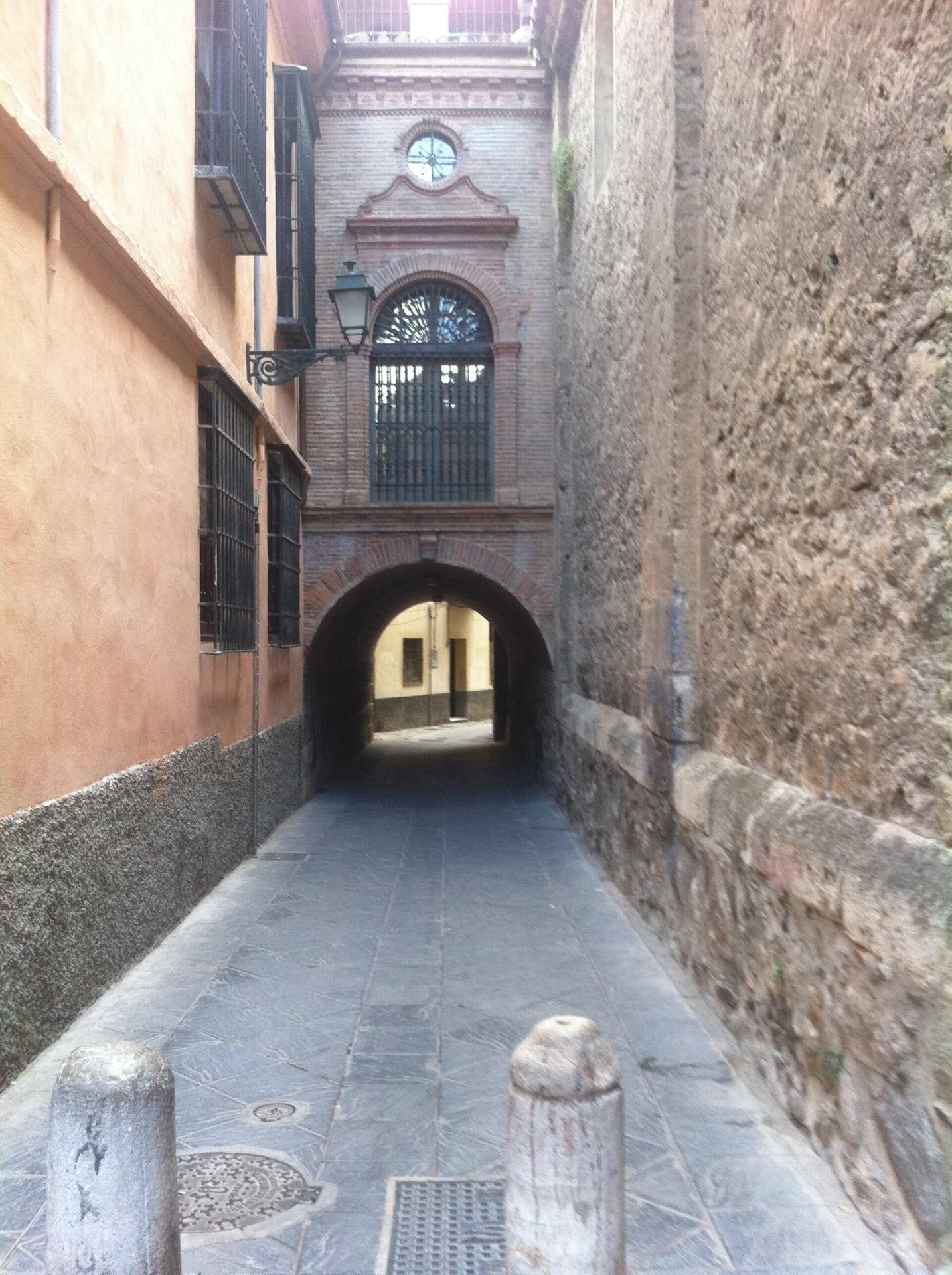
- Callejón Señor, Grenade. — Chabe01, CC BY-SA 4.0 · source
- Bâtiment à l'angle de la calle Ancha Virgen et de la cuesta de Aixe, Grenade. — Chabe01, CC BY-SA 4.0 · source
- Casa de los Girones de Granada. RI-51-0000222 — SaraGuerri, CC BY-SA 3.0 · source
- Granada-Calle Pavaneras-Yehudá Ibn Tibon — Javi Guerra Hernando, CC BY-SA 4.0 · source
Images may be cropped or resized. Other photos via Unsplash and Pexels.