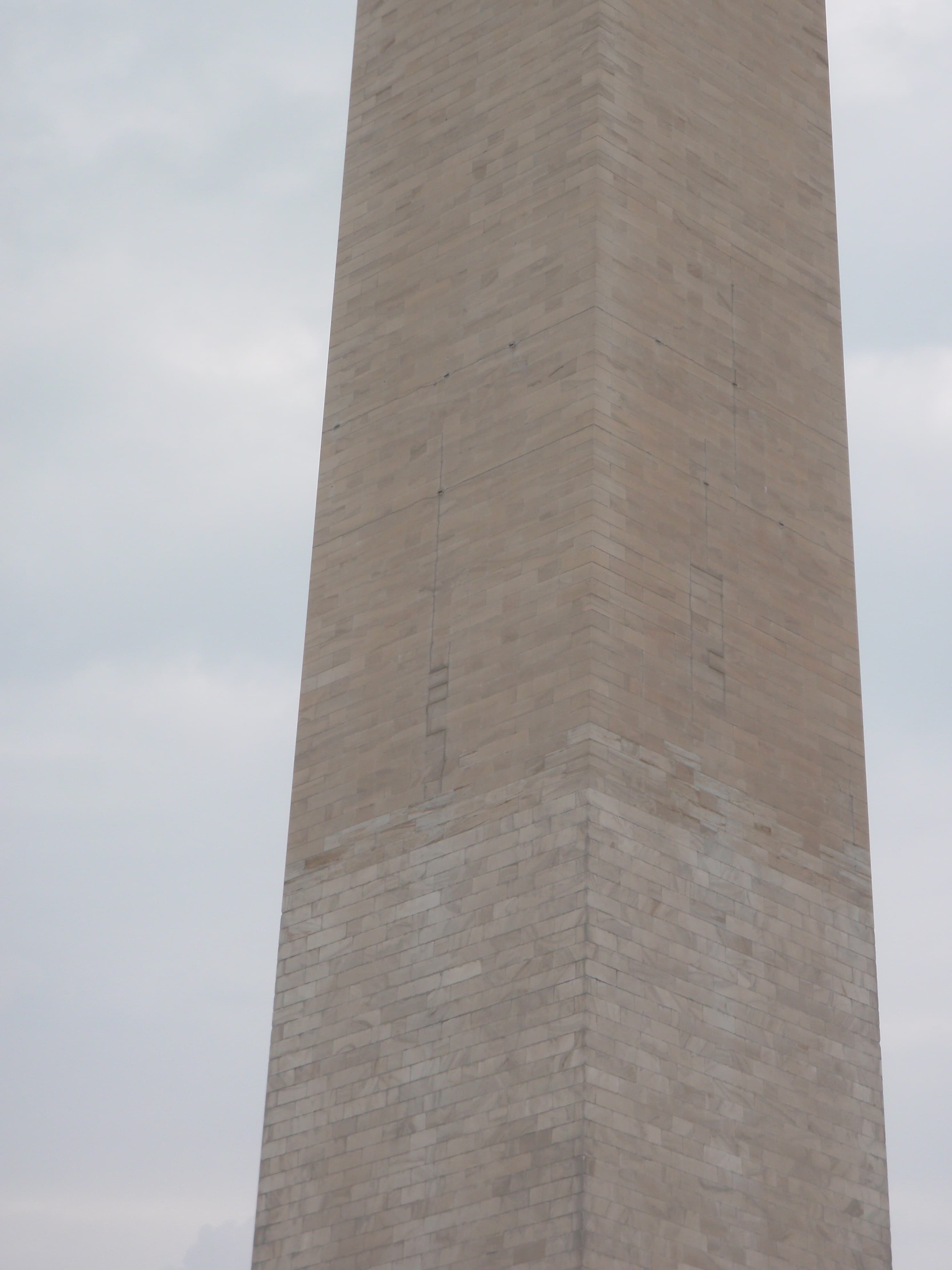
Stand on the grass on the south side of the Washington Monument and look up. Five hundred and fifty-five feet of marble against the sky. Now look more carefully, about a quarter of the way up, at approximately one hundred and fifty feet. There is a visible two-tone seam where the color changes, slightly lighter above, slightly warmer below. The brochures do not always mark it. The National Park Service signs sometimes do. Most visitors photograph the obelisk and walk on.
The Washington Monument's two-tone seam is the most literal record of a committee that fell apart and reassembled, made physical in stone for every visitor to read. It is the joint between an 1850s campaign that ran out of money and an 1880s campaign that finished what the first one started. It is a quarter-century of stalled work striped into the building.
The cornerstone, the architect, and the first stop
The cornerstone was laid on the fourth of July, 1848. The architect was Robert Mills, a South Carolinian who had trained under Benjamin Henry Latrobe and had become the federal city's first generation of native-born American architects. Mills's original design called for more than an obelisk. He proposed a colonnaded base, a circular pantheon at the foot of the shaft, and a statue of George Washington in a Roman chariot drawn by six horses. The shaft would stand 600 feet. None of the base, the pantheon, or the chariot was ever built. What survives is the obelisk, slimmed and stripped of every ornament Mills had imagined for it.
By 1854, construction had reached approximately one hundred and fifty feet. The donations that funded the Washington National Monument Society had run out. The Society had been founded as a private subscription effort because Congress, through the 1830s and 1840s, was unwilling to spend federal money on a monument to the first president. The work depended on small contributions from citizens, from states, from foreign governments. By the early 1850s the small contributions were not enough.
What happened next is the political record the band is striped with.
The Know Nothings and the twenty-five-year halt
Hear a stop from this walk
Vietnam Veterans Memorial: The Counter-Monument
In February of 1855, the anti-Catholic, anti-immigrant Know Nothing Party seized control of the Washington National Monument Society. The seizure was political theater more than a coup. A stone donated by Pope Pius the Ninth, the Pontiff's contribution to the international subscription list, had been delivered to the Society in 1854. Anti-Catholic activists destroyed the Pope's stone, broke into the Society's records, and installed their own slate of officers. Congress, which had been preparing to appropriate two hundred thousand dollars to complete the monument, halted the appropriation. The Society's funding stream collapsed.
The Know Nothings added four feet to the obelisk before surrendering control of the Society in October of 1858. They had achieved nothing the Society had not already achieved before them. The four feet are now somewhere in the lower band, indistinguishable to the eye from the stone around them. The political record of the seizure is invisible. The financial record of what the seizure cost is the visible thing.
Construction did not resume for twenty-one years.
The reasons for the long pause stack. The Civil War (1861 to 1865) drained federal attention and federal money. Reconstruction (1865 to 1877) absorbed the next decade. The Society itself was discredited. The unfinished stump of the obelisk stood at about one hundred and fifty feet, exposed to the weather, used as a backdrop for cattle grazing on the Mall (the Mall was not yet the formal grass parterre it would become after the McMillan Plan of 1902; in the 1860s it was working pasture). Photographs from the period show the truncated shaft rising from a landscape of carriage paths and grazing fields, the city's most ambitious unfinished building.
The restart and the quarry change
A federal effort restarted construction in 1879. The Army Corps of Engineers took over the project under Lieutenant Colonel Thomas Lincoln Casey, who would oversee both the completion of the Monument and (later) the design of the Library of Congress Jefferson Building. Casey was an engineer, not a Beaux-Arts architect; his contribution to the Monument was structural, not stylistic. He stabilized the foundations (which had not been built to carry the planned 555 feet) and prepared the shaft to receive the second campaign's stone.
The stone is where the band came from. The original 1848 to 1854 marble had been quarried in Maryland, at a quarry near Cockeysville in Baltimore County known by the local name "Texas Quarry." The name is geographic accident. The Texas Quarry is a place in Maryland, not in the state of Texas. (Travelers and journalists have, for a century and a half, occasionally collapsed the name to "Texas marble" and produced the false but persistent claim that the lower section of the obelisk is Texas stone. It is not. It is Maryland stone from a quarry called Texas.)
The restart in 1879 wanted to match the original Cockeysville marble. The Texas Quarry's particular bed had been worked out. A brief attempt in 1879 and 1880 to use marble from Sheffield, Massachusetts, produced quality problems, and the Sheffield stone was abandoned. The second campaign settled on marble from the Beaver Dam quarry, also in Maryland, with a warmer tone than the original Cockeysville stock. The Beaver Dam marble carried the second phase up from approximately one hundred and fifty feet to the full 555-foot pyramid cap.
The seam you can see from the south lawn is the joint between the two quarries and the two campaigns. The lower stone is cooler and slightly grayer; the upper stone is warmer and faintly cream. The difference is small enough that some visitors miss it; once seen, it is impossible to unsee. The horizon line of the band is at about one hundred and fifty feet, roughly the height construction reached when the first campaign halted.
The dedication and the missing base
The Monument was dedicated on the twenty-first of February, 1885. The dedication was held in winter so that the date would fall close to George Washington's birthday (February 22). The Monument opened to the public in 1888, after the internal staircase and (in 1888) a steam-powered elevator were installed. The elevator was, at the time, the fastest commercial passenger elevator in the country, climbing the full 500-plus feet in about twelve minutes (a modern visitor's elevator does the same trip in about seventy seconds).
Robert Mills had been dead for thirty years by the time of the dedication. The colonnaded base, the circular pantheon, and the chariot of Washington had been quietly dropped from the design during the long pause. What was dedicated was the bare obelisk that the eye recognizes today as the Washington Monument. The Mills design was not finished. A simpler version of the obelisk's original shape was finished.
The committee that began the building, the committee that seized it, the committee that abandoned it, and the federal effort that completed it are four different committees across four different American political moments. None of them got the building they had originally proposed. What stands is what the four campaigns could collectively bring to completion: a pure obelisk, no base, two-toned, finished thirty-seven years after the cornerstone was laid.
What the seam means
A monument is supposed to look timeless. The Washington Monument deliberately does not. It carries its own delay in its skin. The Park Service has, at various points, considered chemically treating the second-phase marble to match the first. They have not done it. The seam is now treated as historical record, not blemish.
The seam means that the federal government's most visible monument to its first president is also its most visible monument to its own inability, between 1854 and 1879, to complete a building it had started. The political record (Know Nothing seizure, Civil War, Reconstruction, the collapse of the private subscription model) is striped into the obelisk. Every era of the twenty-five-year pause shows up as a horizontal band that the next generation of Americans had to learn to read.
The Mall is full of monuments that pretend their own construction was inevitable. The Washington Monument refuses the pretense. It is the building that announces, in stone, that monuments are committee products, that committees fail, that committees reassemble, and that the work resumes when the political conditions allow.
Robert Mills's chariot is not there. The colonnaded base is not there. The Pope's stone is not there. What you can see is a 555-foot obelisk with a horizontal band at one hundred and fifty feet, finished thirty-seven years after it was begun, two quarries deep, and standing in the middle of an axis the next generation of committees would spend the twentieth century arguing about.
The band is not a flaw. It is the most honest thing on the Mall.
Sources
- Wikipedia, Washington Monument. https://en.wikipedia.org/wiki/Washington_Monument
- National Park Service, Washington Monument site bulletin. https://www.nps.gov/wamo/
- Wikipedia, Robert Mills (architect). https://en.wikipedia.org/wiki/Robert_Mills_(architect)
- Wikipedia, Know Nothing. https://en.wikipedia.org/wiki/Know_Nothing
- Kirk Savage, Monument Wars: Washington, D.C., the National Mall, and the Transformation of the Memorial Landscape (University of California Press, 2009).
Ready to experience it?
The National Mall: An Axis Designed by Committee
110 min · 7.12 km · moderate
More from Washington Dc
Explore more at your own pace.
Best Self-Guided Walking Tours in Washington, DC (2026)
One Day in Washington, DC: A Walkable Monuments-to-U-Street Itinerary (2026)
Washington, DC Travel Guide: How Many Days, Getting Around, When to Go (2026)
Best History Walking Tours in Washington, DC (2026)
What to Eat in Washington, DC: A Food Guide (2026)