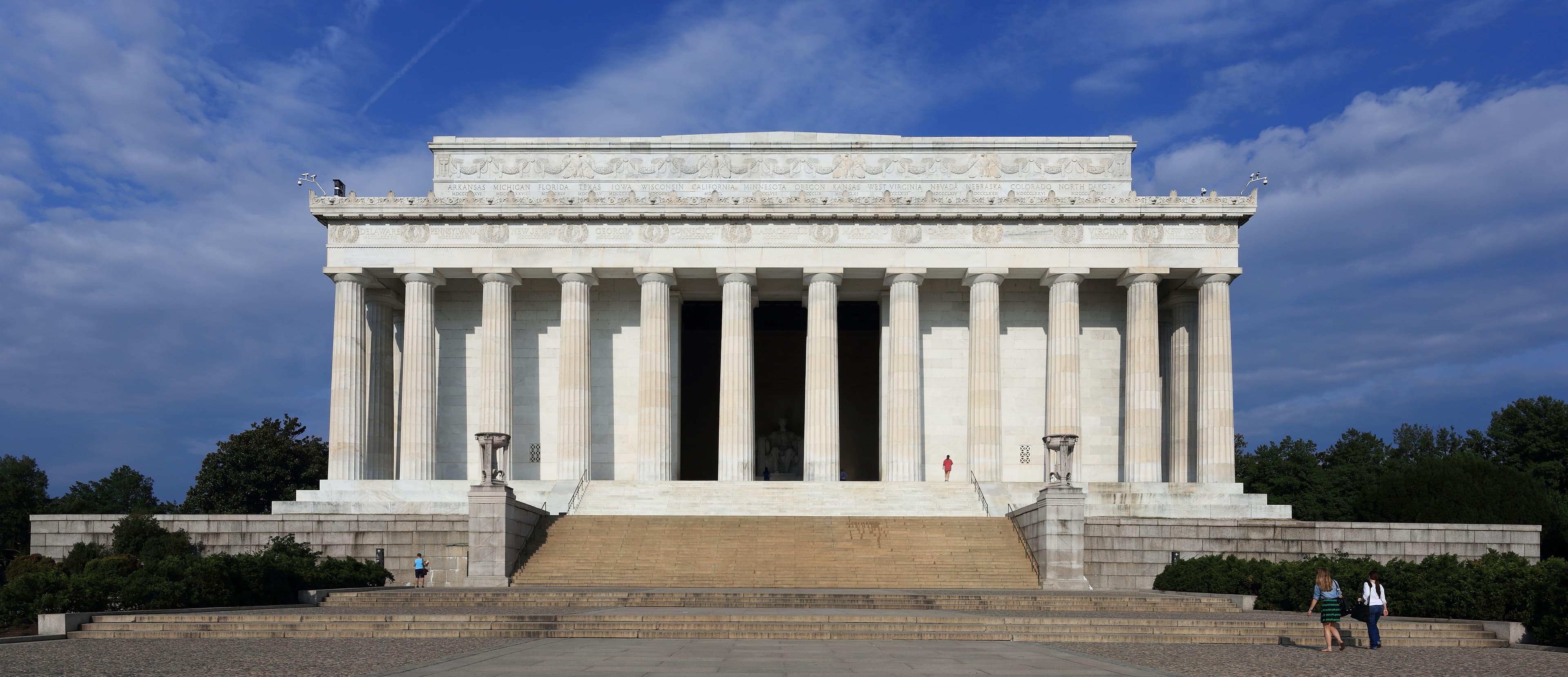
The eighteenth step from the top landing of the Lincoln Memorial is the step where Martin Luther King delivered the closing address of the March on Washington for Jobs and Freedom on the twenty-eighth of August, 1963. The step is marked. The National Park Service engraved an inscription into the marble in 2003 to fix the moment in the building. The inscription reads: I HAVE A DREAM. MARTIN LUTHER KING, JR. THE MARCH ON WASHINGTON FOR JOBS AND FREEDOM. AUGUST 28, 1963.
The engraving is the third inscription on the step. The first was the morning of August twenty-eighth itself, when King delivered the speech. The second was twenty-four years earlier, on Easter Sunday 1939, when the contralto Marian Anderson sang on the same step before a crowd of approximately seventy-five thousand. King stood on a stage Anderson had made.
This is the single fact most visitors leave the Lincoln Memorial without. The step the brochure pictures was a Civil Rights stage before the most famous speech delivered from it was ever written.
Easter Sunday, April ninth, 1939
The story begins three months before Anderson sang. In January 1939, the impresario Sol Hurok attempted to book Constitution Hall, the largest concert hall in Washington, for a Marian Anderson recital. The hall was owned and operated by the Daughters of the American Revolution. The DAR's policy, in 1939, restricted performances to white artists. They refused the booking.
The refusal might have stayed inside the segregated booking practice of Washington concert halls. It did not. Eleanor Roosevelt, then First Lady and an active DAR member, resigned her membership in protest. Her resignation became national news. She wrote about it in her syndicated newspaper column "My Day" without mentioning Anderson by name; she did not need to. The story was already public.
Secretary of the Interior Harold Ickes, with President Franklin Roosevelt's quiet support, offered Anderson the Lincoln Memorial steps for an open-air concert on Easter Sunday, April ninth. The Lincoln Memorial was federal property under the Interior Department's jurisdiction. The offer carried the federal government's institutional weight against a private hall's segregationist policy.
Anderson sang at five in the evening on Easter Sunday. The crowd numbered approximately seventy-five thousand. The radio audience that broadcast the concert nationwide was in the millions. Ickes introduced her with the line "Genius knows no color line." Anderson opened with My Country, 'Tis of Thee. The program ran about thirty minutes and included spirituals as well as the standard concert-recital repertoire. The DAR Archives hold the correspondence from January through April 1939 documenting the booking refusal, the resignation, and the Lincoln Memorial alternative.
The concert was a deliberate act of Civil Rights theatre, planned by Ickes, by Walter White of the NAACP, and by Anderson's manager, to make the federal government's institutional voice audible against the DAR's exclusion. The Lincoln Memorial, sixteen years old in 1939 and designed as a neoclassical temple to the president who had ended the legal institution of slavery, was the only architecturally adequate Washington venue that the federal government controlled and could open to an integrated audience without negotiation.
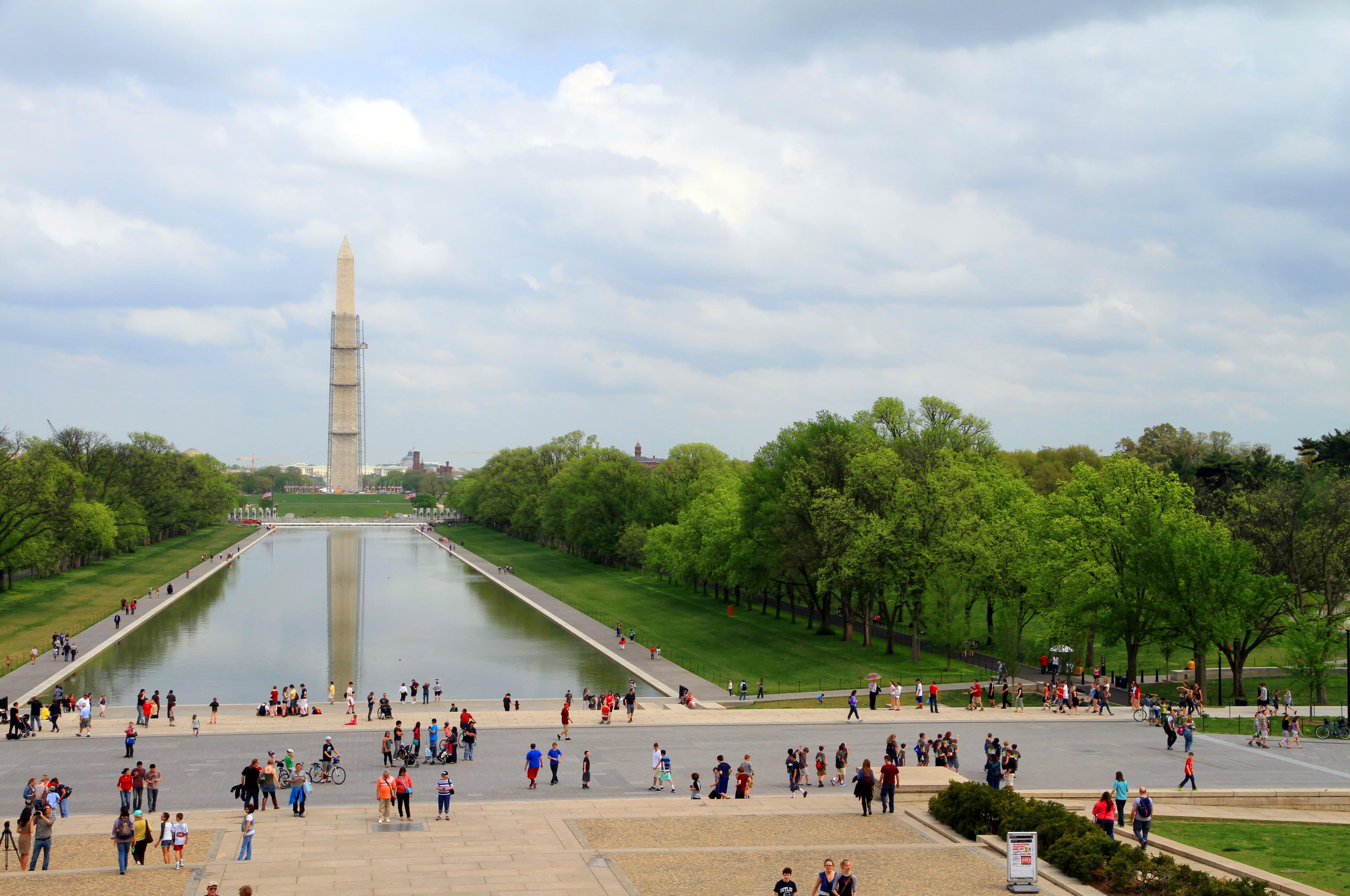
The choice of the eighteenth step, specifically, was a sightline decision. The eighteenth step from the top landing places the singer above the audience without putting her under the statue's overhang. The acoustics from the eighteenth step carry across the Reflecting Pool and the open lawn in front of the Memorial without significant echo. Photographs from the day show Anderson standing on the step with the statue of Lincoln behind her, the crowd extending down to the Reflecting Pool, and the Washington Monument rising beyond the crowd. The composition was deliberate. It became the iconographic template for everything that happened on the same step afterward.
The march, the Big Six, and the morning of August twenty-eighth
Hear a stop from this walk
Martin Luther King Jr. Memorial: The Stone of Hope
A. Philip Randolph had been planning a march on Washington since 1941. Randolph was the head of the Brotherhood of Sleeping Car Porters, the first major Black-led labor union recognized by the American Federation of Labor. His 1941 march on Washington was called off after President Franklin Roosevelt issued Executive Order 8802 desegregating federal defense contracts. The march was deferred, not cancelled.
Twenty-two years later, in 1963, Randolph reactivated the march. The coalition that organized it, called the Big Six, comprised Randolph (Brotherhood of Sleeping Car Porters), Martin Luther King Junior (Southern Christian Leadership Conference), Roy Wilkins (National Association for the Advancement of Colored People), Whitney Young Junior (Urban League), John Lewis (Student Nonviolent Coordinating Committee), and James Farmer (Congress of Racial Equality). The official name of the march was the March on Washington for Jobs and Freedom. The economic demand sat first in the title. The freedom demand sat second. The order was structural to the organizing coalition: Randolph's union background carried the labor frame; the civil rights organizations carried the freedom frame; both were required to bring the coalition to the Mall.
Bayard Rustin, an organizer and a longtime associate of Randolph's, ran the day's operational logistics. Rustin was openly homosexual at a time when that openness was career-ending in American public life, and his role as the day's organizational mind was kept partly off the visible platform for that reason. The march would not have happened in the form it took without Rustin. He coordinated the buses, the staging, the speakers' order, the sound system, the medical tents, the portable toilets, and the day-of-event field communication that kept two hundred and fifty thousand people moving and fed across a single August afternoon.
The crowd estimate of two hundred and fifty thousand is the official National Park Service figure. Drew Hansen, in The Dream (HarperCollins, 2003), carries the figure. Charles Euchner, in Nobody Turn Me Around (Beacon Press, 2010), carries the figure. The NAACP's institutional history cites two hundred and sixty thousand. The round figure of two hundred and fifty thousand is the canonical reference across most academic and institutional accounts. The crowd was integrated by design. Estimates suggest roughly seventy-five percent of the marchers were Black and twenty-five percent were white. The day was peaceful. There were no significant arrests.
The speakers' list ran ten names. King was the closing address. He spoke last because Randolph and Rustin had structured the program to peak at the end. The morning's other speakers (Lewis, Wilkins, Young, Randolph himself) had set the political frame. King's role was the closing rhetorical lift.
The departure from the prepared text
King had a prepared text. Copies survive in the Stanford King Papers Project archive at Stanford University. The text is a coherent eight-minute speech that builds an argument about the unmet promise of the founding documents (the Declaration of Independence, the Constitution, the Emancipation Proclamation) and ends with a call for the federal government to honor the promissory note Black Americans were holding.
The phrase "I have a dream" is not in the prepared text.
Approximately twelve minutes into the delivery, King was reading from his prepared remarks. He was on the eighteenth step. Mahalia Jackson, the gospel singer, was seated on the platform directly behind him. Jackson and King had performed together before; she knew his sermon repertoire. King had used the dream rhetorical figure ("I have a dream") in earlier sermons, including a Detroit speech two months earlier on the twenty-third of June, 1963. The Detroit version had not become national news.
Jackson leaned forward, on the platform, and said: Tell them about the dream, Martin. The phrasing is documented in Drew Hansen's The Dream (2003) and in Clarence B. Jones's Behind the Dream: The Making of the Speech that Transformed a Nation (Macmillan, 2011). Jones was King's lawyer and speechwriter and was present on the platform. Both accounts converge on the phrasing. Hansen reconstructs the moment from interviews with multiple platform attendees in the months and years after the speech. Jones, as direct witness, confirms the intervention in his 2011 memoir.
King set the prepared text aside. The next six minutes of audio recording, with the repeated rhetorical figure "I have a dream," became the most-quoted American speech of the twentieth century. The improvisation was not entirely improvisation. King was drawing on sermon material he had developed and tested before. But the structural decision to abandon the prepared remarks at minute twelve was a real-time decision, prompted by Jackson's instruction.
The dream language is not in the typewritten text in the Stanford archive. It is in the audio recording held by the National Park Service and the Library of Congress. The two records do not match. The mismatch is the speech.
What the eighteenth step holds
A monument is a piece of architecture that holds an interpretive claim. The Lincoln Memorial was dedicated on the thirtieth of May, 1922. Its architect was Henry Bacon. Its sculptor was Daniel Chester French. The McMillan Plan of 1902 had specified the site. The dedication was the architectural completion of the axis the McMillan committee had proposed twenty years earlier. None of that is what the eighteenth step holds today.
What the eighteenth step holds is the seventy-five thousand who stood in front of Anderson in 1939, and the two hundred and fifty thousand who stood in front of King in 1963, and the small federal carving the National Park Service added in 2003 on the fortieth anniversary of the speech. The carving was dedicated on the twenty-second of August, 2003, six days before the actual anniversary. Coretta Scott King attended and spoke. The Interior Department, the descendant federal agency of the one that had offered Anderson the Memorial in 1939, hosted the dedication.
The 1939 concert and the 1963 speech and the 2003 inscription are three federal acts of inscription on the same step. The federal government opened the building to Anderson against the DAR. The federal government permitted the 1963 march. The federal government engraved the 1963 moment into the marble in 2003. Each act was made by a different administration in a different decade against different political resistance. Together they composed the eighteenth step as a piece of federal architecture that holds a Civil Rights interpretive claim.
The architectural Lincoln Memorial is the territory of a different tour. The eighteenth step is the territory of this one. The step was made a Civil Rights stage in 1939 by Marian Anderson, made famous in 1963 by Martin Luther King with Mahalia Jackson's intervention from behind him, and made permanent in 2003 by the engraver who carved the inscription that today identifies it.
Stand on the step. Face east. The Reflecting Pool runs out to the Washington Monument. Two hundred and fifty thousand people stood between you and the obelisk on August twenty-eighth, 1963. Seventy-five thousand stood there on April ninth, 1939. The morning is what the building you are standing on was, by the end of the twentieth century, mostly remembered for. The architectural object was redrawn by use.
Sources
- Drew D. Hansen, The Dream: Martin Luther King, Jr., and the Speech that Inspired a Nation (HarperCollins / Ecco, 2003).
- Charles Euchner, Nobody Turn Me Around: A People's History of the 1963 March on Washington (Beacon Press, 2010).
- Clarence B. Jones, Behind the Dream: The Making of the Speech that Transformed a Nation (Palgrave Macmillan, 2011).
- National Park Service, Marian Anderson and Constitution Hall. https://www.nps.gov/articles/000/marian-anderson-and-constitution-hall.htm
- National Park Service, March on Washington for Jobs and Freedom. https://www.nps.gov/articles/march-on-washington.htm
- National Park Service, Lincoln Memorial: I Have a Dream Marker. https://www.nps.gov/places/000/lincoln-memorial-i-have-a-dream-marker.htm
- Smithsonian Music, Marian Anderson and the Concert at the Lincoln Memorial. https://music.si.edu/story/marian-anderson-and-concert-lincoln-memorial
- DAR Archives, Marian Anderson Documents (January–April 1939). https://www.dar.org/national-society/marian-anderson/nsdar-archives-marian-anderson-documents-january-april-1939
Ready to experience it?
The Other Axis: The Mall as Civil Rights Stage
120 min · 7.84 km · moderate
More from Washington Dc
Explore more at your own pace.

Best Self-Guided Walking Tours in Washington, DC (2026)
One Day in Washington, DC: A Walkable Monuments-to-U-Street Itinerary (2026)
Washington, DC Travel Guide: How Many Days, Getting Around, When to Go (2026)
Best History Walking Tours in Washington, DC (2026)

What to Eat in Washington, DC: A Food Guide (2026)